Applied Mathematics and Mechanics (English Edition) ›› 2026, Vol. 47 ›› Issue (4): 695-718.doi: https://doi.org/10.1007/s10483-026-3366-8
Previous Articles Next Articles
Hongge HAN1, Liang WANG1, Zhanli LIU2, Yongtao SUN1,3,4,5,6,†( ), Anshuai WANG1, Yueting ZHU7, Jie WANG8,9, Haoqiang GAO1, Qian DING1
Received:2025-10-03
Revised:2026-01-21
Published:2026-03-31
Contact:
Yongtao SUN, E-mail: ytsun@tju.edu.cn2010 MSC Number:
Hongge HAN, Liang WANG, Zhanli LIU, Yongtao SUN, Anshuai WANG, Yueting ZHU, Jie WANG, Haoqiang GAO, Qian DING. Development and application of a lumped parameter model for predicting blast wave effects on middle ear dynamics. Applied Mathematics and Mechanics (English Edition), 2026, 47(4): 695-718.
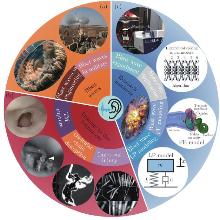
Fig. 1
Blast wave-induced hearing injury and research methods[26,34–41]: (a) blast waves in various scenarios; (b) blast wave-induced hearing injury in human ear; (c) methods for studying blast wave transmission in ear (color online)"
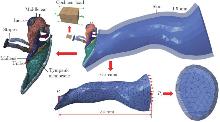
Fig. 2
FE model of human ear and its mesh size (color online)"
Table 1
Material properties of the components in the FE model"
| Structure | Component | Young’s modulus/Pa | Density/ |
|---|---|---|---|
| TM | Pars tensa | | |
| Pars flaccida | | ||
| Ossicles | |||
| Malleus | Head | | |
| Neck | | ||
| Handle | | ||
| Incus | Body | | |
| Short process | | ||
| Long process | | ||
| Stapes | | | |
| Joints | Incudomalleolar joint | | |
| Incudostapedial joint | | | |
| Manubrium fold | | | |
| Ligaments and tendons | Superior mallear ligament | | |
| Lateral mallear ligament | | ||
| Anterior mallear ligament | | ||
| Posterior incudal ligament | | ||
| Stapedial tendon | | ||
| Tympanic annulus ligament | | ||
| Superior incudal ligament | | ||
| Tensor tympani tendon | | ||
| Stapedial annular ligament | | ||
| Skin | | | |
| Relevant data sources: Gan et al.[ | |||
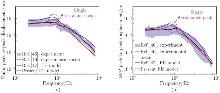
Fig. 3
Resonance characteristics of the FE model for (a) the umbo and (b) the SFP, demonstrating the basis for adopting an SDOF model (color online)"
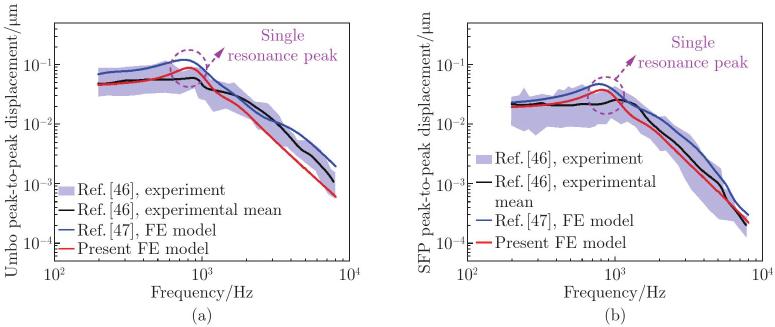
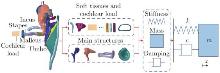
Fig. 4
FE model of the human middle ear (left), the simplified LP model (right), and the equivalent process (color online)"
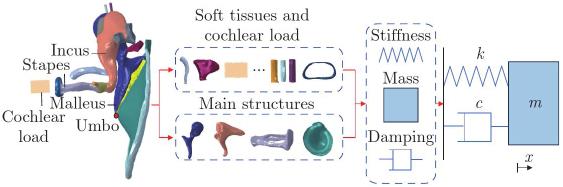
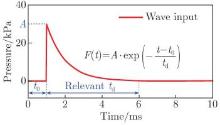
Fig. 5
Blast wave modeled as a simplified impulse wave as an input wave to the models (color online)"
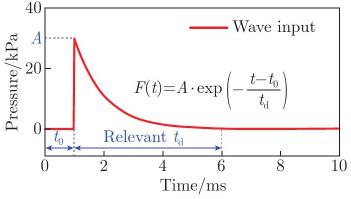
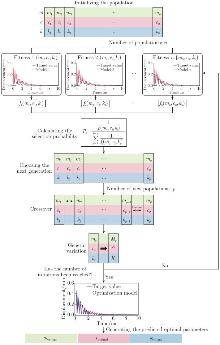
Fig. 6
Flowchart generated by a genetic algorithm for identifying LP model parameters (color online)"
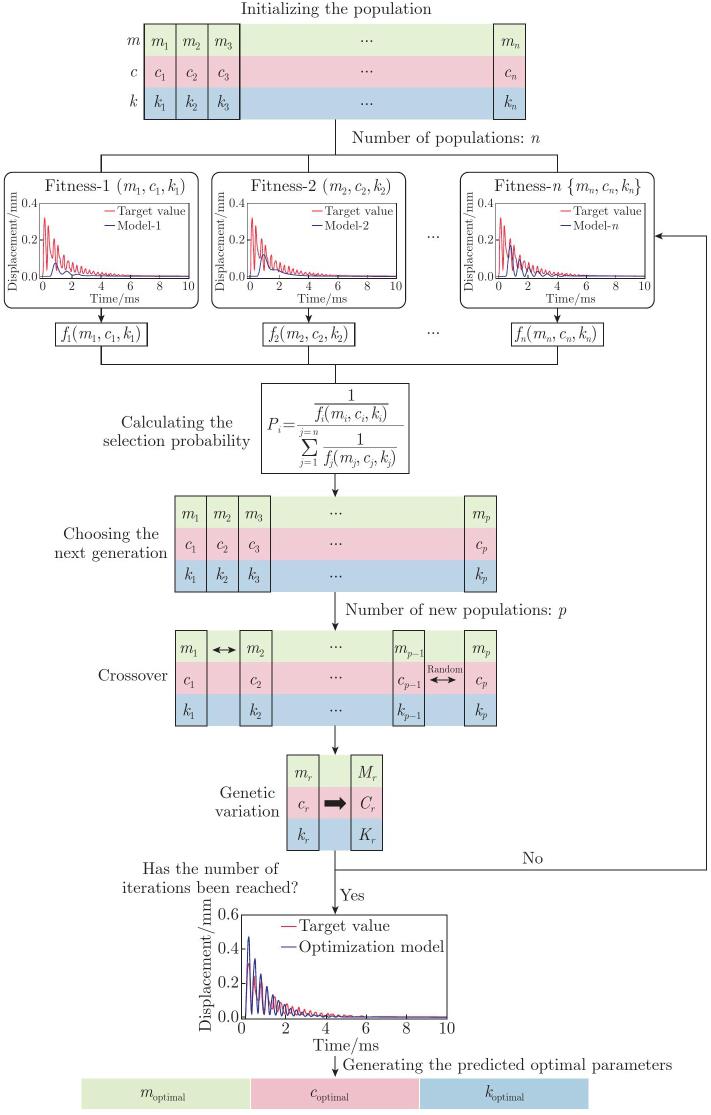
Table 2
Optimal values for the LP model to predict the TM response"
| LP model parameter | m/kg | c/ | k/ |
|---|---|---|---|
| Optimal value | | 0.030 | |
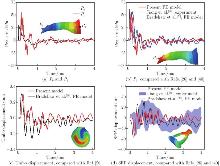
Fig. 7
Verification of FE model accuracy: (a) input wave P0 and output wave P1 for the FE model; (b) results of P1, compared with Refs. [26] and [40]; (c) umbo displacement, compared with Ref. [26]; (d) SFP displacement, compared with Refs. [26] and [40] (color online)"
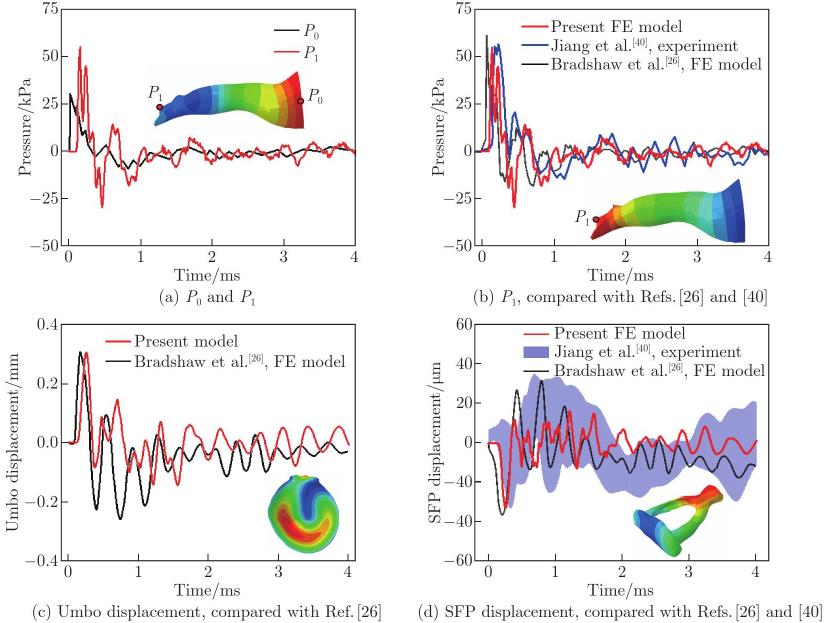
Table 3
Detailed parameters and numbers of the twelve blast waves"
| Condition | Peak pressure/dB | A/kPa | t0/ms | |
|---|---|---|---|---|
| 1 | 183.5 | 30 | 0 | 1 |
| 2 | 183.5 | 30 | 0.5 | 1 |
| 3 | 183.5 | 30 | 1 | 1 |
| 4 | 183.5 | 30 | 0 | 0.5 |
| 5 | 183.5 | 30 | 0 | 1 |
| 6 | 183.5 | 30 | 0 | 2 |
| 7 | 180 | 20 | 0 | 0.5 |
| 8 | 180 | 20 | 0 | 1 |
| 9 | 180 | 20 | 0 | 2 |
| 10 | 174 | 10 | 0 | 0.5 |
| 11 | 174 | 10 | 0 | 1 |
| 12 | 174 | 10 | 0 | 2 |
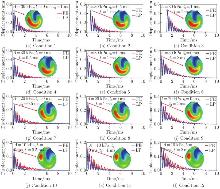
Fig. 8
Comparison of the TM displacement response between the FE (red) and LP (blue) models under twelve conditions. The curves show the displacement at the umbo of the TM, while the heat maps represent the spatial distributions of the displacement of the first peak in the FE model (color online)"
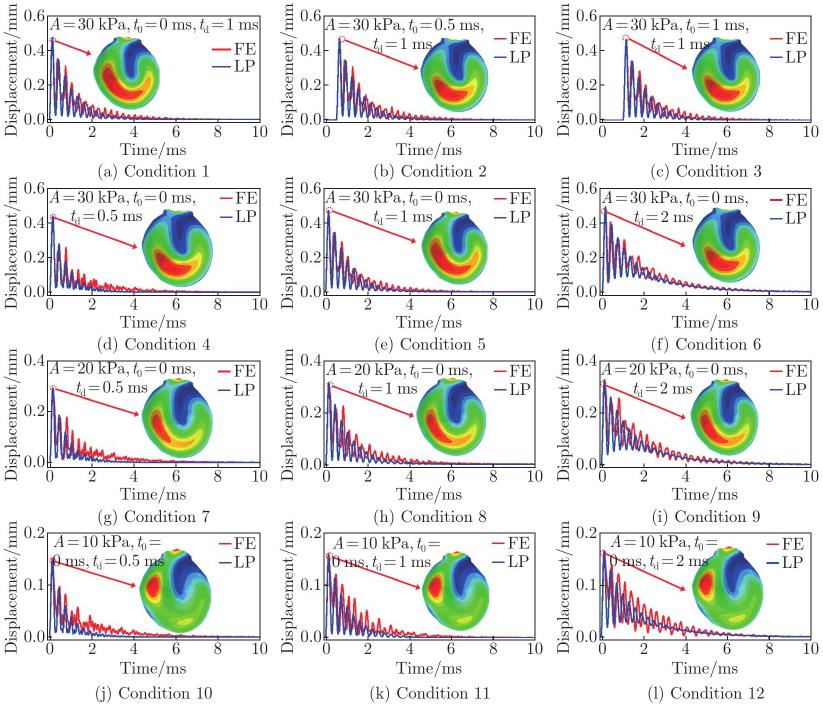
Fig. 9
Consistency and accuracy evaluation of the LP model for the TM displacement: (a) consistency analysis with a ±12% error band; (b) bootstrap distributions of prediction accuracy with the KDE, normal approximation, and 95% CI (inset: point estimate with 95% CI) (color online)"
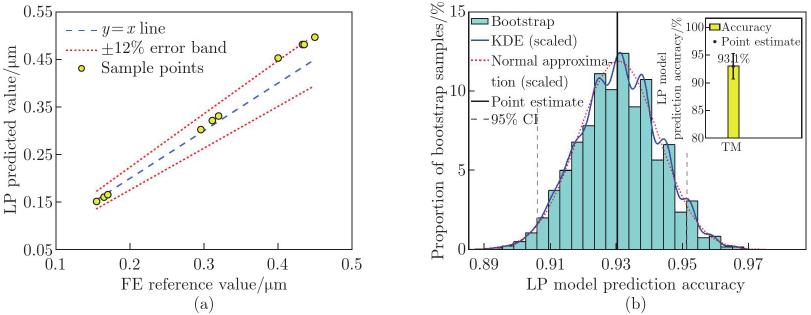
Table 4
Optimal values for the LP model to predict the stapes response"
| LP model parameter | m/kg | c/ | k/ |
|---|---|---|---|
| Optimal value | | 0.048 | |
Fig. 10
Comparison of the SFP displacement response between the FE (red) and LP (blue) models under twelve conditions. The curves show the displacement at the center of the SFP, while the heat maps display the spatial distributions of the displacement of the first peak in the FE model (color online)"
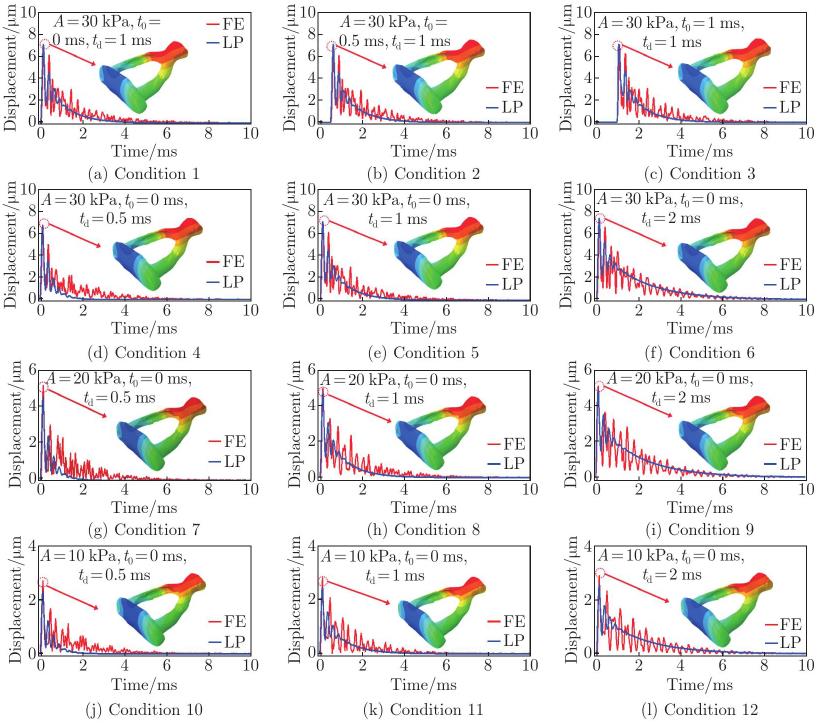
Fig. 11
Consistency and accuracy evaluation of the LP model for stapes displacements: (a) consistency analysis with a ±12% error band; (b) bootstrap distributions of prediction accuracy with the KDE, normal approximation, and 95% CI (inset: point estimate with 95% CI) (color online)"
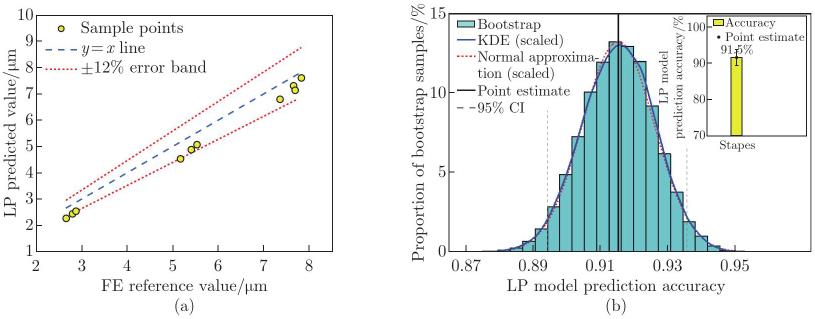
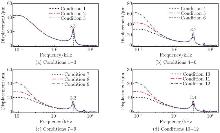
Fig. 12
Displacement responses of the TM in the frequency domain, as predicted by the LP model (color online)"
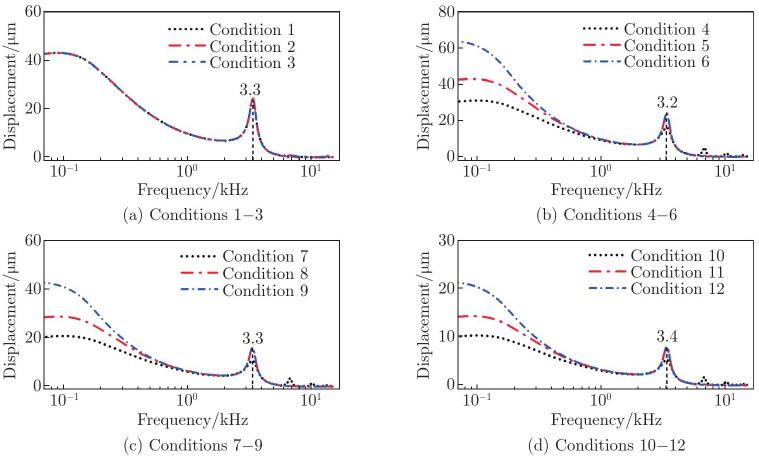
Fig. 13
Displacement responses of the SFP in the frequency domain, as predicted by the LP model (color online)"
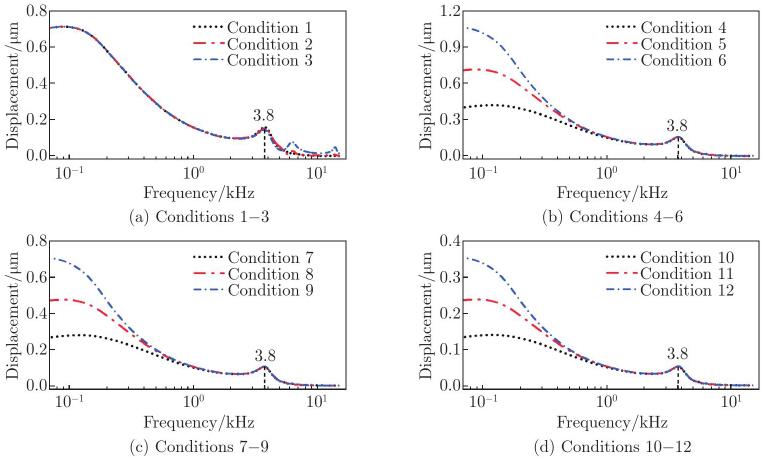
Fig. 14
Decibel curves illustrating changes in the TM displacement response, where red arrows indicate an increase, while blue arrows signify a decrease (color online)"
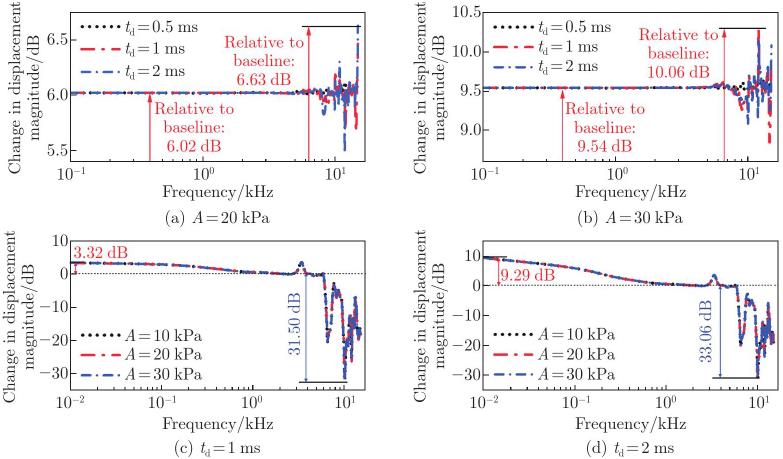
Fig. 15
Decibel curves illustrating changes in the SFP displacement response, where red arrows indicate an increase, while blue arrows signify a decrease (color online)"
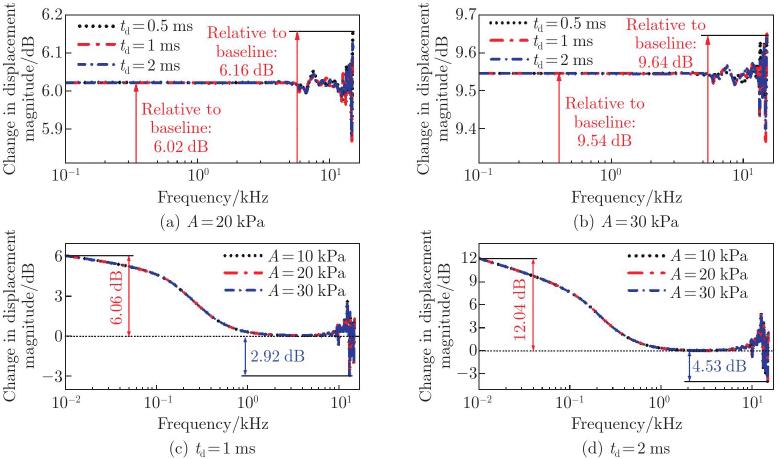
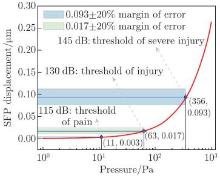
Fig. 16
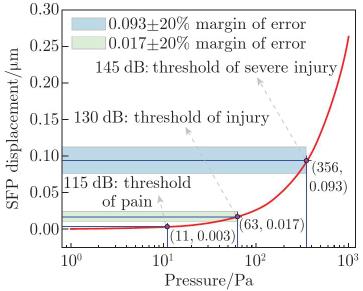
Correlation between the blast-wave sound pressure and the SFP displacement (color online)"
| [1] | BALLIVET DE RÉGLOIX, S., CRAMBERT, A., MAURIN, O., LISAN, Q., MARTY, S., and PONS, Y. Blast injury of the ear by massive explosion: a review of 41 cases. Journal of the Royal Army Medical Corps, 163(5), 333–338 (2017) |
| [2] | CHO, S. I., GAO, S. S., XIA, A. P., WANG, R., SALLES, F. T., RAPHAEL, P. D., ABAYA, H., WACHTEL, J., BAEK, J., JACOBS, D., RASBAND, M. N., and OGHALAI, J. S. Mechanisms of hearing loss after blast injury to the ear. PLoS One, 8(7), e67618 (2013) |
| [3] | CAVE, K. M., CORNISH, E. M., and CHANDLER, D. W. Blast injury of the ear: clinical update from the global war on terror. Military Medicine, 172(7), 726–730 (2007) |
| [4] | MA, Q. H., CHONG, K., WANG, B. F., and ZHOU, Q. Strong shock propagation for the finite-source circular blast in a confined domain. Applied Mathematics and Mechanics (English Edition), 45(6), 1071–1084 (2024) https://doi.org/10.1007/s10483-024-3120-7 |
| [5] | PAIK, C. B., PEI, M., and OGHALAI, J. S. Review of blast noise and the auditory system. Hearing Research, 425, 108459 (2022) |
| [6] | ZHOU, Y., WANG, L., and HUANG, J. L. Periodic response and stability analysis of vibro-impact systems by an enriched harmonic balance method. Applied Mathematics and Mechanics (English Edition), 46(5), 907–926 (2025) https://doi.org/10.1007/s10483-025-3253-8 |
| [7] | LONG, J. B., BENTLEY, T. L., WESSNER, K. A., CERONE, C., SWEENEY, S., and BAUMAN, R. A. Blast overpressure in rats: recreating a battlefield injury in the laboratory. Journal of Neurotrauma, 26(6), 827–840 (2009) |
| [8] | RITENOUR, A. E., BLACKBOURNE, L. H., KELLY, J. F., MCLAUGHLIN, D. F., PEARSE, L. A., HOLCOMB, J. B., and WADE, C. E. Incidence of primary blast injury in US military overseas contingency operations: a retrospective study. Annals of Surgery, 251(6), 1140–1144 (2010) |
| [9] | HOFFMANN, C., POYAT, C., ALHANATI, L., HAUS-CHEYMOL, R., DE RUDNICKI, S., BOUIX-PICASSO, J., and DONAT, N. French military deaths in Afghanistan: a retrospective analysis of 450 combat casualties between 2010 and 2012. BMJ Military Health, 167(2), 140 (2021) |
| [10] | BASS, C. R., RAFAELS, K. A., and SALZAR, R. S. Pulmonary injury risk assessment for short-duration blasts. The Journal of Trauma, 65(3), 604–615 (2008) |
| [11] | MA, Q. H., WANG, B. F., and ZHOU, Q. Asymptotic self-similar solution for a finite-source spherical blast wave in power-law density media. Applied Mathematics and Mechanics (English Edition), 46(9), 1771–1786 (2025) https://doi.org/10.1007/s10483-025-3288-7 |
| [12] | JAGADE, M. V., PATIL, R. A., SUHAIL, I. S., KELKAR, P., NEMANE, S., MAHENDRU, J., KALBANDE, V., and KEWLE, P. Bomb blast injury: effect on middle and inner ear. Indian Journal of Otolaryngology and Head and Neck Surgery, 60(4), 324–330 (2008) |
| [13] | GAN, R. Z. Biomechanical changes of tympanic membrane to blast waves. Advances in Experimental Medicine and Biology, 1097, 321–334 (2018) |
| [14] | BIEN, A. G., JIANG, S. Y., and GAN, R. Z. Real-time measurement of stapes motion and intracochlear pressure during blast exposure. Hearing Research, 429, 108702 (2023) |
| [15] | SHI, H. B., XIANG, S. Y., WANG, L., SUN, Y. T., WANG, J., and LIU, Z. L. Characterization of middle ear soft tissue damping and its role in sound transmission. Biomechanics and Modeling in Mechanobiology, 22(3), 1003–1018 (2023) |
| [16] | KWACZ, M., MAREK, P., BORKOWSKI, P., and MRÓWKA, M. A three-dimensional finite element model of round window membrane vibration before and after stapedotomy surgery. Biomechanics and Modeling in Mechanobiology, 12(6), 1243–1261 (2013) |
| [17] | YU, Y. C., WANG, T. C., and SHIH, T. C. A comprehensive finite-element human ear model to estimate noise-induced hearing loss associated with occupational noise exposure. Computer Methods and Programs in Biomedicine, 226, 107179 (2022) |
| [18] | ZHANG, J., JIAO, C. X., ZOU, D. L., TA, N., and RAO, Z. S. Assigning viscoelastic and hyperelastic properties to the middle-ear soft tissues for sound transmission. Biomechanics and Modeling in Mechanobiology, 19(3), 957–970 (2020) |
| [19] | GAN, R. Z., FENG, B., and SUN, Q. L. Three-dimensional finite element modeling of human ear for sound transmission. Annals of Biomedical Engineering, 32(6), 847–859 (2004) |
| [20] | ZHANG, X. M. and GAN, R. Z. Finite element modeling of energy absorbance in normal and disordered human ears. Hearing Research, 301, 146–155 (2013) |
| [21] | CHEN, S. I., LEE, M. H., YAO, C. M., CHEN, P. R., CHOU, Y. F., LIU, T. C., SONG, Y. L., and LEE, C. F. Modeling sound transmission of human middle ear and its clinical applications using finite element analysis. The Kaohsiung Journal of Medical Sciences, 29(3), 133–139 (2013) |
| [22] | HAN, H. G., WANG, L., ZHU, Y. T., LIU, Z. L., SUN, Y. T., WANG, J., WANG, L. L., XIANG, S. Y., SHI, H. B., and DING, Q. Finite element analysis of conductive hearing loss caused by fixation and detachment of ligament and tendon in the middle ear. Computer Methods and Programs in Biomedicine, 236, 107540 (2023) |
| [23] | WANG, L., HAN, H. G., WANG, J., ZHU, Y. T., LIU, Z. L., SUN, Y. T., WANG, L. L., XIANG, S. Y., SHI, H. B., and DING, Q. Finite element analysis of repairing tympanic membrane perforation using autologous graft material and biodegradable bionic cobweb scaffold. Computer Methods and Programs in Biomedicine, 243, 107868 (2024) |
| [24] | LECKNESS, K., NAKMALI, D., and GAN, R. Z. Computational modeling of blast wave transmission through human ear. Military Medicine, 183, 262–268 (2018) |
| [25] | BROWN, M. A., JI, X. D., and GAN, R. Z. 3D finite element modeling of blast wave transmission from the external ear to cochlea. Annals of Biomedical Engineering, 49(2), 757–768 (2021) |
| [26] | BRADSHAW, J. J., BROWN, M. A., JIANG, S. Y., and GAN, R. Z. 3D finite element model of human ear with 3-chamber spiral cochlea for blast wave transmission from the ear canal to cochlea. Annals of Biomedical Engineering, 51(5), 1106–1118 (2023) |
| [27] | GARBER, L., KHODAEI, S., and KESHAVARZ-MOTAMED, Z. The critical role of lumped parameter models in patient-specific cardiovascular simulations. Archives of Computational Methods in Engineering, 29(5), 2977–3000 (2022) |
| [28] | KIM, E. J. and CAPOCCIA, M. Synergistic model of cardiac function with a heart assist device. Bioengineering (Basel), 7(1), 1 (2019) |
| [29] | DI MOLFETTA, A., FERRARI, G., IACOBELLI, R., FILIPPELLI, S., FRESIELLO, L., GUCCIONE, P., TOSCANO, A., and AMODEO, A. Application of a lumped parameter model to study the feasibility of simultaneous implantation of a continuous flow ventricular assist device (VAD) and a pulsatile flow VAD in BIVAD patients. Artificial Organs, 41(3), 242–252 (2017) |
| [30] | BENEVENTO, E., DJEBBARI, A., KESHAVARZ-MOTAMED, Z., CECERE, R., and KADEM, L. Hemodynamic changes following aortic valve bypass: a mathematical approach. PLoS One, 10(4), e0123000 (2015) |
| [31] | KESHAVARZ-MOTAMED, Z., RIKHTEGAR NEZAMI, F., PARTIDA, R. A., NAKAMURA, K., STAZIAKI, P. V., BEN-ASSA, E., GHOSHHAJRA, B., BHATT, A. B., and EDELMAN, E. R. Elimination of transcoarctation pressure gradients has no impact on left ventricular function or aortic shear stress after intervention in patients with mild coarctation. JACC: Cardiovascular Interventions, 9(18), 1953–1965 (2016) |
| [32] | FENG, B. and GAN, R. Z. Lumped parametric model of the human ear for sound transmission. Biomechanics and Modeling in Mechanobiology, 3(1), 33–47 (2004) |
| [33] | LIU, Z. H., LIU, H. G., WANG, J., YANG, J. H., HAO, J. B., and YANG, S. G. Analysis of design parameters of round-window stimulating type electromagnetic transducer by a nonlinear lumped parameter model of implanted human ear. Mathematical Biosciences and Engineering, 19(3), 2453–2470 (2022) |
| [34] | IYOHO, A. E., HO, K., and CHAN, P. The development of a tympanic membrane model and probabilistic dose-response risk assessment of rupture because of blast. Military Medicine, 185, 234–242 (2020) |
| [35] | POLANIK, M. D., TRAKIMAS, D. R., BLACK, N. L., CHENG, J. T., KOZIN, E. D., and REMENSCHNEIDER, A. K. High-frequency conductive hearing following total drum replacement tympanoplasty. Otolaryngology — Head and Neck Surgery, 162(6), 914–921 (2020) |
| [36] | CHUJO, K., NAKAGAWA, T., and KOMUNE, S. Temporal bone fracture with ossicular dislocation caused by a blow to the opposite side of the head. Auris Nasus Larynx, 35(2), 273–275 (2008) |
| [37] | YETISER, S., HIDIR, Y., BIRKENT, H., SATAR, B., and DURMAZ, A. Traumatic ossicular dislocations: etiology and management. American Journal of Otolaryngology, 29(1), 31–36 (2008) |
| [38] | WAGNER, E. L. and SHIN, J. B. Mechanisms of hair cell damage and repair. Trends in Neurosciences, 42(6), 414–424 (2019) |
| [39] | KOU, Y. X., CHEN, W., WANG, J., LIU, W., YANG, S. G., and LIU, H. G. Personalized prediction of speech intelligibility for hearing-impaired listeners using a physiological model of the human ear. Applied Acoustics, 221, 110006 (2024) |
| [40] | JIANG, S. Y., DAI, C. K., and GAN, R. Z. Dual-laser measurement of human stapes footplate motion under blast exposure. Hearing Research, 403, 108177 (2021) |
| [41] | LIANG, J. Y. and YAO, W. J. Revealing the contribution of basilar membrane’s biological activity to the mechanism of the cochlear phonosensitive amplification. Applied Mathematics and Mechanics (English Edition), 44(5), 823–840 (2023) https://doi.org/10.1007/s10483-023-2986-7 |
| [42] | GAN, R. Z., LECKNESS, K., SMITH, K., and JI, X. D. Characterization of protection mechanisms to blast overpressure for personal hearing protection devices — biomechanical measurement and computational modeling. Military Medicine, 184, 251–260 (2019) |
| [43] | GAN, R. Z., SUN, Q. L., FENG, B., and WOOD, M. W. Acoustic-structural coupled finite element analysis for sound transmission in human ear — pressure distributions. Medical Engineering & Physics, 28(5), 395–404 (2006) |
| [44] | LIU, H. G., GE, S. R., CHENG, G., YANG, J. H., RAO, Z. S., and HUANG, X. S. Transducer type and design influence on the hearing loss compensation behaviour of the electromagnetic middle ear implant in a finite element analysis. Advances in Mechanical Engineering, 6, 867108 (2014) |
| [45] | WANG, L. L., WANG, L., ZHU, Y. T., LIU, Z. L., SUN, Y. T., WANG, J., HAN, H. G., XIANG, S. Y., SHI, H. B., and DING, Q. Nonlinear dynamic response and stability analysis of the stapes reconstruction in human middle ear. Applied Mathematics and Mechanics (English Edition), 44(10), 1739–1760 (2023) https://doi.org/10.1007/s10483-023-3037-9 |
| [46] | GAN, R. Z. and WANG, X. L. Multifield coupled finite element analysis for sound transmission in otitis media with effusion. The Journal of the Acoustical Society of America, 122(6), 3527–3538 (2007) |
| [47] | SHI, H. B., YAN, Z. M., LI, Y. F., SUN, Y. T., WANG, J., and LIU, Z. L. Revealing the effects of tympanic membrane implant mechanical properties on high-frequency hearing loss after clinical myringoplasty: a finite element analysis. International Journal for Numerical Methods in Biomedical Engineering, 41(3), e70028 (2025) |
| [48] | RIGBY, S. E., TYAS, A., and BENNETT, T. Single-degree-of-freedom response of finite targets subjected to blast loading — the influence of clearing. Engineering Structures, 45, 396–404 (2012) |
| [49] | LI, B. W. and LI, Q. M. Damage boundary of structural components under shock environment. International Journal of Impact Engineering, 118, 67–77 (2018) |
| [50] | GAN, R. Z., LECKNESS, K., NAKMALI, D., and JI, X. D. Biomechanical measurement and modeling of human eardrum injury in relation to blast wave direction. Military Medicine, 183, 245–251 (2018) |
| [51] | GILCHRIST, M. D., MURPHY, J. G., and RASHID, B. Generalisations of the strain-energy function of linear elasticity to model biological soft tissue. International Journal of Non-Linear Mechanics, 47(2), 268–272 (2012) |
| [52] | ABEDINI, M., MUTALIB, A. A., RAMAN, S. N., ALIPOUR, R., and AKHLAGHI, E. Pressure-impulse (P-I) diagrams for reinforced concrete (RC) structures: a review. Archives of Computational Methods in Engineering, 26(3), 733–767 (2019) |
| [53] | KRAUTHAMMER, T., ASTARLIOGLU, S., BLASKO, J., SOH, T. B., and NG, P. H. Pressure-impulse diagrams for the behavior assessment of structural components. International Journal of Impact Engineering, 35(8), 771–783 (2008) |
| [54] | KRINGLEBOTN, M. Network model for the human middle ear. Scandinavian Audiology, 17(2), 75–85 (1988) |
| [55] | FADAEI, M., ABOUALI, O., EMDAD, H., FARAMARZI, M., and AHMADI, G. Numerical simulation of wave propagation in a realistic model of the human external ear. Computer Methods in Biomechanics and Biomedical Engineering, 18(16), 1797–1810 (2015) |
| [56] | ISAAC, O. S., ALSHAMMARI, O. G., PICKERING, E. G., CLARKE, S. D., and RIGBY, S. E. Blast wave interaction with structures — an overview. International Journal of Protective Structures, 14(4), 584–630 (2023) |
| [57] | ZHANG, X. M., GUAN, X. Y., NAKMALI, D., PALAN, V., PINEDA, M., and GAN, R. Z. Experimental and modeling study of human tympanic membrane motion in the presence of middle ear liquid. Journal of the Association for Research in Otolaryngology, 15(6), 867–881 (2014) |
| [58] | AIBARA, R., WELSH, J. T., PURIA, S., and GOODE, R. L. Human middle-ear sound transfer function and cochlear input impedance. Hearing Research, 152(1), 100–109 (2001) |
| [59] | MAYORGA, M. A. The pathology of primary blast overpressure injury. Toxicology, 121(1), 17–28 (1997) |
| [60] | NATARAJAN, N., BATTS, S., and STANKOVIC, K. M. Noise-induced hearing loss. Journal of Clinical Medicine, 12(6), 2347 (2023) |
| [61] | KIMURA, E., MIZUTARI, K., KURIOKA, T., KAWAUCHI, S., SATOH, Y., SATO, S., and SHIOTANI, A. Effect of shock wave power spectrum on the inner ear pathophysiology in blast-induced hearing loss. Scientific Reports, 11(1), 14704 (2021) |
| [1] | Fenglian LI, Yiping WANG, Yuxing ZOU. Optimization for sound insulation of a sandwich plate with a corrugation and auxetic honeycomb hybrid core [J]. Applied Mathematics and Mechanics (English Edition), 2024, 45(9): 1595-1612. |
| [2] | Jianlin YI, Zheng WU, Rongyu XIA, Zheng LI. Reconfigurable metamaterial for asymmetric and symmetric elastic wave absorption based on exceptional point in resonant bandgap [J]. Applied Mathematics and Mechanics (English Edition), 2023, 44(1): 1-20. |
| [3] | Yu LIN, Yaming CHEN, Chuanfu XU, Xiaogang DENG. Optimization of a global seventh-order dissipative compact finite-difference scheme by a genetic algorithm [J]. Applied Mathematics and Mechanics (English Edition), 2018, 39(11): 1679-1690. |
| [4] | M. A. Z. RAJA, R. SAMAR, T. HAROON, S. M. SHAH. Unsupervised neural network model optimized with evolutionary computations for solving variants of nonlinear MHD Jeffery-Hamel problem [J]. Applied Mathematics and Mechanics (English Edition), 2015, 36(12): 1611-1638. |
| [5] | ZHAO Ke;GAO Zheng-Hong;HUANG Jiang-Tao. Robust design of natural laminar flow supercritical airfoil by multi-objective evolution method [J]. Applied Mathematics and Mechanics (English Edition), 2014, 35(2): 191-202. |
| [6] | BAI Ya-Lei;MA Xing-Yu;MENG Xiao. Lift enhancement of airfoil and tip flow control for wind turbine [J]. Applied Mathematics and Mechanics (English Edition), 2011, 32(7): 825-836. |
| [7] | WANG Long;WANG Tong-Guang;LUO Yuan. Improved non-dominated sorting genetic algorithm (NSGA)-II in multi-objective optimization studies of wind turbine blades [J]. Applied Mathematics and Mechanics (English Edition), 2011, 32(6): 739-748. |
| [8] | HONG Mei;ZHANG Ren;XUE Feng;LIU Ke-Feng. Space-time objective decomposition of vortex equations and mechanism analysis of subtropical high abnormal activities [J]. Applied Mathematics and Mechanics (English Edition), 2009, 30(10): 1263-1270. |
| [9] | YIN Bo;XU Dian;AN Yi-ran;CHEN Yao-song. Aerodynamic optimization of 3D wing based on iSIGHT [J]. Applied Mathematics and Mechanics (English Edition), 2008, 29(5): 603-610 . |
| [10] | CHEN Ling-li;YU Jie. Optimal distribution of reliability for a large network based on connectivity [J]. Applied Mathematics and Mechanics (English Edition), 2008, 29(12): 1633-1642 . |
| [11] | ZHANG Ren;HONG Mei;SUN Zhao-bo;NIU Sheng-jie;ZHU Wei-jun;MIN Jin-zhong;WAN Qi-lin. NON-LINEAR DYNAMIC MODEL RETRIEVAL OF SUBTROPICAL HIGH BASED ON EMPIRICAL ORTHOGONAL FUNCTION AND GENETIC ALGORITHM [J]. Applied Mathematics and Mechanics (English Edition), 2006, 27(12): 1645-1653 . |
| Viewed | ||||||
|
Full text |
|
|||||
|
Abstract |
|
|||||





 Email Alert
 RSS
RSS