Applied Mathematics and Mechanics (English Edition) ›› 2026, Vol. 47 ›› Issue (4): 815-838.doi: https://doi.org/10.1007/s10483-026-3370-8
Previous Articles Next Articles
Pei ZHANG1, P. SCHIAVONE2, Luke ZHAO1, Dongbo LI1, Yanming REN3, Hai QING4,†( )
)
Received:2025-10-24
Revised:2026-01-29
Published:2026-03-31
Contact:
Hai QING, E-mail: qinghai@nuaa.edu.cnSupported by:2010 MSC Number:
Pei ZHANG, P. SCHIAVONE, Luke ZHAO, Dongbo LI, Yanming REN, Hai QING. On well-posed local-nonlocal mixed integral model of piezoelectricity for dynamic stability and vibration analysis of piezoelectric Timoshenko nanobeams with general boundary constraints. Applied Mathematics and Mechanics (English Edition), 2026, 47(4): 815-838.
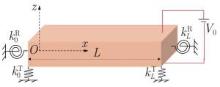
Fig. 1
Schematic of a piezoelectric nanobeam with general constraints (color online)"
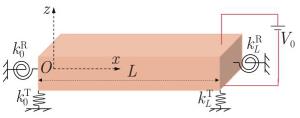
Table 1
Required spring stiffness values for different boundary conditions"
| BC | Requirement | Spring stiffness |
|---|---|---|
| Simply supported (S) | | |
| Clamped (C) | | |
| Free (F) | | |
| Elastically constrained (E) | | |
Table 2
Mechanical and electrical properties adopted in numerical simulations"
| Property | | | | | | |
|---|---|---|---|---|---|---|
| For | 81.3 | 25.6 | | 40.324 8 | | |
| For others | 132 | 26 | | 14.1 | | |
Table 3
Comparative results of the first three dimensionless frequencies of the local piezoelectric Timoshenko beam having L=450 nm and h=15 nm, evaluated by the present model with ξ→1 and κ→0 and the local piezoelectricity model"
| BC | Present | Local model[ | ||||
|---|---|---|---|---|---|---|
| 1st mode | 2nd mode | 3rd mode | 1st mode | 2nd mode | 3rd mode | |
| CC | 0.223 5 | 0.611 3 | 1.187 3 | 0.225 1 | 0.616 5 | 1.197 3 |
| CS | 0.155 4 | 0.500 8 | 1.036 9 | 0.155 8 | 0.502 3 | 1.038 8 |
| CF | 0.035 5 | 0.221 8 | 0.617 0 | 0.036 0 | 0.222 4 | 0.622 0 |
Table 4
Comparative results of the first dimensionless frequencies of the piezoelectric Bernoulli-Euler beam made of PZT-4 with L=20 nm and h=0.01L for V0=0 mV and μ11=0"
| BC | ξ | Present GDQM solution | Bernoulli-Euler beam[ | ||||
|---|---|---|---|---|---|---|---|
| | | | | | | ||
| SS | 0.5 | 9.900 9 | 9.840 0 | 9.764 7 | 9.900 9 | 9.840 3 | 9.764 6 |
| 0.1 | 9.582 8 | 9.734 2 | 9.582 1 | 9.852 8 | 9.734 2 | 9.582 1 | |
| CC | 0.5 | 21.199 9 | 20.544 3 | 19.946 6 | 21.199 9 | 20.544 3 | 19.946 6 |
| 0.1 | 19.593 6 | 18.265 0 | 17.072 0 | 19.593 6 | 18.265 0 | 17.072 0 | |
| CS | 0.5 | 15.022 3 | 14.728 8 | 14.438 2 | 15.022 3 | 14.728 8 | 14.382 0 |
| 0.1 | 14.390 6 | 13.780 8 | 13.183 1 | 14.390 6 | 13.780 8 | 13.183 1 | |
| CF | 0.5 | 3.447 4 | 3.401 1 | 3.357 4 | 3.447 3 | 3.401 1 | 3.357 3 |
| 0.1 | 3.319 7 | 3.217 0 | 3.120 9 | 3.319 7 | 3.217 0 | 3.120 9 | |
Table 5
Comparative results of the first dimensionless frequencies of the piezoelectric Bernoulli-Euler beam made of PZT-4 with L=20 nm and h=0.01L for ξ=0.01, κ=0.05, and μ11=0"
| BC | Mode | Present GDQM solution | Bernoulli-Euler beam[ | ||||
|---|---|---|---|---|---|---|---|
| | | | | | | ||
| SS | 1st | 12.142 0 | 9.838 9 | 6.795 6 | 12.142 0 | 9.838 9 | 6.795 6 |
| 2nd | 40.617 7 | 38.043 3 | 35.281 5 | 40.617 7 | 38.043 3 | 35.281 5 | |
| CC | 1st | 20.243 3 | 18.808 2 | 17.243 2 | 20.243 3 | 18.808 2 | 17.243 2 |
| 2nd | 52.460 0 | 50.382 5 | 48.211 0 | 52.460 0 | 50.382 6 | 48.211 0 | |
| CS | 1st | 15.911 8 | 14.077 9 | 11.945 4 | 15.911 8 | 14.077 9 | 11.945 4 |
| 2nd | 46.526 1 | 44.231 0 | 41.809 2 | 46.526 1 | 44.231 0 | 41.809 2 | |
Table 6
Dimensionless frequencies of SS piezoelectric nanobeams with h=10 nm and V0=0 mV"
| | κ | Timoshenko beam | Bernoulli-Euler beam | ||||
|---|---|---|---|---|---|---|---|
| | | | | | | ||
| 6 | | 9.306 4 | 9.306 4 | 9.306 4 | 9.954 2 | 9.954 2 | 9.954 2 |
| 0.1 | 8.820 1 | 8.774 3 | 8.720 5 | 9.580 1 | 9.549 4 | 9.516 2 | |
| 0.2 | 8.013 9 | 7.878 6 | 7.718 7 | 8.801 1 | 8.677 9 | 8.529 6 | |
| 0.3 | 7.245 7 | 7.003 3 | 6.711 4 | 8.016 8 | 7.770 9 | 7.461 1 | |
| 10 | | 9.701 4 | 9.701 4 | 9.701 4 | 9.955 5 | 9.955 5 | 9.955 5 |
| 0.1 | 9.279 7 | 9.242 7 | 9.200 2 | 9.581 2 | 9.550 5 | 9.517 4 | |
| 0.2 | 8.487 6 | 8.359 1 | 8.206 0 | 8.802 5 | 8.679 4 | 8.531 3 | |
| 0.3 | 7.708 1 | 7.463 4 | 7.161 3 | 8.018 3 | 7.772 7 | 7.463 3 | |
| 16 | | 9.853 5 | 9.853 5 | 9.853 5 | 9.955 9 | 9.955 9 | 9.955 9 |
| 0.1 | 9.459 5 | 9.426 2 | 9.389 6 | 9.581 7 | 9.551 0 | 9.517 9 | |
| 0.2 | 8.675 1 | 8.549 8 | 8.399 7 | 8.803 1 | 8.680 1 | 8.532 2 | |
| 0.3 | 7.892 6 | 7.647 4 | 7.341 2 | 8.019 1 | 7.773 7 | 7.464 5 | |
Table 7
Dimensionless frequencies of CC piezoelectric nanobeams with h=10 nm and V0=0 mV"
| | κ | Timoshenko beam | Bernoulli-Euler beam | ||||
|---|---|---|---|---|---|---|---|
| | | | | | | ||
| 6 | | 17.266 3 | 17.266 3 | 17.266 3 | 22.505 5 | 22.505 5 | 22.505 5 |
| 0.1 | 13.688 2 | 13.305 6 | 12.831 8 | 17.028 4 | 16.457 4 | 15.756 4 | |
| 0.2 | 11.137 3 | 10.536 9 | 9.837 4 | 13.512 0 | 12.653 6 | 11.667 7 | |
| 0.3 | 9.503 5 | 8.743 4 | 7.898 1 | 11.418 7 | 10.352 6 | 9.187 8 | |
| 10 | | 20.094 6 | 20.094 6 | 20.094 6 | 22.528 3 | 22.528 3 | 22.528 3 |
| 0.1 | 15.556 3 | 15.075 9 | 14.483 4 | 17.044 3 | 16.472 6 | 15.770 7 | |
| 0.2 | 12.490 2 | 11.751 9 | 10.897 6 | 13.524 2 | 12.664 8 | 11.677 7 | |
| 0.3 | 10.602 2 | 9.676 3 | 8.655 3 | 11.429 1 | 10.361 7 | 9.195 4 | |
| 16 | | 21.479 2 | 21.479 2 | 21.479 2 | 22.542 7 | 22.542 7 | 22.542 7 |
| 0.1 | 16.417 5 | 15.885 9 | 15.231 8 | 17.054 2 | 16.482 0 | 15.779 5 | |
| 0.2 | 13.093 9 | 12.286 8 | 11.356 7 | 13.531 7 | 12.671 6 | 11.683 7 | |
| 0.3 | 11.086 7 | 10.079 8 | 8.975 2 | 11.435 4 | 10.367 1 | 9.199 9 | |
Table 8
Dimensionless frequencies of CS piezoelectric nanobeams with h=10 nm and V0=0 mV"
| | κ | Timoshenko beam | Bernoulli-Euler beam | ||||
|---|---|---|---|---|---|---|---|
| | | | | | | ||
| 6 | | 13.174 6 | 13.174 6 | 13.174 6 | 15.528 8 | 15.528 8 | 15.528 8 |
| 0.1 | 11.281 9 | 11.077 6 | 10.824 5 | 13.163 6 | 12.907 2 | 12.588 9 | |
| 0.2 | 9.587 9 | 9.225 6 | 8.798 4 | 11.102 3 | 10.647 6 | 10.109 0 | |
| 0.3 | 8.351 2 | 7.858 1 | 7.294 6 | 9.640 3 | 9.021 6 | 8.309 2 | |
| 10 | | 14.534 3 | 14.534 3 | 14.534 3 | 15.538 3 | 15.538 3 | 15.538 3 |
| 0.1 | 12.377 1 | 12.143 7 | 11.854 2 | 13.171 1 | 12.914 5 | 12.595 9 | |
| 0.2 | 10.474 6 | 10.060 5 | 9.570 9 | 11.108 5 | 10.653 6 | 10.114 7 | |
| 0.3 | 9.108 0 | 8.544 0 | 7.896 6 | 9.645 8 | 12.914 5 | 8.313 9 | |
| 16 | | 15.123 2 | 15.123 2 | 15.123 2 | 15.543 8 | 15.543 8 | 15.543 8 |
| 0.1 | 12.844 5 | 12.597 7 | 12.291 4 | 13.175 5 | 12.918 8 | 12.600 1 | |
| 0.2 | 10.848 8 | 10.411 1 | 9.892 9 | 11.112 2 | 10.657 1 | 10.118 0 | |
| 0.3 | 9.425 9 | 8.830 0 | 8.144 6 | 9.649 1 | 9.029 8 | 8.316 7 | |
Table 9
Dimensionless frequencies of CF piezoelectric nanobeams with h=10 nm and V0=0 mV"
| | κ | Timoshenko beam | Bernoulli-Euler beam | ||||
|---|---|---|---|---|---|---|---|
| | | | | | | ||
| 6 | | 3.408 9 | 3.408 9 | 3.408 9 | 3.541 4 | 3.541 4 | 3.541 4 |
| 0.1 | 3.011 4 | 2.961 8 | 2.897 1 | 3.116 4 | 3.063 4 | 2.994 4 | |
| 0.2 | 2.703 7 | 2.619 7 | 2.512 8 | 2.791 4 | 2.702 3 | 2.589 0 | |
| 0.3 | 2.465 6 | 2.355 5 | 2.218 2 | 2.542 0 | 2.425 7 | 2.280 9 | |
| 10 | | 3.493 1 | 3.493 1 | 3.493 1 | 3.543 4 | 3.543 4 | 3.543 4 |
| 0.1 | 3.078 4 | 3.026 6 | 2.959 2 | 3.118 1 | 3.065 1 | 2.996 1 | |
| 0.2 | 2.759 8 | 2.672 6 | 2.561 6 | 2.792 9 | 2.703 8 | 2.590 4 | |
| 0.3 | 2.514 5 | 2.400 5 | 2.258 4 | 2.543 3 | 2.426 9 | 2.282 0 | |
| 16 | | 3.524 4 | 3.524 4 | 3.524 4 | 3.544 7 | 3.544 7 | 3.544 7 |
| 0.1 | 3.103 1 | 3.050 6 | 2.982 2 | 3.119 1 | 3.066 1 | 2.997 0 | |
| 0.2 | 2.780 4 | 2.692 0 | 2.579 6 | 2.793 8 | 2.704 6 | 2.591 2 | |
| 0.3 | 2.532 5 | 2.417 0 | 2.273 2 | 2.544 1 | 2.427 7 | 2.282 7 | |
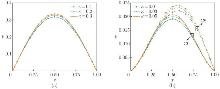
Fig. 2
The first vibration mode shapes (deflection w) of (a) SS and (b) CC and CS piezoelectric Timoshenko nanobeams for different values of nonlocal length-scale parameter κ, evaluated by the local-nonlocal mixed piezoelectricity with ξ=0.5, where the length-height ratio and external voltage are L/h=8 and V0=0 mV, respectively (color online)"
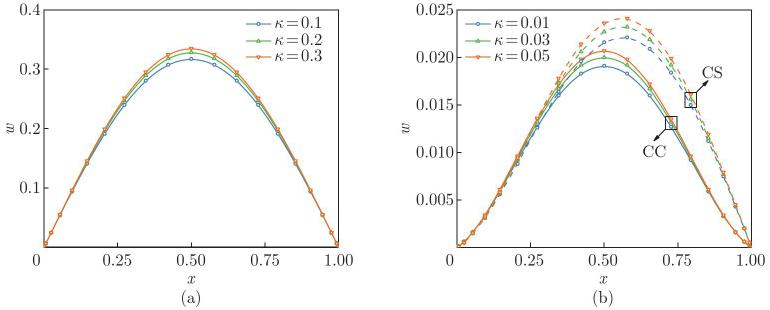
Fig. 3
The first vibration mode shapes (electrical potential ψ) of (a) SS and (b) CC and CS piezoelectric Timoshenko nanobeams for different values of nonlocal length-scale parameter κ, evaluated by the local-nonlocal mixed piezoelectricity with ξ=0.5, where the length-height ratio and external voltage are L/h=8 and V0=0 mV, respectively (color online)"
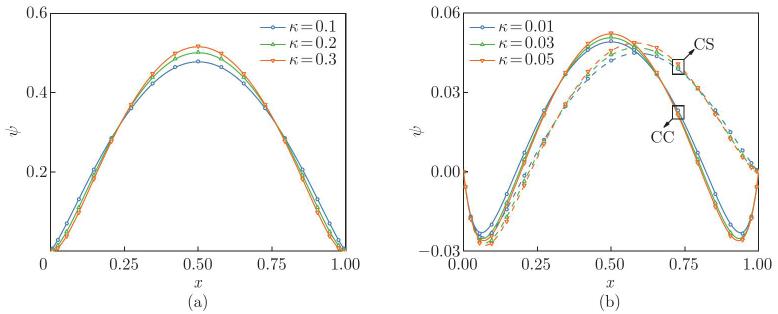
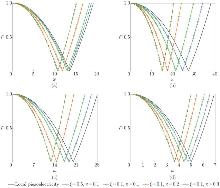
Fig. 4
Dynamic force factor γ2 of (a) SS, (b) CC, (c) CS, and (d) CF piezoelectric Timoshenko nanobeams versus the dimensionless excitation frequency ω for various values of the mixture parameter ξ and the nonlocal length-scale parameter κ, where the length-height ratio, static force factor, and external voltage are L/h=8, γ1=0.5, and V0=0 mV, respectively (color online)"
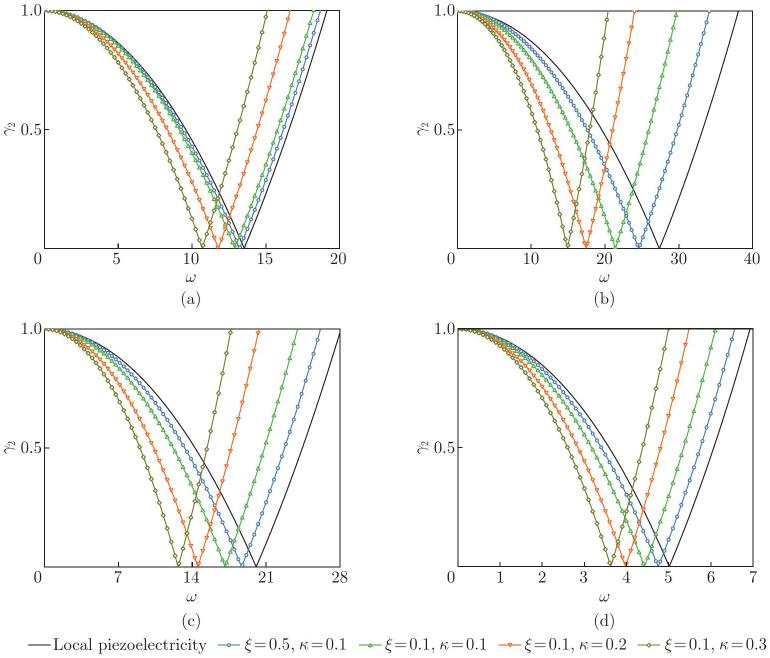
Fig. 5
Dynamic force factor γ2 of (a) SS, (b) CC, (c) CS, and (d) CF piezoelectric Timoshenko nanobeams versus the dimensionless excitation frequency ω for various values of static force factor γ1, where the length-height ratio, mixture parameter, nonlocal length-scale parameter, and external voltage are L/h=8, ξ=0.1, κ=0.1, and V0=0 mV, respectively (color online)"
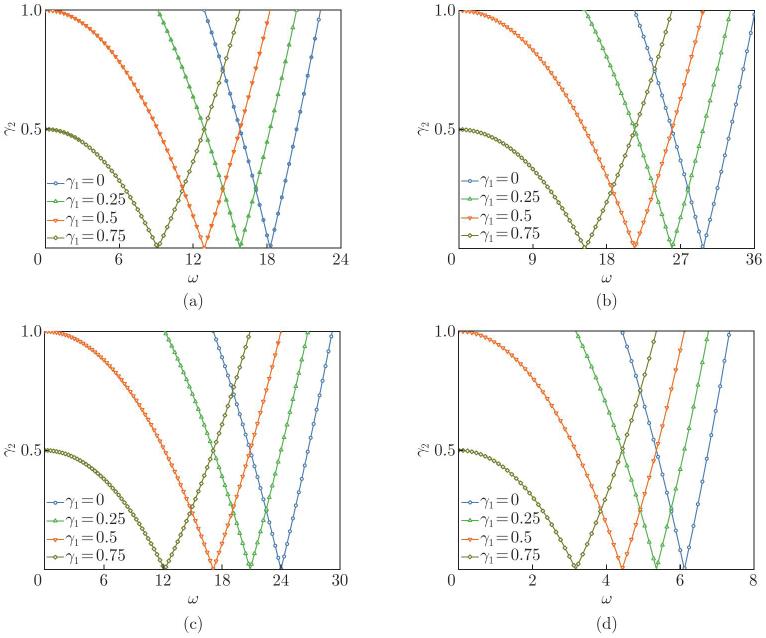
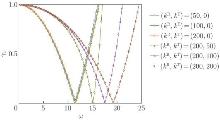
Fig. 6
Dynamic force factor γ2 of doubly elastically constrained piezoelectric Timoshenko nanobeams versus the dimensionless excitation frequency ω for various combinations of spring stiffness (kT, kR), where the length-height ratio, static force factor, mixture parameter, nonlocal length-scale parameter, and external voltage are L/h=8, γ1=0.5, ξ=0.1, κ=0.1, and V0=0 mV (color online)"
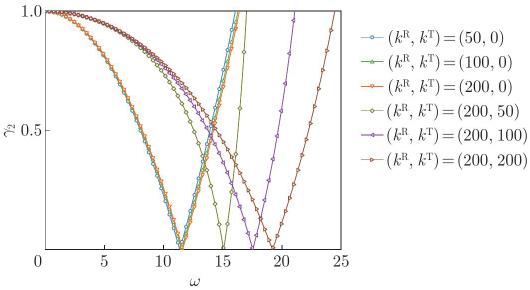
Fig. 7
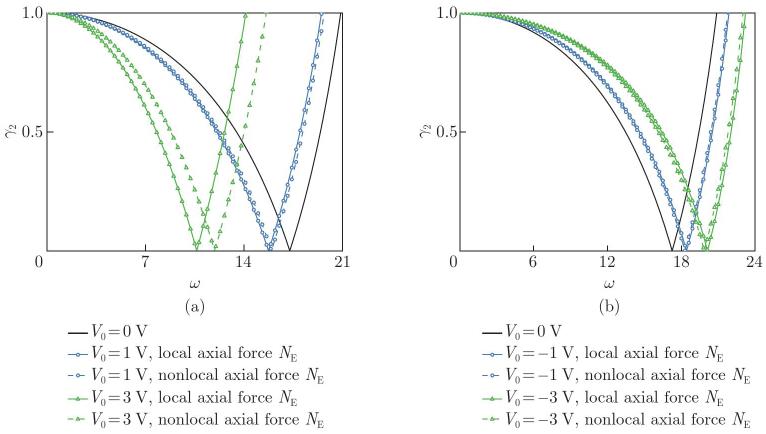
Dynamic force factor γ2 of doubly elastically constrained piezoelectric Timoshenko nanobeams versus the dimensionless excitation frequency ω for various values of the external voltage V0, where the length-height ratio, static force factor, mixture parameter, nonlocal length-scale parameter, and combination of spring stiffness are L/h=8, γ1=0.5, ξ=0.1, κ=0.1, and (kT, kR)=(100, 50), respectively (color online)"
| [1] | EOM, C. B. and TROLIER-MCKINSTRY, S. Thin-film piezoelectric MEMS. MRS Bulletin, 37, 1007–1017 (2012) |
| [2] | MOHITH, S., UPADHYA, A. R., NAVIN, K. P., KULKARNI, S. M., and RAO, M. Recent trends in piezoelectric actuators for precision motion and their applications: a review. Smart Materials and Structures, 30, 013002 (2021) |
| [3] | PILLAI, G. and LI, S. S. Piezoelectric MEMS resonators: a review. IEEE Sensors Journal, 21, 12589–12605 (2021) |
| [4] | MOTZ, C., WEYGAND, D., SENGER, J., and GUMBSCH, P. Micro-bending tests: a comparison between three-dimensional discrete dislocation dynamics simulations and experiments. Acta Materialia, 56, 1942–1955 (2008) |
| [5] | PENG, C., ZHAN, Y., and LOU, J. Size-dependent fracture mode transition in copper nanowires. Small, 8, 1889–1894 (2012) |
| [6] | ERINGEN, A. C. and EDELEN, D. G. B. On nonlocal elasticity. International Journal of Engineering Science, 10, 233–248 (1972) |
| [7] | MINDLIN, R. D. Second gradient of strain and surface-tension in linear elasticity. International Journal of Solids and Structures, 1, 417–438 (1965) |
| [8] | LIM, C. W., ZHANG, G., and REDDY, J. N. A higher-order nonlocal elasticity and strain gradient theory and its applications in wave propagation. Journal of the Mechanics and Physics of Solids, 78, 298–313 (2015) |
| [9] | LU, L., GUO, X. M., and ZHAO, J. Z. A unified size-dependent plate model based on nonlocal strain gradient theory including surface effects. Applied Mathematical Modelling, 68, 583–602 (2019) |
| [10] | LU, L., ZHU, L., GUO, X. M., ZHAO, J. Z., and LIU, G. Z. A nonlocal strain gradient shell model incorporating surface effects for vibration analysis of functionally graded cylindrical nanoshells. Applied Mathematics and Mechanics (English Edition), 40(12), 1695–1722 (2019)https://doi.org/10.1007/s10483-019-2549-7 |
| [11] | KRÖNER, E. Elasticity theory of materials with long range cohesive forces. International Journal of Solids and Structures, 3, 731–742 (1967) |
| [12] | ERINGEN, A. C. Theory of nonlocal elasticity and some applications. Res Mechanica, 21, 313–342 (1987) |
| [13] | ERINGEN, A. C. On differential equations of nonlocal elasticity and solutions of screw dislocation and surface waves. Journal of Applied Physics, 54, 4703–4710 (1983) |
| [14] | THAI, H. T., VO, T. P., NGUYEN, T. K., and KIM, S. E. A review of continuum mechanics models for size-dependent analysis of beams and plates. Composite Structures, 177, 196–219 (2017) |
| [15] | SHAAT, M., GHAVANLOO, E., and FAZELZADEH, S. A. Review on nonlocal continuum mechanics: physics, material applicability, and mathematics. Mechanics of Materials, 150, 103587 (2020) |
| [16] | ZHOU, Z. G. and WANG, B. The scattering of harmonic elastic anti-plane shear waves by a Griffith crack in a piezoelectric material plane by using the non-local theory. International Journal of Engineering Science, 40, 303–317 (2002) |
| [17] | LIU, C., KE, L. L., WANG, Y. S., YANG, J., and KITIPORNCHAI, S. Thermo-electro-mechanical vibration of piezoelectric nanoplates based on the nonlocal theory. Composite Structures, 106, 167–174 (2013) |
| [18] | WANG, W. J., LI, P., JIN, F., and WANG, J. Vibration analysis of piezoelectric ceramic circular nanoplates considering surface and nonlocal effects. Composite Structures, 140, 758–775 (2016) |
| [19] | LI, C., ZHU, C., ZHANG, N., SUI, S., and ZHAO, J. Free vibration of self-powered nanoribbons subjected to thermal-mechanical-electrical fields based on a nonlocal strain gradient theory. Applied Mathematical Modelling, 110, 583–602 (2022) |
| [20] | ZHOU, S. S., QI, L., ZHANG, R. M., LI, A. Q., QIAO, J. W., and ZHOU, S. J. Electro-mechanical responses of transversely isotropic piezoelectric nano-plate based on the nonlocal strain gradient theory with flexoelectric effect. Acta Mechanica, 234, 5647–5672 (2023) |
| [21] | MAO, J. J., LU, H. M., ZHANG, W., and LAI, S. K. Vibrations of graphene nanoplatelet reinforced functionally gradient piezoelectric composite microplate based on nonlocal theory. Composite Structures, 236, 111813 (2020) |
| [22] | BAKHTIARI-NEJAD, F. and NAZEMIZADEH, M. Size-dependent dynamic modeling and vibration analysis of MEMS/NEMS-based nanomechanical beam based on the nonlocal elasticity theory. Acta Mechanica, 227, 1363–1379 (2016) |
| [23] | ZENKOUR, A. M. and SOBHY, M. Nonlocal piezo-hygrothermal analysis for vibration characteristics of a piezoelectric Kelvin-Voigt viscoelastic nanoplate embedded in a viscoelastic medium. Acta Mechanica, 229, 3–19 (2017) |
| [24] | HE, Q. L., ZHU, C. S., HAN, B. H., FANG, X. Q., and LIU, J. X. Size-dependent free vibration of piezoelectric semiconductor plate. Acta Mechanica, 234, 4821–4836 (2023) |
| [25] | FANG, X. Q., ZOU, Y. H., and HE, Q. L. Nonlinear vibration of five-layered functionally graded piezoelectric semiconductor nano-plate on Pasternak foundation. Mechanics Based Design of Structures and Machines, 52, 10761–10782 (2024) |
| [26] | FANG, X. Q., DUAN, J. Q., ZHU, C. S., and LIU, J. X. Vibration analysis of piezoelectric semiconductor beams with size-dependent damping characteristic. Materials Today Communications, 36, 106929 (2023) |
| [27] | CHALLAMEL, N. and WANG, C. M. The small length scale effect for a non-local cantilever beam: a paradox solved. Nanotechnology, 19, 345703 (2008) |
| [28] | LI, C., YAO, L. Q., CHEN, W. Q., and LI, S. Comments on nonlocal effects in nano-cantilever beams. International Journal of Engineering Science, 87, 47–57 (2015) |
| [29] | ELTAHER, M. A., ALSHORBAGY, A. E., and MAHMOUD, F. F. Vibration analysis of Euler-Bernoulli nanobeams by using finite element method. Applied Mathematical Modelling, 37, 4787–4797 (2013) |
| [30] | ZHANG, P. and QING, H. On well-posedness of two-phase nonlocal integral models for higher-order refined shear deformation beams. Applied Mathematics and Mechanics (English Edition), 42(7), 931–950 (2021)https://doi.org/10.1007/s10483-021-2750-8 |
| [31] | ZHANG, P., SCHIAVONE, P., and QING, H. Two-phase local/nonlocal mixture models for buckling analysis of higher-order refined shear deformation beams under thermal effect. Mechanics of Advanced Materials and Structures, 29, 7605–7622 (2022) |
| [32] | ROMANO, G. and BARRETTA, R. Nonlocal elasticity in nanobeams: the stress-driven integral model. International Journal of Engineering Science, 115, 14–27 (2017) |
| [33] | ROMANO, G. and BARRETTA, R. Stress-driven versus strain-driven nonlocal integral model for elastic nano-beams. Composites Part B: Engineering, 114, 184–188 (2017) |
| [34] | ROMANO, G., BARRETTA, R., and DIACO, M. On nonlocal integral models for elastic nano-beams. International Journal of Mechanical Sciences, 131-132, 490–499 (2017) |
| [35] | KE, L. L. and WANG, Y. S. Thermoelectric-mechanical vibration of piezoelectric nanobeams based on the nonlocal theory. Smart Materials and Structures, 21, 025018 (2012) |
| [36] | ZHANG, D. P., LEI, Y. J., and ADHIKARI, S. Flexoelectric effect on vibration responses of piezoelectric nanobeams embedded in viscoelastic medium based on nonlocal elasticity theory. Acta Mechanica, 229, 2379–2392 (2018) |
| [37] | SHARIATI, M., SHISHESAZ, M., SAHBAFAR, H., POURABDY, M., and HOSSEINI, M. A review on stress-driven nonlocal elasticity theory. Journal of Computational Applied Mechanics, 52, 535–552 (2021) |
| [38] | TIAN, Y., XU, B., YU, D., MA, Y., WANG, Y., JIANG, Y., HU, W., TANG, C., GAO, Y., LUO, K., ZHAO, Z., WANG, L. M., WEN, B., HE, J., and LIU, Z. Ultrahard nanotwinned cubic boron nitride. nature, 493, 385–388 (2013) |
| [39] | LI, X., WEI, Y., LU, L., LU, K. and GAO, H. Dislocation nucleation governed softening and maximum strength in nano-twinned metals. nature, 464, 877–880 (2010) |
| [40] | SCHIØTZ, J. and JACOBSEN, K. W. A maximum in the strength of nanocrystalline copper. Science, 301, 1357–1359 (2003) |
| [41] | WANG, Y. B., HUANG, K., ZHU, X. W., and LOU, Z. M. Exact solutions for the bending of Timoshenko beams using Eringen’s two-phase nonlocal model. Mathematics and Mechanics of Solids, 24, 559–572 (2019) |
| [42] | FAKHER, M. and HOSSEINI-HASHEMI, S. Vibration of two-phase local/nonlocal Timoshenko nanobeams with an efficient shear-locking-free finite-element model and exact solution. Engineering with Computers, 38, 231–245 (2020) |
| [43] | QING, H. Well-posedness of two-phase local/nonlocal integral polar models for consistent axisymmetric bending of circular microplates. Applied Mathematics and Mechanics (English Edition), 43(5), 637–652 (2022)https://doi.org/10.1007/s10483-022-2843-9 |
| [44] | ZHANG, P., SCHIAVONE, P., and QING, H. Unified two-phase nonlocal formulation for vibration of functionally graded beams resting on nonlocal viscoelastic Winkler-Pasternak foundation. Applied Mathematics and Mechanics (English Edition), 44(1), 89–108 (2023)https://doi.org/10.1007/s10483-023-2948-9 |
| [45] | FERNÁNDEZ-SÁEZ, J. and ZAERA, R. Vibrations of Bernoulli-Euler beams using the two-phase nonlocal elasticity theory. International Journal of Engineering Science, 119, 232–248 (2017) |
| [46] | ZHU, X. W., WANG, Y. B., and DAI, H. H. Buckling analysis of Euler-Bernoulli beams using Eringen’s two-phase nonlocal model. International Journal of Engineering Science, 116, 130–140 (2017) |
| [47] | FAKHER, M., BEHDAD, S., NADERI, A., and HOSSEINI-HASHEMI, S. Thermal vibration and buckling analysis of two-phase nanobeams embedded in size dependent elastic medium. International Journal of Mechanical Sciences, 171, 105381 (2020) |
| [48] | ZHANG, P., SCHIAVONE, P., and QING, H. Local-nonlocal integral theories of elasticity with discontinuity for longitudinal vibration analysis of cracked rods. Acta Mechanica, 235, 7419–7440 (2024) |
| [49] | NADERI, A., FAKHER, M., and HOSSEINI-HASHEMI, S. On the local/nonlocal piezoelectric nanobeams: vibration, buckling, and energy harvesting. Mechanical Systems and Signal Processing, 151, 107432 (2021) |
| [50] | REN, Y. and QING, H. Elastic buckling and free vibration of functionally graded piezoelectric nanobeams using nonlocal integral models. International Journal of Structural Stability and Dynamics, 22, 2250047 (2022) |
| [51] | WANG, Q. On buckling of column structures with a pair of piezoelectric layers. Engineering Structures, 24, 199–205 (2002) |
| [52] | ALTAN, S. B. Uniqueness of initial-boundary value problems in nonlocal elasticity. International Journal of Solids and Structures, 25, 1271–1278 (1989) |
| [53] | KE, L. L., WANG, Y. S., and WANG, Z. D. Nonlinear vibration of the piezoelectric nanobeams based on the nonlocal theory. Composite Structures, 94, 2038–2047 (2012) |
| [54] | WANG, K. F. and WANG, B. L. The electromechanical coupling behavior of piezoelectric nanowires: surface and small-scale effects. Europhysics Letters, 97, 66005 (2012) |
| [55] | WANG, X. W. Novel differential quadrature element method for vibration analysis of hybrid nonlocal Euler-Bernoulli beams. Applied Mathematics Letters, 77, 94–100 (2018) |
| [56] | AL-SHUJAIRI, M. and MOLLAMAHMUTOĞLU, Ç. Buckling and free vibration analysis of functionally graded sandwich micro-beams resting on elastic foundation by using nonlocal strain gradient theory in conjunction with higher order shear theories under thermal effect. Composites Part B: Engineering, 154, 292–312 (2018) |
| [57] | TORNABENE, F., FANTUZZI, N., UBERTINI, F., and VIOLA, E. Strong formulation finite element method based on differential quadrature: a survey. Applied Mechanics Reviews, 67, 020801 (2015) |
| [58] | ZHANG, P., SCHIAVONE, P., and QING, H. Stress-driven local/nonlocal mixture model for buckling and free vibration of FG sandwich Timoshenko beams resting on a nonlocal elastic foundation. Composite Structures, 289, 115473 (2022) |
| [59] | ZHANG, P., SCHIAVONE, P., and QING, H. A unified local-nonlocal integral formulation for dynamic stability of FG porous viscoelastic Timoshenko beams resting on nonlocal Winkler-Pasternak foundation. Composite Structures, 322, 117416 (2023) |
| [60] | KOLAHCHI, R., HOSSEINI, H., and ESMAILPOUR, M. Differential cubature and quadrature-Bolotin methods for dynamic stability of embedded piezoelectric nanoplates based on visco-nonlocal-piezoelasticity theories. Composite Structures, 157, 174–186 (2016) |
| [61] | PHAM, Q. H. and NGUYEN, P. C. Dynamic stability analysis of porous functionally graded microplates using a refined isogeometric approach. Composite Structures, 284, 115086 (2022) |
| [62] | CHEN, H. Y., LI, W., and YANG, H. Dynamic stability in parametric resonance of vibrating beam micro-gyroscopes. Applied Mathematical Modelling, 103, 327–343 (2022) |
| [63] | LI, H. N., LI, C., SHEN, J. P., and YAO, L. Q. Vibration analysis of rotating functionally graded piezoelectric nanobeams based on the nonlocal elasticity theory. Journal of Vibration Engineering and Technologies, 9, 1155–1173 (2021) |
| [64] | ZHU, X. W. and LI, L. A well-posed Euler-Bernoulli beam model incorporating nonlocality and surface energy effect. Applied Mathematics and Mechanics (English Edition), 40(11), 1561–1588 (2019)https://doi.org/10.1007/s10483-019-2541-5 |
| [65] | JIANG, J. N. and WANG, L. F. Analytical solutions for the thermal vibration of strain gradient beams with elastic boundary conditions. Acta Mechanica, 229, 2203–2219 (2018) |
| [66] | LIU, H. B., WEI, Z. G., TAN, G. J., HAN, Y. Y., and LIU, Z. Y. Vibratory characteristics of cracked non-uniform beams with different boundary conditions. Journal of Mechanical Science and Technology, 33, 377–392 (2019) |
| [67] | TANG, Y. and QING, H. Size-dependent nonlinear post-buckling analysis of functionally graded porous Timoshenko microbeam with nonlocal integral models. Communications in Nonlinear Science and Numerical Simulation, 116, 106808 (2023) |
| [68] | ZHANG, P., SCHIAVONE, P., and QING, H. Hygro-thermal vibration study of nanobeams on size-dependent visco-Pasternak foundation via stress-driven nonlocal theory in conjunction with two-variable shear deformation assumption. Composite Structures, 312, 116870 (2023) |
| [1] | Zhiwen FAN, Hai QING. Size-dependent bending and vibration analysis of piezoelectric nanobeam based on fractional-order kinematic relations [J]. Applied Mathematics and Mechanics (English Edition), 2025, 46(7): 1261-1272. |
| [2] | Tingting CHEN, Kai WANG, Shengchao CHEN, Ziyu XU, Zhe LI, Jiaxi ZHOU. Nonlinear electromechanical coupling dynamics of a two-degree-of-freedom hybrid energy harvester [J]. Applied Mathematics and Mechanics (English Edition), 2025, 46(6): 989-1010. |
| [3] | Chang LI, Rongjun CHEN, Cheng LI, Hai QING. Two-phase nonlocal integral model with bi-Helmholtz kernel for free vibration analysis of multi-walled carbon nanotubes considering size-dependent van der Waals forces [J]. Applied Mathematics and Mechanics (English Edition), 2025, 46(11): 2095-2114. |
| [4] | H.M. FEIZABAD, M.H. YAS. Free vibration and buckling analysis of polymeric composite beams reinforced by functionally graded bamboo fibers [J]. Applied Mathematics and Mechanics (English Edition), 2024, 45(3): 543-562. |
| [5] | Pei ZHANG, P. SCHIAVONE, Hai QING. Dynamic stability analysis of porous functionally graded beams under hygro-thermal loading using nonlocal strain gradient integral model [J]. Applied Mathematics and Mechanics (English Edition), 2023, 44(12): 2071-2092. |
| [6] | Pei ZHANG, P. SCHIAVONE, Hai QING. Unified two-phase nonlocal formulation for vibration of functionally graded beams resting on nonlocal viscoelastic Winkler-Pasternak foundation [J]. Applied Mathematics and Mechanics (English Edition), 2023, 44(1): 89-108. |
| [7] | P. Z. S. PAZ, F. R. CUNHA, Y. D. SOBRAL. Stability of plane-parallel flow of magnetic fluids under external magnetic flelds [J]. Applied Mathematics and Mechanics (English Edition), 2022, 43(2): 295-310. |
| [8] | Pei ZHANG, Hai QING. On well-posedness of two-phase nonlocal integral models for higher-order refined shear deformation beams [J]. Applied Mathematics and Mechanics (English Edition), 2021, 42(7): 931-950. |
| [9] | Pei ZHANG, Hai QING. Two-phase nonlocal integral models with a bi-Helmholtz averaging kernel for nanorods [J]. Applied Mathematics and Mechanics (English Edition), 2021, 42(10): 1379-1396. |
| [10] | Dongxing CAO, Wei XIA, Wenhua HU. Low-frequency and broadband vibration energy harvester driven by mechanical impact based on layer-separated piezoelectric beam [J]. Applied Mathematics and Mechanics (English Edition), 2019, 40(12): 1777-1790. |
| [11] | M. GRYGOROWICZ, E. MAGNUCKA-BLANDZI. Mathematical modeling for dynamic stability of sandwich beam with variable mechanical properties of core [J]. Applied Mathematics and Mechanics (English Edition), 2016, 37(10): 1361-1374. |
| [12] | Haijue XU, Yuchuan BAI. Theoretical analyses on hydrodynamic instability in narrow deep river with variable curvature [J]. Applied Mathematics and Mechanics (English Edition), 2015, 36(9): 1147-1168. |
| [13] | V. R. REDDY, M. SUBBIAH. Stability of stratified shear flows in channels with variable cross sections [J]. Applied Mathematics and Mechanics (English Edition), 2015, 36(11): 1459-1480. |
| [14] | DOU Hua-Shu;V. GANESH. Short wave stability of homogeneous shear flows with variable topography [J]. Applied Mathematics and Mechanics (English Edition), 2014, 35(5): 541-548. |
| [15] | K. DANESHJOU; M. TALEBITOOTI; R. TALEBITOOTI. Free vibration and critical speed of moderately thick rotating laminated composite conical shell using generalized differential quadrature method [J]. Applied Mathematics and Mechanics (English Edition), 2013, 34(4): 437-456. |
| Viewed | ||||||
|
Full text |
|
|||||
|
Abstract |
|
|||||





 Email Alert
 RSS
RSS