Applied Mathematics and Mechanics (English Edition) ›› 2025, Vol. 46 ›› Issue (11): 2199-2220.doi: https://doi.org/10.1007/s10483-025-3316-7
• • 上一篇
收稿日期:2025-03-20
修回日期:2025-09-19
发布日期:2025-10-29
B. S. SANJU1, R. NAVEEN KUMAR1,†( ), R. S. VARUN KUMAR2, A. ABDULRAHMAN3
Received:2025-03-20
Revised:2025-09-19
Published:2025-10-29
Contact:
R. NAVEEN KUMAR
E-mail:r_naveen@blr.amrita.edu
中图分类号:
. [J]. Applied Mathematics and Mechanics (English Edition), 2025, 46(11): 2199-2220.
B. S. SANJU, R. NAVEEN KUMAR, R. S. VARUN KUMAR, A. ABDULRAHMAN. Physics-informed neural network approach to analyze the onset of oscillatory and stationary convections in chemically triggered Navier-Stokes-Voigt fluid layer heated and salted from below[J]. Applied Mathematics and Mechanics (English Edition), 2025, 46(11): 2199-2220.
"
"
| Parameter | Straughan[ | Kumar et al.[ | Present study | ||||||
|---|---|---|---|---|---|---|---|---|---|
| 50 | 21.67 | 1.495 154 | 0 | 4.935 | 689.96 | 4.935 | 689.955 | 4.935 | 689.955 |
| 50 | 21.67 | 1.928 934 | 1 | 4.903 | 699.36 | 4.903 | 699.364 | 4.903 | 699.364 |
| 50 | 21.67 | 2.362 713 | 2 | 4.872 | 708.75 | 4.872 | 708.753 | 4.872 | 708.753 |
| 6.99 | 70.44 | 0.153 605 | 0 | 4.935 | 668.33 | 4.935 | 668.335 | 4.935 | 668.335 |
| 6.99 | 70.44 | 0.437 677 | 1 | 4.865 | 688.34 | 4.865 | 688.343 | 4.865 | 688.341 |
| 6.99 | 70.44 | 0.720 471 | 2 | 4.800 | 708.26 | 4.800 | 708.280 | 4.800 | 708.259 |
| 6.99 | 111.2 | 0.061 330 | 0 | 4.935 | 664.33 | 4.935 | 664.331 | 4.935 | 664.331 |
| 6.99 | 111.2 | 0.174 820 | 1 | 4.889 | 676.95 | 4.889 | 676.950 | 4.889 | 676.949 |
| 6.99 | 111.2 | 0.287 949 | 2 | 4.847 | 689.53 | 4.847 | 689.536 | 4.847 | 689.529 |
"
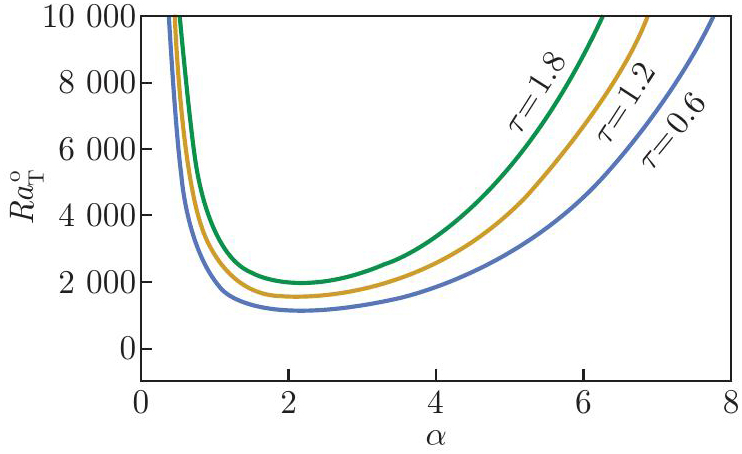
"
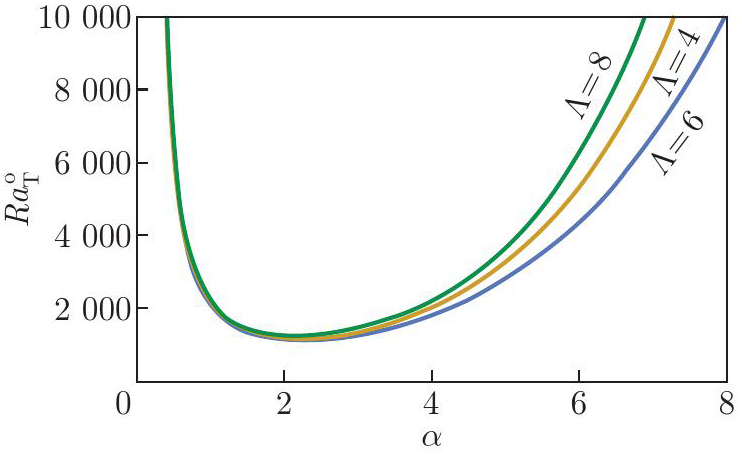
"
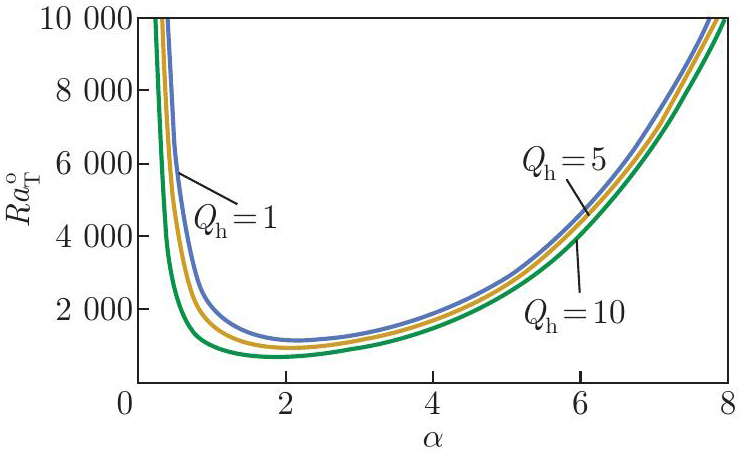
"
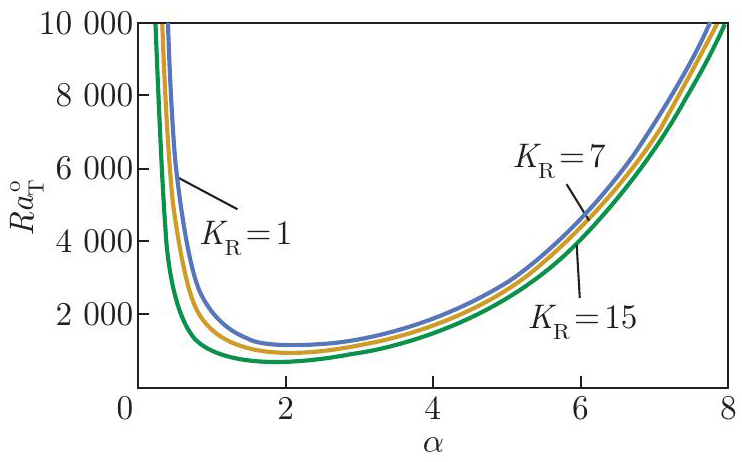
"
"
"
"
"
"
"
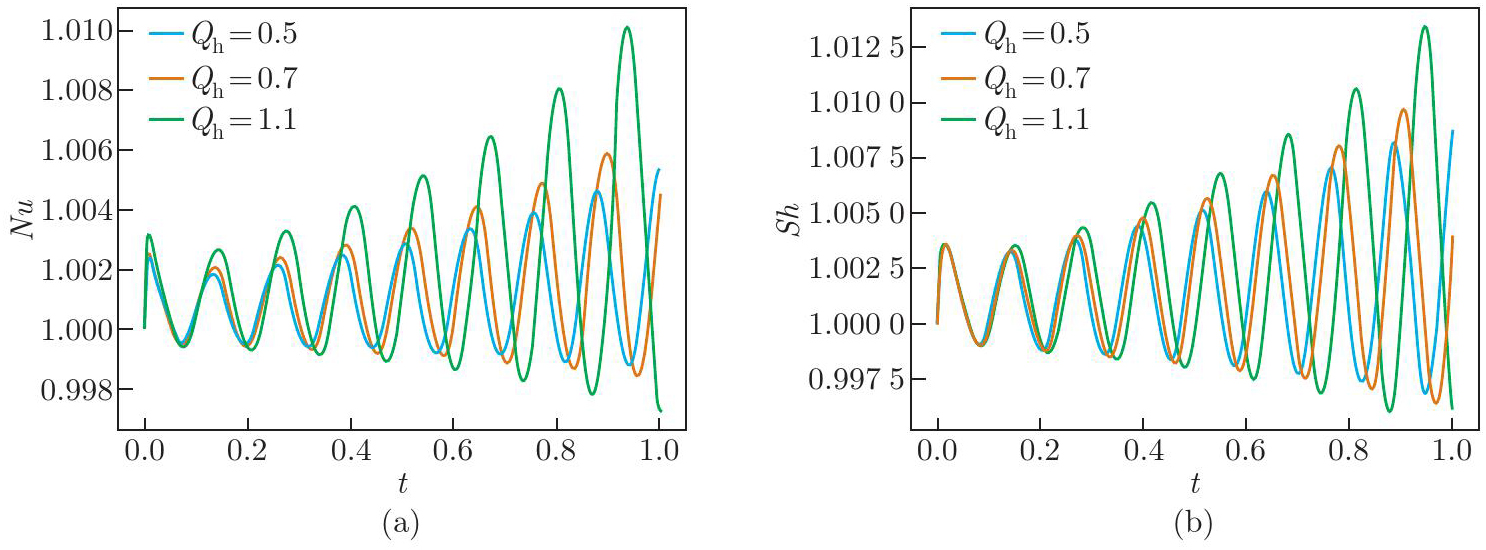
"
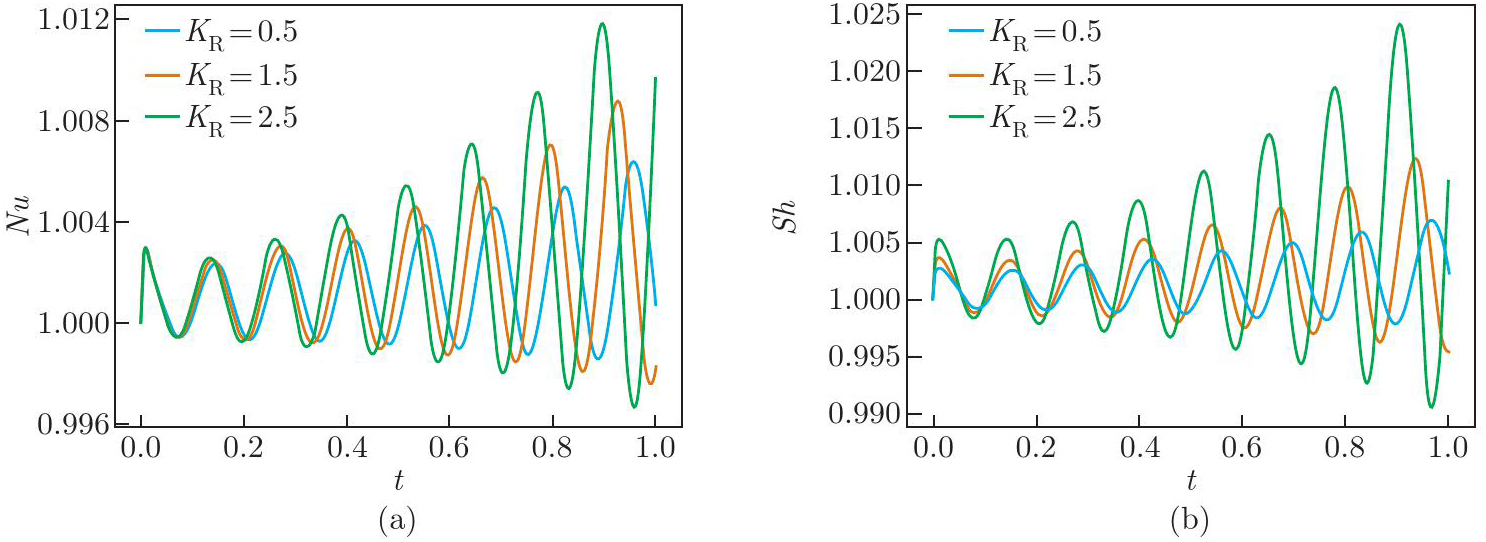
"
"
"
"
"
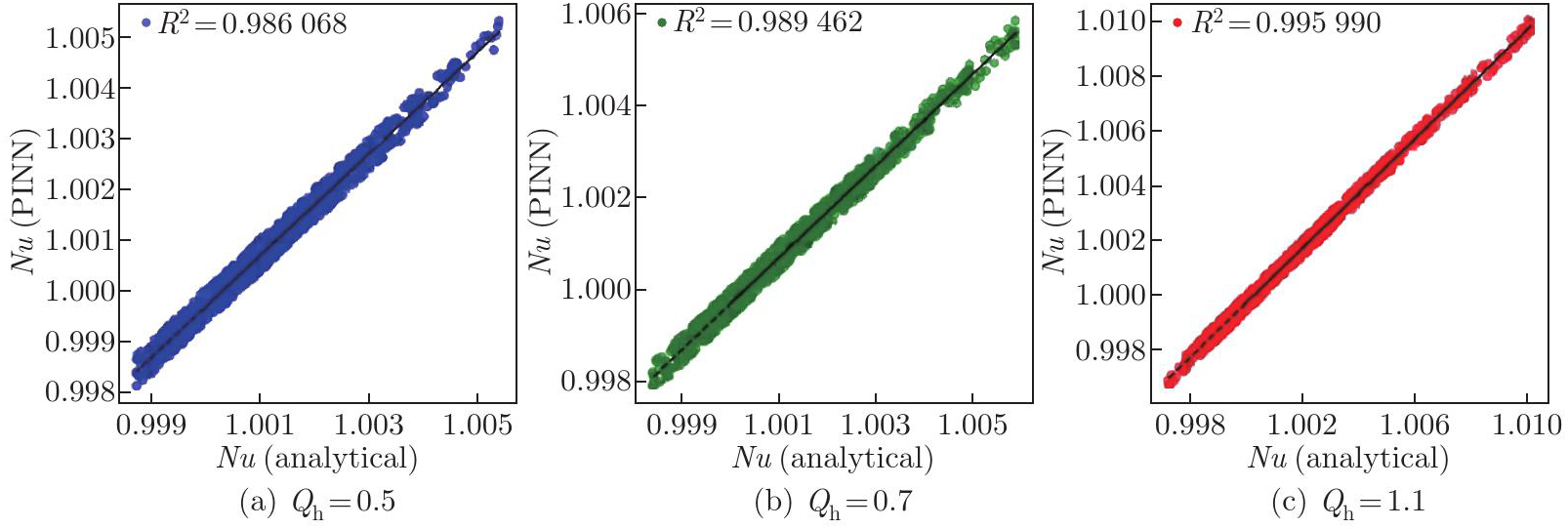
"
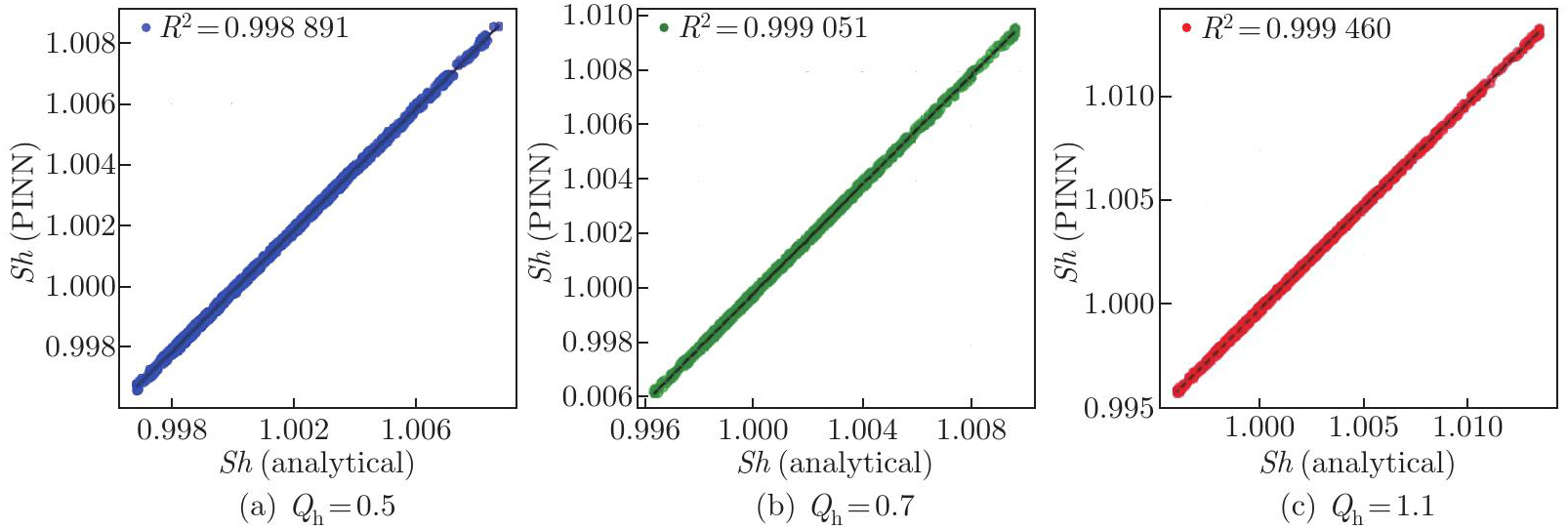
"
"
"
| Time | ||||||||
|---|---|---|---|---|---|---|---|---|
| 0 | 0.5 | 0.5 | 1 | 0.999 975 479 | 2.452 1 | 1 | 0.999 733 628 | 0.000 266 372 |
| 0.5 | 1.002 820 4 | 1.002 693 781 | 0.000 126 66 | 1.004 347 9 | 1.004 159 538 | 0.000 188 372 | ||
| 1 | 1.005 390 9 | 1.005 311 241 | 7.965 3 | 1.008 710 4 | 1.008 521 573 | 0.000 188 817 | ||
| 0 | 0.7 | 1 | 0.999 597 804 | 0.000 402 2 | 1 | 0.999 782 193 | 0.000 217 807 | |
| 0.5 | 1.002 822 4 | 1.002 426 452 | 0.000 395 91 | 1.003 224 8 | 1.003 159 459 | 6.535 96 | ||
| 1 | 1.004 518 3 | 1.004 511 918 | 6.413 4 | 1.003 952 4 | 1.003 756 113 | 0.000 196 298 | ||
| 0 | 1.1 | 1 | 0.999 608 767 | 0.000 391 23 | 1 | 0.999 805 393 | 0.000 194 607 | |
| 0.5 | 1.001 160 1 | 1.000 715 430 | 0.000 444 72 | 0.999 595 1 | 0.999 465 912 | 0.000 129 235 | ||
| 1 | 1.005 390 9 | 0.996 893 827 | 0.008 497 07 | 1.008 710 4 | 0.995 932 906 | 0.012 777 484 | ||
| 0 | 0.5 | 1 | 1 | 0.999 882 402 | 0.000 117 6 | 1 | 0.999 758 826 | 0.000 241 174 |
| 0.5 | 1.001 780 3 | 1.001 398 222 | 0.000 382 11 | 1.000 531 8 | 1.000 456 709 | 7.506 58 | ||
| 1 | 0.998 304 3 | 0.997 701 441 | 0.000 602 83 | 0.995 439 6 | 0.995 184 948 | 0.000 254 693 | ||
| 0 | 1.5 | 1 | 0.999 411 647 | 0.000 588 35 | 1 | 0.999 936 605 | 6.339 5 | |
| 0.5 | 1.004 437 2 | 1.003 855 805 | 0.000 581 42 | 1.006 250 2 | 1.005 951 479 | 0.000 298 693 | ||
| 1 | 1.009 640 3 | 1.009 577 905 | 6.234 9 | 1.010 318 3 | 1.010 158 196 | 0.000 160 118 |
| [1] | SANGAMESH, RAGHUNATHA, K. R., and CHAMKHA, A. J. Linear stability analysis of thermohaline and magneto-convection in a viscoelastic fluid layer. Chinese Journal of Physics, 94, 720–735 (2025) |
| [2] | REKHA, D. R. S., JAWALI, V., ALSHEHRI, M., CHUNG, J. D., SHAH, N. A., PRABHAKAR, S. V., NAVEEN KUMAR, R., VERMA, A., VARSHNEY, G., and MANJUNATH, B. T. The analytical study of double diffusive convection in a rectangular enclosure bounded by porous lining with thermal radiation. Scientific Reports, 14, 17095 (2024) |
| [3] | AL-DAWODY, M. F., HASSAN, A. M., ABDULKADHIM, A., HAMZA, N. H., AL-DOSSARI, M., KUMAR, R. N., ASHUROV, M., and KHAN, M. I. Magnetic field effects on double-diffusive mixed convection and entropy generation in a cam-shaped enclosure. International Communications in Heat and Mass Transfer, 159, 108166 (2024) |
| [4] | YAN, Y., WU, S., TIAN, K., and TIAN, Z. Numerical simulation for 2D double-diffusive convection (DDC) in rectangular enclosures based on a high resolution upwind compact streamfunction model I: numerical method and code validation. Applied Mathematics and Mechanics (English Edition), 43(9), 1431–1448 (2022) https://doi.org/10.1007/s10483-022-2895-6 |
| [5] | HAMID, M., USMAN, M., and TIAN, Z. Computational analysis for fractional characterization of coupled convection-diffusion equations arising in MHD flows. Applied Mathematics and Mechanics (English Edition), 44(4), 669–692 (2023) https://doi.org/10.1007/s10483-023-2970-6 |
| [6] | STRAUGHAN, B. Double diffusion in a Navier-Stokes-Voigt fluid with a Christov heat law. Annali dell’ Università di Ferrara, 71, 23 (2024) |
| [7] | ARJUN, C. M., PRAVEENA, M. M., and GOGATE, S. S. P. Linear stability analysis of Navier-Stokes-Voigt fluid with slip boundary condition in a porous medium. Physics of Fluids, 37, 014127 (2025) |
| [8] | BASAVARAJAPPA, M. and BHATTA, D. Nonlinear stability analysis of Rayleigh-Bénard problem for a Navier-Stokes-Voigt fluid. International Journal of Non-Linear Mechanics, 162, 104712 (2024) |
| [9] | SHARMA, S., SUNIL, and SHARMA, P. Stability analysis of thermosolutal convection in a rotating Navier-Stokes-Voigt fluid. Zeitschrift für Naturforschung A, 79, 689–702 (2024) |
| [10] | KAVITHA, G. N., SHANKAR, B. M., and SHIVAKUMARA, I. S. On the magnetohydrodynamic stability of channel flow of Navier-Stokes-Voigt fluid. Physics of Fluids, 36, 043105 (2024) |
| [11] | BARMAN, P. Stability analyses of micropolar fluid-saturated horizontal porous layer due to the influence of uniform internal heat source and vertical throughflow. Physics of Fluids, 37, 024116 (2025) |
| [12] | BIXAPATHI, S. and BABU, A. B. Analyzing the effects of internal heating and chemical reactions in a porous layer due to a vertical oblique magnetic field and gravity modulation. Physics of Fluids, 37, 014119 (2025) |
| [13] | KRUTHIK, P. S., IDRIS, R., and SIDDHESHWAR, P. G. Study of the linear and nonlinear regimes of natural convection with weak or dominating internal heat generation for rigid-free boundaries. Journal of Porous Media, 28, 21–39 (2025) |
| [14] | JAKHAR, A. and KUMAR, A. Weakly nonlinear instability analysis in triple-diffusive convection under gravity modulation in the presence of an internal heat generator. Heat Transfer, 54, 167–183 (2025) |
| [15] | JAKHAR, A. and KUMAR, A. Instability analysis of double diffusive convection under time dependent solute boundary conditions in the presence of internal heat generator. Physics of Fluids, 35, 077101 (2023) |
| [16] | KOSAR, S., SAGHEER, M., and HUSSAIN, S. Effect of inclined magnetic field and chemical reaction on Casson fluid flow over a stretching surface with Cattaneo-Christov double diffusion. International Journal of Modern Physics B, 39, 2550002 (2025) |
| [17] | KRISHNA, M. V. and REDDY, B. P. Thermal radiation, heat source, and chemical reaction impacts on MHD convective flow of casson fluid past an infinite inclined oscillating vertical porous plate. Multiscale and Multidisciplinary Modeling, Experiments and Design, 8, 196 (2025) |
| [18] | BIXAPATHI, S., BABU, A. B., and ANILKUMAR, D. Effects of internal heating and chemical reactions on triple-diffusive convection under rotation modulation. Physics of Fluids, 37, 024132 (2025) |
| [19] | BHARTY, M., SRIVASTAVA, A. K., and MAHATO, H. Stability of magneto double diffusive convection in couple stress liquid with chemical reaction. Journal of Heat and Mass Transfer Research, 10, 171–190 (2023) |
| [20] | NAVEED, M., IMRAN, M., ASGHAR, T., and ABBAS, Z. Transport mechanism in chemically reactive hybrid nanofluid flow containing gyrotactic micro-organisms over a curved oscillatory surface. Applied Mathematics and Mechanics (English Edition), 46(1), 177–192 (2025) https://doi.org/10.1007/s10483-025-3208-7 |
| [21] | TRIPATHI, V. K., RAJU, C. S. K., and YOOK, S. J. Stability analysis of bidispersive porous convection with maximum density and variable viscosity effects. Physics of Fluids, 37, 024123 (2025) |
| [22] | GANGADHARAIAH, Y. H., RASHMI, K. R., JEYAPRAKASH, N., PRASAD, C. D., TIWARI, A., KARTHIK, S. B., BAVAN, S., and ADEN, A. A. Influence of induced magnetic field and gravity fluctuations on the onset of double-diffusive penetrative convection in porous media with throughflow. International Journal of Thermofluids, 26, 101051 (2025) |
| [23] | SINGH, M. K. and BHARTI, P. Linear and nonlinear stability analysis of double-diffusion convection in an inclined Brinkman porous media with a concentration-based internal heat source. Physics of Fluids, 36, 124134 (2024) |
| [24] | WANG, L., WANG, L., ZHU, Y., LIU, Z., SUN, Y., WANG, J., HAN, H., XIANG, S., SHI, H., and DING, Q. Nonlinear dynamic response and stability analysis of the stapes reconstruction in human middle ear. Applied Mathematics and Mechanics (English Edition), 44(10), 1739–1760 (2023) https://doi.org/10.1007/s10483-023-3037-9 |
| [25] | HARSHA, S. V., SHEKARA, G. C., KUMAR, C. H., and MAYUR, D. H. Stability analysis of mixed convection of nanofluid flow through a horizontal porous channel using LTNE model. Microgravity Science and Technology, 36, 56 (2024) |
| [26] | STRAUGHAN, B. Thermosolutal convection with a Navier-Stokes-Voigt fluid. Applied Mathematics & Optimization, 84, 2587–2599 (2021) |
| [27] | YADAV, D., AL-SIYABI, M., AWASTHI, M. K., AL-NADHAIRI, S., AL-RAHBI, A., AL-SUBHI, M., RAGOJU, R., and BHATTACHARYYA, K. Chemical reaction and internal heating effects on the double diffusive convection in porous membrane enclosures soaked with maxwell fluid. Membranes, 12, 338 (2022) |
| [28] | STRAUGHAN, B. Effect of temperature upon double diffusive instability in Navier-Stokes-Voigt models with kazhikhov-smagulov and korteweg terms. Applied Mathematics & Optimization, 87, 54 (2023) |
| [29] | LAGARIS, I. E., LIKAS, A., and FOTIADIS, D. I. Artificial neural networks for solving ordinary and partial differential equations. IEEE Transactions on Neural Networks, 9, 987–1000 (1998) |
| [30] | SHARMA, P., CHUNG, W. T., AKOUSH, B., and IHME, M. A review of physics-informed machine learning in fluid mechanics. Energies, 16, 2343 (2023) |
| [31] | KUMAR, R. S. V., CHANDAN, K., SHARMA, N., KARTHIK, K., KUMAR, R. N., GOWDA, R. J. P., MUHAMMAD, T., and GILL, H. S. Analyzing magnetic dipole impact in fluid flow with endothermic/exothermic reactions: neural network simulation. Physica Scripta, 99, 065215 (2024) |
| [32] | GOWDA, R. J. P., BEEMKUMAR, N., KULSHRESHTA, A., CHOHAN, J. S., ABDULRAHMAN, A., and CHANDAN, K. Physics-informed neural networks approach for pollutant dispersion flow caused by magnetic dipole. Physica Scripta (2024) https://doi.org/10.1088/1402-4896/ad8cab |
| [33] | MERDASI, A., EBRAHIMI, S., YANG, X., and KUNZ, R. Physics informed neural network application on mixing and heat transfer in combined electroosmotic-pressure driven flow. Chemical Engineering and Processing-Process Intensification, 193, 109540 (2023) |
| [34] | KARTHIK, K., SOWMYA, G., SHARMA, N., KUMAR, C., SHASHIKALA, V. K. R., SHIVAPRAKASH, S. A., MUHAMMAD, T., and GILL, H. S. Predictive modeling through physics-informed neural networks for analyzing the thermal distribution in the partially wetted wavy fin. ZAMM-Journal of Applied Mathematics and Mechanics, 104, e202400180 (2024) |
| [35] | RODENBUSH, C. M., VISWANATH, D. S., and HSIEH, F. A group contribution method for the prediction of thermal conductivity of liquids and its application to the Prandtl number for vegetable oils. Industrial & Engineering Chemistry Research, 38, 4513–4519 (1999) |
| [36] | KUMAR, D. L. K., SANGAMESH, and RAGHUNATHA, K. R. Linear and weakly nonlinear multi-diffusive convection in a Navier-Stokes-Voigt fluid layer. Arab Journal of Basic and Applied Sciences, 31, 629–649 (2024) |
| [1] | . [J]. Applied Mathematics and Mechanics (English Edition), 2025, 46(2): 391-402. |
| [2] | Chenggong LI, J. P. Y. MAA. Multi-relaxation-time lattice Boltzmann simulations of lid driven flows using graphics processing unit[J]. Applied Mathematics and Mechanics (English Edition), 2017, 38(5): 707-722. |
| [3] | Xinhui SI, Haozhe LI, Yanan SHEN, Liancun ZHENG. Effects of nonlinear velocity slip and temperature jump on pseudo-plastic power-law fluid over moving permeable surface in presence of magnetic field[J]. Applied Mathematics and Mechanics (English Edition), 2017, 38(3): 333-342. |
| [4] | Renjie JIANG, Pengjun ZHENG. Resonance in flow past oscillating cylinder under subcritical conditions[J]. Applied Mathematics and Mechanics (English Edition), 2017, 38(3): 363-378. |
| [5] | S. MAITI, S. K. PANDEY. Rheological fluid motion in tube by metachronal waves of cilia[J]. Applied Mathematics and Mechanics (English Edition), 2017, 38(3): 393-410. |
| [6] | Chenyue XIE, Jianjun TAO, Ji LI. Viscous Rayleigh-Taylor instability with and without diffusion effect[J]. Applied Mathematics and Mechanics (English Edition), 2017, 38(2): 263-270. |
| [7] | Yunlong LI, Wei CAO. Research of influence of reduced-order boundary on accuracy and solution of interior points[J]. Applied Mathematics and Mechanics (English Edition), 2017, 38(1): 111-124. |
| [8] | Haiyan SONG, Lifu LIANG. Investigation of power-type variational principles in liquid-filled system[J]. Applied Mathematics and Mechanics (English Edition), 2015, 36(12): 1651-1662. |
| [9] | T. HAYAT, M. IMTIAZ, A. ALSAEDI. Partial slip effects in flow over nonlinear stretching surface[J]. Applied Mathematics and Mechanics (English Edition), 2015, 36(11): 1513-1526. |
| [10] | Wentang WU, Yanji HONG, Baochun FAN. Numerical investigation of turbulent channel flow controlled by spatially oscillating spanwise Lorentz force[J]. Applied Mathematics and Mechanics (English Edition), 2015, 36(9): 1113-1120. |
| [11] | Haiping TIAN, Nan JIANG, Yongxiang HUANG, Shaoqiong YANG. Study on local topology model of low/high streak structures in wall-bounded turbulence by tomographic time-resolved particle image velocimetry[J]. Applied Mathematics and Mechanics (English Edition), 2015, 36(9): 1121-1130. |
| [12] | Benwen LI, Shangshang CHEN. Direct spectral domain decomposition method for 2D incompressible Navier-Stokes equations[J]. Applied Mathematics and Mechanics (English Edition), 2015, 36(8): 1073-1090. |
| [13] | Yang SONG, Chunxiao XU, Weixi HUANG, Guixiang CUI. Optimal transient growth in turbulent pipe flow[J]. Applied Mathematics and Mechanics (English Edition), 2015, 36(8): 1057-1072. |
| [14] | Yongming ZHANG, Caihong SU. Self-consistent parabolized stability equation (PSE) method for compressible boundary layer[J]. Applied Mathematics and Mechanics (English Edition), 2015, 36(7): 835-846. |
| [15] | Mingwei GE, Yingtao ZUO, Ying DENG, Yuhua LI. Spatial relation between fluctuating wall pressure and near-wall streamwise vortices in wall bounded turbulent flow[J]. Applied Mathematics and Mechanics (English Edition), 2015, 36(6): 719-728. |
| 阅读次数 | ||||||
|
全文 |
|
|||||
|
摘要 |
|
|||||





 Email Alert
 RSS
RSS