Applied Mathematics and Mechanics (English Edition) ›› 2026, Vol. 47 ›› Issue (1): 115-134.doi: https://doi.org/10.1007/s10483-026-3339-6
Previous Articles Next Articles
M. N. NGUYEN, S. JUNG, D. LEE†( )
)
Received:2025-07-23
Revised:2025-10-22
Published:2025-12-30
Contact:
D. LEE, E-mail: dongkyulee@sejong.ac.krSupported by:2010 MSC Number:
M. N. NGUYEN, S. JUNG, D. LEE. Multi-material topology optimization under stress constraints of respective materials in multi-physics structures. Applied Mathematics and Mechanics (English Edition), 2026, 47(1): 115-134.
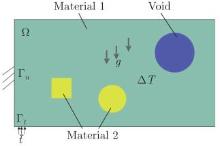
Fig. 1
Concepts of the MMTO method for multi-physics systems (color online)"
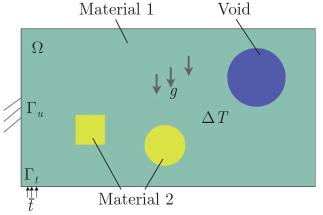
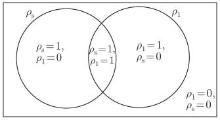
Fig. 2
Extended SIMP method"
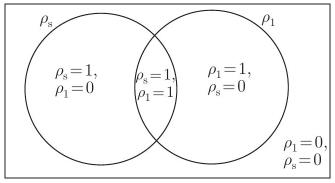
Table 1
Material properties used for the L-shaped structure"
| Material candidate | |||
|---|---|---|---|
| Material 1 | 3 | ||
| Material 2 | 1 | ||
| Void | 0 | 0 |
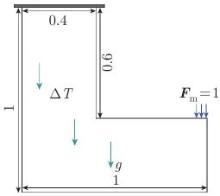
Fig. 3
Design domain of the L-shaped structure under thermal and self-weight loads (color online)"
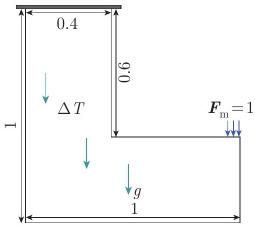
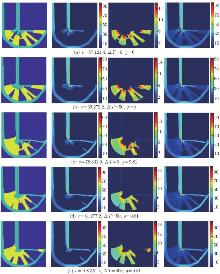
Fig. 4
Optimized designs and von Mises stress maps for compliance-based MMTO under volume constraints. The subfigures in a line from left to right are for optimization structure, stress distribution of Material 1, stress distribution of Material 2, and stress distribution of optimized structures, respectively (color online)"
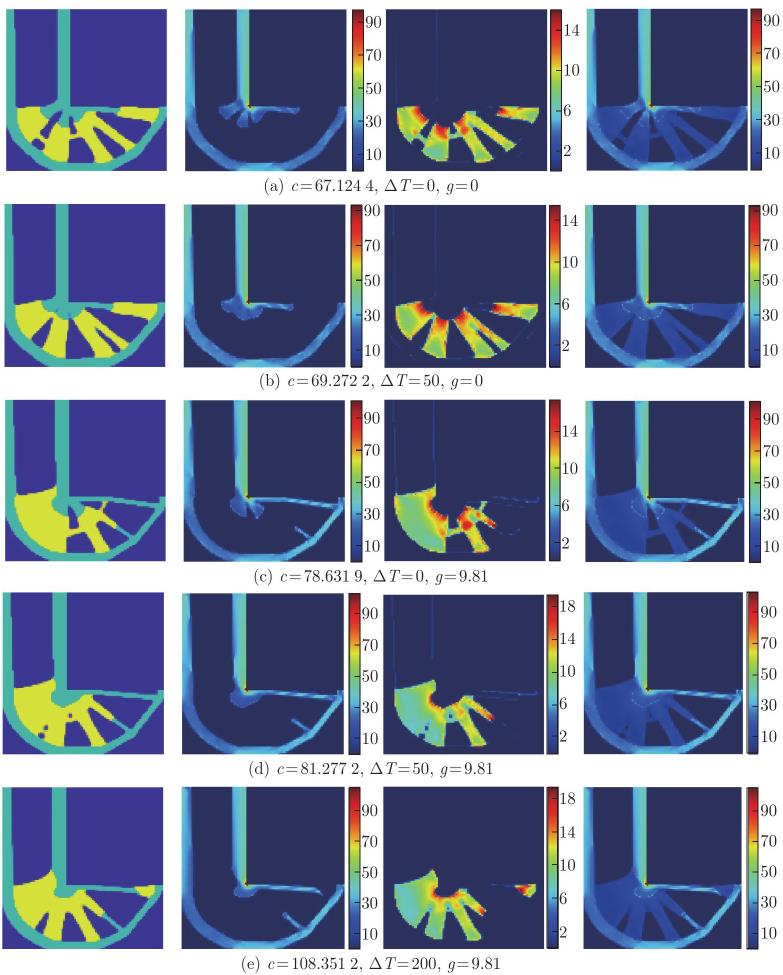
Fig. 5
Comparison of different von Mises stress constraints when ΔT=0 and g=0: (a) σ¯1=0 and σ¯2=0; (b) σ¯1=90 and σ¯2=13; (c) σ¯1=90 and σ¯2=12; (d) σ¯1=80 and σ¯2=12; (e) σ¯1=75 and σ¯2=12. The subfigures in a line from left to right denote the same as those in Fig. 4 (color online)"
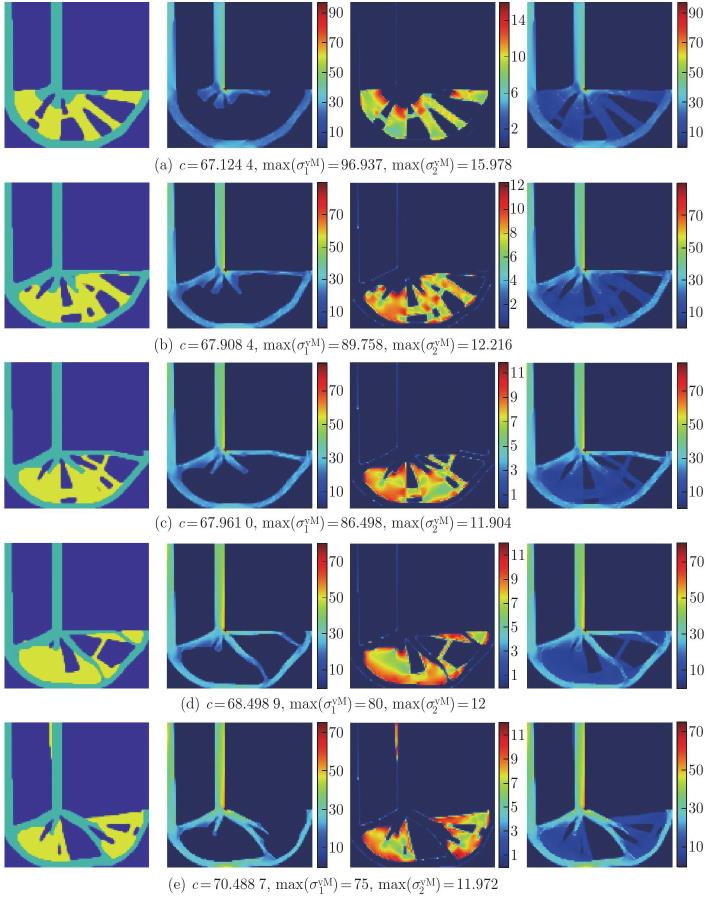
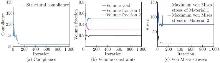
Fig. 6
History of the optimization process of Fig. 5(e) (color online)"
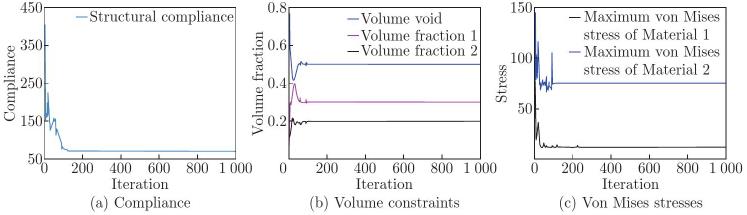
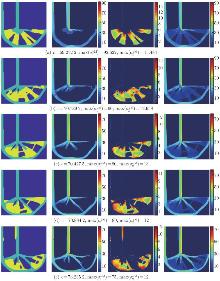
Fig. 7
Comparison of different von Mises stress constraints when ΔT=50 and g=0: (a) σ¯1=0 and σ¯2=0; (b) σ¯1=90 and σ¯2=13; (c) σ¯1=80 and σ¯2=13; (d) σ¯1=80 and σ¯2=12; (e) σ¯1=75 and σ¯2=12. The subfigures in a line from left to right denote the same as those in Fig. 4 (color online)"
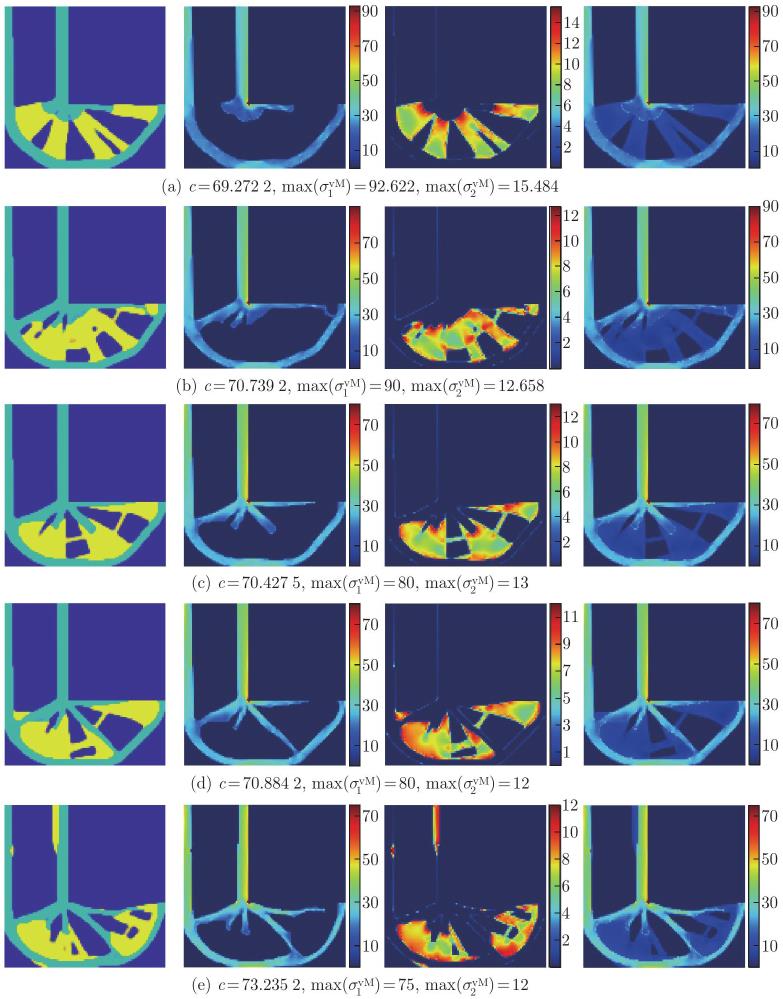
Fig. 8
Comparison of different von Mises stress constraints at ΔT=0 and g=9.81: (a) σ¯1=0 and σ¯2=0; (b) σ¯1=90 and σ¯2=16; (c) σ¯1=90 and σ¯2=13; (d) σ¯1=80 and σ¯2=16; (e) σ¯1=80 and σ¯2=13. The subfigures in a line from left to right denote the same as those in Fig. 4 (color online)"
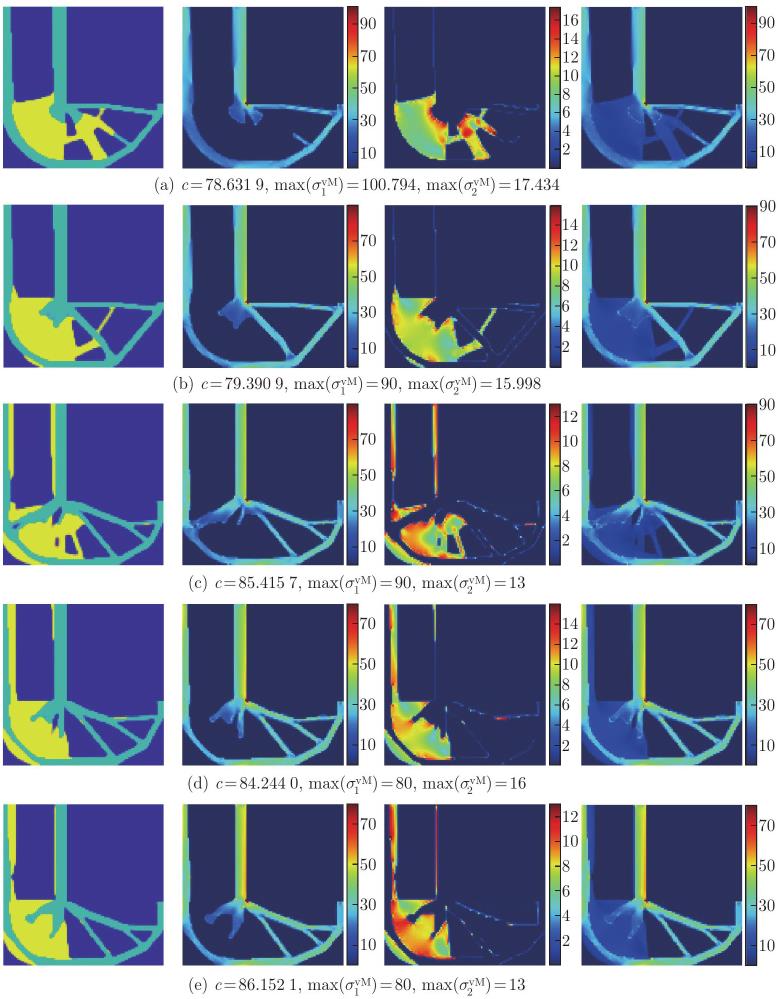
Fig. 9
Comparison of different von Mises stress constraints at ΔT=50 and g=9.81: (a) σ¯1=0 and σ¯2=0; (b) σ¯1=80 and σ¯2=16; (c) σ¯1=80 and σ¯2=14; (d) σ¯1=80 and σ¯2=12.5; (e) σ¯1=90 and σ¯2=14; (f) σ¯1=90 and σ¯2=13. The subfigures in a line from left to right denote the same as those in Fig. 4 (color online)"
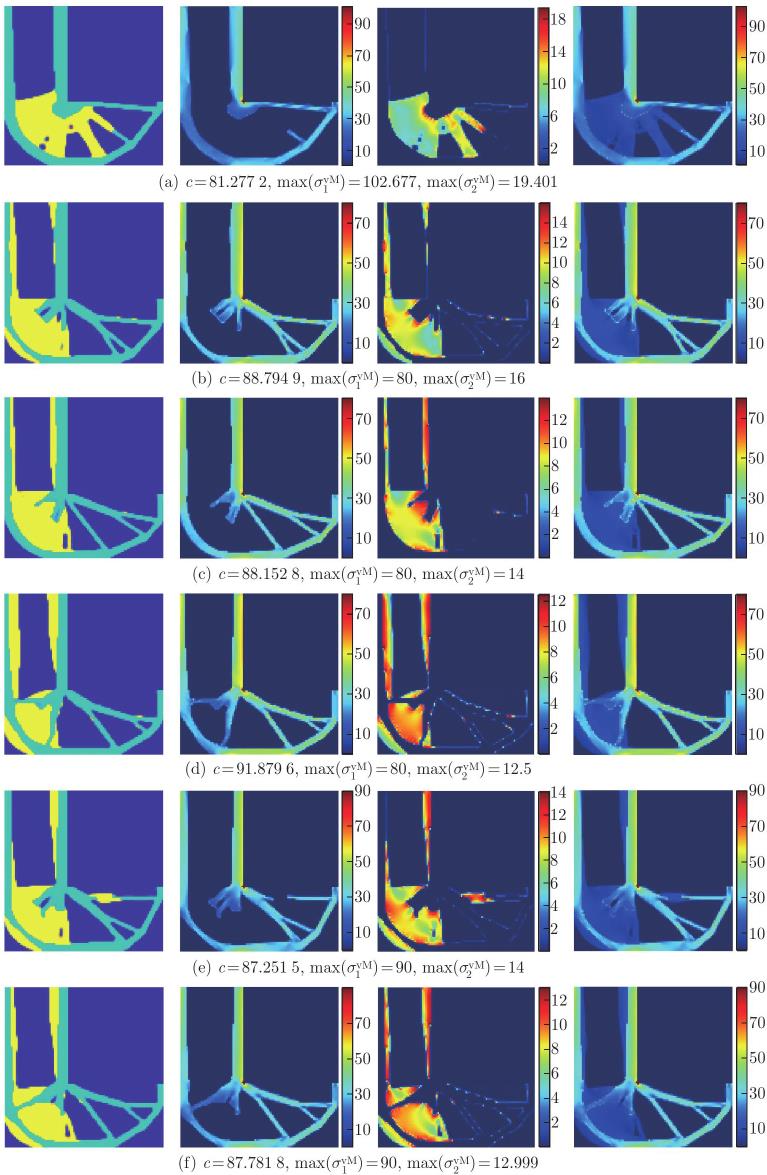
Fig. 10
Comparison of different von Mises stress constraints at ΔT=200 and g=9.81: (a) σ¯1=0 and σ¯2=0; (b) σ¯1=80 and σ¯2=16; (c) σ¯1=80 and σ¯2=14; (d) σ¯1=80 and σ¯2=12.5. The subfigures in a line from left to right denote the same as those in Fig. 4 (color online)"
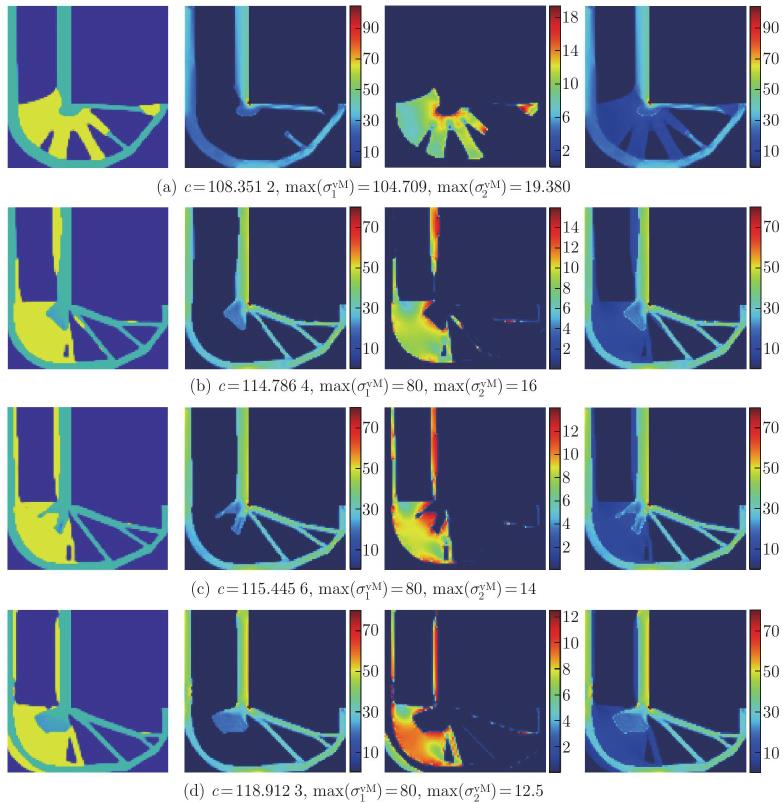
Fig. 11
Comparison of different working conditions at σ¯1=90 and σ¯2=14: (a) ΔT=0 and g=0; (b) ΔT=50 and g=0; (c) ΔT=0 and g=9.81; (d) ΔT=50 and g=9.81; (e) ΔT=200 and g=9.81. The subfigures in a line from left to right denote the same with those in Fig. 4 (color online)"
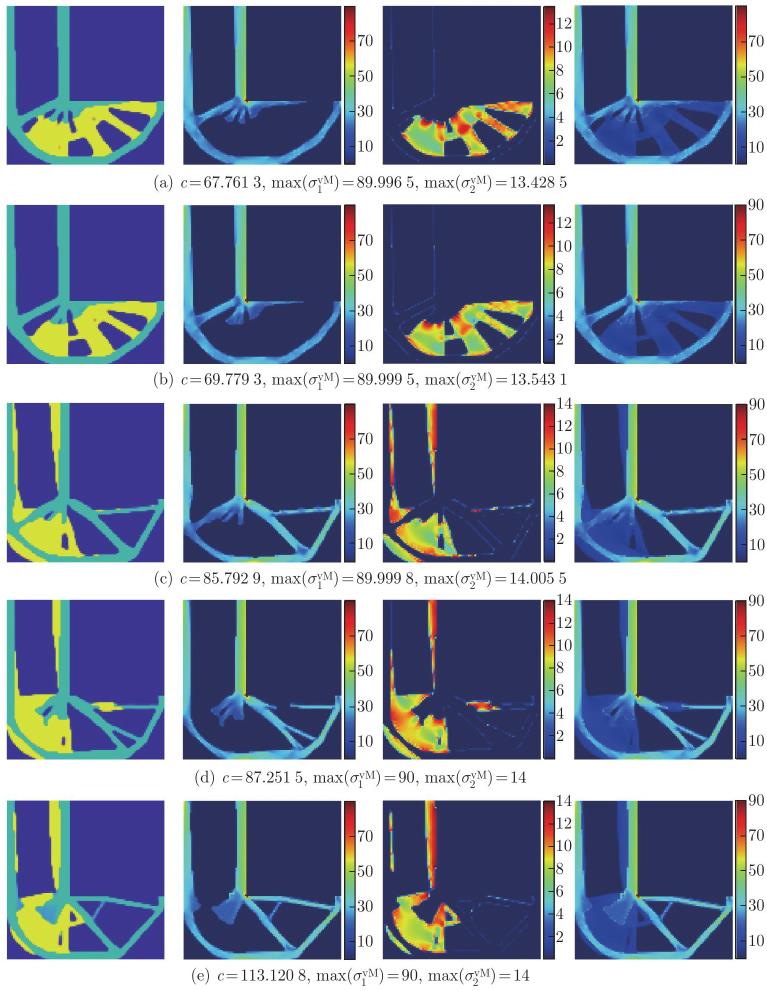
Fig. 12
Comparison of different von Mises stress and mass constraints at ΔT=50 and g=9.81: (a) σ¯1=0 and σ¯2=0; (b) σ¯1=90 and σ¯2=14; (c) σ¯1=90 and σ¯2=13; (d) σ¯1=90 and σ¯2=10; (e) σ¯1=80 and σ¯2=10. The subfigures in a line from left to right denote the same as those in Fig. 4 (color online)"

| [1] | YIN, L. and ANANTHASURESH, G. K. Topology optimization of compliant mechanisms with multiple materials using a peak function material interpolation scheme. Structural and Multidisciplinary Optimization, 23, 49–62 (2001) |
| [2] | STEGMANN, J. and LUND, E. Discrete material optimization of general composite shell structures. International Journal for Numerical Methods in Engineering, 62, 2009–2027 (2005) |
| [3] | TAVAKOLI, R. and MOHSENI, S. M. Alternating active-phase algorithm for multimaterial topology optimization problems: a 115-line MATLAB implementation. Structural and Multidisciplinary Optimization, 49, 621–642 (2014) |
| [4] | ZUO, W. J. and SAITOU, K. Multi-material topology optimization using ordered SIMP interpolation. Structural and Multidisciplinary Optimization, 55, 477–491 (2016) |
| [5] | LIAO, H. T., YUAN, W. H., AI, S. G., and YUAN, X. J. An univariate method for multi-material topology optimization and its application to engineering structures with unstructured meshes. Computer Methods in Applied Mechanics and Engineering, 437, 117749 (2025) |
| [6] | HAN, Y. S. Stress-based bi-directional evolutionary topology optimization for structures with multiple materials. Engineering with Computers, 40, 2905–2923 (2024) |
| [7] | NGUYEN, M. N. and LEE, D. Design of the multiphase material structures with mass, stiffness, stress, and dynamic criteria via a modified ordered SIMP topology optimization. Advances in Engineering Software, 189, 103592 (2024) |
| [8] | NGUYEN, M. N. and LEE, D. Improving the performance of a multi-material topology optimization model involving stress and dynamic constraints. Composite Structures, 324, 117532 (2023) |
| [9] | HUANG, X. M., CHEN, Y., HOU, L., MIAO, C. M., and LI, Y. Stress-related multi-material structures topology optimization with gradient interfaces. Composite Structures, 365, 119176, (2025) |
| [10] | SVANBERG, K. The method of moving asymptotes: a new method for structural optimization. International Journal for Numerical Methods in Engineering, 24, 359–373 (1987) |
| [11] | ANSOLA, R., CANALES, J., and TÁRRAGO, J. A. An efficient sensitivity computation strategy for the evolutionary structural optimization (ESO) of continuum structures subjected to self-weight loads. Finite Elements in Analysis and Design, 42, 1220–1230 (2006) |
| [12] | BRUYNEEL, M. and DUYSINX, P. Note on topology optimization of continuum structures including self-weight. Structural and Multidisciplinary Optimization, 29, 245–246 (2005) |
| [13] | HUANG, X. and XIE, Y. M. Evolutionary topology optimization of continuum structures including design-dependent self-weight loads. Finite Elements in Analysis and Design, 47, 942–948 (2011) |
| [14] | FÉLIX, L., GOMES, A. A., and SULEMAN, A. Topology optimization of the internal structure of an aircraft wing subjected to self-weight load. Engineering Optimization, 52, 1119–1135 (2019) |
| [15] | GARAIGORDOBIL, A., ANSOLA, R., CANALES, J., and BORINAGA, R. Addressing topology optimization with overhang constraints for structures subjected to self-weight loads. Structural and Multidisciplinary Optimization, 65, 358 (2022) |
| [16] | KUMAR, P. Topology optimization of stiff structures under self-weight for given volume using a smooth Heaviside function. Structural and Multidisciplinary Optimization, 65, 128 (2022) |
| [17] | HAN, Y. S., XU, B., WANG, Q., and LIU, Y. H. Bi-directional evolutionary topology optimization of continuum structures subjected to inertial loads. Advances in Engineering Software, 155, 102897 (2021) |
| [18] | SANTOS, R. B. D. and LOPES, C. G. Topology optimization of structures subject to self-weight loading under stress constraints. Engineering Computations, 39, 380–394 (2021) |
| [19] | NGUYEN, M. N. and LEE, D. Topology optimization framework of multiple-phase materials with stress and dynamic constraints under self-weight loads. Applied Mathematical Modelling, 138, 115814 (2025) |
| [20] | LI, Q., STEVEN, G., and XIE, Y. M. Thermoelastic topology optimization for problems with varying temperature fields. Journal of Thermal Stresses, 24, 347–366 (2006) |
| [21] | XIA, Q. and WANG, M. Y. Topology optimization of thermoelastic structures using level set method. Computational Mechanics, 42, 837–857 (2008) |
| [22] | ZHU, X., ZHAO C., WANG, X., ZHOU, Y., HU, P., and MA, Z. D. Temperature-constrained topology optimization of thermo-mechanical coupled problems. Engineering Optimization, 51, 1687–1709 (2019) |
| [23] | GAO, T. and ZHANG, W. H. Topology optimization involving thermo-elastic stress loads. Structural and Multidisciplinary Optimization, 42, 725–738 (2010) |
| [24] | OOMS, T., VANTYGHEM, G., THIENPONT, T., COILE, R. V., and CORTE, W. D. Compliance-based topology optimization of structural components subjected to thermo-mechanical loading. Structural and Multidisciplinary Optimization, 66, 126 (2023) |
| [25] | GONÇALVES, M., DIAS-DE-OLIVEIRA, J. A., and VALENTE, R. A new bidirectional algorithm for topology optimization of thermoelastic structural problems. International Journal of Mechanics and Materials in Design, 18, 309–325 (2022) |
| [26] | GAO, T., XU, P. L., and ZHANG, W. H. Topology optimization of thermo-elastic structures with multiple materials under mass constraint. Computers & Structures, 173, 150–160 (2016) |
| [27] | ZHENG, J., RONG, X. P., and JIANG, C. Thermoelastic topology optimization for structures with temperature-dependent material properties. Science China Technological Sciences, 66, 3488–3503 (2023) |
| [28] | CHEN, Y., YE, L., ZHANG, Y. X., and YANG, C. H. A multi-material topology optimization with temperature-dependent thermoelastic properties. Engineering Optimization, 54, 2140–2155 (2021) |
| [29] | NGUYEN, M. N., KANG, J., SHIN, S., and LEE, D. Robust multi-physical-material topology optimization with thermal-self-weight uncertain loads. Finite Elements in Analysis and Design, 246, 104319 (2025) |
| [30] | WANG, B., WANG, G. M., SHI, Y. X., HUANG, L., and TIAN, K. Stress-constrained thermo-elastic topology optimization of axisymmetric disks considering temperature-dependent material properties. Mechanics of Advanced Materials and Structures, 29, 7459–7475 (2021) |
| [31] | CHENG, G. and JIANG, Z. Study on topology optimization with stress constraints. Engineering Optimization, 20, 129–148 (1992) |
| [32] | DUYSINX, P. and BENDSØE, M. P. Topology optimization of continuum structures with local stress constraints. International Journal for Numerical Methods in Engineering, 43, 1453–1478 (1998) |
| [33] | PARÍS, J., NAVARRINA, F., COLOMINAS, I., and CASTELEIRO, M. Topology optimization of continuum structures with local and global stress constraints. Structural and Multidisciplinary Optimization, 39, 419–437 (2009) |
| [34] | BRUGGI, M. On an alternative approach to stress constraints relaxation in topology optimization. Structural and Multidisciplinary Optimization, 36, 125–141 (2008) |
| [35] | LE, C., NORATO, J., BRUNS, T., HA, C., and TORTORELLI, D. Stress-based topology optimization for continua. Structural and Multidisciplinary Optimization, 41, 605–620 (2010) |
| [36] | HOLMBERG, E., TORSTENFELT, B., and KLARBRING, A. Stress constrained topology optimization. Structural and Multidisciplinary Optimization, 48, 33–47 (2013) |
| [37] | FAN, Z., XIA, L., LAI, W. X., XIA, Q., and SHI, T. L. Evolutionary topology optimization of continuum structures with stress constraints. Structural and Multidisciplinary Optimization, 59, 647–658 (2018) |
| [38] | SENHORA, F. V., GIRALDO-LONDOÑO, O., MENEZES, I. F. M., and PAULINO, G. H. Topology optimization with local stress constraints: a stress aggregation-free approach. Structural and Multidisciplinary Optimization, 62, 1639–1668 (2020) |
| [39] | YANG, D. X., LIU, H. L., ZHANG, W. S., and LI, S. Stress-constrained topology optimization based on maximum stress measures. Computers & Structures, 198, 23–39 (2018) |
| [40] | NGUYEN, M. N., HOANG, V. N., and LEE, D. Multiscale topology optimization with stress, buckling and dynamic constraints using adaptive geometric components. Thin-Walled Structures, 183, 110405, (2023) |
| [41] | DEATON, J. D. and GRANDHI, R. V. Stress-based design of thermal structures via topology optimization. Structural and Multidisciplinary Optimization, 53, 253–270 (2016) |
| [42] | MENG, Q. X., XU, B., HUANG, C. G., and WANG, G. Lightweight topology optimization of thermal structures under compliance, stress and temperature constraints. Journal of Thermal Stresses, 44, 1121–1149 (2021) |
| [43] | OGAWA, S. and YAMADA, T. Stress constraint topology optimization of coupled thermo-mechanical problems using the temperature dependence of allowable stress. Computers & Structures, 281, 107006 (2023) |
| [44] | NGUYEN, M. N., HOANG, V. N., and LEE D. Topology optimization framework for thermoelastic multiphase materials under vibration and stress constraints using extended solid isotropic material penalization. Composite Structures, 344, 118316 (2024) |
| [45] | TAMIJANI, A. Y. Stress and stiffness-based topology optimization of two-material thermal structures. Computers & Structures, 256, 106641 (2021) |
| [1] | SHI Lian-shuan;WANG Yue-fang;SUN Huan-chun. APPROACH FOR LAYOUT OPTIMIZATION OF TRUSS STRUCTURES WITH DISCRETE VARIABLES UNDER DYNAMIC STRESS, DISPLACEMENT AND STABILITY CONSTRAINTS [J]. Applied Mathematics and Mechanics (English Edition), 2006, 27(5): 593-599 . |
| [2] | ZHOU Ke-min;LI Jun-feng. FORMING MICHELL TRUSS IN THREE-DIMENSIONS BY FINITE ELEMENT METHOD [J]. Applied Mathematics and Mechanics (English Edition), 2005, 26(3): 381-388 . |
| [3] | SHI Lian-shuan;SUN Huan-chun;FENG En-min. A METHOD FOR TOPOLOGICAL OPTIMIZATION OF STRUCTURES WITH DISCRETE VARIABLES UNDER DYNAMIC STRESS AND DISPLACEMENT CONSTRAINTS [J]. Applied Mathematics and Mechanics (English Edition), 2001, 22(7): 781-787. |
| Viewed | ||||||
|
Full text |
|
|||||
|
Abstract |
|
|||||





 Email Alert
 RSS
RSS