Applied Mathematics and Mechanics (English Edition) ›› 2026, Vol. 47 ›› Issue (5): 1157-1176.doi: https://doi.org/10.1007/s10483-026-3377-7
Previous Articles Next Articles
Yuhan SONG1,2, Shixing LIU1,2, Wenan JIANG3, Yongxin GUO1,2,†( )
)
Received:2025-11-23
Revised:2026-02-24
Published:2026-05-06
Contact:
Yongxin GUO, E-mail: yxguo@lnu.edu.cnSupported by:2010 MSC Number:
Yuhan SONG, Shixing LIU, Wenan JIANG, Yongxin GUO. A geometric algorithm for orbital dynamics based on Lie derivative. Applied Mathematics and Mechanics (English Edition), 2026, 47(5): 1157-1176.
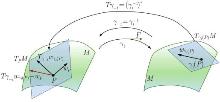
Fig. 1
Geometric interpretation of the Lie derivative (color online)"
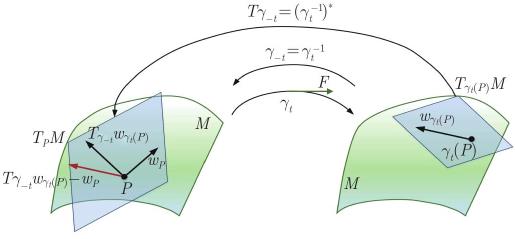
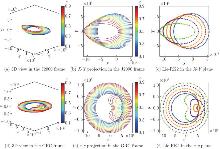
Fig. 2
1∶2 resonant orbits in the Earth-Moon system with initial phase 0° and e=0.1-0.9. (a)–(c): J2000 inertial frame (X, Y, Z); (d)–(f): GRC frame (x, y, z) (color online)"

Table 1
CPU time and efficiency comparison between Lie and RK2 under different eccentricities"
| Eccentricity | CPU time/s | Improving efficiency | |
|---|---|---|---|
| Lie | RK2 | ||
| 0.1 | 0.029 7 | 0.037 4 | 21% |
| 0.3 | 0.023 1 | 0.043 9 | 47% |
| 0.5 | 0.024 0 | 0.038 2 | 37% |
| 0.7 | 0.028 2 | 0.047 0 | 40% |
| 0.9 | 0.023 9 | 0.032 7 | 27% |
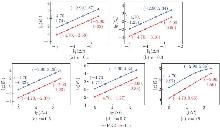
Fig. 3
Variable-step global error comparison for the 1∶2 resonant orbits with an initial phase of 0° and different eccentricities (EG represents the global error) (color online)"
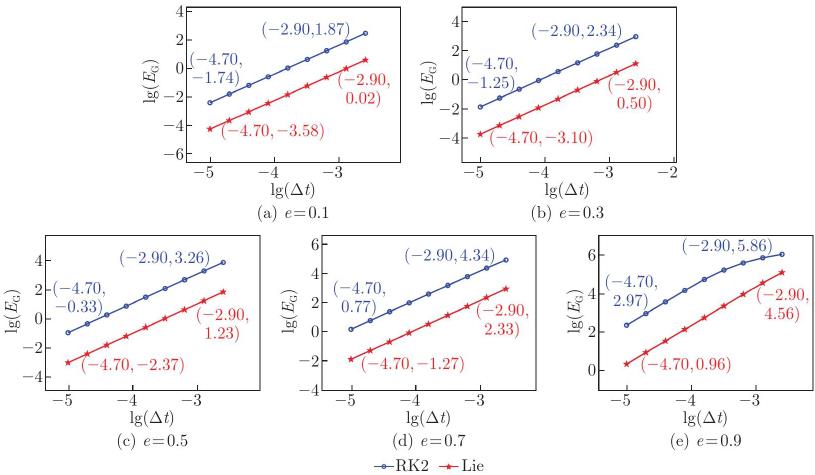
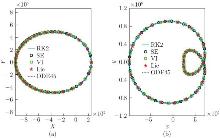
Fig. 4
1∶2 resonant orbit in the Earth-Moon system with initial phase 0° and e=0.6 (color online)"
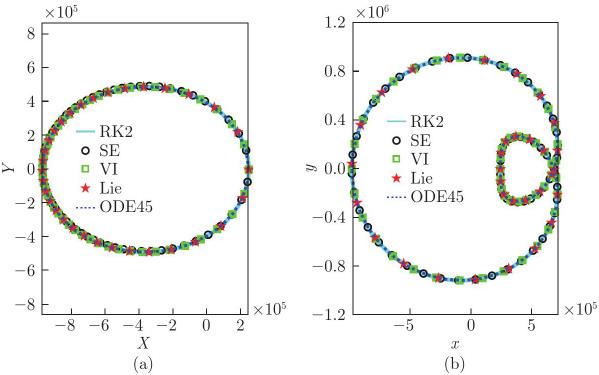

Fig. 5
Global errors for the two-body 1∶2 resonant orbit with e=0.6 and θ0=0° (color online)"
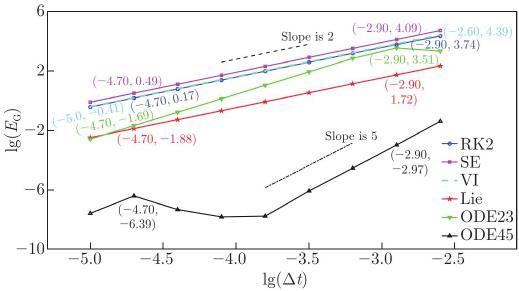
Table 2
Relative logarithmic deviation of the global error with respect to the ODE45 reference solution for the two-body 1∶2 resonant orbit with e=0.6 andθ0=0°"
| Lie | RK2 | SE | VI | ODE23 | |
|---|---|---|---|---|---|
| -5.0 | -0.67 | -0.94 | -0.98 | -0.95 | -0.66 |
| -4.7 | -0.71 | -1.03 | -1.08 | -1.03 | -0.74 |
| -4.4 | -0.82 | -1.10 | -1.15 | -1.11 | -0.89 |
| -4.1 | -0.91 | -1.18 | -1.22 | -1.18 | -1.01 |
| -3.8 | -0.99 | -1.27 | -1.31 | -1.27 | -1.14 |
| -3.5 | -1.09 | -1.42 | -1.48 | -1.43 | -1.32 |
| -3.2 | -1.25 | -1.70 | -1.77 | -1.70 | -1.62 |
| -2.9 | -1.58 | -2.26 | -2.38 | -2.28 | -2.18 |
| -2.6 | -2.66 | -4.09 | -4.35 | -4.14 | -3.36 |
Table 3
CPU time and efficiency comparison of the Lie relative to RK2, SE, VI, and ODE45"
| Resonance ratio | CPU time/s | Improving efficiency/% | |||||||
|---|---|---|---|---|---|---|---|---|---|
| Lie | RK2 | SE | VI | ODE45 | RK2-Lie | SE-Lie | VI-Lie | ODE45-Lie | |
| 1∶2 | 0.009 2 | 0.013 1 | 0.009 4 | 0.120 5 | 0.014 6 | 29.8 | 2.1 | 92.4 | 37.0 |

Fig. 6
1:2 resonant orbit in the Earth-Moon system with eccentricity e=0.6: (a) trajectory in the J2000 inertial frame for an initial phase of 0°, (b) results in the GRC frame, where markers 1–4 correspond to initial phases of 0°, 90°, 180°, and 270°, respectively (color online)"

Table 4
CPU time and efficiency comparison between Lie and RK2 at different initial phases"
| Initial phase/(°) | CPU time/s | Improving efficiency | |
|---|---|---|---|
| Lie | RK2 | ||
| 0 | 0.006 0 | 0.011 1 | 46% |
| 90 | 0.006 2 | 0.010 6 | 42% |
| 180 | 0.006 2 | 0.011 0 | 44% |
| 270 | 0.005 9 | 0.010 7 | 45% |
Table 5
CPU time and efficiency comparison of the Lie and RK2 at various resonance ratios in the CRTBP"
| Resonance ratio | CPU time/s | Improving efficiency | |
|---|---|---|---|
| Lie | RK2 | ||
| 1∶1 | 0.009 5 | 0.017 3 | 45% |
| 1∶2 | 0.007 6 | 0.012 2 | 38% |
| 1∶3 | 0.010 3 | 0.017 3 | 40% |
| 1∶4 | 0.012 9 | 0.021 8 | 41% |
| 2∶1 | 0.005 2 | 0.015 6 | 67% |
| 2∶3 | 0.780 4 | 1.411 2 | 45% |
| 3∶1 | 0.007 4 | 0.020 6 | 64% |
| 3∶2 | 0.003 3 | 0.007 0 | 53% |
| 4∶1 | 0.003 6 | 0.010 6 | 65% |

Fig. 7
Variable-step global error comparison for the 1:2 resonant orbits with different initial phase differences. (a)–(d) correspond to initial phases of 0°, 90°, 180°, and 270° (color online)"


Fig. 8
Flowchart of the differential correction method"
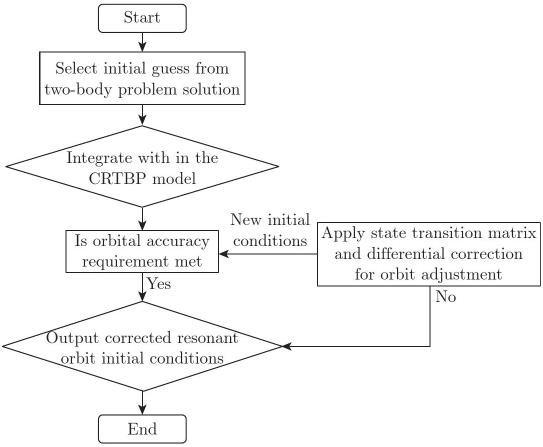

Fig. 9
Resonant orbit families of the Earth-Moon system with an initial phase of 0° (color online)"


Fig. 10
Three-dimensional distributions of the initial conditions (x0, vy0, C) for the Earth-Moon resonant orbit families with initial phase 0° (colors indicate the orbital period T) (color online)"


Fig. 11
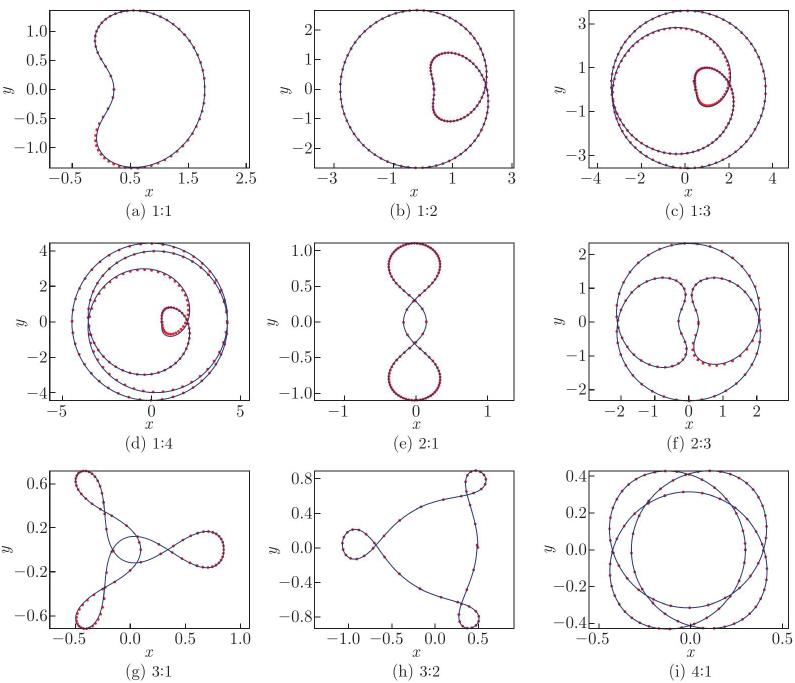
Comparison of resonant orbits in the CRTBP under the GRC coordinate system for different resonance ratios (red dots denote the Lie, while blue curves represent the RK2) (color online)"
Fg. 12
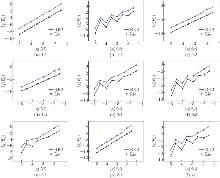
Variable step global error comparison in the CRTBP under the GRC coordinate system for different resonance ratios (color online)"


Fig. A1
Coordinate systems in the Earth-Moon: (a) Earth-centered J2000 geocentric equatorial inertial frame; (b) Earth-centered inertial frame (XE, YE, ZE) (black), geocentric rotating coordinate frame (x, y, z) (orange), and barycentric rotating frame (xB, yB, zB) (green). The gray dashed segments denote the spacecraft-Earth and spacecraft-Moon distances r1 and r2 (color online)"

| [1] | ANTONIADOU, K. I. and VOYATZIS, G. Resonant periodic orbits in the exoplanetary systems. Astrophysics and Space Science, 349(2), 657–676 (2014) |
| [2] | VAQUERO, M. and HOWELL, K. C. Design of transfer trajectories between resonant orbits in the Earth-Moon restricted problem. Acta Astronautica, 94(1), 302–317 (2014) |
| [3] | LI, X., QIAN, Y. J., YANG, X. D., and ZHANG, W. Stability and bifurcation analyses for exterior resonant families in Earth-Moon system. Results in Physics, 31, 104961 (2021) |
| [4] | KAPOLKA, T. J., BETTINGER, R. A., and HICKS, K. D. Methods for analyzing transforming orbits. Nonlinear Dynamics, 113(9), 9773–9789 (2025) |
| [5] | PAN, S. S. and HOU, X. Y. Analysis of resonance transition periodic orbits in the circular restricted three-body problem. Applied Sciences, 12(18), 8952 (2022) |
| [6] | KOON, W., LO, M., MARSDEN, J., and ROSS, S. Dynamical Systems, the Three-Body Problem and Space Mission Design, Springer, New York (2009) |
| [7] | ANDERSON, R. L., CAMPAGNOLA, S., and LANTOINE, G. Broad search for unstable resonant orbits in the planar circular restricted three-body problem. Celestial Mechanics and Dynamical Astronomy, 124(2), 177–199 (2016) |
| [8] | HAIRER, E., LUBICH, C., and WANNER, G. Geometric Numerical Integration: Structure Preserving Algorithms for Ordinary Differential Equations, Springer, Berlin (2006) |
| [9] | WU, X., MEI, L. J., HUANG, G. Q., and LIU, S. Q. Analytical and numerical studies on differences between Lagrangian and Hamiltonian approaches at the same post-Newtonian order. Physical Review D, 91(2), 024042 (2015) |
| [10] | LIU, L., WU, X., HUANG, G. Q., and LIU, F. Y. Higher order explicit symmetric integrators for inseparable forms of coordinates and momenta. Monthly Notices of the Royal Astronomical Society, 459(2), 1968–1976 (2016) |
| [11] | CARITÁ, G. A., ALJBAAE, S., MORAIS, M. H. M., SIGNOR, A. C., CARRUBA, V., PRADO, A. F. B. A., and HUSSMANN, H. Image classification of retrograde resonance in the planar circular restricted three-body problem. Celestial Mechanics and Dynamical Astronomy, 136(2), 10 (2024) |
| [12] | MORAIS, M. H. M., NAMOUNI, F., VOYATZIS, G., and KOTOULAS, T. A study of the 1/2 retrograde resonance: periodic orbits and resonant capture. Celestial Mechanics and Dynamical Astronomy, 133(5), 21 (2021) |
| [13] | CARITÁ, G. A., SIGNOR, A. C., MORAIS, M. H. M., DE CARVALHO, R. E., and PRADO, A. F. B. A. Retrograde resonances at high mass ratio in the circular restricted 3-body problem. Nonlinear Dynamics, 111(18), 17021–17035 (2023) |
| [14] | BONASERA, S. and BOSANAC, N. Computing natural transitions between tori near resonances in the Earth-Moon system. Journal of Guidance, Control, and Dynamics, 46(3), 443–454 (2023) |
| [15] | CHUJO, T. and TAKAO, Y. Synodic resonant halo orbits of solar sails in restricted four-body problem. Journal of Spacecraft and Rockets, 59(6), 2129–2147 (2022) |
| [16] | BOUDAD, K. K., HOWELL, K. C., and DAVIS, D. C. Dynamics of synodic resonant near rectilinear halo orbits in the bicircular four-body problem. Advances in Space Research, 66(9), 2194–2214 (2020) |
| [17] | KOBLICK, D. C. and KELLY, P. Novel three-body tulip-shaped orbit families for lunar missions. The Journal of the Astronautical Sciences, 72(4), 32 (2025) |
| [18] | BINDER, A. and ARNAS, D. Reliable and repeatable transit through cislunar space using 2:1 resonant spatial orbits. Journal of Guidance, Control, and Dynamics, 47(9), 1973–1979 (2024) |
| [19] | CUI, S. H., WANG, Y., ZHANG, R. K., ZHANG, H., and GAO, Y. Two-impulse transfers from lunar distant retrograde orbits to resonant orbits. Journal of Guidance, Control, and Dynamics, 48(6), 1348–1365 (2025) |
| [20] | ANDERSON, R. L. Tour design using resonant-orbit invariant manifolds in patched circular restricted three-body problems. Journal of Guidance, Control, and Dynamics, 44(1), 106–119 (2021) |
| [21] | KUMAR, B., ANDERSON, R. L., and DE LA LLAVE, R. High-order resonant orbit manifold expansions for mission design in the planar circular restricted 3-body problem. Communications in Nonlinear Science and Numerical Simulation, 97, 105691 (2021) |
| [22] | DIAB, O., CIRCI, C., YANG, H. W., and LI, S. Hybrid method for computing resonant families traversing total bifurcations in the PCR3BP. Journal of Guidance, Control, and Dynamics, 48(7), 1545–1562 (2025) |
| [23] | GALEŞ, C., APETRII, M., and NADABAICĂ, G. Modeling the resonant dynamics of infinitesimal particles orbiting nonspherical rotating bodies. Celestial Mechanics and Dynamical Astronomy, 137(5), 28 (2025) |
| [24] | FORMIGA, J. K. S., DE MORAES, R. V., and DOS SANTOS, D. P. S. Resonance influence on orbital dynamics of space debris in LEO. Journal of Space Safety Engineering, 12(4), 694–704 (2025) |
| [25] | LIN, M. P., LUO, T., and CHIBA, H. Semi-analytical computation of bifurcation of orbits near collinear libration point in the restricted three-body problem. Physica D: Nonlinear Phenomena, 470, 134404 (2024) |
| [26] | ANTONIADOU, K. I. and VOYATZIS, G. Periodic orbits in the 1:2:3 resonant chain and their impact on the orbital dynamics of the Kepler-51 planetary system. Astronomy & Astrophysics, 661, A62 (2022) |
| [27] | LEE, J. and AHN, J. Low-thrust resonance gravity-assist trajectory design for lunar missions. Journal of Spacecraft and Rockets, 61(4), 1074–1083 (2024) |
| [28] | ZUBKO, V. A., EISMONT, N. A., FEDYAEV, K. S., and BELYAEV, A. A. A method for constructing an interplanetary trajectory of a spacecraft to Venus using resonant orbits to ensure landing in the desired region. Advances in Space Research, 72(2), 161–179 (2023) |
| [29] | SHU, H. Z. and LIN, M. P. Analysis of pitchfork bifurcations and symmetry breaking in the elliptic restricted three-body problem. Celestial Mechanics and Dynamical Astronomy, 137(4), 21 (2025) |
| [30] | KLEIN, K.G., SPENCE, H., ALEXANDROVA, O., ARGALL, M., ARZAMASSKIY, L., BOOKBINDER, J., BROEREN, T., CAPRIOLI, D., CASE, A., CHANDRAN, B., CHEN, L. J., DORS, I., EASTWOOD, J., FORSYTH, C., GALVIN, A., GENOT, V., HALEKAS, J., HESSE, M., HINE, B., HORBURY, T., JIAN, L., KASPER, J., KRETZSCHMAR, M., KUNZ, M., LAVRAUD, B., LE CONTEL, O., MALLET, A., MARUCA, B., MATTHAEUS, W., NIEHOF, J., OBRIEN, H., OWEN, C., RETINO, A., REYNOLDS, C., ROBERTS, O., SCHEKOCHIHIN, A., SKOUG, R., SMITH, C., SMITH, S., STEINBERG, J., STEVENS, M., SZABO, A., TENBARGE, J., TORBERT, R., VASQUEZ, B., VERSCHAREN, D., WHITTLESEY, P., WICKIZER, B., ZANK, G., and ZWEIBEL, E. HelioSwarm: a multipoint, multiscale mission to characterize turbulence. Space Science Reviews, 219, 74 (2023) |
| [31] | QIAN, Y. J., ZONG, K., YANG, X. D., SI, Z., and GAO, F. Forced resonance orbit analysis of binary asteroid system with consideration of solar radiation pressure. Nonlinear Dynamics, 109(3), 1399–1422 (2022) |
| [32] | LAURENT, A. The Lie derivative and Noether’s theorem on the aromatic bicomplex for the study of volume-preserving numerical integrators. Journal of Computational Dynamics, 11(1), 10–22 (2024) |
| [33] | ABOUELMAGD, E. I., GUIRAO, J. L. G., and MOSTAFA, A. Numerical integration of the restricted three-body problem with Lie series. Astrophysics and Space Science, 354(2), 369–378 (2014) |
| [34] | ABOUELMAGD, E. I., MIA, R., and PERDIOU, A. E. Lie series solution of the bicircular problem. Results in Physics, 31, 104848 (2021) |
| [35] | JIANG, W. A., GU, Z. H., LIU, C., FENG, H. R., and CHEN, L. Q. A high efficiency Lie derivative algorithm for the nonautonomous nonlinear systems. International Journal of Modern Physics C, 34(11), 1–10 (2023) |
| [36] | GU, Z. H., JIANG, W. A., and CHEN, L. Q. Efficient Lie derivative algorithm for two special nonlinear equations. Pramana, 98(3), 114 (2024) |
| [37] | HUANG, F. L., SONG, Y. H., JIANG, W. A., and CHEN, L. Q. Lie derivative algorithm for preserving geometry on cylindrical manifolds. Nonlinear Dynamics, 113(17), 22799–22821 (2025) |
| [38] | SZÜCS-CSILLIK, I. The Lie-integrator and the Hénon-Heiles system. Romanian Astronomical Journal, 20(1), 49–66 (2010) |
| [39] | HANSLMEIER, A. and DVORAK, R. Numerical integration with Lie-series. Astronomy and Astrophysics, 132, 203–207 (1984) |
| [40] | BANCELIN, D., HESTROFFER, D., and THUILLOT, W. Numerical integration of dynamical systems with Lie series. Celestial Mechanics and Dynamical Astronomy, 112(2), 221–234 (2012) |
| [41] | PÁL, A. Lie-series for orbital elements: I, the planar case. Celestial Mechanics and Dynamical Astronomy, 119(1), 45–54 (2014) |
| [42] | ZHAO, S. J. and LEI, H. L. Lie-series transformations and applications to construction of analytical solution. Nonlinear Dynamics, 113(3), 2183–2198 (2025) |
| [43] | GRÖBNER, W. and KNAPP, H. Contributions to the Method of Lie Series, Bibliographisches Institut, Mannheim (1967) |
| [44] | FENG, K. and QIN, M. Z. Hamiltonian mechanics and symplectic geometry. Symplectic Geometric Algorithms for Hamiltonian Systems, Springer, Berlin, 165–186 (2010) |
| [45] | QIN, Y. Y., DENG, Z. C., and HU, W. P. Structure-preserving properties of three differential schemes for oscillator system. Applied Mathematics and Mechanics (English Edition), 35(6), 783–790 (2014) https://doi.org/10.1007/s10483-014-1828-6 |
| [46] | YI, Z. G., YUE, B. Z., and DENG, M. L. Chebyshev spectral variational integrator and applications. Applied Mathematics and Mechanics (English Edition), 41(5), 753–768 (2020) https://doi.org/10.1007/s10483-020-2602-8 |
| [47] | MARSDEN, J. E. and WEST, M. Discrete mechanics and variational integrators. Acta Numerica, 10, 357–514 (2001) |
| [1] | Jiahao ZHOU, Jiaxi ZHOU, Hongbin PAN, Kai WANG, Changqi CAI, Guilin WEN. Multi-layer quasi-zero-stiffness meta-structure for high-efficiency vibration isolation at low frequency [J]. Applied Mathematics and Mechanics (English Edition), 2024, 45(7): 1189-1208. |
| [2] | GONG Sheng-ping;LI Jun-feng;BAOYIN He-xi;GAO Yun-feng. Lunar landing trajectory design based on invariant manifold [J]. Applied Mathematics and Mechanics (English Edition), 2007, 28(2): 201-207 . |
| [3] | ZHANG Rong-ye. HAMILTONIAN MECHANICS ON KÄHLER MANIFOLDS [J]. Applied Mathematics and Mechanics (English Edition), 2006, 27(3): 353-362 . |
| [4] | ZHANG Rong-ye. INVARIANT FORM AND INTEGRAL INVARIANTS ON KÄHLER MANIFOLD [J]. Applied Mathematics and Mechanics (English Edition), 2006, 27(2): 269-278 . |
| [5] | ZHANG Rong-ye. DYNAMICS IN NEWTONIAN-RIEMANNIAN SPACE-TIME(Ⅳ) [J]. Applied Mathematics and Mechanics (English Edition), 2001, 22(4): 448-459. |
| [6] | ZHANG Rong-ye. DYNAMICS IN NEWTONIAN-RIEMANNIAN SPACE-TIME(Ⅲ) [J]. Applied Mathematics and Mechanics (English Edition), 2001, 22(4): 436-447. |
| [7] | Zhang Rongye . DYNAMICS IN NEWTONIAN-RIEMANNIAN SPACETIME (Ⅰ) [J]. Applied Mathematics and Mechanics (English Edition), 2000, 21(7): 825-835. |
| [8] | Zhu Ruzeng;Xiang Cheng. STUDIES OF MELNIKOV METHOD AND TRANSVERSAL HOMOCLINIC ORBITS IN THE CIRCULAR PLANAR RESTRICTED THREE-BODY PROBLEM [J]. Applied Mathematics and Mechanics (English Edition), 1996, 17(12): 1177-1187. |
| Viewed | ||||||
|
Full text |
|
|||||
|
Abstract |
|
|||||





 Email Alert
 RSS
RSS