Applied Mathematics and Mechanics (English Edition) ›› 2026, Vol. 47 ›› Issue (5): 1001-1018.doi: https://doi.org/10.1007/s10483-026-3379-9
Previous Articles Next Articles
Le DU1, Jianmin LONG2, Zhaohe DAI3, Rui XIAO1,†( ), Weiqiu CHEN1
Received:2025-12-29
Revised:2026-03-04
Published:2026-05-06
Contact:
Rui XIAO, E-mail: rxiao@zju.edu.cnSupported by:2010 MSC Number:
Le DU, Jianmin LONG, Zhaohe DAI, Rui XIAO, Weiqiu CHEN. Adhesion of stretched elastomers: a model based on Lennard-Jones potential. Applied Mathematics and Mechanics (English Edition), 2026, 47(5): 1001-1018.

Fig. 1
Adhesive contact of a rigid spherical indenter with a pre-stretched elastomer, where the radius of the rigid sphere is R, and the principal stretch of the elastomer is λ"


Fig. 2
Schematic diagram of the contact interface"


Fig. 3
Finite element model (FEM) of the adhesive contact between a rigid sphere and a pre-stretched elastomer with a detailed view of the interface (color online)"


Fig. 4
(a)–(c) Comparison between the FSCM and finite element results for force-displacement curves at small classical Tabor numbers (μ∗=0.01, 0.3, 0.5) under different stretching states (λ=0.8, 1, 2); (d) comparison between the FSCM and theoretical results at μ∗=5 under different stretching states (λ=0.8, 1, 2), where the black dashed line is for the results from the JKR model[13], while the red and blue dashed lines are for the results from the model of He and Ding[31] (color online)"

Fig. 5
Force-displacement curves for (a) and (c) μ∗=1 and (b) and (d) μ∗=5 under different stretching states (λ=0.76, 0.8, 1, 2, 5, 10, and 20), where (a) and (b) are compared with the Bradley curves, and (c) and (d) are compared with the JKR curves (color online)"
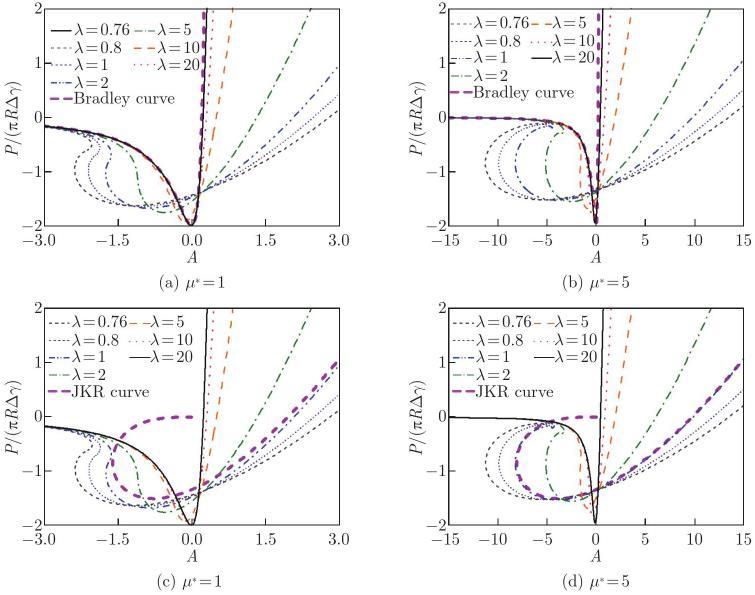
Fig. 6
(a) Normalized pull-off force as a function of the pre-stretch λ for different classical Tabor parameters (μ∗=0.5, 1, 2, 5); (b) normalized pull-off force as a function of the classical Tabor parameter μ∗ for different pre-stretch values (λ=0.8, 1, 2, 3); (c) normalized pull-off force as a function of the modified Tabor parameter μmod for different pre-stretch values (λ=0.8, 1, 2, 3) (color online)"
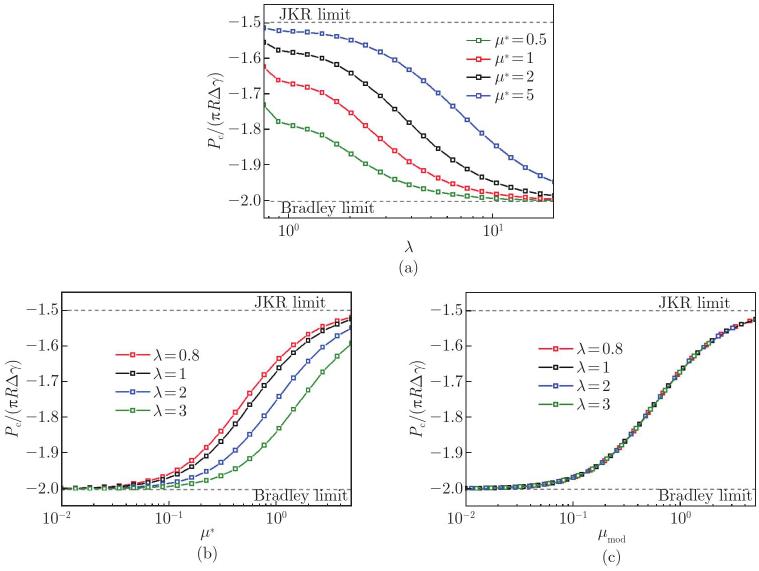
Fig. 7
(a) Displacement and (b) central gap at the jump-in and jump-out points as a function of the classical Tabor parameter for different pre-stretched states (λ=0.8, 1, 2, 3); (c) comparison between the FSCM and analytical solutions (SRT and He and Ding[31]) for the displacement at the jump-in and jump-out points as a function of the classical Tabor parameter under different pre-stretches (λ=0.8, 2); (d) comparison between the FSCM and analytical solutions (SRT) for the central gap at the jump-in and jump-out points as a function of the classical Tabor parameter under different pre-stretches (λ=0.8, 2) (color online)"
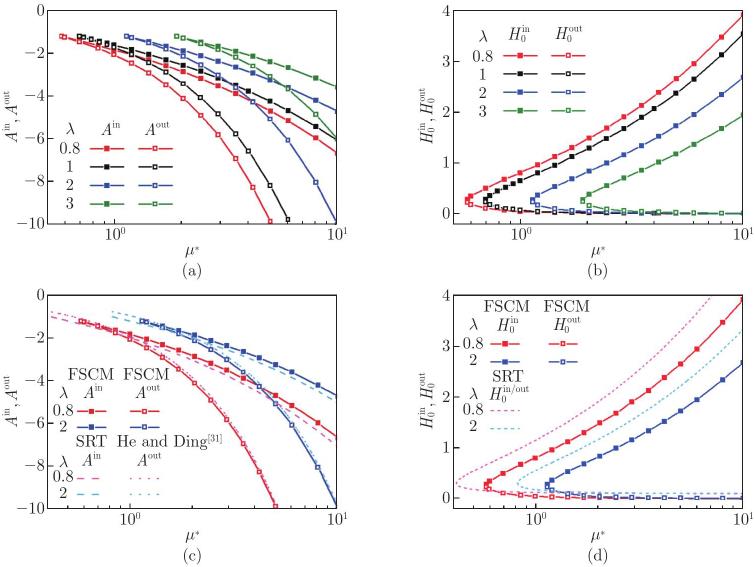

Fig. 8
Effects of the pre-stretch (λ=0.8, 1, 2, 3) of the elastomer on (a) the surface profile and (b) the pressure distribution at A=0 and μ∗=1 and effects of the pre-stretch (λ=0.8, 1, 2, 3) of the elastomer on (c) the surface profile and (d) the pressure distribution at P/(πΔγR)=0 and μ∗=1 (color online)"

| [1] | GAO, H. J. and YAO, H. M. Shape insensitive optimal adhesion of nanoscale fibrillar structures. Proceedings of the National Academy of Sciences of the United States of America, 101(21), 7851–7856 (2004) |
| [2] | SHULL, K. R. Contact mechanics and the adhesion of soft solids. Materials Science and Engineering: R: Reports, 36(1), 1–45 (2002) |
| [3] | DAI, Z. Jump of an atomic force microscopy probe towards an elastic substrate in a liquid environment. Journal of Fluid Mechanics, 1013, A49 (2025) |
| [4] | KIM, S., SHAFIEI, F., RATCHFORD, D., and LI, X. Q. Controlled AFM manipulation of small nanoparticles and assembly of hybrid nanostructures. Nanotechnology, 22(11), 115301 (2011) |
| [5] | ANNAPOORANAN, R., JEYAKUMAR, S. S., CHAMBERS, R. J., LONG, R., and CAI, S. Q. Ultra rate-dependent pressure sensitive adhesives enabled by soft elasticity of liquid crystal elastomers. Advanced Functional Materials, 34(1), 2309123 (2024) |
| [6] | LEE, C., SHI, H. Q., JUNG, J., ZHENG, B. W., WANG, K., TUTIKA, R., LONG, R., LEE, B. P., GU, G. X., and BARTLETT, M. D. Bioinspired materials for underwater adhesion with pathways to switchability. Cell Reports Physical Science, 4(10), 101597 (2023) |
| [7] | YANG, X. W., SRIVASTAVA, A., and LONG, R. Adhesive contact of an inflated circular membrane with curved surfaces. International Journal of Solids and Structures, 279, 112371 (2023) |
| [8] | DONG, X. X., ZHANG, R., TIAN, Y., RAMOS, M. A., HU, T. S., WANG, Z. H., ZHAO, H., ZHANG, L. P., WAN, Y. Y., XIA, Z. H., and XU, Q. Functionally graded gecko setae and the biomimics with robust adhesion and durability. ACS Applied Polymer Materials, 2(7), 2658–2666 (2020) |
| [9] | FLENNER, S., SCHABER, C. F., KRASNOV, I., STIEGLITZ, H., ROSENTHAL, M., BURGHAMMER, M., GORB, S. N., and MÜLLER, M. Multiple mechanical gradients are responsible for the strong adhesion of spider attachment hair. Advanced Materials, 32(37), 2002758 (2020) |
| [10] | YUK, H., VARELA, C. E., NABZDYK, C. S., MAO, X. Y., PADERA, R. F., ROCHE, E. T., and ZHAO, X. H. Dry double-sided tape for adhesion of wet tissues and devices. Nature, 575(7781), 169–174 (2019) |
| [11] | BRADLEY, R. S. The cohesive force between solid surfaces and the surface energy of solids. The London, Edinburgh, and Dublin Philosophical Magazine and Journal of Science, 13(86), 853–862 (1932) |
| [12] | HERTZ, H. Ueber die Berührung fester elastischer Körper (on the contact of elastic solids). Journal fur die Reine und Angewandte Mathematik, 1882(92), 156–171 (1882) |
| [13] | JOHNSON, K. L., KENDALL, K., and ROBERTS, A. D. Surface energy and the contact of elastic solids. Proceedings of the Royal Society of London. A: Mathematical and Physical Sciences, 324(1558), 301–313 (1971) |
| [14] | DERJAGUIN, B. V., MULLER, V. M., and TOPOROV, Y. P. Effect of contact deformations on the adhesion of particles. Journal of Colloid and Interface Science, 53(2), 314–326 (1975) |
| [15] | TABOR, D. Surface forces and surface interactions. Journal of Colloid and Interface Science, 58(1), 2–13 (1977) |
| [16] | MAUGIS, D. Adhesion of spheres: the JKR-DMT transition using a Dugdale model. Journal of Colloid and Interface Science, 150(1), 243–269 (1992) |
| [17] | DUGDALE, D. S. Yielding of steel sheets containing slits. Journal of the Mechanics and Physics of Solids, 8(2), 100–104 (1960) |
| [18] | FUNG, Y. C. What are the residual stresses doing in our blood vessels? Annals of Biomedical Engineering, 19(3), 237–249 (1991) |
| [19] | HONG, W., ZHAO, X. H., and SUO, Z. G. Formation of creases on the surfaces of elastomers and gels. Applied Physics Letters, 95(11), 111901 (2009) |
| [20] | CIAVARELLA, M., JOE, J., PAPANGELO, A., and BARBER, J. R. The role of adhesion in contact mechanics. Journal of the Royal Society Interface, 16(151), 20180738 (2019) |
| [21] | CHATEAUMINOIS, A., NGUYEN, D. T., and FRÉTIGNY, C. Effects of stretching on the frictional stress of rubber. Soft Matter, 13(35), 5849–5857 (2017) |
| [22] | LIANG, T., YUAN, W. K., and WANG, G. F. Influence of equi-biaxial residual stress on spherical indentation of strain hardening materials. International Journal of Applied Mechanics, 13(5), 2150052 (2021) |
| [23] | RAUSCH, M. K. and KUHL, E. On the effect of prestrain and residual stress in thin biological membranes. Journal of the Mechanics and Physics of Solids, 61(9), 1955–1969 (2013) |
| [24] | ROGERS, J., HUANG, Y. G., SCHMIDT, O. G., and GRACIAS, D. H. Origami MEMS and NEMS. MRS Bulletin, 41(2), 123–129 (2016) |
| [25] | YUAN, L. X., YUAN, W. K., and WANG, G. F. Effects of residual stress on the hardness of elastoplastic material under spherical indentation. Journal of Applied Mechanics, 87(5), 051004 (2020) |
| [26] | ZHU, F. B., ZHANG, C. L., QIAN, J., and CHEN, W. Q. Mechanics of dielectric elastomers: materials, structures, and devices. Journal of Zhejiang University: Science A, 17(1), 1–21 (2016) |
| [27] | FELDER, E. and BARQUINS, M. Adherence of natural rubber plates subjected to biaxial tensile strain. Journal of Physics D: Applied Physics, 25(1A), A9(1992) |
| [28] | WATERS, J. F., KALOW, J., GAO, H. J., and GUDURU, P. R. Axisymmetric adhesive contact under equibiaxial stretching. The Journal of Adhesion, 88(2), 134–144 (2012) |
| [29] | FRÉTIGNY, C. and CHATEAUMINOIS, A. Contact of a spherical probe with a stretched rubber substrate. Physical Review E, 96(1), 013001 (2017) |
| [30] | BARNEY, C. W. and ZHENG, Y. L. Peeling a rigid sphere from a stretched rubber substrate. Extreme Mechanics Letters, 79, 102381 (2025) |
| [31] | HE, L. H. and DING, K. W. Adhesive contact of a rigid sphere to finitely stretched substrates. Chinese Science Bulletin, 54(11), 1970–1972 (2009) |
| [32] | HE, L. H. Elastic interaction between force dipoles on a stretchable substrate. Journal of the Mechanics and Physics of Solids, 56(10), 2957–2971 (2008) |
| [33] | ZHENG, Y., HU, Y. H., and CAI, S. Q. Contact mechanics of a gel under constrained swelling. Journal of the Mechanics and Physics of Solids, 124, 427–445 (2019) |
| [34] | XIA, G. Z. Indentation on a constrained electroactive gel. Journal of the Mechanics and Physics of Solids, 197, 106045 (2025) |
| [35] | ARGATOV, I. and PAPANGELO, A. Axisymmetric JKR-type adhesive contact under equibiaxial stretching. The Journal of Adhesion, 97(2), 140–154 (2021) |
| [36] | FENG, J. Q. Contact behavior of spherical elastic particles: a computational study of particle adhesion and deformations. Colloids and Surfaces A: Physicochemical and Engineering Aspects, 172(1-3), 175–198 (2000) |
| [37] | GREENWOOD, J. A. Adhesion of elastic spheres. Proceedings of the Royal Society of London. Series A: Mathematical, Physical and Engineering Sciences, 453(1961), 1277–1297 (1997) |
| [38] | YAN, S. P. and HE, L. H. Adhesive force between a spherical rigid particle and an incompressible elastic substrate. Mechanics of Materials, 49, 66–71 (2012) |
| [39] | YAN, S. P. and HE, L. H. Adhesive contact between a rigid nanofiber and an incompressible elastic substrate. International Journal of Solids and Structures, 50(16-17), 2712–2717 (2013) |
| [40] | ZHU, Y. D., ZHENG, Z. J., HUANG, C. G., and YU, J. L. Adhesion of graded elastic materials: a full self-consistent model and its application. Journal of the Mechanics and Physics of Solids, 169, 105078 (2022) |
| [41] | ZHU, X. Y. and XU, W. Effect of surface tension on the behavior of adhesive contact based on Lennard-Jones potential law. Journal of the Mechanics and Physics of Solids, 111, 170–183 (2018) |
| [42] | RUBINSTEIN, M. and PANYUKOV, S. Nonaffine deformation and elasticity of polymer networks. Macromolecules, 30, 8036–8044 (1997) |
| [43] | MASUREL, R., ROCHÉ, M., LIMAT, L., IONESCU, I., and DERVAUX, J. Elastocapillary ridge as a noninteger disclination. Physical Review Letters, 122(24), 248004 (2019) |
| [44] | LIANG, H. Y., CAO, Z., WANG, Z. L., and DOBRYNIN, A. V. Surface stress and surface tension in polymeric networks. ACS Macro Letters, 7(1), 116–121 (2018) |
| [45] | SCHULMAN, R. D., TREJO, M., SALEZ, T., RAPHAËL, E., and DALNOKI-VERESS, K. Surface energy of strained amorphous solids. Nature Communications, 9, 982 (2018) |
| [46] | DERJAGUIN, B. V. Theorie des anhaftens kleiner teilchen (theory of adhering small particles). Kolloid-Zeitschrift, 69(2), 155–164 (1934) |
| [47] | GREENWOOD, J. A. On the DMT theory. Tribology Letters, 26(3), 203–211 (2007) |
| [48] | GREENWOOD, J. A. Adhesion of small spheres. Philosophical Magazine, 89(11), 945–965 (2009) |
| [49] | ISRAELACHVILI, J. N. Intermolecular and Surface Forces, Academic Press, San Diego, CA (1992) |
| [50] | MULLER, V. M., YUSHCHENKO, V. S., and DERJAGUIN, B. V. On the influence of molecular forces on the deformation of an elastic sphere and its sticking to a rigid plane. Journal of Colloid and Interface Science, 77(1), 91–101 (1980) |
| [51] | PAPANGELO, A. and CIAVARELLA, M. A numerical study on roughness-induced adhesion enhancement in a sphere with an axisymmetric sinusoidal waviness using Lennard-Jones interaction law. Lubricants, 8(9), 90 (2020) |
| [52] | ZHENG, Z. J., YU, J. L., LI, J. R., and LIN, J. Adhesive contact of power-law axisymmetric elastic objects. Journal of University of Science and Technology of China, 37, 1293–1299 (2007) |
| [53] | ZHU, Y. D., ZHENG, Z. J., ZHANG, Y. L., WU, H. G., and YU, J. L. Adhesion of elastic wavy surfaces: interface strengthening/weakening and mode transition mechanisms. Journal of the Mechanics and Physics of Solids, 151, 104402 (2021) |
| [54] | SONG, Z. and KOMVOPOULOS, K. Adhesion-induced instabilities in elastic and elastic-plastic contacts during single and repetitive normal loading. Journal of the Mechanics and Physics of Solids, 59(4), 884–897 (2011) |
| [55] | JIN, F., GUO, X., and GAO, H. J. Adhesive contact on power-law graded elastic solids: the JKR-DMT transition using a double-Hertz model. Journal of the Mechanics and Physics of Solids, 61(12), 2473–2492 (2013) |
| [56] | BIOT, M. A. Surface instability of rubber in compression. Applied Scientific Research, Section A, 12(2), 168–182 (1963) |
| [57] | YU, C. L., ZENG, W. J., WANG, B. J., CUI, X. W., GAO, Z. D., YIN, J., LIU, L. Q., WEI, X. L., WEI, Y. G., and DAI, Z. H. Stiffer is stickier: adhesion in elastic nanofilms. Nano Letters, 25(5), 1876–1882 (2025) |
| [58] | YUAN, W. K. and WANG, G. F. Adhesion between a rigid sphere and a stretched membrane using the Dugdale model. International Journal of Solids and Structures, 208-209, 214–220 (2021) |
| [59] | CIAVARELLA, M., GREENWOOD, J. A., and BARBER, J. R. Effect of Tabor parameter on hysteresis losses during adhesive contact. Journal of the Mechanics and Physics of Solids, 98, 236–244 (2017) |
| [60] | SONG, Z. and KOMVOPOULOS, K. Adhesive contact of an elastic semi-infinite solid with a rigid rough surface: strength of adhesion and contact instabilities. International Journal of Solids and Structures, 51(6), 1197–1207 (2014) |
| [61] | FENG, J. Q. Adhesive contact of elastically deformable spheres: a computational study of pull-off force and contact radius. Journal of Colloid and Interface Science, 238(2), 318–323 (2001) |
| [1] | Yansong WANG, T. SHIMADA, Kaifa WANG, Baolin WANG. Rate effects on load-sharing and adhesion performance of bioinspired micropillar-arrayed surfaces [J]. Applied Mathematics and Mechanics (English Edition), 2026, 47(5): 985-1000. |
| [2] | Youxue BAN, Xinyao YANG, Q. X. LI, Changwen MI. Coupled effects of surface elasticity, couple stresses, and adhesion in nanocontact mechanics [J]. Applied Mathematics and Mechanics (English Edition), 2025, 46(7): 1237-1260. |
| [3] | Pengxu GUO, Yueting ZHOU. Exact analysis of the orientation-adjusted adhesive full stick contact of layered structures with the asymmetric bipolar coordinates [J]. Applied Mathematics and Mechanics (English Edition), 2022, 43(6): 883-898. |
| [4] | Yuchen ZHANG, Linghui HE. Preload-responsive adhesion of microfibre arrays to rough surfaces [J]. Applied Mathematics and Mechanics (English Edition), 2017, 38(2): 155-160. |
| [5] | YANG Li;TU Yo-Song;TAN Hui-Li. Influence of atomic force microscope (AFM) probe shape on adhesion force measured in humidity environment [J]. Applied Mathematics and Mechanics (English Edition), 2014, 35(5): 567-574. |
| [6] | R. ANSARI;E. KAZEMI. Detailed investigation on single water molecule entering carbon nanotubes [J]. Applied Mathematics and Mechanics (English Edition), 2012, 33(10): 1287-1300. |
| [7] | Arezki TOUZALINE. Analysis of a quasistatic contact problem with adhesion and nonlocal friction for viscoelastic materials [J]. Applied Mathematics and Mechanics (English Edition), 2010, 31(5): 623-634. |
| [8] | LV Cun-jing;YIN Ya-jun;ZHENG Quan-shui. Nonlinear effects of line tension in adhesion of small droplets [J]. Applied Mathematics and Mechanics (English Edition), 2008, 29(10): 1251-1262 . |
| [9] | SUN Wen-hua;SHENG Wan-cheng. Two-dimensional non-selfsimilar initial value problem for adhesion particle dynamics [J]. Applied Mathematics and Mechanics (English Edition), 2007, 28(9): 1191-1198 . |
| [10] | Wu Miaosheng;Zhou Zhulin . OPTIMUM DESIGN OF ADHESIVE BONDING OFRESIN-BASE COMPOSITES [J]. Applied Mathematics and Mechanics (English Edition), 1997, 18(11): 1093-1397. |
| Viewed | ||||||
|
Full text |
|
|||||
|
Abstract |
|
|||||





 Email Alert
 RSS
RSS