Applied Mathematics and Mechanics (English Edition) ›› 2026, Vol. 47 ›› Issue (5): 1177-1204.doi: https://doi.org/10.1007/s10483-026-3381-7
Qihang MA1, Feng FENG2, Bofu WANG1,†( ), Quan ZHOU1
Received:2026-01-17
Revised:2026-03-16
Published:2026-05-06
Contact:
Bofu WANG, E-mail: bofuwang@shu.edu.cnSupported by:2010 MSC Number:
Qihang MA, Feng FENG, Bofu WANG, Quan ZHOU. High-order finite-volume central targeted essentially non-oscillatory schemes for shock-driven flows on unstructured meshes. Applied Mathematics and Mechanics (English Edition), 2026, 47(5): 1177-1204.
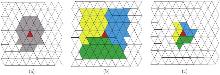
Fig. 1
WENO/CWENO stencils on 2D triangular grids: (a) 5th-order central stencil for WENO, (b) 5th-order directional stencils for WENO, and (c) 3rd-order directional stencils for CWENO (the cell under consideration is displayed in red, while the central stencil elements are displayed in gray, and each directional stencil is indicated by a distinct color, where the actual number of cells in the stencil equals twice the polynomial degrees of freedom, as depicted in Eq. (5)) (color online)"
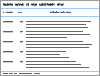
Table 1
Errors and accuracy with 2D Euler equations for CTENO and CTENOZ schemes (h is the number of edges, Ne is the total number of elements, and both L∞ error and L2 error are calculated based on h and Ne, in all figures and tables throughout this paper, CTENO3 denotes the 3rd-order CTENO scheme. Likewise, CTENOZ3 and CTENOZ4 refer to the 3rd-order and 4th-order CTENOZ schemes, respectively, and other notations follow the same rule)"
| h | Ne | L∞ error | L∞ order | L2 error | L2 order | |
|---|---|---|---|---|---|---|
| CTENO3 | 1/10 | 100 | ||||
| CTENOZ3 | 1/20 | 400 | 2.42 | 2.43 | ||
| 1/40 | 1 600 | 2.90 | 2.90 | |||
| 1/80 | 6 400 | 2.98 | 2.98 | |||
| 1/160 | 25 600 | 3.00 | 3.00 | |||
| CTENO4 | 1/10 | 100 | ||||
| CTENOZ4 | 1/20 | 400 | 3.64 | 3.65 | ||
| 1/40 | 1 600 | 3.94 | 3.92 | |||
| 1/80 | 6 400 | 3.99 | 3.97 | |||
| 1/160 | 25 600 | 4.00 | 3.99 | |||
| CTENO5 | 1/10 | 100 | ||||
| CTENOZ5 | 1/20 | 400 | 4.73 | 4.72 | ||
| 1/40 | 1 600 | 4.94 | 4.95 | |||
| 1/80 | 6 400 | 4.99 | 4.99 | |||
| 1/160 | 25 600 | 4.99 | 4.99 | |||
| CTENO6 | 1/10 | 100 | ||||
| CTENOZ6 | 1/20 | 400 | 5.73 | 5.73 | ||
| 1/40 | 1 600 | 6.00 | 5.97 | |||
| 1/80 | 6 400 | 6.01 | 6.01 | |||
| 1/160 | 25 600 | 6.00 | 6.00 | |||
| CTENO7 | 1/10 | 100 | ||||
| CTENOZ7 | 1/20 | 400 | 7.11 | 7.09 | ||
| 1/40 | 1 600 | 6.92 | 6.93 | |||
| 1/80 | 6 400 | 6.84 | 6.84 | |||
| 1/160 | 25 600 | 6.81 | 6.85 |
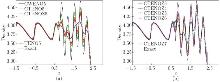
Fig. 2
Shock-density wave interaction: (a) CWENO, TENO, CTENO, and CTENOZ of 5th-order; (b) CTENOZ scheme of various orders (color online)"
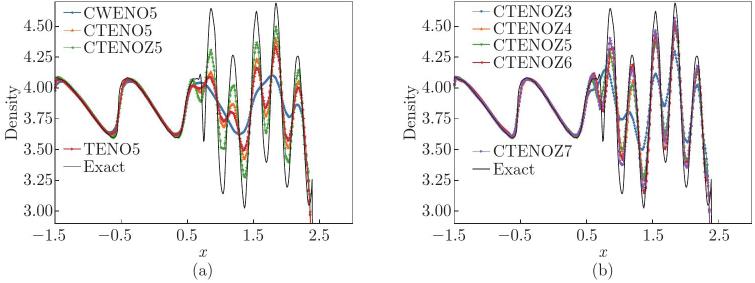
Fig. 3
Shock-density wave interaction with different λ1′: 5th-order solutions from (a) CTENO and (b) CTENOZ. Comparison between CTENO and CTENOZ at (c) 5th-order and (d) 7th-order (color online)"
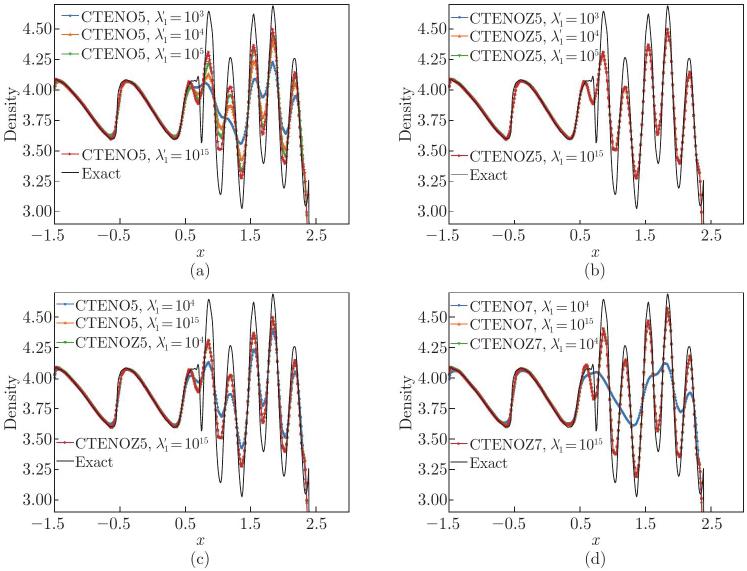
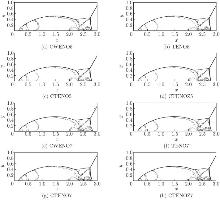
Fig. 4
2D double Mach reflection of a strong shock: (a) CWENO5, (b) TENO5, (c)CTENO5, (d) CTENOZ5, (e) CWENO7, (f) TENO7, (g) CTENO7, and (h) CTENOZ7 with full domain"
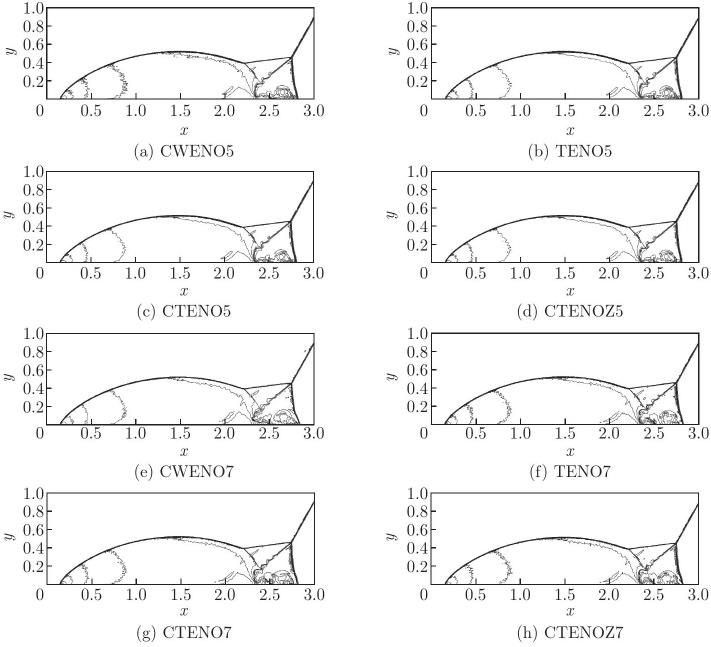

Fig. 5
2D double Mach reflection of a strong shock: (a) CWENO5, (b) TENO5, (c) CTENO5, (d) CTENOZ5, (e) CWENO7, (f) TENO7, (g) CTENO7, and (h) CTENOZ7"

Table 2
Normalized computational time (with respect to CWENO5 with 369 604 uniform triangular elements) for 2D double Mach reflection test problem"
| Element | CWENO5 | TENO5 | CTENO5 | CTENOZ5 |
|---|---|---|---|---|
| 369 604 | 1.000 | 1.036 | 1.033 | 1.000 |
| 714 138 | 2.798 | 2.870 | 2.795 | 2.811 |
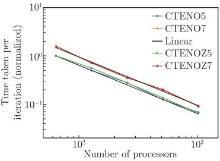
Fig. 6
Parallel scalability of CTENO5, CTENO7, CTENOZ5, and CTENOZ7 numerical schemes for the 2D double Mach reflection (color online)"

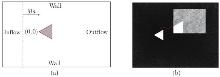
Fig. 7
Interaction of a shock wave with a wedge in 2D: (a) computational conditions and domain with (b) 413 791 triangular elements (color online)"

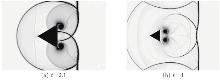
Fig. 8
Interaction of a shock wave with a wedge in 2D: result from CTENOZ5 at (a) t=2.1 and (b) t=4 (the figures contain 40 density gradient magnitude contours ranging from 0 to 5) (color online)"
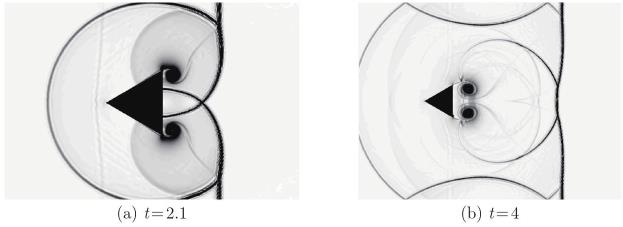
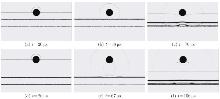
Fig. 9
Interaction of a shock wave with a cylinder in 2D: results from CTENOZ5 at (a) t=20 μs, (b) t=38 μs, and (c) t=76 μs with regular reflection to Mach reflection shock waves. Results from CTENOZ5 at (d) t=20 μs, (e) t=67 μs, and (f) t=106 μs with Mach reflection shock waves (the figures show density gradient magnitude contours ranging from 0 to 5 000) (color online)"

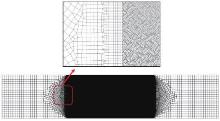
Fig. 10
Hybrid grid for helium bubble shock wave (the refined mesh is applied in shock-bubble interaction region) (color online)"

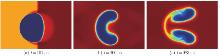
Fig. 11
Helium bubble shock wave: results at various instants from the CTENOZ schemes with 5th order (the figures contain 14 density contours ranging from 0.3 to 1.6) (color online)"
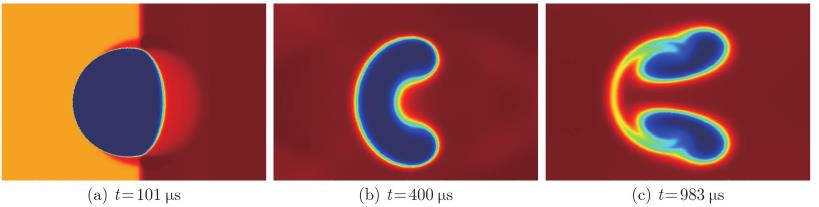
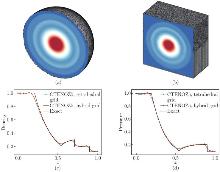
Fig. 12
3D explosion problem: (a) unstructured tetrahedral elements with cross-sectional density distribution of simulation results, ranging from 0.15 to 1.0 with 18 levels; (b) unstructured hybrid elements with cross-sectional density distribution of simulation results, ranging from 0.15 to 1.0 with 18 levels; (c) density profile compared with exact results; (d) pressure profile compared with exact results (color online)"

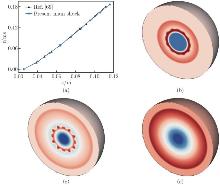
Fig. 13
3D explosion problem: (a) numerically generated x-t diagram with numerical results compared with Brode’s results under blast sphere gas flow; (b) cross-sectional density distribution at t=0.19 ms ranging from 2 to 24; (c) cross-sectional density distribution at t=0.3 ms ranging from 2 to 24; (d) cross-sectional pressure profile at t=0.3 ms ranging from 2×10⁵ Pa to 2×10⁶ Pa (color online)"

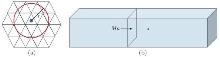
Fig. 14
(a) Point particle position and surrounded elements; (b) schematic diagram of computational domain and point particle (color online)"
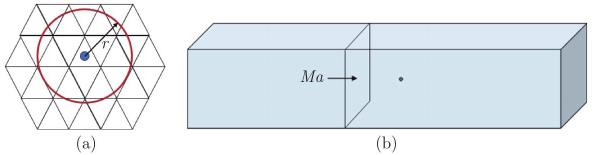
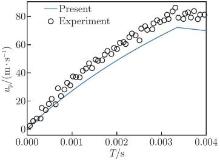
Fig. 15
Numerical results of particle velocity evolution in shock tube compared with the experimental results (color online)"
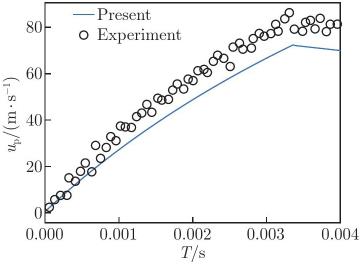
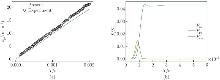
Fig. 16
Results from present simulations: (a) velocity data from shock tube experiments; (b) particle forces during the shock interaction (color online)"

| [1] | JAMESON, A. Analysis and design of numerical schemes for gas dynamics, 1: artificial diffusion, upwind biasing, limiters and their effect on accuracy and multigrid convergence. International Journal of Computational Fluid Dynamics, 4(3-4), 171–218 (1995) |
| [2] | HARTEN, A. High resolution schemes for hyperbolic conservation laws. Journal of Computational Physics, 135(2), 260–278 (1983) |
| [3] | HARTEN, A. and OSHER, S. Uniformly high-order accurate nonoscillatory schemes. SIAM Journal on Numerical Analysis, 24(2), 279–309 (1987) |
| [4] | LIU, X. D., OSHER, S., and CHAN, T. Weighted essentially non-oscillatory schemes. Journal of Computational Physics, 115(1), 200–212 (1994) |
| [5] | JIANG, G. S. and SHU, C. W. Efficient implementation of weighted ENO schemes. Journal of Computational Physics, 126(1), 202–228 (1996) |
| [6] | HENRICK, A. K., ASLAM, T. D., and POWERS, J. M. Mapped weighted essentially nonoscillatory schemes: achieving optimal order near critical points. Journal of Computational Physics, 207(2), 542–567 (2005) |
| [7] | BORGES, R., CARMONA, M., COSTA, B., and DON, W. S. An improved weighted essentially non-oscillatory scheme for hyperbolic conservation laws. Journal of Computational Physics, 227(6), 3191–3211 (2008) |
| [8] | JOHNSEN, E., LARSSON, J., BHAGATWALA, A. V., CABOT, W. H., MOIN, P., OLSON, B. J., RAWAT, P. S., SHANKAR, S. K., SJÖGREEN, B., YEE, H. C., ZHONG, X. L., and LELE, S. K. Assessment of high-resolution methods for numerical simulations of compressible turbulence with shock waves. Journal of Computational Physics, 229(4), 1213–1237 (2010) |
| [9] | ACKER, F., BORGES, R. B. D. R., and COSTA, B. An improved WENO-Z scheme. Journal of Computational Physics, 313, 726–753 (2016) |
| [10] | HILL, D. J. and PULLIN, D. I. Hybrid tuned center-difference-weno method for large eddy simulations in the presence of strong shocks. Journal of Computational Physics, 194(2), 435–450 (2004) |
| [11] | WEIRS, V., CANDLER, G., WEIRS, V., and CANDLER, G. Optimization of weighted ENO schemes for DNS of compressible turbulence. 13th Computational Fluid Dynamics Conference, AIAA, Virginia, U.S.A. (1997) |
| [12] | YAN, Z. G., LIU, H. Y., MAO, M. L., ZHU, H. J., and DENG, X. G. New nonlinear weights for improving accuracy and resolution of weighted compact nonlinear scheme. Computers & Fluids, 127, 226–240 (2016) |
| [13] | SHU, C. W. Essentially non-oscillatory and weighted essentially non-oscillatory schemes. Acta Numerica, 29, 701–762 (2020) |
| [14] | FU, L., HU, X. Y., and ADAMS, N. A. A family of high-order targeted eno schemes for compressiblefluid simulations. Journal of Computational Physics, 305, 333–359 (2016) |
| [15] | FU, L. A low-dissipation finite-volume method based on a new teno shock-capturing scheme. Computer Physics Communications, 235, 25–39 (2019) |
| [16] | YE, C. C., ZHANG, P. J. Y., WAN, Z. H., and SUN, D. J. An alternative formulation of targeted ENO scheme for hyperbolic conservation laws. Computers & Fluids, 238, 105368 (2022) |
| [17] | HAIMOVICH, O. and FRANKEL, S. H. Numerical simulations of compressible multicomponent and multiphase flow using a high-order targeted ENO (TENO) finite-volume method. Computers & Fluids, 146, 105–116 (2017) |
| [18] | DONG, H. B., FU, L., ZHANG, F., NULL, Y. L., and LIU, J. Detonation simulations with a fifth-order TENO scheme. Communications in Computational Physics, 25(5), 1357–1393 (2025) |
| [19] | MA, T. B., WANG, C. T., and XU, X. Z. Conservative high precision pseudo arc-length method for strong discontinuity of detonation wave. Applied Mathematics and Mechanics (English Edition), 43(3), 417–436 (2022) https://doi.org/10.1007/s10483-022-2817-9 |
| [20] | LUSHER, D. J. and SANDHAM, N. D. Shock-wave/boundary-layer interactions in transitional rectangular duct flows. Flow, Turbulence and Combustion, 105(2), 649–670 (2020) |
| [21] | LUSHER, D. J. and SANDHAM, N. Assessment of low-dissipative shock-capturing schemes for transitional and turbulent shock interactions. AIAA Aviation 2019 Forum, AIAA, Virginia, U.S.A. (2019) |
| [22] | HE, K., LIU, H. W., GUO, T. B., LI, X. L., and HE, Z. W. A class of order-preserving, spectral-property-optimized, and shock-capturing finite difference schemes for compressible flows. Physics of Fluids, 37(2), 026110 (2025) |
| [23] | HOU, Y. H., JIN, K., FENG, Y. L., and ZHENG, X. J. High-order targeted essentially non-oscillatory scheme for two-fluid plasma model. Applied Mathematics and Mechanics (English Edition), 44(6), 941–960 (2023) https://doi.org/10.1007/s10483-023-3003-6 |
| [24] | FU, L. Review of the high-order TENO schemes for compressible gas dynamics and turbulence. Archives of Computational Methods in Engineering, 30(4), 2493–2526 (2023) |
| [25] | JI, Z., LIANG, T., and FU, L. High-order finite-volume TENO schemes with dual ENO-like stencil selection for unstructured meshes. Journal of Scientific Computing, 95(3), 76 (2023) |
| [26] | VINCENT, P. E. and JAMESON, A. Facilitating the adoption of unstructured high-order methods amongst a wider community of fluid dynamicists. Mathematical Modelling of Natural Phenomena, 6(3), 97–140 (2011) |
| [27] | LI, Z. J., SHEN, Y., and DING, H. Flow pattern and wave propagation induced by local energy deposition at droplet surface. Science China Physics, Mechanics & Astronomy, 68(9), 294706 (2025) |
| [28] | HU, Y., HUANG, Z. L., CAO, Y., SUN, Q. H., HUANG, H. J., DING, C. Y., and WANG, Z. Exploration of electron and ion thermodynamic models in laser-plasma expansion. Science China Physics, Mechanics & Astronomy, 68(9), 294707 (2025) |
| [29] | MA, Q. H., CHONG, K., WANG, B. F., and ZHOU, Q. Strong shock propagation for the finite-source circular blast in a confined domain. Applied Mathematics and Mechanics (English Edition), 45(6), 1071–1084 (2024) https://doi.org/10.1007/s10483-024-3120-7 |
| [30] | MA, Q. H., WANG, B. F., and ZHOU, Q. Asymptotic self-similar solution for a finite-source spherical blast wave in power-law density media. Applied Mathematics and Mechanics (English Edition), 46(9), 1771–1786 (2025) https://doi.org/10.1007/s10483-025-3288-7 |
| [31] | HU, C. Q. and SHU, C. W. Weighted essentially non-oscillatory schemes on triangular meshes. Journal of Computational Physics, 150(1), 97–127 (1999) |
| [32] | ZHANG, Y. T. and SHU, C. W. Third order weno scheme on three dimensional tetrahedral meshes. Communications in Computational Physics, 5(2), 836–848 (2009) |
| [33] | SHI, J., HU, C. Q., and SHU, C. W. A technique of treating negative weights in WENO schemes. Journal of Computational Physics, 175(1), 108–127 (2002) |
| [34] | ZHU, J. and SHU, C. W. A new type of multi-resolution WENO schemes with increasingly higher order of accuracy on triangular meshes. Journal of Computational Physics, 392, 19–33 (2019) |
| [35] | BALSARA, D. S., GARAIN, S., FLORINSKI, V., and BOSCHERI, W. An efficient class of WENO schemes with adaptive order for unstructured meshes. Journal of Computational Physics, 404, 109062 (2020) |
| [36] | DUMBSER, M. and KÄSER, M. Arbitrary high order non-oscillatory finite volume schemes on unstructured meshes for linear hyperbolic systems. Journal of Computational Physics, 221(2), 693–723 (2007) |
| [37] | LEVY, D., PUPPO, G., and RUSSO, G. Compact central WENO schemes for multidimensional conservation laws. SIAM Journal on Scientific Computing, 22(2), 656–672 (2000) |
| [38] | DUMBSER, M., BOSCHERI, W., SEMPLICE, M., and RUSSO, G. Central weighted ENO schemes for hyperbolic conservation laws on fixed and moving unstructured meshes. SIAM Journal on Scientific Computing, 39(6), A2564–A2591 (2017) |
| [39] | TSOUTSANIS, P. and DUMBSER, M. Arbitrary high order central non-oscillatory schemes on mixed-element unstructured meshes. Computers & Fluids, 225, 104961 (2021) |
| [40] | TSOUTSANIS, P., ADEBAYO, E. M., MERINO, A. C., ARJONA, A. P., and SKOTE, M. CWENO finite-volume interface capturing schemes for multicomponent flows using unstructured meshes. Journal of Scientific Computing, 89(3), 64 (2021) |
| [41] | JI, Z., LIANG, T., and FU, L. A class of new high-order finite-volume TENO schemes for hyperbolic conservation laws with unstructured meshes. Journal of Scientific Computing, 92(2), 61 (2022) |
| [42] | TSOUTSANIS, P. Stencil selection algorithms for WENO schemes on unstructured meshes. Journal of Computational Physics, 475, 108840 (2023) |
| [43] | ANTONIADIS, A. F., DRIKAKIS, D., FARMAKIS, P. S., FU, L., KOKKINAKIS, I., NOGUEIRA, X., SILVA, P. A. S. F., SKOTE, M., TITAREV, V., and TSOUTSANIS, P. UCNS3D: an open-source high-order finite-volume unstructured CFD solver. Computer Physics Communications, 279, 108453 (2022) |
| [44] | KARYPIS, G. and KUMAR, V. Multilevelk-way partitioning scheme for irregular graphs. Journal of Parallel and Distributed Computing, 48(1), 96–129 (1998) |
| [45] | TSOUTSANIS, P., ANTONIADIS, A. F., and JENKINS, K. W. Improvement of the computational performance of a parallel unstructured WENO finite volume CFD code for Implicit Large Eddy Simulation. Computers & Fluids, 173, 157–170 (2018) |
| [46] | MENG, X. H., WU, J. Z., CHONG, K. L., and ZHOU, Q. Thermal and kinetic energy dissipation rates in vertical convection over rough sidewalls. Physics of Fluids, 38(3), 035137 (2026) |
| [47] | MENG, W. S., ZHAO, C. B., WU, J. Z., WANG, B. F., ZHOU, Q., and CHONG, K. L. Simulation of flow and debris migration in extreme ultraviolet source vessel. Physics of Fluids, 36(2), 023322 (2024) |
| [48] | STROUD, A. Approximate Calculation of Multiple Integrals, Prentice-Hall Inc., New Jersey (1971) |
| [49] | STROUD, A. H. Some fourth degree integration formulas for simplexes. Mathematics of Computation, 30(134), 291–294 (1976) |
| [50] | GOTTLIEB, S. and SHU, C. W. Total variation diminishing Runge-Kutta schemes. Mathematics of Computation, 67(221), 73–85 (1998) |
| [51] | TSOUTSANIS, P., ANTONIADIS, A. F., and DRIKAKIS, D. WENO schemes on arbitrary unstructured meshes for laminar, transitional and turbulent flows. Journal of Computational Physics, 256(C), 254–276 (2014) |
| [52] | STEWART, G. W. Matrix Algorithms, Volume 1: Basic Decompositions, Society for Industrial and Applied Mathematics, Philadelphia, U.S.A. (1998) |
| [53] | FU, L. A very-high-order TENO scheme for all-speed gas dynamics and turbulence. Computer Physics Communications, 244, 117–131 (2019) |
| [54] | FU, L., HU, X. Y., and ADAMS, N. A. A new class of adaptive high-order targeted ENO schemes for hyperbolic conservation laws. Journal of Computational Physics, 374, 724–751 (2018) |
| [55] | FU, L., HU, X. Y., and ADAMS, N. A. Targeted ENO schemes with tailored resolution property for hyperbolic conservation laws. Journal of Computational Physics, 349, 97–121 (2017) |
| [56] | CASTRO, M., COSTA, B., and DON, W. S. High order weighted essentially non-oscillatory WENO-Z schemes for hyperbolic conservation laws. Journal of Computational Physics, 230(5), 1766–1792 (2011) |
| [57] | TORO, E. F., SPRUCE, M., and SPEARES, W. Restoration of the contact surface in the HLL-Riemann solver. Shock Waves, 4(1), 25–34 (1994) |
| [58] | SHU, C. W. and OSHER, S. Efficient implementation of essentially non-oscillatory shock-capturing schemes. Journal of Computational Physics, 77(2), 439–471 (1988) |
| [59] | WOODWARD, P. and COLELLA, P. The numerical simulation of two-dimensional fluid flow with strong shocks. Journal of Computational Physics, 54(1), 115–173 (1984) |
| [60] | TSOUTSANIS, P. Extended bounds limiter for high-order finite-volume schemes on unstructured meshes. Journal of Computational Physics, 362(C), 69–94 (2018) |
| [61] | MILTON, V. D. and FRANK, M. W. An album of fluid motion. Journal of Fluid Engineering, 104, 542–543 (1982) |
| [62] | DUMBSER, M., KÄSER, M., TITAREV, V. A., and TORO, E. F. Quadrature-free non-oscillatory finite volume schemes on unstructured meshes for nonlinear hyperbolic systems. Journal of Computational Physics, 226(1), 204–243 (2007) |
| [63] | GUAN, H., WANG, J. C., WEI, Z. J., and WU, C. J. Numerical analysis of the interaction of 3D compressible bubble clusters. Applied Mathematics and Mechanics (English Edition), 40(8), 1181–1196 (2019) https://doi.org/10.1007/s10483-019-2509-6 |
| [64] | ALLAIRE, G., CLERC, S., and KOKH, S. A five-equation model for the simulation of interfaces between compressible fluids. Journal of Computational Physics, 181(2), 577–616 (2002) |
| [65] | HAAS, J. F. and STURTEVANT, B. Interaction of weak shock waves with cylindrical and spherical gas inhomogeneities. Journal of Fluid Mechanics, 181, 41–76 (1987) |
| [66] | CORALIC, V. and COLONIUS, T. Finite-volume WENO scheme for viscous compressible multicomponent flows. Journal of Computational Physics, 274(C), 95–121 (2014) |
| [67] | TERASHIMA, H. and TRYGGVASON, G. A front-tracking/ghost-fluid method for fluid interfaces in compressible flows. Journal of Computational Physics, 228(11), 4012–4037 (2009) |
| [68] | QUIRK, J. J. and KARNI, S. On the dynamics of a shock-bubble interaction. Journal of Fluid Mechanics, 318, 129–163 (1996) |
| [69] | BRODE, H. L. Numerical solutions of spherical blast waves. Journal of Applied Physics, 26(6), 766–775 (1955) |
| [70] | HARILAL, S. S., BINDHU, C. V., TILLACK, M. S., NAJMABADI, F., and GAERIS, A. C. Internal structure and expansion dynamics of laser ablation plumes into ambient gases. Journal of Applied Physics, 93(5), 2380–2388 (2003) |
| [71] | ZHAO, Z. Y. and LI, W. Z. Numerical simulation of laser-produced plasma expansion on a droplet surface. Scientific Reports, 13, 4085 (2023) |
| [72] | PRICE, M. A., NGUYEN, V. T., HASSAN, O., and MORGAN, K. An Euler-Lagrange particle approach for modeling fragments accelerated by explosive detonation. International Journal for Numerical Methods in Engineering, 106(11), 904–926 (2016) |
| [73] | CAPECELATRO, J. and WAGNER, J. L. Gas-particle dynamics in high-speed flows. Annual Review of Fluid Mechanics, 56, 379–403 (2024) |
| [74] | PARMAR, M., HASELBACHER, A., and BALACHANDAR, S. On the unsteady inviscid force on cylinders and spheres in subcritical compressible flow. Philosophical Transactions of the Royal Society A: Mathematical, Physical and Engineering Sciences, 366(1873), 2161–2175 (2008) |
| [75] | LING, Y. and BALACHANDAR, S. Simulation and scaling analysis of a spherical particle-laden blast wave. Shock Waves, 28(3), 545–558 (2018) |
| [76] | JOURDAN, G., HOUAS, L., IGRA, O., ESTIVALEZES, J. L., DEVALS, C., and MESHKOV, E. E. Drag coefficient of a sphere in a non-stationary flow: new results. Proceedings of the Royal Society A: Mathematical, Physical and Engineering Sciences, 463(2088), 3323–3345 (2007) |
| [77] | BALAKRISHNAN, K., NANCE, D. V., and MENON, S. Simulation of impulse effects from explosive charges containing metal particles. Shock Waves, 20(3), 217–239 (2010) |
| [78] | WAGNER, J. L., BERESH, S. J., KEARNEY, S. P., PRUETT, B. O. M., and WRIGHT, E. K. Shock tube investigation of quasi-steady drag in shock-particle interactions. Physics of Fluids, 24(12), 123301 (2012) |
| [1] | Jihong ZHENG, Jizeng WANG, Youhe ZHOU, Xiaojing LIU. Adaptive wavelet multi-resolution solution for one-dimensional Burgers’ equation at high Reynolds numbers [J]. Applied Mathematics and Mechanics (English Edition), 2026, 47(6): 1401-1416. |
| [2] | Lan JIANG, Jie WU, Liming YANG, Hao DONG. Gas kinetic flux solver based finite volume weighted essentially non-oscillatory scheme for inviscid compressible flows [J]. Applied Mathematics and Mechanics (English Edition), 2023, 44(6): 961-980. |
| [3] | Keqi YE, Yuelin ZHAO, Feng WU, Wanxie ZHONG. An adaptive artificial viscosity for the displacement shallow water wave equation [J]. Applied Mathematics and Mechanics (English Edition), 2022, 43(2): 247-262. |
| [4] | Jian QIN, Jie WU, Chao MA. A high-order scheme based on lattice Boltzmann flux solver for viscous compressible flow simulations [J]. Applied Mathematics and Mechanics (English Edition), 2022, 43(10): 1601-1614. |
| [5] | Ziqiang CHENG, Shihao LIU, Yan JIANG, Jianfang LU, Mengping ZHANG, Shuhai ZHANG. A high order boundary scheme to simulate complex moving rigid body under impingement of shock wave [J]. Applied Mathematics and Mechanics (English Edition), 2021, 42(6): 841-854. |
| [6] | Sheng GONG, Chuijie WU. A study of a supersonic capsule/rigid disk-gap-band parachute system using large-eddy simulation [J]. Applied Mathematics and Mechanics (English Edition), 2021, 42(4): 485-500. |
| [7] | Jian YU, Chao YAN, Zhenhua JIANG. Revisit of dilation-based shock capturing for discontinuous Galerkin methods [J]. Applied Mathematics and Mechanics (English Edition), 2018, 39(3): 379-394. |
| [8] | Xiaodi WU, Fu CHEN, Huaping LIU. Combined immersed boundary method and multiple-relaxation-time lattice Boltzmann flux solver for numerical simulations of incompressible flows [J]. Applied Mathematics and Mechanics (English Edition), 2017, 38(12): 1679-1696. |
| [9] | Mingsheng YE, Ming DONG. Near-wall behaviors of oblique-shock-wave/turbulent-boundary-layer interactions [J]. Applied Mathematics and Mechanics (English Edition), 2017, 38(10): 1357-1376. |
| [10] | Yunlong LI, Wei CAO. Research of influence of reduced-order boundary on accuracy and solution of interior points [J]. Applied Mathematics and Mechanics (English Edition), 2017, 38(1): 111-124. |
| [11] | Chun WANG, Gaoxiang XIANG, Zonglin JIANG. Theoretical approach to one-dimensional detonation instability [J]. Applied Mathematics and Mechanics (English Edition), 2016, 37(9): 1231-1238. |
| [12] | Xiao-dong LI;Min JIANG;Jun-hui GAO;Da-kai LIN;Li LIU;Xiao-yan LI. Recent advances of computational aeroacoustics [J]. Applied Mathematics and Mechanics (English Edition), 2015, 36(1): 131-140. |
| [13] | Quan-wen GE. High-order Lagrangian cell-centered conservative scheme on unstructured meshes [J]. Applied Mathematics and Mechanics (English Edition), 2014, 35(9): 1203-1222. |
| [14] | Zhen-hua JIANG;Chao YAN;Jian YU. High-order discontinuous Galerkin solver on hybrid anisotropic meshes for laminar and turbulent simulations [J]. Applied Mathematics and Mechanics (English Edition), 2014, 35(7): 799-812. |
| [15] | ZHANG Wen-Zhi;HUANG Pei-Yan. Coupling of high order multiplication perturbation method and reduction method for variable coefficient singular perturbation problems [J]. Applied Mathematics and Mechanics (English Edition), 2014, 35(1): 97-104. |
| Viewed | ||||||
|
Full text |
|
|||||
|
Abstract |
|
|||||





 Email Alert
 RSS
RSS