Applied Mathematics and Mechanics (English Edition) ›› 2026, Vol. 47 ›› Issue (6): 1323-1340.doi: https://doi.org/10.1007/s10483-026-3400-6
Previous Articles Next Articles
Junsong HU1, Ruijie DENG2, Pan WANG3,†( )
)
Received:2025-11-22
Revised:2026-04-17
Online:2026-06-18
Published:2026-06-18
Contact:
Pan WANG, E-mail: wangpan0623@csu.edu.cnSupported by:2010 MSC Number:
Junsong HU, Ruijie DENG, Pan WANG. Crystal plasticity modeling of low-cycle fatigue in 6061-T6 aluminum alloy. Applied Mathematics and Mechanics (English Edition), 2026, 47(6): 1323-1340.
Table 1
Nominal chemical composition of the 6061 aluminum alloy (%)"
| Element | Al | Si | Fe | Cu | Mn | Mg | Cr | Zn |
|---|---|---|---|---|---|---|---|---|
| Content | Bal. | 0.7 | 0.5 | 0.3 | 0.12 | 1.2 | 0.1 | 0.1 |
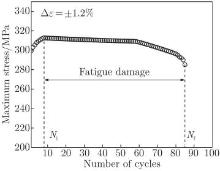
Fig. 1
Evolution of the maximum stress versus the cycle number during the LCF testing at Δε=±1.2% and ambient temperature (25℃)"
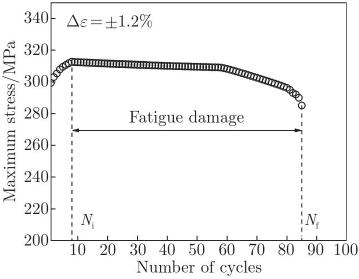
Table 2
Fatigue life characteristics of the 6061-T6 alloy under LCF loading at ambient temperature"
| | | | |
|---|---|---|---|
| | 37 | 386 | 9.6% |
| | 15 | 157 | 9.6% |
| | 8 | 76 | 10.5% |
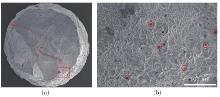
Fig. 2
SEM fractographs of the 6061 alloy after the LCF failure at Δε=±1.2%: (a) overall fracture surface morphology with the crack initiation site (red box) and predominant crack propagation direction (red arrow); (b) high-magnification view revealing the morphology of micro-voids and dimples (color online)"
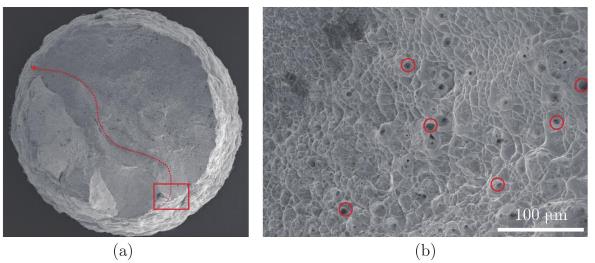
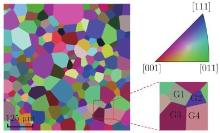
Fig. 3
RVE model of the polycrystalline 6061 alloy containing 200 grains with random crystallographic orientations, where the specific grains are selected for the local analysis (color online)"
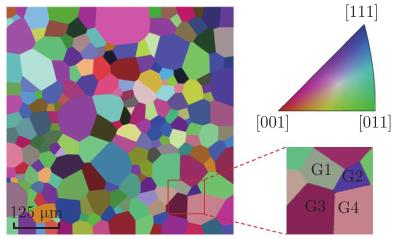
Table 3
Calibrated constitutive parameters for the 6061-T6 alloy"
| Parameter | Symbol | Value | Unit |
|---|---|---|---|
| Reference slip rate | | 106 | s-1 |
| Activation energy | Q | 3.0 | eV |
| Athermal solute strength | | 106 | MPa |
| Fitting parameter 1 | p | 1.6 | – |
| Fitting parameter 2 | q | 2.0 | – |
| Dislocation storage coefficient | K | 0.022 | – |
| Dynamic recovery parameter | d | 4.8 | nm |
| Kinematic hardening coefficient | h | 180 | MPa |
| Backstress recovery parameter | f | 40 | MPa |
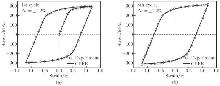
Fig. 4
Comparison between the CPFE predictions (solid-line curves) and experimental measurements (discrete points) for the volume-averaged stress-strain response at Δε=±1.2%: (a) 1st loading cycle and (b) 8th loading cycle"
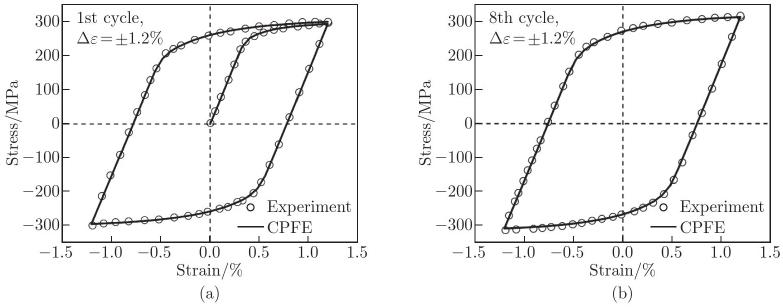
Fig. 5
Validation of cyclic stress-strain responses at multiple total strain amplitudes: (a)–(c) hysteresis loops at Δε=±0.8% for the 1st, 10th, and 36th cycles; (d)–(f) hysteresis loops at Δε=±1.0% for the 1st, 10th, and 14th cycles, where symbols represent the experimental data while solid lines denote the CPFE predictions"
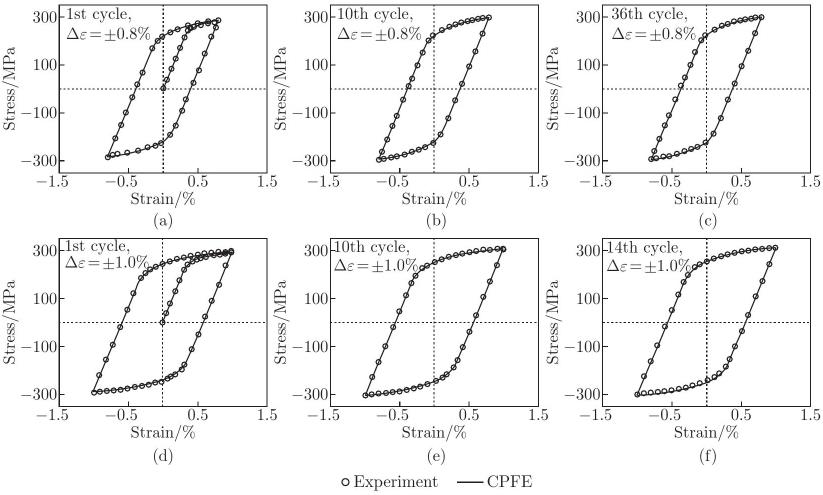
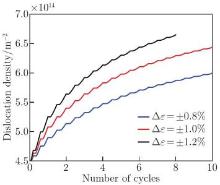
Fig. 6
Predicted evolution of the dislocation density with the number of cycles in the 6061 alloy during the strain-controlled LCF testing at various total strain amplitudes (color online)"
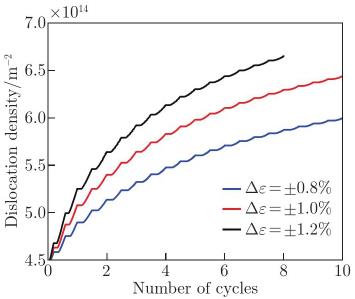
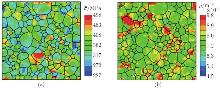
Fig. 7
Spatial distribution within the polycrystalline RVE after eight cycles at Δε=±1.2%: (a) equivalent stress and (b) total dislocation density (color online)"
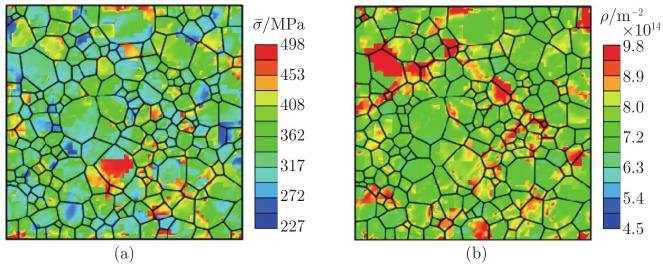
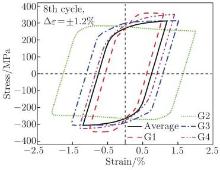
Fig. 8
Comparison of the local cyclic stress-strain responses for selected grains with different crystallographic orientations after eight cycles at Δε=±1.2% (color online)"
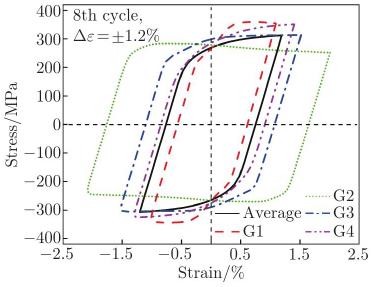
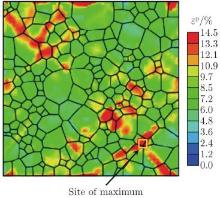
Fig. 9
Strain localization after eight cycles at Δε=±1.2%, visualized by the distribution of accumulated equivalent plastic strain (color online)"
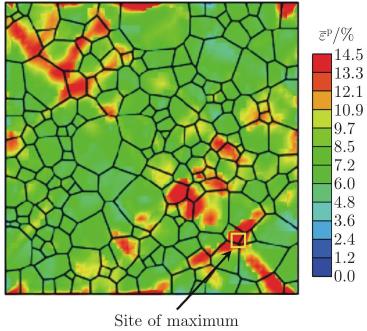
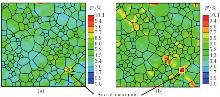
Fig. 10
Distribution of the accumulated equivalent plastic strain in the polycrystalline RVE after ten loading cycles at (a) Δε=±0.8% and (b) Δε=±1.0% (color online)"
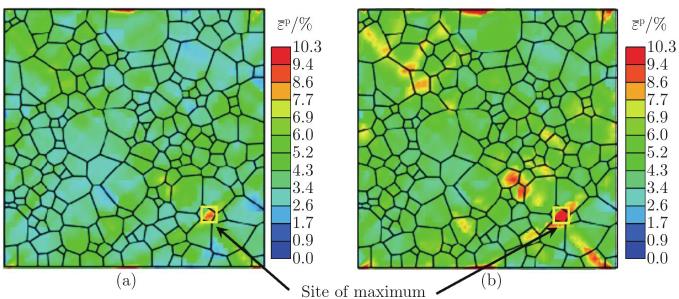
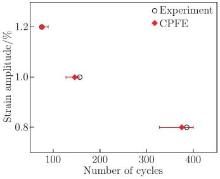
Fig. 11
Comparison between the predicted and experimental fatigue lives for the 6061-T6 alloy under strain-controlled cyclic loading at ambient temperature (color online)"
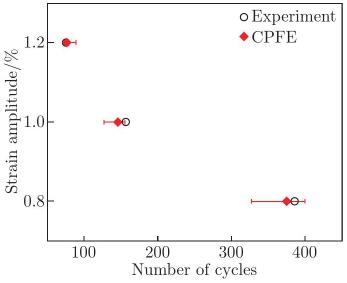
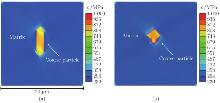
Fig. 12
Equivalent stress distribution in the single-crystal aluminum matrix after eight loading cycles at Δε=±1.2%, highlighting the stress concentration adjacent to the coarse particles of (a) needle-shaped and (b) platelet-shaped (color online)"
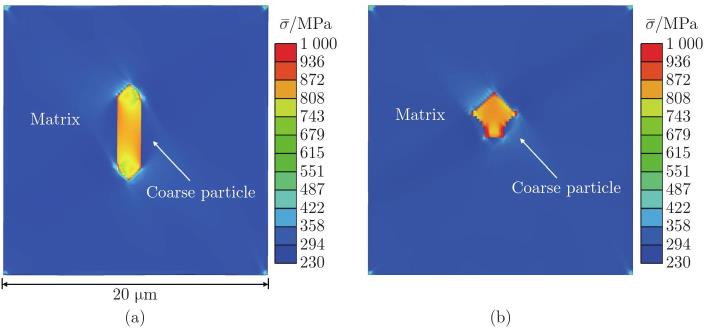
Fig. 13
Accumulated equivalent plastic strain field in the single-crystal matrix following eight cycles at Δε=±1.2%, demonstrating the heterogeneous plastic deformation surrounding the coarse particles of (a) needle-shaped and (b) platelet-shaped, where the insets show the corresponding contour maps of dislocation density around the intermetallic phases (color online)"
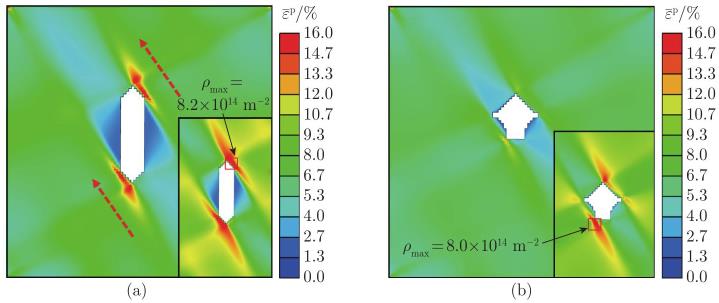
Fig. A1
Stress-strain responses for the RVEs with different grain numbers at Δε=±1.2%: (a) 1st loading cycle and (b) 8th loading cycle (color online)"
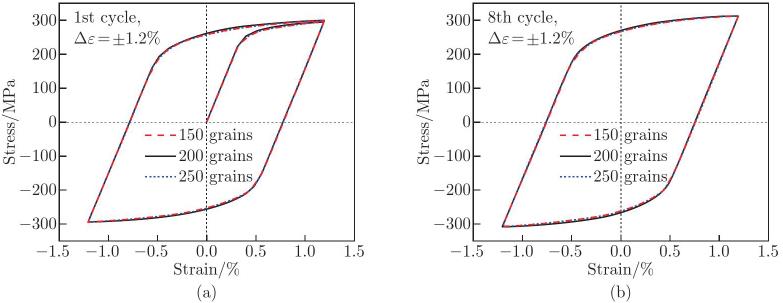
Fig. A2
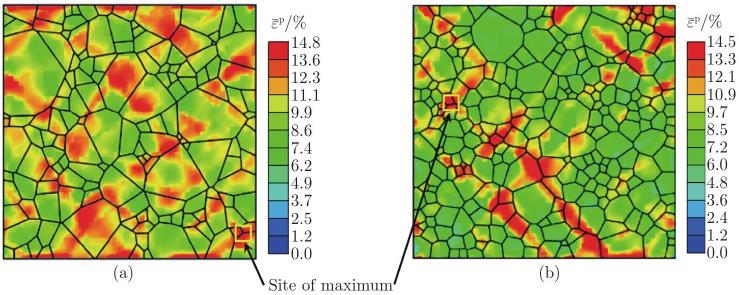
Distribution of the accumulated equivalent plastic strain after eight cycles at Δε=±1.2%: (a) 150 grains and (b) 250 grains (color online)"
| [1] | LEE, S. H., SAITO, Y., SAKAI, T., and UTSUNOMIYA, H. Microstructures and mechanical properties of 6061 aluminum alloy processed by accumulative roll-bonding. Materials Science and Engineering: A, 325, 228–235 (2022) |
| [2] | YAO, S. J., TANG, Q. H., YANG, J., WANG, C. Y., SUN, H. F., RONG, R. L., SUN, H. R., and CHU, G. N. Microstructural characterization and mechanical properties of 6061 aluminum alloy processed with short-time solid solution and aging treatment. Journal of Alloys and Compounds, 960, 170704 (2023) |
| [3] | KAUFMAN, J. G. Properties of Aluminum Alloys: Fatigue Data and Effects of Temperature, Product Form, and Processing, ASM International, Ohio (2008) |
| [4] | HOSSEINABADI, O. F. and KHEDMATI, M. R. A review on ultimate strength of aluminium structural elements and systems for marine applications. Ocean Engineering, 232, 109153 (2021) |
| [5] | PRAMOD, R., SHANMUGAM, N. S., KRISHNADASAN, C. K., RADHAKRISHNAN, G., and THOMAS, M. Design and development of aluminum alloy 6061-T6 pressure vessel liner for aerospace applications: a technical brief. Proceedings of the Institution of Mechanical Engineers, Part L: Journal of Materials: Design and Applications, 236, 1130–1148 (2022) |
| [6] | FENG, A. H., CHEN, D. L., and MA, Z. Y. Microstructure and low-cycle fatigue of a friction-stir-welded 6061 aluminum alloy. Metallurgical and Materials Transactions A, 41, 2626–2641 (2010) |
| [7] | GASEM, Z. M. and ALI, S. S. Low-cycle fatigue behavior of powder metallurgy 6061 aluminum alloy reinforced with submicron-scale Al2O3 particles. Materials Science and Engineering: A, 562, 109–117 (2013) |
| [8] | MCCULLOUGH, R. R., JORDON, J. B., ALLISON, P. G., RUSHING, T., and GARCIA, L. Fatigue crack nucleation and small crack growth in an extruded 6061 aluminum alloy. International Journal of Fatigue, 119, 52–61 (2019) |
| [9] | SANGID, M. D., MAIER, H. J., and SEHITOGLU, H. A physically based fatigue model for prediction of crack initiation from persistent slip bands in polycrystals. Acta Materialia, 59, 328–341 (2011) |
| [10] | SANGID, M. D. The physics of fatigue crack initiation. International Journal of Fatigue, 57, 58–72 (2013) |
| [11] | SHIRAIWA, T., BRIFFOD, F., and ENOKI, M. Prediction of fatigue crack initiation of 7075 aluminum alloy by crystal plasticity simulation. Materials, 16, 1595 (2023) |
| [12] | ZHAO, Y., HE, B., YANG, J. L., LIU, Y. X., ZHANG, T., and WANG, F. H. Critical role of intermetallic particles in the corrosion of 6061 aluminum alloy and anodized aluminum used in semiconductor processing equipment. Acta Metallurgica Sinica (English Letters), 38, 904–924 (2025) |
| [13] | KOBAYASHI, T. Strength and fracture of aluminum alloys. Materials Science and Engineering: A, 286, 333–341 (2000) |
| [14] | AVRAMENKO, T., MICHEL, S., STUTZ, A., KOLLENDER, J., BURDA, I., HANS, U., AFFOLTER, C., and TERRASI, G. P. A comparative study on corrosion fatigue susceptibility and microstructural effects in 6061-T6 and 6082-T6 aluminum alloys. Metals, 15, 653 (2025) |
| [15] | HA, S., JANG, J. H., and KIM, K. Finite element implementation of dislocation-density-based crystal plasticity model and its application to pure aluminum crystalline materials. International Journal of Mechanical Sciences, 120, 249–262 (2017) |
| [16] | ZHANG, X. X., KNOOP, D., ANDRÄ, H., HARJO, S., KAWASAKI, T., LUTZ, A., and LAHRES, M. Multiscale constitutive modeling of additively manufactured Al-Si-Mg alloys based on measured phase stresses and dislocation density. International Journal of Plasticity, 140, 102972 (2021) |
| [17] | ROTERS, F., EISENLOHR, P., HANTCHERLI, L., TJAHJANTO, D. D., BIELER, T. R., and RAABE, D. Overview of constitutive laws, kinematics, homogenization and multiscale methods in crystal plasticity finite-element modeling: theory, experiments, applications. Acta Materialia, 58, 1152–1211 (2010) |
| [18] | ALANKAR, A., MASTORAKOS, I. N., and FIELD, D. P. A dislocation-density-based 3D crystal plasticity model for pure aluminum. Acta Materialia, 57, 5936–5946 (2009) |
| [19] | WONG, S. L., MADIVALA, M., PRAHL, U., ROTERS, F., and RAABE, D. A crystal plasticity model for twinning-and transformation-induced plasticity. Acta Materialia, 118, 140–151 (2016) |
| [20] | WANG, J., CHEN, T. J., and ZHOU, C. Z. Crystal plasticity modeling of fretting fatigue behavior of an aluminum alloy. Tribology International, 156, 106841 (2021) |
| [21] | ZHOU, D. W., WANG, X. W., YANG, X. Y., ZHANG, T. Y., JIANG, Y., ZHANG, X. C., GONG, J. M., and TU, S. A generalized physical-based failure indicator parameter used in crystal plasticity model to predict fatigue life under low cycle fatigue and creep-fatigue loadings. International Journal of Fatigue, 166, 107290 (2023) |
| [22] | WANG, J. X., WU, H., DU, R., MA, H. S., and LIU, X. M. Prediction of stress concentration near voids using crystal plasticity modelling. Acta Mechanica Sinica, 41, 424484 (2024) |
| [23] | VEERABABU, J., KANNAN, R., GOYAL, S., and NAGESHA, A. Low cycle fatigue behavior of forged alloy 617M. Transactions of the Indian National Academy of Engineering, 7, 417–424 (2022) |
| [24] | SERRANO-MUNOZ, I., BUFFIERE, J. Y., MOKSO, R., VERDU, C., and NADOT, Y. Location, location & size: defects close to surfaces dominate fatigue crack initiation. Scientific Reports, 7, 45239 (2017) |
| [25] | BRAMMER, A. T., JORDON, J. B., ALLISON, P. G., and BARKEY, M. E. Strain-controlled low-cycle fatigue properties of extruded 6061-T6 aluminum alloy. Journal of Materials Engineering and Performance, 22, 1348–1350 (2013) |
| [26] | KRÖNER, E. General continuum theory of dislocations and proper stresses. Archive for Applied Mechanics, 4, 273–334 (1960) |
| [27] | ASARO, R. J. and RICE, J. R. Strain localization in ductile single crystals. Journal of the Mechanics and Physics of Solids, 25, 309–338 (1977) |
| [28] | GREEN, A. E. and NAGHDI, P. M. Some remarks on elastic-plastic deformation at finite strain. International Journal of Engineering Science, 9, 1219–1229 (1971) |
| [29] | KOCKS, U. F. and MECKING, H. Physics and phenomenology of strain hardening: the FCC case. Progress in Materials Science, 48, 171–273 (2003) |
| [30] | ABAQUS G. Abaqus 6.11, Dassault Systemes Simulia Corporation, RI, Providence (2011) |
| [31] | MEISSONNIER, F. T., BUSSO, E. P., and O’DOWD, N. P. Finite element implementation of a generalised non-local rate-dependent crystallographic formulation for finite strains. International Journal of Plasticity, 17, 601–640 (2001) |
| [32] | DUNNE, F. P. E., WILKINSON, A. J., and ALLEN, R. Experimental and computational studies of low cycle fatigue crack nucleation in a polycrystal. International Journal of Plasticity, 23, 273–295 (2007) |
| [33] | XU, Y. L., WAN, W. F., and DUNNE, F. P. E. Microstructural fracture mechanics: stored energy density at fatigue cracks. Journal of the Mechanics and Physics of Solids, 146, 104209 (2021) |
| [34] | WAN, W. F., XU, Y. L., YU, X. K., and DUNNE, F. P. E. Microstructurally-sensitive fatigue crack nucleation in a Zircaloy-4 alloy. Journal of the Mechanics and Physics of Solids, 180, 105417 (2023) |
| [35] | FRODAL, B. H., THOMESEN, S., BORVIK, T., and HOPPERSTAD, O. S. On the coupling of damage and single crystal plasticity for ductile polycrystalline materials. International Journal of Plasticity, 142, 102996 (2021) |
| [36] | BOWER, A. F. Applied Mechanics of Solids, CRC Press, Boca Raton (2009) |
| [37] | JIANG, X., GALANO, M., and AUDEBERT, F. Extrusion textures in Al, 6061 alloy and 6061/SiCp nanocomposites. Materials Characterization, 88, 111–118 (2014) |
| [38] | KOPEC, M., LIU, X. C., GORNIEWICZ, D., MODRZEJEWSKI, P., ZASADA, D., JÓŹWIAK, S., JANISZEWSKI, J., and KOWALEWSKI, Z. L. Mechanical response of 6061-T6 aluminium alloy subjected to dynamic testing at low temperature: experiment and modelling. International Journal of Impact Engineering, 185, 104843 (2024) |
| [39] | WOO, W., BALOGH, L., UNGÁR, T., CHOO, H., and FENG, Z. L. Grain structure and dislocation density measurements in a friction-stir welded aluminum alloy using X-ray peak profile analysis. Materials Science and Engineering: A, 498, 308–313 (2008) |
| [40] | BANERJEE, B. and BHAWALKAR, A. An extended mechanical threshold stress plasticity model: modeling 6061-T6 aluminum alloy. Journal of Mechanics of Materials and Structures, 3, 391–424 (2008) |
| [41] | FAROOQ, H., CAILLETAUD, G., FOREST, S., and RYCKELYNCK, D. Crystal plasticity modeling of the cyclic behavior of polycrystalline aggregates under non-symmetric uniaxial loading: global and local analyses. International Journal of Plasticity, 126, 102619 (2020) |
| [42] | JIN, M., LEE, B., YOO, J., JO, Y., and LEE, S. Cryogenic deformation behaviour of aluminium alloy 6061-T6. Metals and Materials International, 30, 1492–1504 (2024) |
| [43] | DAI, S. H. and LI, J. C. M. Dislocation-free zone at the crack tip. Scripta Metallurgica, 16, 183–188 (1982) |
| [44] | SANGID, M. D., MAIER, H. J., and SEHITOGLU, H. The role of grain boundaries on fatigue crack initiation: an energy approach. International Journal of Plasticity, 27, 801–821 (2011) |
| [45] | XIE, Q., LIANG, J., STOICA, A. D., LI, R., YANG, P., ZHAO, Z., WANG, J., LAN, H., LI, R., and AN, K. In-situ neutron diffraction study on the tension-compression fatigue behavior of a twinning induced plasticity steel. Scripta Materialia, 137, 83–87 (2017) |
| [46] | LIU, W. H., ZHANG, X. M., TANG, J. G., and DU, Y. X. Simulation of void growth and coalescence behavior with 3D crystal plasticity theory. Computational Materials Science, 40, 130–139 (2007) |
| [47] | DEMIR, E. and GUTIERREZ-URRUTIA, I. Investigation of strain hardening near grain boundaries of an aluminum oligocrystal: experiments and crystal based finite element method. International Journal of Plasticity, 136, 102898 (2021) |
| [48] | CHEN, Z., FANG, G., and ZHAO, J. Q. Formability evaluation of aluminum alloy 6061-T6 sheet at room and elevated temperatures. Journal of Materials Engineering and Performance, 26, 4626–4637 (2017) |
| [49] | HO, H. S., RISBET, M., and FEAUGAS, X. On the unified view of the contribution of plastic strain to cyclic crack initiation: impact of the progressive transformation of shear bands to persistent slip bands. Acta Materialia, 85, 155–167 (2015) |
| [50] | YUAN, G. J., ZHANG, X. C., CHEN, B., TU, S. T., and ZHANG, C. C. Low-cycle fatigue life prediction of a polycrystalline nickel-base superalloy using crystal plasticity modelling approach. Journal of Materials Science & Technology, 38, 28–38 (2020) |
| [51] | EDWARDS, G. A., STILLER, K., DUNLOP, G. L., and COUPER, M. J. The precipitation sequence in Al-Mg-Si alloys. Acta Materialia, 46, 3893–3904 (1998) |
| [52] | GUZMÁN-FLORES, I., GRANDA-GUTIÉRREZ, E. E., CRUZ-GONZÁLEZ, C. E., HERNÁNDEZ-GARCÍA, H. M., DÍAZ-GUILLÉN, J. C., FLORES-GONZÁLEZ, L., PRAGA-ALEJO, R. J., and MARTÍNEZ-DELGADO, D. I. Enhancing the mechanical properties of a 6061 aluminum alloy by heat treatment from the perspective of taguchi design-of-experiments. Applied Sciences, 14, 5407 (2024) |
| [1] | Fei SHEN, Weiping HU, Qingchun MENG. New approach based on continuum damage mechanics with simple parameter identification to fretting fatigue life prediction [J]. Applied Mathematics and Mechanics (English Edition), 2015, 36(12): 1539-1554. |
| [2] | ZHAO Yong-xiang;YANG Bing;PENG Jia-chun. Reconstruction of probabilistic S-N curves under fatigue life following lognormal distribution with given confidence [J]. Applied Mathematics and Mechanics (English Edition), 2007, 28(4): 455-460 . |
| [3] | ZHANG Xiao-qing;YANG Gui-tong;HUANG Xiao-qing. ANALYTICAL MODEL OF CERAMIC/METAL ARMOR IMPACTED BY DEFORMABLE PROJECTILE [J]. Applied Mathematics and Mechanics (English Edition), 2006, 27(3): 287-294 . |
| [4] | HU Hong-jiu;GUO Xing-ming;LI Pei-ning;XIE Yu-jun;LI Jie. A NEW CYCLIC J-INTEGRAL FOR LOW-CYCLE FATIGUE CRACK GROWTH [J]. Applied Mathematics and Mechanics (English Edition), 2006, 27(2): 149-160 . |
| [5] | ZHAO Yong-xiang;HE Chao-ming;YANG Bing;HUANG Yu-zhong;GAO Qing;WU Ping-bo. PROBABILISTIC MODELS FOR LONG FATIGUE CRACK GROWTH RATES OF LZ50 AXLE STEEL [J]. Applied Mathematics and Mechanics (English Edition), 2005, 26(8): 1093-1099 . |
| [6] | ZHAO Yong-xiang;YANG Bing;LIANG Hong-qin;WU Ping-bo;ZENG Jing. NEW METHOD FOR MEASURING RANDOM THRESHOLDS OF LONG FATIGUE CRACK PROPAGATION [J]. Applied Mathematics and Mechanics (English Edition), 2005, 26(6): 761-766 . |
| [7] | YANG Yong-yu;LIU Xin-wei;YANG Fan. STRATIFIED MODEL FOR ESTIMATING FATIGUE CRACK GROWTH RATE OF METALLIC MATERIALS [J]. Applied Mathematics and Mechanics (English Edition), 2005, 26(4): 515-521 . |
| [8] | XIONG Jun-jiang;WU Zhe;GAO Zhen-tong . GENERALIZED FATIGUE CONSTANT LIFE CURVE AND TWO-DIMENSIONAL PROBABILITY DISTRIBUTION OF FATIGUE LIMIT [J]. Applied Mathematics and Mechanics (English Edition), 2002, 23(10): 1188-1193. |
| [9] | Jiang Fengchun;Liu Ruitang;Liu Diankui. A DAMAGE FUNCTION USED FOR PREDICTION OF LOW CYCLIC FATIGUE LIFE [J]. Applied Mathematics and Mechanics (English Edition), 1999, 20(12): 1377-1383. |
| [10] | Mingyang ZHANG, Mengcheng CHEN, Wei FANG, Kaicheng XU, Hong HUANG. Fatigue correlation reliability evaluation of heavy-haul railway bridges [J]. Applied Mathematics and Mechanics (English Edition), 2025, 46(7): 1295-1314. |
| Viewed | ||||||
|
Full text |
|
|||||
|
Abstract |
|
|||||





 Email Alert
 RSS
RSS