Applied Mathematics and Mechanics (English Edition) ›› 2026, Vol. 47 ›› Issue (8): 1769-1788.doi: https://doi.org/10.1007/s10483-026-3421-7
Previous Articles Next Articles
Yu LU1, Xiaobing MA2, Baozeng YUE1( )
)
Received:2025-12-22
Revised:2026-05-28
Online:2026-07-31
Published:2026-07-31
Contact:
Baozeng YUE, E-mail: bzyue@bit.edu.cnSupported by:2010 MSC Number:
Yu LU, Xiaobing MA, Baozeng YUE. Dynamics modeling and attitude control of on-orbit refueling system. Applied Mathematics and Mechanics (English Edition), 2026, 47(8): 1769-1788.
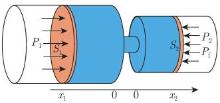
Fig. 1
Schematic diagram of the refueling model (color online)"
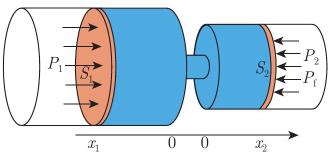
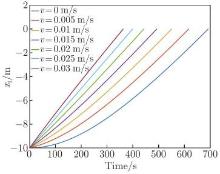
Fig. 2
Numerical solution of refueling tank liquid level under different v (color online)"
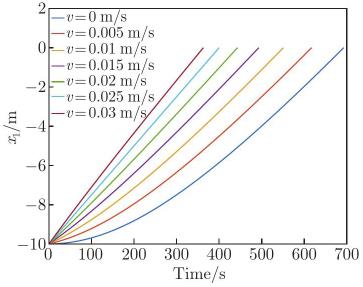
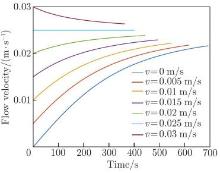
Fig. 3
Numerical solution of refueling tank flow velocity under different v (color online)"
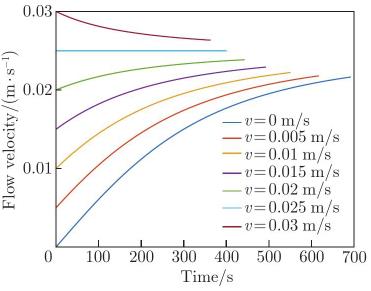
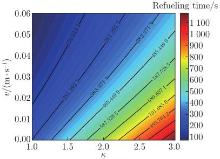
Fig. 4
Analytical solution of refueling time (ρ=800 kg/m3, L=10 m, and κP1=106 Pa) (color online)"
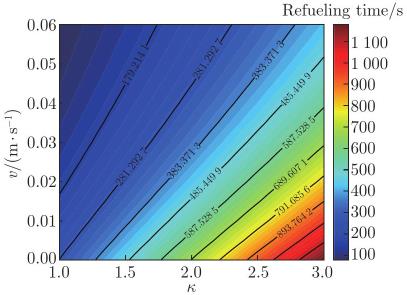
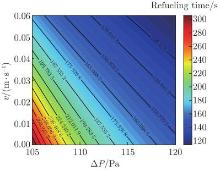
Fig. 5
Analytical solution of refueling time (ρ=800 kg/m3, L=10 m, and κ=2) (color online)"
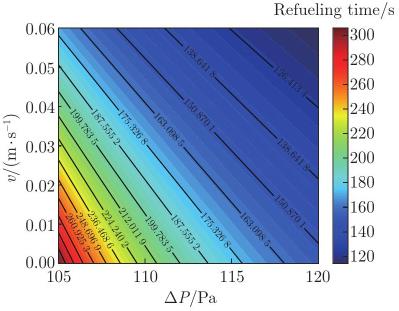
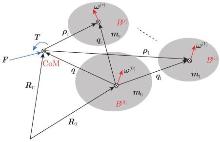
Fig. 6
The system schematic diagram (color online)"
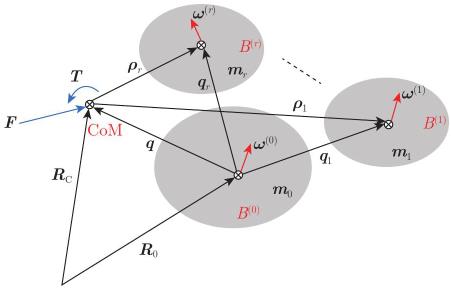
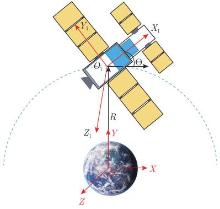
Fig. 7
The schematic diagram of on-orbit refueling system (color online)"
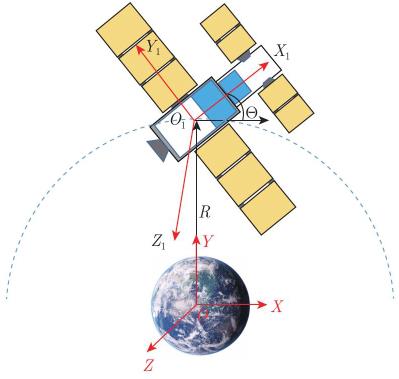
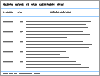
Table 1
Parameters of the on-orbit refueling system"
| Category | Parameter | Symbol | Value |
|---|---|---|---|
| Rigid body | Mass | m0 | |
| Moment of inertia | I(0) | ||
| Refueling tank | Initial liquid level | x1 | |
| Initial height of liquid | L1 | ||
| Radius | R1 | ||
| Liquid density | ρ | ||
| Receiving tank | Initial liquid level | x2 | |
| Initial height of liquid | L2 | 0 m | |
| Radius | R2 | 0.9 m | |
| Liquid density | ρ |
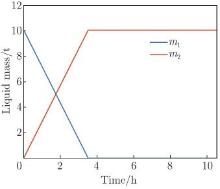
Fig. 8
Changes in liquid mass inside the storage tanks (color online)"
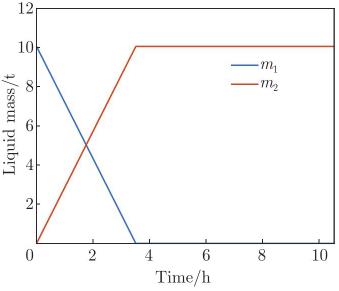
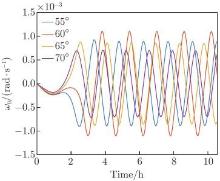
Fig. 9
Angular velocity of the main rigid body (color online)"
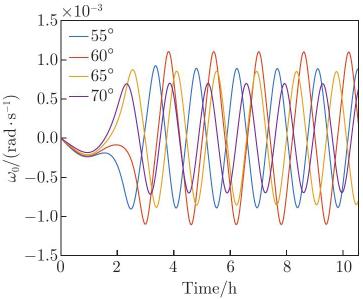
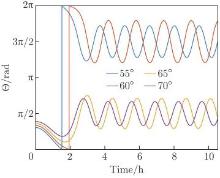
Fig. 10
Pitch angle of the main rigid body (color online)"
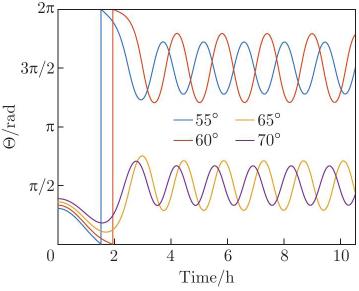
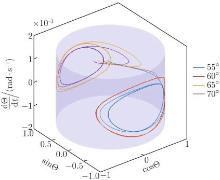
Fig. 11
Phase diagram of pitch angle (projected onto a cylindrical surface) (color online)"
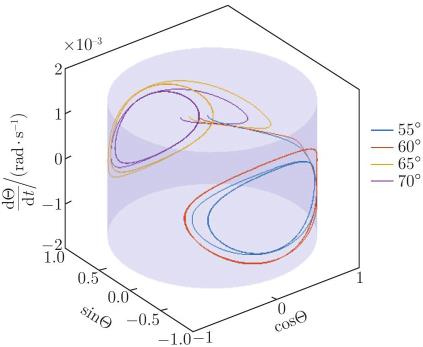
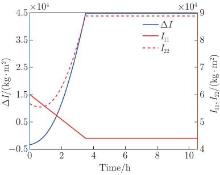
Fig. 12
The moment of inertia of the system (color online)"
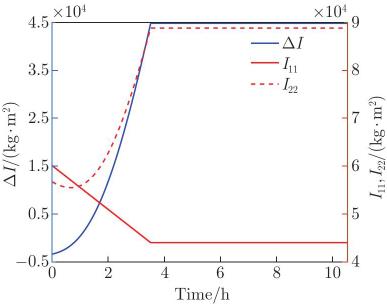
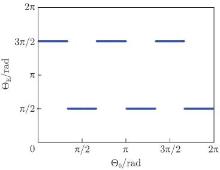
Fig. 13
Scanning results of initial attitude angle and stable equilibrium point (color online)"
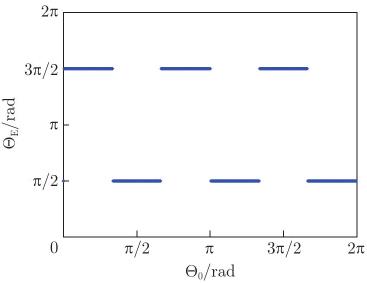
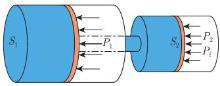
Fig. 14
Schematic diagram of the optimized refueling model (color online)"
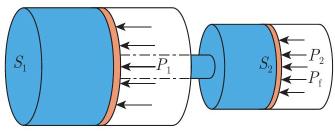
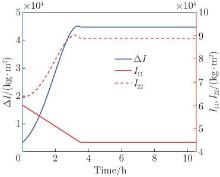
Fig. 15
The moment of inertia of optimized system (color online)"
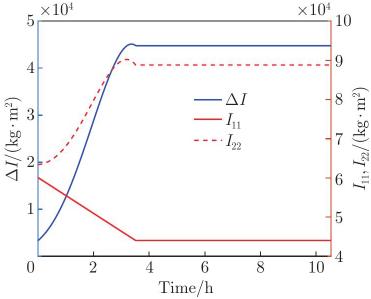
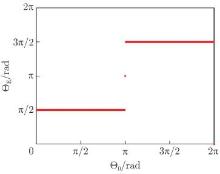
Fig. 16
Scanning results of initial attitude angle and stable equilibrium point (optimized system) (color online)"
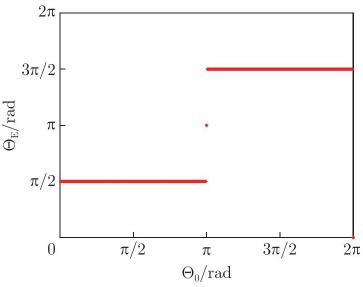
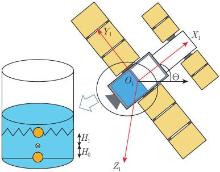
Fig. 17
Schematic diagram of equivalent model for liquid sloshing (color online)"
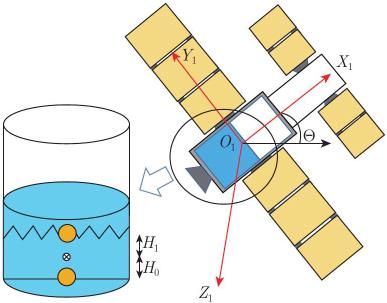
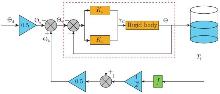
Fig. 18
Schematic diagram of control strategy (color online)"
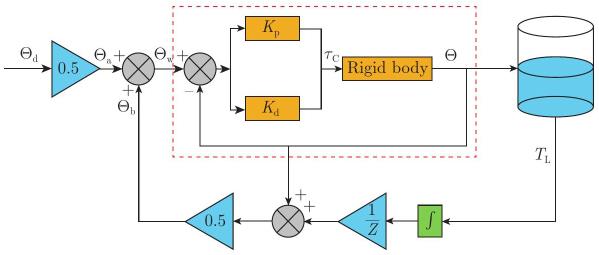
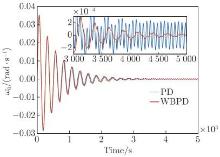
Fig. 19
Comparison of angular velocity (color online)"
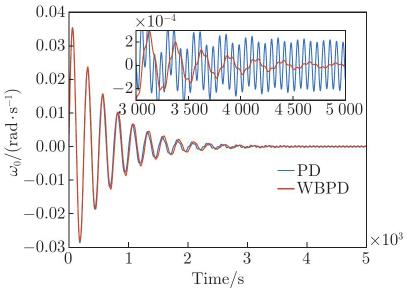
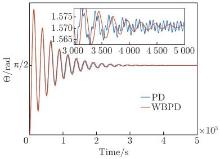
Fig. 20
Comparison of pitch angular velocity (color online)"
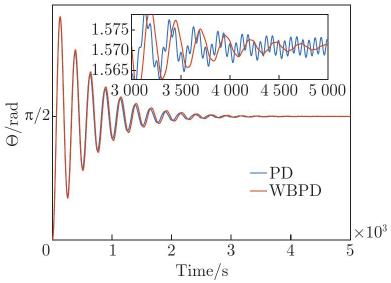
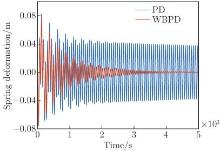
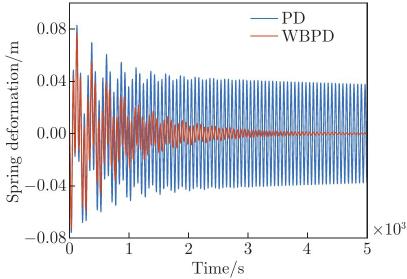
Fig. 21
Comparison of spring deformation (color online)"
| [1] | SINCARSIN, G. B. and HUGHES, P. C. Gravitational orbit-attitude coupling for very large spacecraft. Celestial Mechanics, 31(2), 143–161 (1983) |
| [2] | LIU, C., XU, J. Y., and YUE, X. K. RBF neural network-based cooperative electromagnetic takeover control for large-scale failed spacecraft. IEEE Transactions on Aerospace and Electronic Systems, 62, 506–515 (2026) |
| [3] | LU, Y., YUE, B. Z., HAO, B. L., MA, B. L., LIU, F., and CHANG, Y. Y. Stage separation of recoverable liquid launch vehicle by using moving pulsating ball analogue for propellant sloshing. Chinese Journal of Aeronautics, 37(2), 360–370 (2024) |
| [4] | SHENG, Z. Y., CHEN, W. D., CHEN, Z. S., and WEN, H. Sequence planning for on-orbit robotic assembly based on symbiotic organisms search with diversification strategy. Acta Astronautica, 219, 941–951 (2024) |
| [5] | DUNN, B. P. High-energy orbit refueling for orbital transfer vehicles. Journal of Spacecraft and Rockets, 24(6), 518–522 (1987) |
| [6] | MALYH, D., VAULIN, S., FEDOROV, V., PESHKOV, R., and SHALASHOV, M. A brief review on in-orbit refueling projects and critical techniques. Aerospace Systems, 5(2), 185–196 (2022) |
| [7] | RADKE, C. and LEHNHARDT, E. Gateway to the future: lessons learned in development of the refueling systems for NASA’s first lunar space station. IAF Space Propulsion Symposium, International Astronautical Federation (IAF), Milan, 616–625 (2024) |
| [8] | MCLEAN, C., MUSTAFI, S., WALLS, L., PITCHFORD, B., WOLLEN, M., and SCHMIDT, J. Simple, robust cryogenic propellant depot for near term applications. 2011 Aerospace Conference, IEEE, New Jersey, 1–24 (2011) |
| [9] | ODA, M., KIBE, K., and YAMAGATA, F. ETS-VII: space robot in-orbit experiment satellite. Proceedings of IEEE International Conference on Robotics and Automation, IEEE, New Jersey, 739–744 (2002) |
| [10] | YOSHIDA, K. Achievements in space robotics. IEEE Robotics & Automation Magazine, 16(4), 20–28 (2009) |
| [11] | DIPPREY, N. and ROTENBERGER, S. Orbital express propellant resupply servicing. 39th AIAA/ASME/SAE/ASEE Joint Propulsion Conference and Exhibit, AIAA, Reston, 4898 (2003) |
| [12] | FRIEND, R. B. Orbital express program summary and mission overview. Sensors and Systems for Space Applications II, 6958, 695803 (2008) |
| [13] | LI, G. Y., HUANG, Y. Y., HAN, W., WU, Z. Y., and YANG, Y. J. Space liquid transport experiments in Tianyuan-1. Microgravity Science and Technology, 34(5), 100 (2022) |
| [14] | SAH, R., SRIVASTAVA, R., LIMA, R., VATSAL, V., and DAS, K. Numerical modeling of liquid propellant mass transfer with sloshing during on-orbit refueling. 2024 IEEE Aerospace Conference, IEEE, New Jersey, 1–14 (2024) |
| [15] | PEI, J. and ROITHMAYR, C. M. Attitude dynamics of on-orbit refueling configurations. 2022 AAS/AIAA Astrodynamics Specialist Conference, AIAA, Reston (2022) |
| [16] | ZHENG, H. M. and ZHAI, G. Attitude dynamics of coupled spacecraft undergoing fuel transfer. Multibody System Dynamics, 46(4), 355–379 (2019) |
| [17] | SUN, Y. Y., LI, J., ZHENG, H. M., WANG, Y. X., and ZHAI, G. An attitude stabilization approach integrated of passive and active scenarios for on-orbit refueling considering liquid transfer. Nonlinear Dynamics, 113(11), 13193–13209 (2025) |
| [18] | ZHAI, G., ZHENG, H. M., and BIN, L. Attitude dynamics of spacecraft with time-varying inertia during on-orbit refueling. Journal of Guidance, Control, and Dynamics, 41(8), 1744–1754 (2018) |
| [19] | YUE, B. Z. and ZHU, L. M. Hybrid control of liquid-filled spacecraft maneuvers by dynamic inversion and input shaping. AIAA Journal, 52(3), 618–626 (2014) |
| [20] | LU, Y. and YUE, B. Z. Dynamic modeling of liquid-filled free-floating space robot and joint trajectory planning with considering liquid positioning. Aerospace Science and Technology, 161, 110133 (2025) |
| [21] | LU, Y., YUE, B. Z., MA, B. L., HAO, B. L., and UPHAM, M. P. A universal nonlinear equivalent model and its stability analysis for large amplitude liquid sloshing in rotationally symmetric tanks. Nonlinear Dynamics, 113(7), 6031–6047 (2025) |
| [22] | XIAO, L., HU, Q. L., and GUO, L. Attitude tracking control of spacecraft with time-varying inertia matrix. 2018 IEEE CSAA Guidance, Navigation and Control Conference, IEEE, New Jersey, 1–6 (2020) |
| [23] | HE, L., CHEN, X. Q., KUMAR, K. D., SHENG, T., and YUE, C. F. A novel three-axis attitude stabilization method using in-plane internal mass-shifting. Aerospace Science and Technology, 92, 489–500 (2019) |
| [24] | HE, L., SHENG, T., KUMAR, K. D., ZHAO, Y., RAN, D. C., and CHEN, X. Q. Attitude maneuver of a satellite using movable masses. Acta Astronautica, 176, 464–475 (2020) |
| [25] | PANICUCCI, P., ALLARD, C., and SCHAUB, H. Spacecraft dynamics employing a general multi-tank and multi-thruster mass depletion formulation. The Journal of the Astronautical Sciences, 65(4), 423–447 (2018) |
| [26] | COLAGROSSI, A. and LAVAGNA, M. Integrated vibration suppression attitude control for flexible spacecrafts with internal liquid sloshing. Multibody System Dynamics, 51(2), 123–157 (2021) |
| [27] | LIU, F., YUE, B. Z., and MA, B. L. Dynamics and control of mass-variable liquid-filled spacecraft with combined nonlinear slosh. IEEE Transactions on Aerospace and Electronic Systems, 60(3), 3509–3522 (2024) |
| [28] | THOMPSON, J. W. and O’CONNOR, W. Wave-based attitude control of spacecraft with fuel sloshing dynamics. Archive of Mechanical Engineering, 63(2), 263–275 (2016) |
| [29] | LU, Y. and YUE, B. Z. Dynamic modeling and wave-based PID control of rockets considering liquid sloshing. Journal of Guidance, Control, and Dynamics, 49(3), 759–771 (2025) |
| [30] | LU, Y. and YUE, B. Z. Nonlinear dynamics model of liquid-filled spacecraft and its fuzzy wave-based PID control method. Acta Astronautica, 245, 50–63 (2026) |
| [31] | CHEN, S. X., CHEN, W. D., CHEN, T., LUO, C. Q., and WEI, Z. T. Iterative learning-based tension feedback control for multiple deployments of tethered satellite system. IEEE Transactions on Industrial Electronics, 73(2), 3049–3058 (2026) |
| [32] | HUGHES, P. C. Spacecraft Attitude Dynamics, Courier Corporation, Massuchusetts (2012) |
| [33] | TRIVISONNO, N., GARELLI, L., and STORTI, M. The tennis racket theorem: an analysis and numerical simulation of the intermediate axis theorem. Mecánica Computacional, 38(34), 1341–1353 (2021) |
| [34] | ABRAMSON, H. N. The Dynamic Behavior of Liquids in Moving Containers, with Applications to Space Vehicle Technology, National Aeronautics and Space Administration, Washington (1966) |
| [1] | Meiling LI, Yingjing QIAN, Wenxue CHEN, Yan SHEN, Yue LIU. Asteroid impact trajectory based on Jupiter-perturbed Sun-Earth planar bicircular restricted four-body problem invariant manifolds [J]. Applied Mathematics and Mechanics (English Edition), 2026, 47(6): 1279-1300. |
| [2] | R. A. JAFARI-TALOOKOLAEI, H. GHANDVAR, E. JUMAEV, S. KHATIR, T. CUONG-LE. Free vibration and transient response of double curved beams connected by intermediate straight beams [J]. Applied Mathematics and Mechanics (English Edition), 2025, 46(1): 37-62. |
| [3] | Chentong GAO, Huiyu SUN, Jianping GU, W. M. HUANG. Dynamic modeling of a three-dimensional braided compositethin plate considering braiding directions [J]. Applied Mathematics and Mechanics (English Edition), 2025, 46(1): 123-138. |
| [4] | Xiaofeng LIU, Qishuai WANG, Haiquan LI, Guoping CAI. Dynamics and control of variable geometry truss manipulator [J]. Applied Mathematics and Mechanics (English Edition), 2017, 38(2): 243-262. |
| [5] | Haiyan SONG, Lifu LIANG. Investigation of power-type variational principles in liquid-filled system [J]. Applied Mathematics and Mechanics (English Edition), 2015, 36(12): 1651-1662. |
| [6] | Wei-li HUANG;Jian-le CAI. Conformal invariance for nonholonomic system of Chetaev’s type with variable mass [J]. Applied Mathematics and Mechanics (English Edition), 2012, 33(11): 1393-1402. |
| [7] | YAO Wen-li;CHEN Bin;LIU Cai-shan;XU Jian. Sliding state stepping algorithm for solving impact problems of multi-rigid-body system with joint friction [J]. Applied Mathematics and Mechanics (English Edition), 2007, 28(12): 1621-1627 . |
| [8] | HUANG Yong-an;DENG Zi-chen;YAO Lin-xiao. Dynamic analysis of a rotating rigid-flexible coupled smart structure with large deformations [J]. Applied Mathematics and Mechanics (English Edition), 2007, 28(10): 1349-1360 . |
| [9] | YUE Yuan;XIE Jian-hua. null [J]. Applied Mathematics and Mechanics (English Edition), 2007, 28(8): 1109-1117 . |
| [10] | JIA Yi-feng;CHEN Yu-fu;XU Zhi-qiang. APPLICATION OF WU ELIMINATION METHOD TO CONSTRAINED DYNAMICS [J]. Applied Mathematics and Mechanics (English Edition), 2006, 27(10): 1399-1408 . |
| [11] | Yehia A. Abdel-aziz;M. H. Yehia;F. A. Abd El-Salam;M. Radwan. PERIODIC MOTIONS OF SPINNING RIGID SPACECRAFT UNDER INFLUENCE OF GRAVITATIONAL AND MAGNETIC FIELDS [J]. Applied Mathematics and Mechanics (English Edition), 2006, 27(8): 1061-1069 . |
| [12] | ZHANG Yin-long;SHEN Qing;CHEN Xu-jun. SYNCHRONOUS EFFECT OF SLIPPING HEAVY LOADS ON RO-RO SHIP ROLLING IN WAVES [J]. Applied Mathematics and Mechanics (English Edition), 2006, 27(7): 959-966 . |
| [13] | ZHANG Ding-guo;ZHOU Sheng-feng. DYNAMIC ANALYSIS OF FLEXIBLE-LINK AND FLEXIBLE-JOINT ROBOTS [J]. Applied Mathematics and Mechanics (English Edition), 2006, 27(5): 695-704 . |
| [14] | ZHANG Rong-ye. HAMILTONIAN MECHANICS ON KÄHLER MANIFOLDS [J]. Applied Mathematics and Mechanics (English Edition), 2006, 27(3): 353-362 . |
| [15] | LU Ying-jie;REN Ge-xue. A SYMPLECTIC ALGORITHM FOR DYNAMICS OF RIGID BODY [J]. Applied Mathematics and Mechanics (English Edition), 2006, 27(1): 51-57 . |
| Viewed | ||||||
|
Full text |
|
|||||
|
Abstract |
|
|||||





 Email Alert
 RSS
RSS