Applied Mathematics and Mechanics (English Edition) ›› 2025, Vol. 46 ›› Issue (12): 2341-2360.doi: https://doi.org/10.1007/s10483-025-3329-8
Previous Articles Next Articles
Dengbo ZHANG1, Qingke ZHOU2, Xiangfei JI1, Youqi TANG2,†( )
)
Received:2025-07-23
Revised:2025-09-30
Published:2025-11-28
Contact:
Youqi TANG, E-mail: tangyouqi2000@163.comSupported by:2010 MSC Number:
Dengbo ZHANG, Qingke ZHOU, Xiangfei JI, Youqi TANG. Nonlinear vibrations of axially transporting viscoelastic plates immersed in liquids. Applied Mathematics and Mechanics (English Edition), 2025, 46(12): 2341-2360.
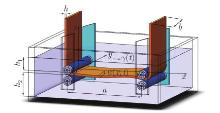
Fig. 1
The diagram of an axially transporting immersed viscoelastic plate (color online)"
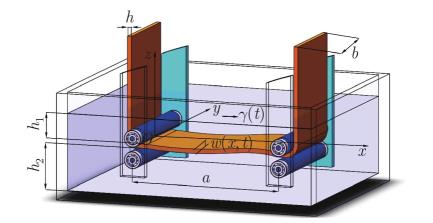
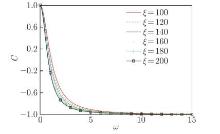
Fig. 2
The numerical variation of C with the natural frequency[29] (color online)"
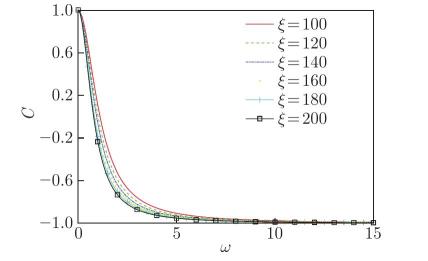
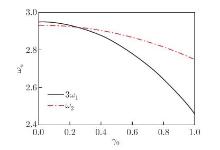
Fig. 3
Effect of the average speed on the first two natural frequencies (color online)"
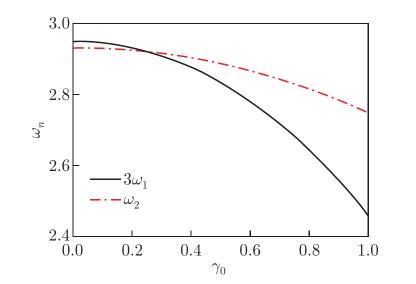
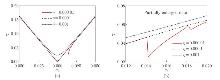
Fig. 4
Influence of viscoelasticity on stability region (κ=0.5, ζ=0.069 7, and madd=16.219 7): (a) the first-order mode; (b) the partially enlarged detail of Fig. 4(a) (color online)"
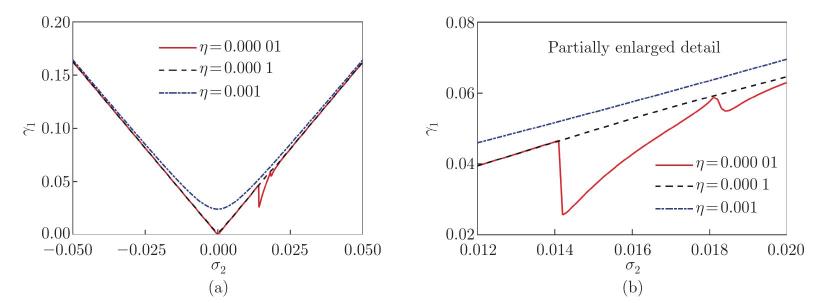
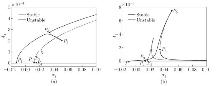
Fig. 5
Steady-state oscillating responses (η=0.000 01, κ=0.5, ζ=0.069 7, and madd=16.219 7, and kN=11 150.614 1): (a) the first-order mode; (b) the second-order mode"
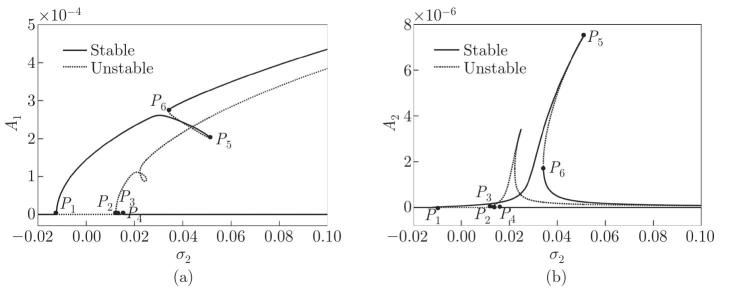

Fig. 6
Steady-state oscillating responses (η=0.000 1, κ=0.5, ζ=0.069 7, madd=16.219 7, and kN=11 150.614 1): (a) the first-order mode; (b) the second-order mode"

Fig. 7
Steady-state oscillating responses (η=0.001, κ=0.5, ζ=0.069 7, madd=16.219 7, and kN=11 150.614 1): (a) the first-order mode; (b) the second-order mode"
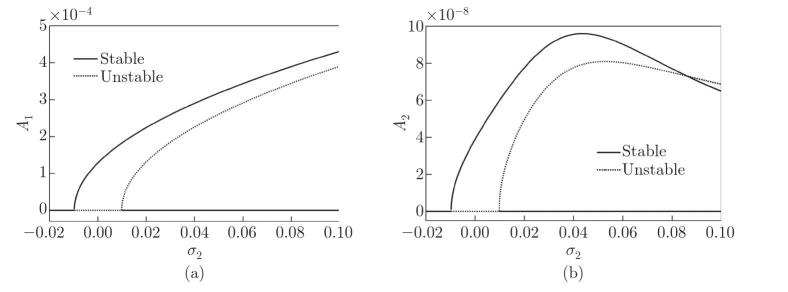
Fig. 8
Time history and phase portrait (γ0=0.4, γ1=0.04, κ=0.5, ζ=0.069 7, kN=11 150.614 1, madd=16.219 7, η=0.000 1, σ2=0, and ε=1): (a) time history diagram; (b) phase diagram"
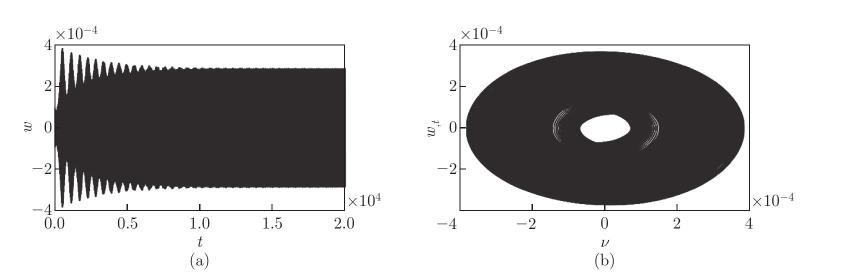

Fig. 9
Partially enlarged diagrams of Fig. 8: (a) time history diagram; (b) phase diagram"

Fig. 10
Spectrum diagram of Fig. 8(a)"
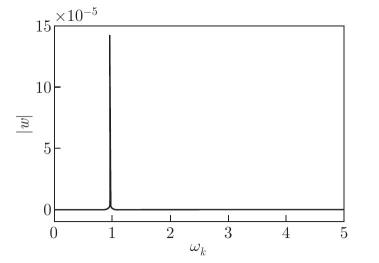
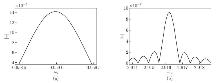
Fig. 11
Partially enlarged diagrams of Fig. 10: (a) the first peak; (b) the second peak"
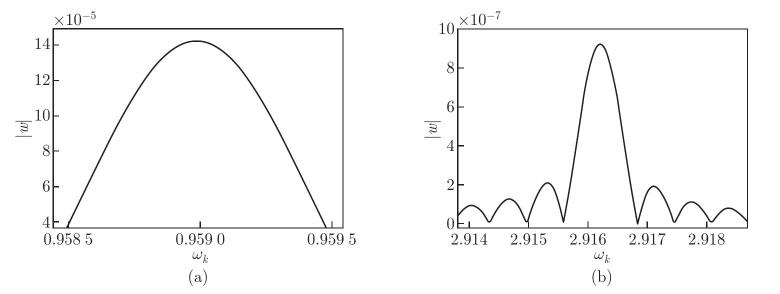
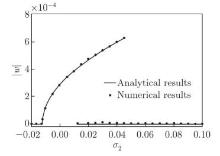
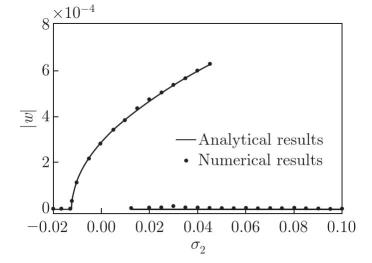
Fig. 12
Comparison between analytical and numerical results"
| [1] | ZHOU, Y. F. and WANG, Z. M. Vibrations of axially moving viscoelastic plate with parabolically varying thickness. Journal of Sound and Vibration, 316(1-5), 198–210 (2008) |
| [2] | TANG, Y. Q. and CHEN, L. Q. Stability analysis and numerical confirmation in parametric resonance of axially moving viscoelastic plates with time-dependent speed. European Journal of Mechanics-A/Solids, 37, 106–121 (2013) |
| [3] | ARMAND ROBINSON, M. T. Analysis of the vibration of axially moving viscoelastic plate with free edges using differential quadrature method. Journal of Vibration and Control, 24(17), 3908–3919 (2017) |
| [4] | SHEN, J. P., WANG, P. Y., GAN, W. T., and LI, C. Stability of vibrating functionally graded nanoplates with axial motion based on the nonlocal strain gradient theory. International Journal of Structural Stability and Dynamics, 20(8), 2050088 (2020) |
| [5] | LU, S. F., XUE, N., ZHANG, W., SONG, X. J., and MA, W. S. Dynamic stability of axially moving graphene reinforced laminated composite plate under constant and varied velocities. Thin-Walled Structures, 167, 108176 (2021) |
| [6] | WANG, Y. Q., XUE, S. W., HUANG, X. B., and DU, W. Vibrations of axially moving vertical rectangular plates in contact with fluid. International Journal of Structural Stability and Dynamics, 16(2), 1450092 (2016) |
| [7] | WANG, Y. Q. and ZU, J. W. Nonlinear steady-state responses of longitudinally traveling functionally graded material plates in contact with liquid. Composite Structures, 164, 130–144 (2017) |
| [8] | LI, H., LANG, T., LIU, Y., and LI, J. Nonlinear vibrations and stability of an axially moving plate immersed in fluid. Acta Mechanica Solida Sinica, 32(6), 737–753 (2019) |
| [9] | ZHOU, Y. F. and WANG, Z. M. Transverse vibration characteristics of axially moving viscoelastic plate. Applied Mathematics and Mechanics (English Edition), 28(2), 209–218 (2007) https://doi.org/10.1007/s10483-007-0209-1 |
| [10] | GHAYESH, M. H., AMABILI, M., and PAÏDOUSSIS, M. P. Nonlinear dynamics of axially moving plates. Journal of Sound and Vibration, 332(2), 391–406 (2013) |
| [11] | AN, C. and SU, J. Dynamic analysis of axially moving orthotropic plates: integral transform solution. Applied Mathematics and Computation, 228, 489–507 (2014) |
| [12] | MARYNOWSKI, K. Free vibration analysis of an axially moving multiscale composite plate including thermal effect. International Journal of Mechanical Sciences, 120, 62–69 (2017) |
| [13] | ESMAEILZADEH, M. and KADKHODAYAN, M. Dynamic analysis of stiffened bi-directional functionally graded plates with porosities under a moving load by dynamic relaxation method with kinetic damping. Aerospace Science and Technology, 93, 105333 (2019) |
| [14] | BANICHUK, N., JERONEN, J., NEITTAANMÄKI, P., and TUOVINEN, T. Dynamic behaviour of an axially moving plate undergoing small cylindrical deformation submerged in axially flowing ideal fluid. Journal of Fluids and Structures, 27(7), 986–1005 (2011) |
| [15] | WANG, Y. Q., HUANG, X. B., and LI, J. Hydroelastic dynamic analysis of axially moving plates in continuous hot-dip galvanizing process. International Journal of Mechanical Sciences, 110, 201–216 (2016) |
| [16] | WANG, Y. Q. and ZU, J. W. Analytical analysis for vibration of longitudinally moving plate submerged in infinite liquid domain. Applied Mathematics and Mechanics (English Edition), 38(5), 625–646 (2017) https://doi.org/10.1007/s10483-017-2192-9 |
| [17] | LI, H. C., KE, L. L., YANG, J., and KITIPORNCHAI, S. Size-dependent free vibration of microbeams submerged in fluid. International Journal of Structural Stability and Dynamics, 20(12), 2050131 (2020) |
| [18] | LOTFAN, S., ANAMAGH, M R., and BEDIZ, B. A general higher-order model for vibration analysis of axially moving doubly-curved panels/shells. Thin-Walled Structures, 164, 107813 (2021) |
| [19] | WANG, Y. Q., DU, W., HUANG, X. B., and XUE, S. Study on the dynamic behavior of axially moving rectangular plates partially submersed in fluid. Acta Mechanica Solida Sinica, 28(6), 706–721 (2015) |
| [20] | WANG, Y., WU, H., YANG, F., and WANG, Q. An efficient method for vibration and stability analysis of rectangular plates axially moving in fluid. Applied Mathematics and Mechanics (English Edition), 42(2), 291–308 (2021) https://doi.org/10.1007/s10483-021-2701-5 |
| [21] | LI, H. C., KE, L. L., YANG, J., KITIPORNCHAI, S., and WANG, Y. S. Free vibration of variable thickness FGM beam submerged in fluid. Composite Structures, 233, 111582 (2020) |
| [22] | TAATI, E., RASTIAN, V., and FALLAH, F. Nonlinear geometric fluid-structure interaction model of multilayered sandwich plates in contact with unbounded or bounded fluid flow. Ocean Engineering, 292, 116559 (2024) |
| [23] | NIEMI, J. and PRAMILA, A. FEM-analysis of transverse vibrations of an axially moving membrane immersed in ideal fluid. International Journal for Numerical Methods in Engineering, 24(12), 2301–2313 (1987) |
| [24] | HOSSEINI-HASHEMI, S., KARIMI, M., and ROKNI, H. Natural frequencies of rectangular Mindlin plates coupled with stationary fluid. Applied Mathematical Modelling, 36(2), 764–778 (2012) |
| [25] | TUBALDI, E., ALIJANI, F., and AMABILI, M. Non-linear vibrations and stability of a periodically supported rectangular plate in axial flow. International Journal of Non-Linear Mechanics, 66, 54–65 (2014) |
| [26] | TUBALDI, E., AMABILI, M., and ALIJANI, F., Nonlinear vibrations of plates in axial pulsating flow. Journal of Fluids and Structures, 56, 33–55 (2015) |
| [27] | CHEN, L. Q. and TANG, Y. Q. Parametric stability of axially accelerating viscoelastic beams with the recognition of longitudinally varying tensions. Journal of Vibration and Acoustics, 134, 011008 (2012) |
| [28] | DING, H. and ZU, J. W. Periodic and chaotic responses of an axially accelerating viscoelastic beam under two-frequency excitations. International Journal of Applied Mechanics, 5(2), 1350019 (2013) |
| [29] | TANG, Y. Q., ZHOU, Q. K., JIANG, S. Y., and TAN, X. Dynamics of axially moving viscoelastic panels immersed in fluid. Journal of Sound and Vibration, 582, 118400 (2024) |
| [30] | PANDA, L. N. and KAR, R. C. Nonlinear dynamics of a pipe conveying pulsating fluid with parametric and internal resonances. Nonlinear Dynamics, 49(1), 9–30 (2007) |
| [31] | GHAYESH, M. H., KAZEMIRAD, S., and AMABILI, M. Coupled longitudinal-transverse dynamics of an axially moving beam with an internal resonance. Mechanism and Machine Theory, 52, 18–34 (2012) |
| [32] | SAHOO, B., PANDA, L. N., and POHIT, G. Parametric and internal resonances of an axially moving beam with time-dependent velocity. Modelling and Simulation in Engineering, 2013, 919517 (2013) |
| [33] | DING, H. and LI, D. P. Static and dynamic behaviors of belt-drive dynamic systems with a one-way clutch. Nonlinear Dynamics, 78(2), 1553–1575 (2014) |
| [34] | MAO, X. Y., DING, H., and CHEN, L. Q. Internal resonance of a supercritically axially moving beam subjected to the pulsating speed. Nonlinear Dynamics, 95, 631–651 (2019) |
| [35] | TANG, Y. Q. and CHEN, L. Q. Nonlinear free transverse vibrations of in-plane moving plates: without and with internal resonances. Journal of Sound and Vibration, 330(1), 110–126 (2011) |
| [36] | ZHANG, D. B., TANG, Y. Q., and CHEN, L. Q. Internal resonance in parametric vibrations of axially accelerating viscoelastic plates. European Journal of Mechanics-A/Solids, 75, 142–155 (2019) |
| [37] | LI, H. Y., LI, J., and LIU, Y. J. Internal resonance of an axially moving unidirectional plate partially immersed in fluid under foundation displacement excitation. Journal of Sound and Vibration, 358, 124–141 (2015) |
| [38] | WANG, Y. Q. and YANG, Z. Nonlinear vibrations of moving functionally graded plates containing porosities and contacting with liquid: internal resonance. Nonlinear Dynamics, 90(2), 1461–1480 (2017) |
| [39] | WANG, Y. Q. and ZU, J. W. Instability of viscoelastic plates with longitudinally variable speed and immersed in ideal liquid. International Journal of Applied Mechanics, 9(1) 1750005 (2017) |
| [40] | CHEN, L. Q. and TANG, Y. Q. Combination and principal parametric resonances of axially accelerating viscoelastic beams: recognition of longitudinally varying tensions. Journal of Sound and Vibration, 330(23), 5598–5614 (2011) |
| [41] | MOTE, C. D. JR. A study of band saw vibrations. Journal of the Franklin Institute, 276(6), 430–444 (1965) |
| [42] | SONI, S., JAIN, N. K., and JOSHI, P. V. Analytical modeling for nonlinear vibration analysis of partially cracked thin magneto-electro-elastic plate coupled with fluid. Nonlinear Dynamics, 90(1), 137–170 (2017) |
| [43] | HADDARA, M. R. and CAO, S. A study of the dynamic response of submerged rectangular flat plates. Marine Structures, 9(10), 913–933 (1996) |
| [1] | Guilin SHE, Yujie HE. Nonlinear 1:1 internal resonance in graphene platelet-reinforced fluid-conveying pipes [J]. Applied Mathematics and Mechanics (English Edition), 2025, 46(10): 1903-1920. |
| [2] | Lele REN, Wei ZHANG, Yufei ZHANG. Inter-well internal resonance analysis of rectangular asymmetric cross-ply bistable composite laminated cantilever shell under transverse foundation excitation [J]. Applied Mathematics and Mechanics (English Edition), 2024, 45(8): 1353-1370. |
| [3] | Dengbo ZHANG, Youqi TANG, Ruquan LIANG, Yuanmei SONG, Liqun CHEN. Internal resonance of an axially transporting beam with a two-frequency parametric excitation [J]. Applied Mathematics and Mechanics (English Edition), 2022, 43(12): 1805-1820. |
| [4] | Yunfei LIU, Jun WANG, Jiaxin HU, Zhaoye QIN, Fulei CHU. Multiple internal resonances of rotating composite cylindrical shells under varying temperature fields [J]. Applied Mathematics and Mechanics (English Edition), 2022, 43(10): 1543-1554. |
| [5] | Yunfei LIU, Zhaoye QIN, Fulei CHU. Nonlinear dynamic responses of sandwich functionally graded porous cylindrical shells embedded in elastic media under 1:1 internal resonance [J]. Applied Mathematics and Mechanics (English Edition), 2021, 42(6): 805-818. |
| [6] | Jing WANG, Yilin ZHU, Bo ZHANG, Huoming SHEN, Juan LIU. Nonlocal and strain gradient effects on nonlinear forced vibration of axially moving nanobeams under internal resonance conditions [J]. Applied Mathematics and Mechanics (English Edition), 2020, 41(2): 261-278. |
| [7] | A. NIKPOURIAN, M. R. GHAZAVI, S. AZIZI. Size-dependent modal interactions of a piezoelectrically laminated microarch resonator with 3:1 internal resonance [J]. Applied Mathematics and Mechanics (English Edition), 2020, 41(10): 1517-1538. |
| [8] | Yunyue CONG, Houjun KANG, Tieding GUO. Analysis of in-plane 1:1:1 internal resonance of a double cable-stayed shallow arch model with cables' external excitations [J]. Applied Mathematics and Mechanics (English Edition), 2019, 40(7): 977-1000. |
| [9] | Houjun KANG, Tieding GUO, Weidong ZHU, Junyi SU, Bingyu ZHAO. Dynamical modeling and non-planar coupled behavior of inclined CFRP cables under simultaneous internal and external resonances [J]. Applied Mathematics and Mechanics (English Edition), 2019, 40(5): 649-678. |
| [10] | S. SAHMANI, A. M. FATTAHI. Small scale effects on buckling and postbuckling behaviors of axially loaded FGM nanoshells based on nonlocal strain gradient elasticity theory [J]. Applied Mathematics and Mechanics (English Edition), 2018, 39(4): 561-580. |
| [11] | Hu DING, Linglu HUANG, Xiaoye MAO, Liqun CHEN. Primary resonance of traveling viscoelastic beam under internal resonance [J]. Applied Mathematics and Mechanics (English Edition), 2017, 38(1): 1-14. |
| [12] | Xiaodong WANG, Yushu CHEN, Lei HOU. Nonlinear dynamic singularity analysis of two interconnected synchronous generator system with 1:3 internal resonance and parametric principal resonance [J]. Applied Mathematics and Mechanics (English Edition), 2015, 36(8): 985-1004. |
| [13] | Rui MA;Yu-Shu CHEN. Bifurcation of multi-freedom gear system with spalling defect [J]. Applied Mathematics and Mechanics (English Edition), 2013, 34(4): 475-488. |
| [14] | J.ZUECO;S.AHMED. Combined heat and mass transfer by mixed convection MHD flow along a porous plate with chemical reaction in presence of heat source [J]. Applied Mathematics and Mechanics (English Edition), 2010, 31(10): 1217-1230. |
| [15] | A.Tekin;E.Ozkaya;S.M.Bagdath. Three-to-one internal resonance in multiple stepped beam systems [J]. Applied Mathematics and Mechanics (English Edition), 2009, 30(9): 1131-1142. |
| Viewed | ||||||
|
Full text |
|
|||||
|
Abstract |
|
|||||





 Email Alert
 RSS
RSS