Applied Mathematics and Mechanics (English Edition) ›› 2026, Vol. 47 ›› Issue (3): 555-572.doi: https://doi.org/10.1007/s10483-026-3358-8
Previous Articles Next Articles
Ling WANG1, Huoming SHEN2,3, Yuxing WANG2,4,†( )
)
Received:2025-10-02
Revised:2025-12-25
Published:2026-03-02
Contact:
Yuxing WANG, E-mail: wangyuxing1991@163.comSupported by:2010 MSC Number:
Ling WANG, Huoming SHEN, Yuxing WANG. Generalized semi-analytical modeling of three-dimensional contact responses in piezoelectric semiconductors with conductive indenters. Applied Mathematics and Mechanics (English Edition), 2026, 47(3): 555-572.
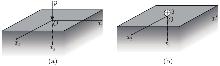
Fig. 1
Schematic diagrams of an n-type PSC half-space subject to (a) a unit normal force or (b) a unit electric charge"
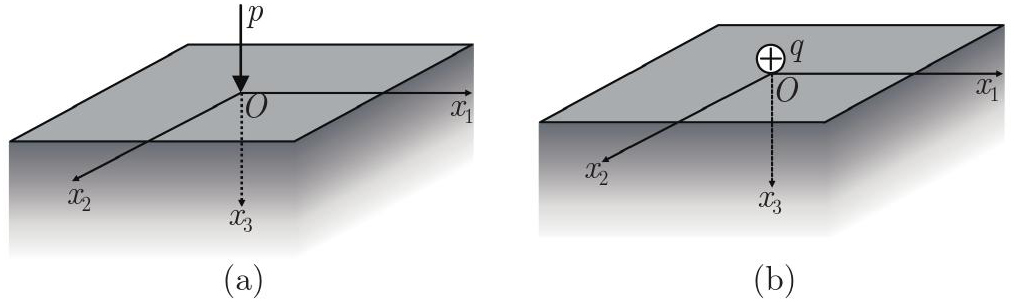
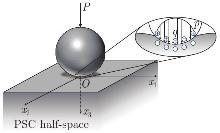
Fig. 2
Schematic of the contact between a PSC half-space and a rigid spherical indenter (color online)"
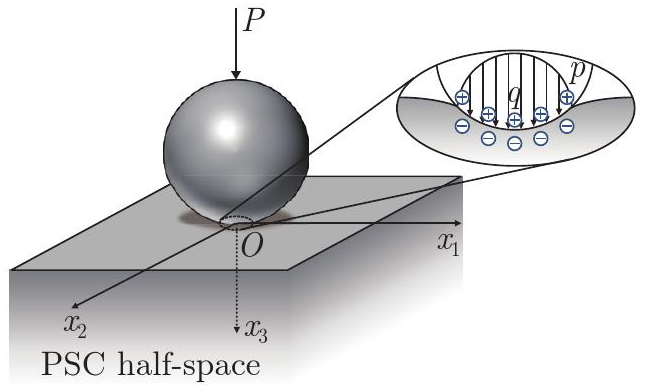
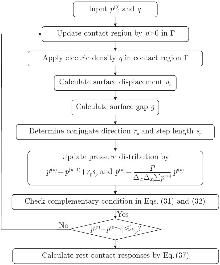
Fig. 3
Flowchart of the numerical procedure"
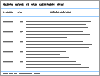
Table 1
Material parameters of ZnO"
| Elastic constant/GPa | Piezoelectric constant/(C·m-2) | ||||||
|---|---|---|---|---|---|---|---|
| 210 | 121 | 105 | 211 | 43 | -0.48 | -0.57 | 1.32 |
Table 2
Convergence of the normalized pressure peaks with respect to the mesh number for q=0.01 C/m2"
| 3.311 | 3.292 | 3.232 | |
| 1.557 | 1.546 | 2.362 | |
| 1.564 | 1.553 | 1.919 | |
| 1.559 | 1.549 | 1.706 | |
| 1.556 | 1.545 | 1.603 | |
| 1.554 | 1.543 | 1.506 | |
| 1.554 | 1.543 | 1.506 |
Table 3
Convergence of the normalized pressure peaks with respect to the mesh number for q=0.05 C/m2"
| 3.308 | 3.290 | 3.232 | |
| 1.554 | 1.543 | 2.362 | |
| 1.562 | 1.551 | 1.919 | |
| 1.557 | 1.547 | 1.706 | |
| 1.553 | 1.542 | 1.603 | |
| 1.552 | 1.542 | 1.506 | |
| 1.552 | 1.542 | 1.506 |
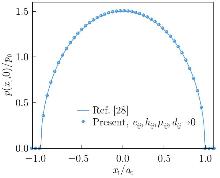
Fig. 4
Comparison between the present reduced model and the analytical solution[28] (color online)"
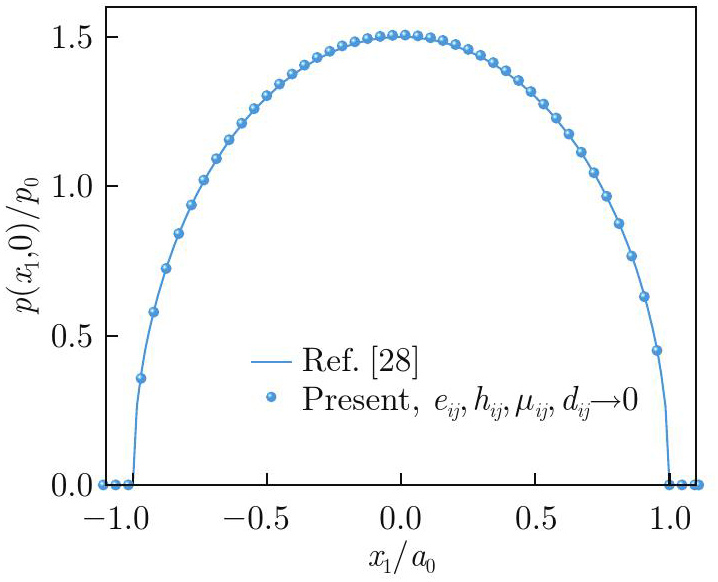
Fig. 5
Comparison between the results obtained from the present model and those from Ref. [11]: (a) force-displacement curves; (b) electric potential-displacement curves (color online)"
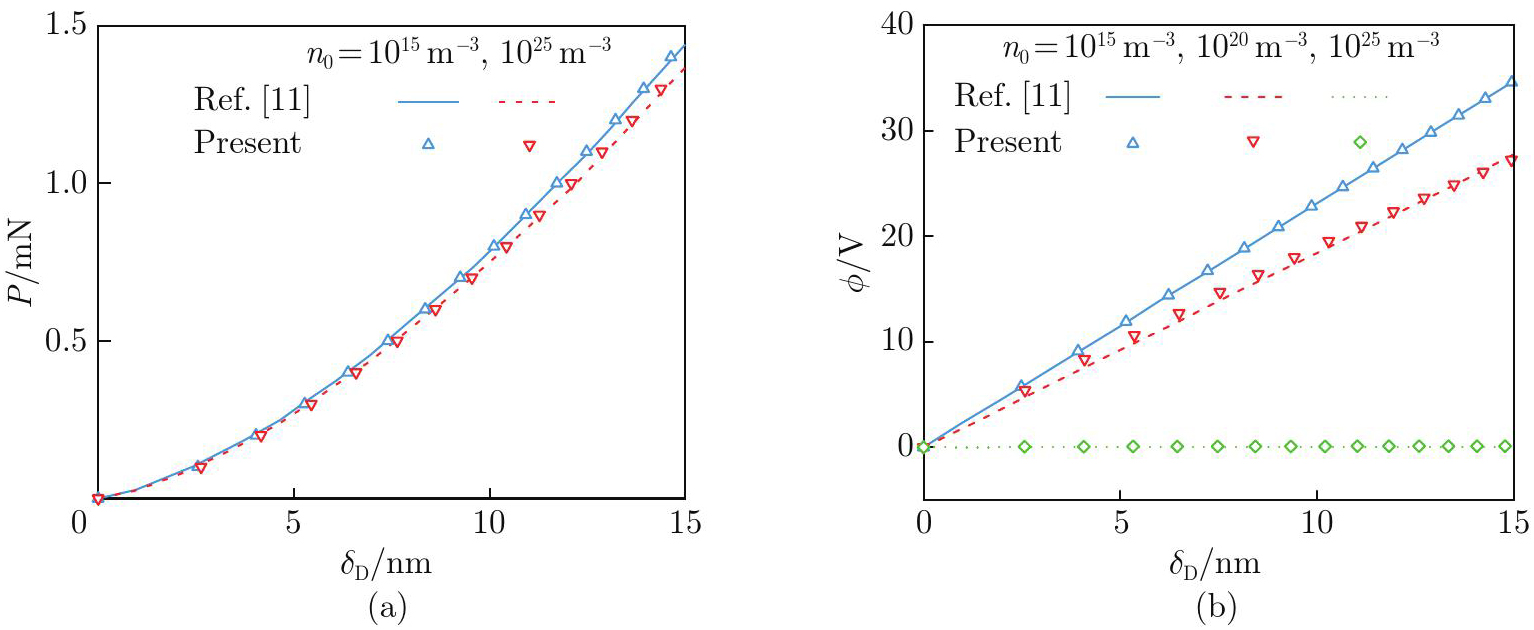
Fig. 6
Surface pressure distributions along the x1-axis for different (a) surface charge densities and (b) steady carrier concentrations (color online)"
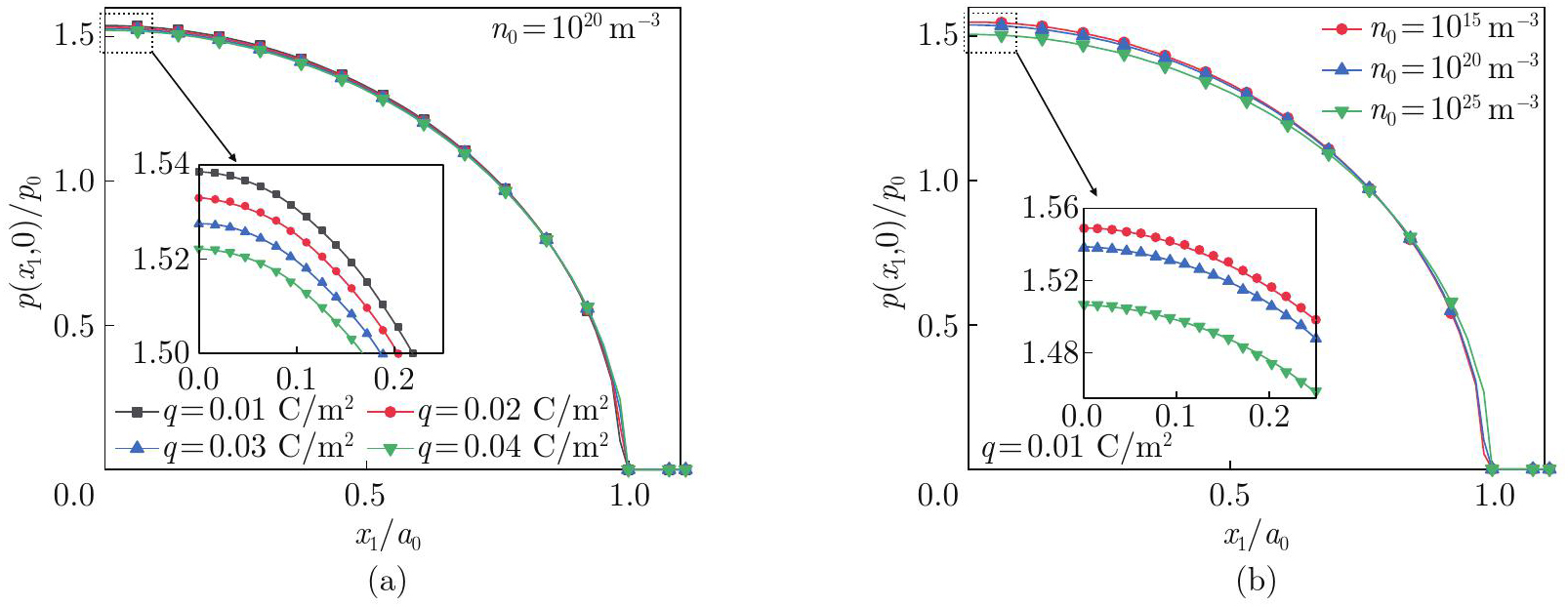
Fig. 7
Surface electric potential distributions along the x1-axis for different (a) surface charge densities and (b) steady carrier concentrations (color online)"
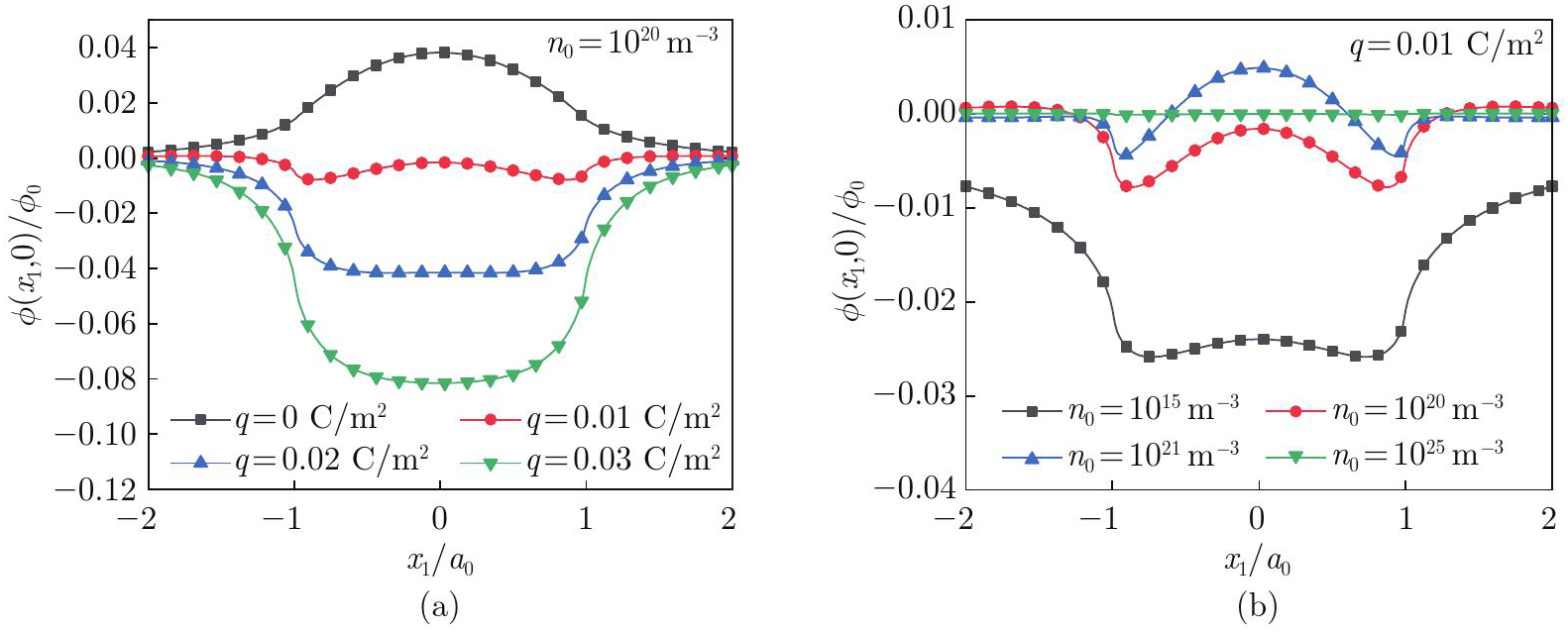
Fig. 8
P versus δD curves for different (a) surface charge densities and (b) steady carrier concentrations (color online)"
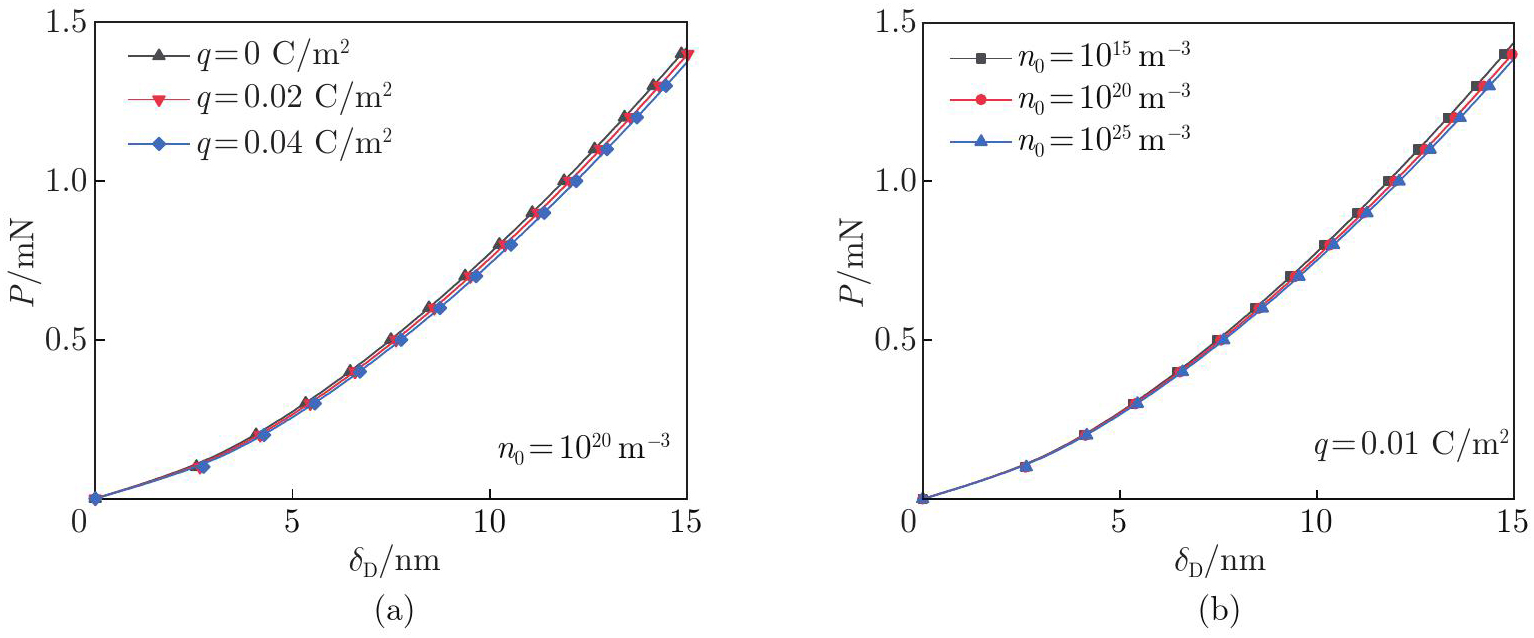
Fig. 9
ϕ(0, 0)/ϕ0 versus δD curves for different (a) surface charge densities and (b) steady carrier concentrations (color online)"
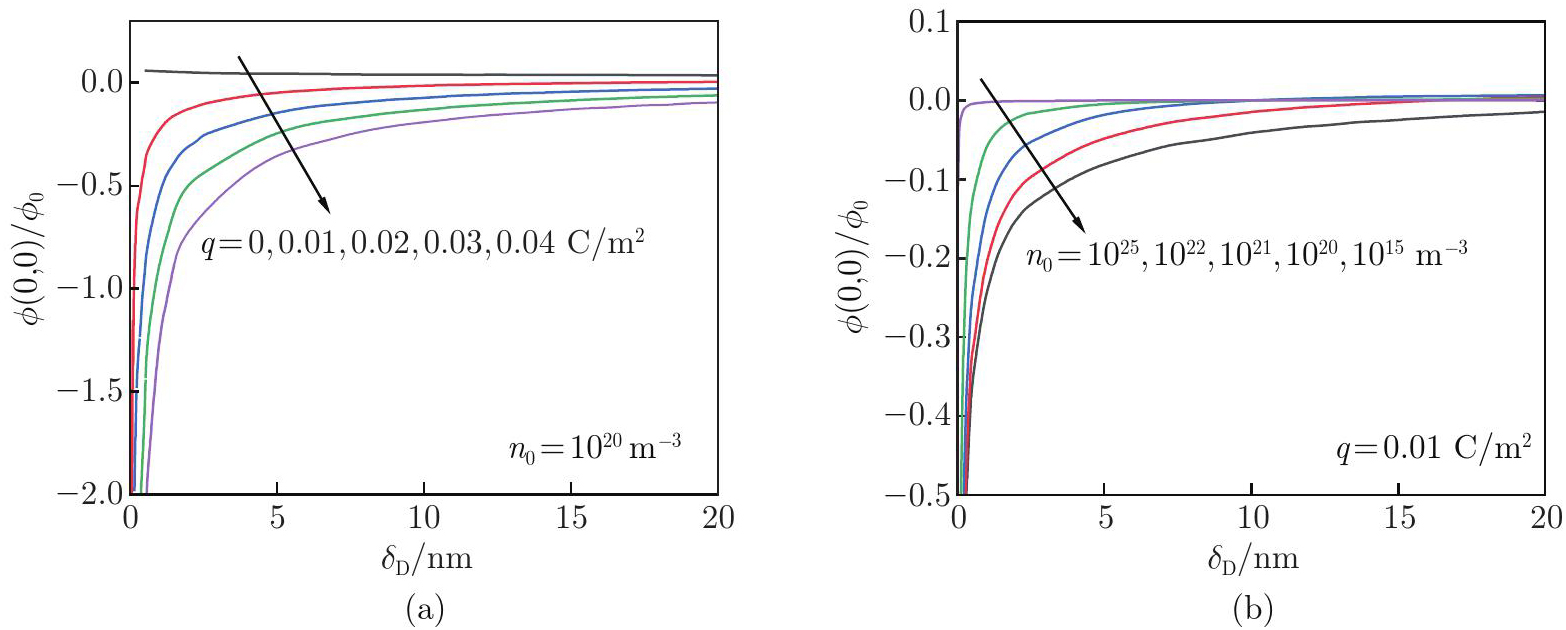
Fig. 10
Dependence of the total contact force on the steady carrier concentration for different (a) surface charge densities and (b) indentation depths (color online)"
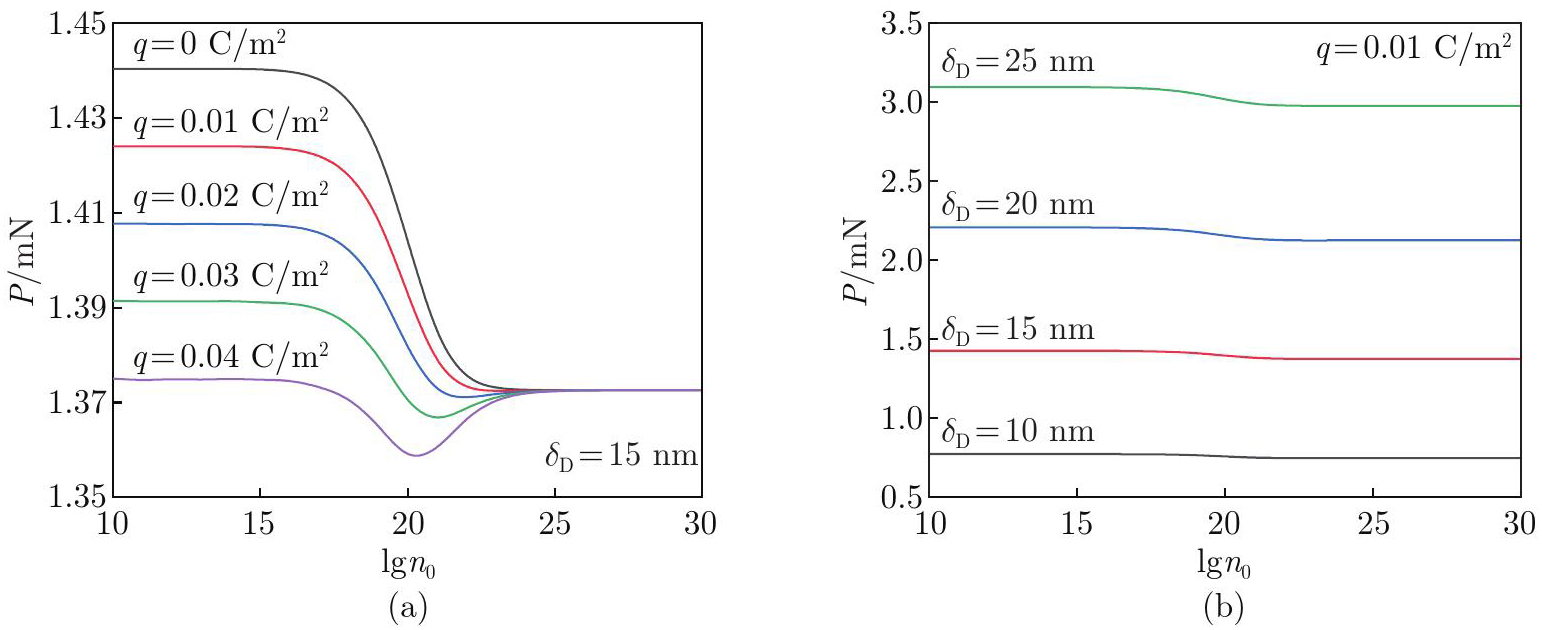
Fig. 11
Dependence of the central electric potential on the steady carrier concentration for different (a) surface charge densities and (b) indentation depths (color online)"
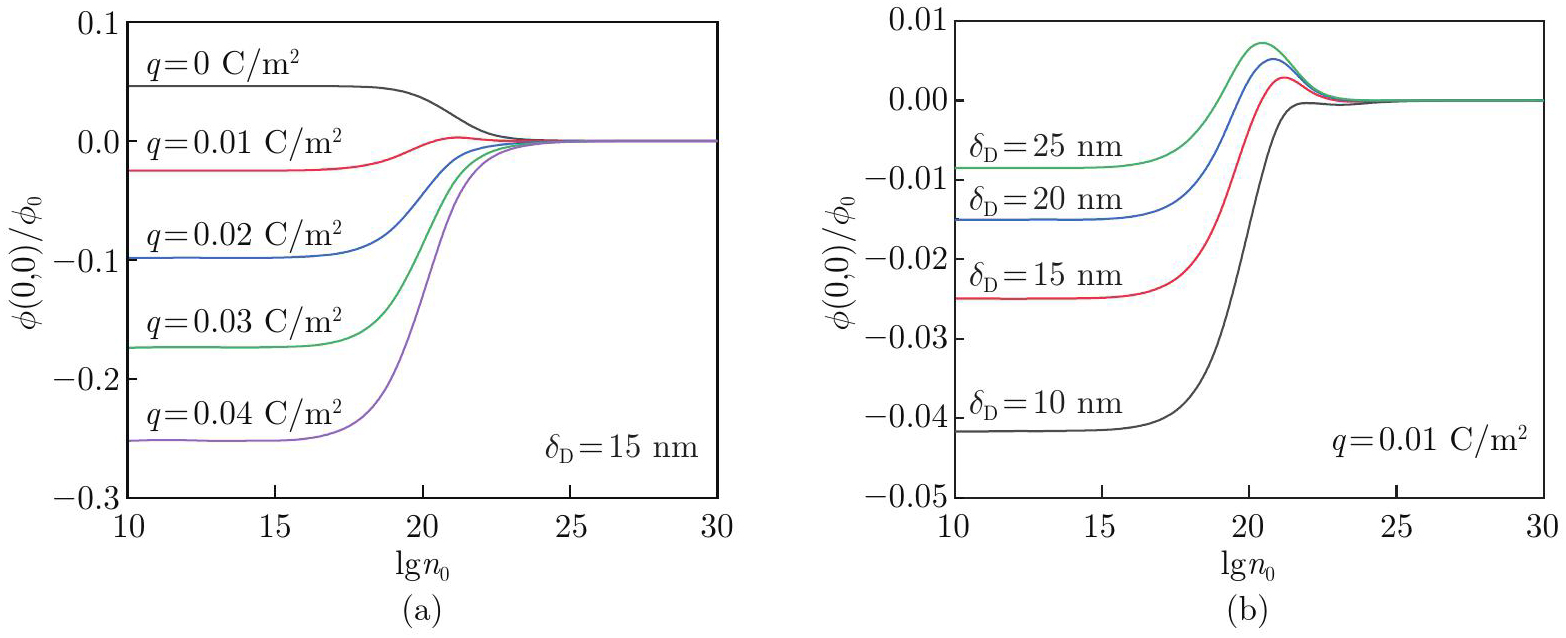
Fig. 12
Sensitivity of (a) the indentation depth and (b) the central electric potential to independent material parameters for different n0 (color online)"
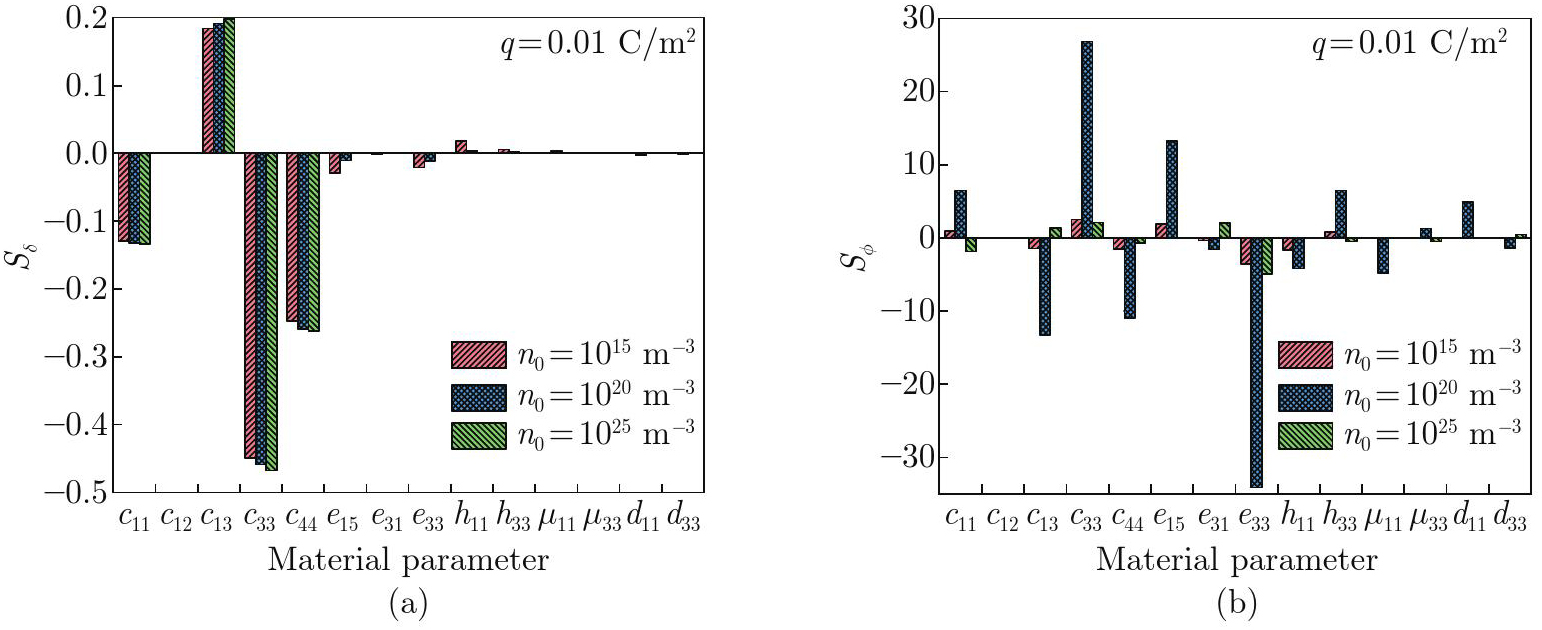
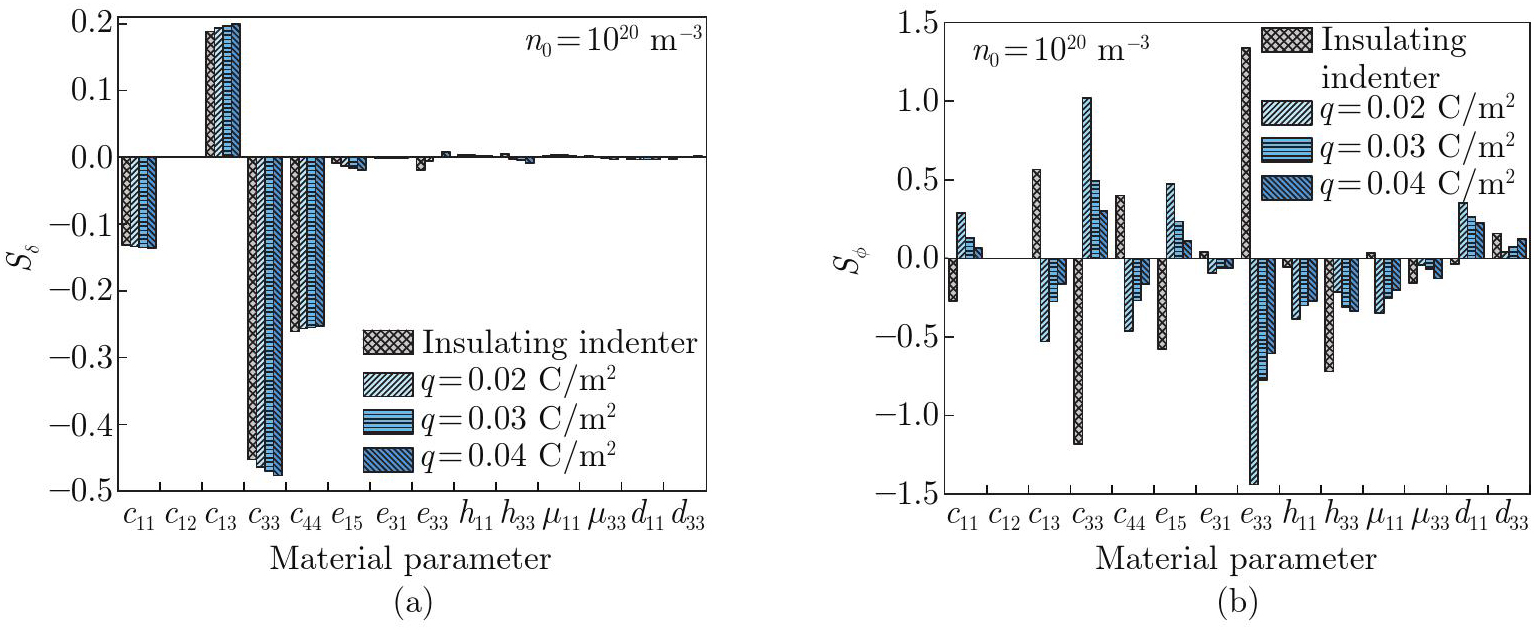
Fig. 13
Sensitivity of (a) the indentation depth and (b) the central electric potential to independent material parameters for different q (color online)"
| [1] | WU, W., WEN, X., and WANG, Z. L. Taxel-addressable matrix of vertical-nanowire piezotronic transistors for active and adaptive tactile imaging. Science, 340(6135), 952–957 (2013) |
| [2] | LI, Y., FENG, J., ZHAO, Y., WANG, J., and XU, C. Ultrathin flexible linear-piezoelectric ZnO thin film actuators: tuning the piezoelectric responses by in-plane epitaxial strain. Applied Surface Science, 599, 153969 (2022) |
| [3] | ZHOU, Y. S., WANG, K., HAN, W., RAI, S. C., ZHANG, Y., DING, Y., PAN, C., ZHANG, F., ZHOU, W., and WANG, Z. L. Vertically aligned CdSe nanowire arrays for energy harvesting and piezotronic devices. ACS Nano, 6(7), 6478–6482 (2012) |
| [4] | HAN, C., LU, C., ZHAO, M., and ZHANG, Q. Nonlinear finite element analysis of electromechanical behaviors in a piezoelectric semiconductor beam. International Journal of Non-Linear Mechanics, 149, 104311 (2023) |
| [5] | ZHANG, Q., LI, M., and ZHAO, M. Dynamic analysis of a piezoelectric semiconductor nanoplate with surface effect. Materials Today Communications, 33, 104406 (2022) |
| [6] | ZHAO, M., UMAIR, M., LU, C., and QIN, G. Electric current-restrained crack propagation in brittle GaN ceramics. Journal of Materials Science, 56(9), 5730–5735 (2021) |
| [7] | LI, D., ZHANG, C., ZHANG, S., WANG, H., CHEN, W., and ZHANG, C. Propagation of terahertz elastic longitudinal waves in piezoelectric semiconductor rods. Ultrasonics, 132, 106964 (2023) |
| [8] | LIU, Y., ZHANG, Y., YANG, Q., NIU, S., and WANG, Z. L. Fundamental theories of piezotronics and piezo-phototronics. Nano Energy, 14, 257–275 (2015) |
| [9] | QIN, G., ZHANG, X., MA, S., ZHANG, Q., FAN, C., and ZHAO, M. An accurate computational method for analysis of electromechanical properties of structures with metal-GaN piezoelectric semiconductor contact. Computational Materials Science, 152, 70–77 (2018) |
| [10] | GAO, S., ZHANG, L., LIU, J., NIE, G., and CHEN, W. Indentation behavior of a semi-infinite piezoelectric semiconductor under a rigid flat-ended cylindrical indenter. Applied Mathematics and Mechanics (English Edition), 45(4), 649–662 (2024) https://doi.org/10.1007/s10483-024-3107-5 |
| [11] | GAO, S., ZHANG, Z., NIE, G., LIU, J., and CHEN, W. Indentation responses of piezoelectric semiconductors. International Journal of Solids and Structures, 290, 112682 (2024) |
| [12] | GAO, S., JU, C., NIE, G., LIU, J., and CHEN, W. Indentation response characteristics of a piezoelectric semiconductor layer. International Journal of Mechanical Sciences, 286, 109809 (2025) |
| [13] | GAO, S., NIE, G., LIU, J., and CHEN, W. Spherical indentation on a piezoelectric semiconductor film/elastic substrate system. Acta Mechanica Solida Sinica, 38(5), 872–883 (2025) |
| [14] | POLONSKY, I. A. and KEER, L. M. A numerical method for solving rough contact problems based on the multi-level multi-summation and conjugate gradient techniques. Wear, 231(2), 206–219 (1999) |
| [15] | LIU, S., WANG, Q., and LIU, G. A versatile method of discrete convolution and FFT (DC-FFT) for contact analyses. Wear, 243(1-2), 101–111 (2000) |
| [16] | LIU, S. and WANG, Q. Studying contact stress fields caused by surface tractions with a discrete convolution and fast Fourier transform algorithm. Journal of Tribology, 124(1), 36–45 (2002) |
| [17] | WANG, Q. J., SUN, L., ZHANG, X., LIU, S., and ZHU, D. FFT-based methods for computational contact mechanics. Frontiers in Mechanical Engineering, 6, 61 (2020) |
| [18] | MA, L., LI, X., LI, Y., PAN, B., TIAN, Y., SHEN, Y., DING, S., and ZHANG, X. Impact of frictional heat and electric charge on the thermomechanical contact properties of piezoelectric quasicrystals: a DC-FFT algorithm. Materials Today Communications, 41, 110721 (2024) |
| [19] | HUANG, R., DING, S., CHEN, Q., LV, C., ZHANG, X., and LI, X. Sliding frictional contact of one dimensional hexagonal piezoelectric quasicrystals coating on piezoelectric substrate with imperfect interface. International Journal of Solids and Structures, 239, 111423 (2022) |
| [20] | WANG, Y., SHEN, H., LI, J., WANG, L., LIU, J., WANG, J., and LIU, H. Three-dimensional frictional contact within the framework of couple stress elasticity. Applied Mathematical Modelling, 131, 288–305 (2024) |
| [21] | WANG, Y., ZHANG, X., SHEN, H., LIU, J., and ZHANG, B. Couple stress-based 3D contact of elastic films. International Journal of Solids and Structures, 191, 449–463 (2020) |
| [22] | WANG, Y., ZHANG, X., SHEN, H., LIU, J., ZHANG, B., and XU, S. Three-dimensional contact analysis with couple stress elasticity. International Journal of Mechanical Sciences, 153, 369–379 (2019) |
| [23] | WANG, Z. J., WANG, W. Z., MENG, F. M., and WANG, J. X. Fretting contact analysis on three-dimensional elastic layered half space. Journal of Tribology, 133(3), 031401 (2011) |
| [24] | WANG, Y., ZHANG, X., KEER, L. M., and SHEN, H. Sub-Rayleigh elastodynamic frictional contact of a layer-substrate system. Tribology International, 148, 106299 (2020) |
| [25] | CHENG, A., SUN, L., MENGA, N., YANG, W., and ZHANG, X. Interfacial performance evolution of ceramics-in-polymer composite electrolyte in solid-state lithium metal batteries. International Journal of Engineering Science, 204, 104137 (2024) |
| [26] | HU, Y., ZENG, Y., and YANG, J. A mode III crack in a piezoelectric semiconductor of crystals with 6 mm symmetry. International Journal of Solids and Structures, 44(11-12), 3928–3938 (2007) |
| [27] | SLADEK, J., SLADEK, V., BISHAY, P. L., and GARCIA-SANCHEZ, F. Influence of electric conductivity on intensity factors for cracks in functionally graded piezoelectric semiconductors. International Journal of Solids and Structures, 59, 79–89 (2015) |
| [28] | DING, H., CHEN, W., and ZHANG, L. Elasticity of Transversely Isotropic Materials, Springer Dordrecht, Netherlands (2006) |
| [29] | SUI, Y., WANG, W., ZHANG, H., and LIANG, H. 3D frictional contact of graded magneto-electro-elastic film-substrate system under electromagnetic fields. International Journal of Solids and Structures, 269, 112217 (2023) |
| [30] | BARBER, J. R. Contact Mechanics, Springer Cham, Switzerland (2018) |
| [31] | WANG, Y., SHEN, H., ZHANG, X., ZHANG, B., LIU, J., and LI, X. Semi-analytical study of microscopic two-dimensional partial slip contact problem within the framework of couple stress elasticity: cylindrical indenter. International Journal of Solids and Structures, 138, 76–86 (2018) |
| [32] | MAKAGON, A., KACHANOV, M., KALININ, S. V., and KARAPETIAN, E. Indentation of spherical and conical punches into piezoelectric half-space with frictional sliding: applications to scanning probe microscopy. Physical Review B, 76(6), 064115 (2007) |
| [33] | ZHANG, X., HE, T., MIWA, H., NANBU, T., MURAKAMI, R., LIU, S., CAO, J., and WANG, Q. J. A new approach for analyzing the temperature rise and heat partition at the interface of coated tool tip-sheet incremental forming systems. International Journal of Heat and Mass Transfer, 129, 1172–1183 (2019) |
| [1] | Xiang XU, Peilin FU, Xiaowei WANG, Jianming GONG, Jianping ZHAO, Qianhua KAN. Semi-analytical contact modeling of finite-width functionally graded coatings [J]. Applied Mathematics and Mechanics (English Edition), 2026, 47(8): 1835-1854. |
| [2] | Guozheng ZHANG, Zhaohe DA. Asymptotic models for thin transversely isotropic elastic layers [J]. Applied Mathematics and Mechanics (English Edition), 2026, 47(7): 1603-1624. |
| [3] | Zhengzhe XIE, S. EL-BORGI, Jie SU, Liaoliang KE. Mixed elastohydrodynamic lubrication contact of piezoelectric materials with different Gaussian rough surfaces [J]. Applied Mathematics and Mechanics (English Edition), 2026, 47(5): 965-984. |
| [4] | Ru TIAN, Lisha YI, Guoquan NIE, Jinxi LIU, Ernian PAN, Yuesheng WANG. Lamb waves in multilayered piezoelectric semiconductor plates [J]. Applied Mathematics and Mechanics (English Edition), 2025, 46(8): 1493-1510. |
| [5] | Lele ZHANG, Zheng ZHAO, Xiaofan HU, Guoquan NIE, Jinxi LIU. Exact multi-field coupling modeling and analysis of piezoelectric semiconductor plates [J]. Applied Mathematics and Mechanics (English Edition), 2025, 46(7): 1331-1346. |
| [6] | Linyao WANG, Aibing ZHANG, Chuanzeng ZHANG, Jianke DU, Z. M. XIAO, Jia LOU. Rayleigh wave propagation in an elastic half-space with an attached piezoelectric semiconductor layer considering flexoelectricity and size-effects [J]. Applied Mathematics and Mechanics (English Edition), 2025, 46(6): 1069-1088. |
| [7] | Zibo WEI, Peijun WEI, Chunyu XU, Xiao GUO. Dispersion, attenuation, and bandgap of in-plane coupled Bloch waves in piezoelectric semiconductor phononic crystal with PN junction [J]. Applied Mathematics and Mechanics (English Edition), 2025, 46(5): 813-830. |
| [8] | Qiaoyun ZHANG, Xiaoyan ZHANG, Jiahao XU, Zhicai SONG, Minghao ZHAO. Vibration characteristic analysis of a cracked piezoelectric semiconductor curved beam [J]. Applied Mathematics and Mechanics (English Edition), 2025, 46(10): 1967-1982. |
| [9] | Shijing GAO, Lele ZHANG, Jinxi LIU, Guoquan NIE, Weiqiu CHEN. Indentation behavior of a semi-infinite piezoelectric semiconductor under a rigid flat-ended cylindrical indenter [J]. Applied Mathematics and Mechanics (English Edition), 2024, 45(4): 649-662. |
| [10] | Wanli YANG, Jinxi LIU, Yizhan YANG, Yuantai HU. The mechanism to reform dynamic performance of an elastic wave-front in a piezoelectric semiconductor by the wave-carrier interaction induced from static biasing fields [J]. Applied Mathematics and Mechanics (English Edition), 2023, 44(3): 381-396. |
| [11] | Pengxu GUO, Yueting ZHOU. Exact analysis of the orientation-adjusted adhesive full stick contact of layered structures with the asymmetric bipolar coordinates [J]. Applied Mathematics and Mechanics (English Edition), 2022, 43(6): 883-898. |
| [12] | S. A. SAHU, S. NIRWAL, S. MONDAL. Reflection and transmission of quasi-plane waves at the interface of piezoelectric semiconductors with initial stresses [J]. Applied Mathematics and Mechanics (English Edition), 2021, 42(7): 951-968. |
| [13] | Minghao ZHAO, Zelong MA, Chunsheng LU, Qiaoyun ZHANG. Application of the homotopy analysis method to nonlinear characteristics of a piezoelectric semiconductor fiber [J]. Applied Mathematics and Mechanics (English Edition), 2021, 42(5): 665-676. |
| [14] | Wanli YANG, Yuantai HU, E. N. PAN. Electronic band energy of a bent ZnO piezoelectric semiconductor nanowire [J]. Applied Mathematics and Mechanics (English Edition), 2020, 41(6): 833-844. |
| [15] | Xinchun SHANG, Jiaxuan LIU, Xuhua GAO, Weiyao ZHU. Analysis on nonlinear effect of unsteady percolation in the inhomogeneous shale gas reservoir [J]. Applied Mathematics and Mechanics (English Edition), 2020, 41(1): 105-122. |
| Viewed | ||||||
|
Full text |
|
|||||
|
Abstract |
|
|||||





 Email Alert
 RSS
RSS