Applied Mathematics and Mechanics (English Edition) ›› 2026, Vol. 47 ›› Issue (4): 905-926.doi: https://doi.org/10.1007/s10483-026-3368-6
Previous Articles Next Articles
T. T. BANH1,2,4, N. T. Y. NGUYEN3, H. P. BAN4, D. LEE4,†( )
)
Received:2025-12-02
Revised:2026-02-05
Published:2026-03-31
Contact:
D. LEE, E-mail: dongkyulee@sejong.ac.krSupported by:2010 MSC Number:
T. T. BANH, N. T. Y. NGUYEN, H. P. BAN, D. LEE. Structural optimization of stress-bearing structures of nearly incompressible problems under design-dependent pressure loads. Applied Mathematics and Mechanics (English Edition), 2026, 47(4): 905-926.
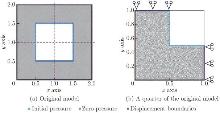
Fig. 1
Geometry and boundary conditions of a closed planar container under the internal pressure (color online)"
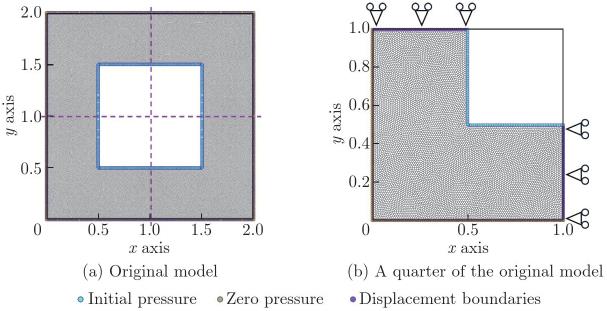
Table 1
Comparison of different objectives and constraints of the closed planar container"
| Case | Optimized design | Stress plot |
|---|---|---|
| Case 1: Minimum compliance design under volume constraint (20%V0) when | 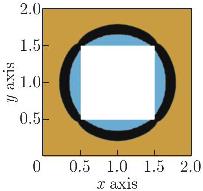 | 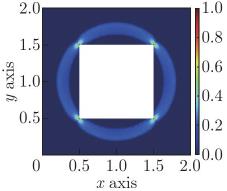 |
| Case 2: Minimum volume design under stress constraint | 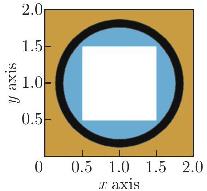 | 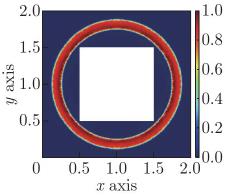 |
| Case 3: Minimum stress design under volume constraint (20%V0) when | 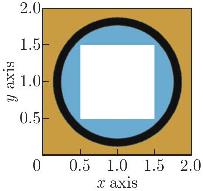 | 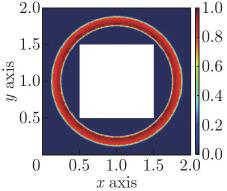 |
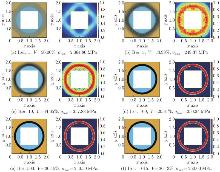
Fig. 2
Evolutions of the topology at several intermediate steps of the PCE-based volume design under σadm=250 MPa and its corresponding normalized von Mises stress under the plane stress condition (color online)"
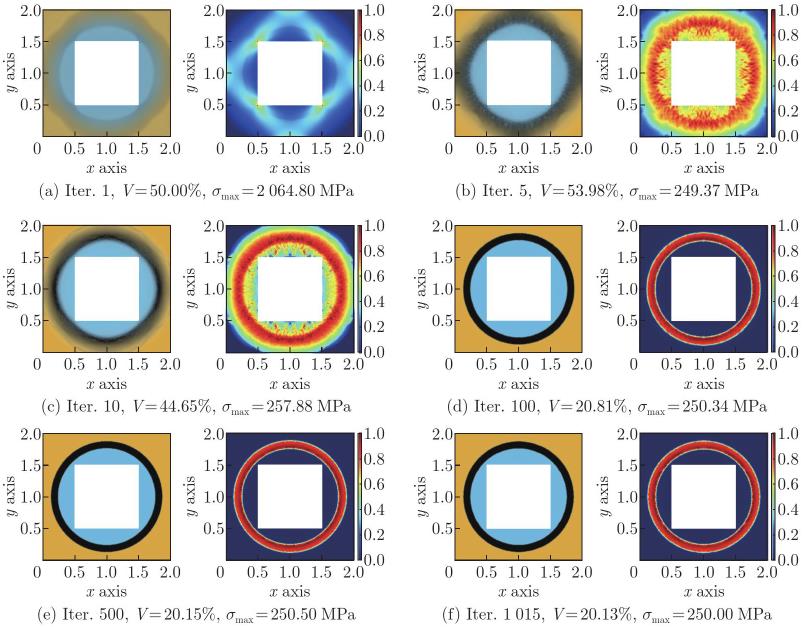
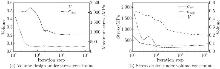
Fig. 3
Convergence histories of the stress and volume"
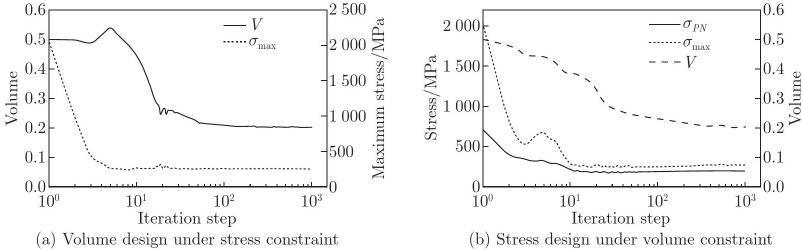
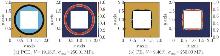
Fig. 4
Volume design for the nearly incompressible (ν=0.499 99) plane strain (color online)"
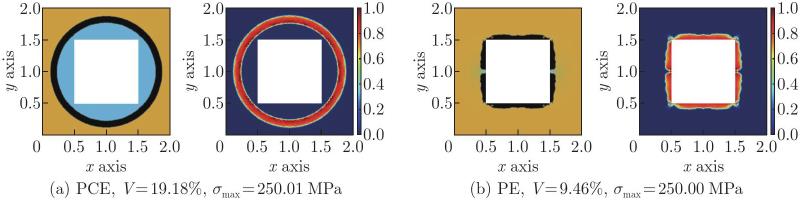
Table 2
Comparison of stress designs between the discrete methods under different conditions"
| Plane stress | Plane strain | |||
|---|---|---|---|---|
| PCEs | PEs | PCEs | PEs | |
| Compressibility ( | 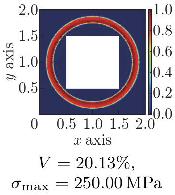 | 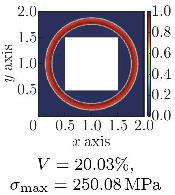 | 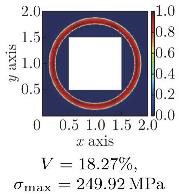 | 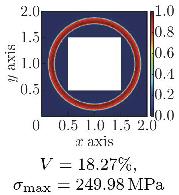 |
| Near incompressibility ( | 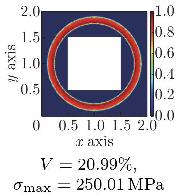 | 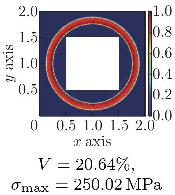 | 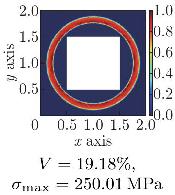 | 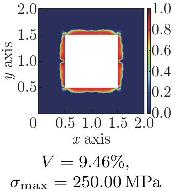 |
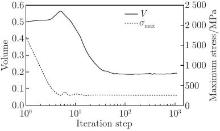
Fig. 5
Convergence histories of the volume and corresponding maximum stress under the nearly incompressible plane strain conditions"
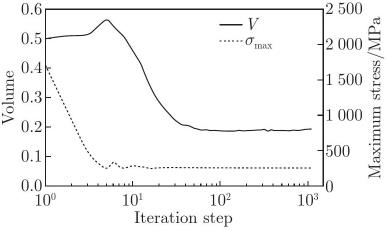
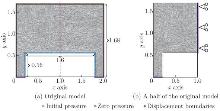
Fig. 6
Geometrical shape and boundary conditions of the arch structure (color online)"
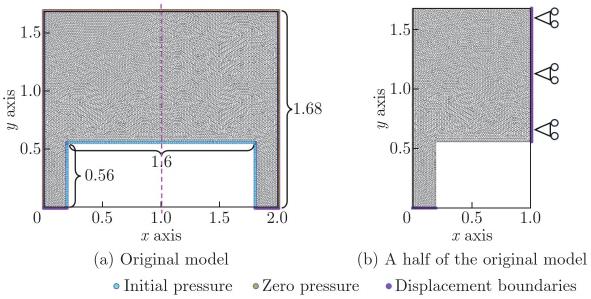
Table 3
Comparison of the optimal arches under different pressure intensities"
| Case | Optimized design | Stress plot |
|---|---|---|
| Case 1: | 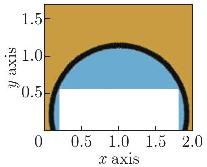 | 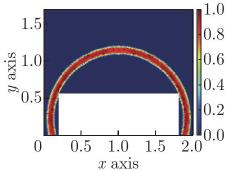 |
| Case 2: | 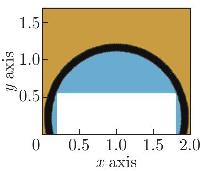 | 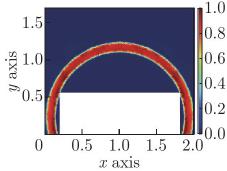 |
| Case 3: | 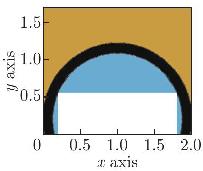 | 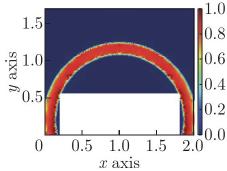 |
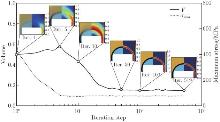
Fig. 7
Convergence histories of the volume and corresponding maximum stress under p0=7 MPa (color online)"
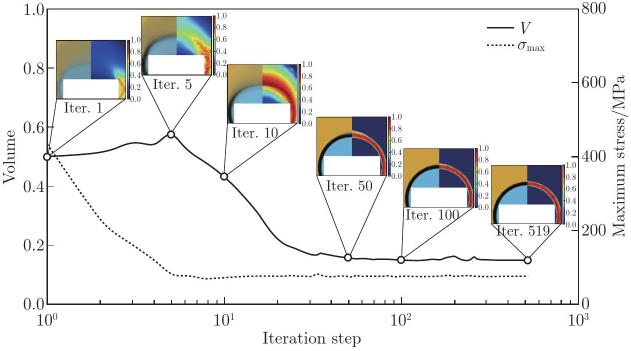
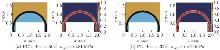
Fig. 8
Stress-constrained volume arch-design under the nearly incompressible (ν=0.499 99) plane stress (color online)"
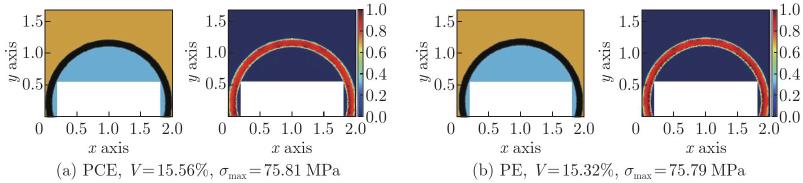
Fig. 9
Stress-constrained volume arch-design under the nearly incompressible (ν=0.499 99) plane strain (color online)"
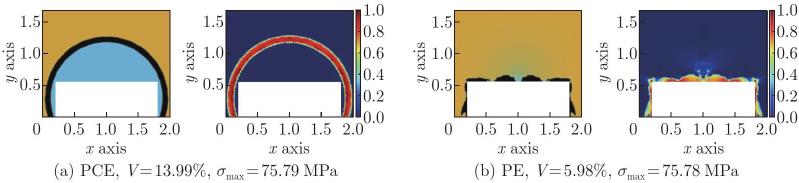
Fig. 10
Mesh-refinement test of a nearly incompressible arch under the plane strain (color online)"
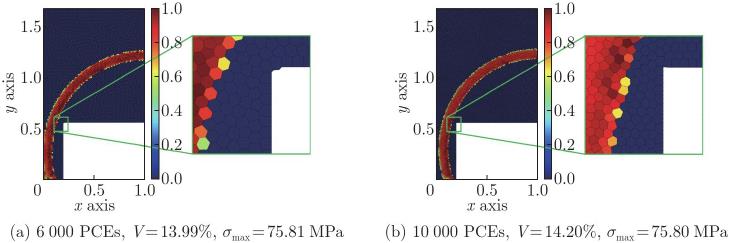
Fig. 11
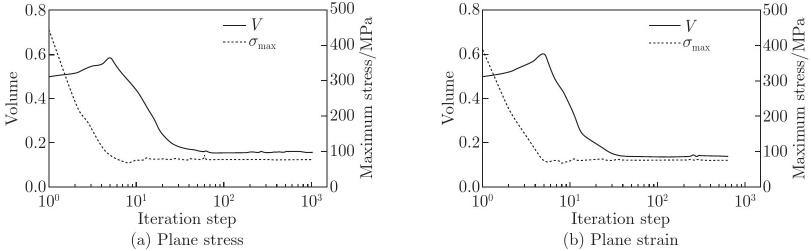
Convergence histories of the stress and volume for the nearly incompressible arches (ν=0.499 99)"
| [1] | BENDSØE, M. P. and KIKUCHI, N. Generating optimal topologies in structural design using a homogenization method. Computer Methods in Applied Mechanics and Engineering, 71, 197–224 (1988) |
| [2] | XIE, Y. M. and STEVEN, G. P. Evolutionary structural optimization for dynamic problems. Computers and Structures, 58, 1067–1073 (1996) |
| [3] | HUANG, X. D. and XIE, Y. M. A further review of ESO type methods for topology optimization. Structural and Multidisciplinary Optimization, 41, 671–683 (2010a) |
| [4] | XIA, L., ZHANG, L., XIA, Q., and SHI, T. L. Stress-based topology optimization using bi-directional evolutionary structural optimization method. Computer Methods in Applied Mechanics and Engineering, 333, 356–370 (2018) |
| [5] | GUO, X., ZHANG, W. S., ZHANG, J., and YUAN, J. Explicit structural topology optimization based on moving morphable components (MMC) with curved skeletons. Computer Methods in Applied Mechanics and Engineering, 310, 711–748 (2016) |
| [6] | HOANG, V. N., NGUYEN, N. L., and NGUYEN-XUAN, H. Topology optimization of coated structure using moving morphable sandwich bars. Structural and Multidisciplinary Optimization, 61, 491–506 (2020) |
| [7] | HOANG, V. N. and NGUYEN-XUAN, H. Extruded-geometric-component-based 3D topology optimization. Computer Methods in Applied Mechanics and Engineering, 371, 113293 (2020) |
| [8] | GAO, J., XIAO, M., ZHANG, Y., and GAO, L. A comprehensive review of isogeometric topology optimization: methods, applications and prospects. Chinese Journal of Mechanical Engineering, 33, 87 (2020) |
| [9] | LIEU, Q. X. and LEE, J. Multiresolution topology optimization using isogeometric analysis. The International Journal for Numerical Methods in Engineering, 112, 2025–2047 (2017) |
| [10] | LIEU, Q. X. and LEE, J. A multi-resolution approach for multi-material topology optimization based on isogeometric analysis. Computer Methods in Applied Mechanics and Engineering, 323, 272–302 (2017) |
| [11] | ZHU, J. H., ZHOU, H., WANG, C., ZHOU, L., YUAN, S. Q., and ZHANG, W. H. A review of topology optimization for additive manufacturing: status and challenges. Chinese Journal of Aeronautics, 34, 91–110 (2021) |
| [12] | PÉREZ, A. B. H., DE JESÚS PABLO SOTELO, A., LÓPEZ, F. R., GÓMEZ, J. J. H., and RIVERA, M. F. M. On topology optimisation methods and additive manufacture for satellite structures: a review. Aerospace, 10, 1025 (2023) |
| [13] | ROZVANY, G. I. N. Aims, scope, methods, history and unified terminology of computer-aided topology optimization in structural mechanics. Structural and Multidisciplinary Optimization, 21, 90–108 (2001) |
| [14] | BENDSØE, M. P. and SIGMUND, O. Topology Optimization: Theory, Methods and Applications, Springer, Berlin (2003) |
| [15] | SIGMUND, O. and MAUTE, K. Topology optimization approaches. Structural and Multidisciplinary Optimization, 48, 1031–1055 (2013b) |
| [16] | DEATON, J. D. and GRANDHI, R. V. A survey of structural and multidisciplinary continuum topology optimization: post 2000. Structural and Multidisciplinary Optimization, 49, 1–38 (2014) |
| [17] | DUYSINX, P. and BENDSØE, M. P. Topology optimization of continuum structures with local stress constraints. International Journal for Numerical Methods in Engineering, 43(8), 1453–1478 (1998) |
| [18] | LE, C., NORATO, J., BRUNS, T., HA, C., and TORTORELLI, D. Stress-based topology optimization for continua. Structural and Multidisciplinary Optimization, 41, 605–620 (2010) |
| [19] | FAN, Z., XIA, L., LAI, W. X., XIA, Q., and SHI, T. L. Evolutionary topology optimization of continuum structures with stress constraints. Structural and Multidisciplinary Optimization, 59, 647–658 (2019) |
| [20] | GUO, X., ZHANG, W. S., WANG, M. Y., and WEI, P. Stress-related topology optimization via level set approach. Computer Methods in Applied Mechanics and Engineering, 200, 3439–3452 (2011) |
| [21] | DUYSINX, P. and BENDSØE, M. P. Topology optimization of continuum structures with local stress constraints. International Journal for Numerical Methods in Engineering, 43, 1453–1478 (1998) |
| [22] | CHENG, G. D. and GUO, X. ε-relaxed approach in structural topology optimization. Structural and Multidisciplinary Optimization, 13, 258–266 (1997) |
| [23] | BRUGGI, M. On an alternative approach to stress constraints relaxation in topology optimization. Structural and Multidisciplinary Optimization, 36, 125–141 (2008) |
| [24] | BRUGGI, M. and DUYSINX, P. Topology optimization for minimum weight with compliance and stress constraints. Structural and Multidisciplinary Optimization, 46, 369–384 (2012) |
| [25] | HOLMBERG, E., TORSTENFELT, B., and KLARBRING, A. Stress constrained topology optimization. Structural and Multidisciplinary Optimization, 48, 33–47 (2013) |
| [26] | XIA, L., ZHANG, L., XIA, Q., and SHI, T. L. Stress-based topology optimization using bi-directional evolutionary structural optimization method. Computer Methods in Applied Mechanics and Engineering, 333, 356–370 (2018) |
| [27] | XU, B., HAN, Y. S., and ZHAO, L. Bi-directional evolutionary topology optimization of geometrically nonlinear continuum structures with stress constraints. Applied Mathematical Modelling, 80, 771–791 (2020) |
| [28] | HAN, Z. T., WEI, K., GU, Z. Q., MA, X. K., and YANG, X. J. Stress-constrained multi-material topology optimization via an improved alternating active-phase algorithm. Engineering Optimization, 54, 305–328 (2022) |
| [29] | HU, J. Y., LIU, Y., LUO, Y. F., HUANG, H. X., and LIU, S. T. Topology optimization of multi-material structures considering a piecewise interface stress constraint. Computer Methods in Applied Mechanics and Engineering, 398, 115274 (2022) |
| [30] | BANH, T. T., LIEU, Q. X., KANG, J., JU, Y., SHIN, S., and LEE, D. A novel robust stress-based multimaterial topology optimization model for structural stability framework using refined adaptive continuation method. Engineering with Computers, 40, 677–713 (2024) |
| [31] | BANH, T. T., SHIN, S., KANG, J., ZHANG, J., and LEE, D. Comprehensive multi-material topology optimization for stress-driven design with refined volume constraint subjected to harmonic force excitation. Engineering with Computers, 40, 2651–2680 (2024) |
| [32] | BANH, T. T., LIEU, Q. X., NGUYEN, S. H., and LEE, D. Stress-driven design of incompressible multi-materials under frequency constraints. International Journal of Mechanical Sciences, 277, 109416 (2024) |
| [33] | BANH, T. T. and LEE, D. Comprehensive thermoelastic stress-driven approach for thermo-mechanical-pressure multiphysics systems. International Journal of Mechanical Sciences, 291-292, 110133 (2024) |
| [34] | LEE, E., JAMES, K. A., and MARTINS, J. R. R. A. Stress-constrained topology optimization with design-dependent loading. Structural and Multidisciplinary Optimization, 46, 569–601 (2012) |
| [35] | EMMENDOERFER, H., SILVA, E. C. N., and FANCELLO, E. A. Stress-constrained level set topology optimization for design-dependent pressure load problems. Computer Methods in Applied Mechanics and Engineering, 344, 569–601 (2019) |
| [36] | GAO, T., ZHANG, W., ZHU, J., XU, Y., and BASSIR, D. Topology optimization of heat conduction problem involving design-dependent heat load effect. Finite Element Analysis and Design, 44, 805–813 (2008) |
| [37] | HAMMER, V. B. and OLHOFF, N. Topology optimization of continuum structures subjected to pressure loading. Structural and Multidisciplinary Optimization, 19, 85–92 (2000) |
| [38] | DU, J. and OLHOFF, N. Topological optimization of continuum structures with design-dependent surface loading, part I: new computational approach for 2D problems. Structural and Multidisciplinary Optimization, 27, 151–165 (2004) |
| [39] | ZHANG, H., ZHANG, X., and LIU, S. T. A new boundary search scheme for topology optimization of continuum structures with design-dependent loads. Structural and Multidisciplinary Optimization, 37, 121–129 (2008) |
| [40] | LEE, E. and MARTINS, J. R. R. A. Structural topology optimization with design-dependent pressure loads. Computer Methods in Applied Mechanics and Engineering, 233, 40–48 (2012) |
| [41] | WANG, C. F., ZHAO, M., and GE, T. Structural topology optimization with design-dependent pressure loads. Structural and Multidisciplinary Optimization, 53, 1005–1018 (2016) |
| [42] | CHEN, B. C. and KIKUCHI, N. Topology optimization with design-dependent loads. Finite Elements in Analysis and Design, 37, 57–70 (2001) |
| [43] | BOURDIN, B. and CHAMBOLLE, A. Design-dependent loads in topology optimization. ESAIM: Control, Optimisation and Calculus of Variations, 9, 19–48 (2003) |
| [44] | SIGMUND, O. and CLAUSEN, P. M. Topology optimization using a mixed formulation: an alternative way to solve pressure load problems. Computer Methods in Applied Mechanics and Engineering, 196, 1874–1889 (2007) |
| [45] | KUMAR, P., FROUWS, J. S., and LANGELAAR, M. Topology optimization of fluidic pressure-loaded structures and compliant mechanisms using the Darcy method. Structural and Multidisciplinary Optimization, 61, 1637–1655 (2020) |
| [46] | KUMAR, P. Topology optimization of pressure-loaded multi-material structures. Advances in Structural Integrity for Mechanical, Civil, and Aerospace Applications, Springer, Singapore (2023) |
| [47] | KUMAR, P. TOPress: a MATLAB implementation for topology optimization of structures subjected to design-dependent pressure loads. Structural and Multidisciplinary Optimization, 66, 97 (2023) |
| [48] | KUMAR, P. TOPress3D: 3D topology optimization with design-dependent pressure loads in MATLAB. Optimization and Engineering, 26, 1113–1141 (2025) |
| [49] | CHADHA, K. S. and KUMAR, P. PyTOaCNN: topology optimization using an adaptive convolutional neural network in Python. Soft Computing, 30, 653–673 (2026) |
| [50] | BANH, T. T. and LEE, D. Efficient topology optimization for geometrically nonlinear multi-material systems under design-dependent pressure loading. Engineering with Computers, 41, 1155–1189 (2025) |
| [51] | SUSSMAN, T. and BATHE, K. J. A finite element formulation for nonlinear incompressible elastic and inelastic analysis. Computers and Structures, 26, 357–409 (1987) |
| [52] | ZHANG, G. D., ALBERDI, R., and KHANDELWAL, K. Topology optimization with incompressible materials under small and finite deformations using mixed u/p elements. International Journal for Numerical Methods in Engineering, 115, 1015–1052 (2018) |
| [53] | SIMO, J. C. and RIFAI, M. S. A class of mixed assumed strain methods and the method of incompatible modes. International Journal for Numerical Methods in Engineering, 29, 1595–1638 (1990) |
| [54] | HUGHES, T. J. R. Generalization of selective integration procedures to anisotropic and nonlinear media. International Journal for Numerical Methods in Engineering, 15, 1413–1418 (1980) |
| [55] | BRUGGI, M. Topology optimization with mixed finite elements on regular grids. Computer Methods in Applied Mechanics and Engineering, 305, 133–153 (2016) |
| [56] | JANG, G. W., PANGANIBAN, H., and CHUNG, T. J. P1-nonconforming quadrilateral finite element for topology optimization. International Journal for Numerical Methods in Engineering, 84, 685–707 (2010) |
| [57] | LI, C. and TONG, L. Y. Topology optimization of incompressible materials based on the mixed SBFEM. Computers & Structures, 165, 24–33 (2016) |
| [58] | LI, E., CHANG, C. C., HE, Z. C., ZHANG, Z. P., and LI, Q. Smoothed finite element method for topology optimization involving incompressible materials. Engineering Optimization, 48, 2064–2089 (2016) |
| [59] | NGUYEN-XUAN, H., CHAU, K. N., and CHAU, K. N. Polytopal composite finite elements. Computer Methods in Applied Mechanics and Engineering, 355, 405–437 (2019) |
| [60] | HOANG, V. N., NGUYEN, H. B., and NGUYEN-XUAN, H. Explicit topology optimization of nearly incompressible materials using polytopal composite elements. Advances in Engineering Software, 149, 102903 (2020) |
| [61] | HOANG, V. N., PHAM, T., HO, D., and NGUYEN-XUAN, H. Robust multiscale design of incompressible multi-materials under loading uncertainties. Engineering with Computers, 38, 875–890 (2021) |
| [62] | NGUYEN, N. V., NGUYEN-XUAN, H., and LEE, J. Polygonal composite elements for stress-constrained topology optimization of nearly incompressible materials. European Journal of Mechanics-A/Solids, 94, 104548 (2022) |
| [63] | BANH, T. T., SHIN, S., KANG, J., and LEE, D. Frequency-constrained topology optimization in incompressible multi-material systems under design-dependent loads. Thin-Walled Structures, 196, 111467 (2024) |
| [64] | SVANBERG, K. The method of moving asymptotes: a new method for structural optimization. International Journal for Numerical Methods in Engineering, 24, 359–373 (1987) |
| [65] | ZIENKIEWICZ, O. C., TAYLOR, R. L., and ZHU, J. Z. Multidomain mixed approximations. The Finite Element Method: Its Basis and Fundamentals, Elsevier, the Netherlands (2005) |
| [66] | TALISCHI, C., PAULINO, G. H., and MENEZES, I. F. M. PolyTop: a Matlab implementation of a general topology optimization framework using unstructured polygonal finite element meshes. Structural and Multidisciplinary Optimization, 45, 329–357 (2012) |
| [1] | T. T. BANH, E. DAMTSAS, H. P. BAN, M. HERRMANN, D. LEE. A novel multi-material topology design automation algorithm for a customized MATLAB and Rhino-Grasshopper plugin with a generalized solid isotropic material with penalization [J]. Applied Mathematics and Mechanics (English Edition), 2026, 47(6): 1363-1382. |
| Viewed | ||||||
|
Full text |
|
|||||
|
Abstract |
|
|||||





 Email Alert
 RSS
RSS