Applied Mathematics and Mechanics (English Edition) ›› 2026, Vol. 47 ›› Issue (8): 1647-1668.doi: https://doi.org/10.1007/s10483-026-3417-7
Kangfan YU1, Yunwei CHEN1, Chuanyun YU1, Jianrun ZHANG1, Xi LU1, Xiaofei DU2, Qidi FU1( )
)
Received:2026-02-20
Revised:2026-06-26
Online:2026-07-31
Published:2026-07-31
Contact:
Qidi FU, E-mail: fqd@seu.edu.cnSupported by:2010 MSC Number:
Kangfan YU, Yunwei CHEN, Chuanyun YU, Jianrun ZHANG, Xi LU, Xiaofei DU, Qidi FU. Modular reconfigurable quasi-zero-stiffness isolators: design, analysis, and experiment. Applied Mathematics and Mechanics (English Edition), 2026, 47(8): 1647-1668.
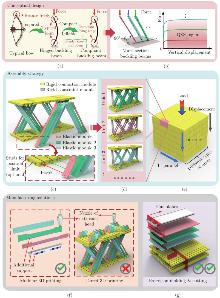
Fig. 1
Conceptual design, assembly strategy, and fabrication of proposed MRQIs: (a) bow-inspired compliant buckling beam; (b) excellent QZS characteristics of multi-section buckling beams; (c) unit assembly diagram; (d) units in various combinations; (e) unit-to-unit assembly strategy diagram; (f) schematic diagram of small-batch processing methods; (g) schematic diagram of the mass processing method (color online)"
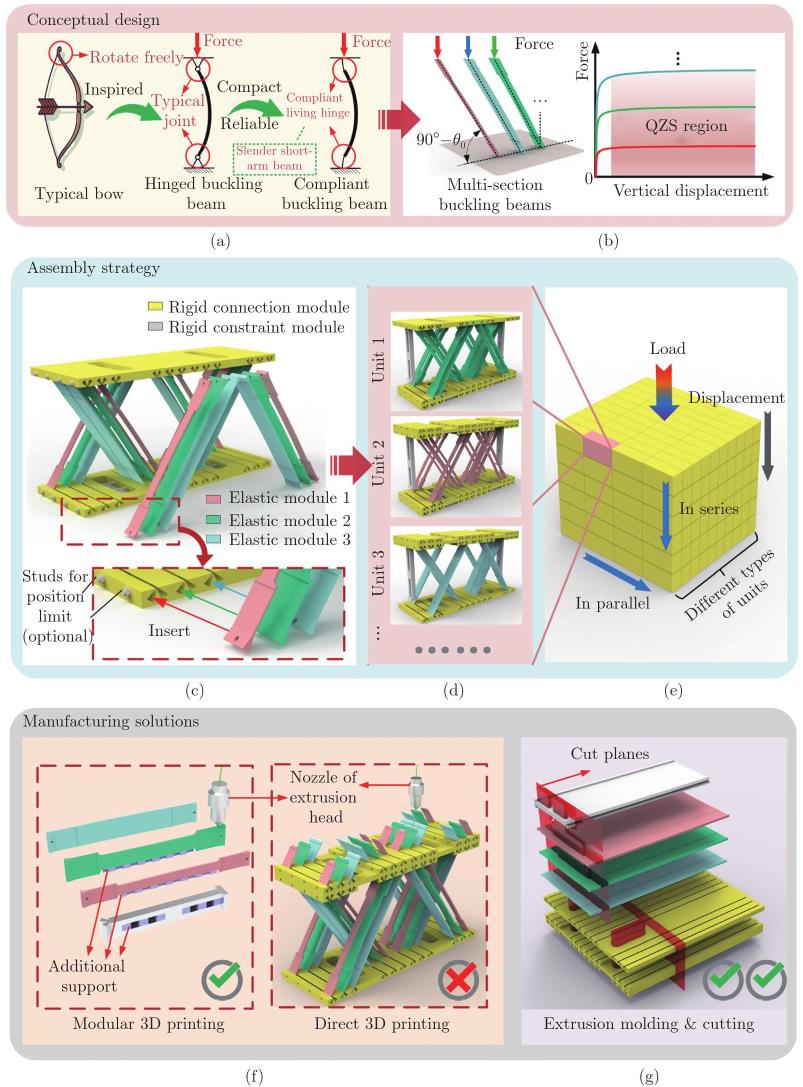
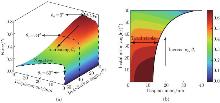
Fig. 2
Effect of initial installation angle θ0 on static characteristics of the elastic module 1: (a) 3D and (b) 2D diagrams of restoring force versus displacement and initial installation angle (color online)"
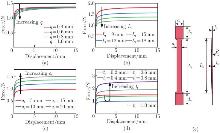
Fig. 3
Static properties of the elastic module under different design parameters. Force-displacement characteristics under different (a) initial deflection amount q, (b) straight beam length Lt, (c) straight beam width at, (d) straight beam thickness tt, and (e) basic design dimension annotation of elastic modules (color online)"
Table 1
Design parameters of proposed elastic modules"
| Parameter | q/mm | θ0/(°) | ||||||
|---|---|---|---|---|---|---|---|---|
| Elastic module 1 | 0.6 | 15 | 10 | 0.6 | 70 | 6 | 1.0 | 34 |
| Elastic module 2 | 0.4 | 15 | 15 | 0.6 | 70 | 10 | 1.2 | 34 |
| Elastic module 3 | 0.6 | 15 | 15 | 0.7 | 70 | 15 | 1.2 | 34 |
| q: initial deflection; | ||||||||
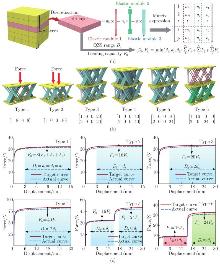
Fig. 4
Programmable QZS behaviors of the proposed isolators: (a) matrix of isolator assembly relationships; (b) six representative assembly samples (designated as Types 1–6) and their assembly matrices; (c) target and actual (accounting for self-weight effects) force-displacement relationship curves for the six samples (color online)"
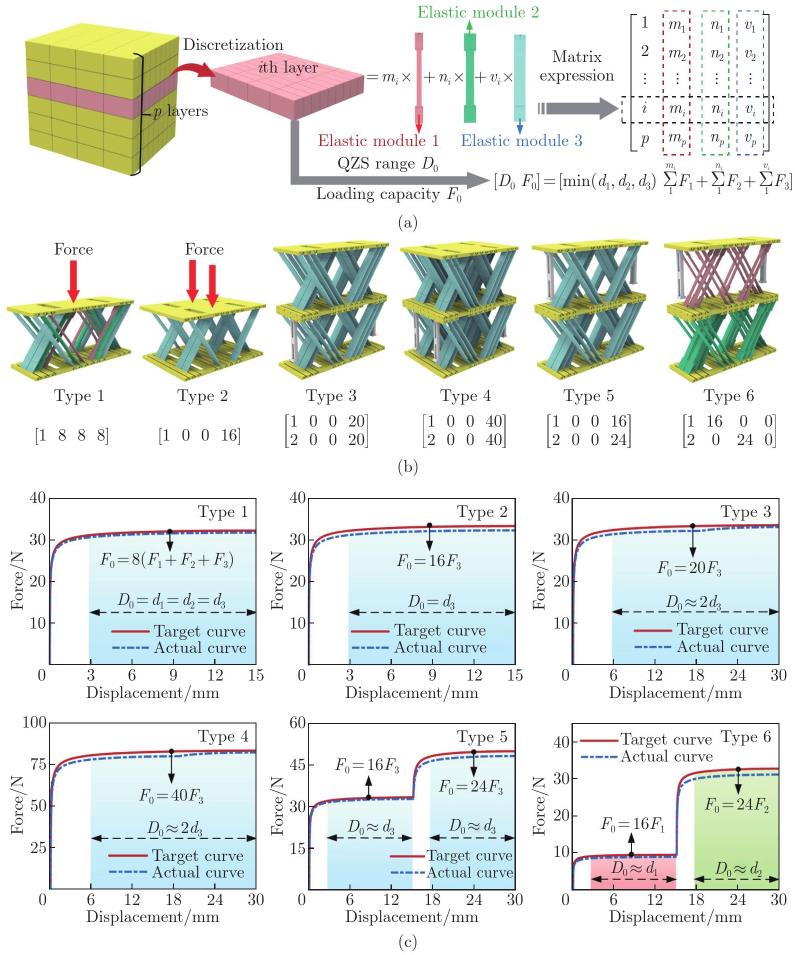
Fig. 5
Dynamic lumped parameter model of the MRQI-QZS vibration isolation system: (a) equivalent dynamic model of QZS isolator system (Type 1) under displacement or force excitation; (b) schematic of equivalent linear isolator; (c) default static equilibrium position of QZS isolator and force-displacement curve of linear isolator (color online)"
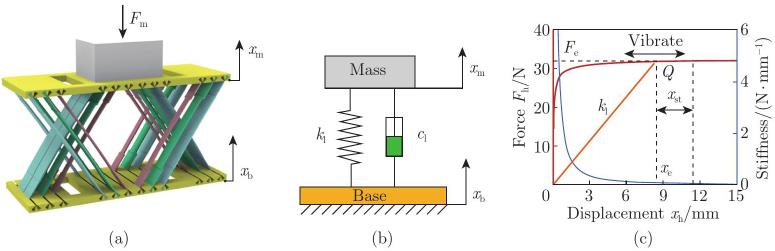
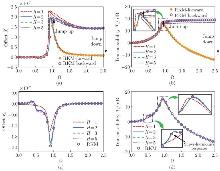
Fig. 6
Comparison of numerical solutions and analytical solutions at different H: (a) displacement offset X¯0 and (b) transmissibility Td under displacement excitation (x¯b0=0.1, ξ=0.067); (c) force offset F¯0 and (d) transmissibility TF under force excitation (F¯m0=0.01, ξ=0.1) (color online)"
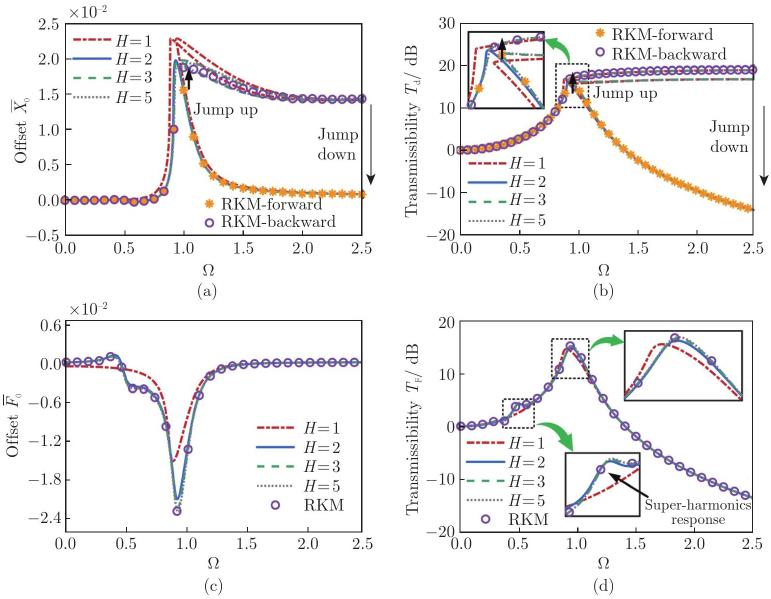
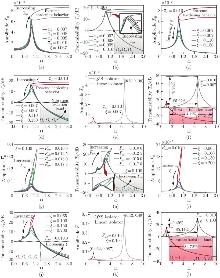
Fig. 7
Amplitude response and transmissibility curves of the MRQI-QZS system under different conditions, where (a)–(f) show results under displacement excitation, while (g)–(l) show results under force excitation: (a) amplitude response X¯H and (b) transmissibility Td under different displacement excitation amplitudes x¯b0; (c) amplitude response X¯H and (d) transmissibility Td under different damping ratios ξ; (e) comparison of amplitude response X¯H and (f) transmissibility Td between QZS system and the linear system; (g) amplitude response F¯H and (h) transmissibility TF under different force excitation amplitudes F¯m0; (i) amplitude response F¯H and (j) transmissibility TF under different damping ratios ξ; (k) comparison of amplitude response F¯H and (l) transmissibility TF between QZS system and the linear system (color online)"
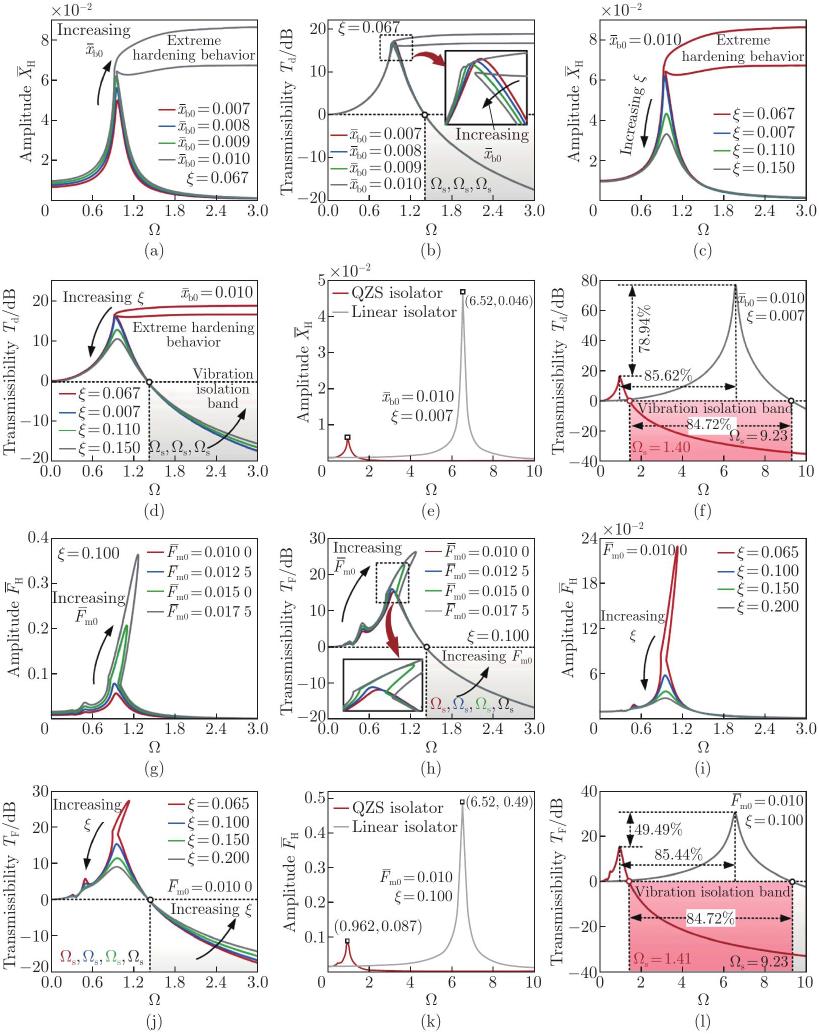
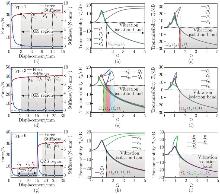
Fig. 8
Vibration isolation performance of different types of MRQI-QZS systems at various equilibrium positions: (a) static property, (b) displacement transmissibility, and (c) force transmissibility of the MRQI-QZS system composed of Type 1 isolators; (d) static property, (e) displacement transmissibility, and (f) force transmissibility of the MRQI-QZS system composed of Type 3 isolators; (g) static property, (h) displacement transmissibility, and (i) force transmissibility of the MRQI-QZS system composed of Type 6 isolators (color online)"
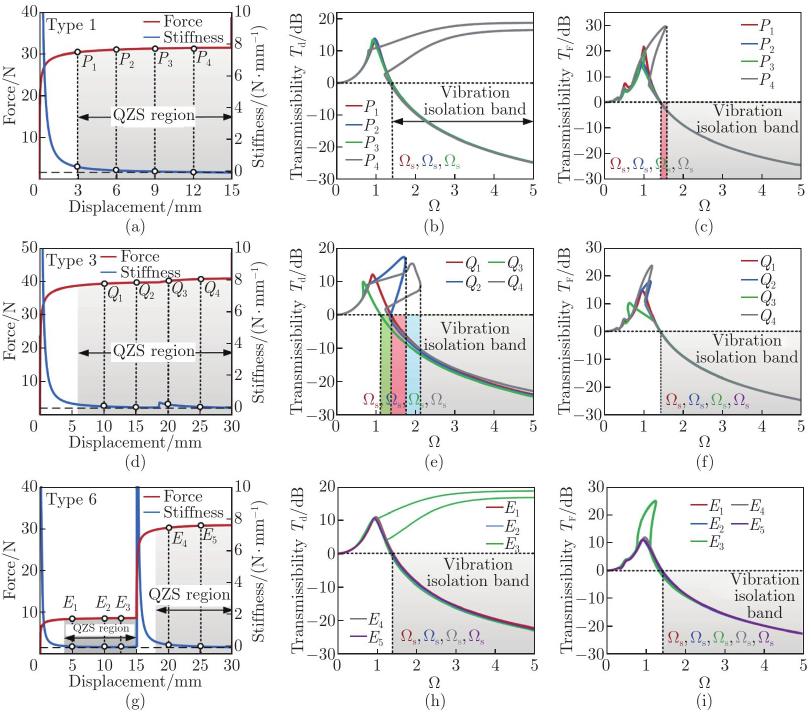
Fig. 9
Verification of QZS characteristics through static experiments: comparison of experimental and simulation results for force-displacement curves of (a) Prototype 1 and (b) Prototype 2; (c) comparison of experimental and simulated compressive deformation patterns for sample 1 (color online)"
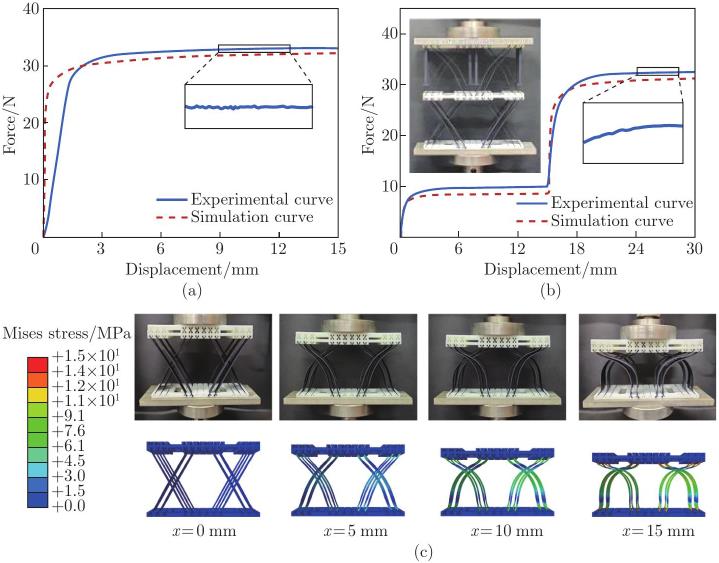
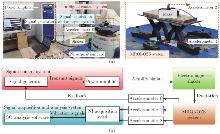
Fig. 10
(a) Dynamic performance test platform comprises a signal control system, electromagnetic shaker, and QZS system corresponding to Prototype 1, signal acquisition, and analysis system; (b) schematic diagram of the dynamic performance test platform (color online)"
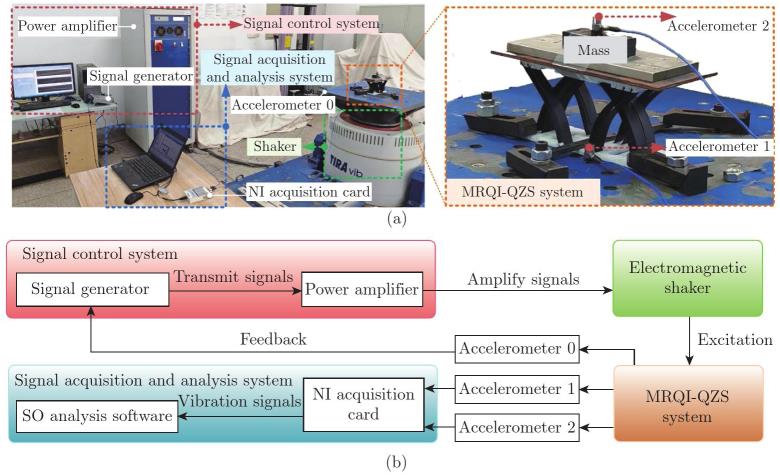
Fig. 11
Dynamic response under the sinusoidal sweeping and periodic excitation: (a) comparison of experimental transmissibility, theoretical transmissibility, and equivalent linear system transmissibility under the sweeping excitation (f∈[1 Hz, 10 Hz], xb0=2.0 mm); (b) corresponding experimental response in the time domain; (c) experimental response in the time domain under the periodic excitation (f=5 Hz, 7 Hz, 9 Hz, xb0=2.0 mm) (color online)"
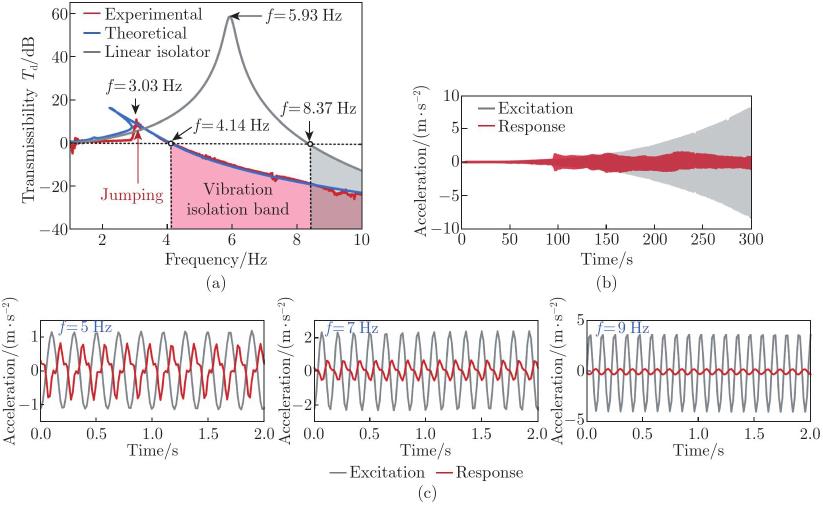
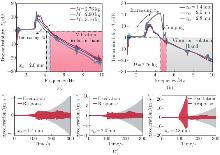
Fig. 12
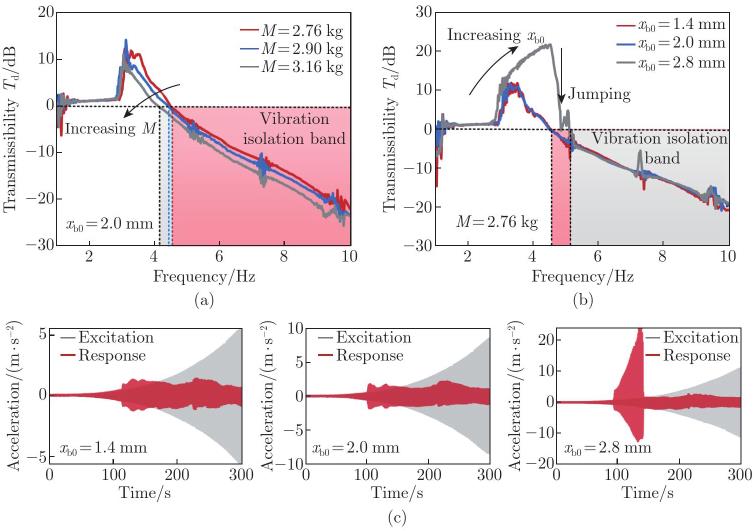
Experimental vibration isolation performance under different (a) load masses and (b) base excitations; (c) experimental time-domain response under different base excitations (color online)"
| [1] | ZHOU, K., WEN, L. B., GONG, D., ZHOU, J. S., and CHEN, Y. J. Vibro-acoustic analysis and suppression of corrugated sandwich panel structures with general boundary conditions. Thin-Walled Structures, 212, 113196 (2025) |
| [2] | CHEN, H. T. and JIANG, B. A review of fault detection and diagnosis for the traction system in high-speed trains. IEEE Transactions on Intelligent Transportation Systems, 21(2), 450–465 (2020) |
| [3] | LIU, H. Z., YAN, Y. D., CUI, J. W., GENG, Y. Q., SUN, T., LUO, X. C., and ZONG, W. J. Recent advances in design and preparation of micro diamond cutting tools. International Journal of Extreme Manufacturing, 6(6), 062008 (2024) |
| [4] | BALAJI, P. S. and SELVAKUMAR, K. K. Applications of nonlinearity in passive vibration control: a review. Journal of Vibration Engineering & Technologies, 9(2), 183–213 (2021) |
| [5] | CHEN, N., YANG, Z. C., ZUO, A., JIANG, P. F., JIN, S. K., and XU, Y. L. Bandgap regulations of longitudinal wave for a nonlinear metastructure isolator with high-static-low-dynamic stiffness. Composite Structures, 327, 117706 (2024) |
| [6] | ZHAO, F., JI, J. C., YE, K., and LUO, Q. T. An innovative quasi-zero stiffness isolator with three pairs of oblique springs. International Journal of Mechanical Sciences, 192, 106093 (2021) |
| [7] | LEI, H. W., REN, H., ZHOU, P., GUO, F., and WANG, Y. L. Embedding intelligent excitation adaptability for resonance-suppressed QZS vibration isolation. International Journal of Mechanical Sciences, 307, 110931 (2025) |
| [8] | ZHOU, C. Y., SONG, Y. Z., SUN, H., HU, X. Y., YANG, L. P., PU, H. Y., and LIU, C. Design and experiment of an integrate 3-DoF adjustable QZS vibration isolation system with high-order stability. Mechanical Systems and Signal Processing, 228, 112483 (2025) |
| [9] | LIU, S. W., PENG, G. L., LI, Z. X., LI, W. H., and SUN, L. D. Low-frequency vibration isolation via an elastic origami-inspired structure. International Journal of Mechanical Sciences, 260, 108622 (2023) |
| [10] | CHANG, Y. P., ZHOU, J. X., WANG, K., and XU, D. L. Theoretical and experimental investigations on semi-active quasi-zero-stiffness dynamic vibration absorber. International Journal of Mechanical Sciences, 214, 106892 (2022) |
| [11] | ZHAO, F., JI, J. C., CAO, S. Q., YE, K., and LUO, Q. T. QZS isolators with multi-pairs of oblique bars for isolating ultralow frequency vibrations. Nonlinear Dynamics, 112(3), 1815–1842 (2024) |
| [12] | JING, X., ZHU, Z., GUO, Y., and LIU, S. Nonlinear inertia and its effect within an X-shaped mechanism, part II: nonlinear influences and experimental validations. Mechanical Systems and Signal Processing, 200, 110591 (2023) |
| [13] | ZHU, Z. H. and JING, X. J. Nonlinear inertia and its effect within an X-shaped mechanism. Advances in Applied Nonlinear Dynamics, Vibration, and Control – 2023, Springer, Singapore, 554–569 (2024) |
| [14] | WANG, S. W., LING, P., YAN, G., MA, H. Y., and YAN, B. Multi-stage quasi-zero stiffness vibration isolation with linear-to-torsion magnetic negative stiffness mechanism for variable load. Mechanical Systems and Signal Processing, 249, 114055 (2026) |
| [15] | LIU, Y. F., OU, H. F., and HU, L. L. A novel isolator with movable cyclic quasi-zero-stiffness enabling low-frequency vibration suppression under arbitrary loads. Mechanical Systems and Signal Processing, 247, 113924 (2026) |
| [16] | HAN, H. S., WANG, W. Q., YU, B. H., TANG, L. H., WANG, Y. L., and CAO, D. Q. Integrated design of quasi-zero-stiffness vibration isolators based on bifurcation theory. Aerospace Science and Technology, 146, 108940 (2024) |
| [17] | WU, Y., GUO, M. X., SOROKIN, V., TANG, L. H., FANG, B., AW, K., and HAN, H. S. Multi-directional nonlinear energy sink with quasi-zero stiffness property inspired by origami. Thin-Walled Structures, 218, 114092 (2026) |
| [18] | FAN, H. G., YANG, L. J., TIAN, Y. C., and WANG, Z. W. Design of metastructures with quasi-zero dynamic stiffness for vibration isolation. Composite Structures, 243, 112244 (2020) |
| [19] | SHU, Y. Q., WANG, K., CHEN, T. T., PAN, H. B., DENG, Y. P., YIN, H. F., and ZHOU, J. X. A quasi-zero-stiffness metastructure for concurrent low-frequency vibration attenuation and energy harvesting. Thin-Walled Structures, 214, 113371 (2025) |
| [20] | LIU, Z. Q., LYU, Q. F., LI, D. Y., HUAN, R. H., and HUANG, Z. L. A straight-arch-straight beam tandem quasi-zero stiffness structure. International Journal of Mechanical Sciences, 286, 109818 (2025) |
| [21] | HOU, S. and WEI, J. Z. A quasi-zero stiffness mechanism with monolithic flexible beams for low-frequency vibration isolation. Mechanical Systems and Signal Processing, 210, 111154 (2024) |
| [22] | HOU, S., WEI, J. Z., SUI, G. D., and XIE, Z. M. Effects of series sequence on the nonlinear dynamic responses of integrated quasi-zero stiffness isolators. Nonlinear Dynamics, 113(11), 12661–12691 (2025) |
| [23] | ZHANG, Y. S., HOU, F., LU, Z. Q., DING, H., and CHEN, L. Q. Analytical and experimental study of thermoplastic polyurethane inclined beam isolator with quasi-zero stiffness and fractional derivative damping. Mechanical Systems and Signal Processing, 224, 111962 (2025) |
| [24] | BANERJEE, P., BALAJI, P. S., and MURUGAN, S. A dual-function compliant metastructure based on quasi-zero-stiffness for combined vibration isolation and vibration energy harvesting. International Journal of Dynamics and Control, 13(4), 135 (2025) |
| [25] | OU, H. F., ZENG, J., LIN, M. Q., WANG, Y. F., ZENG, Y. J., FANG, X., and HU, L. L. Stair-stepping metamaterial and the derived isolator for all-DOF vibrations with multi-payloads. Engineering Structures, 330, 119890 (2025) |
| [26] | GILMORE, P., GANDHI, U., and SINGH, R. Effect of disk-to-disk variations on the nonlinear static characteristics and stability regimes of coned disk spring stacks: experimental and computational studies of quasi-zero-stiffness isolators. Mechanical Systems and Signal Processing, 219, 111609 (2024) |
| [27] | PAN, G. P., JIAO, X. L., LIN, C. M., GUAN, Z. F., WU, J. N., LIU, H. L., ZHAO, H. C., and HUANG, H. High load-bearing quasi-zero stiffness metamaterials for vibration isolation. International Journal of Mechanical Sciences, 293, 110225 (2025) |
| [28] | YIN, G. H., LI, Y. L., PENG, Y., and YAO, S. Customized inverse design of integrative quasi-zero-stiffness metastructures by data-driven method. Engineering Structures, 340, 120744 (2025) |
| [29] | MA, C., WU, K., WANG, Y. F., and WANG, Y. S. Customized design of periodic metacushion with quasi-zero-stiffness for low-frequency vibration isolation. International Journal of Solids and Structures, 320, 113518 (2025) |
| [30] | LIU, W. L., WU, L. L., SUN, J. B., and ZHOU, J. Origami-inspired quasi-zero stiffness metamaterials for low-frequency multi-direction vibration isolation. Applied Physics Letters, 123(8), 084102 (2023) |
| [32] | JIANG, W., ZHANG, X. G., HAN, D., WANG, L., CHEN, W. Q., XIE, Y. M., and REN, X. Experimental and numerical analysis of a novel assembled auxetic structure with two-stage programmable mechanical properties. Thin-Walled Structures, 185, 110555 (2023) |
| [33] | GUO, X. Y., XU, Y. M., WANG, X., XU, X., ZHU, N., JI, H. B., YUE, Z. S., LI, Z., JI, Y., LI, B. Y., and WANG, P. F. Hierarchical discrete assembly of mechanical metamaterials with application to modular unmanned aerial systems. Advanced Materials Technologies, 11(3), e01455 (2026) |
| [34] | ZHA, W. Y., YANG, R., YAO, Y. T., LIU, Y. J., and LENG, J. S. Negative stiffness mechanical metamaterial with controllably programmable bandgaps. International Journal of Mechanical Sciences, 303, 110614 (2025) |
| [35] | HE, J., LIANG, T. B., WANG, Y. H., XIA, L., and XIONG, Y. Quasi-zero stiffness metamaterials with programmable multistability for multi-scenario applications. Applied Materials Today, 46, 102864 (2025) |
| [36] | WANG, W. J., ZHANG, W. M., GUO, M. F., YANG, H., and MA, L. Impact resistance of assembled plate-lattice auxetic structures. Composite Structures, 338, 118132 (2024) |
| [37] | ZHANG, Z. Q., NIU, M. Q., and CHEN, L. Q. Analysis and optimization of a quasi-zero-stiffness vibration isolator based on partially rigidized compliant mechanisms. Engineering Structures, 343, 121048 (2025) |
| [38] | LIU, C. P. and JING, X. J. X-mechanism guided topological design on quasi-zero stiffness meta-ring. Mechanical Systems and Signal Processing, 234, 112814 (2025) |
| [39] | CHEN, Y. H., NIU, M. Q., FAN, Y. M., and CHEN, L. Q. Quasi-zero-stiffness vibration isolation via a double-layer compliant mechanism. International Journal of Mechanical Sciences, 304, 110670 (2025) |
| [40] | LIU, W. F., JANBAZ, S., DYKSTRA, D., ENNIS, B., and COULAIS, C. Harnessing plasticity in sequential metamaterials for ideal shock absorption. Nature, 634(8035), 842–847 (2024) |
| [41] | YU, K., CHEN, Y., YU, C., LI, P., REN, Z., ZHANG, J., and LU, X. Origami-inspire quasi-zero stiffness structure for flexible low-frequency vibration isolation. International Journal of Mechanical Sciences, 276, 109377 (2024) |
| [31] | ZHENG, P. Y., HAN, B., LIU, Z. P., WANG, Q. Z., WANG, Z. Y., and ZHANG, Q. Multistable twist metastructures with enhanced collapsibility and multidimensional programmability. Additive Manufacturing, 95, 104550 (2024) |
| [42] | YU, K., CHEN, Y., YU, C., ZHANG, J., and LU, X. A compact nonlinear stiffness-modulated structure for low-frequency vibration isolation under heavy loads. Nonlinear Dynamics, 112(8), 5863–5893 (2024) |
| [1] | Bo YAN, Ning YU, Chuanyu WU. A state-of-the-art review on low-frequency nonlinear vibration isolation with electromagnetic mechanisms [J]. Applied Mathematics and Mechanics (English Edition), 2022, 43(7): 1045-1062. |
| [2] | Guilin WEN, Yu LIN, Junfeng HE. A quasi-zero-stiffness isolator with a shear-thinning viscous damper [J]. Applied Mathematics and Mechanics (English Edition), 2022, 43(3): 311-326. |
| Viewed | ||||||
|
Full text |
|
|||||
|
Abstract |
|
|||||





 Email Alert
 RSS
RSS