Applied Mathematics and Mechanics (English Edition) ›› 2026, Vol. 47 ›› Issue (8): 1669-1690.doi: https://doi.org/10.1007/s10483-026-3415-9
Previous Articles Next Articles
Xingui ZHOU, Zhuangzhuang ZHANG, Zuhao LI, Junjie CHEN, Kai LI( )
)
Received:2026-02-27
Revised:2026-05-19
Online:2026-07-31
Published:2026-07-31
Contact:
Kai LI, E-mail: kli@ahjzu.edu.cnSupported by:2010 MSC Number:
Xingui ZHOU, Zhuangzhuang ZHANG, Zuhao LI, Junjie CHEN, Kai LI. A bistable liquid crystal elastomer self-oscillator with hysteretic optical occlusion. Applied Mathematics and Mechanics (English Edition), 2026, 47(8): 1669-1690.
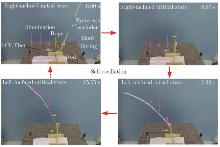
Fig. 1
Under a steady line illumination, the oscillator exhibits self-oscillation. Using a rope-rod bistable structure and a hysteretic occluder, self-oscillation is realized via hysteretic optical occlusion, eliminating the need for LCE’s rapid response to excitation in traditional systems (color online)"
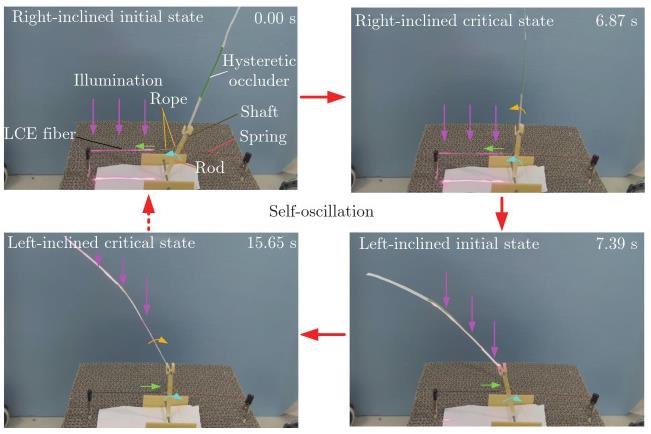
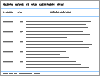
Table 1
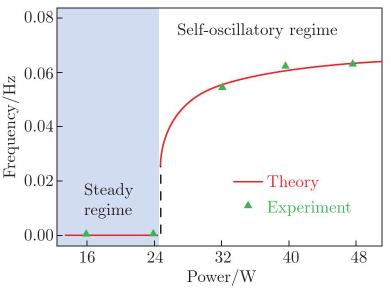
Self-oscillation period with diverse light powers"
| Light power/W | 16 | 24 | 32 | 40 | 48 |
|---|---|---|---|---|---|
| Period/s | Static | Static | 18.18 | 16.13 | 15.87 |
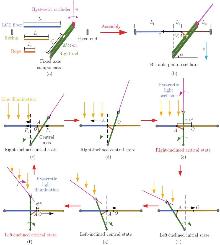
Fig. 2
Schematics of the LCE-based bistable self-oscillator: (a) key components of the system, including the LCE fiber, spring, rope, rod, and hysteretic occluder; (b) assembled bistable photo-oscillator, showing the geometric configuration and coordinate system (the origin O, moving point A, and key dimensions L1, Ls, Lc, Lb, Lsp, and Lr); (c)–(h) sequential states of one full oscillation cycle under steady illumination, where red arrows indicate the order of state transitions, in which (c) shows the right-inclined initial state, with the rod and occluder resting on the right; (d) shows the right-inclined central state, with Point A from the right to central axis; (e) shows the right-inclined critical state, with the rod from the right to the central axis; (f) shows the left-inclined critical state, with the rod from the left to the central axis; (g) shows the left-inclined central state, with Point A from the left to the central axis; (h) shows the left-inclined initial state, with the rod and occluder resting on the left. Under steady illumination, the hysteretic occluder enables the fiber to fully contract and relax at the critical state, thereby completing the state transition and generating self-oscillation (color online)"
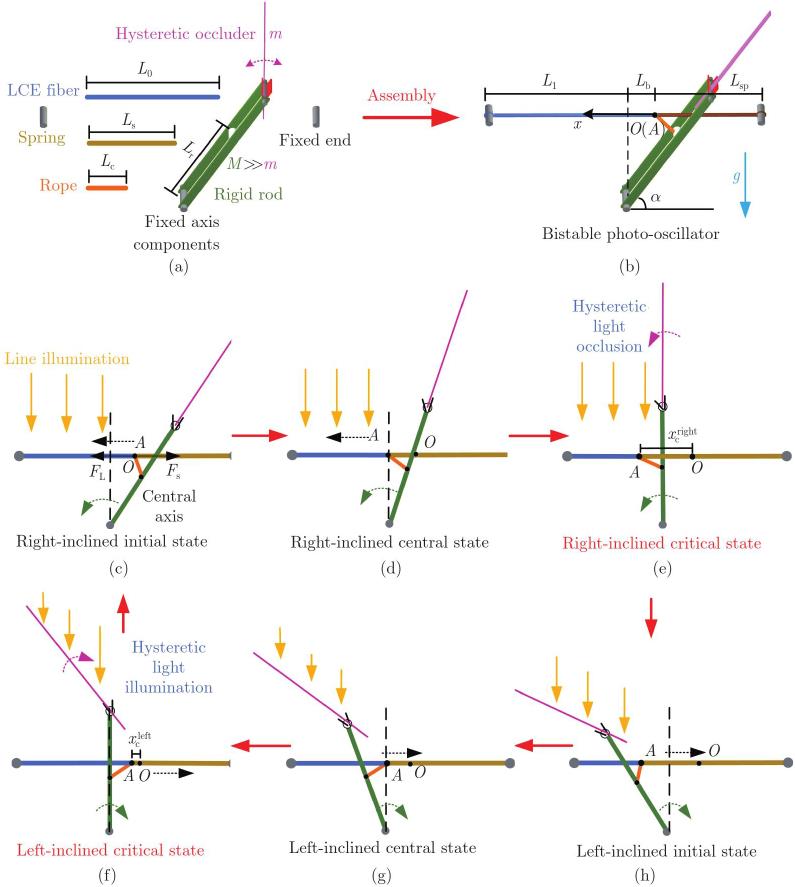
Fig. 3
Two motion regimes of the LCE-based self-oscillator: steady regime and self-oscillatory regime, where the system parameters are k¯=0.3, C¯0=0.25, H¯=0.35, L¯r=0.3, and L¯c=0.11: (a) α versus t¯ with L¯b=0.1 and Q¯=0.8; (b) α versus t¯ with L¯b=0.08 and Q¯=1.1; (c) α versus t¯ with L¯b=0.1 and Q¯=1.1; (d) ε versus t¯ with L¯b=0.1 and Q¯=0.8; (e) ε versus t¯ with L¯b=0.08 and Q¯=1.1; (f) ε versus t¯ with L¯b=0.1 and Q¯=1.1 (color online)"
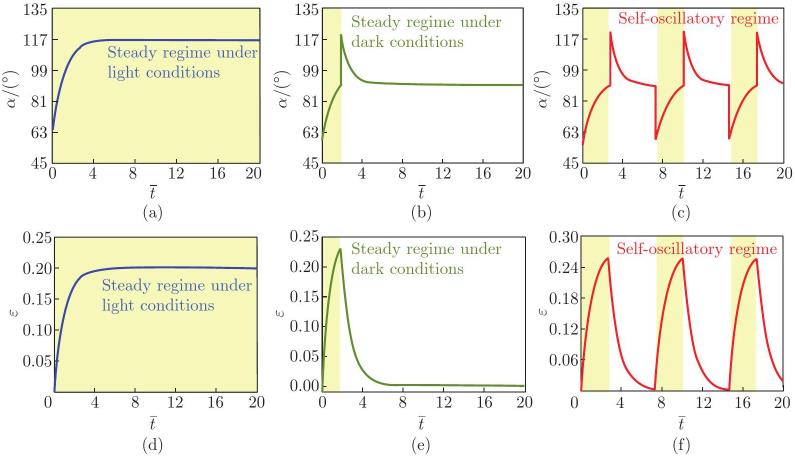
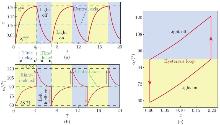
Fig. 4
Bistable mechanism of the self-oscillator, where the system parameters are k¯=0.3, Q¯=1.1, C¯0=0.25, H¯=0.35, L¯b=0.11, L¯r=0.3, and L¯c=0.11: (a) x¯ versus t¯; (b) α versus t¯; (c) geometric hysteresis loop. When the critical displacement is reached at Point A, the unique bistable structure causes a sudden change in the rod’s tilt angle, resulting in a state transition of the self-oscillator (color online)"
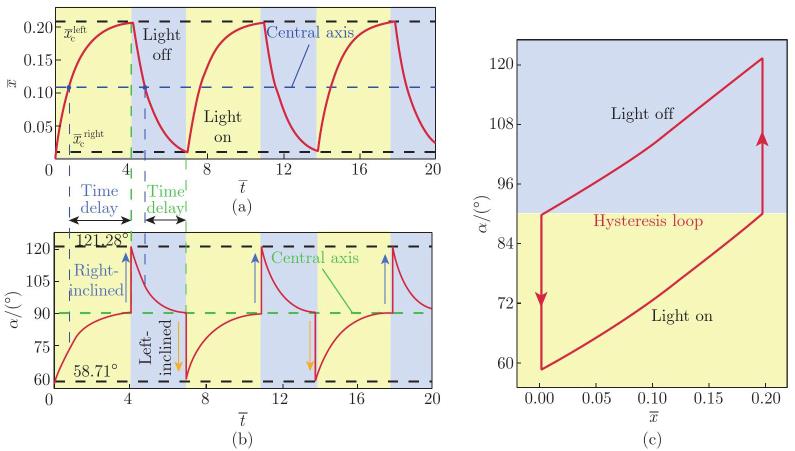
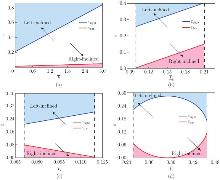
Fig. 5
Effects of parameters on the critical strain, where the base parameters are Q¯=1.1, C¯0=0.25, H¯=0.35, k¯=0.3, L¯b=0.11, L¯c=0.11, and L¯r=0.3: (a) ε versus k¯; (b) ε versus L¯b; (c) ε versus L¯c; (d) ε versus L¯r. εright is the critical strain for right-to-left transition under light conditions, while εleft is the critical strain for left-to-right transition under dark conditions. Self-excited oscillation occurs when the light-driven contraction strain exceeds εright, and the strain recovery under dark conditions falls below εleft (color online)"
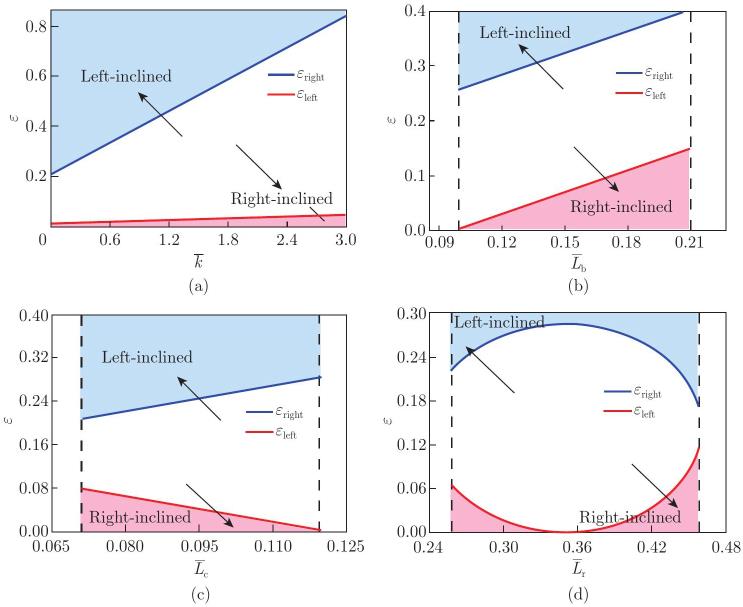
Table 2
Geometric configuration constraints for the self-oscillator"
| Parameter | ||||
|---|---|---|---|---|
| Range |
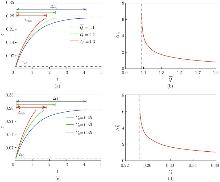
Fig. 6
Effects of the photothermal power Q¯ and contraction coefficient C¯0 on Δt¯1, where the fixed parameters are k¯=0.3, H¯=0.35, L¯r=0.3, L¯b=0.11, and L¯c=0.11: (a) ε versus t¯ under C¯0=0.25 and Q¯=1.1, 1.2, 1.3; (b) Δt¯1 versus Q¯; (c) ε versus t¯ under Q¯=1.1 and C¯0=0.25, 0.30, 0.35; (d) Δt¯1 versus C¯0 (color online)"
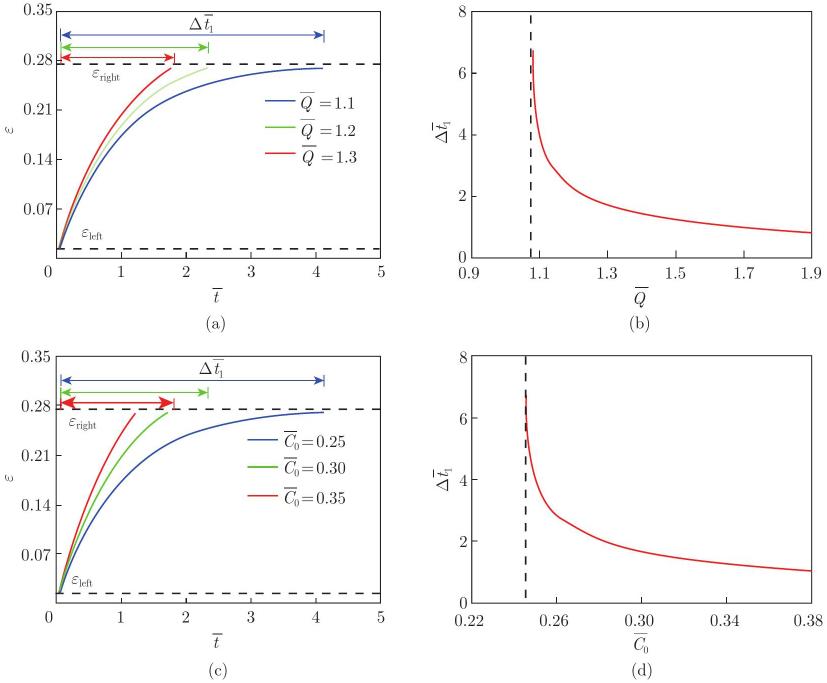
Fig. 7
Effects of the photothermal power Q¯ and contraction coefficient C¯0 on Δt¯3, where the fixed parameters are k¯=0.3, H¯=0.35, L¯r=0.3, L¯b=0.11, and L¯c=0.11: (a) ε versus t¯ for Q¯=1.1, 1.2, 1.3 and C¯0=0.25; (b) Δt¯3 versus Q¯; (c) ε versus t¯ for Q¯=1.1 and C¯0=0.25, 0.30, 0.35; (d) Δt¯3 versus C¯0 (color online)"
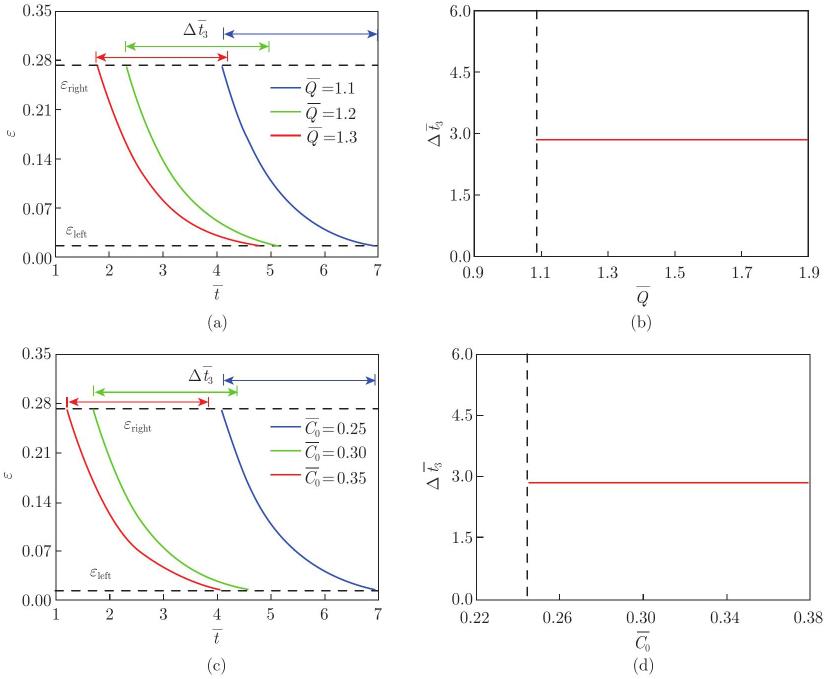
Fig. 8
Effects of Q¯ and C¯0 on Δt¯p, where the fixed parameters are H¯=0.35, L¯r=0.3, k¯=0.3, L¯b=0.11, and L¯c=0.11: (a) α versus t¯ under C¯0=0.25 and Q¯=1.1, 1.2, 1.3; (b) ε versus t¯ under C¯0=0.25 and Q¯=1.1, 1.2, 1.3; (c) Δt¯p versus Q¯; (d) α versus t¯ under Q¯=1.1 and C¯0=0.25, 0.30, 0.35; (e) ε versus t¯ under Q¯=1.1 and C¯0=0.25, 0.30, 0.35; (f) Δt¯p versus C¯0 (color online)"
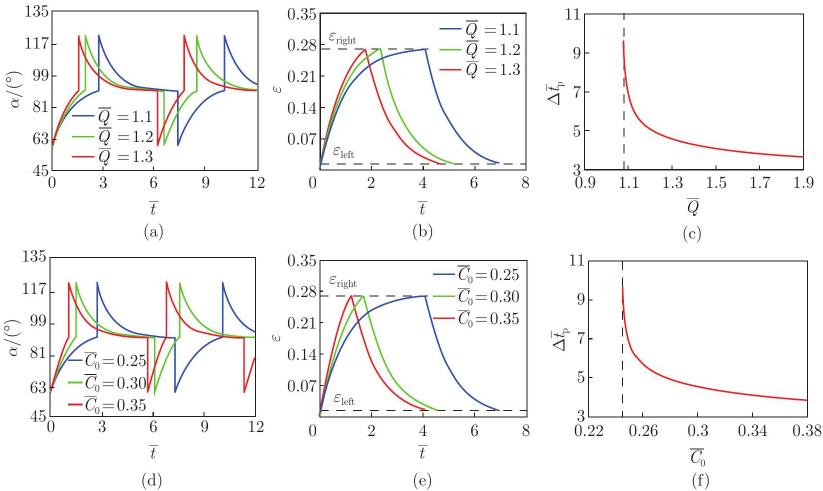
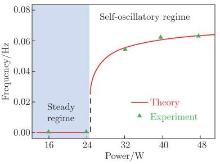
Fig. 9
Theoretical and experimental frequencies of the self-oscillator under varying light powers (color online)"
| [1] | HE, Q. G., YIN, R., HUA, Y. C., JIAO, W. J., MO, C. Y., SHU, H., and RANEY, J. R. A modular strategy for distributed, embodied control of electronics-free soft robots. Science Advances, 9(27), eade9247 (2023) |
| [2] | LIU, J. Q., XU, L. L., JI, Q. X., CHANG, L. F., HU, Y., PENG, Q. Y., and HE, X. D. A MXene-based light-driven actuator and motor with self-sustained oscillation for versatile applications. Advanced Functional Materials, 34(4), 2310955 (2024) |
| [3] | LI, Z. H., XIA, D., LEI, M., and YAN, H. Numerical investigation on self-propelled hydrodynamics of squid-like multiple tentacles with synergistic expansion. Ocean Engineering, 287, 115808 (2023) |
| [4] | LI, Z. H., XIA, D., KANG, S. Z., LI, Y., and LI, T. A comparative study of multi-tentacled underwater robot with different self-steering behaviors: maneuvering and cruising modes. Physics of Fluids, 36(11), 115118 (2024) |
| [5] | ZHENG, R., MA, L. L., FENG, W., PAN, J. T., WANG, Z. Y., CHEN, Z. X., ZHANG, Y. H., LI, C. Y., CHEN, P., BISOYI, H. K., LI, B. X., LI, Q., and LU, Y. Q. Autonomous self-sustained liquid crystal actuators enabling active photonic applications. Advanced Functional Materials, 33(38), 2301142 (2023) |
| [6] | XU, P. B., REN, X. L., ZHU, H. W., and YU, Y. Development of a self-sustained chaotic stirrer with electrothermal response liquid crystal elastomers. Chaos, Solitons and Fractals, 203, 117656 (2026) |
| [7] | CHARROYER, L., CHIELLO, O., and SINOU, J. J. Self-excited vibrations of a non-smooth contact dynamical system with planar friction based on the shooting method. International Journal of Mechanical Sciences, 144, 90–101 (2018) |
| [8] | ZHENG, E., BRANDENBOURGER, M., ROBINET, L., SCHALL, P., LERNER, E., and COULAIS, C. Self-oscillation and synchronization transitions in elastoactive structures. Physical Review Letters, 130(17), 178202 (2023) |
| [9] | ZHANG, B., YAN, Y. M., DONG, X., DYKMAN, M. I., and CHAN, H. B. Frequency stabilization of self-sustained oscillations in a sideband-driven electromechanical resonator. Physical Review Applied, 22(3), 034072 (2024) |
| [10] | LI, K., XIANG, J. Q., ZHANG, Z. Z., and DAI, Y. T. Logic-inspired bistable liquid crystal elastomer photo-oscillator via magnetic-photothermal coupling. Thin-Walled Structures, 225, 114759 (2026) |
| [11] | NIE, Z. Z., WANG, M., HUANG, S., LIU, Z. Y., and YANG, H. Multimodal self-sustainable autonomous locomotions of light-driven Seifert ribbon actuators based on liquid crystal elastomers. Angewandte Chemie International Edition, 135(25), e202304081 (2023) |
| [12] | MA, S. S., XUE, P., TANG, Y. Q., BI, R., XU, X. H., WANG, L., and LI, Q. Responsive soft actuators with MXene nanomaterials. Responsive Materials, 2(1), e20230026 (2024) |
| [13] | LIU, J., JIANG, H. Y., TIAN, J. Q., TANG, Y. Q., FENG, C. B., ZHOU, X. Y., HUANG, Z. J., LI, B. X., LU, Y. Q., and LI, Q. Stimuli-responsive liquid crystal elastomers: from materials to applications. Advanced Functional Materials, 36, e24606 (2026) |
| [14] | HE, X. M., AIZENBERG, M., KUKSENOK, O., ZARZAR, L. D., SHASTRI, A., BALAZS, A. C., and AIZENBERG, J. Synthetic homeostatic materials with chemo-mechano-chemical self-regulation. Nature, 487, 214–218 (2012) |
| [15] | KANG, X. F., MA, S. J., WANG, X. Z., ZHANG, A., HU, J., and XIA, G. H. Nonlinear dynamics of low frequency compact piezoelectric energy harvesting vibration system by a cucurbit flute-inspired beam with intelligent adjustable. Chaos, Solitons and Fractals, 208, 118315 (2026) |
| [16] | HENKE, E. M., SCHLATTER, S., and ANDERSON, I. A. Soft dielectric elastomer oscillators driving bioinspired robots. Soft Robotics, 4(4), 353–366 (2017) |
| [17] | ZOU, J. J., MA, Y. N., LIU, C. X., XIE, Y. M., DAI, X. Y., LI, X. H., LI, S. X., PENG, S. H., YUE, Y., WANG, S., NAN, C. W., and ZHANG, X. Self-powered sensor based on compressible ionic gel electrolyte for simultaneous determination of temperature and pressure. InfoMat, 6(7), e12545 (2024) |
| [18] | DAI, L., ZHENG, C. H., SONG, J. Z., and XIAO, R. Shape memory polymers for neural interfaces: a mini-review. Smart Materials and Structures, 34(7), 073002 (2025) |
| [19] | ZHOU, X. G., PENG, H. L., QIU, Y. L., and LI, K. Delayed oscillation of light-responsive hydrogel layers bonded to a rigid substrate under periodic illumination. Chaos, Solitons and Fractals, 202, 117445 (2026) |
| [20] | ZHU, L. R., HE, M. Q., CHEN, B. H., QIAN, J., and XIAO, R. Inflation of a polydomain nematic elastomeric membrane. Journal of the Mechanics and Physics of Solids, 198, 106075 (2025) |
| [21] | YANG, H. X., ZHANG, C., CHEN, B. H., WANG, Z. J., XU, Y., and XIAO, R. Bioinspired design of stimuli-responsive artificial muscles with multiple actuation modes. Smart Materials and Structures, 32(8), 085023 (2023) |
| [22] | WANG, Y. C., DANG, A. L., ZHANG, Z. F., YIN, R., GAO, Y. C., FENG, L., and YANG, S. Repeatable and reprogrammable shape morphing from photoresponsive gold nanorod/liquid crystal elastomers. Advanced Materials, 32, 2004270 (2020) |
| [23] | XU, Z. T., CHEN, Y. Z., ZHU, L. R., GE, Q., WU, Z. L., QU, S. X., and XIAO, R. Tailored helix morphing of 3D-printed liquid crystal elastomer bilayers. Cell Reports Physical Science, 6, 9 (2025) |
| [24] | WANG, Y. C., YIN, R., JIN, L. S., LIU, M. Z., GAO, Y. C., RANEY, J., and YANG, S. 3D-printed photoresponsive liquid crystal elastomer composites for free-form actuation. Advanced Functional Materials, 33, 2210614 (2023) |
| [25] | WANG, X. R., WANG, P. X., CHEN, J. J., HUANG, C. Y., and LI, K. Light-powered self-propelling boat via self-rotating liquid crystal elastomer rod. Applied Mathematics and Mechanics (English Edition), 47(5), 1065–1084 (2026) https://doi.org/10.1007/s10483-026-3378-8 |
| [26] | WEI, L., JIANG, X., HU, X. A., GE, D. L., and LI, K. Gravity-independent self-rolling of a photothermal liquid crystal elastomer rod for microgravity actuation. Communications in Nonlinear Science and Numerical Simulation, 157, 109764 (2026) |
| [27] | BAZIR, A., BAUMANN, A., ZIEBERT, F., and KULIĆ, I. M. Dynamics of fiberboids. Soft Matter, 16, 5210–5223 (2020) |
| [28] | LIAO, B., ZANG, H. B., CHEN, M. Y., WANG, Y. J., LANG, X., ZHU, N. N., YANG, Z., and YI, Y. Soft rod-climbing robot inspired by winding locomotion of snake. Soft Robotics, 74, 500–511 (2020) |
| [29] | WU, H. Y., HOU, H. Y., QIU, Y. L., GE, D. L., and LI, K. Light-powered self-rolling liquid crystal elastomer rovers between two hollows. Communications in Nonlinear Science and Numerical Simulation, 156, 109723 (2026) |
| [30] | BAI, C. P., KANG, J. T., and WANG, Y. Q. Light-induced motion of three-dimensional pendulum with liquid crystal elastomeric fiber. International Journal of Mechanical Sciences, 266, 108911 (2024) |
| [31] | SUN, X. D. and ZHAO, J. Photomechanical self-oscillation of a bifilar pendulum with liquid crystal elastomeric fiber. Chaos, Solitons and Fractals, 205, 117838 (2026) |
| [32] | GE, D. L. and YANG, Q. C. Light-powered self-sustained jumper via splay-aligned liquid crystal elastomer. Chaos, Solitons and Fractals, 206, 117918 (2026) |
| [33] | ZHANG, Z. Z., QIU, Y. L., and LI, K. Light-fueled self-ejecting liquid crystal elastomer launcher inspired by lizard tail autotomy. Chaos, Solitons and Fractals, 194, 116265 (2025) |
| [34] | CHEN, L., XIA, Y. J., TANG, Z. Y., ZHAO, J. L., and ZHOU, K. Self-sustaining chaotic characteristics of double pendulum based on self-shading effect. Chaos, Solitons and Fractals, 207, 118031 (2026) |
| [35] | XU, P. B., ZHU, H. W., ZHOU, K., REN, X. L., and ZHOU, L. Self-sustained chaotic warning indicator system based on liquid crystal elastomer. Chaos, Solitons and Fractals, 206, 117984 (2026) |
| [36] | CHEN, J. J., WANG, X. R., and LI, K. Dissipation-mediated liquid crystal elastomer self-jumper under constant illumination. Chaos, Solitons and Fractals, 208, 118176 (2026) |
| [37] | KIM, Y., VAN DEN BERG, J., and CROSBY, A. J. Autonomous snapping and jumping polymer gels. Nature Materials, 20, 1695–1701 (2021) |
| [38] | CHEN, J. J., YE, Q., TIAN, J. C., BAO, Y., and LI, K. Cat-inspired self-adaptive liquid crystal elastomer photo-jumper. Thin-Walled Structures, 225, 114756 (2026)) |
| [39] | SARTORI, P., YADAV, R. S., DEL BARRIO, J., DESIMONE, A., and SÁNCHEZ-SOMOLINOS, C. Photochemically induced propulsion of a 4D printed liquid crystal elastomer biomimetic swimmer. Advanced Science, 11(25), 2308561 (2024) |
| [40] | SHI, P. J., ZHAO, Y. S., LIU, Z. X., and HE, X. M. Liquid crystal elastomer composite-based photo-oscillator for microrobots. Journal of Composite Materials, 57(4), 633–643 (2023) |
| [41] | XU, P. B., ZHANG, J. H., ZHOU, K., WANG, M. H., and HU, W. F. Self-sustaining chaotic characteristics of liquid crystal elastomer pendulum under different linear temperature fields. Chaos, Solitons and Fractals, 205, 117812 (2026) |
| [42] | ZHOU, L., CHEN, H. M., LI, Z. H., CHEN, X. H., GAO, T., and GE, D. L. Self-oscillation of a photo-actuated dual-beam system under linear optical excitation. Chaos, Solitons and Fractals, 204, 117740 (2026) |
| [43] | ZHAO, Y. S., LI, Q. F., LIU, Z. X., ALSAID, Y., SHI, P. J., KHALID JAWED, M., and HE, X. M. Sunlight-powered self-excited oscillators for sustainable autonomous soft robotics. Science Robotics, 8(77), eadf4753 (2023) |
| [44] | CHEN, J. J., YE, Q., HU, Z. J., WANG, X. R., and ZHOU, X. G. Jellyfish-inspired non-reciprocal light-fueled self-propelling liquid crystal elastomer-based fluidic saucer. Chaos, Solitons and Fractals, 206, 117889 (2026) |
| [45] | CHEN, H., YAO, X., QIN, H. L., CONG, H. P., and YU, S. H. A photoactivated self-adaptive liquid crystal elastomer oscillator from orientation and polymerization guided by nanowire assembly. Advanced Functional Materials, 35(2), 2412728 (2024) |
| [46] | HU, Y., JI, Q. X., HUANG, M. J., CHANG, L. F., ZHANG, C. C., WU, G., ZI, B., BAO, N. Z., CHEN, W., and WU, Y. C. Light-driven self-oscillating actuators with phototactic locomotion based on black phosphorus heterostructure. Angewandte Chemie International Edition, 60, 20511–20517 (2021) |
| [47] | SUN, J., HU, W., ZHANG, L. Y., LAN, R. C., YANG, H., and YANG, D. K. Light-driven self-oscillating behavior of liquid-crystalline networks triggered by dynamic isomerization of molecular motors. Advanced Functional Materials, 31, 2103311 (2021) |
| [48] | MANNA, R. K., SHKLYAEV, O. E., and BALAZS, A. C. Chemical pumps and flexible sheets spontaneously form self-regulating oscillators in solution. Proceedings of the National Academy of Sciences of the United States of America, 118, e2022987118 (2021) |
| [49] | LI, Z. W., MYUNG, N. V., and YIN, Y. D. Light-powered soft steam engines for self-adaptive oscillation and biomimetic swimming. Science Robotics, 6(61), eabi4523 (2021) |
| [50] | GE, D. L., ZHOU, X. S., LIANG, X. D., and LI, K. Snap-through self-sliding of a liquid crystal elastomer-skateboard photo-oscillator. Thin-Walled Structures, 226, 114951 (2026) |
| [51] | YU, Y., LIU, F. F., HUANG, C. Y., and LI, K. Self-swing of a thermo-responsive L-shaped rod partially resting on a hot plate. Thin-Walled Structures, 221, 114464 (2026) |
| [52] | LENG, X. Q., MEI, G. K., ZHANG, G. H., LIU, Z. F., and ZHOU, X. Tethering of twisted-fiber artificial muscles. Chemical Society Reviews, 52(7), 2377–2390 (2023) |
| [53] | WANG, Y. P., SUN, J. H., LIAO, W., and YANG, Z. Q. Liquid crystal elastomer twist fibers toward rotating microengines. Advanced Materials, 34(9), 2107840 (2022) |
| [54] | ZHAO, Y., CHI, Y. D., HONG, Y. Y., LI, Y. B., YANG, S., and YIN, J. Twisting for soft intelligent autonomous robot in unstructured environments. Proceedings of the National Academy of Sciences of the United States of America, 119(22), e2200265119 (2022) |
| [55] | REN, L. Q., HE, Y. L., WANG, B. F., XU, J. Y., WU, Q., WANG, Z. G., LI, W. X., REN, L., ZHOU, X. L., LIU, Q. P., LI, B. Q., and SONG, Z. Y. 4D printed self-sustained soft crawling machines fueled by constant thermal field. Advanced Functional Materials, 34(33), 2400161 (2024) |
| [56] | VANTOMME, G., ELANDS, L. C. M., GELEBART, A. H., MEIJER, E. W., POGROMSKY, A. Y., NIJMEIJER, H., and BROER, D. J. Coupled liquid crystalline oscillators in Huygens’ synchrony. Nature Materials, 20, 1702–1706 (2021) |
| [57] | KIM, H., SUNDARAM, S., KANG, J. H., TANJEEM, N., EMRICK, T., and HAYWARD, R. C. Coupled oscillation and spinning of photothermal particles in Marangoni optical traps. Proceedings of the National Academy of Sciences of the United States of America, 118(18), e2024581118 (2021) |
| [58] | WANG, Y. C., LIU, J. Q., and YANG, S. Multi-functional liquid crystal elastomer composites. Applied Physics Reviews, 9, 011301 (2022) |
| [59] | KUENSTLER, A. S., CHEN, Y. Z., BUI, P., KIM, H., DESIMONE, A., JIN, L. H., and HAYWARD, R. C. Blueprinting photothermal shape-morphing of liquid crystal elastomers. Advanced Materials, 32, 2000609 (2020) |
| [60] | YU, Y., QUAN, Y. Y., LI, T. Y., HUANG, C. Y., MA, H. H., and LI, K. Self-synchronization of a two-span liquid crystal elastomer continuous beam above a hot platform. Chaos, Solitons and Fractals, 202, 117528 (2026)) |
| [61] | HAUSER, A. W., SUNDARAM, S., and HAYWARD, R. C. Photothermocapillary oscillators. Physical Review Letters, 121, 158001 (2018) |
| [62] | CHAKRABARTI, A., CHOI, G. P. T., and MAHADEVAN, L. Self-excited motions of volatile drops on swellable sheets. Physical Review Letters, 124(25), 258002 (2020) |
| [63] | HERBERT, K. M., FOWLER, H. E., MCCRACKEN, J. M., SCHLAFMANN, K. R., KOCH, J. A., and WHITE, T. J. Synthesis and alignment of liquid crystalline elastomers. Nature Reviews Materials, 7(1), 23–38 (2022) |
| [64] | WANG, L. Q., WEI, Z. X., XU, Z. T., YU, Q. M., WU, Z. L., WANG, Z. J., QIAN, J., and XIAO, R. Shape morphing of 3D printed liquid crystal elastomer structures with precuts. ACS Applied Polymer Materials, 5(9), 7477–7484 (2023) |
| [65] | CHEN, J. J., QIU, Y. L., ZHOU, X. G., GE, D. L., and LI, K. Impatiens-inspired self-sustained photo-ejector with liquid-crystal elastomer shell. Thin-Walled Structures, 219, 114312 (2026) |
| [66] | BAI, C. P., KANG, J. T., and WANG, Y. Q. Kirigami-inspired light-responsive conical spiral actuators with large contraction ratio using liquid crystal elastomer fiber. ACS Applied Materials & Interfaces, 17(9), 14488–14498 (2025) |
| [67] | KANG, W. D., CHENG, Q., LIU, C. Y., WANG, Z. J., LI, D. F., and LIANG, X. D. A constitutive model of monodomain liquid crystal elastomers with the thermal-mechanical-nematic order coupling. Journal of the Mechanics and Physics of Solids, 196, 105995 (2025) |
| [68] | WANG, X. C., DAI, Y. T., and ZHAO, J. Light-driven self-swing of a liquid crystal elastomer fiber-based composite pendulum in magnetic field. Chaos, Solitons and Fractals, 202, 117570 (2026) |
| [69] | BAI, C. P., KANG, J. T., and WANG, Y. Q. Light-induced wrinkling in annulus anisotropic liquid crystal elastomer films. Physical Review E, 111(1), 015421 (2025) |
| [70] | LI, C., XU, L. Y., DAI, Y. T., and DAI, Y. A light-driven self-spinning and translation disc exploiting photothermal liquid crystal elastomers. Micromachines, 17, 284 (2026) |
| [71] | KANG, J. T., UNIVERSITY, N., BAI, C. P., UNIVERSITY, N., WANG, Y. Q., and UNIVERSITY, N. Tunable energy absorption characteristics of 3D-printed anisotropic liquid crystal elastomers. ACS Applied Polymer Materials, 7(21), 14497–14507 (2025) |
| [72] | YANG, H. X., YIN, X. F., ZHANG, C., CHEN, B. H., SUN, P., and XU, Y. Weaving liquid crystal elastomer fiber actuators for multifunctional soft robotics. Science Advances, 11(8), eads3058 (2025) |
| [73] | RAHMATI, A. H., MOZAFFARI, K., LIU, L. P., and SHARMA, P. A static and dynamic theory for photo-flexoelectric liquid crystal elastomers and the coupling of light, deformation and electricity. Journal of the Mechanics and Physics of Solids, 195, 105949 (2025) |
| [74] | SUN, J. H., WANG, Y. P., LIAO, W., and YANG, Z. Q. Ultrafast, high-contractile electrothermal-driven liquid crystal elastomer fibers towards artificial muscles. Small, 17, 2103700 (2021) |
| [75] | LIAO, W. and YANG, Z. Q. The integration of sensing and actuating based on a simple design fiber actuator towards intelligent soft robots. Advanced Materials Technologies, 7(6), 2101260 (2022) |
| [76] | CHEN, B. H., LIU, C. Y., XU, Z. T., WANG, Z. J., and XIAO, R. Modeling the thermo-responsive behaviors of polydomain and monodomain nematic liquid crystal elastomers. Mechanics of Materials, 188, 104838 (2024) |
| [77] | ZHAO, J., WANG, Y., GAO, J. F., CHEN, J. J., and LI, K. Self-oscillation of a thin-walled cantilever enabled by a minimal liquid crystal elastomer switching actuator. Thin-Walled Structures, 227, 114970 (2026) |
| [78] | ZANG, T. Z., WANG, J. W., YAN, G. Y., LU, X. L., HU, J. S., XIA, H. S., and ZHAO, Y. State of the art, insights and perspectives for bio-inspired liquid crystal elastomer soft actuators. Advanced Materials, 37(41), e08694 (2025) |
| [79] | FANG, X., LOU, J., WANG, J., CHUANG, K. C., WU, H. M., and HUANG, Z. L. A self-excited bistable oscillator with a light-powered liquid crystal elastomer. International Journal of Mechanical Sciences, 271, 109124 (2024) |
| [80] | ZHANG, Z. Z., JIANG, X. Y., QIU, Y. L., and LI, K. Stepwise self-oscillation of a photo-oscillator via time delay. International Journal of Mechanical Sciences, 288, 110046 (2025)) |
| [81] | COCCOLO, M., CANTISÁN, J., SEOANE, J. M., RAJASEKAR, S., and SANJUÁN, M. A. Delay-induced resonance suppresses damping-induced unpredictability. Philosophical Transactions of the Royal Society A: Mathematical, Physical and Engineering Sciences, 379(2192), 20200232 (2021) |
| [82] | CHEMBO, Y. K., BRUNNER, D., JACQUOT, M., and LARGER, L. Optoelectronic oscillators with time-delayed feedback. Reviews of Modern Physics, 91(3), 035006 (2019) |
| [83] | ALANAZY, A., MOATIMID, G., AMER, T., and GALAL, A. Non-perturbative approach in scrutinizing nonlinear time-delay of van der Pol-Duffing oscillator. European Journal of Pure and Applied Mathematics, 18(1), 5495 (2025) |
| [1] | Xueru WANG, Pengxin WANG, Junjie CHEN, Chuanyang HUANG, Kai LI. Light-powered self-propelling boat via self-rotating liquid crystal elastomer rod [J]. Applied Mathematics and Mechanics (English Edition), 2026, 47(5): 1065-1084. |
| [2] | N. A. SAEED, Y. Y. ELLABBAN, Lei HOU, Haiming YI, Shun ZHONG, F. Z. DURAIHEM, O. M. OMARA. Nonlinear vibration of quasi-zero stiffness structure with piezoelectric harvester and RL-load: intra-well and inter-well oscillation modes under 1:1 internal resonance [J]. Applied Mathematics and Mechanics (English Edition), 2025, 46(8): 1451-1474. |
| [3] | Kai LI, Chongfeng ZHAO, Yunlong QIU, Yuntong DAI. Light-powered self-rolling of a liquid crystal elastomer-based dicycle [J]. Applied Mathematics and Mechanics (English Edition), 2025, 46(2): 253-268. |
| [4] | Weicong ZHANG, Zengting XU, Baihong CHEN, Xiangren KONG, Rui XIAO, Jin QIAN. Mechanical design of stimuli-responsive flexible rotary joint using liquid crystal elastomers [J]. Applied Mathematics and Mechanics (English Edition), 2025, 46(12): 2221-2240. |
| [5] | Lele REN, Wei ZHANG, Yufei ZHANG. Inter-well internal resonance analysis of rectangular asymmetric cross-ply bistable composite laminated cantilever shell under transverse foundation excitation [J]. Applied Mathematics and Mechanics (English Edition), 2024, 45(8): 1353-1370. |
| [6] | Lele REN, Wei ZHANG, Ting DONG, Yufei ZHANG. Snap-through behaviors and nonlinear vibrations of a bistable composite laminated cantilever shell: an experimental and numerical study [J]. Applied Mathematics and Mechanics (English Edition), 2024, 45(5): 779-794. |
| [7] | Meiqi WU, Peng LV, Hongyuan LI, Jiale YAN, Huiling DUAN, Wei ZHANG. Theoretical and experimental investigation of the resonance responses and chaotic dynamics of a bistable laminated composite shell in the dynamic snap-through mode [J]. Applied Mathematics and Mechanics (English Edition), 2024, 45(4): 581-602. |
| [8] | Haiyang WU, Jiangfeng LOU, Biao ZHANG, Yuntong DAI, Kai LI. Stability analysis of a liquid crystal elastomer self-oscillator under a linear temperature field [J]. Applied Mathematics and Mechanics (English Edition), 2024, 45(2): 337-354. |
| [9] | Wenjie SUN, Wentao MA, Fei ZHANG, Wei HONG, Bo LI. Snap-through path in a bistable dielectric elastomer actuator [J]. Applied Mathematics and Mechanics (English Edition), 2022, 43(8): 1159-1170. |
| [10] | Xiantao ZHANG, Haicheng ZHANG, Xiao ZHOU, Ze SUN. Recent advances in wave energy converters based on nonlinear stiffness mechanisms [J]. Applied Mathematics and Mechanics (English Edition), 2022, 43(7): 1081-1108. |
| [11] | Bo YAN, Ning YU, Chuanyu WU. A state-of-the-art review on low-frequency nonlinear vibration isolation with electromagnetic mechanisms [J]. Applied Mathematics and Mechanics (English Edition), 2022, 43(7): 1045-1062. |
| [12] | Yijie BIAN, Puhao LI, Fan YANG, Peng WANG, Weiwei LI, Hualin FAN. Deformation mode and energy absorption of polycrystal-inspired square-cell lattice structures [J]. Applied Mathematics and Mechanics (English Edition), 2020, 41(10): 1561-1582. |
| [13] | Yun CUI, Yafei YIN, Chengjun WANG, K. SIM, Yuhang LI, Cunjiang YU, Jizhou SONG. Transient thermo-mechanical analysis for bimorph soft robot based on thermally responsive liquid crystal elastomers [J]. Applied Mathematics and Mechanics (English Edition), 2019, 40(7): 943-952. |
| [14] | Ruirui LIU, Haibo WANG, Jialing YANG, Hua LIU, Yuxin SUN. Theoretical analysis on quasi-static lateral compression of elliptical tube between two rigid plates [J]. Applied Mathematics and Mechanics (English Edition), 2015, 36(8): 1005-1016. |
| [15] | Mao-bin HU;Qi-yi LIU;Wang-ping SUN;Rui JIANG;Qing-song WU. Packing induced bistable phenomenon in granular flow: analysis from complex network perspective [J]. Applied Mathematics and Mechanics (English Edition), 2014, 35(12): 1565-1572. |
| Viewed | ||||||
|
Full text |
|
|||||
|
Abstract |
|
|||||





 Email Alert
 RSS
RSS