Applied Mathematics and Mechanics (English Edition) ›› 2026, Vol. 47 ›› Issue (2): 401-422.doi: https://doi.org/10.1007/s10483-026-3349-7
Previous Articles Next Articles
Yeyu CHEN1, Zhenyu OUYANG1, Zhaowu LIN2, Jianzhong LIN1,2,†( )
)
Received:2025-08-03
Revised:2025-11-28
Online:2026-02-04
Published:2026-02-04
Contact:
Jianzhong LIN, E-mail: mecjzlin@public.zju.edu.cnSupported by:2010 MSC Number:
Yeyu CHEN, Zhenyu OUYANG, Zhaowu LIN, Jianzhong LIN. Motion characteristics of a flexible self-propelled slender particle in a backward-facing step flow. Applied Mathematics and Mechanics (English Edition), 2026, 47(2): 401-422.
Fig. 1
Schematic of a slender particle under the active strain field. (a) Schematic diagram of the active strain model, where the blue highlighted part represents the active section. The dashed box represents the deformed particle. (b) Sinusoidal strain applied to the two surfaces of the slender particle during half an oscillation period (0⩽t<T/2), where α represents the amplitude (color online)"
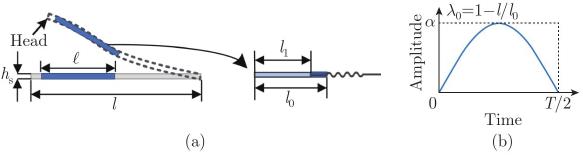
Fig. 2
Characteristics of a slender particle under the active strain model. (a) Simulated undulatory shape of the active slender particle (deformation intensity α=1). (b) Distribution of the particle curvature along the length (color online)"
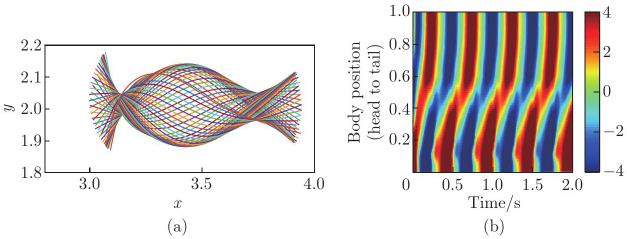
Fig. 3
Schematic of a slender particle moving in a BFS flow. The blue rectangle represents the slender particle, which is released after the inflow reaches a steady state. A separation vortex forms downstream of the step with x1 representing the reattachment length (color online)"
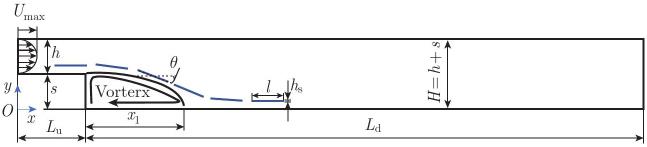
Fig. 4
Motion behavior of a slender particle released at different initial heights y. (a) Time evolution of slender body configurations. Each snapshot is taken at intervals of 5 000Δt. The shaded region indicates the step, and the blue dashed line shows the centerline of the channel. (b) Variation of the velocity. The solid line and dashed line represent the horizontal velocity Ux and vertical velocity Uy, respectively (color online)"
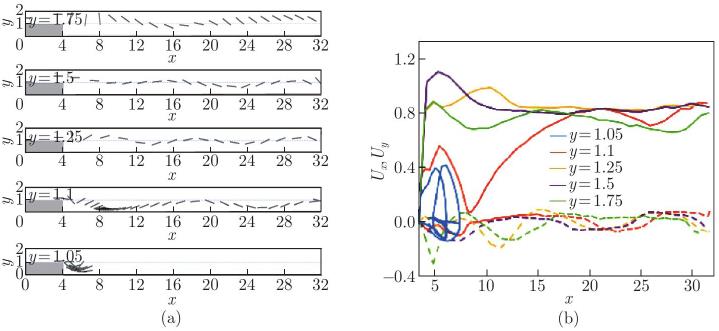
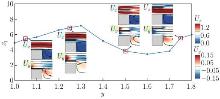
Fig. 5
Variation of reattachment length x1 and local steady-state velocity field for different initial release heights y. The blue and green insets show horizontal velocity distributions Ux and vertical velocity distributions Uy, respectively. The shaded region indicates the step (color online)"
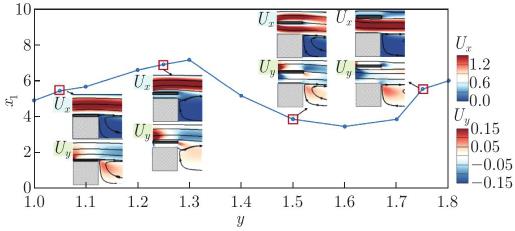
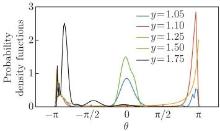
Fig. 6
Probability density functions of the slender particle’s orientation θ at different initial release heights y (color online)"
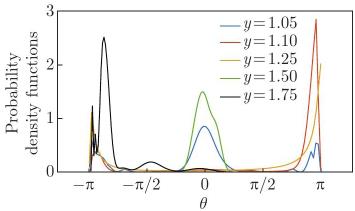
Fig. 7
Trajectories of the slender particle with different aspect ratios w after release at y=1.05. (a) The inset box indicates the region for early-stage trajectory fitting. (b) Variation of the initial trajectory slope A1 (from linear fitting y=A1x+B1) with respect to aspect ratio w (color online)"
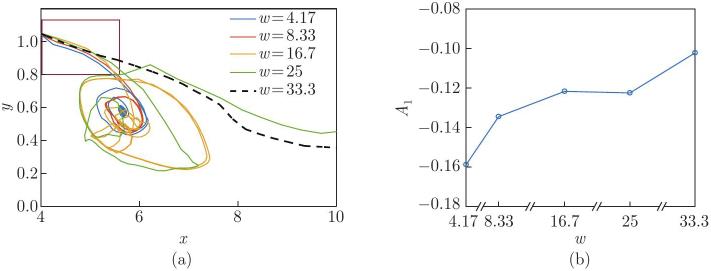
Fig. 8
Variations in motion parameters of a slender particle under different w. (a) Probability density functions of the slender particle’s orientation θ. (b) Bending factor γ (color online)"
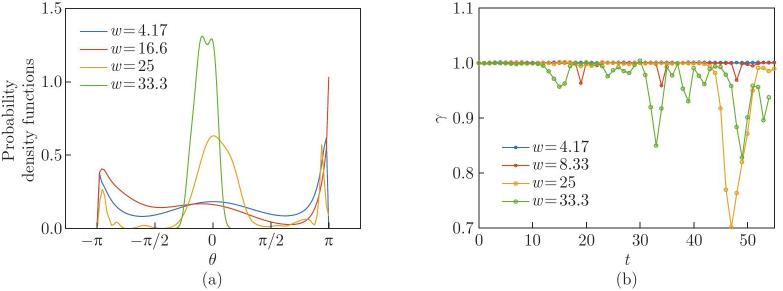
Fig. 9
Local streamlines and shear velocity distributions around the slender particle for different aspect ratios w. (a)–(c) The trapping mode at w=4.1. (d)–(f) The motion of the particle after contact with the separation vortex at w=33.3. The initial release time of the slender particle is taken as t=0 unless otherwise specified. The horizontal axis x range starts from the back of the step (x=4) (color online)"
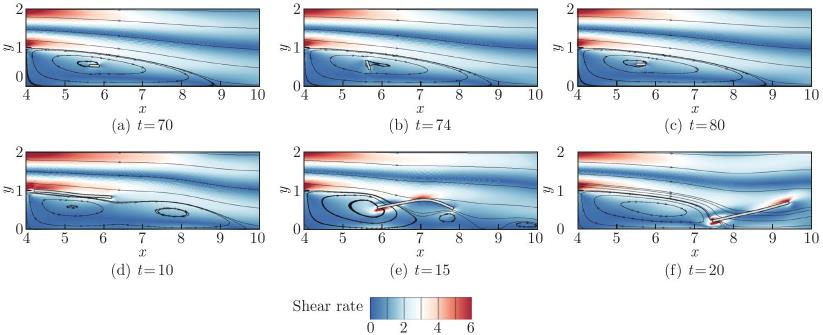
Fig. 10
Local streamlines and shear velocity distributions around the slender particle under unstable trapping mode for the aspect ratios w=25 (color online)"
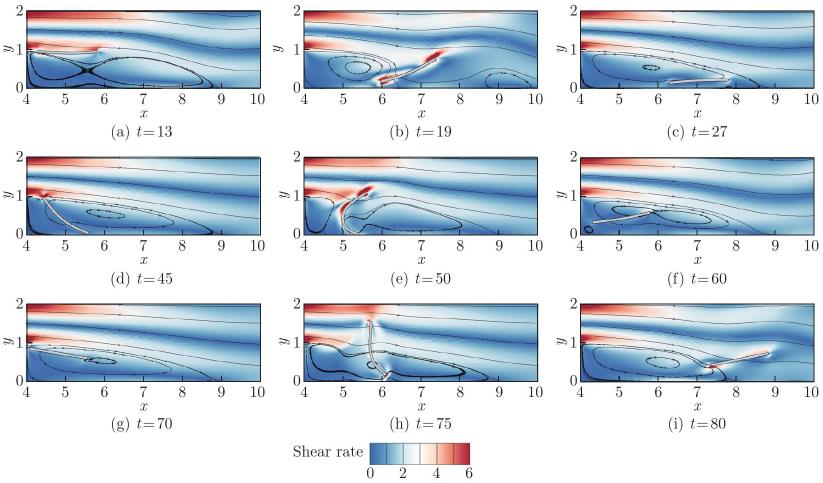
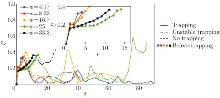
Fig. 11
Velocity evolution of the slender particle after release for various aspect ratios w (color online)"
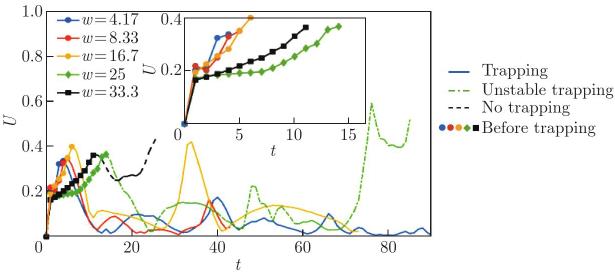
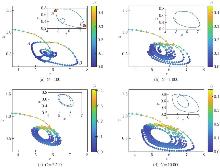
Fig. 12
The trajectory of a slender particle with different G from initial release to stable motion at Re=200. The blue line represents the trajectory of the slender particle in a whole cycle when it is in stable motion. Points A and B represent the two endpoints of the major axis of the fitted elliptical trajectory, and the color bar represents the total velocity U of the slender particle (color online)"
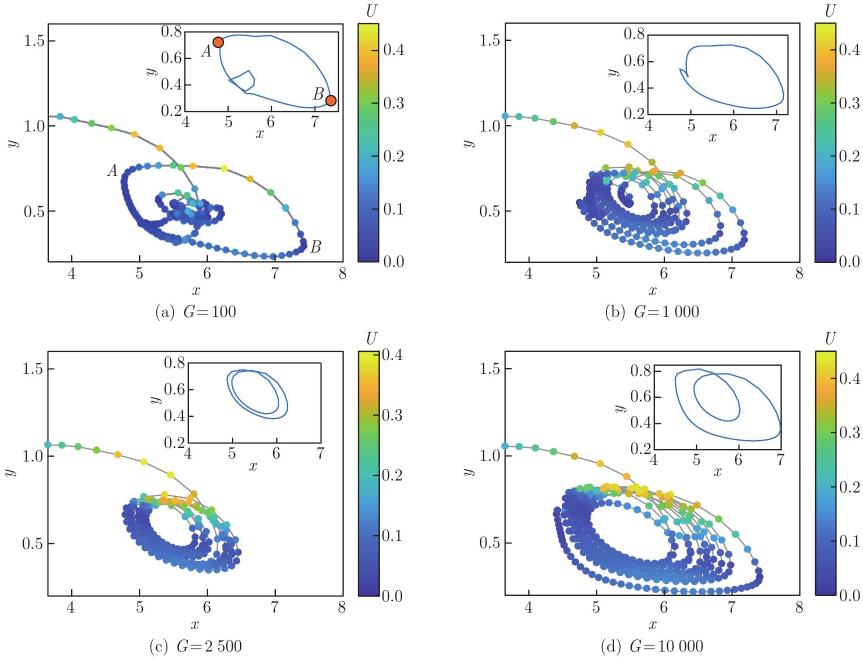
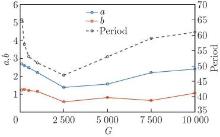
Fig. 13
Ellipse fitting results of the outer trajectory of the slender particle (major axis a, minor axis b), and a complete rotation period varies with G (color online)"
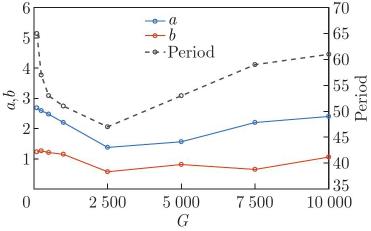
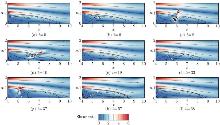
Fig. 14
The configuration of the slender particle and the shear rate of the flow field in a stable rotation period when the shear modulus G=100. When the slender particle moves closest to the sidewall of the step during the period, t=0 (color online)"
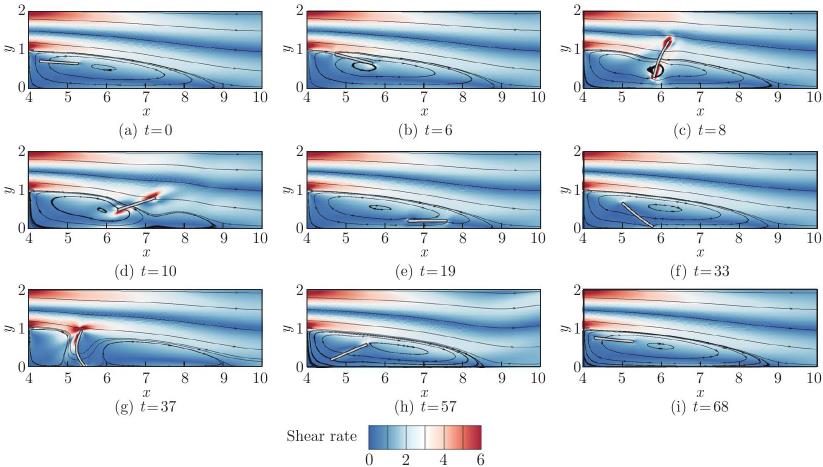
Fig. 15
The configuration of the slender particle and the shear rate of the flow field in a stable rotation period when the shear modulus G=10 000. When the slender particle moves closest to the sidewall of the step during the period, t=0 (color online)"
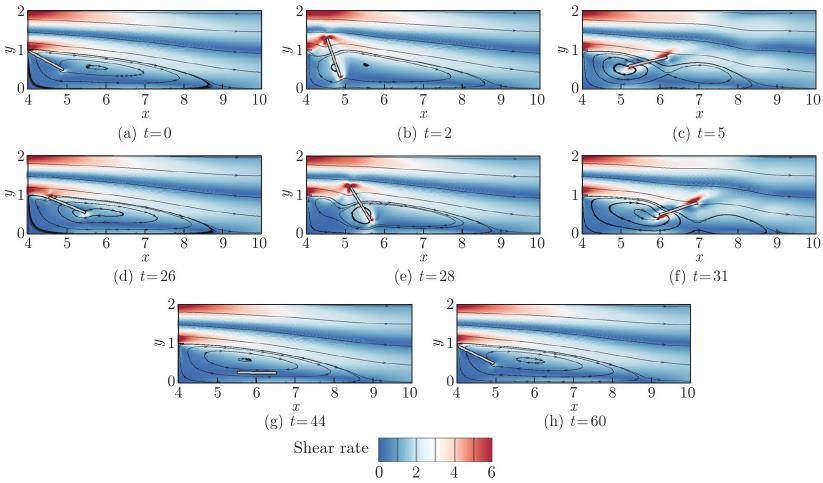
Fig. 16
Variations in motion parameters of a slender particle under different G. (a) bending factor γ; (b) probability density functions of the slender particle’s orientation θ (color online)"
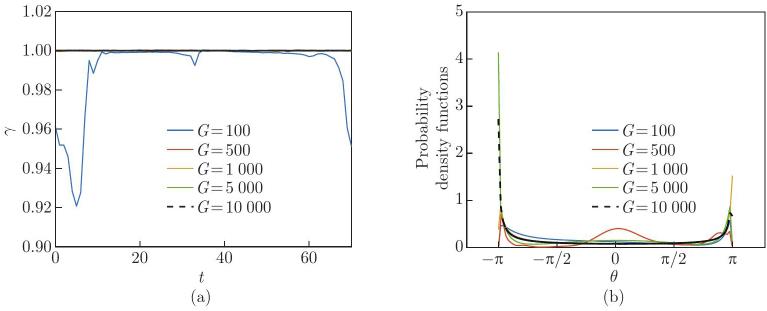
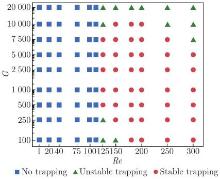
Fig. 17
Motion modes of a slender body at different Re and G (color online)"
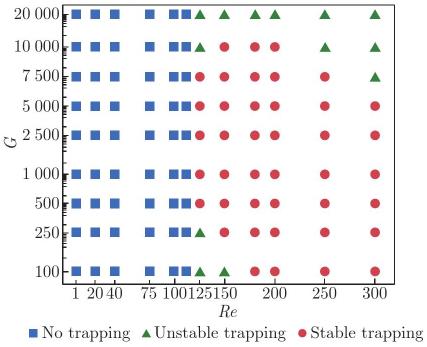
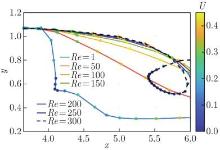
Fig. 18
The trajectory of a slender particle after release at different Re when G=7 500. The black dashed line represents the unstable trapping mode. The color bar is the total velocity U (color online)"
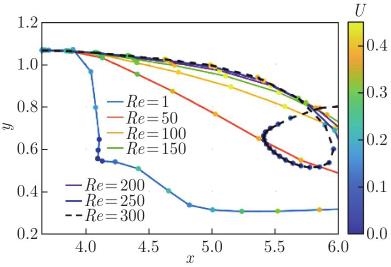
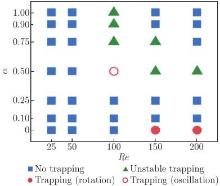
Fig. 19
The motion modes of a slender particle at different Re and deformation intensity α (color online)"
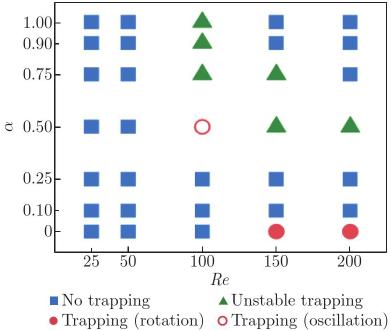
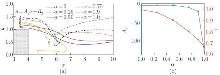
Fig. 20
Motion behavior of a slender particle with different deformation intensities α at Re=100. (a) Trajectory of a slender particle. The dashed line represents the unstable trapping motion. The gray box represents the step. (b) Initial trajectory slope A2 and bending factor γ (color online)"
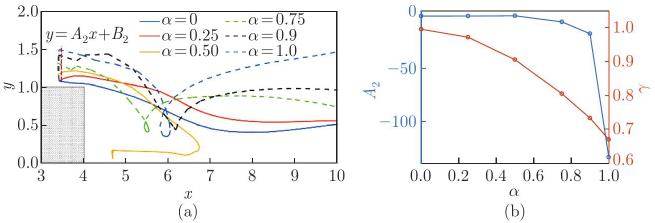
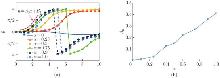
Fig. 21
Orientation θ changes after initial release at different deformation intensities α. (a) θ changes over time t. (b) Orientation slope varies with α (color online)"
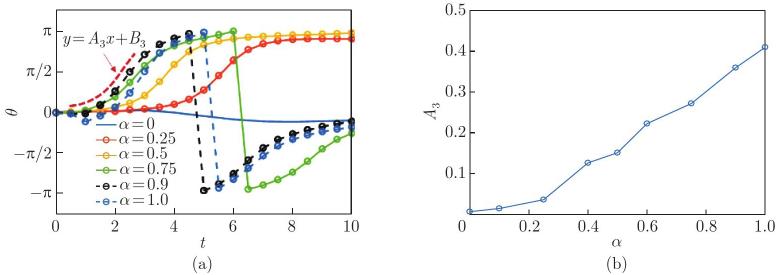
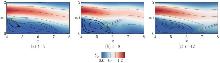
Fig. 22
Flow field and streamline evolution around the passive slender particle (α=0) at the release stage (no trapping). The green circle indicates the head of the slender particle. The horizontal axis x range starts from the back of the step (x=4) (color online)"
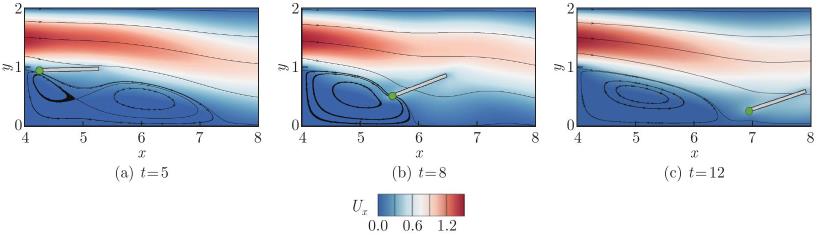
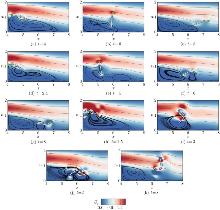
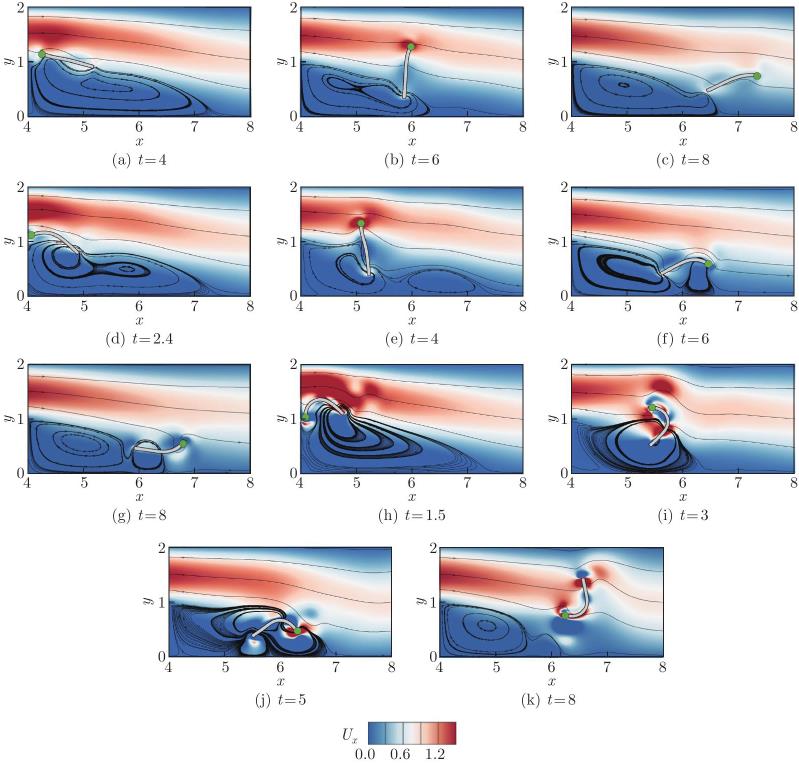
Fig. 23
Flow field and streamline evolution around the slender particle with different deformation intensities α at the release stage. (a)–(c) Low activity: α=0.25, no trapping. (d)–(g) Moderate activity: α=0.5, trapping (oscillation). (h)–(k) High activity: α=1.0, unstable trapping. The green circle indicates the head of the slender particle (color online)"
| [1] | CUI, J. Y., LIU, Y., and JIN, Y. Z. Impact of initial fiber states on different fiber dynamic patterns in the laminar channel flow. International Journal of Mechanical Sciences, 198, 106359 (2021) |
| [2] | CAPPELLO, J., BECHERT, M., DUPRAT, C., DU ROURE, O., GALLAIRE, F., and LINDNER, A. Transport of flexible fibers in confined microchannels. Physical Review Fluids, 4(3), 034202 (2019) |
| [3] | DU ROURE, O., LINDNER, A., NAZOCKDAST, E. N., and SHELLEY, M. J. Dynamics of flexible fibers in viscous flows and fluids. Annual Review of Fluid Mechanics, 51, 539–572 (2019) |
| [4] | YUAN, J. Z., ZHOU, J., RAIZEN, D. M., and BAU, H. H. High-throughput, motility-based sorter for microswimmers such as C. elegans. Lab on a Chip, 15(13), 2790–2798 (2015) |
| [5] | LUNDELL, F., SÖDERBERG, L. D., and ALFREDSSON, P. H. Fluid mechanics of paper-making. Annual Review of Fluid Mechanics, 43, 195–217 (2011) |
| [6] | DRESCHER, K., SHEN, Y., BASSLER, B. L., and STONE, H. A. Biofilm streamers cause catastrophic disruption of flow with consequences for environmental and medical systems. Proceedings of the National Academy of Sciences of the United States of America, 110(11), 4345–4350 (2013) |
| [7] | D’ANGELO, M. V., SEMIN, B., PICARD, G., POITZSCH, M. E., HULIN, J. P., and AURADOU, H. Single fiber transport in a fracture slit: influence of the wall roughness and of the fiber flexibility. Transport in Porous Media, 84, 389–408 (2010) |
| [8] | LI, Z. B., BIELINSKI, C., LINDNER, A., DU ROURE, O., and DELMOTTE, B. Dynamics of rigid fibers interacting with triangular obstacles in microchannel flows. Physical Review Fluids, 9(4), 044302 (2024) |
| [9] | SHANKAR, P. N. and DESHPANDE, M. D. Fluid mechanics in the driven cavity. Annual Review of Fluid Mechanics, 32, 93–136 (2000) |
| [10] | SHEN, C. and FLORYAN, J. M. Low Reynolds number flow over cavities. Physics of Fluids, 28(11), 3191–3198 (1985) |
| [11] | ARMALY, B. F., DURST, F., PEREIRA, J. C. F., and SCHÖNUNG, B. Experimental and theoretical investigation of backward-facing step flow. Journal of Fluid Mechanics, 127, 473–496 (1983) |
| [12] | LIU, W. W., ZHENG, C., and WU, C. Y. Infiltration and resuspension of dilute particle suspensions in micro cavity flow. Powder Technology, 395, 400–408 (2022) |
| [13] | HADDADI, H. and DI CARLO, D. Inertial flow of a dilute suspension over cavities in a microchannel. Journal of Fluid Mechanics, 811, 436–467 (2017) |
| [14] | SHEN, F., XUE, S., XU, M., PANG, Y., and LIU, Z. M. Experimental study of single-particle trapping mechanisms into microcavities using microfluidics. Physics of Fluids, 31(4), 042002 (2019) |
| [15] | JIANG, M. Q., QIAN, S. Z., and LIU, Z. H. Fully resolved simulation of single-particle dynamics in a microcavity. Microfluidics and Nanofluidics, 22(12), 144 (2018) |
| [16] | KHOJAH, R., LO, D., TANG, F., and DI CARLO, D. The evolution of flow and mass transport in 3D confined cavities. Microfluidics and Nanofluidics, 25, 102 (2021) |
| [17] | CAPONE, A. and ROMANO, G. P. Interactions between fluid and fibers in a turbulent backward-facing step flow. Physics of Fluids, 27(5), 053303 (2015) |
| [18] | YAKHSHI-TAFTI, E., CHO, H. J., and KUMAR, R. Backward-facing step flow in microchannels using microparticle image velocimetry. Journal of Thermophysics and Heat Transfer, 25(1), 96–104 (2011) |
| [19] | BECHERT, M., CAPPELLO, J., DAÏEFF, M., GALLAIRE, F., LINDNER, A., and DUPRAT, C. Controlling transport dynamics of confined asymmetric fibers. Europhysics Letters, 126(4), 44001 (2019) |
| [20] | MARCHETTI, B., RASPA, V., LINDNER, A., DU ROURE, O., BERGOUGNOUX, L., GUAZZELLI, É., and DUPRAT, C. Deformation of a flexible fiber settling in a quiescent viscous fluid. Physical Review Fluids, 3(10), 104102 (2018) |
| [21] | NAGEL, M., BRUN, P. T., BERTHET, H., LINDNER, A., GALLAIRE, F., and DUPRAT, C. Oscillations of confined fibres transported in microchannels. Journal of Fluid Mechanics, 835, 444–460 (2018) |
| [22] | AL-FAQHERI, W., THIO, T. H. G., QASAIMEH, M. A., DIETZEL, A., MADOU, M., and AL-HALHOULI, A. Particle/cell separation on microfluidic platforms based on centrifugation effect: a review. Microfluidics and Nanofluidics, 21(7), 102 (2017). |
| [23] | TEN HAGEN, B., KÜMMEL, F., WITTKOWSKI, R., TAKAGI, D., LÖWEN, H., and BECHINGER, C. Gravitaxis of asymmetric self-propelled colloidal particles. Nature Communications, 5, 4829 (2014) |
| [24] | CHEN, L., YANG, C., XIAO, Y., YAN, X., HU, L., EGGERSDORFER, M., CHEN, D., WEITZ, D. A., and YE, F. Millifluidics, microfluidics, and nanofluidics: manipulating fluids at varying length scales. Materials Today Nano, 16, 100136 (2021) |
| [25] | TANASIJEVIĆ, I. and LAUGA, E. Microswimmers in vortices: dynamics and trapping. Soft Matter, 18(47), 8931–8944 (2022) |
| [26] | PARIDA, L. The locomotory characteristics of Caenorhabditis elegans in various external environments: a review. Applied Animal Behaviour Science, 255, 105741 (2022) |
| [27] | LI, A., LUO, Y. X., LIU, Y., XU, Y. Q., TIAN, F. B., and WANG, Y. Hydrodynamic behaviors of self-propelled sperms in confined spaces. Engineering Applications of Computational Fluid Mechanics, 16(1), 141 (2022) |
| [28] | DEBNATH, T., CHAUDHURY, P., MUKHERJEE, T., MONDAL, D., and GHOSH, P. K. Escape kinetics of self-propelled particles from a circular cavity. The Journal of Chemical Physics, 155(19), 194104 (2021) |
| [29] | PRAMANIK, R., VERSTAPPEN, R. W. C. P., and ONCK, P. R. Nature-inspired miniaturized magnetic soft robotic swimmers. Applied Physics Reviews, 11(2), 021318 (2024) |
| [30] | HU, X., CHEN, W. J., TAO, W. Q., LIN, J. Z., ZHU, Z. C., LI, L. M., and LIU, B. Trapping micro-swimmers over a cavity in an inertial micro-channel. International Journal of Mechanical Sciences, 285, 109796 (2025) |
| [31] | YANG, Y. N., OUYANG, Z. Y., YE, H., XU, J. B., and LIN, J. Z. The hydrodynamic characteristics of a squirmer swimming in a lid-driven cavity. Powder Technology, 456, 120817 (2025) |
| [32] | YUAN, H., YUAN, W. W., DUAN, S. X., JIAO, K. R., ZHANG, Q., LIM, E. G., CHEN, M., ZHAO, C., PAN, P., LIU, X. Y., and SONG, P. F. Microfluidic-assisted Caenorhabditis elegans sorting: current status and future prospects. Cyborg and Bionic Systems, 4, 0011 (2023) |
| [33] | LAI, J. C. S., YUE, J., and PLATZER, M. F. Control of backward-facing step flow using a flapping foil. Experiments in Fluids, 32(1), 44 (2002) |
| [34] | BISWAS, G., BREUER, M., and DURST, F. Backward-facing step flows for various expansion ratios at low and moderate Reynolds numbers. Journal of Fluids Engineering, 126(3), 362–374 (2004) |
| [35] | YU, Z. S. A DLM/FD method for fluid/flexible-body interactions. Journal of Computational Physics, 207(1), 1–27 (2005) |
| [36] | GLOWINSKI, R., PAN, T. W., HESLA, T. I., and JOSEPH, D. D. A distributed Lagrange multiplier/fictitious domain method for particulate flows. International Journal of Multiphase Flow, 25(5), 755–794 (1999) |
| [37] | LIN, Z. W., HESS, A., YU, Z. S., CAI, S. Q., and GAO, T. A fluid-structure interaction study of soft robotic swimmer using a fictitious domain/active-strain method. Journal of Computational Physics, 376, 1138–1155 (2019) |
| [38] | HAMLET, C., FAUCI, L. J., and TYTELL, E. D. The effect of intrinsic muscular nonlinearities on the energetics of locomotion in a computational model of an anguilliform swimmer. Journal of Theoretical Biology, 385, 119–129 (2015) |
| [39] | LAUGA, E. Swimming at low Reynolds number: a beginner’s guide to undulatory locomotion. Reports on Progress in Physics, 83(7), 076601 (2020) |
| [40] | GAGNON, D. A., KEIM, N. C., and ARRATIA, P. E. Undulatory swimming in shear-thinning fluids: experiments with Caenorhabditis elegans. Journal of Fluid Mechanics, 758, R3 (2014) |
| [41] | HEEREMANS, T., DEBLAIS, A., BONN, D., and WOUTERSEN, S. Chromatographic separation of active polymer-like worm mixtures by contour length and activity. Science Advances, 8(23), eabj7918 (2022) |
| [42] | AI, X. N., ZHUO, W. P., LIANG, Q. L., MCGRATH, P. T., and LU, H. A high-throughput device for size-based separation of C. elegans developmental stages. Lab on a Chip, 14(10), 1746–1752 (2014) |
| [43] | SKJETNE, P., ROSS, R. F., and KLINGENBERG, D. J. Simulation of single fiber dynamics. Journal of Chemical Physics, 107(6), 2108–2118 (1997) |
| [44] | SŁOWICKA, A. M., EKIEL-JEŻEWSKA, M. L., SADLEJ, K., and WAJNRYB, E. Dynamics of fibers in a wide microchannel. The Journal of Chemical Physics, 136(4), 044902 (2012) |
| [45] | CUI, J. Y., WANG, Z. K., LIU, Y., JIN, Y. Z., and ZHU, Z. C. Three-dimensional simulation of lateral migration of fiber in a laminar channel flow. International Journal of Mechanical Sciences, 236, 107766 (2022) |
| [46] | FORGACS, O. L., ROBERTSON, A. A., and MASON, S. G. The hydrodynamic behaviour of paper-making fibres. Pulp and Paper Magazine of Canada, 59(4), 117–125 (1958) |
| [47] | PARK, J. S. and JUNG, H. I. Multiorifice flow fractionation: continuous size-based separation of microspheres using a series of contraction/expansion microchannels. Analytical Chemistry, 81(20), 8280–8288 (2009) |
| [1] | Yadong HUANG, Desheng ZHANG, Fadong GU. Amplification mechanism of perturbation energy in controlled backward-facing step flow [J]. Applied Mathematics and Mechanics (English Edition), 2021, 42(10): 1479-1494. |
| [2] | Yan FANG, Chen WANG, Hongyuan JIANG. Crystallization of self-propelled particles on a spherical substrate [J]. Applied Mathematics and Mechanics (English Edition), 2019, 40(10): 1387-1398. |
| Viewed | ||||||
|
Full text |
|
|||||
|
Abstract |
|
|||||





 Email Alert
 RSS
RSS