Applied Mathematics and Mechanics (English Edition) ›› 2026, Vol. 47 ›› Issue (2): 423-442.doi: https://doi.org/10.1007/s10483-026-3350-8
P. T. NGUYEN, K. A. LUONG, J. H. LEE†( )
)
Received:2025-08-25
Revised:2025-12-04
Online:2026-02-04
Published:2026-02-04
Contact:
J. H. LEE, E-mail: jhlee@sejong.ac.krSupported by:2010 MSC Number:
P. T. NGUYEN, K. A. LUONG, J. H. LEE. Neural boundary shape functions in physics-informed neural networks for discontinuous and high-frequency problems. Applied Mathematics and Mechanics (English Edition), 2026, 47(2): 423-442.
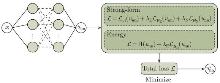
Fig. 1
Schematic diagram of standard PINNs (color online)"
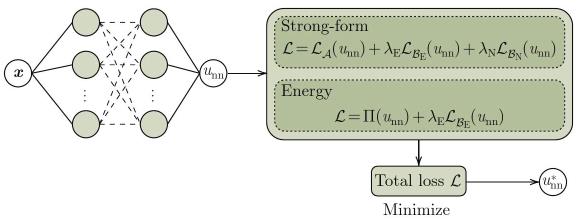
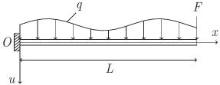
Fig. 2
Cantilever beam problem"
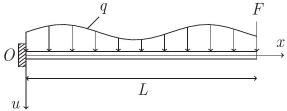
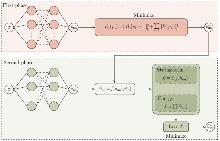
Fig. 3
Schematic diagram of the proposed method (color online)"
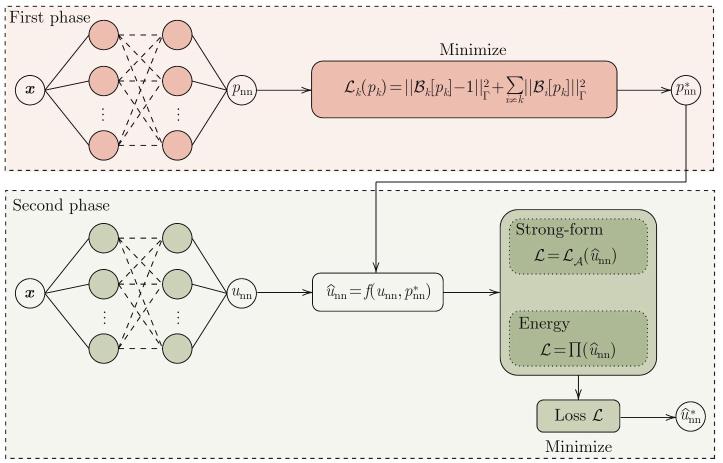
Table 1
Relative errors of approximated deflections obtained by the proposed methods with various activation functions and optimizers for the cantilever beam"
| Activation function | Method | Optimizer | |||
|---|---|---|---|---|---|
| Adam | L-BFGS | Adagrad | Adam+L-BFGS | ||
| Present-SF | |||||
| Present-En | |||||
| Present-SF | |||||
| Present-En | |||||
| Present-SF | |||||
| Present-En | |||||
| Present-SF | |||||
| Present-En | |||||
| Note: Adam represents the adaptive moment estimation, L-BFGS represents the limited-memory Broyden-Fletcher-Goldfarb-Shanno algorithm, and Adagrad represents the adaptive gradient algorithm | |||||
Table 2
Relative errors of approximated deflections obtained by the proposed methods with various network architectures for the cantilever beam"
| Method | Two hidden layers | Three hidden layers | ||||
|---|---|---|---|---|---|---|
| 30 neurons | 40 neurons | 50 neurons | 30 neurons | 40 neurons | 50 neurons | |
| Present-SF | ||||||
| Present-En | ||||||
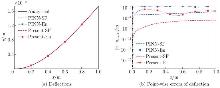
Fig. 4
Predicted deflections and the corresponding point-wise errors of the cantilever beam by the considered methods (color online)"
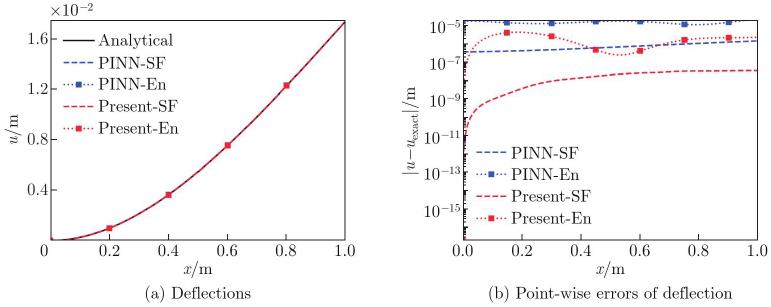
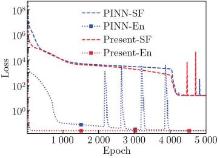
Fig. 5
Training histories of the cantilever beam by the considered methods (color online)"
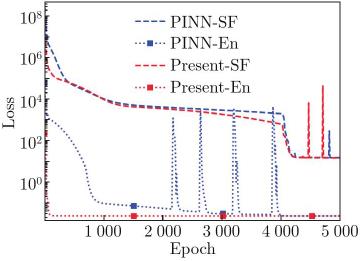
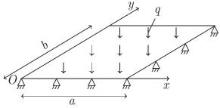
Fig. 6
Simply supported square plate"
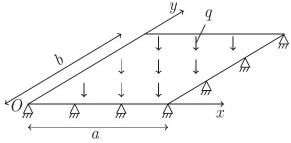
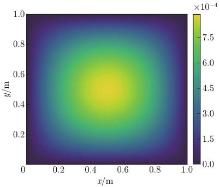
Fig. 7
FEM solutions of the simply supported square plate (color online)"
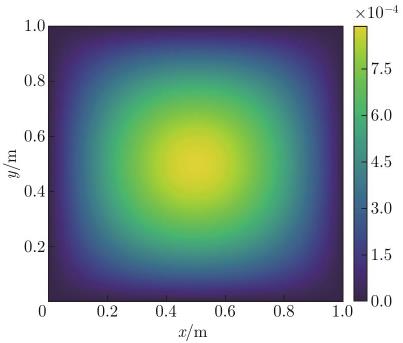
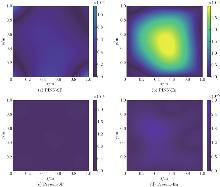
Fig. 8
Point-wise errors of the simply supported square plate by the considered methods (color online)"
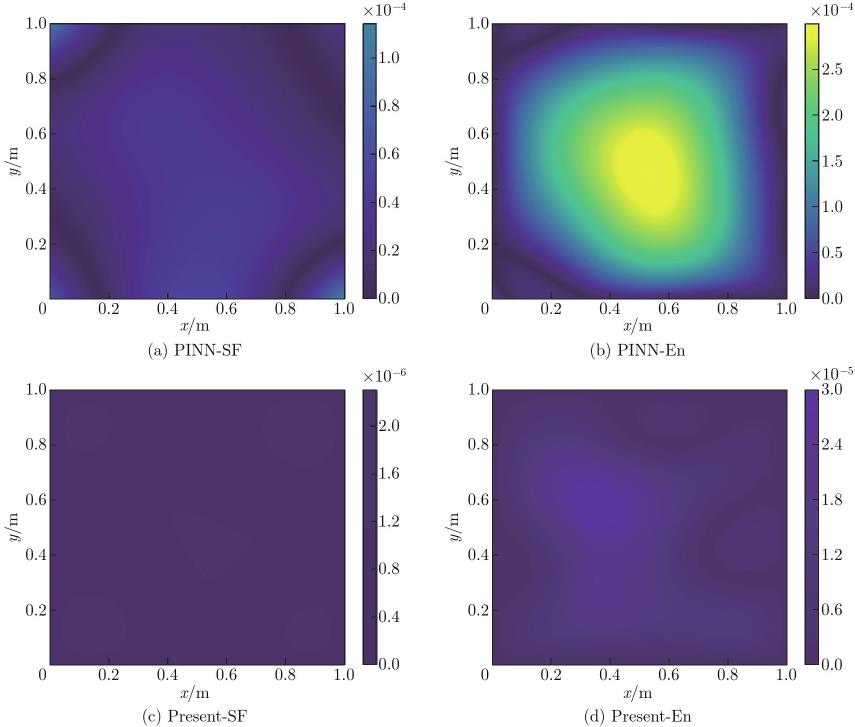
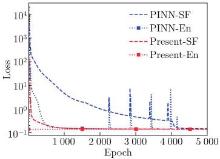
Fig. 9
Training histories of the simply supported square plate by the considered methods (color online)"
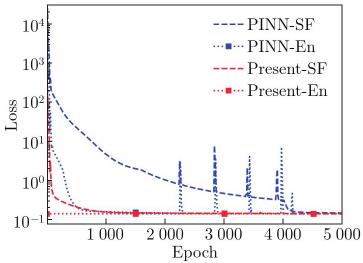
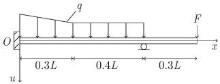
Fig. 10
Beam with internal pin support problem"
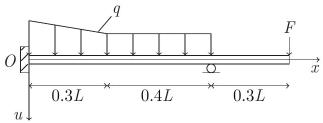
Fig. 11
Predicted deflections and the corresponding point-wise errors of the beam with internal pin supports by the considered methods (color online)"
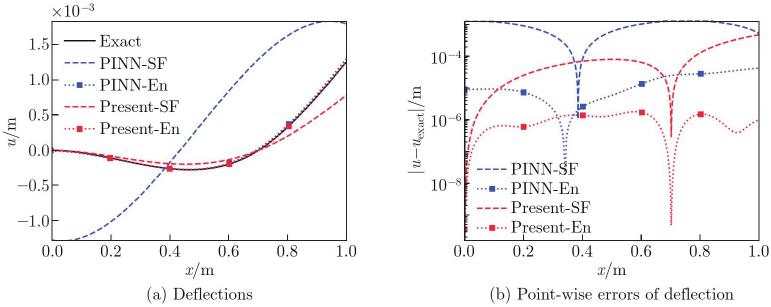
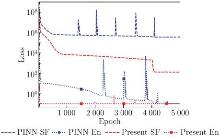
Fig. 12
Training histories of the beam with internal pin supports by the considered methods (color online)"
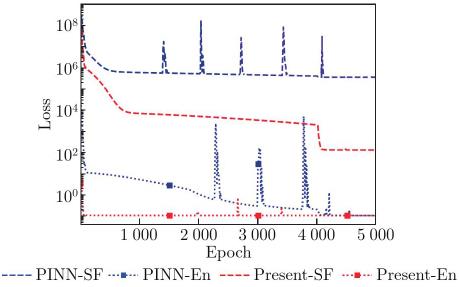
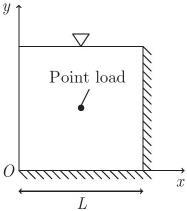
Fig. 13
Plate with mixed edge constraints"
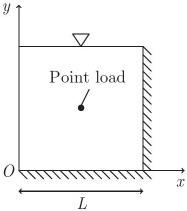
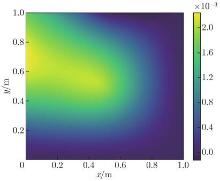
Fig. 14
FEM solutions of the plate with mixed edge constraints (color online)"
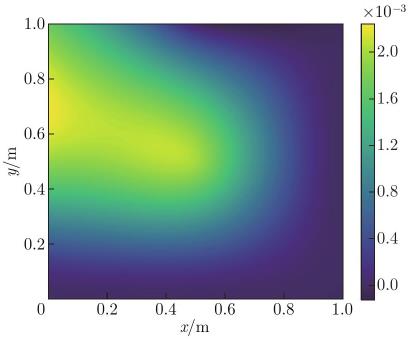
Fig. 15
Point-wise errors of the plate with mixed edge constraints by the considered methods (color online)"
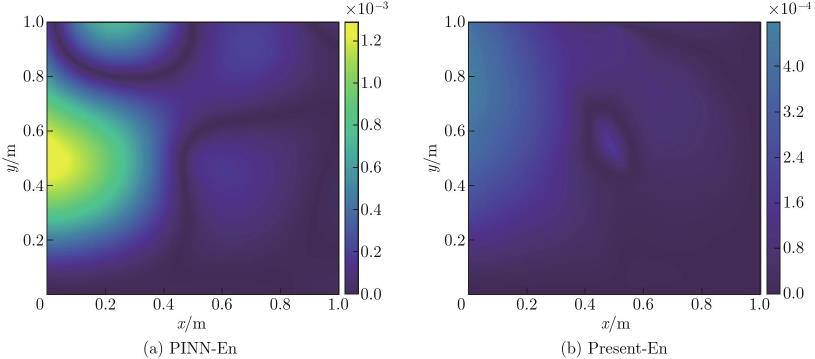
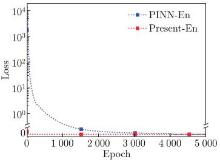
Fig. 16
Training histories of the plate with mixed edge constraints by the considered methods (color online)"
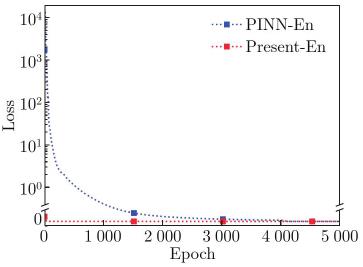
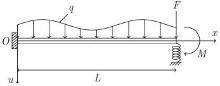
Fig. 17
Beam with clamped-spring supports"
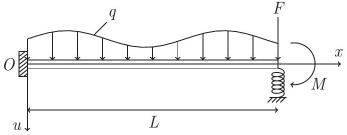
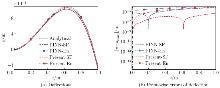
Fig. 18
Predicted deflections and the corresponding point-wise errors of the beam with clamped-spring supports by the considered methods (color online)"
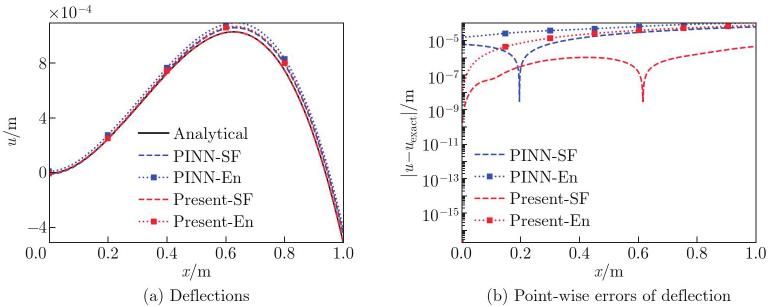
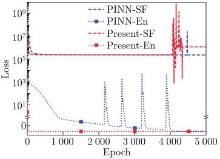
Fig. 19
Training histories of the beam with clamped-spring supports by the considered methods (color online)"
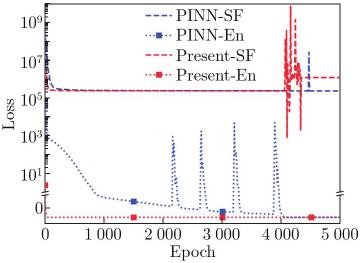
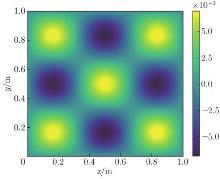
Fig. 20
Analytical solutions of the simply supported square plate with high-frequency loading (color online)"
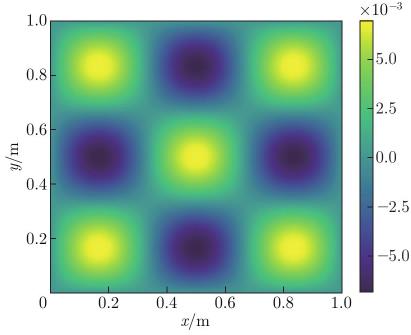
Fig. 21
Point-wise errors of the simply supported square plate with high-frequency loading by the considered methods (color online)"
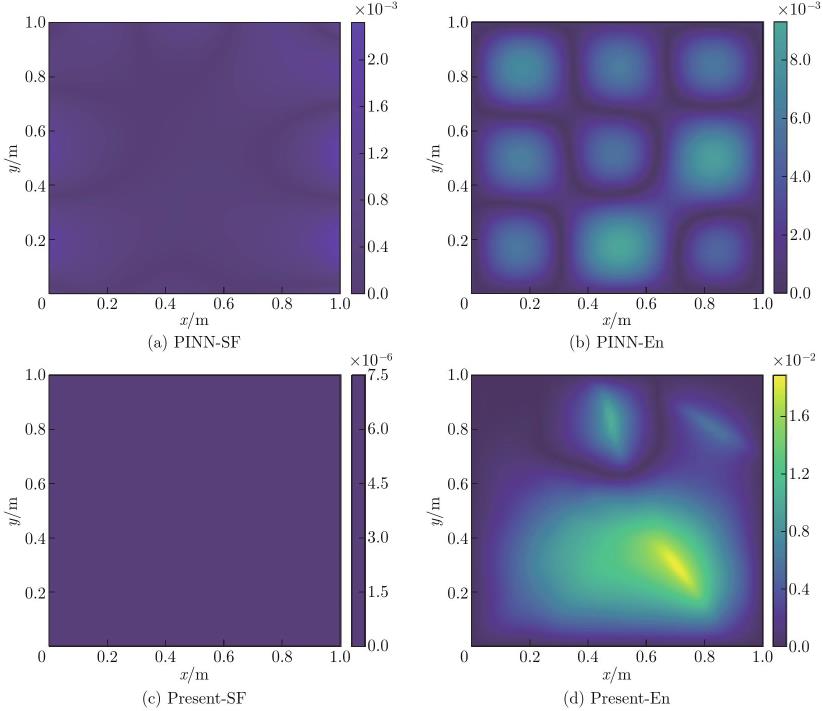
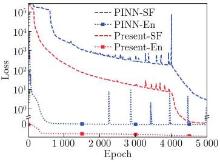
Fig. 22
Training histories of the simply supported square plate with high-frequency loading by the considered methods (color online)"
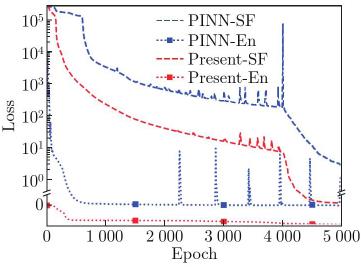
Table 3
Comparison of training time of the considered methods for all examples Unit: min"
| Problem | Present method | PINN-SF | PINN-En | ||
|---|---|---|---|---|---|
| Finding shape functions | Present-SF | Present-En | |||
| Subsection 4.1.1 | 1.3 | 8.6 | 5.1 | 1.9 | 1.5 |
| Subsection 4.1.2 | 16.6 | 44.7 | 8.2 | 9.3 | 2.2 |
| Subsection 4.2.1 | 4.7 | 10.5 | 5.3 | 2.6 | 1.2 |
| Subsection 4.2.2 | 20.3 | – | 17.2 | – | 3.7 |
| Subsection 4.3.1 | 1.4 | 9.4 | 8.3 | 2.6 | 1.5 |
| Subsection 4.3.2 | 16.6 | 71.2 | 24.1 | 17.9 | 5.4 |
Fig. 23
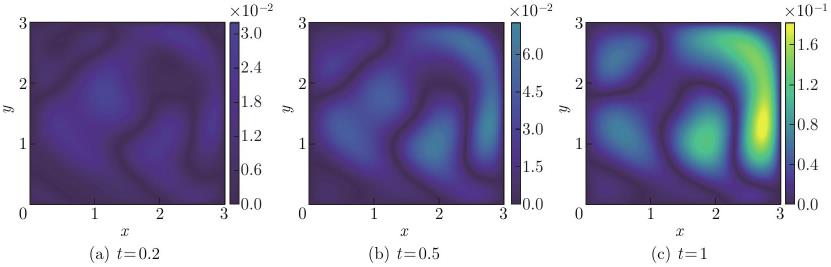
Analytical solutions of the advection-diffusion problem (color online)"
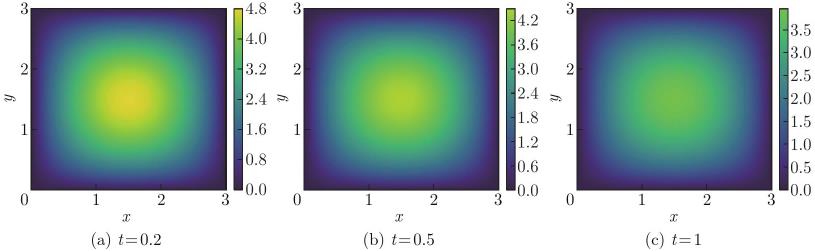
Fig. 24
Point-wise errors of the advection-diffusion problem by the proposed strong-form method (color online)"
| [1] | JOHNSON, C. Numerical Solution of Partial Differential Equations by the Finite Element Method, Cambridge University Press, Cambridge (1988) |
| [2] | ÖZIŞIK, M. N., ORLANDE, H. R., COLAÇO, M. J., and COTTA, R. M. Finite Difference Methods in Heat Transfer, CRC Press, New York (2017) |
| [3] | HESTHAVEN, J. S., GOTTLIEB, D. I., and GOTTLIEB, S. Spectral Methods for Time-Dependent Problems, Cambridge University Press, Cambridge (2007) |
| [4] | LEVEQUE, R. J. Finite Difference Methods for Ordinary and Partial Differential Equations: Steady-State and Time-Dependent Problems, Society for Industrial and Applied Mathematics, United States (2007) |
| [5] | HUGHES, T. J. The Finite Element Method: Linear Static and Dynamic Finite Element Analysis, Dover Publications, Mineola, NY (2003) |
| [6] | KOPRIVA, D. A. Implementing Spectral Methods for Partial Differential Equations: Algorithms for Scientists and Engineers, Springer Science & Business Media, Berlin (2009) |
| [7] | POZRIKIDIS, C. Finite and Spectral Element Methods Using Matlab, University of California, San Diego, U. S. A. (2005) |
| [8] | RAISSI, M., PERDIKARIS, P., and KARNIADAKIS, G. E. Physics-informed neural networks: a deep learning framework for solving forward and inverse problems involving nonlinear partial differential equations. Journal of Computational Physics, 378, 686–707 (2019) |
| [9] | E, W. and YU, B. The deep ritz method: a deep learning-based numerical algorithm for solving variational problems. Communications in Mathematics and Statistics, 66, 1–12 (2018) |
| [10] | WU, Z., WANG, H., HE, C., ZHANG, B., XU, T., and CHEN, Q. The application of physics-informed machine learning in multiphysics modeling in chemical engineering. Industrial & Engineering Chemistry Research, 62(44), 18178–18204 (2023) |
| [11] | CAI, S., WANG, Z., WANG, S., PERDIKARIS, P., and KARNIADAKIS, G. E. Physics-informed neural networks for heat transfer problems. Journal of Heat Transfer, 143(6), 060801 (2021) |
| [12] | WU, Y., FENG, W., LI, Y., ZHANG, K., and YANG, F. Dual-stage method with PINN for coupled strong-form diffusion and energy-based deformation analysis in lithium-ion batteries. Applied Mathematical Modelling, 143, 115986 (2025) |
| [13] | BAI, J., LIN, Z., WANG, Y., WEN, J., LIU, Y., RABCZUK, T., GU, Y., and FENG, X. Q. Energy-based physics-informed neural network for frictionless contact problems under large deformation. Computer Methods in Applied Mechanics and Engineering, 437, 117787 (2025) |
| [14] | HU, Z., SHUKLA, K., KARNIADAKIS, G. E., and KAWAGUCHI, K. Tackling the curse of dimensionality with physics-informed neural networks. Neural Networks, 176, 106369 (2024) |
| [15] | LE-DUC, T., LEE, S., NGUYEN-XUAN, H., and LEE, J. A hierarchically normalized physics-informed neural network for solving differential equations: application for solid mechanics problems. Engineering Applications of Artificial Intelligence, 133, 108400 (2024) |
| [16] | BAI, J., LIU, G. R., GUPTA, A., ALZUBAIDI, L., FENG, X. Q., and GU, Y. Physics-informed radial basis network (PIRBN): a local approximating neural network for solving nonlinear partial differential equations. Computer Methods in Applied Mechanics and Engineering, 415, 116290 (2023) |
| [17] | JAGTAP, A. D., KAWAGUCHI, K., and KARNIADAKIS, G. E. Adaptive activation functions accelerate convergence in deep and physics-informed neural networks. Journal of Computational Physics, 404, 109136 (2020) |
| [18] | TOSCANO, J. D., OOMMEN, V., VARGHESE, A. J., ZOU, Z., AHMADI DARYAKENARI, N., WU, C., and KARNIADAKIS, G. E. From PINNs to PIKANs: recent advances in physics-informed machine learning. Machine Learning for Computational Science and Engineering, 1(1), 15 (2025) |
| [19] | RAHAMAN, N., BARATIN, A., ARPIT, D., DRAXLER, F., LIN, M., HAMPRECHT, F. A., BENGIO, Y., and COURVILLE, A. On the spectral bias of neural networks. The 36th International Conference on Machine Learning, 5301–5310 (2019) |
| [20] | WANG, S., TENG, Y., and PERDIKARIS, P. Understanding and mitigating gradient flow pathologies in physics-informed neural networks. SIAM Journal on Scientific Computing, 43(5), A3055–A3081 (2021) |
| [21] | SON, H., CHO, S. W., and HWANG, H. J. Enhanced physics-informed neural networks with augmented Lagrangian relaxation method (AL-PINNs). Neurocomputing, 548, 126424 (2023) |
| [22] | CHEN, Z., LAI, S. K., YANG, Z., NI, Y. Q., YANG, Z., and CHEUNG, K. C. AT-PINN-HC: a refined time-sequential method incorporating hard-constraint strategies for predicting structural behavior under dynamic loads. Computer Methods in Applied Mechanics and Engineering, 436, 117691 (2025) |
| [23] | LYU, L., WU, K., DU, R., and CHEN, J. Enforcing exact boundary and initial conditions in the deep mixed residual method. CSIAM Transactions on Applied Mathematics, 2, 748–775 (2021) |
| [24] | LUONG, K. A., LE-DUC, T., and LEE, J. Deep reduced-order least-square method — a parallel neural network structure for solving beam problems. Thin-Walled Structures, 191, 111044 (2023) |
| [25] | DE RYCK, T. and MISHRA, S. Numerical analysis of physics-informed neural networks and related models in physics-informed machine learning. Acta Numerica, 33, 633–713 (2024) |
| [26] | HU, Z., SHI, Z., KARNIADAKIS, G. E., and KAWAGUCHI, K. Hutchinson trace estimation for high-dimensional and high-order physics-informed neural networks. Computer Methods in Applied Mechanics and Engineering, 424, 116883 (2024) |
| [27] | LUONG, K. A., LE-DUC, T., and LEE, J. Automatically imposing boundary conditions for boundary value problems by unified physics-informed neural network. Engineering with Computers, 40(3), 1717–1739 (2024) |
| [28] | WANG, J., MO, Y. L., IZZUDDIN, B., and KIM, C. W. Exact Dirichlet boundary physics-informed neural network EPINN for solid mechanics. Computer Methods in Applied Mechanics and Engineering, 414, 116184 (2023) |
| [29] | HU, T., JIN, B., and WANG, F. An iterative deep Ritz method for monotone elliptic problems. Journal of Computational Physics, 527, 113791 (2025) |
| [30] | DONDL, P., MÜLLER, J., and ZEINHOFER, M. Uniform convergence guarantees for the deep Ritz method for nonlinear problems. Advances in Continuous and Discrete Models, 2022(1), 49 (2022) |
| [31] | LIU, C. S. A boundary shape function method for analyzing nonlinear composite beams, subjecting to nonlinear boundary moment conditions. Composite Structures, 264, 113636 (2021) |
| [32] | LIU, C. S., QIU, L., and LIN, J. Simulating thin plate bending problems by a family of two-parameter homogenization functions. Applied Mathematical Modelling, 79, 284–299 (2020) |
| [33] | CHANG, T. Y., GIE, G. M., HONG, Y., and JUNG, C. Y. Singular layer physics informed neural network method for plane parallel flows. Computers & Mathematics with Applications, 166, 91–105 (2024) |
| [34] | GIE, G. M., HONG, Y., JUNG, C. Y., and MUNKHJIN, T. Semi-analytic PINN methods for boundary layer problems in a rectangular domain. Journal of Computational and Applied Mathematics, 450, 115989 (2024) |
| [35] | SUKUMAR, N. and SRIVASTAVA, A. Exact imposition of boundary conditions with distance functions in physics-informed deep neural networks. Computer Methods in Applied Mechanics and Engineering, 389, 114333 (2022) |
| [36] | REDDY, J. N. Energy Principles and Variational Methods in Applied Mechanics, 3rd ed., John Wiley & Sons, New York (2017) |
| [37] | SHIN, Y., DARBON, J., and KARNIADAKIS, G. E. On the convergence of physics informed neural networks for linear second-order elliptic and parabolic type PDEs. Communications in Computational Physics, 28, 2042–2074 (2020) |
| [38] | STEIN, M. Large sample properties of simulations using Latin hypercube sampling. Technometrics, 29(2), 143–151 (1987) |
| [39] | MISHRA, S. and MOLINARO, R. Estimates on the generalization error of physics-informed neural networks for approximating PDEs. IMA Journal of Numerical Analysis, 43(1), 1–43 (2023) |
| [40] | DE RYCK, T., MISHRA, S., and MOLINARO, R. wPINNs: weak physics informed neural networks for approximating entropy solutions of hyperbolic conservation laws. SIAM Journal on Numerical Analysis, 62(2), 811–841 (2024) |
| [41] | CHANG, K., REN, H., and LAI, J. Extended particle weak-form-based neural networks for seismic modeling. IEEE Geoscience and Remote Sensing Letters, 22, 3002605 (2025) |
| [42] | LIN, P. C. Bending of cantilever rectangular plate with concentrated load. Applied Mathematics and Mechanics (English Edition), 3(2), 281–291 (1982) https://doi.org/10.1007/BF01877662 |
| [43] | MEMA, E., WANG, T., and KNAP, J. Deep Ritz method with Fourier feature mapping: a deep learning approach for solving variational models of microstructure. Journal of Computational Science, 91, 102631 (2025) |
| [44] | TANCIK, M., SRINIVASAN, P., MILDENHALL, B., FRIDOVICH-KEIL, S., RAGHAVAN, N., SINGHAL, U., RAMAMOORTHI, R., BARRON, J., and NG, R. Fourier features let networks learn high frequency functions in low dimensional domains. Advances in Neural Information Processing Systems, 33, 7537–7547 (2020) |
| [45] | WATANABE, M. Numerical Methods (Finite Element) for Time-Dependent Partial Differential Equations, M. Sc. dissertation, Utah State University (1982) |
| [1] | Daiwei DONG, Wei SUO, Jiaqing KOU, Weiwei ZHANG. PINN-MG: a multigrid-inspired hybrid framework combining the iterative method and physics-informed neural networks [J]. Applied Mathematics and Mechanics (English Edition), 2026, 47(8): 1855-1878. |
| [2] | Chenxu LIU, Yingjing QIAN, Guilan YU, Zhanli LIU, Xiaodong YANG. A modular physics-informed neural network for nonlinear vibration isolators [J]. Applied Mathematics and Mechanics (English Edition), 2026, 47(8): 1747-1768. |
| [3] | Jiamin QIAN, Lincong CHEN, J. Q. SUN. Neural network solution based on the minimum potential energy principle for static problems of structural mechanics [J]. Applied Mathematics and Mechanics (English Edition), 2025, 46(6): 1125-1142. |
| [4] | Nanxi DING, Hengzhen FENG, H. Z. LOU, Shenghua FU, Chenglong LI, Zihao ZHANG, Wenlong MA, Zhengqian ZHANG. Prediction of velocity and pressure of gas-liquid flow using spectrum-based physics-informed neural networks [J]. Applied Mathematics and Mechanics (English Edition), 2025, 46(2): 341-356. |
| [5] | K. CHANDAN, K. KARTHIK, K. V. NAGARAJA, B. C. PRASANNAKUMARA, R. S. VARUN KUMAR, T. MUHAMMAD. Radiative heat transfer analysis of a concave porous fin under the local thermal non-equilibrium condition: application of the clique polynomial method and physics-informed neural networks [J]. Applied Mathematics and Mechanics (English Edition), 2024, 45(9): 1613-1632. |
| [6] | Long WANG, Lei ZHANG, Guowei HE. Chien-physics-informed neural networks for solving singularly perturbed boundary-layer problems [J]. Applied Mathematics and Mechanics (English Edition), 2024, 45(9): 1467-1480. |
| [7] | Lei WANG, Zikun LUO, Mengkai LU, Minghai TANG. A physics-informed neural network for simulation of finite deformation in hyperelastic-magnetic coupling problems [J]. Applied Mathematics and Mechanics (English Edition), 2024, 45(10): 1717-1732. |
| [8] | Jing'ang ZHU, Yiheng XUE, Zishun LIU. A transfer learning enhanced physics-informed neural network for parameter identification in soft materials [J]. Applied Mathematics and Mechanics (English Edition), 2024, 45(10): 1685-1704. |
| [9] | Qingdong ZENG, Long BO, Lijun LIU, Xuelong LI, Jianmeng SUN, Zhaoqin HUANG, Jun YAO. Analysis of fracture propagation and shale gas production by intensive volume fracturing [J]. Applied Mathematics and Mechanics (English Edition), 2023, 44(8): 1385-1408. |
| [10] | J. N. FUHG, A. KARMARKAR, T. KADEETHUM, H. YOON, N. BOUKLAS. Deep convolutional Ritz method: parametric PDE surrogates without labeled data [J]. Applied Mathematics and Mechanics (English Edition), 2023, 44(7): 1151-1174. |
| [11] | Xuhui MENG. Variational inference in neural functional prior using normalizing flows: application to differential equation and operator learning problems [J]. Applied Mathematics and Mechanics (English Edition), 2023, 44(7): 1111-1124. |
| [12] | Yichuan HE, Zhicheng WANG, Hui XIANG, Xiaomo JIANG, Dawei TANG. An artificial viscosity augmented physics-informed neural network for incompressible flow [J]. Applied Mathematics and Mechanics (English Edition), 2023, 44(7): 1101-1110. |
| [13] | Zhiping MAO, Xuhui MENG. Physics-informed neural networks with residual/gradient-based adaptive sampling methods for solving partial differential equations with sharp solutions [J]. Applied Mathematics and Mechanics (English Edition), 2023, 44(7): 1069-1084. |
| [14] | W. WU, M. DANEKER, M. A. JOLLEY, K. T. TURNER, L. LU. Effective data sampling strategies and boundary condition constraints of physics-informed neural networks for identifying material properties in solid mechanics [J]. Applied Mathematics and Mechanics (English Edition), 2023, 44(7): 1039-1068. |
| [15] | Tianbao MA, Chentao WANG, Xiangzhao XU. Conservative high precision pseudo arc-length method for strong discontinuity of detonation wave [J]. Applied Mathematics and Mechanics (English Edition), 2022, 43(3): 417-436. |
| Viewed | ||||||
|
Full text |
|
|||||
|
Abstract |
|
|||||





 Email Alert
 RSS
RSS