Applied Mathematics and Mechanics (English Edition) ›› 2026, Vol. 47 ›› Issue (4): 927-940.doi: https://doi.org/10.1007/s10483-026-3365-7
Minghao GENG, Kaileong CHONG, Yuan MA†( )
)
Received:2025-11-10
Revised:2026-01-21
Published:2026-03-31
Contact:
Yuan MA, E-mail: yma@shu.edu.cnSupported by:2010 MSC Number:
Minghao GENG, Kaileong CHONG, Yuan MA. Convective shielding mechanisms in melting of double circular ice bodies. Applied Mathematics and Mechanics (English Edition), 2026, 47(4): 927-940.
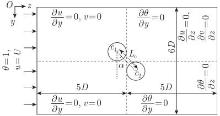
Fig. 1
Melting model of double circular ice bodies under the action of incoming flow"
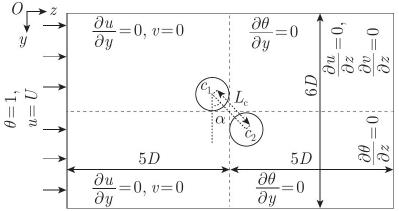

Table 1
Parameter settings for different cases of double circular ice melting"
| Case | α | | | |
|---|---|---|---|---|
| 1 | 0 | 1.2 | | |
| 2 | 11.25 | 1.2 | | |
| 3 | 22.5 | 1.2 | | |
| 4 | 33.75 | 1.2 | | |
| 5 | 45 | 1.2 | | |
| 6 | 56.25 | 1.2 | | |
| 7 | 67.5 | 1.2 | | |
| 8 | 78.75 | 1.2 | | |
| 9 | 90 | 1.2 | | |
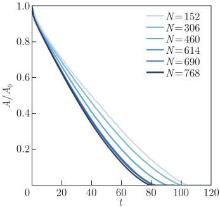
Fig. 2
A/A0 (normalized area) versus dimensionless time t for different grid numbers N (color online)"
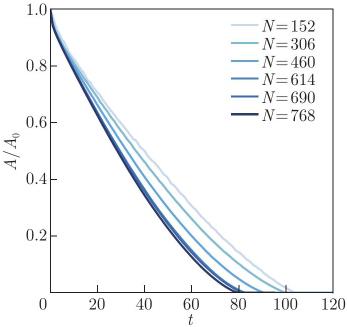
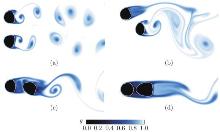
Fig. 3
Instantaneous temperature fields under different α: (a) α=0∘, (b) α=45∘, (c) α=78.75∘, and (d) α=90∘ (color online)"
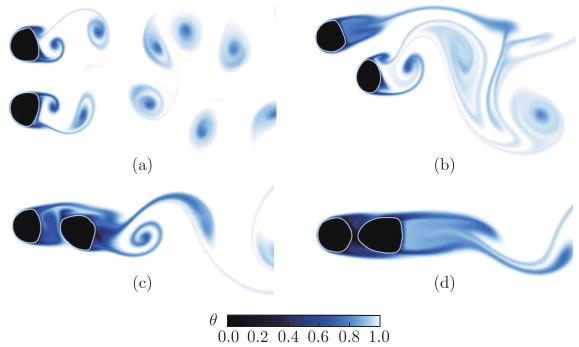
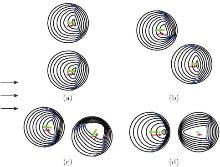
Fig. 4
The shape evolution of double ice bodies under different α: (a) α=0∘, (b) α=45∘, (c) α=78.75∘, and (d) α=90∘, where the blue color represents the positions of flow separation points, the green color represents the positions of centroids, the black arrow indicates the direction of flow, and the red arrow reflects the direction of movement of the centroids (color online)"
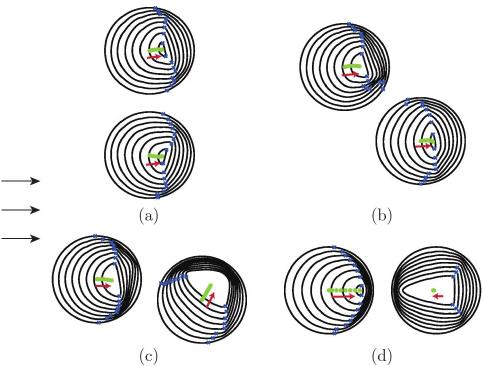
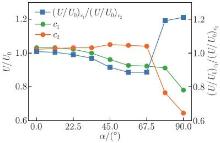
Fig. 5
The overall melting rates of double circular ice bodies under different α, normalized by the melting rate of a single circular ice body, where c1 is the melting rate of the upstream circular ice, and c2 is the melting rate of the downstream circular ice (color online)"
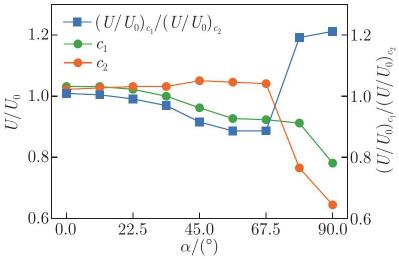
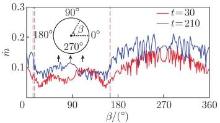
Fig. 6
The local melting rate of the circular ice at different t, where the dashed line represents the position of the flow separation point, and the included angle β is utilized to denote different positions on the circular ice (color online)"
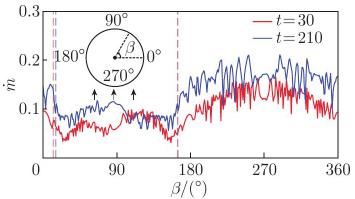
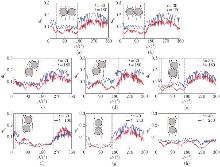
Fig. 7
Local melting rates on double circular ice bodies under different α: (a, b) α=0∘, (c, d) α=45∘, (e, f) α=78.75∘, and (g, h) α=90∘. (a), (c), (e), and (g) depict the local melting rates on the upstream and circular ice body, while (b), (d), (f), and (h) depict the local melting rates on the downstream circular ice body. The dashed line indicates the flow separation point. Results at two different dimensionless times are shown in red and blue (color online)"
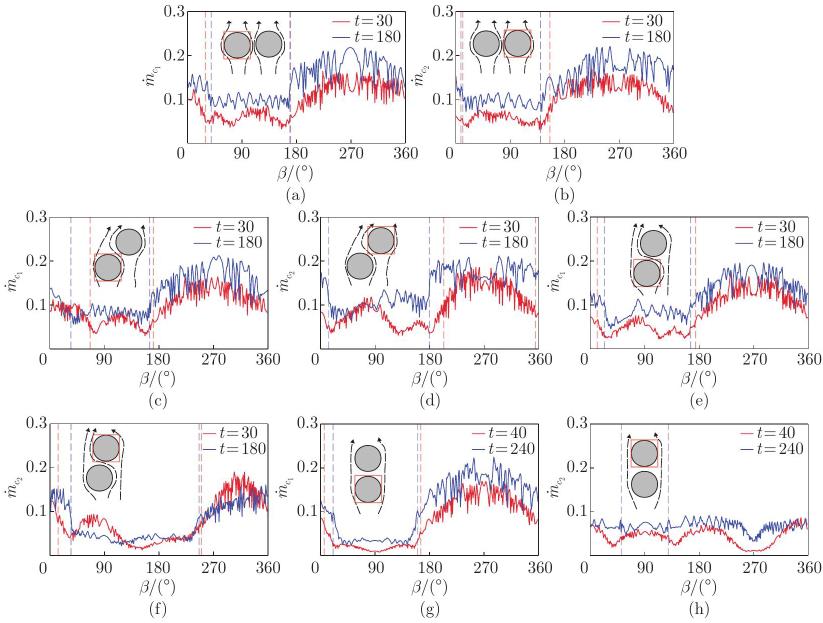
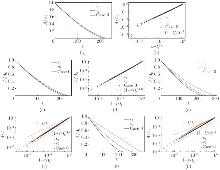
Fig. 8
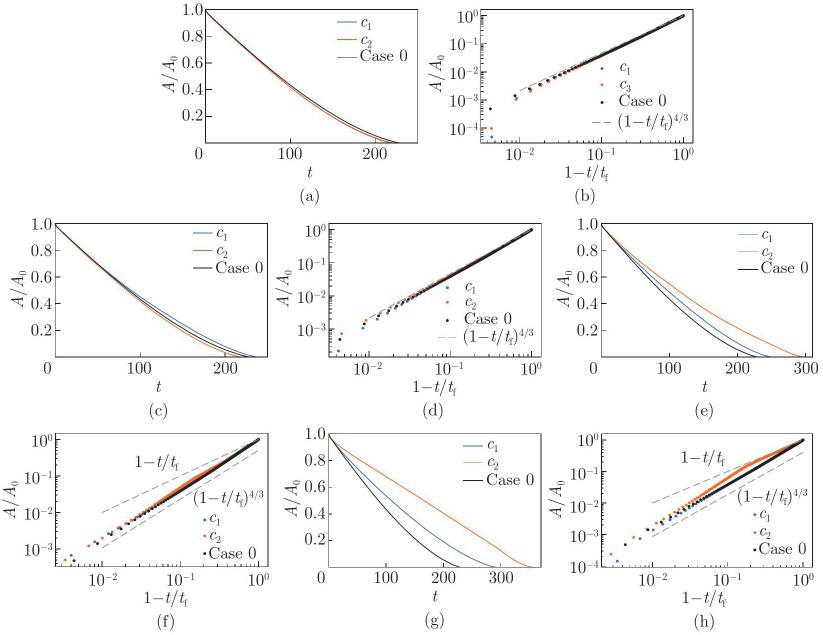
For (a, b) α=0∘, (c, d) α=45∘, (e, f) α=78.75∘, and (g, h) α=90∘, (a), (c), (e), and (g) show the time series of the normalized area A/A0, while (b), (d), (f), and (h) present the scaling laws for the melting of double circular ices. Here, c1 represents the upstream circular ice, and c2 represents the downstream circular ice (color online)"
| [1] | HOCK, R. Glacier melt: a review of processes and their modelling. Progress in Physical Geography, 29(3), 362–391 (2005) |
| [2] | DU, Y. H., CALZAVARINI, E., and SUN, C. The physics of freezing and melting in the presence of flows. Nature Reviews Physics, 6, 676–690 (2024) |
| [3] | ROACH, L. A., SMITH, M. M., HERMAN, A., and RINGEISEN, D. Physics of the seasonal sea ice zone. Annual Review of Marine Science, 17, 355–379 (2025) |
| [4] | CENEDESE, C. and STRANEO, F. Icebergs melting. Annual Review of Fluid Mechanics, 55, 377–402 (2023) |
| [5] | HEWITT, I. J. Subglacial plumes. Annual Review of Fluid Mechanics, 52, 145–169 (2020) |
| [6] | ANDERSON, D. M. and GUBA, P. Convective phenomena in mushy layers. Annual Review of Fluid Mechanics, 52, 93–119 (2020) |
| [7] | WORSTER, M. G. Convection in mushy layers. Annual Review of Fluid Mechanics, 29, 91–122 (1997) |
| [8] | LIBBRECHT, K. G. Physical dynamics of ice crystal growth. Annual Review of Materials Research, 47, 271–295 (2017) |
| [9] | GRABOWSKI, W. W. and WANG, L. P. Growth of cloud droplets in a turbulent environment. Annual Review of Fluid Mechanics, 45, 293–324 (2013) |
| [10] | BURROWS, S. M., MCCLUSKEY, C. S., CORNWELL, G., STEINKE, I., ZHANG, K., ZHAO, B., ZAWADOWICZ, M., RAMAN, A., KULKARNI, G., CHINA, S., ZELENYUK, A., and DEMOTT, P. J. Ice-nucleating particles that impact clouds and climate: observational and modeling research needs. Reviews of Geophysics, 60, e2021RG000745 (2022) |
| [11] | KNOPF, D. A. and ALPERT, P. A. Atmospheric ice nucleation. Nature Reviews Physics, 5, 203–217 (2023) |
| [12] | RIGNOT, E., JACOBS, S., MOUGINOT, J., and SCHEUCHL, B. Ice-shelf melting around Antarctica. Science, 341, 266–270 (2013) |
| [13] | ENDERLIN, E. M., HAMILTON, G. S., STRANEO, F., and SUTHERLAND, D. A. Iceberg meltwater fluxes dominate the freshwater budget in Greenland’s iceberg-congested glacial fjords. Geophysical Research Letters, 43, 11287–11294 (2016) |
| [14] | SMITH, K. L., ROBISON, B. H., HELLY, J. J., KAUFMANN, R. S., RUHL, H. A., SHAW, T. J., TWINING, B. S., and VERNET, M. Free-drifting icebergs: hot spots of chemical and biological enrichment in the Weddell Sea. Science, 317, 478–482 (2007) |
| [15] | THOMAS, S. K., CASSONI, R. P., and MACARTHUR, C. D. Aircraft anti-icing and de-icing techniques and modeling. Journal of Aircraft, 33, 841–854 (1996) |
| [16] | RAOUX, S. Phase change materials. Annual Review of Materials Research, 39, 25–48 (2009) |
| [17] | RUBINŠTEĬN, L. I. The Stefan problem. Translations of Mathematical Monographs, American Mathematical Society, Providence, RI (1971) |
| [18] | DELVES, R. T. Theory of the stability of a solid-liquid interface during growth from stirred melts. Journal of Crystal Growth, 8, 13–25 (1971) |
| [19] | JIANG, T., GEORGELIN, M., and POCHEAU, A. Flow-induced traveling waves on solidification interfaces. European Physical Letters, 102, 54002 (2013) |
| [20] | GILPIN, R. R., HIRATA, T., and CHENG, K. C. Wave formation and heat transfer at an ice-water interface in the presence of a turbulent flow. Journal of Fluid Mechanics, 99, 619–640 (1980) |
| [21] | TOPPALADODDI, S. and WETTLAUFER, J. S. The combined effects of shear and buoyancy on phase boundary stability. Journal of Fluid Mechanics, 868, 648–665 (2019) |
| [22] | COUSTON, L. A., HESTER, E., FAVIER, B., TAYLOR, J. R., HOLLAND, P. R., and JENKINS, A. Topography generation by melting and freezing in a turbulent shear flow. Journal of Fluid Mechanics, 911, A44 (2021) |
| [23] | AHLERS, G., GROSSMANN, S., and LOHSE, D. Heat transfer and large scale dynamics in turbulent Rayleigh-Bénard convection. Reviews of Modern Physics, 81(2), 503–537 (2009) |
| [24] | LOHSE, D. and XIA, K. Q. Small-scale properties of turbulent Rayleigh-Bénard convection. Annual Review of Fluid Mechanics, 42, 335–364 (2010) |
| [25] | CHILLÀ, F. and SCHUMACHER, J. New perspectives in turbulent Rayleigh-Bénard convection. The European Physical Journal E, 35(7), 58 (2012) |
| [26] | SHISHKINA, O. Rayleigh-Bénard convection: the container shape matters. Physical Review Fluids, 6(9), 090502 (2021) |
| [27] | LOHSE, D. and SHISHKINA, O. Ultimate turbulent thermal convection. Physics Today, 76(11), 26–32 (2023) |
| [28] | XIA, K. Q., HUANG, S. D., XIE, Y. C., and ZHANG, L. Tuning heat transport via coherent structure manipulation: recent advances in thermal turbulence. National Science Review, 10(6), nwad012 (2023) |
| [29] | LOHSE, D. and SHISHKINA, O. Ultimate Rayleigh-Bénard turbulence. Reviews of Modern Physics, 96(3), 035001 (2024) |
| [30] | SHISHKINA, O. and LOHSE, D. Ultimate regime of Rayleigh-Bénard turbulence: subregimes and their scaling relations for the Nusselt vs Rayleigh and Prandtl numbers. Physical Review Letters, 133, 144001 (2024) |
| [31] | XIA, K. Q., CHONG, K. L., DING, G. Y., and ZHANG, L. Some fundamental issues in buoyancy-driven flows with implications for geophysical and astrophysical systems. Acta Mechanica Sinica, 41(1), 324287 (2025) |
| [32] | DIETSCHE, C. and MÜLLER, U. Influence of Bénard convection on solid-liquid interfaces. Journal of Fluid Mechanics, 161, 249–268 (1985) |
| [33] | VASIL, G. M. and PROCTOR, M. R. E. Dynamic bifurcations and pattern formation in melting-boundary convection. Journal of Fluid Mechanics, 686, 77–108 (2011) |
| [34] | FAVIER, B., PURSEED, J., and DUCHEMIN, L. Rayleigh-Bénard convection with a melting boundary. Journal of Fluid Mechanics, 858, 437–473 (2019) |
| [35] | PARSAZADEH, M. and DUAN, X. L. Numerical and experimental investigation of phase change heat transfer in the presence of Rayleigh-Bénard convection. Journal of Heat Transfer, 142, 062401 (2020) |
| [36] | MACHICOANE, N., BONAVENTURE, J., and VOLK, R. Melting dynamics of large ice balls in a turbulent swirling flow. Physics of Fluids, 25, 125101 (2013) |
| [37] | STAPOUNTZIS, H., DIMITRIADIS, T. G., GIOURGAS, K., and KOTSANIDIS, K. Melting of ice spheres in nearly isotropic turbulence with zero mean. 10th Pacific Symposium on Flow Visualization and Image Proceeding, Naples, 15–18 (2015) |
| [38] | RAVICHANDRAN, S., TOPPALADODDI, S., and WETTLAUFER, J. S. The combined effects of buoyancy, rotation, and shear on phase boundary evolution. Journal of Fluid Mechanics, 941, A39 (2022) |
| [39] | RAVICHANDRAN, S. and WETTLAUFER, J. S. Melting driven by rotating Rayleigh-Bénard convection. Journal of Fluid Mechanics, 916, A28 (2021) |
| [40] | YANG, R., HOWLAND, C. J., LIU, H. R., VERZICCO, R., and LOHSE, D. Morphology evolution of a melting solid layer above its melt heated from below. Journal of Fluid Mechanics, 956, A23 (2023) |
| [41] | WILSON, N. J., VREUGDENHIL, C. A., GAYEN, B., and HESTER, E. W. Double-diffusive layer and meltwater plume effects on ice face scalloping in phase-change simulations. Geophysical Research Letters, 50, e2023GL104396 (2023) |
| [42] | HESTER, E. W., MCCONNOCHIE, C. D., CENEDESE, C., COUSTON, L. A., and VASIL, G. Aspect ratio affects iceberg melting. Physical Review Fluids, 6, 023802 (2021) |
| [43] | YANG, R., HOWLAND, C. J., LIU, H. R., VERZICCO, R., and LOHSE, D. Shape effect on solid melting in flowing liquid. Journal of Fluid Mechanics, 980, R1 (2024) |
| [44] | YANG, R., CHONG, K. L., LIU, H. R., VERZICCO, R., and LOHSE, D. Abrupt transition from slow to fast melting of ice. Physical Review Fluids, 7, 083503 (2022) |
| [45] | WANG, Z. Q., CALZAVARINI, E., SUN, C., and TOSCHI, F. How the growth of ice depends on the fluid dynamics underneath. Proceedings of the National Academy of Sciences of the United States of America, 118, e2012870118 (2021) |
| [46] | YANG, R., HOWLAND, C. J., LIU, H. R., VERZICCO, R., and LOHSE, D. Ice melting in salty water: layering and non-monotonic dependence on the mean salinity. Journal of Fluid Mechanics, 969, R2 (2023) |
| [47] | DU, Y. H., WANG, Z. Q., JIANG, L. F., CALZAVARINI, E., and SUN, C. Sea water freezing modes in a natural convection system. Journal of Fluid Mechanics, 960, A35 (2023) |
| [48] | BELLINCIONI, E., LOHSE, D., and HUISMAN, S. G. Melting of floating ice cylinders in fresh and saline environments. Journal of Fluid Mechanics, 1019, A29 (2025) |
| [49] | XU, D. H., BOOTSMA, S. T., VERZICCO, R., LOHSE, D., and HUISMAN, S. G. Buoyancy-driven flow regimes for a melting vertical ice cylinder in saline water. Journal of Fluid Mechanics, 1019, A11 (2025) |
| [50] | DU, Y. H., WANG, F., CALZAVARINI, E., and SUN, C. Sea ice aging by diffusion-driven desalination. Physical Review Letters, 135(10), 104201 (2025) |
| [51] | XUE, Z. H., ZHANG, J., and NI, M. J. Flow regimes in a melting system composed of binary fluid. Journal of Fluid Mechanics, 998, A14 (2024) |
| [52] | WILLIAMSON, C. H. K. Sinusoidal flow relative to circular cylinders. Journal of Fluid Mechanics, 155, 141–174 (1985) |
| [53] | SUMNER, D. Two circular cylinders in cross-flow: a review. Journal of Fluids and Structures, 26, 849–899 (2010) |
| [54] | WANG, Z. Q., JIANG, L. F., DU, Y. H., SUN, C., and CALZAVARINI, E. Ice front shaping by upward convective current. Physical Review Fluids, 6, L091501 (2021) |
| [55] | WANG, Z. Q., CALZAVARINI, E., and SUN, C. Equilibrium states of the ice-water front in a differentially heated rectangular cell. European Physical Letters, 135, 54001 (2021) |
| [56] | ANGRIMAN, S., LOHSE, D., VERZICCO, R., and HUISMAN, S. G. Collective effects of neighbouring melting ice objects. Journal of Fluid Mechanics, 1027, A10 (2026) |
| [57] | FANG, W. P., WU, J. Z., HUANG, Z. L., WANG, B. F., ZHOU, Q., and CHONG, K. L. Vibration-induced morphological evolution of a melting solid under microgravity. Journal of Fluid Mechanics, 1001, A43 (2024) |
| [58] | YANG, R., HOWLAND, C. J., LIU, H. R., VERZICCO, R., and LOHSE, D. Enhanced efficiency of latent heat energy storage by inclination. PRX Energy, 3, 043006 (2024) |
| [59] | MEKSYN, D. New Methods in Laminar Boundary-Layer Theory, Pergamon Press, Oxford (1961) |
| [60] | GROSSMANN, S. and LOHSE, D. Fluctuations in turbulent Rayleigh-Bénard convection: the role of plumes. Physics of Fluids, 16, 4462–4472 (2004) |
| [61] | RISTROPH, L., MOORE, M. N. J., CHILDRESS, S., SHELLEY, M. J., and ZHANG, J. Sculpting of an erodible body by flowing water. Proceedings of the National Academy of Sciences of the United States of America, 109, 19606–19609 (2012) |
| [62] | MOORE, M. N. J., RISTROPH, L., CHILDRESS, S., ZHANG, J., and SHELLEY, M. J. Self-similar evolution of a body eroding in a fluid flow. Physics of Fluids, 25, 116602 (2013) |
| [1] | PAN Shi-Dong;ZHOU Zhen-Gong;WU Lin-Zhi. Basic solutions of multiple parallel symmetric mode-III cracks in functionally graded piezoelectric/piezomagnetic material plane [J]. Applied Mathematics and Mechanics (English Edition), 2013, 34(10): 1201-1224. |
| Viewed | ||||||
|
Full text |
|
|||||
|
Abstract |
|
|||||





 Email Alert
 RSS
RSS