Applied Mathematics and Mechanics (English Edition) ›› 2026, Vol. 47 ›› Issue (6): 1341-1362.doi: https://doi.org/10.1007/s10483-026-3397-7
Previous Articles Next Articles
Danning JING1,2,3, Xuguang CHEN1,2,3, Shuo WANG1,2,3, Qinglin WANG1,2,3, Jie LIU1,2,3, Xinhai CHEN1,2,3,†( )
)
Received:2025-12-16
Revised:2026-04-16
Online:2026-06-18
Published:2026-06-18
Contact:
Xinhai CHEN, E-mail: chenxinhai16@nudt.edu.cnSupported by:2010 MSC Number:
Danning JING, Xuguang CHEN, Shuo WANG, Qinglin WANG, Jie LIU, Xinhai CHEN. Intelligent surrogate modeling for penetration prediction: solving forward and inverse problems with multi-fidelity data. Applied Mathematics and Mechanics (English Edition), 2026, 47(6): 1341-1362.
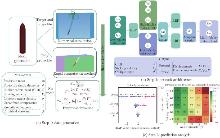
Fig. 1
Multi-fidelity data-network coupling prediction workflow: (a) the data-generation stage for producing low-fidelity rapid results and high-fidelity simulation samples; (b) the network architecture with three RBF sub-networks that receive high/low-fidelity inputs and output displacement/force components; (c) the prediction analysis encompassing SHAP-based interpretability assessments and extrapolation capability tests (SHAP is the abbreviation of Shapley additive explanations, and cat is a standard abbreviation for “concatenate” (concatenation operation) in computer science and deep learning) (color online)"
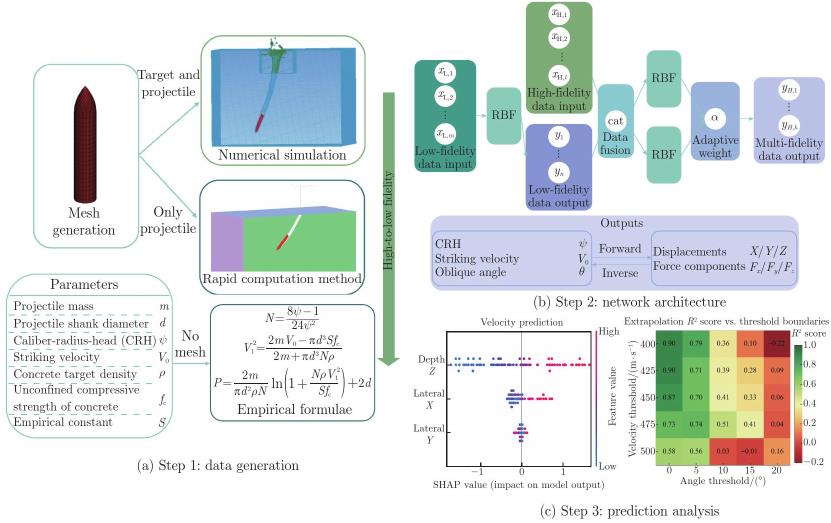
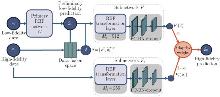
Fig. 2
FE-RBFN (FC-BN denotes fully connected layer and batch normalization) (color online)"
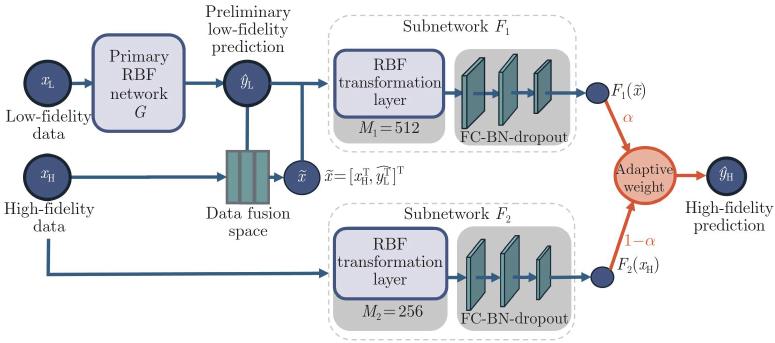

Table 1
Comprehensive configuration of experimental scenarios, data sampling, and multi-fidelity task mapping"
| Variable | Symbol | Unit | Range | Discrete point (HF/LF) | Total case |
| CRH | ψ | – | 1.75–4.25 | Fixed/11 | |
| Velocity | V0 | m/s | 400–900 | 21/21 | HF: 147 |
| Angle | θ | (°) | 0–60 | 7/13 | LF: 3 003 |
| Time | t | ms | 0–tmax | 32/20 | |
| Problem | Physical task | Input | Output | Dataset split (train: test) | |
| Forward 1 | Final depth prediction | | Pd | HF | |
| Forward 2 | Time-series displacement | | X(t)=(X, Y, Z) | 40% : 60% | |
| Forward 3 | Time-series force response | | | LF | |
| Inverse | Parameter identification | Xfinal | | 80% : 20% | |
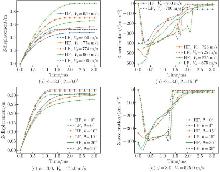
Fig. 3
Multi-fidelity data for training and testing: (a) effect of velocity on the displacement vs. time; (b) effect of velocity on the acceleration vs. time; (c) effect of angle on the displacement vs. time; (d) effect of angle on the acceleration vs. time (color online)"
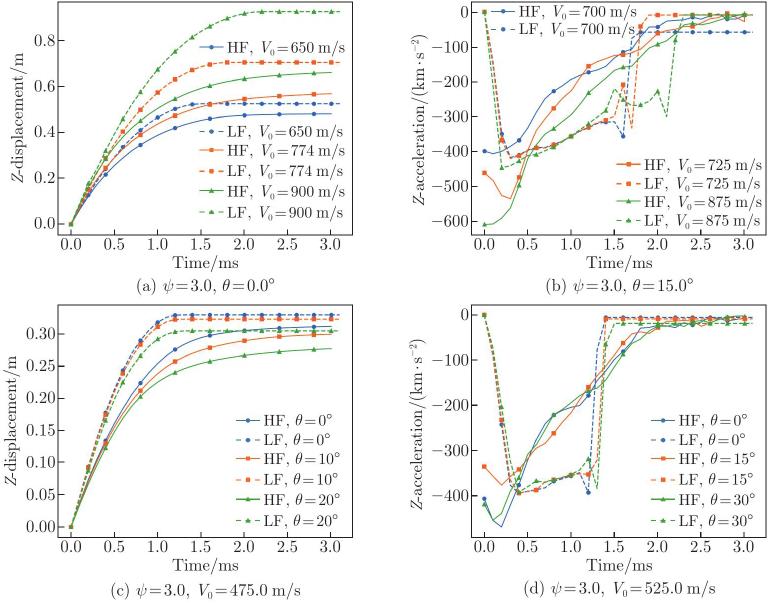
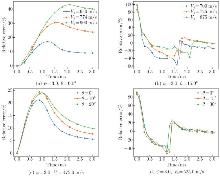
Fig. 4
Temporal evolution of relative error between low-fidelity and high-fidelity simulations under varying impact velocities and angles when ψ=3.0: (a) displacement error with θ=0.0∘; (b) acceleration error with θ=15.0∘; (c) displacement error with V0=475.0 m/s; (d) acceleration error with V0=525.0 m/s (color online)"
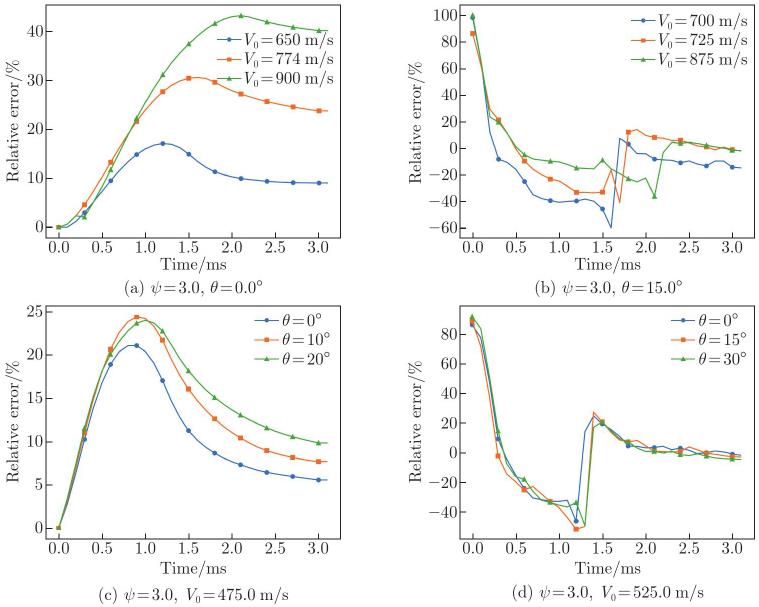
Table 2
Performance comparison of different methods for depth prediction"
| Method | R2 | EMSE | EMAPE/% |
|---|---|---|---|
| Linear regression | 0.924 3 | 0.001 0 | 5.11 |
| Decision tree | 0.926 4 | 0.000 9 | 5.38 |
| k-nearest neighbor | 0.939 9 | 0.000 8 | 4.49 |
| XGBoost | 0.961 1 | 0.000 5 | 4.59 |
| FE-RBFN | 0.981 5 | 0.000 2 | 2.59 |
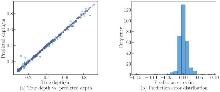
Fig. 5
Performance of FE-RBFN for depth prediction on noisy training data: (a) scatter plot of predicted depth against true depth with ideal line (dashed) and (b) distribution of prediction errors with the mean error marked (color online)"
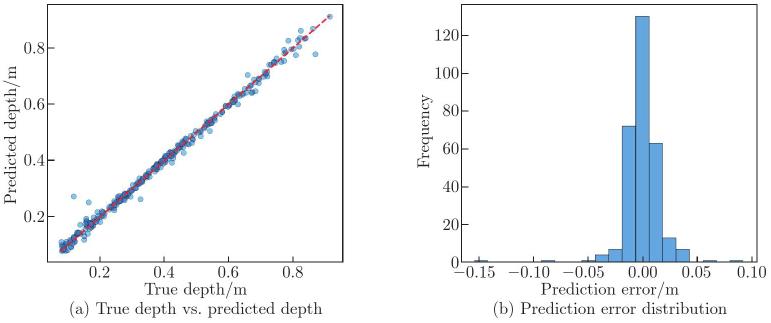
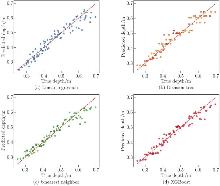
Fig. 6
Comparative performance of different methods on depth prediction with 10% noise: (a) linear regression; (b) decision tree; (c) k-nearest neighbor; (d) XGBoost method (color online)"
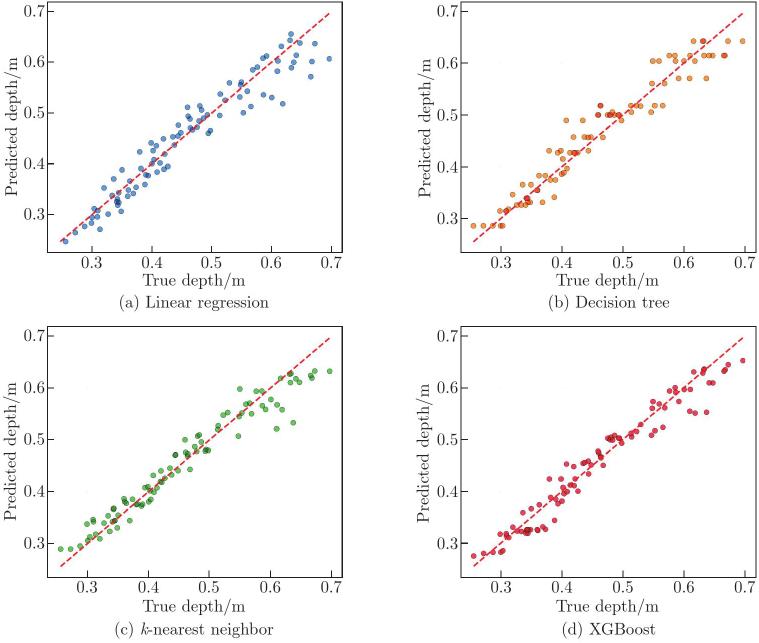
Table 3
Quantitative performance comparison of displacement and force component predictions under 10% noise"
| Method | X | Y | Z | ||||||
|---|---|---|---|---|---|---|---|---|---|
| R2 | EMSE | EMAPE/% | R2 | EMSE | EMAPE/% | R2 | EMSE | EMAPE/% | |
| Displacement | |||||||||
| Linear regression | 0.830 3 | 0.174 1 | 137.4 | 0.626 4 | 0.356 4 | 168.0 | 0.835 6 | 0.162 1 | 148.3 |
| Decision tree | 0.881 5 | 0.112 6 | 231.5 | 0.693 9 | 0.305 4 | 147.3 | 0.894 6 | 0.103 1 | 234.6 |
| k-nearest neighbor | 0.993 6 | 0.006 4 | 36.73 | 0.954 9 | 0.039 7 | 63.66 | 0.993 0 | 0.006 9 | 33.78 |
| XGBoost | 0.994 7 | 0.004 9 | 24.04 | 0.868 9 | 0.126 3 | 106.5 | 0.995 1 | 0.004 5 | 28.40 |
| FE-RBFN | 0.998 3 | 0.001 6 | 10.31 | 0.921 9 | 0.081 0 | 84.91 | 0.998 1 | 0.001 8 | 26.20 |
| Force component | |||||||||
| Linear regression | 0.638 9 | 0.362 5 | 80.98 | 0.000 9 | 1.079 7 | 171.62 | 0.814 6 | 0.201 9 | 63.61 |
| Decision tree | 0.858 5 | 0.142 1 | 43.21 | -0.061 0 | 1.146 6 | 165.68 | 0.973 0 | 0.029 4 | 26.50 |
| k-nearest neighbor | 0.927 8 | 0.072 5 | 30.48 | 0.197 7 | 0.867 1 | 130.25 | 0.993 0 | 0.007 6 | 16.88 |
| XGBoost | 0.923 4 | 0.076 8 | 34.88 | 0.012 3 | 1.067 4 | 160.42 | 0.991 5 | 0.009 2 | 20.11 |
| FE-RBFN | 0.942 6 | 0.060 5 | 25.43 | 0.194 3 | 0.655 1 | 122.78 | 0.994 0 | 0.006 5 | 15.33 |
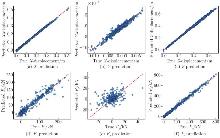
Fig. 7
Performance of FE-RBFN for displacement and force component prediction at critical time points: (a)–(c) Z-displacement vs. time under varied impact conditions; (d)–(f) corresponding Z-force vs. time curves. Predicted results (dashed) and true data (symbols) are both presented (color online)"
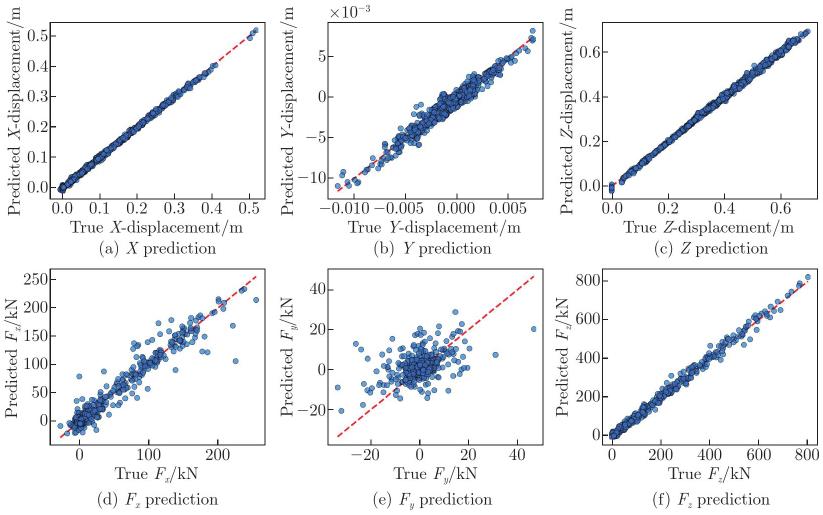
Table 4
Method comparison for inverse parameter prediction (velocity and angle)"
| Method | Velocity | Angle | ||||
|---|---|---|---|---|---|---|
| R2 | EMSE | EMAPE/% | R2 | EMSE | EMAPE/% | |
| Linear regression | 0.940 3 | 0.068 5 | 51.05 | 0.875 8 | 0.117 6 | 70.05 |
| Decision tree | 0.951 9 | 0.055 3 | 47.32 | 0.943 7 | 0.053 3 | 17.54 |
| k-nearest neighbor | 0.917 8 | 0.094 4 | 55.92 | 0.889 9 | 0.104 3 | 91.31 |
| XGBoost | 0.968 6 | 0.036 1 | 39.19 | 0.949 0 | 0.048 3 | 31.11 |
| FE-RBFN | 0.979 7 | 0.023 4 | 29.51 | 0.993 1 | 0.006 5 | 22.26 |
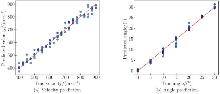
Fig. 8
Performance of FE-RBFN for inverse problem: (a) velocity prediction; (b) angle prediction (color online)"
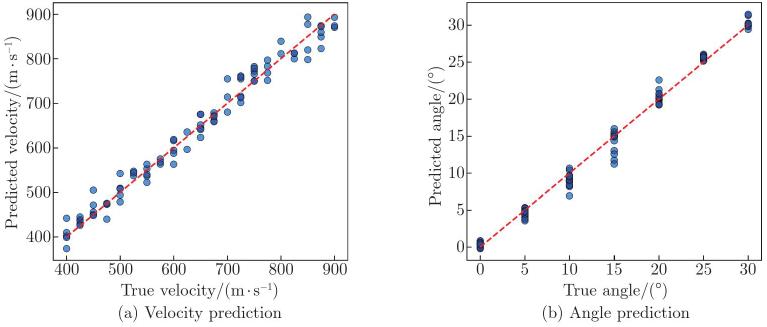
Table 5
Performance comparison between the model trained with only limited high-fidelity data and the proposed multi-fidelity method"
| Training data | R2 | EMSE | EMAPE/% |
|---|---|---|---|
| Only HF data (limited) | 0.613 | 0.005 1 | 13.92 |
| Multi-fidelity data (LF & limited HF) | 0.875 | 0.001 6 | 7.34 |
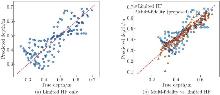
Fig. 9
Performance comparison: (a) prediction using only limited high-fidelity data; (b) comparison between the multi-fidelity results and single-source data results (color online)"
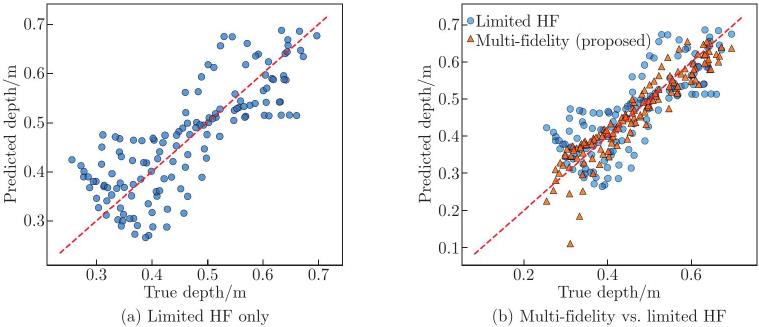
Table 6
Definitions of two distinct extrapolation scenarios for generalization"
| Scenario | Training region | Testing region |
|---|---|---|
| Down-extrapolation | High energy: | Low energy: |
| Up-extrapolation | Low energy: | High energy: |
| *Note: Vth and | ||
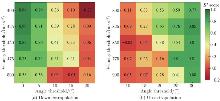
Fig. 10
Comparison of model generalization capabilities: (a) down-extrapolation accuracy and (b) up-extrapolation accuracy (color online)"
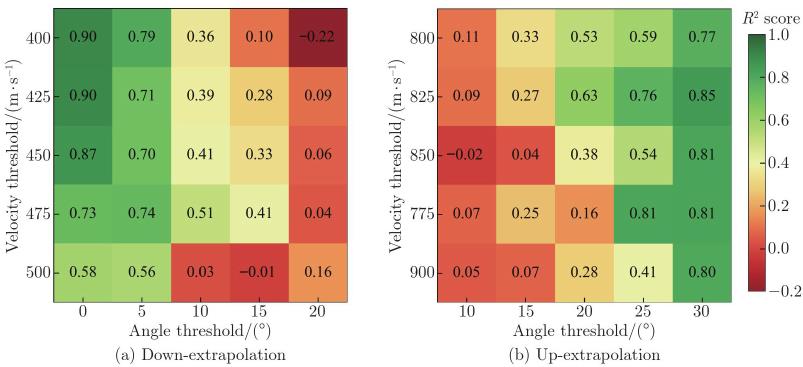
Fig. 11
Sensitivity to systematic discrepancies: (a) systematic overestimation; (b) systematic underestimation (color online)"
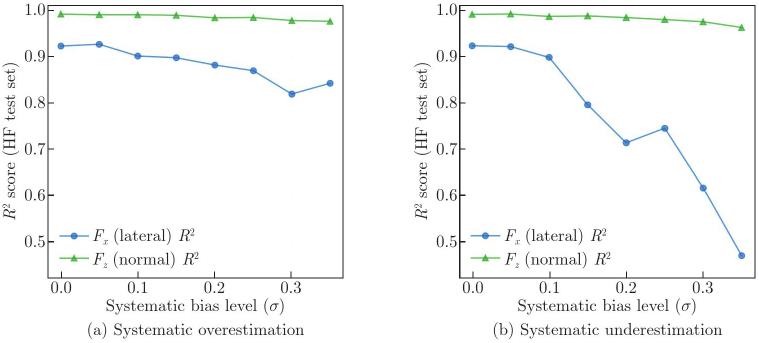
Fig. 12
SHAP summary beeswarm plots for the FE-RBFN inverse model outputs: (a) velocity prediction dominated by depth Z; (b) angle prediction primarily determined by lateral X (color online)"
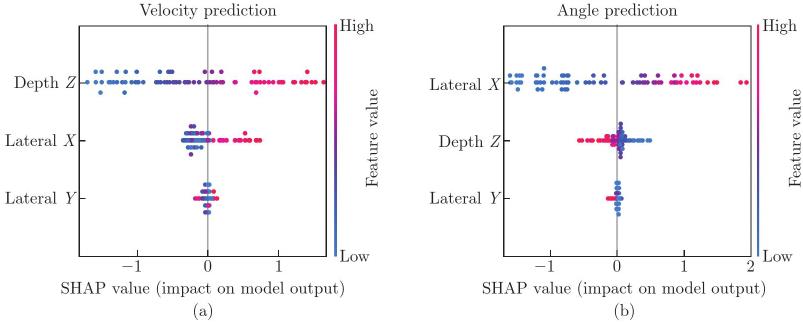
Table A1
Projectile properties"
| | | | | ψ |
|---|---|---|---|---|
| 7 800 | 835 | 13.45 | 203 | 3 |
Table A2
Target properties"
| | | | | λ | | |
|---|---|---|---|---|---|---|
| 44.74 | 25 | 44.74 | 2 340 | 1.023 | 40 | 0.01 |
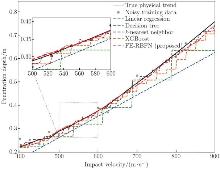
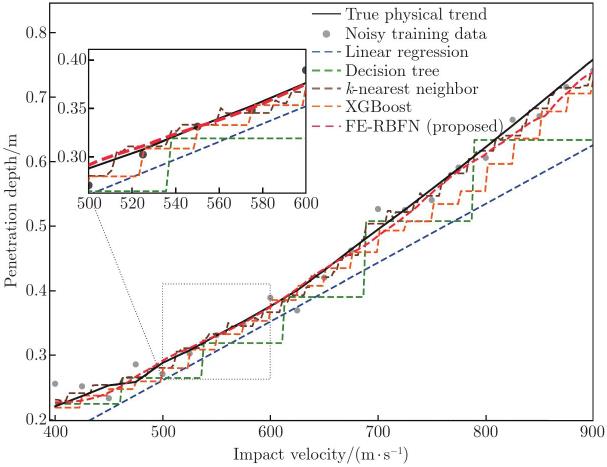
Fig. B1
Robustness comparison of predictions under 10% noise for a representative case (ψ=3.0 and θ=30.0°) (color online)"
| [1] | ALRASHED, A. A., BATARSEH, S. I., ALHARITH, A. M., and ALHAMAD, L. A. The evolution of perforation techniques over time: an overview. SPE Conference at Oman Petroleum & Energy Show, Oman, SPE-225232-MS (2025) |
| [2] | WEN, K., CHEN, X., and LU, Y. Research and development on hypervelocity impact protection using Whipple shield: an overview. Defence Technology, 17(6), 1864–1886 (2021) |
| [3] | LI, X. B. and GONG, J. X. Assessment of leak-tightness for nuclear reactor containment under overpressure conditions considering aging effects. Nuclear Engineering and Technology, 57(1), 103167 (2025) |
| [4] | LIU, Q., HUA, J. Y., XU, Y. F., YANG, K., CHENG, J. C., ZHANG, N. B., LI, C., CAI, Y., and LUO, S. N. Ballistic penetration of high-entropy CrMnFeCoNi alloy: experiments and modelling. International Journal of Mechanical Sciences, 249, 108252 (2023) |
| [5] | LI, X. Y., ZHANG, J., RONG, Y., and WANG, Z. H. Mesoscopic analysis on projectile motion characteristics in oblique penetration into concrete. Defence Technology, 51, 220–233 (2025) |
| [6] | CHEN, X. W., HE, L. L., and YANG, S. Q. Modeling on mass abrasion of kinetic energy penetrator. European Journal of Mechanics-A/Solids, 29(1), 7–17 (2010) |
| [7] | SHOKRIEH, M. M. and JAVADPOUR, G. H. Penetration analysis of a projectile in ceramic composite armor. Composite Structures, 82(2), 269–276 (2008) |
| [8] | THAM, C. Y. Reinforced concrete perforation and penetration simulation using AUTODYN-3D. Finite Elements in Analysis and Design, 41(14), 1401–1410 (2005) |
| [9] | ZHANG, Z., WU, Y. Q., and HUANG, F. L. A semi-empirical formula based on a modified general penetration resistance for predicting the motion of the rigid projectile. Heliyon, 9(3), e13582 (2023) |
| [10] | HUANG, C. L., WANG, Z. Q., LI, S. T., ZHANG, S., CHEN, Y. Q., ZHAO, S. J., XU, Z. Z., and CHEN, L. M. Analytical model of penetration depth and energy dissipation considering impact position. International Journal of Impact Engineering, 191, 104997 (2024) |
| [11] | RAISSI, M., PERDIKARIS, P., and KARNIADAKIS, G. E. Physics-informed neural networks: a deep learning framework for solving forward and inverse problems involving nonlinear partial differential equations. Journal of Computational Physics, 378, 686–707 (2019) |
| [12] | XIAO, Q. S., CHEN, X. H., YANG, H. J., GONG, C. Y., and LIU, J. ST-FlowNet: a lightweight framework for long-term spatio-temporal flow field prediction. Neural Networks, 195, 108243 (2026) |
| [13] | KTENA, S. I., PARISOT, S., FERRANTE, E., RAJCHL, M., LEE, M., GLOCKER, B., and RUECKERT, D. Distance metric learning using graph convolutional networks: application to functional brain networks. Proceedings of the International Conference on Medical Image Computing and Computer-Assisted Intervention, Springer, Cham, 469–477 (2017) |
| [14] | BATTAGLIA, P., PASCU, R., LAI, M., REZENDE, D. J., and KAVUKCUOGLU, K. Interaction networks for learning about objects, relations and physics. Proceedings of the 30th International Conference on Neural Information Processing Systems, Red Hook, New York, 4509–4517 (2016) |
| [15] | LI, B. B., FENG, B., and CHEN, L. Adaptive feature-extraction graph network for physical systems: prediction of inviscid compressible flow in urban explosion. Engineering Structures, 345, 121482 (2025) |
| [16] | QIN, S., LIU, H., WANG, J. H., ZHAO, Q., and ZHANG, L. Physics-data coupling-driven method to predict the penetration depth into concrete targets. Theoretical and Applied Mechanics Letters, 14(3), 100495 (2024) |
| [17] | YU, G. Q., XU, W. J., PENG, C. L., CHEN, C., and GUO, T. Exploration of multi-fidelity co-Kriging and real-time hybrid simulation for time-dependent seismic performance evaluation. Engineering Structures, 345, 121497 (2025) |
| [18] | CASTAÑO-AGUIRRE, M., LÓPEZ-LOPERA, A. F., BARTOLI, N., MASSA, F., and LEFEBVRE, T. Scalable sparse co-Kriging for multi-fidelity data fusion: an application to aerodynamics. Reliability Engineering & System Safety, 272, 112485 (2026) |
| [19] | LIN, Q., HU, D. W., HU, J. X., CHENG, Y. S., and ZHOU, Q. A screening-based gradient-enhanced Gaussian process regression model for multi-fidelity data fusion. Advanced Engineering Informatics, 50, 101437 (2021) |
| [20] | GHOSH, M., WU, L., HAO, Q., and ZHOU, Q. A random forest with multi-fidelity Gaussian process leaves for modeling multi-fidelity data with heterogeneity. Computers & Industrial Engineering, 174, 108746 (2022) |
| [21] | LAN, P., SU, J. J., ZHU, S. R., HUANG, J. S., and ZHANG, S. Reconstructing unsaturated infiltration behavior with sparse data via physics-informed deep learning. Computers and Geotechnics, 168, 106162 (2024) |
| [22] | WU, Y. D., WANG, X. D., MA, M. H., YU, Y. L., LU, W. C., WANG, B. T., and GAO, G. F. Research on the anti-penetration behavior and failure mode analysis of different ceramics. Ceramics International, 49(24), 39800–39814 (2023) |
| [23] | LI, X. B. and GONG, J. X. Calculation method for the penetration depth of missile impact on nuclear containment concrete walls based on plastic limit theory. Journal of Engineering Mechanics, 151(8), 8356 (2025) |
| [24] | WANG, G. H., SHU, Y. Z., LU, W. B., CHEN, M., PAN, X. H., and LU, A. Damage prediction of concrete gravity dams subjected to penetration explosion. Engineering Failure Analysis, 143, 106855 (2023) |
| [25] | ZHANG, D., GUAN, G. S., XU, S. J., YANG, Y., LI, C. Y., and ZHANG, J. N. Damage estimation method for spacecraft protective structures exposed to hypervelocity impacts. Acta Astronautica, 227, 96–113 (2025) |
| [26] | RAMASAMY, A., HILL, A. M., HEPPER, A. E., BULL, A., and CLASPER, J. C. Blast mines: physics, injury mechanisms and vehicle protection. Journal of the Royal Army Medical Corps, 155(4), 258–264 (2009) |
| [27] | SONG, X. S., WANG, W. W., DENG, Y. J., SU, Y. T., JIA, F. R., ZAHEER, Q., and LONG, X. Data-driven modeling for residual velocity of projectile penetrating reinforced concrete slabs. Engineering Structures, 306, 117761 (2024) |
| [28] | YOSSIFON, G., YARIN, A. L., and RUBIN, M. B. Penetration of a rigid projectile into a multi-layered target: theory and numerical computations. International Journal of Engineering Science, 40(12), 1381–1401 (2002) |
| [29] | LI, P. C., ZHANG, X. F., LIU, C., WEI, H. Y., LIU, J. W., and DENG, Y. X. Study on the influence of attack angle and incident angle on ballistic characteristics of projectiles penetration into thin concrete targets. Explosion And Shock Waves, 42, 113302-1 (2022) |
| [30] | LIU, J., WU, C. Q., SU, Y., LI, J., SHAO, R. Z., and CHEN, G. Experimental and numerical studies of ultra-high performance concrete targets against high-velocity projectile impacts. Engineering Structures, 173, 188–202 (2018) |
| [31] | WANG, X. D. and YUAN, M. N. Mechanical model and numerical simulation of oblique penetration of projectile into foamed aluminum laminated target. Mechanics of Advanced Materials and Structures, 31(28), 10382–10390 (2024) |
| [32] | BIAN, H. B., JIA, Y., SHAO, J. F., and PONTIROLI, C. Numerical study of a concrete target under the penetration of rigid projectile using an elastoplastic damage model. Engineering Structures, 111, 525–537 (2016) |
| [33] | YANG, H. W., ZHANG, J., WANG, Z. Y., WANG, Z. H., and LI, Q. M. Numerical study on the resistance of rigid projectiles penetrating into semi-infinite concrete targets. Acta Mechanica Sinica, 37(3), 482–493 (2021) |
| [34] | LI, Q. M. and CHEN, X. W. Dimensionless formulae for penetration depth of concrete target impacted by a non-deformable projectile. International Journal of Impact Engineering, 28(1), 93–116 (2003) |
| [35] | MACEK, R. W. and DUFFEY, T. A. Finite cavity expansion method for near-surface effects and layering during Earth penetration. International Journal of Impact Engineering, 24(3), 239–258 (2000) |
| [36] | WADAGBALKAR, P. and LIU, G. R. Real-time prediction of projectile penetration to laminates by training machine learning models with finite element solver as the trainer. Defence Technology, 17(1), 147–160 (2021) |
| [37] | RYAN, S., SUSHMA, N. M., KUMAR, A. A., BERK, J., HASHEM, T., RANA, S. T., and VENKATESH, S. Machine learning for predicting the outcome of terminal ballistics events. Defence Technology, 31, 14–26 (2024) |
| [38] | THOMPSON, S., TEIXEIRA-DIAS, F., PAULINO, M., and HAMILTON, A. Ballistic response of armour plates using Generative Adversarial Networks. Defence Technology, 18(9), 1513–1522 (2022) |
| [39] | LI, M., WU, H. J., DONG, H., REN, G., ZHANG, P., and HUANG, F. L. Machine learning-based models for predicting the depth of concrete penetration. Computational and Experimental Simulations in Engineering, Springer, Cham, 311–326 (2024) |
| [40] | CHEN, Z., SUN, H. X., WANG, Y. W., and NIU, H. Prediction of penetration depth of earth penetrator based on neural network. IOP Conference Series: Earth and Environmental Science, 267(3), 032004 (2019) |
| [41] | KHAN, M., JAVED, M. F., OTHMAN, N. A., REHMAN, S. K., and AHMAD, F. Predicting penetration depth in ultra-high-performance concrete targets under ballistic impact: an interpretable machine learning approach augmented by deep generative adversarial network. Results in Engineering, 25, 103909 (2025) |
| [42] | HOSSEINI, M. and DALVAND, A. Neural network approach for estimation of penetration depth in concrete targets by ogive-nose steel projectiles. Latin American Journal of Solids and Structures, 12(3), 492–506 (2015) |
| [43] | LI, X. C., DUNKIN, F., and DEZERT, J. Multi-source information fusion: progress and future. Chinese Journal of Aeronautics, 37(7), 24–58 (2024) |
| [44] | MENG, X. H. and KARNIADAKIS, G. E. A composite neural network that learns from multi-fidelity data: application to function approximation and inverse PDE problems. Journal of Computational Physics, 401, 109020 (2020) |
| [45] | GUO, M. W., MANZONI, A., AMENDT, M., CONTI, P., and HESTHAVEN, J. S. Multi-fidelity regression using artificial neural networks: efficient approximation of parameter-dependent output quantities. Computer Methods in Applied Mechanics and Engineering, 389, 114378 (2022) |
| [46] | CHEN, X. G., ZHANG, D., YAO, S. J., and LU, F. Y. Fast algorithm for simulation of normal and oblique penetration into limestone targets. Applied Mathematics and Mechanics (English Edition), 38(5), 671–688 (2017) https://doi.org/10.1007/s10483-017-2193-7 |
| [47] | JAMES, G., WITTEN, D., HASTIE, T., TIBSHIRANI, R., and TAYLOR, J. Linear regression. An Introduction to Statistical Learning: With Applications in Python, Springer, Cham, 69–134 (2023) |
| [48] | BEN CHAABENE, W., FLAH, M., and NEHDI, M. L. Machine learning prediction of mechanical properties of concrete: critical review. Construction and Building Materials, 260, 119889 (2020) |
| [49] | CALOFIR, V., MUNTEANU, R. I., SIMOIU, M. S., and LEMNARU, K. C. Innovative approach to estimate structural damage using linear regression and k-nearest neighbors machine learning algorithms. Results in Engineering, 22, 102250 (2024) |
| [50] | YI, Z. Y., LIU, X. C., MARKOVIC, N., and PHILLIPS, J. Inferencing hourly traffic volume using data-driven machine learning and graph theory. Computers, Environment and Urban Systems, 85, 101548 (2021) |
| [1] | Qinfeng DI, Dakun LUO, Heyuan YANG, Tianxin LI, Wenchang WANG, Feng CHEN, H. ZHANG. AI-driven triple-optimization based on ant colony optimization for minimizing deformation energy in three-dimensional analysis of bottom-hole assemblies [J]. Applied Mathematics and Mechanics (English Edition), 2026, 47(6): 1417-1432. |
| [2] | Yulong ZHENG, Yao TANG, Duo ZHANG, Xianwen RAN. Study on indentation formation mechanism and mass loss under impact loading in concrete penetration [J]. Applied Mathematics and Mechanics (English Edition), 2026, 47(4): 791-814. |
| [3] | Zhaodong DING, Yongjun JIAN, Liangui YANG. Time periodic electroosmotic flow of micropolar fluids through microparallel channel [J]. Applied Mathematics and Mechanics (English Edition), 2016, 37(6): 769-786. |
| [4] | Yang SUN;Wenjuan WANG;Binbin LI;Mabao LIU. Investigation on behavior of crack penetration/deflection at interfaces in intelligent coating system [J]. Applied Mathematics and Mechanics (English Edition), 2015, 36(4): 465-474. |
| [5] | Ming ZHEN;Zhi-gang JIANG;Dian-yi SONG;Fei LIU. Analytical solutions for finite cylindrical dynamic cavity expansion in compressible elastic-plastic materials [J]. Applied Mathematics and Mechanics (English Edition), 2014, 35(8): 1039-1050. |
| [6] | Yong-chi LI;Zhi-hai WANG;Xiao-jun WANG;Xiu-zhang HU. An engineering analysis of penetration of metal ball into fibre-reinforced composite targets [J]. Applied Mathematics and Mechanics (English Edition), 2009, 30(3): 365-372. |
| [7] | GAO Shi-qiao;LIU Hai-peng;LI Ke-jie;HUANG Feng-lei;JIN Lei. NORMAL EXPANSION THEORY FOR PENETRATION OF PROJECTILE AGAINST CONCRETE TARGET [J]. Applied Mathematics and Mechanics (English Edition), 2006, 27(4): 485-492 . |
| [8] | LIU Yu-hong;ZENG Yan-jun;XU Jing-feng;ZHANG Mei. METHOD ON ESTIMATION OF DRUG’S PENETRATED PARAMETERS [J]. Applied Mathematics and Mechanics (English Edition), 2004, 25(4): 440-444. |
| [9] | Wang Li-ren . AN ENGINEERING FORMULA ON THE CALCULATION OF OBLIQUE PENETRATION BY LONG-ROD PROJECTILE [J]. Applied Mathematics and Mechanics (English Edition), 1992, 13(10): 939-945. |
| Viewed | ||||||
|
Full text |
|
|||||
|
Abstract |
|
|||||





 Email Alert
 RSS
RSS