Applied Mathematics and Mechanics (English Edition) ›› 2026, Vol. 47 ›› Issue (4): 791-814.doi: https://doi.org/10.1007/s10483-026-3367-9
Previous Articles Next Articles
Yulong ZHENG, Yao TANG, Duo ZHANG†( ), Xianwen RAN
Received:2025-11-11
Revised:2026-01-28
Published:2026-03-31
Contact:
Duo ZHANG, E-mail: zhangduo@nudt.edu.cn2010 MSC Number:
Yulong ZHENG, Yao TANG, Duo ZHANG, Xianwen RAN. Study on indentation formation mechanism and mass loss under impact loading in concrete penetration. Applied Mathematics and Mechanics (English Edition), 2026, 47(4): 791-814.
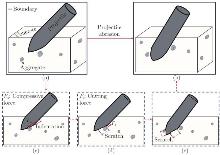
Fig. 1
Evolution of indentation-scratch and its link to erosion in penetration. (a) The projectile penetrates the concrete; (b) the shape of the abrasive shot head changes after multiple abrasions by the aggregate; (c) the surface of the projectile forms indentations under the action of the normal component of the penetration resistance; (d) the surface indentations on the projectile develop into scratches under the influence of the tangential component of penetration resistance; (e) multiple abrasions formed on the surface of the projectile due to the impact of multiple projectiles (color online)"
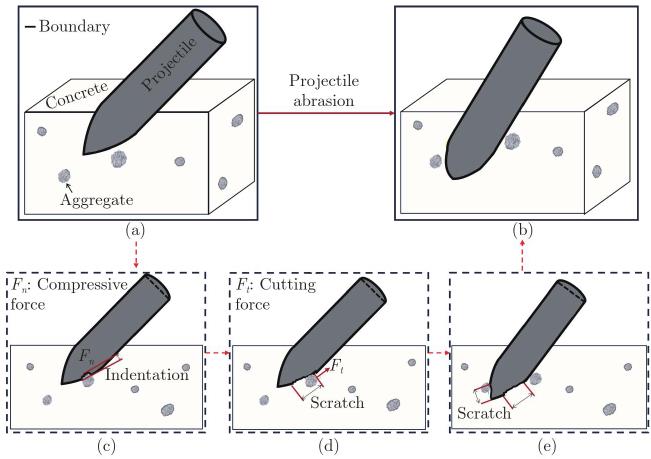
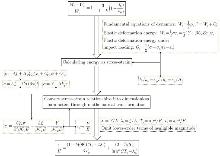
Fig. 2
Logical diagram for deriving the indentation depth (color online)"
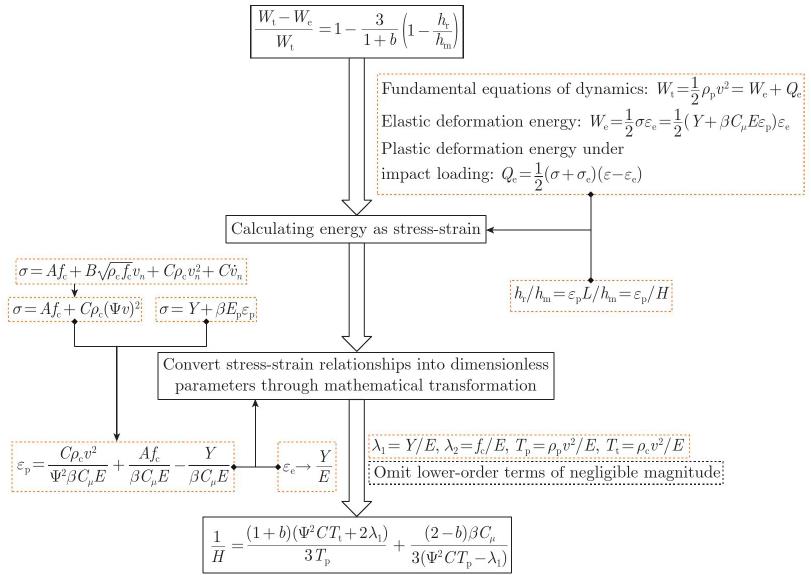
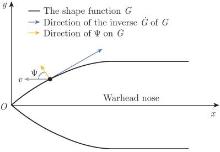
Fig. 3
Relationship between the velocity distribution function Ψ and the shape distribution function G (color online)"
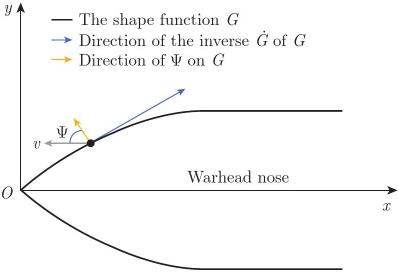

Fig. 4
Erosion morphology of projectile[12]"

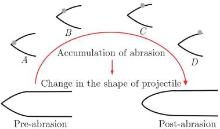
Fig. 5
Schematic of erosion accumulation, where the indentation depth at the point of maximum curvature (Point A) is several times that of the projectile rod (Point D), consistent with the change in the velocity distribution, and the accumulation of indentations and abrasion at different locations on the projectile surface has resulted in a change in the shape of the projectile’s nose (color online)"
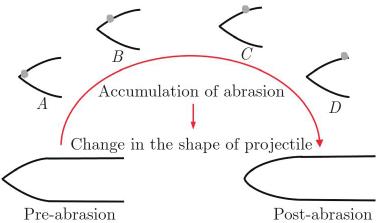
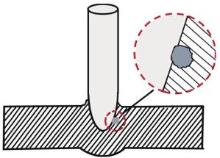
Fig. 6
Contact diagram between the projectile surface and target plate aggregate (color online)"
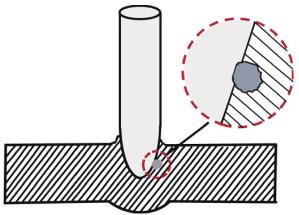
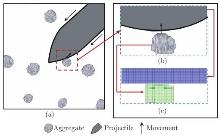
Fig. 7
Correspondence between the contact diagram of projectile aggregate and the finite element model: (a) direction of the relative motion between the projectile and concrete aggregate, (b) microscopic schematic diagram of the contact point between the projectile surface and aggregate, and (c) equivalent finite element model for contact between the projectile surface and aggregate dominated by the normal velocity (color online)"
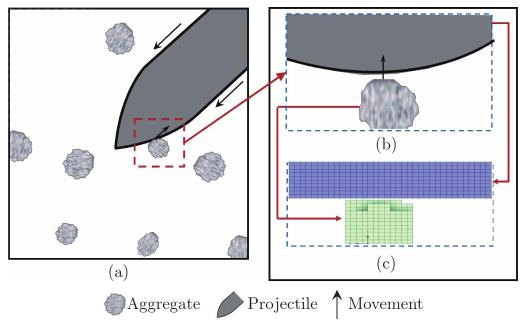
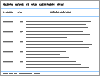
Table 1
Simulation results of progressive grid partitioning"
| Operating condition | Mesh size | ||
|---|---|---|---|
| 0.2 mm | 0.1 mm | 0.05 mm | |
| HPb63-3 (400 m/s) | 0.012 792 20 | 0.011 478 700 | 0.011 461 100 |
| HPb63-3 (500 m/s) | 0.019 144 70 | 0.018 918 300 | 0.018 868 900 |
| HPb63-3 (602 m/s) | 0.020 279 20 | 0.020 137 500 | 0.020 127 600 |
| HPb63-3 (700 m/s) | 0.020 400 50 | 0.020 277 600 | 0.020 259 300 |
| Q235 (400 m/s) | 0.003 317 28 | 0.003 249 930 | 0.003 298 380 |
| Q235 (576 m/s) | 0.004 317 60 | 0.004 107 683 | 0.004 100 275 |
| Q235 (600 m/s) | 0.004 602 17 | 0.004 407 683 | 0.004 350 130 |
| Q235 (700 m/s) | 0.005 480 17 | 0.005 334 110 | 0.005 317 090 |
Table 2
Experimental results of abrasion of literature projectile[19]"
| Warhead pattern projectile | Velocity/ | Volumetric abrasion/% |
|---|---|---|
| Q235 ogive-nosed | 576 | 2.57 |
| HPb63-3 ogive-nosed | 498 | 4.16 |
| HPb63-3 ogive-nosed | 602 | 5.94 |
Table 3
Material parameters"
| Material | Density | Young’s modulus E/GPa | Poisson’s ratio μ | Yield strength Y/MPa |
|---|---|---|---|---|
| Q235 | 7 910 | 210 | 0.3 | 235 |
| HPb63-3 | 8 500 | 105 | 0 | 140 |
Table 4
Concrete material parameters"
| Parameter | Value | Parameter | Value |
|---|---|---|---|
| | 2 440 | A0/MPa | |
| μ | 0.2 | α | 394 |
| | 4 | β | 145 |
Table 5
Comparison between the finite-element simulation and experimental results"
| Operating condition | H | Experimental γ/% | Calculated γ/% | Error/% |
|---|---|---|---|---|
| Q235 | 0.004 107 683 | 2.57 | 2.396 | 6.77 |
| 0.002 044 388 | ||||
| HPb63-3 (602 m/s) | 0.020 187 500 | 5.94 | 5.88 | 1.01 |
| 0.006 219 890 | ||||
| HPb63-3 (498 m/s) | 0.018 724 900 | 4.16 | 4.27 | 2.64 |
| 0.004 384 180 |
Table 6
Indentation depth between the theoretical and simulated hm under low and high speed impact loads"
| Material | Impact load application rate/ | Theoretical | Simulated | Error/% |
|---|---|---|---|---|
| Q235 | 300 | 0.000 910 8 | 0.001 580 0 | 42.35 |
| Q235 | 200 | 0.000 403 5 | 0.001 270 0 | 68.23 |
| Q235 | 100 | 0.000 100 6 | 0.000 842 8 | 88.06 |
| Q235 | 1 000 | 0.010 790 0 | 0.004 300 0 | 150.93 |
| Q235 | 1 200 | 0.015 880 0 | 0.005 100 0 | 211.37 |
| Q235 | 2 000 | 0.031 980 0 | 0.008 210 0 | 289.52 |
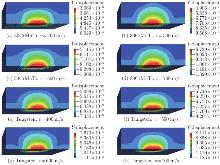
Fig. 8
Finite element displacement field of 30CrMnTi and W tungsten alloy projectiles under operating conditions from 400 m/s to 700 m/s (color online)"
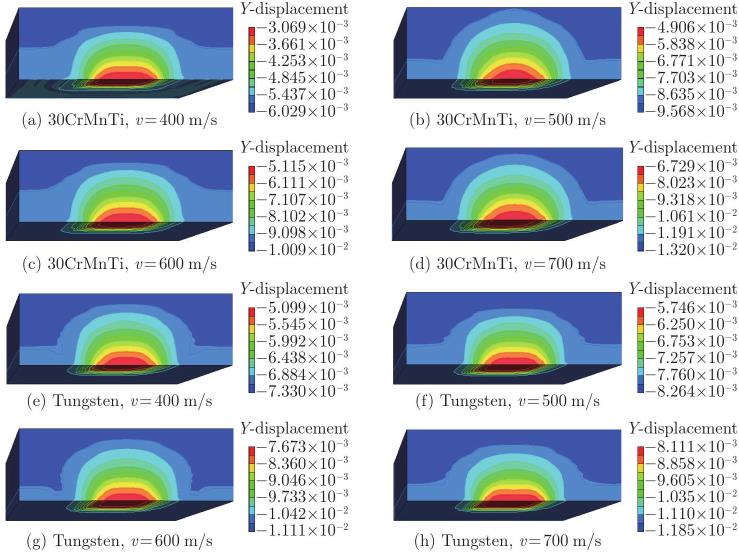
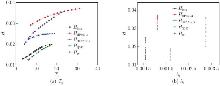
Fig. 9
Relationships between the indentation depth and λ1 (Tp) in the finite element simulation (color online)"
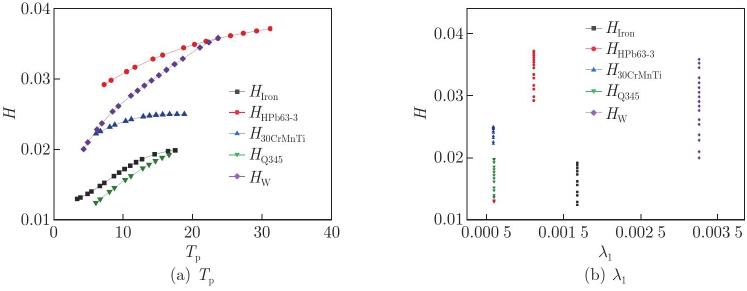
Table 7
Comparison of different data"
| Abrasion rate of projectile under experimental conditions/% | Abrasion rate under finite element simulation conditions/% | Abrasion rate calculated by the empirical formula/% |
|---|---|---|
| 5.94 | 5.88 | 5.453 |
| 4.16 | 4.27 | 4.076 |
| [1] | CHEN, X. W. Mechanics of structural design of EPW (I): the penetration/perforation theory and the analysis on the cartridge of projectile. Expolosion and Shock Waves, 25(6), 499–505 (2005) |
| [2] | FELDGUN, V., YANKELEVSKY, D., and KARINSKI, Y. A new simplified analytical model for soil penetration analysis of rigid projectiles using the Riemann problem solution. International Journal of Impact Engineering, 101, 49–65 (2017) |
| [3] | SONG, D. Y., LIU, F., and JIANG, Z. G. An analytical model for penetration into cylindrical metallic thick target by rigid sharp-nosed projectiles. Engineering Mechanics, 30(1), 31–36 (2013) |
| [4] | LUK, V. K. and FORRESTAL, M. J. Penetration into semi-infinite reinforced-concrete targets with spherical and ogival nose projectiles. International Journal of Impact Engineering, 6(4), 291–301 (1987) |
| [5] | JONES, S. E. and RULE, W. K. On the optimal nose geometry for a rigid penetrator, including the effects of pressure-dependent friction. International Journal of Impact Engineering, 24(4), 403–415 (2000) |
| [6] | DENG, Y. J., CHEN, X. W., ZHONG, W. Z., and HE, L. L. Experimental and numerical study on normal penetration of a projectile into a reinforced concrete target. Expolosion and Shock Waves, 40(2), 023101 (2020) |
| [7] | WANG, Z. L., LI, Y. C., SHEN, R. F., and WANG, J. G. Numerical study on craters and penetration of concrete slab by ogive-nose steel projectile. Computers and Geotechnics, 34(1), 1–9 (2007) |
| [8] | FORRESTAL, M. J., FREW, D. J., HANCHAK, S. J., and BRAR, N. S. Penetration of grout and concrete targets with ogive-nose steel projectiles. International Journal of Impact Engineering, 18(5), 465–476 (1996) |
| [9] | HUANG, M. and GU, G. H. Experiment and simplified analytical model for penetration of rigid projectile in a reinforced concrete target. Journal of Experimental Mechanics, 24(4), 283–290 (2009) |
| [10] | CHENG, X. W., ZHANG, F. J., YANG, S. Q., XIE, R. Z., GAO, H. Y., XU, A. M., JIN, J. M., and QU, M. Mechanics of structural design of EPW (III): investigations on the reduced scale tests. Expolosion and Shock Waves, 26(2), 105–214 (2006) |
| [11] | TABOR, D. The physical meaning of indentation and scratch hardness. British Journal of Applied Physics, 7(5), 159 (1956) |
| [12] | SILLING, S. A. and FORRESTAL, M. J. Mass loss from abrasion on ogive-nose steel projectiles that penetrate concrete targets. International Journal of Impact Engineering, 34(11), 1814–1820 (2007) |
| [13] | WEN, H. M., YANG, Y., and HE, T. Effects of abrasion on the penetration of ogival-nosed projectiles into concrete targets. Latin American Journal of Solids and Structures, 7, 413–422 (2010) |
| [14] | WU, H., QIAN, F., HUANG, F., and WANG, Y. Projectile nose mass abrasion of high-speed penetration into concrete. Advances in Mechanical Engineering, 4, 296503 (2012) |
| [15] | CHEN, X. W., HE, L. L., and YANG, S. Q. Modeling on mass abrasion of kinetic energy penetrator. European Journal of Mechanics-A/Solids, 29(1), 7–17 (2010) |
| [16] | HE, L. L. and CHEN, X. W. Analyses of the penetration process considering mass loss. European Journal of Mechanics-A/Solids, 30(2), 145–157 (2011) |
| [17] | HE, L. L. and CHEN, X. W. Simulation of variation of projectile nose during high-speed penetration into concrete. Chinese Journal of Theoretical and Applied Mechanics, 43(4), 707–715 (2011) |
| [18] | FORRESTAL, M. J., ALTMAN, B. S., CARGILE, J. D., and HANCHAK, S. J. An empirical equation for penetration depth of ogive-nose projectiles into concrete targets. International Journal of Impact Engineering, 15(4), 395–405 (1994) |
| [19] | WU, H. J., HUANG, F. L., WANG, Y. N., DUAN, Z. P., and PI, A. G. Experimental investigation on projectile nose eroding effect of high-velocity penetration into concrete. Acta Armamentarii, 33(1), 48–55 (2012) |
| [20] | LU, F. Y., LI, X. Y., TIAN, Z. D., and JIANG, B. Weapon Damage and Assessment, Science Press, Beijing, 263 (2021) |
| [21] | LIU, Q., YAO, Y., and ZHOU, L. Theoretical analysis of indentation size effect. Journal of Test and Measurement Technology, 23, 1–6 (2009) |
| [22] | KONG, X. Z., WU, H., FANG, Q., and PENG, Y. Rigid and eroding projectile penetration into concrete targets based on an extended dynamic cavity expansion model. International Journal of Impact Engineering, 100, 13–22 (2009) |
| [23] | LANKFORD, J., ANDERSON, C. E., ROYAL, S. A., and RIEGEL, J. P. Penetration erosion phenomenology. International Journal of Impact Engineering, 18, 565–578 (1996) |
| [24] | BISHOP, R. F., HILL, R., and MOTT, N. F. The theory of indentation and hardness tests. Proceedings of the Physical Society, 57(3), 147 (1945) |
| [25] | DUAN, J., WANG, K. H., ZHOU, G. G., and XUE, B. J. Critical ricochet performance of penetrator impacting concrete targets. Expolosion and Shock Waves, 36(6), 797–802 (2016) |
| [26] | CHEN, X., LI, X., CHEN, Y., WU, H. J., and HUANG, F. L. The third dimensionless parameter in the penetration dynamics of rigid projectiles. Chinese Journal of Theoretical and Applied Mechanics, 23(1), 77–84 (2007) |
| [27] | GAO, S. Q., LIU, H. P., and JIN, L. A fuzzy model of the penetration resistance of concrete targets. International Journal of Impact Engineering, 36(4), 644–649 (2009) |
| [28] | LI, P. C., ZHANG, X. F., and WANG, G. J. Dynamic cratering process during penetration of rigid projectile into concrete target. Expolosion and Shock Waves, 43(9), 091402 (2023) |
| [29] | FREW, D. J., HANCHAK, S. J., GREEN, M. L., and FORRESTAL, M. J. Penetration of concrete targets with ogive-nose steel rods. International Journal of Impact Engineering, 21(6), 489–497 (1998) |
| [30] | DENG, Y. J., SONG, W. J., CHEN, X. W., and YAO, Y. A dynamic cavity-expansion penetration model of compressible elastic-plastic response for reinforced concrete targets. Expolosion and Shock Waves, 38(5), 1023–1030 (2018) |
| [31] | KURTARAN, H. H., BUYUK, M., and ESKANDARIAN, A. Ballistic impact simulation of GT model vehicle door using finite element method. Theoretical and Applied Fracture Mechanics, 113–121 (2003) |
| [32] | BROITMAN, E. Indentation hardness measurements at macro-, micro-, and nanoscale: a critical overview. Tribology Letters, 65(1), 23 (2017) |
| [33] | XIE, W. Q., LIU, X. L., and ZHANG, X. P. A review of rock macro-indentation: theories, experiments, simulations, and applications. Journal of Rock Mechanics and Geotechnical Engineering, 16(6), 2351–2374 (2024) |
| [34] | FENG, S. X., ZHANG, Y. X., ZHAO, Y. F., and YUN, M. C. Rock indentation behavior: effects of penetration rates and indenter types. Applied Sciences (Switzerland), 15(4), 1785 (2025) |
| [35] | LIU, X. K., CAI, L. X., and CHEN, H. Residual stress indentation model based on material equivalence. Chinese Journal of Aeronautics, 35(8), 304–313 (2022) |
| [36] | HAUŠILD, P., ČECH, J., MERLE, B., and NOHAVA, J. Effect of temperature and strain rate on indentation size effect at shallow indentation depths. Materials and Design, 255, 114–196 (2025) |
| [37] | CLATON, J. D., LLOYD, J. T., and CASEM, D. T. Simulation and dimensional analysis of instrumented dynamic spherical indentation of ductile metals. International Journal of Mechanical Sciences, 251, 108333 (2023) |
| [38] | HE, Z. H., JIN, D., SHI, J. Y., HAN, X. D., and JAMAL, A. S. Multi-scale creep analysis of SCM-modified concrete, indentation test and multiscale homogenization method. Archives of Civil and Mechanical Engineering, 24(2), 1–14 (2024) |
| [39] | LI, K. Theoretical Studies on the Characterization of Uniaxial Mechanical Properties of Metallic Materials by Indentation Method, M. Sc. dissertation, Xiangtan University, 1–70 (2021) |
| [40] | WITTMANN, F. H., ROELFSTRA, P. E., and SADOUKI, H. Simulation and analysis of composite structures. Materials Science and Engineering, 68(2), 239–248 (1985) |
| [41] | MIRSHAMS, R. A. and POTHAPRAGADA, R. M. Correlation of nanoindentation measurements of nickel made using geometrically different indenter tips. Acta Materialia, 54(4), 1123–1134 (2006) |
| [42] | YANG, B. and VEHOFF, H. Dependence of nanohardness upon indentation size and grain size. Acta Materialia, 55(3), 849–856 (2007) |
| [43] | WANG, H. M., DENG, M., HUANG, Z. Y., LU, K. L., SHEN, G. B., QIAN, H. J., HUANG, Z. Y., QI, J. Q., and WANG, Q. Y. Extraction of the dynamic plastic behavior of AlON single crystals by nanoimpact. Journal of Advanced Ceramics, 13(10), 1566–1577 (2024) |
| [1] | Danning JING, Xuguang CHEN, Shuo WANG, Qinglin WANG, Jie LIU, Xinhai CHEN. Intelligent surrogate modeling for penetration prediction: solving forward and inverse problems with multi-fidelity data [J]. Applied Mathematics and Mechanics (English Edition), 2026, 47(6): 1341-1362. |
| [2] | N. IQBAL, J. CHOI, S. F. SHAH, C. LEE, S. LEE. Mathematical modeling and simulations of stress mitigation by coating polycrystalline particles in lithium-ion batteries [J]. Applied Mathematics and Mechanics (English Edition), 2024, 45(6): 947-962. |
| [3] | Shijing GAO, Lele ZHANG, Jinxi LIU, Guoquan NIE, Weiqiu CHEN. Indentation behavior of a semi-infinite piezoelectric semiconductor under a rigid flat-ended cylindrical indenter [J]. Applied Mathematics and Mechanics (English Edition), 2024, 45(4): 649-662. |
| [4] | Shengyi TANG, Xubin PENG, Huadong YONG. Numerical simulation of the mechanical behavior of superconducting tape in conductor on round core cable using the cohesive zone model [J]. Applied Mathematics and Mechanics (English Edition), 2023, 44(9): 1511-1532. |
| [5] | Hang ZHOU. Complex variable solution for boundary value problem with X-shaped cavity in plane elasticity and its application [J]. Applied Mathematics and Mechanics (English Edition), 2017, 38(9): 1329-1346. |
| [6] | Zhaodong DING, Yongjun JIAN, Liangui YANG. Time periodic electroosmotic flow of micropolar fluids through microparallel channel [J]. Applied Mathematics and Mechanics (English Edition), 2016, 37(6): 769-786. |
| [7] | Yang SUN;Wenjuan WANG;Binbin LI;Mabao LIU. Investigation on behavior of crack penetration/deflection at interfaces in intelligent coating system [J]. Applied Mathematics and Mechanics (English Edition), 2015, 36(4): 465-474. |
| [8] | Ming ZHEN;Zhi-gang JIANG;Dian-yi SONG;Fei LIU. Analytical solutions for finite cylindrical dynamic cavity expansion in compressible elastic-plastic materials [J]. Applied Mathematics and Mechanics (English Edition), 2014, 35(8): 1039-1050. |
| [9] | Zhong-you LI;Yuan-xue LIU. Coupled thermo-hygro-mechanical damage model for concrete subjected to high temperatures [J]. Applied Mathematics and Mechanics (English Edition), 2012, 33(4): 465-482. |
| [10] | Yong-chi LI;Zhi-hai WANG;Xiao-jun WANG;Xiu-zhang HU. An engineering analysis of penetration of metal ball into fibre-reinforced composite targets [J]. Applied Mathematics and Mechanics (English Edition), 2009, 30(3): 365-372. |
| [11] | GAO Shi-qiao;LIU Hai-peng;LI Ke-jie;HUANG Feng-lei;JIN Lei. NORMAL EXPANSION THEORY FOR PENETRATION OF PROJECTILE AGAINST CONCRETE TARGET [J]. Applied Mathematics and Mechanics (English Edition), 2006, 27(4): 485-492 . |
| [12] | GU Chong-shi;SU Huai-zhi;ZHOU Hong. STUDY ON COUPLING MODEL OF SEEPAGE-FIELD AND STRESS-FIELD FOR ROLLED CONTROL CONCRETE DAM [J]. Applied Mathematics and Mechanics (English Edition), 2005, 26(3): 355-363 . |
| [13] | LIU Yu-hong;ZENG Yan-jun;XU Jing-feng;ZHANG Mei. METHOD ON ESTIMATION OF DRUG’S PENETRATED PARAMETERS [J]. Applied Mathematics and Mechanics (English Edition), 2004, 25(4): 440-444. |
| [14] | CHEN Shu-yu;SHEN Cheng-kang;JIN Wu-gen. STUDY ON DYNAMIC CONSTITUTIVE RELATIONS FOR CONCRETE WITH FINITE DEFORMATION [J]. Applied Mathematics and Mechanics (English Edition), 2004, 25(12): 1374-1381. |
| [15] | YANG You-fa;XU Shao-qian;ZHONG Zheng-hua. STUDIES ON STRESS TRANSFERENCE MECHANISM OF STEEL FIBRE REINFORCED CONCRETE [J]. Applied Mathematics and Mechanics (English Edition), 2001, 22(4): 483-494. |
| Viewed | ||||||
|
Full text |
|
|||||
|
Abstract |
|
|||||





 Email Alert
 RSS
RSS