Applied Mathematics and Mechanics (English Edition) ›› 2026, Vol. 47 ›› Issue (6): 1401-1416.doi: https://doi.org/10.1007/s10483-026-3398-8
Previous Articles Next Articles
Jihong ZHENG1,2, Jizeng WANG1,2, Youhe ZHOU1,2, Xiaojing LIU1,2,†( )
)
Received:2026-02-08
Revised:2026-04-17
Online:2026-06-18
Published:2026-06-18
Contact:
Xiaojing LIU, E-mail: liuxiaojing@lzu.edu.cnSupported by:2010 MSC Number:
Jihong ZHENG, Jizeng WANG, Youhe ZHOU, Xiaojing LIU. Adaptive wavelet multi-resolution solution for one-dimensional Burgers’ equation at high Reynolds numbers. Applied Mathematics and Mechanics (English Edition), 2026, 47(6): 1401-1416.
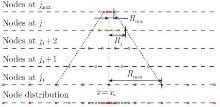
Fig. 1
Multi-resolution refining model for creating node set (color online)"
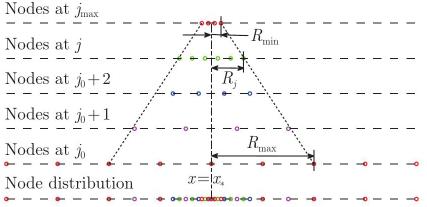
Table 1
Values of grid parameters for constructing multi-resolution node distribution"
| Parameter | Value | ||
|---|---|---|---|
| Some | Some | All | |
| | | | |
| | | | |
| | | | |
| | | ||
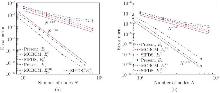
Fig. 2
Error norms as a function of the number of nodes for Example 1: (a) Re=100; (b) Re=200 (color online)"
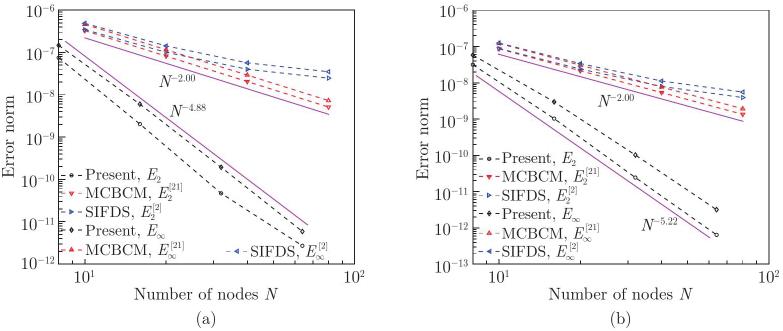
Table 2
Error norms of four numerical solutions for Example 2"
| | t | QBFEM (N=50)[ | MCBCM (N=50)[ | MCBCT4 (N=50)[ | Present (N=8) | ||||
|---|---|---|---|---|---|---|---|---|---|
| | E2 | | E2 | | E2 | | E2 | ||
| 500 | 1.68 | | | | | | | | |
| 2.10 | | | | | | | | | |
| 2.66 | | | | | | | | | |
| 3.30 | | | | | | | | | |
| 1 500 | 1.68 | | | | | | | | |
| 2.10 | | | | | | | | | |
| 2.66 | | | | | | | | | |
| 3.30 | | | | | | | | | |
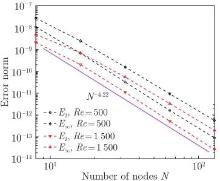
Fig. 3
Relation between error norms at t=3.3 and the number of nodes for Example 2 (color online)"
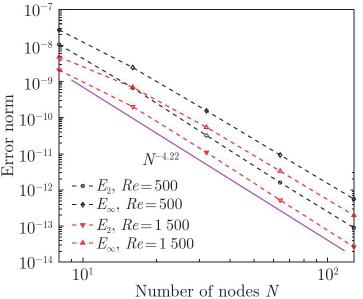
Table 3
Error norms of numerical solutions for Example 3 with Re=200"
| t | MCBCM (N=240)[ | FECM (N=240)[ | RKFIM (N=1200)[ | Present (N=65) | ||||
|---|---|---|---|---|---|---|---|---|
| | E2 | | E2 | | E2 | | E2 | |
| 1.70 | | | | | | | | |
| 2.50 | | | | | | | | |
| 3.00 | | | | | | | | |
| 3.50 | | | | | | | | |
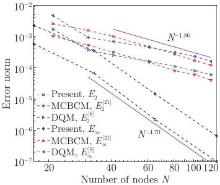
Fig. 4
Errors norms at t=3.6 as a function of the number of nodes for Example 3 with Re=200 (color online)"
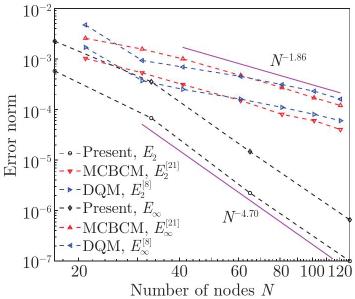
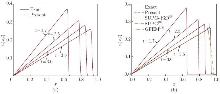
Fig. 5
Wavelet solutions at different times for Example 3: (a) Re=2 000; (b) Re=5 000 (color online)"
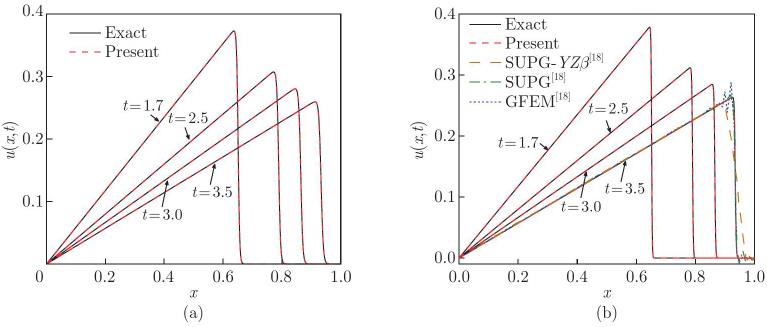
Table 4
Error norms of numerical solutions for Example 3 with Re=2 000 and Re=5 000"
| t | RKFIM | Present | Present | |||
|---|---|---|---|---|---|---|
| | E2 | | E2 | | E2 | |
| 1.70 | | | | | | |
| 3.00 | | | | | | |
| 3.50 | | | | | | |
Table 5
Comparison of numerical solutions for Example 4 with Re=10"
| t | x | Exact | EFDS[ | FEM[ | CNFDS[ | HWCM[ | MHWCM[ | RBFFDS[ | Present (N=32) |
|---|---|---|---|---|---|---|---|---|---|
| 0.4 | 0.25 | 0.308 89 | 0.308 91 | 0.314 29 | 0.308 81 | 0.308 87 | 0.308 89 | 0.308 90 | 0.308 89 |
| 0.50 | 0.569 63 | 0.569 64 | 0.576 36 | 0.569 55 | 0.569 56 | 0.569 63 | 0.569 64 | 0.569 63 | |
| 0.75 | 0.625 44 | 0.625 42 | 0.625 92 | 0.625 40 | 0.625 40 | 0.625 37 | 0.625 50 | 0.625 45 | |
| 1.0 | 0.25 | 0.162 56 | 0.162 57 | 0.163 91 | 0.162 54 | 0.162 55 | 0.162 58 | 0.162 57 | 0.162 57 |
| 0.50 | 0.291 92 | 0.291 92 | 0.294 37 | 0.291 88 | 0.291 88 | 0.291 95 | 0.291 94 | 0.291 92 | |
| 0.75 | 0.287 47 | 0.287 48 | 0.290 16 | 0.287 44 | 0.287 43 | 0.287 47 | 0.287 54 | 0.287 48 | |
| 3.0 | 0.25 | 0.027 20 | 0.027 20 | 0.027 43 | 0.027 20 | 0.027 21 | 0.027 20 | 0.027 19 | 0.027 20 |
| 0.50 | 0.040 21 | 0.040 21 | 0.040 57 | 0.040 21 | 0.040 22 | 0.040 21 | 0.040 19 | 0.040 21 | |
| 0.75 | 0.029 77 | 0.029 77 | 0.013 34 | 0.029 78 | 0.029 78 | 0.029 77 | 0.029 75 | 0.029 77 |
Table 6
Comparison of numerical solutions for Example 4 with Re=200"
| t | x | Exact | CNFDS[ | HWCM[ | MHWCM[ | RBFFDS[ | Present (N=32) |
|---|---|---|---|---|---|---|---|
| 5 | 0.25 | 0.046 96 | 0.046 96 | 0.046 95 | 0.046 98 | 0.046 96 | 0.046 97 |
| 0.50 | 0.093 92 | 0.093 93 | 0.093 91 | 0.093 96 | 0.093 92 | 0.093 92 | |
| 0.75 | 0.140 83 | 0.140 86 | 0.140 83 | 0.140 91 | 0.140 83 | 0.140 83 | |
| 10 | 0.25 | 0.024 22 | 0.024 22 | 0.024 21 | 0.024 22 | 0.024 21 | 0.024 22 |
| 0.50 | 0.048 42 | 0.048 42 | 0.048 42 | 0.048 43 | 0.048 41 | 0.048 42 | |
| 0.75 | 0.071 13 | 0.071 12 | 0.071 14 | 0.071 18 | 0.071 12 | 0.071 14 | |
| 15 | 0.25 | 0.016 31 | 0.016 31 | 0.016 31 | 0.016 31 | 0.016 31 | 0.016 31 |
| 0.50 | 0.032 44 | 0.032 44 | 0.032 44 | 0.032 44 | 0.032 43 | 0.032 44 | |
| 0.75 | 0.044 13 | 0.044 12 | 0.044 15 | 0.044 16 | 0.044 13 | 0.044 14 |
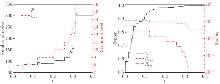
Fig. 6
Grid parameters for constructing multi-resolution node distribution used in Example 4 (color online)"
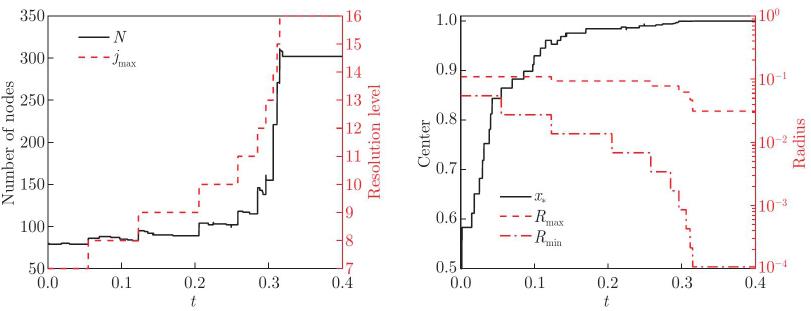
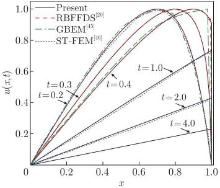
Fig. 7
Numerical solutions for Example 4 with Re=105 (color online)"
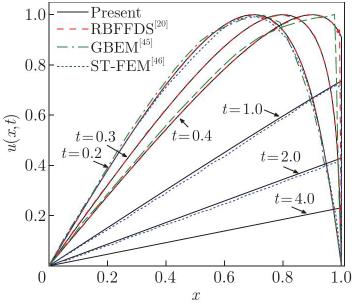
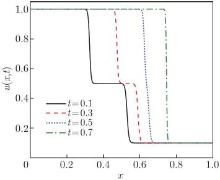
Fig. 8
Wavelet solutions for the shock merging in Example 5 (color online)"
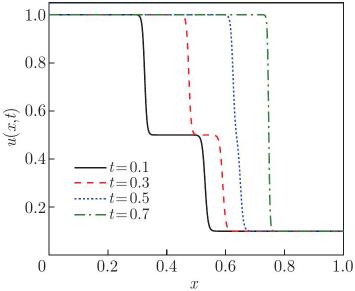
Table 7
Error norms of the wavelet solution for Example 5"
| t | | | | ||||||
|---|---|---|---|---|---|---|---|---|---|
| N | | E2 | N | | E2 | N | | E2 | |
| 0.1 | 88 | | | 206 | | | 325 | | |
| 0.3 | 80 | | | 190 | | | 319 | | |
| 0.5 | 67 | | | 146 | | | 249 | | |
| 0.7 | 61 | | | 123 | | | 195 | | |
| [1] | BONKILE, M. P., AWASTHI, A., LAKSHMI, C., MUKUNDAN, V., and ASWIN, V. S. A systematic literature review of Burgers’ equation with recent advances. Pramana, 90(6), 69 (2018) |
| [2] | RAHMAN, K., HELIL, N., and YIMIN, R. Some new semi-implicit finite difference schemes for numerical solution of Burgers equation. 2010 International Conference on Computer Application and System Modeling, Institute of Electrical and Electronics Engineers, V14-451–V14-455 (2010) |
| [3] | KUTLUAY, S., BAHADIR, A. R., and ÖZDEŞ A. Numerical solution of one-dimensional Burgers equation: explicit and exact-explicit finite difference methods. Journal of Computational and Applied Mathematics, 103(2), 251–261 (1999) |
| [4] | WANG, L. L., LIAO, X., and YANG, H. J. A new linearized second-order energy-stable finite element scheme for the nonlinear Benjamin-Bona-Mahony-Burgers equation. Applied Numerical Mathematics, 201, 431–445 (2024) |
| [5] | RASLAN, K. R. A collocation solution for Burgers equation using quadratic B-spline finite elements. International Journal of Computer Mathematics, 80(7), 931–938 (2003) |
| [6] | SHENG, Y. and ZHANG, T. The finite volume method for two-dimensional Burgers’ equation. Personal and Ubiquitous Computing, 22(5), 1133–1139 (2018) |
| [7] | ZHAN, J. M. and LI, Y. S. Generalized finite spectral method for 1D Burgers and KdV equations. Applied Mathematics and Mechanics (English Edition), 27(12), 1635–1643 (2006) https://doi.org/10.1007/s10483-006-1206-z |
| [8] | KORKMAZ, A. and DAG, İ. Polynomial based differential quadrature method for numerical solution of nonlinear Burgers’ equation. Journal of the Franklin Institute, 348(10), 2863–2875 (2011) |
| [9] | GAO, Y., LE, L. H., and SHI, B. C. Numerical solution of Burgers’ equation by lattice Boltzmann method. Applied Mathematics and Computation, 219(14), 7685–7692 (2013) |
| [10] | LIU, X. J., ZHOU, Y. H., ZHANG, L., and WANG, J. Z. Wavelet solutions of Burgers’ equation with high Reynolds numbers. Science China Technological Sciences, 57(7), 1285–1292 (2014) |
| [11] | LIU, X. J., WANG, J. Z., and ZHOU, Y. H. A space-time fully decoupled wavelet Galerkin method for solving two-dimensional Burgers’ equations. Computers & Mathematics with Applications, 72(12), 2908–2919 (2016) |
| [12] | LIU, Z. Y., YANG, Y. T., and CAI, Q. D. Neural network as a function approximator and its application in solving differential equations. Applied Mathematics and Mechanics (English Edition), 40(2), 237–248 (2019) https://doi.org/10.1007/s10483-019-2429-8 |
| [13] | MAO, Z. P. and MENG, X. H. Physics-informed neural networks with residual/gradient-based adaptive sampling methods for solving partial differential equations with sharp solutions. Applied Mathematics and Mechanics (English Edition), 44(7), 1069–1084 (2023) https://doi.org/10.1007/s10483-023-2994-7 |
| [14] | KADALBAJOO, M. K. and AWASTHI, A. Parameter free hybrid numerical method for solving modified Burgers’ equations on a nonuniform mesh. Asian-European Journal of Mathematics, 10(2), 1750029 (2017) |
| [15] | HON, Y. C. and MAO, X. Z. An efficient numerical scheme for Burgers’ equation. Applied Mathematics and Computation, 95(1), 37–50 (1998) |
| [16] | CALDWELL, J., WANLESS, P., and COOK, A. E. Solution of Burgers’ equation for large Reynolds number using finite elements with moving nodes. Applied Mathematical Modelling, 11(3), 211–214 (1987) |
| [17] | SHYAMAN, V. P., SREELAKSHMI, A., and AWASTHI, A. An adaptive tailored finite point method for the generalized Burgers’ equations. Journal of Computational Science, 62, 101744 (2022) |
| [18] | CENGIZCI, S. and UĞUR, Ö. A stabilized FEM formulation with discontinuity-capturing for solving Burgers’-type equations at high Reynolds numbers. Applied Mathematics and Computation, 442, 127705 (2023) |
| [19] | CENGIZCI, S., UĞUR, Ö., and NATESAN, S. A PINN-enhanced SUPG-stabilized hybrid finite element framework with shock-capturing for computing steady convection-dominated flows. Advances in Engineering Software, 216, 104135 (2026) |
| [20] | JIWARI, R. Local radial basis function-finite difference based algorithms for singularly perturbed Burgers’ model. Mathematics and Computers in Simulation, 198, 106–126 (2022) |
| [21] | MITTAL, R. C. and JAIN, R. K. Numerical solutions of nonlinear Burgers’ equation with modified cubic B-splines collocation method. Applied Mathematics and Computation, 218(15), 7839–7855 (2012) |
| [22] | JIWARI, R. A hybrid numerical scheme for the numerical solution of the Burgers’ equation. Computer Physics Communications, 188, 59–67 (2015) |
| [23] | SINGH, B. K. and GUPTA, M. A new efficient fourth order collocation scheme for solving Burgers’ equation. Applied Mathematics and Computation, 399, 126011 (2021) |
| [24] | UÇAR, Y., YAĞMURLU, M., and ÇELİKKAYA, İ. Numerical solution of Burgers’ type equation using finite element collocation method with strang splitting. Mathematical Sciences and Applications E: Notes, 8(1), 29–45 (2020) |
| [25] | ZHOU, Y. H. Wavelet Numerical Method and Its Applications in Nonlinear Problems, Springer, Singapore (2021) |
| [26] | WANG, J. Z., LIU, X. J., and ZHOU, Y. H. Application of wavelet methods in computational physics. Annalen der Physik, 536(5), 2300461 (2024) |
| [27] | MA, X. L., WU, B., ZHANG, J. H., and SHI, X. A new numerical scheme with wavelet-Galerkin followed by spectral deferred correction for solving string vibration problems. Mechanism and Machine Theory, 142, 103623 (2019) |
| [28] | YU, Q. A homotopy-based wavelet method for extreme large bending analysis of heterogeneous anisotropic plate with variable thickness on orthotropic foundation. Applied Mathematics and Computation, 439, 127641 (2023) |
| [29] | YU, Q. Wavelet solution for hygrothermomechanical bending of initially defected plate undergoing large deformation on nonlinear elastic foundation. Thin-Walled Structures, 179, 109601 (2022) |
| [30] | YU, Q. A hierarchical wavelet method for nonlinear bending of materially and geometrically anisotropic thin plate. Communications in Nonlinear Science and Numerical Simulation, 92, 105498 (2021) |
| [31] | AHMED, S., XU, H., ZHOU, Y., and YU, Q. Modelling convective transport of hybrid nanofluid in a lid driven square cavity with consideration of Brownian diffusion and thermophoresis. International Communications in Heat and Mass Transfer, 137, 106226 (2022) |
| [32] | AHMED, S., XU, H., WANG, A. Y., and CHEN, Q. B. Highly accurate Coiflet wavelet-homotopy solution of Jeffery-Hamel problem at extreme parameters. International Journal of Wavelets, Multiresolution and Information Processing, 20(5), 2250013 (2022) |
| [33] | AHMED, S., CHEN, Z. M., XU, H., and ISHAQ, M. Mixed convection flow in a square lid-driven cavity subject to inclined magnetic field with highly accurate wavelet-homotopy solutions. Computers & Mathematics with Applications, 162, 33–51 (2024) |
| [34] | DIMITRIOU, D. K., NASTOS, C. V., and SARAVANOS, D. A. Multiresolution finite wavelet domain method for efficient modeling of guided waves in composite beams. Wave Motion, 112, 102958 (2022) |
| [35] | DIMITRIOU, D. K. and SARAVANOS, D. A. Exploring the inherent capacity of the multiresolution finite wavelet domain method to provide convergence indicators in transient dynamic simulations. Computers & Structures, 305, 107517 (2024) |
| [36] | LIU, X. J., LIU, G. R., WANG, J. Z., and ZHOU, Y. H. A wavelet multiresolution interpolation Galerkin method for targeted local solution enrichment. Computational Mechanics, 64(4), 989–1016 (2019) |
| [37] | LIU, X. J., ZHOU, Y. H., and WANG, J. Z. Wavelet multiresolution interpolation Galerkin method for nonlinear boundary value problems with localized steep gradients. Applied Mathematics and Mechanics (English Edition), 43(6), 863–882 (2022) https://doi.org/10.1007/s10483-022-2859-5 |
| [38] | LIU, X. J., ZHOU, Y. H., and WANG, J. Z. Highly accurate wavelet solution for bending and free vibration of circular plates over extra-wide ranges of deflections. Journal of Applied Mechanics, 90(3), 031009 (2023) |
| [39] | DEVILLE, M. O., FISCHER, P. F., and MUND, E. H. High-Order Methods for Incompressible Fluid Flow, Cambridge University Press, Cambridge (2004) |
| [40] | DONOHO, D. L. Interpolating Wavelet Transforms, Technical Report 408, Stanford University (1992) |
| [41] | XIE, S. S., HEO, S., KIM, S., WOO, G., and YI, S. Numerical solution of one-dimensional Burgers’ equation using reproducing kernel function. Journal of Computational and Applied Mathematics, 214(2), 417–434 (2008) |
| [42] | ÖZIŞ, T., AKSAN, E. N., and ÖZDEŞ, A. A finite element approach for solution of Burgers’ equation. Applied Mathematics and Computation, 139(2-3), 417–428 (2003) |
| [43] | KADALBAJOO, M. K. and AWASTHI, A. A numerical method based on Crank-Nicolson scheme for Burgers’ equation. Applied Mathematics and Computation, 182(2), 1430–1442 (2006) |
| [44] | JIWARI, R. A Haar wavelet quasilinearization approach for numerical simulation of Burgers’ equation. Computer Physics Communications, 183(11), 2413–2423 (2012) |
| [45] | KAKUDA, K. and TOSAKA, N. The generalized boundary element approach to Burgers’ equation. International Journal for Numerical Methods in Engineering, 29(2), 245–261 (1990) |
| [46] | VAROḠLU, E. and FINN, W. D. L. Space-time finite elements incorporating characteristics for the Burgers’ equation. International Journal for Numerical Methods in Engineering, 16(1), 171–184 (1980) |
| [1] | Qihang MA, Feng FENG, Bofu WANG, Quan ZHOU. High-order finite-volume central targeted essentially non-oscillatory schemes for shock-driven flows on unstructured meshes [J]. Applied Mathematics and Mechanics (English Edition), 2026, 47(5): 1177-1204. |
| [2] | Keqi YE, Yuelin ZHAO, Feng WU, Wanxie ZHONG. An adaptive artificial viscosity for the displacement shallow water wave equation [J]. Applied Mathematics and Mechanics (English Edition), 2022, 43(2): 247-262. |
| [3] | Ziqiang CHENG, Shihao LIU, Yan JIANG, Jianfang LU, Mengping ZHANG, Shuhai ZHANG. A high order boundary scheme to simulate complex moving rigid body under impingement of shock wave [J]. Applied Mathematics and Mechanics (English Edition), 2021, 42(6): 841-854. |
| [4] | Mingsheng YE, Ming DONG. Near-wall behaviors of oblique-shock-wave/turbulent-boundary-layer interactions [J]. Applied Mathematics and Mechanics (English Edition), 2017, 38(10): 1357-1376. |
| [5] | Yunlong LI, Wei CAO. Research of influence of reduced-order boundary on accuracy and solution of interior points [J]. Applied Mathematics and Mechanics (English Edition), 2017, 38(1): 111-124. |
| [6] | Chun WANG, Gaoxiang XIANG, Zonglin JIANG. Theoretical approach to one-dimensional detonation instability [J]. Applied Mathematics and Mechanics (English Edition), 2016, 37(9): 1231-1238. |
| [7] | HUANG Shou-Jun;WANG Jing-Jing. Global structure stability of impact-induced tensile waves in phase-transforming materials [J]. Applied Mathematics and Mechanics (English Edition), 2013, 34(9): 1155-1166. |
| [8] | Li ZOU;Zhen WANG;Zhi ZONG;Dong-yang ZOU;Shuo ZHANG. Solving shock wave with discontinuity by enhanced differential transform method (EDTM) [J]. Applied Mathematics and Mechanics (English Edition), 2012, 33(12): 1569-1582. |
| [9] | SUN Wen-Hua;SHENG Wan-Cheng. The Riemann problem for nonlinear degenerate wave equations [J]. Applied Mathematics and Mechanics (English Edition), 2010, 31(6): 665-674. |
| [10] | ZHANG Shan-Yuan;LIU Zhi-Fang. Nonlinear flexural waves and chaos behavior in finite-deflection Timoshenko beam [J]. Applied Mathematics and Mechanics (English Edition), 2010, 31(11): 1347-1358. |
| [11] | ZHANG Shan-yuan;LIU Zhi-fang. Three kinds of nonlinear dispersive waves in elastic rods with finite deformation [J]. Applied Mathematics and Mechanics (English Edition), 2008, 29(7): 909-917 . |
| [12] | GAO Shi-qiao;LIU Hai-peng;LI Ke-jie;HUANG Feng-lei;JIN Lei. NORMAL EXPANSION THEORY FOR PENETRATION OF PROJECTILE AGAINST CONCRETE TARGET [J]. Applied Mathematics and Mechanics (English Edition), 2006, 27(4): 485-492 . |
| [13] | LI Yong-chi;YAO Lei;HU Xiu-zhang;CAO Jie-dong;DONG Jie. SOME PROBLEMS ON JUMP CONDITIONS OF SHOCK WAVES IN 3-DIMENSIONAL SOLIDS [J]. Applied Mathematics and Mechanics (English Edition), 2006, 27(2): 187-194 . |
| [14] | FAN Huai-guo;ZHANG Chun-xiao;HE Chuan. DIAMOND PORT JET INTERACTION WITH SUPERSONIC FLOW [J]. Applied Mathematics and Mechanics (English Edition), 2005, 26(10): 1332-1340 . |
| [15] | MO Jia-qi;WANG Hui. SHIFT OF SHOCK POSITION FOR A CLASS OF NONLINEAR SINGULARLY PERTURBED PROBLEMS [J]. Applied Mathematics and Mechanics (English Edition), 2005, 26(1): 58-62 . |
| Viewed | ||||||
|
Full text |
|
|||||
|
Abstract |
|
|||||





 Email Alert
 RSS
RSS