Applied Mathematics and Mechanics (English Edition) ›› 2026, Vol. 47 ›› Issue (5): 1065-1084.doi: https://doi.org/10.1007/s10483-026-3378-8
Previous Articles Next Articles
Xueru WANG, Pengxin WANG, Junjie CHEN, Chuanyang HUANG, Kai LI†( )
)
Received:2025-11-13
Revised:2026-02-22
Published:2026-05-06
Contact:
Kai LI, E-mail: kli@ahjzu.edu.cnSupported by:2010 MSC Number:
Xueru WANG, Pengxin WANG, Junjie CHEN, Chuanyang HUANG, Kai LI. Light-powered self-propelling boat via self-rotating liquid crystal elastomer rod. Applied Mathematics and Mechanics (English Edition), 2026, 47(5): 1065-1084.
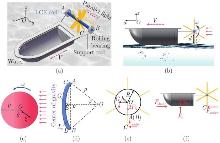
Fig. 1
Schematics of self-propelling boat: (a) three-dimensional configuration; (b) side view; (c) cross section of rotating LCE rod; (d) current state of bend LCE rod; (e) force analysis on LCE rod-blade assembly; (f) force analysis on self-propelling boat. Due to uneven temperature distribution across cross section of rod caused by heating on right side, center of gravity shifts, generating driving moment that causes rod to rotate. This rotation in turn drives blade, resulting in self-propulsion of boat (color online)"
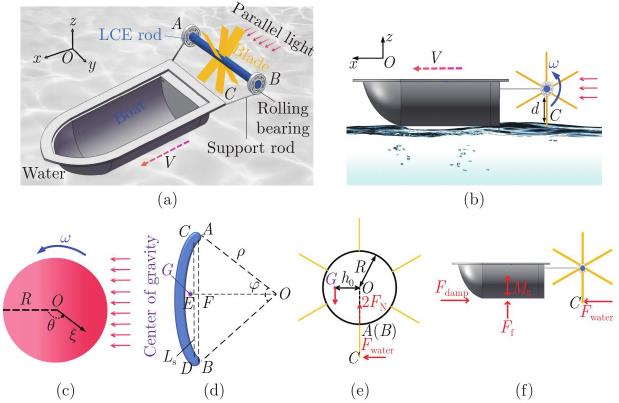
Table 1
Material properties and geometric parameters"
| Parameter | Definition | Value | Unit |
|---|---|---|---|
| τ | Thermal relaxation time | 0.3 | s |
| T0 | Ambient temperature | 300 | K |
| m | Total mass of LCE rod and blade | 0.015 | kg |
| g | Gravitational acceleration | 9.81 | m/s2 |
| R | Cross-sectional radius of LCE rod | 0–0.004 | m |
| p | Photothermal power | 0–100 | K/s |
| α | Thermal expansion coefficient | 0–1×10⁻³ | K-1 |
| β1 | Damping coefficient of blade | 0–2.5 | Kg·m·s-1 |
| β2 | Damping coefficient of boat | 0–2.5 | Kg·m·s-1 |
| Ls | Support span | 0–0.4 | m |
| d | Length of blade | 0.02 | m |
Table 2
Dimensionless parameters"
| Parameter | ||||||
|---|---|---|---|---|---|---|
| Value | 0–0.2 | 0–0.1 | 0–0.3 | 0–20 | 0–1 | 0–1 |
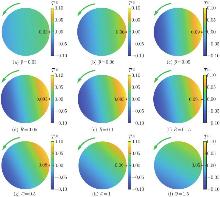
Fig. 2
First-order temperature field component in cross section of LCE rod: (a) p¯=0.03; (b) p¯=0.06; (c) p¯=0.09 (R¯=0.15, ω¯=0.1); (d) R¯=0.05; (e) R¯=0.1; (f) R¯=0.15 (p¯=0.09, ω¯=0.2); (g) ω¯=0.5; (h) ω¯=1; (i) ω¯=1.5 (p¯=0.09, R¯=0.15). Higher values of p¯ lead to higher temperature fields. R¯ has no noticeable effects on temperature distribution, while larger values of ω¯ result in more uniform temperature fields (color online)"
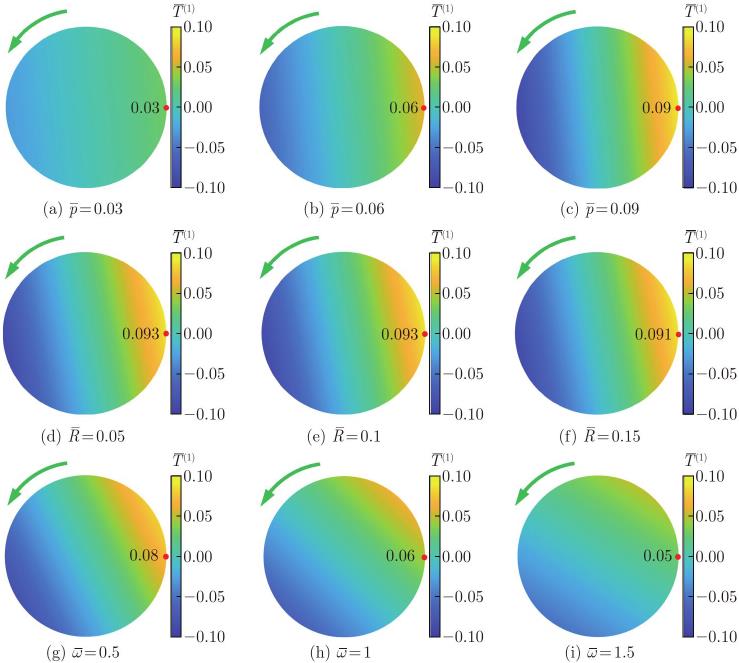
Fig. 3
Effects of photothermal power and thermal expansion coefficient on lateral curvature: (a) contour plot of dimensionless lateral curvature with angular velocity and photothermal power; (b) contour plot of dimensionless lateral curvature with angular velocity and thermal expansion coefficient. Increasing either photothermal power or thermal expansion coefficient leads to larger lateral curvature (color online)"
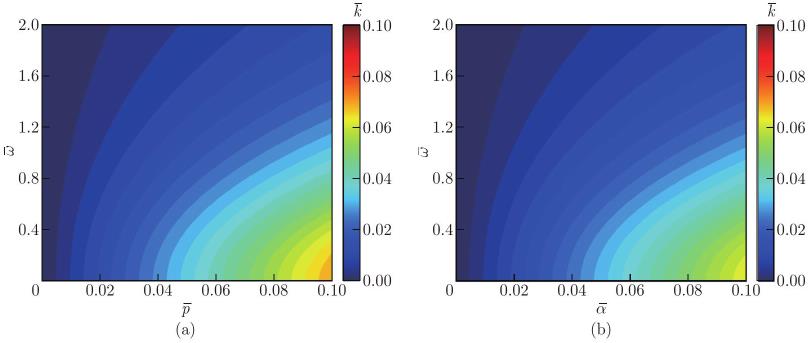
Fig. 4
Effects of photothermal power and thermal expansion coefficient on driving moment: (a) contour plot of dimensionless driving moment with angular velocity and photothermal power; (b) contour plot of dimensionless driving moment with angular velocity and thermal expansion coefficient. Driving moment increases with increasing photothermal power and thermal expansion coefficient (color online)"
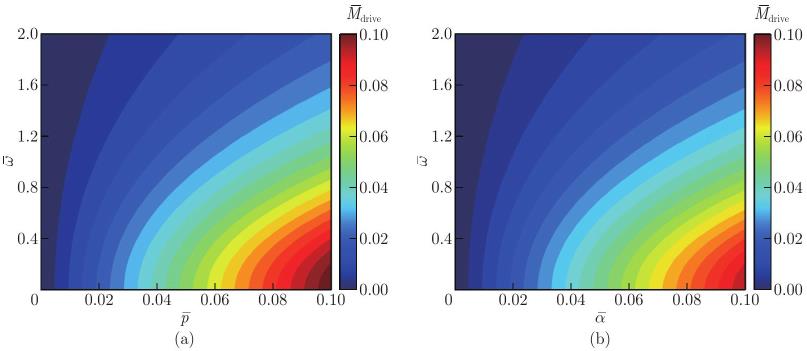

Fig. 5
Effects of photothermal power on self-propulsion: (a) self-rotation angular velocity ω¯ and self-propulsion speed V¯ versus photothermal power p¯; (b) relationship between driving moment M¯drive and angular velocity ω¯ for different photothermal powers p¯. Both angular velocity and self-propulsion speed increase with photothermal power p¯ (color online)"

Fig. 6
Effects of support span on self-propulsion: (a) self-rotation angular velocity ω¯ and self-propulsion speed V¯ versus support span L¯s; (b) relationship between driving moment M¯drive and angular velocity ω¯ for different support spans L¯s. Both self-rotation angular velocity and self-propulsion speed increase with increasing support span L¯s (color online)"
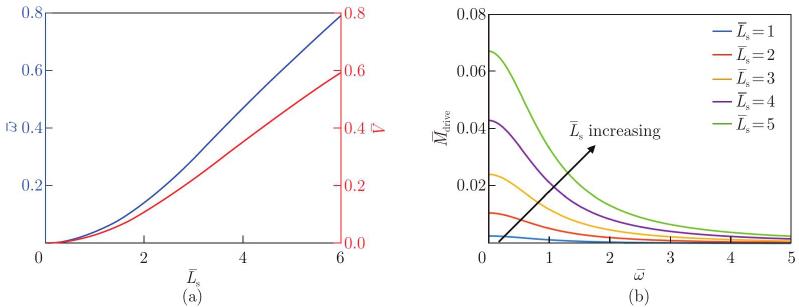
Fig. 7
Effects of thermal expansion coefficient on self-propulsion: (a) self-rotation angular velocity ω¯ and self-propulsion speed V¯ versus thermal expansion coefficient α¯; (b) relationship between driving moment M¯drive and angular velocity ω¯ for different thermal expansion coefficients α¯. As thermal expansion coefficient α¯ increases, both self-rotation angular velocity and self-propulsion speed increase (color online)"

Fig. 8
Effects of damping coefficient of boat on self-propulsion: (a) self-rotation angular velocity ω¯ and self-propulsion speed V¯ versus damping coefficient of boat β¯2; (b) relationship between driving moment M¯drive and angular velocity ω¯ for different damping coefficients of boat β¯2. As damping coefficient of boat β¯2 increases, self-rotation angular velocity and self-propulsion speed decrease (color online)"
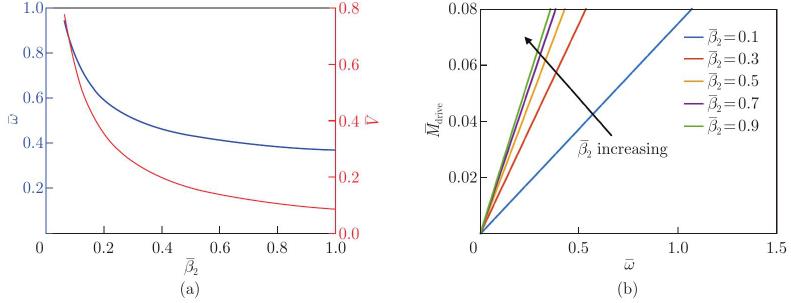
Fig. 9
Effects of damping coefficient of blade on self-propulsion: (a) angular velocity ω¯ and self-propulsion speed V¯ versus damping coefficient of blade β¯1; (b) relationship between driving moment M¯drive and angular velocity ω¯ for different damping coefficients of blade β¯1. As damping coefficient of blade β¯1 increases, self-rotation angular velocity of LCE rod decreases while boat’s self-propulsion speed increases (color online)"
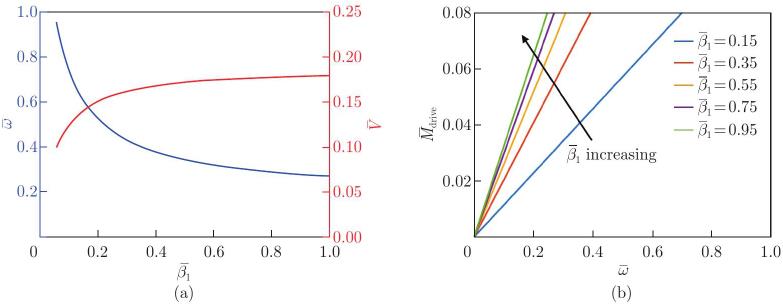
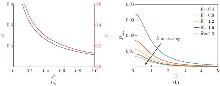
Fig. 10
Effects of radius on self-propulsion: (a) self-rotation angular velocity ω¯ and self-propulsion speed V¯ versus radius R¯; (b) relationship curve between driving moment M¯drive and angular velocity ω¯ for different radii R¯. As radius R¯ increases, self-rotation angular velocity and self-propulsion speed decrease (color online)"

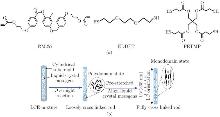
Fig. 11
Fabrication of LCE rod: (a) chemical structure of components; (b) process flow for preparing monodomain LCE rod via two-stage mercaptoacrylate Michael addition and photopolymerization[80]. The process commences with loose cross-linking of mixture using cylindrical mold, followed by complete cross-linking through uniaxial stretching and UV irradiation (color online)"
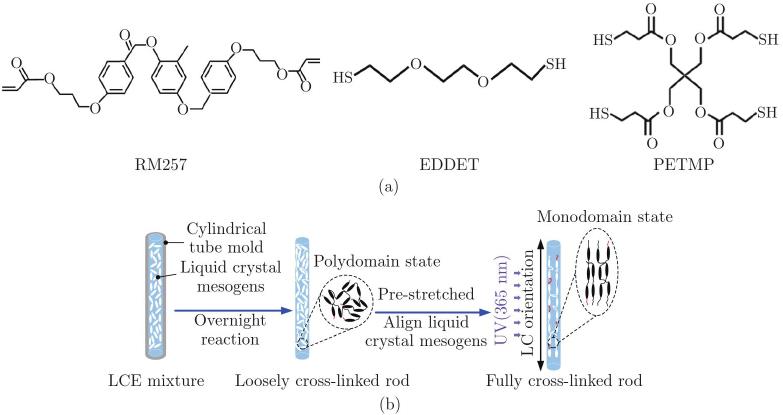
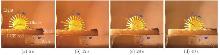
Fig. 12
Light-powered self-propelling of LCE-based boat (see Video S1 of electronic supplementary material, https://doi.org/10.1007/s10483-026-3378-8). LCE rod self-rotates under static light and actuates blade, propelling boat to move forward (color online)"

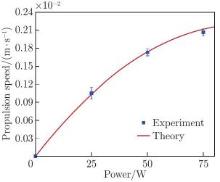
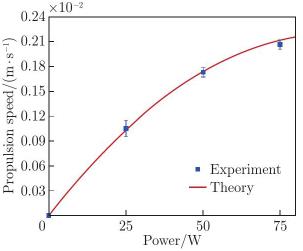
Fig. 13
Dependence of steady-state self-propulsion speed on light power. Self-propulsion speed increases monotonically with light power, in good agreement with theoretical predictions (color online)"
| [34] | ZHAO, J., ZHANG, Z. R., SUN, X. D., ZUO, W., and LI, K. Multi-modal self-sustained motions of a silicone oil paper disc on a surface driven by hot steam. Chaos, Solitons & Fractals, 191, 115898 (2025) |
| [35] | ZHAO, H. Y., CHEN, Z. K., LI, J. H., LUO, Y. W., PENG, Z. K., MAO, G. Y., XIAO, R., and MAO, J. Spatiotemporally programmed dielectric liquid crystal elastomer: electro-reversible 3D morphing via inverse 4D printing. Science Advances, 11, eaeb2289 (2025) |
| [36] | FAN, K. Q., WANG, C. Y., CHEN, C. G., ZHANG, Y., WANG, P. H., and WANG, F. A pendulum-plucked rotor for efficient exploitation of ultralow-frequency mechanical energy. Renewable Energy, 179, 339–350 (2021) |
| [37] | LUO, A. X., ZHANG, Y. L., DAI, X. T., WANG, Y. F., XU, W. H., LU, Y., WANG, M., FAN, K. Q., and WANG, F. An inertial rotary energy harvester for vibrations at ultra-low frequency with high energy conversion efficiency. Applied Energy, 279, 115762 (2020) |
| [38] | XU, P. B., ZHU, H. W., ZHOU, K., REN, X. L., and ZHOU, L. Self-sustained chaotic warning indicator system based on liquid crystal elastomer. Chaos, Solitons & Fractals, 206, 117984 (2026) |
| [39] | WANG, X. C., LI, L. L., ZHAO, J., and DAI, Y. T. Scallop-inspired self-oscillating actuator via liquid crystal elastomer fibers. Chaos, Solitons & Fractals, 202, 117620 (2026) |
| [40] | GE, D. L. and YANG, Q. C. Light-powered self-sustained jumper via splay-aligned liquid crystal elastomer. Chaos, Solitons & Fractals, 206, 117918 (2026) |
| [41] | SUN, X. D. and ZHAO, J. Photomechanical self-oscillation of a bifilar pendulum with liquid crystal elastomeric fiber. Chaos, Solitons & Fractals, 205, 117838 (2026) |
| [42] | ZHOU, L., CHEN, H. M., LI, Z. H., CHEN, X. H., GAO, T., and GE, D. L. Self-oscillation of a photo-actuated dual-beam system under linear optical excitation. Chaos, Solitons & Fractals, 204, 117740 (2026) |
| [43] | XU, P. B., REN, X. L., ZHU, H. W., and YU, Y. Development of a self-sustained chaotic stirrer with electrothermal response liquid crystal elastomers. Chaos, Solitons & Fractals, 203, 117656 (2026) |
| [44] | FANG, X., LOU, J., WANG, J., CHUANG, K. C., WU, H. M., and HUANG, Z. L. A self-excited bistable oscillator with a light-powered liquid crystal elastomer. International Journal of Mechanical Sciences, 271, 109124 (2024) |
| [45] | CHEN, J. J., YE, Q., HU, Z. J., WANG, X. R., and ZHOU, X. G. Jellyfish-inspired non-reciprocal light-fueled self-propelling liquid crystal elastomer-based fluidic saucer. Chaos, Solitons & Fractals, 206, 117889 (2026) |
| [46] | LI, K., WU, H. Y., LIU, Y. F., DAI, Y. T., and YU, Y. Self-swaying of oblique bending cantilevers under steady illumination. European Journal of Mechanics A/Solids, 103, 105187 (2024) |
| [47] | WANG, X. C., DAI, Y. T., and ZHAO, J. Light-driven self-swing of a liquid crystal elastomer fiber-based composite pendulum in magnetic field. Chaos, Solitons & Fractals, 202, 117570 (2026) |
| [48] | WU, H. Y., GE, D. L., QIU, Y. L., LI, K., and XU, P. B. Mechanics of light-fueled bidirectional self-rolling in a liquid crystal elastomer rod on a track. Chaos, Solitons & Fractals, 191, 115901 (2025) |
| [49] | SUN, X., ZHOU, K., and XU, P. B. Chaotic self-beating of left ventricle modeled by liquid crystal elastomer. Thin-Walled Structures, 205, 112540 (2024) |
| [50] | DENG, Z. X., LI, K., PRIIMAGI, A., and ZENG, H. Light-steerable locomotion using zero-elastic-energy modes. Nature Materials, 23, 1728–1735 (2024) |
| [51] | LI, K., XU, P. S., and ZHOU, L. Light-fueled self-rotation of a liquid crystal elastomer rod enabled by lateral constraint. Theoretical and Applied Mechanics Letters, 15, 100569 (2025) |
| [52] | DAI, L., XU, J. W., and XIAO, R. Modeling the stimulus-responsive behaviors of fiber-reinforced soft materials. International Journal of Applied Mechanics, 16, 2450041 (2024) |
| [53] | NIE, Z. Z., WANG, M., HUANG, S., LIU, Z. Y., and YANG, H. Multimodal self-sustainable autonomous locomotions of light-driven Seifert ribbon actuators based on liquid crystal elastomers. Angewandte Chemie International Edition, 62, e202304081 (2023) |
| [54] | QIU, Y. L., DAI, Y. T., and LI, K. Multimodal self-operation of a liquid crystal elastomer spring-linkage mechanism under constant light. International Journal of Solids and Structures, 302, 112998 (2024) |
| [55] | CHEN, J. J., QIU, Y. L., ZHOU, X. G., GE, D. L., and LI, K. Impatiens-inspired self-sustained photo-ejector with liquid crystal elastomer shell. Thin-Walled Structures, 219, 114312 (2025) |
| [1] | KRUSE, K. and JÜLICHER, F. Oscillations in cell biology. Current Opinion in Cell Biology, 17, 20–26 (2005) |
| [2] | LIAO, W. and YANG, Z. Q. The integration of sensing and actuating based on a simple design fiber actuator towards intelligent soft robots. Advanced Materials Technologies, 7, 2101260 (2022) |
| [3] | GE, D. L., BAO, W., LI, K., and LIANG, H. Y. Self-oscillation-driven locomotion in a liquid crystal elastomer-based robot under constant illumination. Communications in Nonlinear Science and Numerical Simulation, 145, 108706 (2025) |
| [4] | BAI, C. P., KANG, J. T., and WANG, Y. Q. Light-induced motion of three-dimensional pendulum with liquid crystal elastomeric fiber. International Journal of Mechanical Sciences, 266, 108911 (2024) |
| [5] | LIU, J. Q., XU, L. C., JI, Q. X., CHANG, L. F., HU, Y., PENG, Q. Y., and HE, X. D. A mxene-based light-driven actuator and motor with self-sustained oscillation for versatile applications. Advanced Functional Materials, 34, 2310955 (2024) |
| [6] | XU, P. B., ZHANG, J. H., ZHOU, K., WANG, M. H., and HU, W. F. Self-sustaining chaotic characteristics of liquid crystal elastomer pendulum under different linear temperature fields. Chaos, Solitons & Fractals, 205, 117812 (2026) |
| [7] | GE, D. L., BAO, W., CHEN, H. M., and LI, K. A liquid crystal elastomer-based generator using light-powered self-oscillations. Chaos, Solitons & Fractals, 199, 116690 (2025) |
| [8] | QIU, Y. L. and LI, K. Light-powered self-striking liquid crystal elastomer hammers inspired by mantis shrimp. Communications in Nonlinear Science and Numerical Simulation, 146, 108802 (2025) |
| [9] | LI, Z. H., XIA, D., KANG, S. Z., LI, Y., and LI, T. A comparative study of multi-tentacled underwater robot with different self-steering behaviors: maneuvering and cruising modes. Physics of Fluids, 36, 115118 (2024) |
| [10] | LI, Z. H., XIA, D., LEI, M., and YAN, H. Numerical investigation on self-propelled hydrodynamics of squid-like multiple tentacles with synergistic expansion. Ocean Engineering, 287, 115808 (2023) |
| [11] | GE, D. L., WEI, S. S., LIANG, Y. S., and LI, K. Snap-through self-peeling of liquid crystal elastomer bilayers under constant light. Thin-Walled Structures, 219, 114260 (2026) |
| [12] | YU, Y., QUAN, Y. Y., LI, T. Y., HUANG, C. Y., MA, H. H., and LI, K. Self-synchronization of a two-span liquid crystal elastomer continuous beam above a hot platform. Chaos, Solitons & Fractals, 202, 117528 (2026) |
| [13] | HE, Q. G., YIN, R., HUA, Y. C., JIAO, W. J., MO, C. Y., SHU, H., and RANEY, J. R. A modular strategy for distributed, embodied control of electronics-free soft robots. Science Advances, 9, eade 9247 (2023) |
| [14] | XU, P. B., ZHOU, K., SUN, X., and LI, K. Self-sustainable chaotic dynamics of a liquid crystal elastomer pendulum in radial linear temperature fields. Communications in Nonlinear Science and Numerical Simulation, 152, 109338 (2026) |
| [15] | LI, J. J., GUO, W. J., ZHAO, W. Q., ZHU, Y. T., BAI, J., XIA, Z. G., ZHOU, X., and LIU, Z. F. Recent advances in flexible self-oscillating actuators. eScience, 4, 100250 (2024) |
| [16] | LIAO, B., ZANG, H. B., CHEN, M. Y., WANG, Y. J., LANG, X., ZHU, N. N., YANG, Z., and YI, Y. Soft rod-climbing robot inspired by winding locomotion of snake. Soft Robotics, 7, 500–511 (2020) |
| [17] | HUANG, C. Y., YANG, F., LI, K., DAI, Y. T., and YU, Y. Modeling and analysis of self-sustaining oscillation behavior of liquid crystal elastomer fiber/baffle system under stable full-field illumination. Chaos, Solitons & Fractals, 194, 116259 (2025) |
| [18] | ZHAO, D. and LIU, Y. A prototype for light-electric harvester based on light sensitive liquid crystal elastomer cantilever. Energy, 198, 117351 (2020) |
| [19] | YU, Y., HUANG, C. Y., LIU, C. Y., WANG, Z. J., MA, H. H., and XU, P. B. Heat-driven self-wobbling of a liquid crystal elastomer double-wheel linkage. Thin-Walled Structures, 217, 113829 (2025) |
| [20] | LI, K., ZHAO, C. F., QIU, Y. L., and DAI, Y. T. Light-powered self-rolling of a liquid crystal elastomer-based dicycle. Applied Mathematics and Mechanics (English Edition), 46(2), 253–268 (2025) https://doi.org/10.1007/s10483-025-3221-8 |
| [21] | ZHOU, X. G., PENG, H. L., QIU, Y. L., and LI, K. Delayed oscillation of light-responsive hydrogel layers bonded to a rigid substrate under periodic illumination. Chaos, Solitons & Fractals, 202, 117445 (2026) |
| [22] | JU, X. K., KONG, J., QI, G. H., DUAN, X. Z., PENG, C., WANG, E. K., DONG, S. J., LI, J., and JIN, Y. D. Dual-function polyionic liquid piezoelectric hydrogel: combining antibacterial activity and electrical stimulation for infected wound treatment. Journal of Colloid and Interface Science, 700, 138317 (2025) |
| [23] | PAI, Y. H., XU, C., ZHU, R. Y., DING, X. Y., BAI, S. Q., LIANG, Z. Q., and CHEN, L. D. Piezoelectric-augmented thermoelectric ionogels for self-powered multimodal medical sensors. Advanced Materials, 37, 2414663 (2025) |
| [56] | WANG, Y. C., LIU, J. Q., and YANG, S. Multi-functional liquid crystal elastomer composites. Applied Physics Reviews, 9(1), 011301 (2022) |
| [57] | KIM, H., SUNDARAM, S., KANG, J. H., TANJEEM, N., EMRICK, T., and HAYWARD, R. C. Coupled oscillation and spinning of photothermal particles in Marangoni optical traps. Proceedings of the National Academy of Sciences of the United States of America, 118, 2024581118 (2021) |
| [58] | WANG, Y. C., YIN, R., JIN, L. S., LIU, M. Z., GAO, Y. C., RANEY, J., and YANG, S. 3D-printed photoresponsive liquid crystal elastomer composites for free-form actuation. Advanced Functional Materials, 33, 2210614 (2023) |
| [59] | LI, K., CHEN, Z. F., and XU, P. B. Light-propelled self-sustained swimming of a liquid crystal elastomer torus at low Reynolds number. International Journal of Mechanical Sciences, 219, 107128 (2022) |
| [60] | YU, Y., ZHOU, L., DU, C. S., ZHU, F. Y., DAI, Y. T., GE, D. L., and LI, K. Self-galloping of a liquid crystal elastomer catenary cable under a steady temperature field. Thin-Walled Structures, 202, 112071 (2024) |
| [61] | ZHAO, J., DAI, C. F., DAI, Y. T., WU, J., and LI, K. Self-oscillation of cantilevered silicone oil paper sheet system driven by steam. Thin-Walled Structures, 203, 112270 (2024) |
| [62] | GE, D. L. and LI, K. Self-oscillating buckling and postbuckling of a liquid crystal elastomer disk under steady illumination. International Journal of Mechanical Sciences, 221, 107233 (2022) |
| [63] | ZHOU, L., DU, C. S., WANG, W., and LI, K. A thermally-responsive fiber engine in a linear temperature field. International Journal of Mechanical Sciences, 225, 107391 (2022) |
| [64] | ZHU, L. R., HE, M. Q., CHEN, B. H., QIAN, J., and XIAO, R. Inflation of a polydomain nematic elastomeric membrane. Journal of the Mechanics and Physics of Solids, 198, 106075 (2025) |
| [65] | YU, Y., LIU, F. F., HUANG, C. Y., and LI, K. Self-swing of a thermo-responsive L-shaped rod partially resting on a hot plate. Thin-Walled Structures, 221, 114464 (2026) |
| [66] | DAI, L., WANG, L. Q., CHEN, B. H., XU, Z. T., WANG, Z. J., and XIAO, R. Shape memory behaviors of 3D printed liquid crystal elastomers. Soft Science, 3, 5 (2023) |
| [67] | BAI, C. P., KANG, J. T., and WANG, Y. Q. Kirigami-inspired light-responsive conical spiral actuators with large contraction ratio using liquid crystal elastomer fiber. ACS Applied Materials & Interfaces, 17, 14488–14498 (2025) |
| [68] | KANG, J. T., BAI, C. P., and WANG, Y. Q. Tunable energy absorption characteristics of 3D-printed anisotropic liquid crystal elastomers. ACS Applied Polymer Materials, 7, 14497–14507 (2025) |
| [69] | YANG, L. L., CHANG, L. F., HU, Y., HUANG, M. J., JI, Q. X., LU, P., LIU, J. Q., CHEN, W., and WU, Y. C. An autonomous soft actuator with light-driven self-sustained wavelike oscillation for phototactic self-locomotion and power generation. Advanced Functional Materials, 30, 1908842 (2020) |
| [70] | OLHAN, S., ANTIL, B., MAIMÍ, P., and BEHERA, B. K. Advances in 4D printing of polymeric composite smart materials. Composite Structures, 377, 119859 (2026) |
| [71] | ZHANG, M., LU, X. X., YE, T. T., HU, H. D., SCARBROUGH, J. P., WANG, R., YAO, Y. X., LI, S. C., and WANG, X. G. Liquid crystal elastomers for solar, mechanical, thermal, and electrochemical energy applications. Journal of Materials Chemistry A, 14, 3185–3209 (2026) |
| [72] | FENG, C. R., RAJAPAKSHA, C. P. H., and JAKLI, A. Ionic elastomers for electric actuators and sensors. Engineering, 7, 581–602 (2021) |
| [73] | SU, J. T., HE, K., LI, Y. Z., TU, J. Q., and CHEN, X. D. Soft materials and devices enabling sensorimotor functions in soft robots. Chemical Reviews, 125, 5848–5977 (2025) |
| [74] | SHI, P. J., CHEN, C., WANG, Z., HONG, W., DUAN, S. D., LIU, Z. X., HOU, W. H., SI, M. Q., ZHANG, C. W., and HE, X. M. Air plastron-enabled heat management for enhanced photothermal actuation in underwater soft robots. Science Advances, 11, eadx7189 (2025) |
| [75] | BOOTHBY, J. M., GAGNON, J. C., MCDOWELL, E., VAN VOLKENBURG, T., CURRANO, L., and XIA, Z. Y. An untethered soft robot based on liquid crystal elastomers. Soft Robotics, 9, 154–162 (2022) |
| [76] | WU, H. Y., HOU, H. Y., QIU, Y. L., GE, D. L., and LI, K. Light-powered self-rolling liquid crystal elastomer rovers between two hollows. Communications in Nonlinear Science and Numerical Simulation, 156, 109723 (2026) |
| [77] | WEI, L., JIANG, X., HU, X. A., GE, D. L., and LI, K. Gravity-independent self-rolling of a photothermal liquid crystal elastomer rod for microgravity actuation. Communications in Nonlinear Science and Numerical Simulation, 157, 109764 (2026) |
| [78] | YANG, H. X., ZHANG, C., CHEN, B. H., WANG, Z. J., XU, Y., and XIAO, R. Bioinspired design of stimuli-responsive artificial muscles with multiple actuation modes. Smart Materials and Structures, 32, 085023 (2023) |
| [24] | PANDA, S., HAJRA, S., MISTEWICZ, K., IN-NA, P., SAHU, M., RAJAITHA, P. M., and KIM, H. J. Piezoelectric energy harvesting systems for biomedical applications. Nano Energy, 100, 107514 (2022) |
| [25] | ZHOU, H. L., ZHANG, Y., QIU, Y., WU, H. P., QIN, W. Y., LIAO, Y. B., YU, Q. M., and CHENG, H. Y. Stretchable piezoelectric energy harvesters and self-powered sensors for wearable and implantable devices. Biosensors and Bioelectronics, 168, 112569 (2020) |
| [26] | WANG, Y. C., DANG, A. L., ZHANG, Z. F., YIN, R., GAO, Y. C., FENG, L., and YANG, S. Repeatable and reprogrammable shape morphing from photoresponsive gold nanorod/liquid crystal elastomers. Advanced Materials, 32, 2004270 (2020) |
| [27] | SUN, J. H., WANG, Y. P., LIAO, W., and YANG, Z. Q. Ultrafast, high-contractile electrothermal-driven liquid crystal elastomer fibers towards artificial muscles. Small, 17, 2103700 (2021) |
| [28] | XU, Z. T., CHEN, Y. Z., ZHU, L. R., GE, Q., WU, Z. L., QU, S. X., and XIAO, R. Tailored helix morphing of 3D-printed liquid crystal elastomer bilayers. Cell Reports Physical Science, 6, 102835 (2025) |
| [29] | YANG, H. X., YIN, X. F., ZHANG, C., CHEN, B. H., SUN, P., and XU, Y. Weaving liquid crystal elastomer fiber actuators for multifunctional soft robotics. Science Advances, 11, eads3058 (2025) |
| [30] | BAI, C. P., KANG, J. T., and WANG, Y. Q. Light-induced wrinkling in annulus anisotropic liquid crystal elastomer films. Physical Review E, 111, 015421 (2025) |
| [31] | KANG, J. T., BAI, C. P., LIU, S. X., and JIA, Y. G. Light-induced nontethered rolling of liquid crystal elastomer and carbon nanotube composite ring. ACS Applied Polymer Materials, 6, 2709–2718 (2024) |
| [32] | SUN, X., ZHOU, K., CHEN, Y. Q., GAO, J. F., and XU, P. B. Self-oscillation chaotic motion of a liquid crystal elastomer pendulum under gradient-stabilized illumination. Chaos, Solitons & Fractals, 193, 116128 (2025) |
| [33] | KANG, W. D., CHENG, Q., LIU, C. Y., WANG, Z. J., LI, D. F., and LIANG, X. D. A constitutive model of monodomain liquid crystal elastomers with the thermal-mechanical-nematic order coupling. Journal of the Mechanics and Physics of Solids, 196, 105995 (2025) |
| [79] | BAUMANN, A., SÁNCHEZ-FERRER, A., JACOMINE, L., MARTINOTY, P., LE HOUEROU, V., ZIEBERT, F., and KULIĆ, I. M. Motorizing fibres with geometric zero-energy modes. Nature Materials, 17, 523–527 (2018) |
| [80] | LIANG, H., LIU, Y. W., XU, H. T., YANG, Y., HE, E. J., YANG, Z. J., WEI, Y., and JI, Y. Thiol-acrylate catalyst enabled post-synthesis fabrication of liquid crystal actuators. Chinese Journal of Polymer Science, 41, 1656–1662 (2023) |
| [1] | Xingui ZHOU, Zhuangzhuang ZHANG, Zuhao LI, Junjie CHEN, Kai LI. A bistable liquid crystal elastomer self-oscillator with hysteretic optical occlusion [J]. Applied Mathematics and Mechanics (English Edition), 2026, 47(8): 1669-1690. |
| [2] | Hefan DONG, Linjuan WANG. Locally resonant plate model considering the rotation coupling effect [J]. Applied Mathematics and Mechanics (English Edition), 2026, 47(2): 369-388. |
| [3] | Tao CHEN, Tianshu LIU. Physical structures of boundary fluxes of orbital rotation and spin for incompressible viscous flow [J]. Applied Mathematics and Mechanics (English Edition), 2025, 46(4): 745-762. |
| [4] | Kai LI, Chongfeng ZHAO, Yunlong QIU, Yuntong DAI. Light-powered self-rolling of a liquid crystal elastomer-based dicycle [J]. Applied Mathematics and Mechanics (English Edition), 2025, 46(2): 253-268. |
| [5] | Weicong ZHANG, Zengting XU, Baihong CHEN, Xiangren KONG, Rui XIAO, Jin QIAN. Mechanical design of stimuli-responsive flexible rotary joint using liquid crystal elastomers [J]. Applied Mathematics and Mechanics (English Edition), 2025, 46(12): 2221-2240. |
| [6] | Min WANG, Shaopu YANG, Yongqiang LIU, Yanhong CHEN, Kai ZHANG. Establishment of the thermo-mechanical coupling model of axle box bearings with track irregularity excitation and analysis of its temperature characteristics [J]. Applied Mathematics and Mechanics (English Edition), 2024, 45(11): 1965-1986. |
| [7] | Zhiyuan WU, Linchuan ZHAO, Han YAN, Ge YAN, Ao CHEN, Wenming ZHANG. Multi-blade rubbing characteristics of the shaft-disk-blade-casing system with large rotation [J]. Applied Mathematics and Mechanics (English Edition), 2024, 45(1): 111-136. |
| [8] | Yunfei LIU, Jun WANG, Jiaxin HU, Zhaoye QIN, Fulei CHU. Multiple internal resonances of rotating composite cylindrical shells under varying temperature fields [J]. Applied Mathematics and Mechanics (English Edition), 2022, 43(10): 1543-1554. |
| [9] | P. SINGH, A. K. SINGH, A. CHATTOPADHYAY. Reflection of three-dimensional plane waves at the free surface of a rotating triclinic half-space under the context of generalized thermoelasticity [J]. Applied Mathematics and Mechanics (English Edition), 2021, 42(9): 1363-1378. |
| [10] | A. E. ABOUELREGAL. Magnetophotothermal interaction in a rotating solid cylinder of semiconductor silicone material with time dependent heat flow [J]. Applied Mathematics and Mechanics (English Edition), 2021, 42(1): 39-52. |
| [11] | K. LOTFY, A. K. KHAMIS, A. A. EL-BARY, M. H. AHMED. Thomson and rotation effects during photothermal excitation process in magnetic semiconductor medium using variable thermal conductivity [J]. Applied Mathematics and Mechanics (English Edition), 2020, 41(6): 909-926. |
| [12] | S. M. ABO-DAHAB, A. M. ABD-ALLA, A. A. KILANY. Effects of rotation and gravity on an electro-magneto-thermoelastic medium with diffusion and voids by using the Lord-Shulman and dual-phase-lag models [J]. Applied Mathematics and Mechanics (English Edition), 2019, 40(8): 1135-1154. |
| [13] | Yun CUI, Yafei YIN, Chengjun WANG, K. SIM, Yuhang LI, Cunjiang YU, Jizhou SONG. Transient thermo-mechanical analysis for bimorph soft robot based on thermally responsive liquid crystal elastomers [J]. Applied Mathematics and Mechanics (English Edition), 2019, 40(7): 943-952. |
| [14] | Zhenhua XIA, Yipeng SHI, Qingdong CAI, Jie GAI. Dissipation function in turbulent plane Poiseuille and Couette flows subject to spanwise rotations [J]. Applied Mathematics and Mechanics (English Edition), 2019, 40(2): 185-192. |
| [15] | Zhigang ZHENG, Rubin WANG. Arm motion control model based on central pattern generator [J]. Applied Mathematics and Mechanics (English Edition), 2017, 38(9): 1247-1256. |
| Viewed | ||||||
|
Full text |
|
|||||
|
Abstract |
|
|||||





 Email Alert
 RSS
RSS