Applied Mathematics and Mechanics (English Edition) ›› 2026, Vol. 47 ›› Issue (2): 369-388.doi: https://doi.org/10.1007/s10483-026-3344-7
Previous Articles Next Articles
Hefan DONG1,2,3, Linjuan WANG1,2,3,†( )
)
Received:2025-07-24
Revised:2025-11-14
Online:2026-02-04
Published:2026-02-04
Contact:
Linjuan WANG, E-mail: wanglj@buaa.edu.cnSupported by:2010 MSC Number:
Hefan DONG, Linjuan WANG. Locally resonant plate model considering the rotation coupling effect. Applied Mathematics and Mechanics (English Edition), 2026, 47(2): 369-388.

Fig. 1
A phenomenon of rotation coupling: the torsional mode of the resonator is excited by the rotational motion of the host structure at certain frequencies"

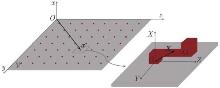
Fig. 2
Diagram of a locally resonant plate with general resonators (color online)"
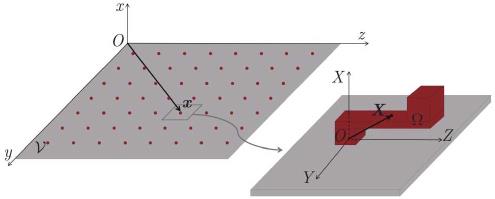
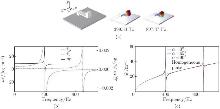
Fig. 3
Inherent characteristics of the locally resonant plate with cantilever resonators: (a) cantilever resonator and its first two vibrational modes; (b) the effective mass density me and effective rotational inertia densities jyye and jzze; (c) dispersion relations at different directions of wave spreading (color online)"
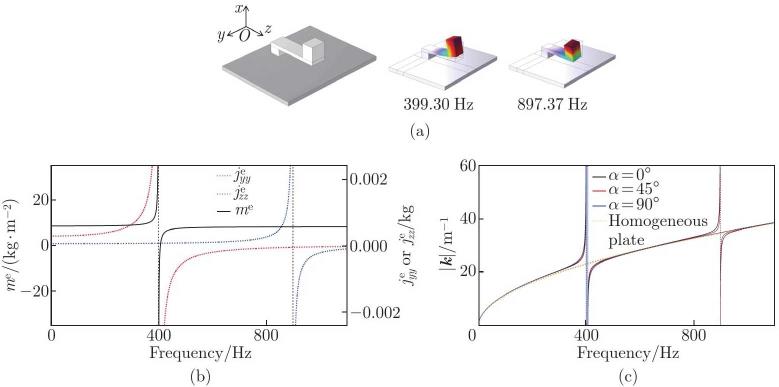
Table 1
Normalized coupling inertias of the cantilever resonator"
| Parameter | ||||||
|---|---|---|---|---|---|---|
| Value | 0.719 59 | 0.968 17 | 0.932 02 |
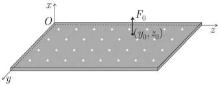
Fig. 4
Schematic diagram of the locally resonant plate under forced vibration"
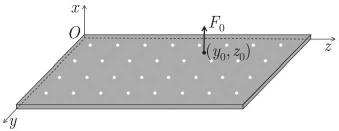
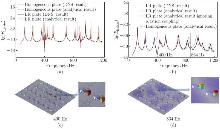
Fig. 5
Dynamic response of the locally resonant plate with cantilever resonators: (a) plate kinetic energy curves at the undamped case; (b) plate kinetic energy curves at the damped case (the curve ignoring the rotation coupling effect is plotted as the blue dotted line); (c) plate deformation when the excitation frequency is 400 Hz, corresponding to the first vertical black dashed line in Fig. 5(b) (the color indicates the magnitude of displacement); (d) plate deformation when the excitation frequency is 864 Hz, corresponding to the second vertical black dashed line in Fig. 5(b) (the LR plate represents the locally resonant plate) (color online)"
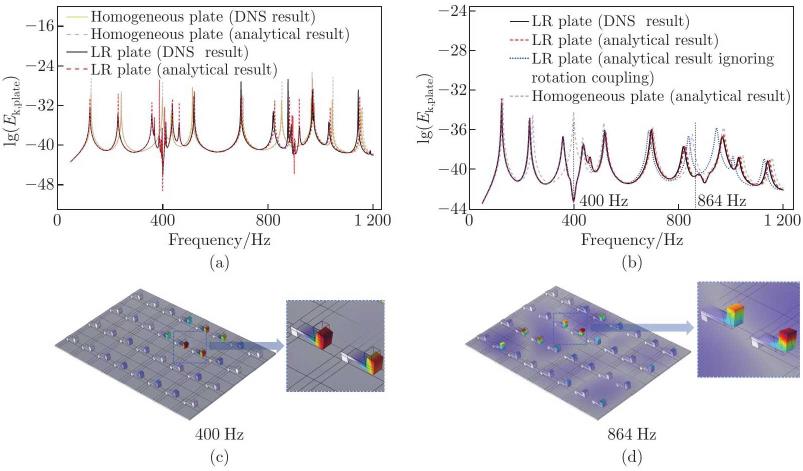
Fig. 6
Dynamic response of the locally resonant plate with multi-beam resonators: (a) vibrational modes of the multi-beam resonator in low-frequency range; (b) plate kinetic energy curves at the damped case (the results for the single-beam resonator locally resonant plate are also presented for comparison, and the result ignoring the rotation coupling effect is plotted as a blue dotted line); (c) deformation of the locally resonant plate when the excitation frequency is 460 Hz corresponding to the first vertical black dashed line in Fig. 6(b). The color indicates the magnitude of displacement; (d) deformation of the locally resonant plate when the excitation frequency is 960 Hz corresponding to the second vertical black dashed line in Fig. 6(b) (the MRL plate represents the multi-beam resonator locally resonant plate, and the SIR plate represents the single-beam resonator locally resonant plate) (color online)"
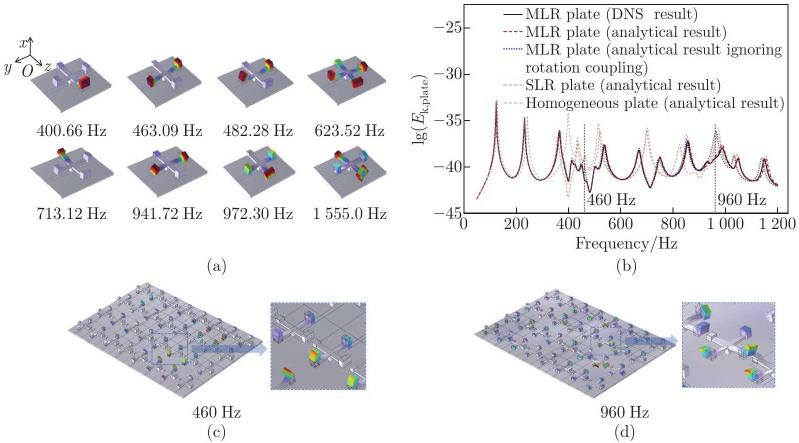
Table 2
Normalized coupling inertias of the multi-beam resonator"
| Parameter | Value | Parameter | Value | Parameter | Value |
|---|---|---|---|---|---|
| 0.414 24 | 0.790 89 | 0.898 17 | |||
| 0.596 99 | 0.084 292 | 0.130 83 | |||
| 0.383 78 | 0.435 73 | 0.242 28 | |||
| 0.024 479 | 0.323 98 | 0.167 28 |
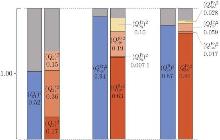
Fig. 7
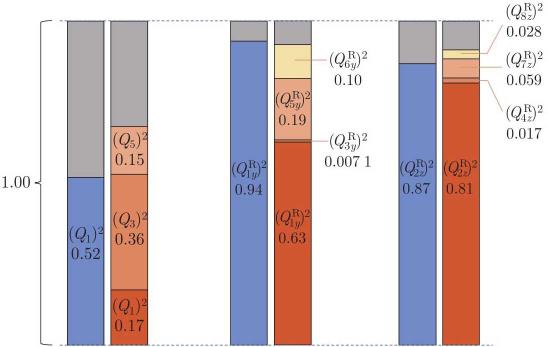
Values of square of the normalized coupling inertias: the first, second, and third columns are (Qk)2, (QkyR)2, and (QkzR)2, respectively. The left bar in each of the three columns is for the single-beam resonator, and the right is for the multi-beam resonator. The gray region on each bar is the sum of square of normalized coupling inertias corresponding to resonator modes out of the concerned frequency range (0–1 200 Hz). The total length of each bar is 1 according to Eq. (27) (color online)"
| [1] | KE, Y. B., YIN, J. F., HE, Y., ZHENG, Z. F., WANG, Q., GENG, X. M., YU, D. L., and WEN, J. H. Locally multi-resonant meta-shells for broadband vibration suppression. International Journal of Mechanical Sciences, 278, 109452 (2024) |
| [2] | PIRES, F. A., BOUKADIA, R. F., WANDEL, M., THOMAS, C., DECKERS, E., DESMET, W., and CLAEYS, C. Novel resonator concept for improved performance of locally resonant based metamaterials. Thin-Walled Structures, 209, 112866 (2025) |
| [3] | JANSSEN, S., VAN BELLE, L., DE MELO, N. G. R., DESMET, W., CLAEYS, C., and DECKERS, E. Improving the noise insulation performance of vibro-acoustic metamaterial panels through multi-resonant design. Applied Acoustics, 213, 109622 (2023) |
| [4] | HALIM, N. W., WU, T. Y., and WANG, S. J. Nested-mass locally resonant metabarriers for seismic wave mitigation. Engineering Structures, 341, 120792 (2025) |
| [5] | BURSI, O. S., BASONE, F., and WENZEL, M. Stochastic analysis of locally resonant linear and hysteretic metamaterials for seismic isolation of process equipment. Journal of Sound and Vibration, 510, 116263 (2021) |
| [6] | TIAN, W., ZHAO, T., and YANG, Z. C. Theoretical modelling and design of metamaterial stiffened plate for vibration suppression and supersonic flutter. Composite Structures, 282, 115010 (2022) |
| [7] | SHI, P. T., CHEN, Z. L., XU, Y. L., GU, Y. S., LIU, F., and YANG, Z. C. Dynamic stability of a lossy locally resonant metamaterial panel in supersonic flow. Thin-Walled Structures, 197, 111614 (2024) |
| [8] | HAO, Y. X., HUO, Y. J., and ZHANG, W. Locally resonant metamaterial plate with cantilever spiral beam-mass resonators and various piezoelectric defects for energy harvesting. Thin-Walled Structures, 213, 113259 (2025) |
| [9] | FURJAN, M., KOLAHCHI, R., and YAYLACI, M. Energy harvesting capabilities and bandgaps of locally resonant piezoelectric metamaterial panels with self-extraction synchronized circuit. Applied Mathematical Modelling, 141, 115934 (2025) |
| [10] | LIU, Z. Y., ZHANG, X. X., MAO, Y. W., ZHU, Y. Y., YANG, Z. Y., CHAN, C. T., and SHENG, P. Locally resonant sonic materials. Science, 289, 1734–1736 (2000) |
| [11] | PIRES, F. A., SANGIULIANO, L., DENAYER, H., DECKERS, E., DESMET, W., and CLAEYS, C. The use of locally resonant metamaterials to reduce flow-induced noise and vibration. Journal of Sound and Vibration, 535, 117106 (2022) |
| [12] | AMARAL, D. R., ICHCHOU, M. N., KOŁAKOWSKI, P., FOSSAT, P., and SALVIA, M. Lightweight gearbox housing with enhanced vibro-acoustic behavior through the use of locally resonant metamaterials. Applied Acoustics, 210, 109435 (2023) |
| [13] | DONG, W. K., HUANG, Z. K., WANG, T., and CHEN, M. X. Low-frequency vibration reduction of an underwater metamaterial plate excited by a turbulent boundary layer. Journal of Fluids and Structures, 126, 104103 (2024) |
| [14] | XIAO, Y., WEN, J. H., WANG, G., and WEN, X. S. Theoretical and experimental study of locally resonant and Bragg band gaps in flexural beams carrying periodic arrays of beam-like resonators. Journal of Vibration and Acoustics, 135, 041006 (2013) |
| [15] | XIAO, Y., WEN, J. H., HUANG, L. Z., and WEN, X. S. Analysis and experimental realization of locally resonant phononic plates carrying a periodic array of beam-like resonators. Journal of Physics D: Applied Physics, 47, 045307 (2014) |
| [16] | ZHAO, T., YANG, Z. C., XU, Y. L., and TIAN, W. Mode localization in metastructure with T-type resonators for broadband vibration suppression. Engineering Structures, 268, 114775 (2022) |
| [17] | BELI, D., FABRO, A. T., RUZZENE, M., and ARRUDA, J. R. F. Wave attenuation and trapping in 3D printed cantilever-in-mass metamaterials with spatially correlated variability. Scientific Reports, 9, 5617 (2019) |
| [18] | MIAO, Z., YIN, J. F., YANG, Y., KE, Y. B., ZHENG, Z. F., GENG, X. M., and WANG, Q. Design of multi-bandgap metamaterial plate based on composite cylindrical resonators. Materials & Design, 250, 113570 (2025) |
| [19] | CLAEYS, C., DECKERS, E., PLUYMERS, B., and DESMET, W. A lightweight vibro-acoustic metamaterial demonstrator: numerical and experimental investigation. Mechanical Systems and Signal Processing, 70-71, 853–880 (2016) |
| [20] | JIN, Y., SHI, Y., YU, G. C., WEI, G. T., HU, B., and WU, L. Z. A multifunctional honeycomb metastructure for vibration suppression. International Journal of Mechanical Sciences, 188, 105964 (2020) |
| [21] | PENG, H. and FRANK PAI, P. Acoustic metamaterial plates for elastic wave absorption and structural vibration suppression. International Journal of Mechanical Sciences, 89, 350–361 (2014) |
| [22] | MENG, Z. X., WANG, L. J., LI, Z., and WANG, J. X. A theoretical framework for joining multiple locally resonant bandgaps of metamaterials towards a super-wide bandgap. Composite Structures, 304, 116348 (2023) |
| [23] | JIA, Q., YU, D. L., HAN, D. H., and WEN, J. H. Lightweight multifunctional metamaterial with low-frequency vibroacoustic reduction and load-bearing performances. Applied Mathematics and Mechanics (English Edition), 46(3), 403–422 (2025) https://doi.org/10.1007/s10483-025-3231-6 |
| [24] | WANG, X. Z., RUI, S. T., YANG, S. K., ZHANG, W. Q., and MA, F. Y. A low-frequency pure metal metamaterial absorber with continuously tunable stiffness. Applied Mathematics and Mechanics (English Edition), 45(7), 1209–1224 (2024) https://doi.org/10.1007/s10483-024-3158-7 |
| [25] | ZHANG, Q., CHEN, Y., ZHANG, K., and HU, G. K. Dirac degeneracy and elastic topological valley modes induced by local resonant states. Physical Review B, 101, 014101 (2020) |
| [26] | CHEN, J. S., SHARMA, B., and SUN, C. T. Dynamic behaviour of sandwich structure containing spring-mass resonators. Composite Structures, 93(8), 2120–2125 (2011) |
| [27] | LI, Q. J. and SHENG, M. P. An improved method for bandgap calculation of a locally resonant plate with multi-periodic of multiple degree-of-freedom resonators. Journal of Applied Physics, 129(24), 245110 (2021) |
| [28] | STEIN, A., NOUH, M., and SINGH, T. Widening, transition and coalescence of local resonance band gaps in multi-resonator acoustic metamaterials: from unit cells to finite chains. Journal of Sound and Vibration, 523, 116716 (2022) |
| [29] | XIAO, Y., WEN, J. H., and WEN, X. S. Broadband locally resonant beams containing multiple periodic arrays of attached resonators. Physics Letters A, 376, 1384–1390 (2012) |
| [30] | CAI, C. Q., ZHU, C. J., ZHANG, F. Y., SUN, J. J., WANG, K., YAN, B., and ZHOU, J. X. Modeling and analysis of gradient metamaterials for broad fusion bandgaps. Applied Mathematics and Mechanics (English Edition), 45(7), 1155–1170 (2024) https://doi.org/10.1007/s10483-024-3154-6 |
| [31] | CUI, J. G., YANG, T. Z., HAN, W. J., LI, L., NIU, M. Q., and CHEN, L. Q. Tunable topological interface states via a parametric system in composite lattices with/without symmetric elements. Applied Mathematics and Mechanics (English Edition), 45(7), 2055–2074 (2024) https://doi.org/10.1007/s10483-024-3194-9 |
| [32] | WANG, T., GUO, H. B., CHEN, M. X., and DONG, W. K. Theoretical modeling and analysis of vibroacoustic characteristics of an acoustic metamaterial plate. Acta Mechanica Solida Sinica, 35(12), 775–786 (2022) |
| [33] | QIANG, C. X., HAO, Y. X., ZHANG, W., LI, J. Q., YANG, S. W., and CAO, Y. T. Bandgaps and vibration isolation of local resonance sandwich-like plate with simply supported overhanging beam. Applied Mathematics and Mechanics (English Edition), 42(11), 1555–1570 (2021) https://doi.org/10.1007/s10483-021-2790-7 |
| [34] | IGUSA, T., ACHENBACH, J. D., and MIN, K. W. Resonance characteristics of connected subsystems: theory and simple configurations. Journal of Sound and Vibration, 146(3), 407–421 (1991) |
| [35] | TIMOSHENKO, S. and WOINOWSKY-KRIEGER, S. Theory of Plates and Shells, McGraw-Hill, New York, 88 (1959) |
| [1] | M. H. BAE, J. H. PARK, C. S. PARK, H. LEE, H. M. SEUNG. Inherent nonreciprocity in double-alternatingnonlinear metamaterial [J]. Applied Mathematics and Mechanics (English Edition), 2026, 47(7): 1487-1510. |
| [2] | Tai REN, Xiuhui HOU, Tingting WANG, Zhiwei ZHU, Kai ZHANG, Zichen DENG. Topological transition enabled by composite symmetry-breaking paths in trefoil-knot honeycomb lattices [J]. Applied Mathematics and Mechanics (English Edition), 2026, 47(3): 497-508. |
| [3] | Qian GENG, Xing ZHOU, Mengyang WANG, Xiongwei YANG, Zhushan SHAO, Yueming LI. Thermal stability design for flexural wave bandgap of metamaterial plates with perforated and pre-curved patterns [J]. Applied Mathematics and Mechanics (English Edition), 2026, 47(3): 443-472. |
| [4] | Weidi XIA, Hongxing LI, Guotao ZHA, Fulin GUO, Chongrui LIU, Fuyin MA. Lightweight integrated sound absorbing-insulating metamaterials with low thickness [J]. Applied Mathematics and Mechanics (English Edition), 2026, 47(2): 215-234. |
| [5] | Siyu REN, Yijun CHAI, Xiongwei YANG. Multistable locally resonant elastic metamaterial with tunable anisotropy [J]. Applied Mathematics and Mechanics (English Edition), 2025, 46(9): 1663-1678. |
| [6] | C. C. PARRA, R. VENEGAS, T. G. ZIELIŃSKI. Acoustic wave propagation in double-porosity permeo-elastic media [J]. Applied Mathematics and Mechanics (English Edition), 2025, 46(8): 1511-1532. |
| [7] | Youjiang CUI, Zhihui XU, Que ZHOU, Baolin WANG, Kaifa WANG, Biao WANG. Effective elastic modulus and energy absorption performance evaluations of a novel re-entrant chiral hybrid honeycomb [J]. Applied Mathematics and Mechanics (English Edition), 2025, 46(5): 781-794. |
| [8] | Qi JIA, Dianlong YU, Donghai HAN, Jihong WEN. Lightweight multifunctional metamaterial with low-frequency vibroacoustic reduction and load-bearing performances [J]. Applied Mathematics and Mechanics (English Edition), 2025, 46(3): 403-422. |
| [9] | Shuai MO, Xu TANG, Keren CHEN, H. HOUJOH, Wei ZHANG. Continuously adjustable mechanical metamaterial based on planetary gear trains and external meshing gears [J]. Applied Mathematics and Mechanics (English Edition), 2025, 46(2): 233-252. |
| [10] | Yongzhe LI, Yongqiang LI, Gaoge LIANG, Quanxing LIU, Yong XIAO. Single-phase multi-resonant metabeam for broadband reduction of multi-polarization low-frequency vibration [J]. Applied Mathematics and Mechanics (English Edition), 2025, 46(12): 2265-2280. |
| [11] | Wei CHEN, Zhihong TANG, Yufen LIAO, Linxin PENG. A six-variable quasi-3D isogeometric approach for free vibration of functionally graded graphene origami-enabled auxeticmetamaterial plates submerged in a fluid medium [J]. Applied Mathematics and Mechanics (English Edition), 2025, 46(1): 157-176. |
| [12] | Fan YANG, Zhaoyang MA, Xingming GUO. Bandgap characteristics analysis and graded design of a novel metamaterial for flexural wave suppression [J]. Applied Mathematics and Mechanics (English Edition), 2025, 46(1): 1-24. |
| [13] | Shuo WANG, Anshuai WANG, Yansen WU, Xiaofeng LI, Yongtao SUN, Zhaozhan ZHANG, Qian DING, G. D. AYALEW, Yunxiang MA, Qingyu LIN. Ultra-wide band gap and wave attenuation mechanism of a novel star-shaped chiral metamaterial [J]. Applied Mathematics and Mechanics (English Edition), 2024, 45(7): 1261-1278. |
| [14] | Long ZHAO, Zeqi LU, Hu DING, Liqun CHEN. A viscoelastic metamaterial beam for integrated vibration isolation and energy harvesting [J]. Applied Mathematics and Mechanics (English Edition), 2024, 45(7): 1243-1260. |
| [15] | Zhou HU, Zhibo WEI, Yan CHEN, Rui ZHU. Reconfigurable mechanism-based metamaterials for ternary-coded elastic wave polarizers and programmable refraction control [J]. Applied Mathematics and Mechanics (English Edition), 2024, 45(7): 1225-1242. |
| Viewed | ||||||
|
Full text |
|
|||||
|
Abstract |
|
|||||





 Email Alert
 RSS
RSS