Applied Mathematics and Mechanics (English Edition) ›› 2026, Vol. 47 ›› Issue (2): 215-234.doi: https://doi.org/10.1007/s10483-026-3352-6
Weidi XIA1, Hongxing LI1, Guotao ZHA2, Fulin GUO2, Chongrui LIU1, Fuyin MA1,†( )
)
Received:2025-09-26
Revised:2025-12-05
Online:2026-02-04
Published:2026-02-04
Contact:
Fuyin MA, E-mail: xjmafuyin@xjtu.edu.cnSupported by:2010 MSC Number:
Weidi XIA, Hongxing LI, Guotao ZHA, Fulin GUO, Chongrui LIU, Fuyin MA. Lightweight integrated sound absorbing-insulating metamaterials with low thickness. Applied Mathematics and Mechanics (English Edition), 2026, 47(2): 215-234.
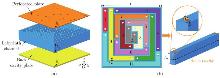
Fig. 1
The labyrinth-type integrated sound absorbing-insulating metamaterial and its basic constituent units: (a) overall schematic diagram of the labyrinth-type metamaterial; (b) schematic diagram of the labyrinth channel cavity surface and the basic unit of spatial transfer (color online)"
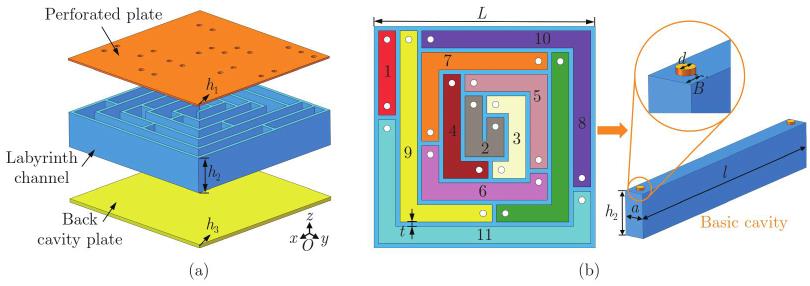
Fig. 2
The basic structural unit of the multi-order resonator integrated sound absorbing-insulating metamaterial: (a) 2nd-order resonator unit; (b) 3rd-order resonator unit (color online)"
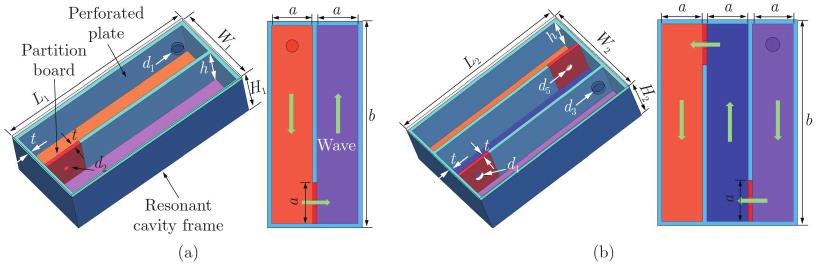
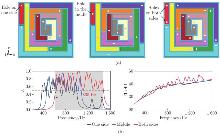
Fig. 3
Effects of perforations on the performance of labyrinth-type integrated metamaterials: (a) schematic diagrams of metamaterial surfaces with a hole on one side, a hole in the middle, and holes on both sides; (b) curves of sound absorption coefficient (A) and TL (color online)"
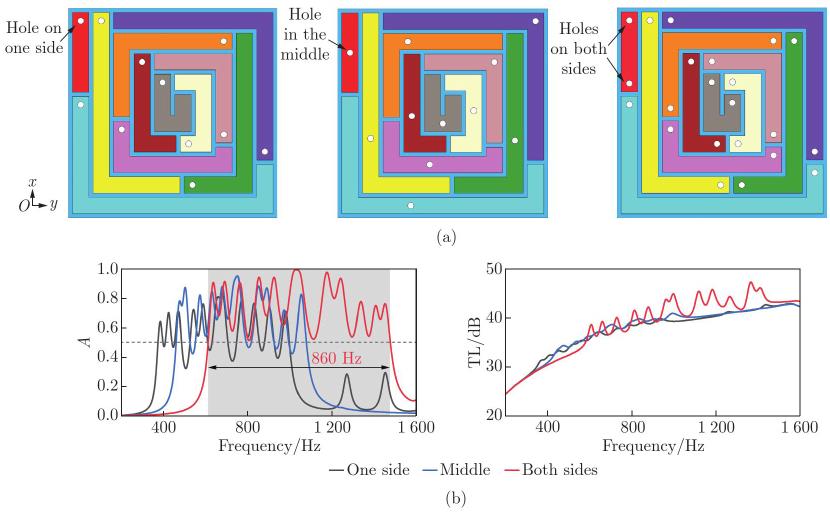
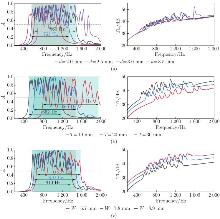
Fig. 4
Sound absorption coefficient (A) and TL curves of the labyrinth-type metamaterial under different structural parameters: (a) effect of hole diameter d; (b) effect of structural thickness T; (c) effect of cavity width W (color online)"
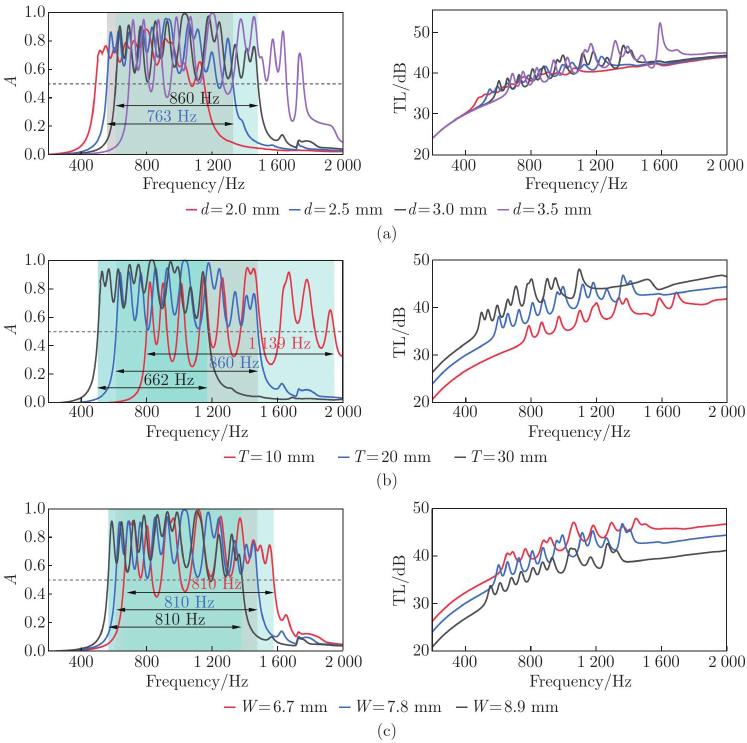
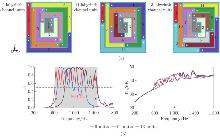
Fig. 5
Effects of channel number on the performance of labyrinth-type integrated metamaterials: (a) labyrinth-type metamaterials with 9, 11, and 13 labyrinth channel units; (b) curves of sound absorption coefficient (A) and TL under different numbers of channel units (color online)"
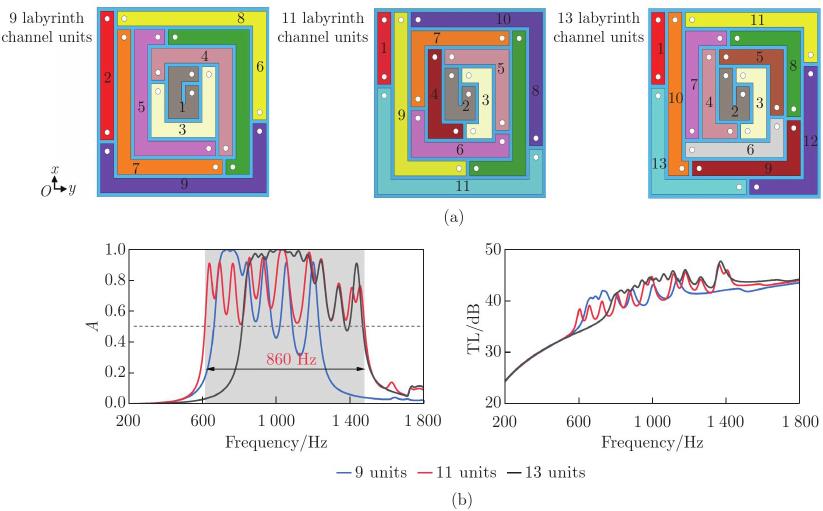
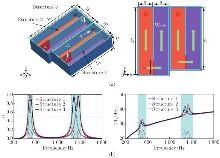
Fig. 6
Integrated structure composed of two 2nd-order resonator structures with different channel lengths: (a) schematic diagram of the coupled structure, where Structures 1 and 2 are 2nd-order resonators, and Structure 3 is an integrated structure; (b) comparison curves of sound absorption coefficient (A) and TL for Structures 1, 2, and 3 (color online)"
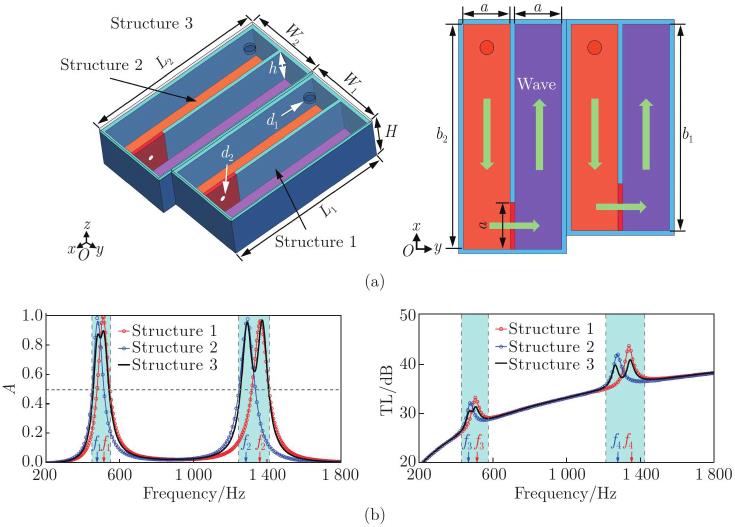
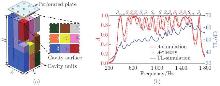
Fig. 7
Multi-order resonator integrated sound absorbing-insulating metamaterial and its performance: (a) schematic diagram of the metamaterial composed of 9 resonant cavity units of 1st-, 2nd-, and 3rd-orders; (b) sound absorption coefficient (A) of the metamaterial (simulation: red curve; theory: red circle) and simulated TL (blue curve) (color online)"
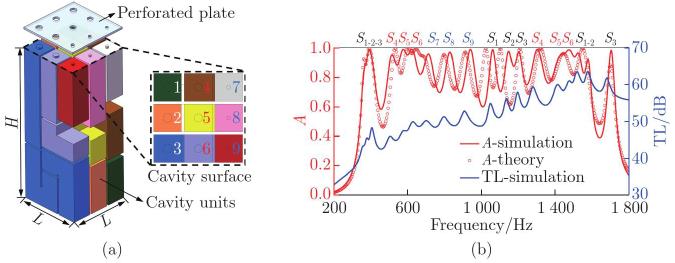
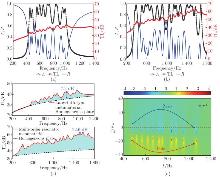
Fig. 8
Analysis on the sound absorption and insulation mechanisms of the labyrinth-type integrated metamaterial and multi-order resonator integrated metamaterial: (a) and (b) A, TL, and R curves; (c) TL results of labyrinth-type metamaterial (upper red line), multi-order resonator metamaterial (bottom red line), and their corresponding homogeneous plates with the same surface mass density (black dashed line). (d) Complex plane analysis diagram of the labyrinth-type integrated metamaterial (color online)"
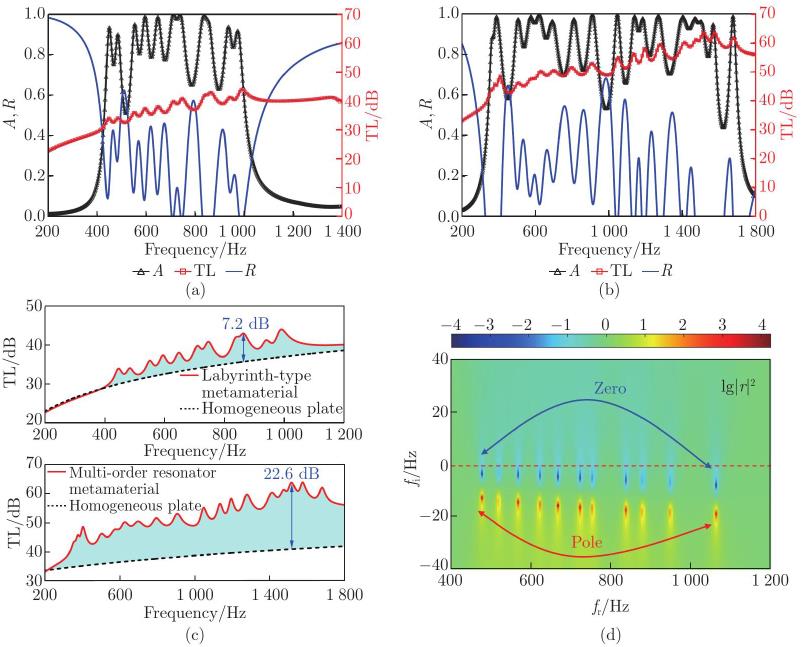
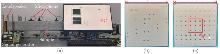
Fig. 9
Performance tests of two metamaterials: (a) experimental operating platform for impedance tube measurement; (b) schematic diagram of the labyrinth-type integrated metamaterial; (c) schematic diagram of the multi-order resonator integrated metamaterial (color online)"
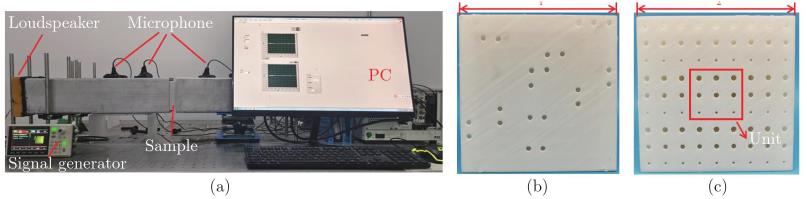
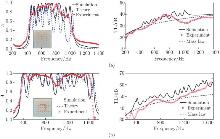
Fig. 10
Experimental results of sound absorption and insulation performance of the samples: (a) labyrinth-type integrated metamaterial; (b) multi-order resonator integrated metamaterial (color online)"
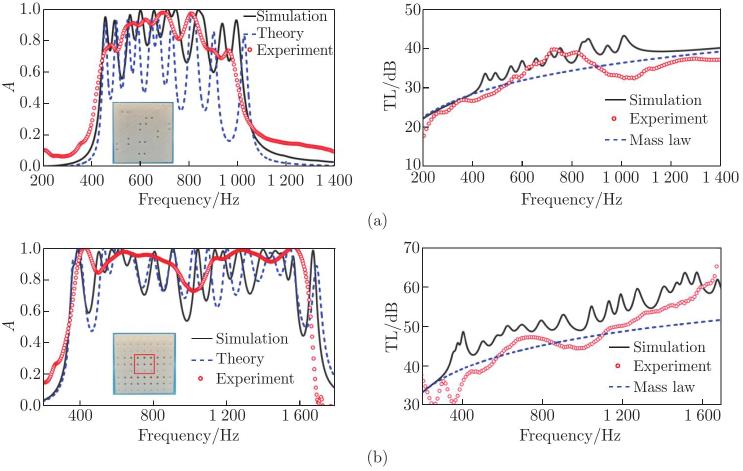
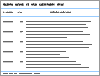
Table 1
Performance comparison of typical noise reducing acoustic metamaterials"
| Structural model | Working band | Absorption coefficient/TL | Thickness | Reference |
|---|---|---|---|---|
| Neck-embedded Helmholtz resonator | 800–3 300 Hz | About 40 mm | [ | |
| Cascade neck-embedded Helmholtz resonator | 320–6 400 Hz | 100 mm | [ | |
| Multiscale porous material with coiled-up channel | 213–3 000 Hz | 100 mm | [ | |
| Multiple-cavity metastructure with gradient thickness | 315–1 326 Hz | 95 mm | [ | |
| Labyrinth-type integrated metamaterial | 425–1 005 Hz | 33 mm | This work | |
| Multi-order resonator integrated metamaterial | 345–1 730 Hz | 82 mm | This work |
| [1] | MA, F., WANG, C., LIU, C., and WU, J. Structural designs, principles, and applications of thin-walled membrane and plate-type acoustic/elastic metamaterials. Journal of Applied Physics, 129, 231103 (2021) |
| [2] | MIN, H. and WANG, B. Enhancing sound insulation performance with active constrained layer damping plates at low frequencies. Applied Acoustics, 222, 110062 (2024) |
| [3] | LI, H., TANG, Z., ZUO, G., and MA, F. Laminated acoustic metamaterials for low-frequency broadband ultra-strong sound insulation. Thin-Walled Structures, 202, 112151 (2024) |
| [4] | MA, F., LIU, C., LI, Y., and WU, J. A thin-walled mesoscopic hybrid slit-resonator metamaterial absorber. Thin-Walled Structures, 193, 111226 (2023) |
| [5] | BAI, X., XIAO, Z., SHI, H., ZHANG, K., LUO, Z., and WU, Y. Omnidirectional sound wave absorption based on the multi-oriented acoustic meta-materials. Applied Acoustics, 228, 110344 (2025) |
| [6] | KUSHWAHA, M. S., HALEVI, P., DOBRZYNSKI, L., and DJAFARI-ROUHANI, B. Acoustic band structure of periodic elastic composites. Physical Review Letters, 71, 2022 (1993) |
| [7] | VASILEIADIS, T., VARGHESE, J., BABACIC, V., GOMIS-BRESCO, J., URRIOS, D. N., and GRACZYKOWSKI, B. Progress and perspectives on phononic crystals. Journal of Applied Physics, 129, 160901 (2021) |
| [8] | TAO, Z., REN, X., ZHAO, A., SUN, L., ZHANG, Y., JIANG, W., HAN, D., ZHANG, X., and XIE, Y. A novel auxetic acoustic metamaterial plate with tunable bandgap. International Journal of Mechanical Sciences, 226, 107414 (2022) |
| [9] | WANG, X., RUI, S., WANG, S., ZHANG, W., and MA, F. A low-frequency pure metal metamaterial absorber with continuously tunable stiffness. Applied Mathematics and Mechanics (English Edition), 45(7), 1209–1224 (2024) https://doi.org/10.1007/s10483-024-3158-7 |
| [10] | LIU, Z., ZHANG, X., MAO, Y., ZHU, Y., YANG, Z., CHAN, C., and SHENG, P. Locally resonant sonic materials. Science, 289, 1734–1736 (2000) |
| [11] | KAINA, N., LEMOULT, F., FINK, M., and LEROSY, G. Negative refractive index and acoustic superlens from multiple scattering in single negative metamaterials. nature, 525, 77–81 (2015) |
| [12] | ZHOU, Y., SANG, T., and WANG, Y. Negative refraction guided by a glide-reflection symmetric crystal interface. Materials, 18, 1210 (2025) |
| [13] | LI, Z., CHEN, K., LI, F., SHI, Z., SUN, Q., LI, P., PENG, Y., HUANG, L., YANG, G., ZHENG, H., and ZHU, X. Decorated bacteria-cellulose ultrasonic metasurface. Nature Communications, 14, 5319 (2023) |
| [14] | SHI, Y., LI, Y., LI, X., and LI, J. A broadband acoustic metamaterial lens for sub-wavelength imaging based on bandwidth enhancement. Applied Acoustics, 227, 110243 (2025) |
| [15] | LI, Y., LIANG, B., TAO, X., ZHU, X., ZHOU, X., and CHENG, J. Acoustic focusing by coiling up space. Applied Physics Letters, 101, 036609 (2012) |
| [16] | XIAO, Y., WANG, N., WANG, X., and LI, Y. Global phase metasurfaces for sound bending splitter. International Journal of Mechanical Sciences, 270, 109081 (2024) |
| [17] | FLEURY, R., SOUNAS, D. L., SIECK, C. F., HABERMAN, M. R., and ALU, A. Sound isolation and giant linear nonreciprocity in a compact acoustic circulator. Science, 343, 516–519 (2014) |
| [18] | KIM, C., KIM, J., and JEON, W. Realization of an acoustic metalens exhibiting broadband high transmission. Journal of Sound and Vibration, 529, 116910 (2022) |
| [19] | ZIGONEANU, L., POPA, B. I., and CUMMER, S. A. Three-dimensional broadband omnidirectional acoustic ground cloak. Nature Materials, 13, 352–355 (2014) |
| [20] | QU, R., GUO, J., LI, Y., TAN, Q., PENG, Z., WANG, L., FANG, Y., and ZHOU, P. Reflected acoustic wave manipulation by metasurfaces in a grazing flow. International Journal of Mechanical Sciences, 284, 109696 (2024) |
| [21] | MEI, Z., LI, X., LYU, Y., LIN, Y., YANG, H., CHENG, X., and YANG, J. Broadening sound absorption bandwidth via multi-order resonances. International Journal of Mechanical Sciences, 280, 109493 (2024) |
| [22] | LIU, Y., ZHANG, W., CAO, G., ZUO, G., LIU, C., and MA, F. Ultra-thin ventilated metasurface pipeline coating for broadband noise reduction. Thin-Walled Structures, 200, 111916 (2024) |
| [23] | JIAN, L., HE, J., WEN, G., WANG, Z., YANG, J., XIE, Y., and LIU, J. Multifunctional TPMS-based metastructures. International Journal of Mechanical Sciences, 293, 110208 (2025) |
| [24] | QIAN, Y., LI, B., and ZHANG, J. Study of ultra-wideband acoustic metamaterial based on multi-order broadband resonance band coupling of ultra-micro perforated panel. Applied Acoustics, 235, 110643 (2025) |
| [25] | MA, F., HUANG, M., and WU, J. Ultrathin lightweight plate-type acoustic metamaterials with positive lumped coupling resonant. Journal of Applied Physics, 121, 015102 (2017) |
| [26] | LANGFELDT, F. and GLEINE, W. Plate-type acoustic metamaterials with strip masses. Journal of the Acoustical Society of America, 149, 3727–3738 (2021) |
| [27] | REN, H., XIAO, Y., CHEN, H., WANG, S., ZHANG, H., and WEN, J. Plate-type metastructure with low-frequency sound insulation and high stiffness properties. Thin-Walled Structures, 202, 112123 (2024) |
| [28] | EMOTO, H. and YAMADA, T. Acoustic metaslit for regional sound insulation for a three-dimensional diffuse sound field incidence. Applied Acoustics, 228, 110297 (2025) |
| [29] | MEI, J., MA, G., YANG, M., WEN, W., and SHENG, P. Dark acoustic metamaterials as super absorbers for low-frequency sound. Nature Communications, 3, 756 (2012) |
| [30] | TANG, S. T., LAU, J., YEUNG, K. Y. A., and YANG, Z. Multiple-frequency perfect absorption by hybrid membrane resonators. Applied Physics Letters, 116, 161902 (2020) |
| [31] | PUNDIR, A., GUPTA, A., and NAG, S. Multi-functional programmable active acoustic meta-surface: acoustic switch, acoustic barrier, and acoustic transmitter. Journal of Applied Physics, 136, 143104 (2024) |
| [32] | LIU, C., WU, J., CHEN, X., and MA, F. A thin low-frequency broadband metasurface with multi-order sound absorption. Journal of Physics D: Applied Physics, 52, 105302 (2019) |
| [33] | HUANG, S., ZHOU, Z., LI, D., LIU, T., WANG, X., ZHU, J., and LI, Y. Compact broadband acoustic sink with coherently coupled weak resonances. Science Bulletin, 65, 373–379 (2020) |
| [34] | LI, Y., YAN, Y., YAN, J., XIE, S., and PENG, Y. Continuous near-perfect sound absorption of a slit-resonator acoustic metastructure. Journal of Applied Physics, 136, 205102 (2024) |
| [35] | JIANG, X., LIANG, B., LI, R., ZOU, X., YIN, L., and CHENG, J. Ultra-broadband absorption by acoustic metamaterials. Applied Physics Letters, 105, 243505 (2014) |
| [36] | ZHU, Y., MERKEL, A., DONDA, K., FAN, S., CAO, L., and ASSOUAR, B. Nonlocal acoustic metasurface for ultrabroadband sound absorption. Physical Review B, 103, 064102 (2021) |
| [37] | SUN, K., FAN, Y., CHEN, S., YE, Z., LI, Z., ZHANG, Q., FU, Q., ZENG, Y., and ZHANG, F. Rabi-like splitting in acoustic cavity coupled with membrane-type metasurface. Advanced Engineering Materials, 26, 2400340 (2024) |
| [38] | ZHANG, C. and HU, X. Three-dimensional single-port labyrinthine acoustic metamaterial: perfect absorption with large bandwidth and tunability. Physical Review Applied, 6, 064025 (2016) |
| [39] | HUANG, S., FANG, X., WANG, X., ASSOUAR, B., CHENG, Q., and LI, Y. Acoustic perfect absorbers via spiral metasurfaces with embedded apertures. Applied Physics Letters, 113, 233501 (2018) |
| [40] | LEE, I., HAN, I., and YOON, G. Compact acoustic metamaterials based on azimuthal labyrinthine channels for broadband low-frequency soundproofing and ventilation. Applied Acoustics, 228, 110273 (2025) |
| [41] | CAI, X., GUO, Q., HU, G., and YANG, J. Ultrathin low-frequency sound absorbing panels based on coplanar spiral tubes or coplanar Helmholtz resonators. Applied Physics Letters, 105(12), 121901 (2014) |
| [42] | LI, J., WANG, W., XIE, Y., POPA, B., and CUMMER, S. A. A sound absorbing metasurface with couple dresonators. Applied Physics Letters, 109, 091908 (2016) |
| [43] | WEN, G., ZHANG, S., WANG, H., WANG, Z., HE, J., CHEN, Z., LIU, J., and XIE, Y. Origami-based acoustic metamaterial for tunable and broadband sound attenuation. International Journal of Mechanical Sciences, 239, 107872 (2023) |
| [44] | LI, X., YU, X., CHUA, J., LEE, H., DING, J., and ZHAI, W. Microlattice metamaterials with simultaneous superior acoustic and mechanical energy absorption. Small, 17, 2100336 (2021) |
| [45] | ZHOU, Z., HUANG, S., LI, D., ZHU, J., and LI, Y. Broadband impedance modulation via non-local acoustic metamaterials. National Science Review, 9, nwab171 (2022) |
| [46] | LIU, C., WU, J., YANG, Z., and MA, F. Ultra-broadband acoustic absorption of a thin microperforated panel metamaterial with multi-order resonance. Composite Structures, 246, 112366 (2020) |
| [47] | YANG, M., CHEN, S., FU, C., and SHENG, P. Optimal sound-absorbing structures. Materials Horizons, 4(4), 673–680 (2017) |
| [48] | ZHAO, H., WANG, Y., YU, D., YANG, H., ZHONG, J., WU, F., and WEN, J. A double porosity material for low frequency sound absorption. Composite Structures, 239, 111978 (2020) |
| [49] | LIANG, Z. and LI, J. Extreme acoustic metamaterial by coiling up space. Physical Review Letters, 108, 114301 (2012) |
| [50] | GUO, J., ZHANG, X., FANG, Y., and QU, R. An extremely-thin acoustic metasurface for low-frequency sound attenuation with a tunable absorption bandwidth. International Journal of Mechanical Sciences, 213, 106872 (2022) |
| [51] | YANG, X., WEN, G., JIAN, L., LIN, C., HE, J., SEDAGHATI, R., HUANG, S., LIU, J., and XIE, Y. Archimedean spiral channel-based acoustic metasurfaces suppressing wide-band low-frequency noise at a deep subwavelength. Materials & Design, 238, 112703 (2024) |
| [52] | JIMENEZ, N., ROMERO-GARCIA, V., PAGNEUX, V., and GROBY, J. Rainbow-trapping absorbers: broadband, perfect and asymmetric sound absorption by subwavelength panels for transmission problems. Scientific Reports, 7, 13595 (2017) |
| [53] | LI, Y., YAN, J., and PENG, Y. Multiscale porous with coiled-up channel for low-frequency broadband sound absorption. International Journal of Mechanical Sciences, 232, 107622 (2022) |
| [54] | LI, Y., YAN, Y., and PENG, Y. Ultra-broadband sound absorption of a multiple-cavity metastructure with gradient thickness. Aerospace Science and Technology, 133, 108140 (2023) |
| [1] | Jinhui LIU, Yu XUE, Zhihong GAO, A. O. KRUSHYNSKA, Jinqiang LI. Actively tunable sandwich acoustic metamaterials with magnetorheological elastomers [J]. Applied Mathematics and Mechanics (English Edition), 2024, 45(11): 1875-1894. |
| [2] | Donghai HAN, Qi JIA, Yuanyu GAO, Qiduo JIN, Xin FANG, Jihong WEN, Dianlong YU. Local resonance metamaterial-based integrated design for suppressing longitudinal and transverse waves in fluid-conveying pipes [J]. Applied Mathematics and Mechanics (English Edition), 2024, 45(10): 1821-1840. |
| [3] | Jianing LIU, Jinqiang LI, Ying WU. Bandgap adjustment of a sandwich-like acoustic metamaterial plate with a frequency-displacement feedback control method [J]. Applied Mathematics and Mechanics (English Edition), 2024, 45(10): 1807-1820. |
| [4] | Peng SHENG, Xin FANG, Dianlong YU, Jihong WEN. Nonlinear metamaterial enabled aeroelastic vibration reduction of a supersonic cantilever wing plate [J]. Applied Mathematics and Mechanics (English Edition), 2024, 45(10): 1749-1772. |
| Viewed | ||||||
|
Full text |
|
|||||
|
Abstract |
|
|||||





 Email Alert
 RSS
RSS