Applied Mathematics and Mechanics (English Edition) ›› 2026, Vol. 47 ›› Issue (6): 1241-1262.doi: https://doi.org/10.1007/s10483-026-3394-8
Previous Articles Next Articles
Jiani JIANG1, Qi WANG1, Shuiqiang ZHANG2, Dongli SHI1, Li DING1, Bingbing AN1, Dongsheng ZHANG1,3,†( )
)
Received:2026-01-05
Revised:2026-04-02
Online:2026-06-18
Published:2026-06-18
Contact:
Dongsheng ZHANG, E-mail: donzhang@staff.shu.edu.cnSupported by:2010 MSC Number:
Jiani JIANG, Qi WANG, Shuiqiang ZHANG, Dongli SHI, Li DING, Bingbing AN, Dongsheng ZHANG. Analysis of competing toughening mechanisms in interlocked bio-inspired glass composites. Applied Mathematics and Mechanics (English Edition), 2026, 47(6): 1241-1262.
Fig. 1
Schematic illustration of the geometry of the interlocking bio-inspired glass composite model: (a) geometric configuration of the interlocking glass layer; (b) overall model (color online)"
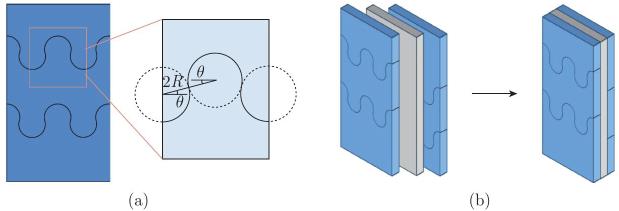
Fig. 2
Three-dimensional finite element modeling: (a) model loading conditions; (b) mesh generation (color online)"
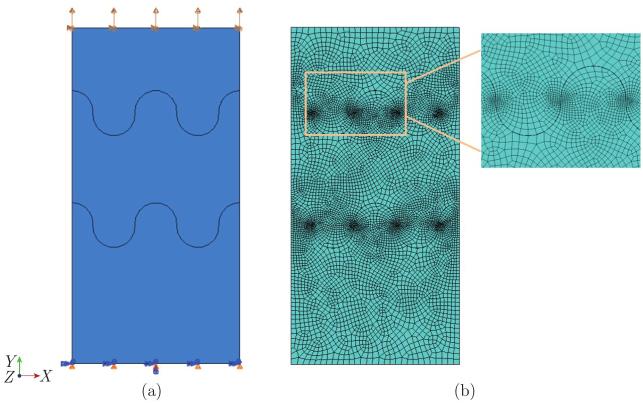
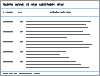
Table 1
Effects of hard component mesh size"
| Mesh division | Local glass mesh size/mm | Global polymer mesh size/mm | Number of elements | Strength/MPa | Failure strain/% |
|---|---|---|---|---|---|
| Coarse mesh | 0.03–0.3 | 0.4 | 13 157 | 3.55 | 2.78 |
| Medium mesh | 0.02–0.2 | 0.3 | 16 966 | 3.58 | 2.65 |
| Fine mesh | 0.015–0.15 | 0.2 | 29 311 | 3.31 | 2.78 |
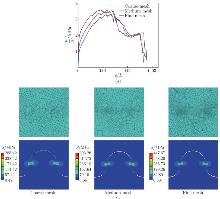
Fig. 3
Mesh sensitivity analysis: (a) tensile stress-strain curves under three mesh densities; (b) three mesh schemes (top) and the resulting von Mises stress (denoted as S) distributions (bottom) (color online)"
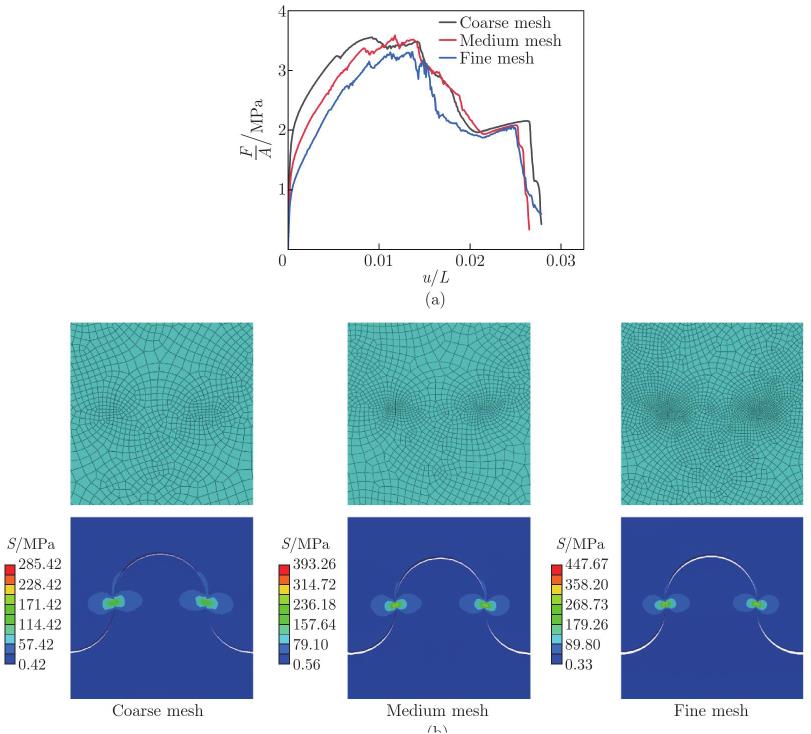
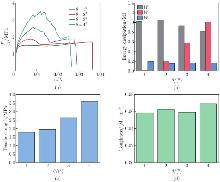
Fig. 4
Effects of interlocking angle on the mechanical properties of biomimetic interlocking glass materials: (a) stress-strain curves; (b) energy dissipation; (c) strength; (d) toughness (color online)"
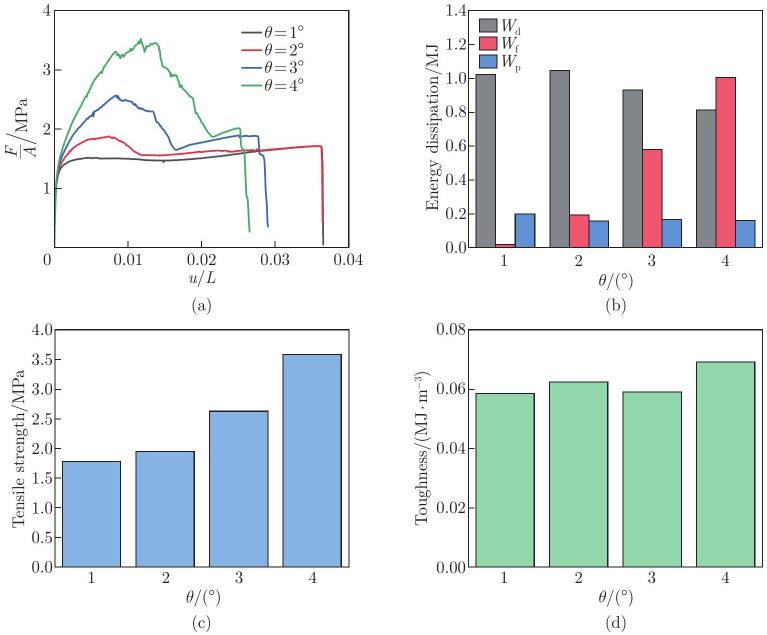
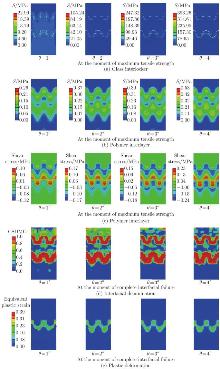
Fig. 5
Numerical simulation results considering the effect of the interlocking angle: (a) von Mises stress (denoted as S) distributions in the glass interlockers; (b) von Mises stress distributions in the polymer interlayer; (c) shear stress distributions in the polymer interlayer; (d) interfacial delamination of the glass-polymer composite; (e) plastic deformation in the polymer (color online)"
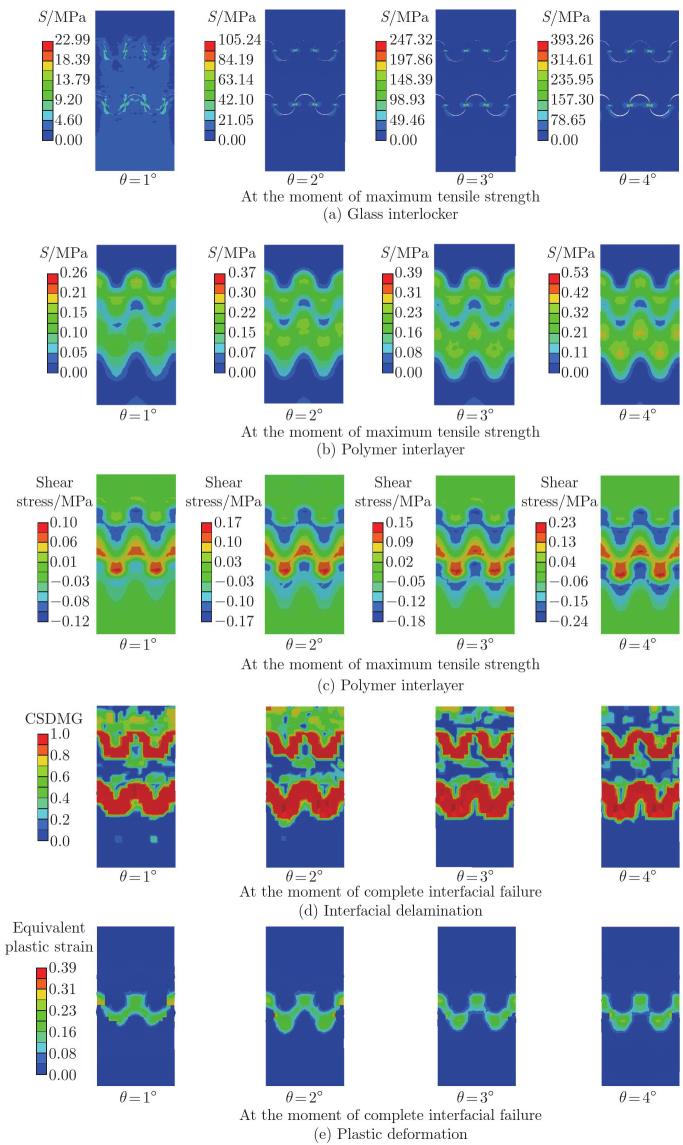
Fig. 6
Effects of friction on the mechanical properties of interlocking glass bio-mimetic materials: (a) stress-strain curves; (b) energy dissipation; (c) strength; (d) toughness (color online)"
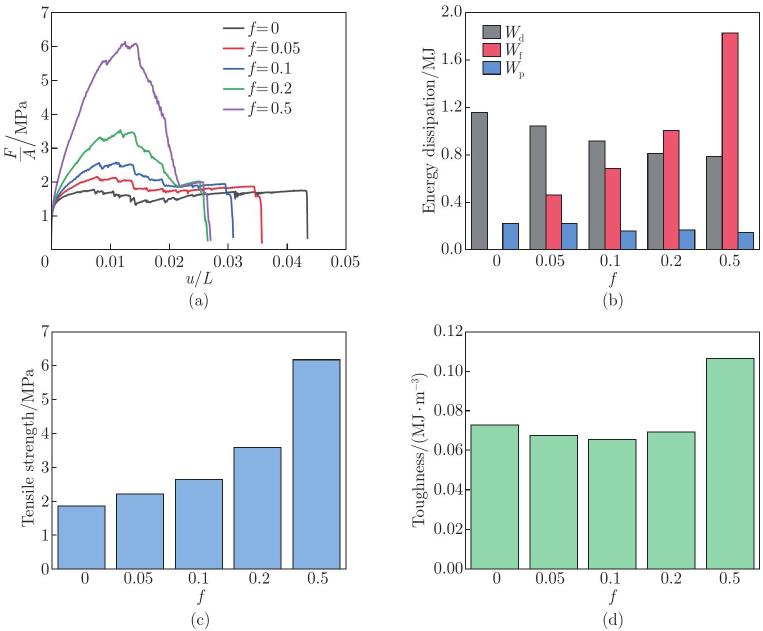
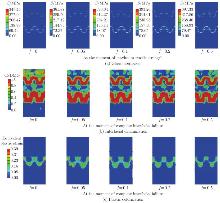
Fig. 7
Numerical simulation results considering the effect of friction: (a) von Mises stress (denoted as S) distributions in the glass interlockers; (b) interfacial delamination of the glass-polymer composite; (c) plastic deformation in the polymer (color online)"
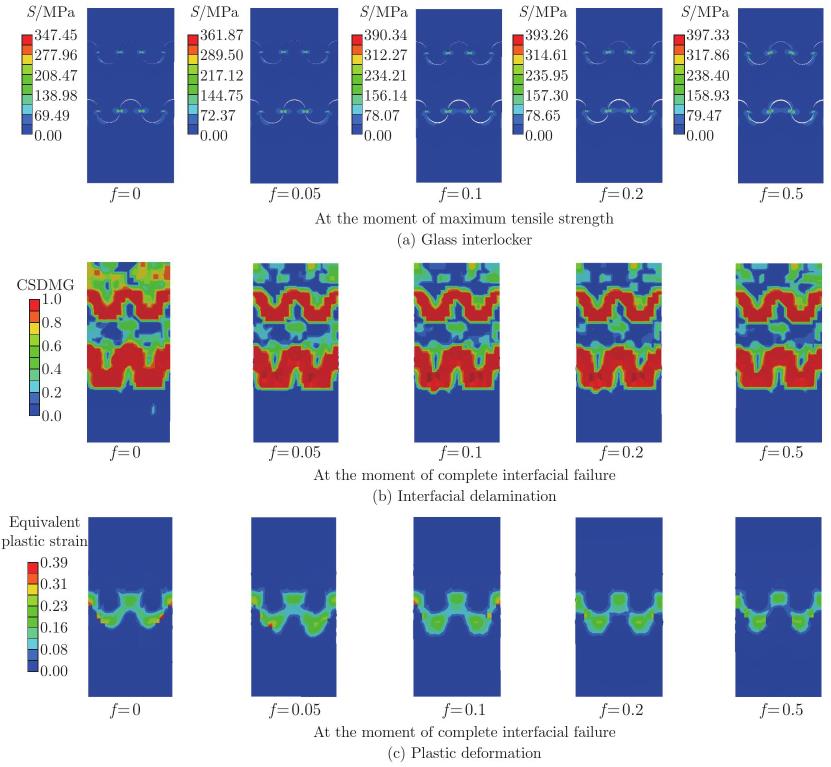
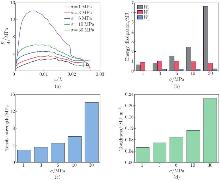
Fig. 8
Effects of interfacial strength on the mechanical properties of bio-inspired interlocking glass materials: (a) stress-strain curve; (b) energy dissipation; (c) strength; (d) toughness (color online)"
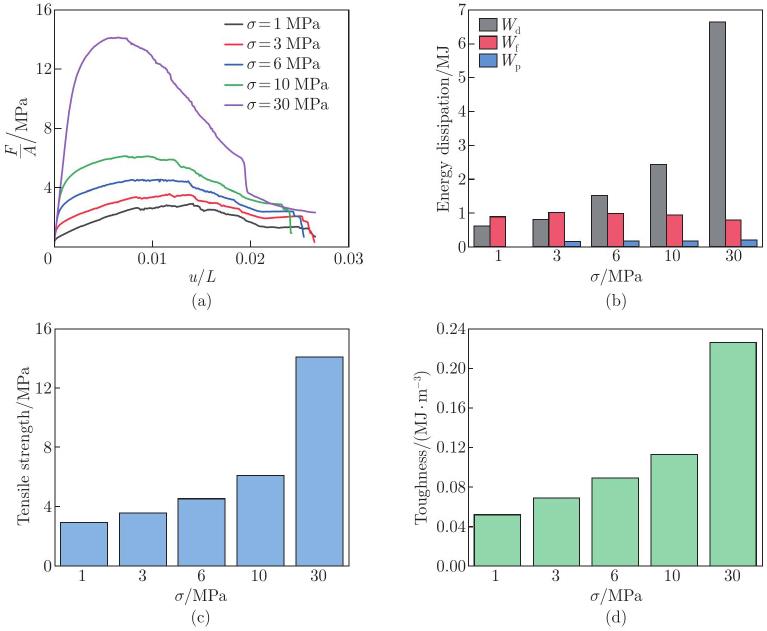
Fig. 9
Numerical simulation results considering the effect of interfacial strength: (a) von Mises stress (denoted as S) distributions in the glass interlockers; (b) interfacial delamination of the glass-polymer composite; (c) plastic deformation in the polymer (color online)"
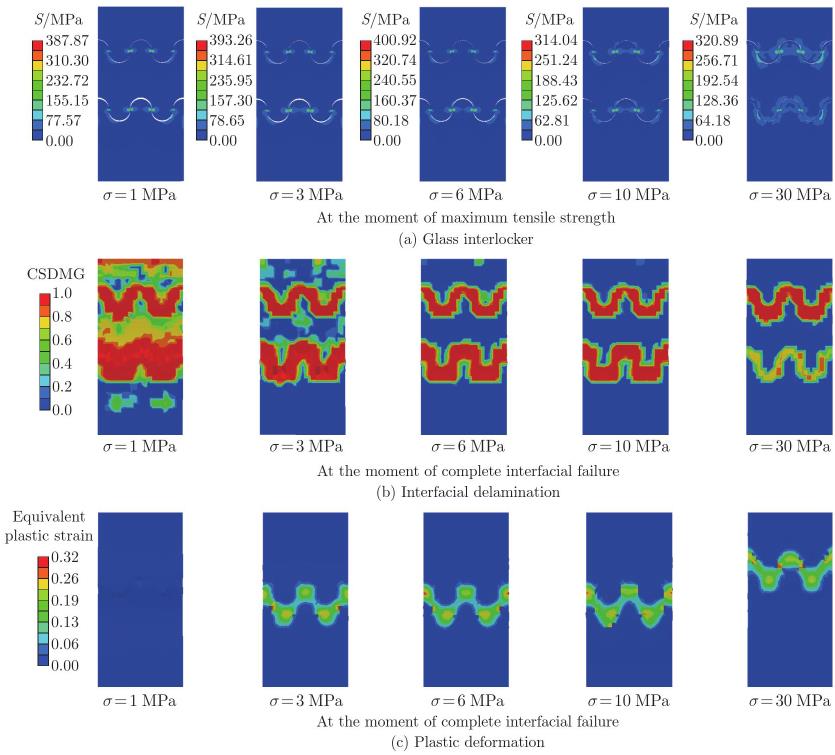
Fig. 10
Effects of interfacial failure displacement on the mechanical properties of bioinspired interlocking glass materials: (a) stress-strain curve; (b) energy dissipation; (c) strength; (d) toughness (color online)"
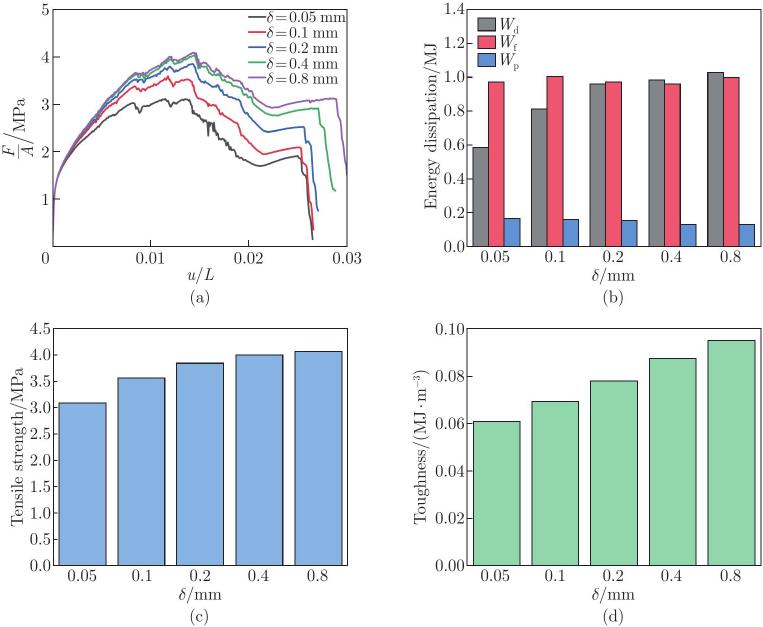
Fig. 11
Numerical simulation results considering the effect of interfacial failure displacement: (a) von Mises stress (denoted as S) distributions in the glass interlockers; (b) interfacial delamination of the glass-polymer composite; (c) plastic deformation in the polymer (color online)"
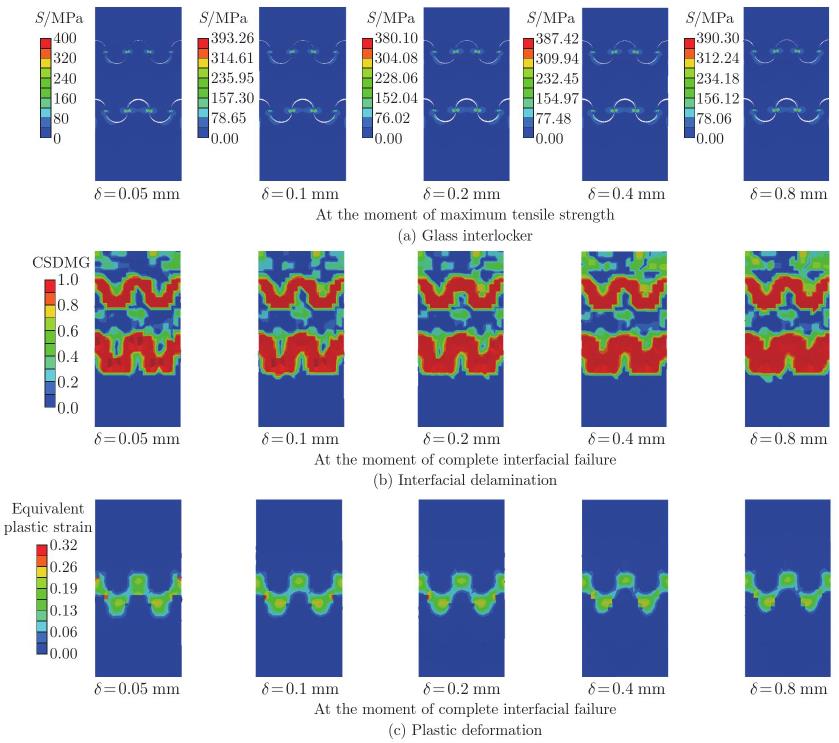
Fig. 12
Effects of polymer yield strength on the mechanical properties of bioinspired interlocking glass materials: (a) stress-strain curve; (b) energy dissipation; (c) plastic energy dissipation curve (color online)"
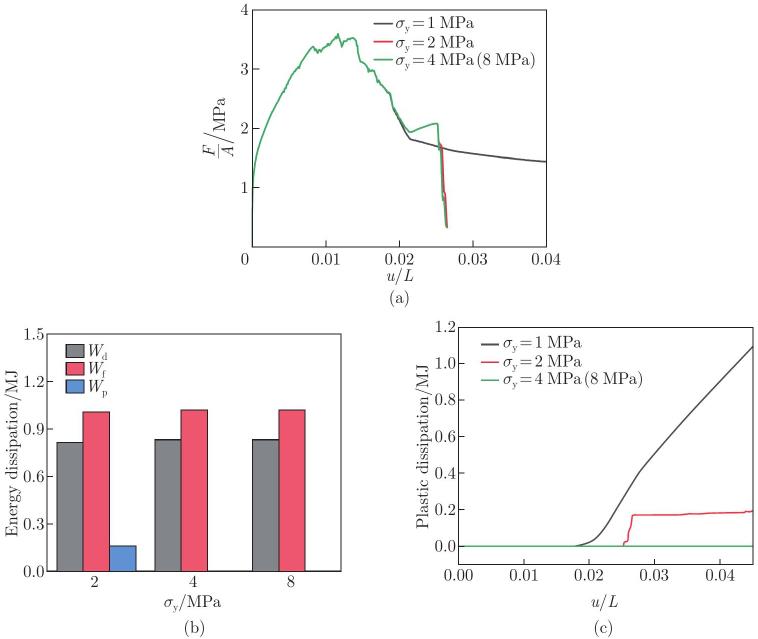
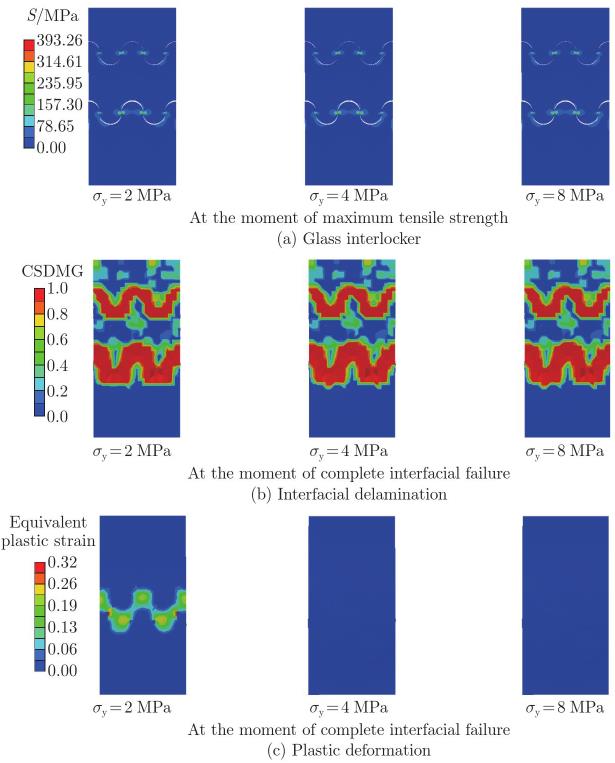
Fig. 13
Numerical simulation results considering the effect of polymer yield strength: (a) von Mises stress (denoted as S) distributions in the glass interlockers; (b) interfacial delamination of the glass-polymer composite; (c) plastic deformation in the polymer (color online)"
| [1] | YIN, Z., DASTJERDI, A., and BARTHELAT, F. Tough and deformable glasses with bioinspired cross-ply architectures. Acta Biomaterialia, 75, 439–450 (2018) |
| [2] | LIU, Z. Q., MEYERS, M. A., ZHANG, Z. F., and RITCHIE, R. O. Functional gradients and heterogeneities in biological materials: design principles, functions, and bioinspired applications. Progress in Materials Science, 88, 467–498 (2017) |
| [3] | SARVESTANI, H. Y., VAN EGMOND, D. A., ESMAIL, I., GENEST, M., PAQUET, C., and ASHRAFI, B. Bioinspired stochastic design: tough and stiff ceramic systems. Advanced Functional Materials, 32(6), 2108492 (2022) |
| [4] | ZHANG, G. L., PENG, J. B., LUAN, Y. B., LI, Y. C., MA, S. G., WANG, M. R., and ZHOU, Z. H. Improved mechanical performance of Strombus gigas shell inspired artificial composites by regulating the laminated structure and interface bonding. Mechanics of Advanced Materials and Structures, 31(22), 5692–5700 (2024) |
| [5] | PENICK, C. A., COPE, G., MORANKAR, S., MISTRY, Y., GRISHIN, A., CHAWLA, N., and BHATE, D. The comparative approach to bio-inspired design: integrating biodiversity and biologists into the design process. Integrative and Comparative Biology, 62(5), 1153–1163 (2022) |
| [6] | LIU, S. Y., XU, Y. Z., LIAO, R. C., HE, G., DING, L., AN, B. B., and ZHANG, D. S. On fracture behavior of inner enamel: a numerical study. Applied Mathematics and Mechanics (English Edition), 44(6), 931–940 (2023) https://doi.org/10.1007/s10483-023-3007-6 |
| [7] | ZHU, H. K., CAO, H., LIU, X., WANG, M. L., MENG, X. Y., ZHOU, Q., and XU, L. X. Nacre-like composite films with a conductive interconnected network consisting of graphene oxide, polyvinyl alcohol and single-walled carbon nanotubes. Materials & Design, 175, 107783 (2019) |
| [8] | ESPINOSA, H. D., RIM, J. E., BARTHELAT, F., and BUEHLER, M. J. Merger of structure and material in nacre and bone — perspectives on de novo biomimetic materials. Progress in Materials Science, 54(8), 1059–1100 (2009) |
| [9] | BARTHELAT, F., TANG, H., ZAVATTIERI, P. D., LI, C. M., and ESPINOSA, H. D. On the mechanics of mother-of-pearl: a key feature in the material hierarchical structure. Journal of the Mechanics and Physics of Solids, 55(2), 306–337 (2007) |
| [10] | CUI, S. K., YANG, Z. Y., and LU, Z. X. An analytical model for the bio-inspired nacreous composites with interlocked “brick-and-mortar” structures. Composites Science and Technology, 193, 108131 (2020) |
| [11] | BARTHELAT, F. Designing nacre-like materials for simultaneous stiffness, strength and toughness: optimum materials, composition, microstructure and size. Journal of the Mechanics and Physics of Solids, 73, 22–37 (2014) |
| [12] | FENG, X. Q., ZHAO, Z. L., YAN, Y., and ZHAO, H. P. Toughening and strengthening mechanisms of biological materials: a review. Materials Science and Engineering R: Reports, 165, 100988 (2025) |
| [13] | ZHANG, Y. Y., HEIM, F. M., BARTLETT, J. L., SONG, N. N., ISHEIM, D., and LI, X. D. Bioinspired, graphene-enabled Ni composites with high strength and toughness. Science Advances, 5(5), eaav5577 (2019) |
| [14] | YAO, S. J., TIAN, L. S., FENG, B. Y., ZENG, X. Y., XIONG, J. Y., GONG, Y. Z., ZHANG, Y., WANG, L. X., HUANG, W., and ZHOU, H. M. Bioinspired nacre-like CFRP composites with 3D organic mortar networks for synergistic multiscale toughness and impact resistance. Composites Science and Technology, 269, 111240 (2025) |
| [15] | GUO, X., DONG, X. Y., ZOU, G. J., GAO, H. J., and ZHAI, W. Strong and tough fibrous hydrogels reinforced by multiscale hierarchical structures with multimechanisms. Science Advances, 9(2), eadf7075 (2023) |
| [16] | WANG, S. X., TAN, L. L., YANG, Z., ZHAO, H. W., and GUO, L. A strong, tough, and stable composite with nacre-inspired sandwich structure. Advanced Materials, 36(29), 2401883 (2024) |
| [17] | LU, J. F., DENG, J. J., WEI, Y., YANG, X. Y., ZHAO, H. W., ZHAO, Q. H., LIU, S. J., LI, F. S., LI, Y. B., DENG, X. L., JIANG, L., and GUO, L. Hierarchically mimicking outer tooth enamel for restorative mechanical compatibility. Nature Communications, 15, 10182 (2024) |
| [18] | LI, Y. B., YUE, H. L., LU, J. F., ZHAO, Q. H., LIU, S. J., YIN, W. Z., HAN, J. M., GUO, T. Q., ZHAO, H. W., and GUO, L. A gradient enamel-mimetic composite via crisscross assembly of aligned hybrid nanowires for excellent mechanical performance. Advanced Materials, 37(51), 2503537 (2025) |
| [19] | LIU, S. J., DENG, J. J., ZHAO, H. W., WANG, T. B., LU, J. F., DING, B. S., GUO, T. Q., RITCHIE, R. O., and GUO, L. Tooth enamel-inspired ceramic coating on metal surface for enhanced mechanical properties and corrosion resistance. Nature Communications, 16, 5980 (2025) |
| [20] | SUN, J., ZHAO, C. X., LI, J., MEI, H., LIU, X., and YAN, S. L. Biomimetic nacreous structure enhances the impact resistance of transparent protective composites. Materials & Design, 258, 114679 (2025) |
| [21] | FAN, L., JI, X. H., WU, C. T., ZHANG, W., TONG, Y. Y., WANG, Q. N., SONG, F. Y., LI, F., LIU, G. Y., and LI, M. Y. Unlocking toughness in 3D-printed cement through bio-inspired designs: current status and future perspectives. RSC Advances, 16(3), 2858–2872 (2026) |
| [22] | LI, Y. N., ORTIZ, C., and BOYCE, M. C. Bioinspired, mechanical, deterministic fractal model for hierarchical suture joints. Physical Review E, 85(3), 031901 (2012) |
| [23] | LI, Y. N., ORTIZ, C., and BOYCE, M. C. A generalized mechanical model for suture interfaces of arbitrary geometry. Journal of the Mechanics and Physics of Solids, 61(4), 1144–1167 (2013) |
| [24] | LI, Y. N., ORTIZ, C., and BOYCE, M. C. Stiffness and strength of suture joints in nature. Physical Review E, 84(6), 062904 (2011) |
| [25] | JIANG, P., ZHANG, S. S., YANG, H., and LI, Y. Suture interface inspired self-recovery architected structures for reusable energy absorption. ACS Applied Materials & Interfaces, 15(36), 43102–43110 (2023) |
| [26] | MIRKHALAF, M., DASTJERDI, A. K., and BARTHELAT, F. Overcoming the brittleness of glass through bio-inspiration and micro-architecture. Nature Communications, 5, 3166 (2014) |
| [27] | MALIK, I. A. and BARTHELAT, F. Toughening of thin ceramic plates using bioinspired surface patterns. International Journal of Solids and Structures, 97-98, 389–399 (2016) |
| [28] | KATZ, Z., SARVESTANI, H. Y., GHOLIPOUR, J., and ASHRAFI, B. Bioinspired hierarchical ceramic sutures for multi-modal performance. Advanced Materials Interfaces, 10(14), 2300098 (2023) |
| [29] | GAO, C., HASSELDINE, B. P. J., LI, L., WEAVER, J. C., and LI, Y. N. Amplifying strength, toughness, and auxeticity via wavy sutural tessellation in plant seedcoats. Advanced Materials, 30(36), 1800579 (2018) |
| [30] | XU, M., AN, B. B., and ZHANG, D. S. Competing mechanisms in fracture of staggered mineralized collagen fibril arrays. Journal of the Mechanical Behavior of Biomedical Materials, 141, 105761 (2023) |
| [31] | WANG, Q., DING, L., WANG, S., RUAN, D. P., XU, Y. Z., CHU, Y. S., AROLA, D., AN, B. B., and ZHANG, D. S. A toughening strategy of the glass composite with a laminated interlocking feature. Applied Mathematics and Mechanics (English Edition), 46(7), 1315–1330 (2025) https://doi.org/10.1007/s10483-025-3270-9 |
| [32] | ZHANG, X., WU, K. J., NI, Y., and HE, L. H. Anomalous inapplicability of nacre-like architectures as impact-resistant templates in a wide range of impact velocities. Nature Communications, 13, 7719 (2022) |
| [33] | CHINTAPALLI, R. K., BRETON, S., DASTJERDI, A. K., and BARTHELAT, F. Strain rate hardening: a hidden but critical mechanism for biological composites. Acta Biomaterialia, 10(12), 5064–5073 (2014) |
| [34] | YANG, L. and THOMASON, J. L. Interface strength in glass fibre-polypropylene measured using the fibre pull-out and microbond methods. Composites Part A: Applied Science and Manufacturing, 41(9), 1077–1083 (2010) |
| [35] | JI, B. H. and GAO, H. J. Mechanical properties of nanostructure of biological materials. Journal of the Mechanics and Physics of Solids, 52(9), 1963–1990 (2004) |
| [36] | AN, B. B., SUN, W. H., and ZHANG, D. S. Role of soft bi-layer coating on the protection of turtle carapace. Journal of Biomechanics, 126, 110618 (2021) |
| [37] | JALALVAND, M., CZÉL, G., FULLER, J. D., WISNOM, M. R., CANAL, L. P., GONZÁLEZ, C. D., and LLORCA, J. Energy dissipation during delamination in composite materials — an experimental assessment of the cohesive law and the stress-strain field ahead of a crack tip. Composites Science and Technology, 134, 115–124 (2016) |
| [38] | YANG, H., SINHA, S. K., FENG, Y., MCCALLEN, D. B., and JEREMIĆ, B. Energy dissipation analysis of elastic-plastic materials. Computer Methods in Applied Mechanics and Engineering, 331, 309–326 (2018) |
| [39] | MOOSA, M. H., ABU-OKAIL, M., ABU-OQAIL, A., AL-SHELKAMY, S. A., SHEWAKH, W. M., and GHAFAR, M. A. Structural and tribological characterization of carbon and glass fabrics reinforced epoxy for bushing applications safety. Polymers, 15, 2064 (2023) |
| [40] | VIÑA, J., GARCÍA, M. A., CASTRILLO, M. A., VIÑA, I., and ARGÜELLES, A. Wear behavior of a glass fiber-reinforced PEI composite. Journal of Thermoplastic Composite Materials, 21(3), 279–286 (2008) |
| [41] | WANG, H. G., ZHENG, A. N., and DAI, G. C. Study on the interfacial bonding of glass fiber reinforced polypropylene composites I: interfacial shear strength. Acta Materiae Compositae Sinica, 16(3), 46–50 (1999) |
| [42] | FATIHA, T., BACHIR, K., and AREZKI, D. Micromechanics of stress transfer across the interface fiber-matrix bonding. International Journal of Materials and Metallurgical Engineering, 14(11), 251–256 (2019) |
| [1] | Zeyu CHAI, Zhen ZHANG, Kefan XU, Xuyuan SONG, Yewei ZHANG, Liqun CHEN. An innovative nonlinear bionic X-shaped vibration isolator enhanced by quasi-zero stiffness characteristics: theory and experimental investigation [J]. Applied Mathematics and Mechanics (English Edition), 2025, 46(8): 1475-1492. |
| [2] | Qi WANG, Li DING, Shuo WANG, Danping RUAN, Yuanzhi XU, Yanshu CHU, D. AROLA, Bingbing AN, Dongsheng ZHANG. A toughening strategy of the glass composite with a laminated interlocking feature [J]. Applied Mathematics and Mechanics (English Edition), 2025, 46(7): 1315-1330. |
| [3] | Xiyan ZOU, Huaiwei HUANG, Xiaohu YAO. Flexoelectric energy dissipating mechanism for multi-impact protection [J]. Applied Mathematics and Mechanics (English Edition), 2025, 46(4): 699-710. |
| [4] | Zeyu CHAI, J. T. HAN, Xuyuan SONG, Jian ZANG, Yewei ZHANG, Zhen ZHANG. Theoretical and experimental investigations on an X-shaped vibration isolator with active controlled variable stiffness [J]. Applied Mathematics and Mechanics (English Edition), 2024, 45(8): 1371-1386. |
| [5] | Guangdong SUI, Shuai HOU, Xiaofan ZHANG, Xiaobiao SHAN, Chengwei HOU, Henan SONG, Weijie HOU, Jianming LI. A bio-inspired spider-like structure isolator for low-frequency vibration [J]. Applied Mathematics and Mechanics (English Edition), 2023, 44(8): 1263-1286. |
| [6] | Guoxin JIN, Zhenghao WANG, Tianzhi YANG. Cascaded quasi-zero stiffness nonlinear low-frequency vibration isolator inspired by human spine [J]. Applied Mathematics and Mechanics (English Edition), 2022, 43(6): 813-824. |
| [7] | Xinyan YIN, Lichao JIA, Chen WANG, Guangming XIE. Modelling of thrust generated by oscillation caudal fin of underwater bionic robot [J]. Applied Mathematics and Mechanics (English Edition), 2016, 37(5): 601-610. |
| [8] | H. M. YOUSSEF. State-space approach to two-temperature generalized thermoelasticity without energy dissipation of medium subjected to moving heat source [J]. Applied Mathematics and Mechanics (English Edition), 2013, 34(1): 63-74. |
| [9] | Zhi-min CHEN;W. G. PRICE. Dissipative free-surface solver for potential flow around hydrofoil distributed with doublets [J]. Applied Mathematics and Mechanics (English Edition), 2012, 33(11): 1467-1480. |
| [10] | Payel Das;Mridula Kanoria. Magneto-thermo-elastic waves in an infinite perfectly conducting elastic solid with energy dissipation [J]. Applied Mathematics and Mechanics (English Edition), 2009, 30(2): 221-228 . |
| [11] | Rajneesh Kumar;Geeta Partap. Axisymmetric free vibrations of infinite micropolar thermoelastic plate [J]. Applied Mathematics and Mechanics (English Edition), 2007, 28(3): 369-369 . |
| [12] | Cai Chongxi;Lin Changhao. PHRAGMEN-LINDELÖF ALTERNATIVE RESULTS FOR THE INITIAL BOUNDARY PROBLEM OF STOKES EQUATION [J]. Applied Mathematics and Mechanics (English Edition), 1996, 17(8): 729-739. |
| Viewed | ||||||
|
Full text |
|
|||||
|
Abstract |
|
|||||





 Email Alert
 RSS
RSS