Applied Mathematics and Mechanics (English Edition) ›› 2026, Vol. 47 ›› Issue (2): 283-302.doi: https://doi.org/10.1007/s10483-026-3348-6
Previous Articles Next Articles
Quanpu LIU1,2, Haonan HE1,3, Siyu WANG1,2, Lin ZHAN2, O. BRUHNS4, Heng XIAO1,3,†( )
)
Received:2025-08-20
Revised:2025-12-01
Online:2026-02-04
Published:2026-02-04
Contact:
Heng XIAO, E-mail: yyhxiao@fyust.edu.cnSupported by:2010 MSC Number:
Quanpu LIU, Haonan HE, Siyu WANG, Lin ZHAN, O. BRUHNS, Heng XIAO. Accurate simulation for strength-degrading effects of geomaterials via a decoupling approach to treating tension-compression asymmetry. Applied Mathematics and Mechanics (English Edition), 2026, 47(2): 283-302.
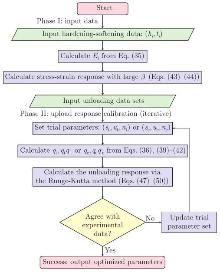
Fig. 1
Flowchart of the proposed numerical scheme (color online)"
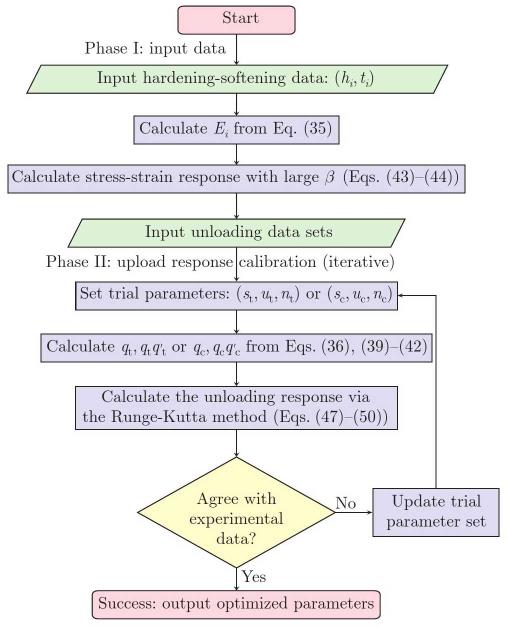
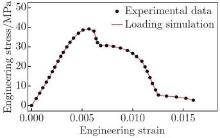
Fig. 2
Simulating hardening to softening effects of sandstone-concrete[71] in compression (color online)"
Fig. 3
Simulating stiffness-degrading effects at hardening stages: tension data in Ref. [72] for salt rock (left) and compression data in Ref. [73] for granite (right) (color online)"
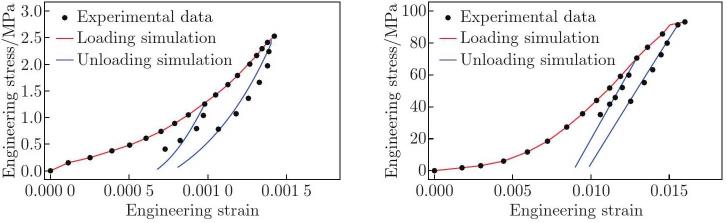
Fig. 4
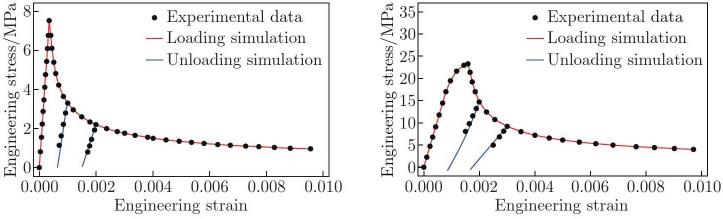
Simulating tensile stiffness-degrading effects at softening stages: plain concrete data (left) in Ref. [74] and HPC data (right) in Ref. [11] (color online)"
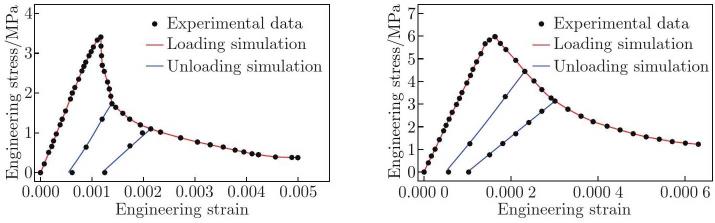
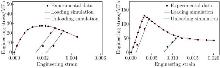
Fig. 5
Simulating compressive stiffness-degrading effects at softening stages: plain concrete data (left) in Ref. [1] and UHPC data in Ref. [24] (color online)"
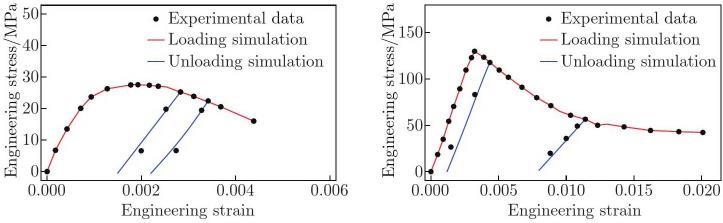
Fig. 6
Simulating stiffness-degrading effects at softening stages: tension data (left) and compression data (right) in Ref. [21] for sandstone and normal strength concrete (color online)"
| [48] | BRUHNS, O. T. Large deformation plasticity: from basic relations to finite deformation. Acta Mechanica Sinica, 36, 472–492 (2020) |
| [49] | XIAO, H., BRUHNS, O. T., and MEYERS, A. Elastoplasticity beyond small deformations. Acta Mechanica, 182, 31–111 (2006) |
| [50] | XIAO, H., BRUHNS, O. T., and MEYERS, A. Logarithmic strain, logarithmic spin and logarithmic rate. Acta Mechanica, 124, 89–105 (1997) |
| [51] | DRUCKER, D. C. and PRAGER, W. Soil mechanics and plastic analysis or limit design. Quarterly of Applied Mathematics, 10, 157–165 (1952) |
| [52] | BRUHNS, O. T., XIAO, H., and MEYERS, A. Self-consistent eulerian rate type elastoplasticity models based upon the logarithmic stress rate. International Journal of Plasticity, 15, 479–520 (1999) |
| [53] | XIAO, H., BRUHNS, O. T., and MEYERS, A. Thermodynamic laws and consistent Eulerian formulation of finite elastoplasticity with thermal effects. Journal of the Mechanics and Physics of Solids, 55, 338–365 (2007) |
| [54] | LODE, W. Versuche über den Einfluß der mittleren Hauptspannung auf die Fließgrenze. Journal of Applied Mathematics and Mechanics, 5, 142–144 (1925) |
| [55] | FROMM, H. Stoffgesetze des isotropen Kontinuums, inbesondere bei zähplastischem Verhalten. Ingenieur-Archiv, 4, 432–466 (1933) |
| [56] | NOVOZHILOV, V. V. On relations between stresses and strains in non-linear elastic media (in Russian). Journal of Applied Mathematics and Mechanics, 15, 183–194 (1951) |
| [57] | KOLUPAEV, A. V., YU, M. H., ALTENBACH, H., and BOLCHOUN, A. Comparison of strength criteria based on the measurements on concrete. Journal of Engineering Mechanics, 144, 04018028 (2018) |
| [58] | ALTENBACH, H. and KOLUPAEV, A. V. General forms of limit surface: application for isotropic materials. Material Modeling and Structural Mechanics, Springer, Cham, 19–94 (2022) |
| [59] | BRUHNS, O. T. Some remarks on Lode angle and Lode parameter. Proceedings in Applied Mathematics and Mechanics, 24, e202400004 (2024) |
| [60] | XIAO, H. An explicit, direct approach to obtaining multiaxial elastic potentials that exactly match data of four benchmark tests for rubbery materials-part 1: incompressible deformations. Acta Mechanica, 223, 2039–2063 (2012) |
| [61] | LIU, Q. P., WANG, H. Y., WANG, S. Y., XIAO, H., and BRUHNS, O. T. An accurate and unified study on non-symmetric tensile and compressive responses of elastoplastic bars and beams until failure. Acta Mechanica, 234, 6561–6577 (2023) |
| [62] | VON KÁRMÁN, T. Festigkeitsversuche unter allseitigem Druck. Z. VDI., 55, 1749–1759 (1911) |
| [63] | BELL, J. F. Volume I: The Experimental Foundations of Solid Mechanics, Springer, Berlin (1984) |
| [64] | ZHAN, L., WANG, S. Y., BRUHNS, O. T., and XIAO, H. High-efficiency algorithms for metal fatigue failure effects under multi-axial repeated loadings. International Journal for Numerical Methods in Engineering, 123, 1277–1293 (2022) |
| [65] | XIAO, H., BRUHNS, O. T., and MEYERS, A. Free rate-independent elastoplastic equations. Journal of Applied Mathematics and Mechanics, 94, 461–476 (2014) |
| [66] | XIAO, H. Thermo-coupled elastoplasticity models with asymptotic loss of the material strength. International Journal of Plasticity, 63, 211–228 (2014) |
| [67] | XIAO, H., BRUHNS, O. T., and MEYERS, A. Surprises due to new elastoplastic equations of Prandtl-Reuss type. Acta Mechanica Sinica, 41, 425087 (2025) |
| [68] | WANG, H., CAI, L., and XIAO, H. A unified model for obtaining stress-strain relationship under spherical indenter loading and test application. Applied Mathematics and Mechanics (English Edition), 46(8), 1591–1608 (2025) https://doi.org/10.1007/s10483-025-3283-6 |
| [1] | KARSAN, I. D. and JIRSA, J. O. Behavior of concrete under compressive loadings. Journal of the Structural Division, 95, 2543–2564 (1969) |
| [2] | OKUBO, S. and FUKUI, K. Complete stress-strain curves for various rock types in uniaxial tension. International Journal of Rock Mechanics and Mining Sciences & Geomechanics Abstracts, 33, 549–556 (1996) |
| [3] | GRAYBEAL, B. A. Compressive behavior of ultrahigh-performance-fiber-reinforced concrete. ACI Materials Journal, 104, 146–152 (2007) |
| [4] | THOMAS, J. and RAMASWAMY, A. Mechanical properties of steel fiber-reinforced concrete. Journal of Materials in Civil Engineering, 19, 385–392 (2007) |
| [5] | GRAYBEAL, B. A. Development of direct tension test method for ultra-high-performance fiberreinforced concrete. ACI Materials Journal, 110, 177–186 (2013) |
| [6] | SHAH, S. P. Determination of fracture parameters (KIcs and CTODc) of plain concrete using three-point bend tests. Materials and Structures, 23, 457–460 (1990) |
| [7] | BAŽANT, Z. P. and KAZEMI, M. T. Determination of fracture energy, process zone length and brittleness number from size effect, with application to rock and concrete. International Journal of Fracture, 44, 111–131 (1990) |
| [8] | KARIHALOO, B. L. and NALLATHAMBI, P. An improved effective crack model for the determination of fracture toughness of concrete. Cement and Concrete Research, 19, 603–610 (1989) |
| [9] | XU, S. and REINHARDT, H. W. Crack extension resistance and fracture properties of quasi-brittle softening materials like concrete based on the complete process of fracture. International Journal of Fracture, 92, 71–99 (1998) |
| [10] | KUHN, C., SCHLÜTER, A., and MÜLLER, R. On degradation functions in phase field fracture models. Computational Materials Science, 108, 374–384 (2015) |
| [11] | SCHRÖDER, J., PISE, M., BRANDS, D., GEBUHR, G., and ANDERS, S. Phase-field modeling of fracture in high performance concrete during low-cycle fatigue: numerical calibration and experimental validation. Computer Methods in Applied Mechanics and Engineering, 398, 115181 (2022) |
| [12] | SUN, Y., ROUBIN, E., SHAO, J. F., and COLLIAT, J. B. FE modeling of concrete with strong discontinuities for 3D shear fractures and comparison with experimental results. Engineering Fracture Mechanics, 251, 107752 (2021) |
| [13] | BAŽANT, Z. P. and OH, B. H. Microplane model for progressive fracture of concrete and rock. Journal of Engineering Mechanics, 111, 559–582 (1985) |
| [14] | CAROL, I. and BAŽANT, Z. P. Damage and plasticity in microplane theory. International Journal of Solids and Structures, 34, 3807–3835 (1997) |
| [15] | BAŽANT, Z. P. and ZI, G. Microplane constitutive model for porous isotropic rocks. International Journal for Numerical and Analytical Methods in Geomechanics, 27, 25–47 (2003) |
| [16] | CHEN, X. and BAŽANT, Z. P. Microplane damage model for jointed rock masses. International Journal for Numerical and Analytical Methods in Geomechanics, 38, 1431–1452 (2014) |
| [17] | SIMO, J. C. and JU, J. W. Strain- and stress-based continuum damage model: I, formulation. International Journal of Solids and Structures, 23, 821–840 (1987) |
| [18] | LUBLINER, J., OLIVER, J., OLLER, S., and ONATE, E. A plastic-damage model for concrete. International Journal of Solids and Structures, 25, 299–326 (1989) |
| [19] | CAROL, I., RIZZI, E., and WILLAM, K. A unified therory of elastic degradation and damage based on a loading surface. International Journal of Solids and Structures, 31, 2835–2865 (1994) |
| [20] | SWOBODA, G., SHEN, X. P., and ROSAS, L. Damage model for jointed rock mass and its application to tunelling. Computers and Geotechnics, 22, 183–203 (1998) |
| [21] | SALARI, M. R., SAEB, S., WILLAM, K. J., PATCHET, S. J., and CARRASCO, R. C. A coupled elastoplastic damage model for geomaterials. Computer Methods in Applied Mechanics and Engineering, 193, 2625–2643 (2004) |
| [22] | CICEKLI, U., VOYIADJIS, G. Z., and ABU AL-RUB, R. K. A plasticity and anisotropic damage model for plain concrete. International Journal of Plasticity, 23, 1874–1900 (2007) |
| [23] | NGUYEN, V. P., STROEVEN, M., and SLUYS, L. J. Multiscale failure modeling of concrete: micromechanical modeling, discontinuous homogenization and parallel computations. Computer Methods in Applied Mechanics and Engineering, 201, 139–156 (2012) |
| [24] | ZHANG, X. C., LU, Y., WU, X. G., WANG, P. Y., LI, Y., LIU, Y., SHEN, C., ZHANG, H. M., and ZHANG, D. Constitutive model for ultra-high performance concrete (UHPC) considering the size effect under cyclic compressive loading. Construction and Building Materials, 368, 130499 (2023) |
| [25] | WU, J. Y., LI, J., and FARIA, R. An energy release rate-based plastic-damage model for concrete. International Journal of Solids and Structures, 43, 583–612 (2006) |
| [26] | ZHANG, J., LI, J., and JU, J. W. 3D elastoplastic damage model for concrete based on novel decomposition of stress. International Journal of Solids and Structures, 94-95, 125–137 (2016) |
| [27] | ZHANG, J. C. Experimental and modelling investigations of the coupled elastoplastic damage of a quasi-brittle rock. Rock Mechanics and Rock Engineering, 51, 465–478 (2018) |
| [28] | SARIKAYA, A. and ERKMEN, R. E. A plastic-damage model for concrete under compression. International Journal of Mechanical Sciences, 150, 584–593 (2019) |
| [29] | MURAKAMI, S. Continuum Damage Mechanics: a Continuum Mechanics Approach to the Analysis of Damage and Fracture, Springer, Berlin (2012) |
| [30] | GROSS, D. and SEELIG, T. Fracture Mechanics: With an Introduction to Micromechanics, Springer, Berlin (2006) |
| [31] | VOYIADJIS, G. Z. Handbook of Damage Mechanics: Nano to Macro Scale for Materials and Structures, Springer, New York (2022) |
| [32] | WAN, R. and GUO, P. A simple constitutive model for granular soils: modified stress-dilatancy approach. Computers and Geotechnics, 22, 109–133 (1998) |
| [33] | GAJO, A. and WOOD, D. Severn-trent sand: a kinematic hardening constitutive model: the q-p formulation. Géotechnique, 49, 595–614 (1999) |
| [34] | MALEKI, M., CAMBOU, B., and DUBUJET, P. Development in modeling cyclic loading of sands based on kinematic hardening. International Journal for Numerical and Analytical Methods in Geomechanics, 33, 1641–1658 (2009) |
| [35] | QIAN, J. G., YANG, J., and HUANG, M. S. Three-dimensional noncoaxial plasticity modeling of shear band formation in geomaterials. Journal of Engineering Mechanics, 134, 322–329 (2008) |
| [36] | DI BENEDETTO, H., BLANC, M., TIOUAJNI, S., and EZAOUI, A. Elastoplastic model with loading memory surfaces (LMS) for monotonic and cyclic behaviour of geomaterials. International Journal for Numerical and Analytical Methods in Geomechanics, 38, 1477–1502 (2014) |
| [37] | HASHIGUCHI, K. Foundation of Elastoplasticity: Subloading Surface Model, Springer, New York (2017) |
| [38] | CHENG, H. Y., THORNTON, A. R., LUDING, S., HAZEL, A. L., and WEINHART, T. Concurrent multi-scale modeling of granular materials: role of coarse-graining in FEM-DEM coupling. Computer Methods in Applied Mechanics and Engineering, 403, 115651 (2023) |
| [39] | LV, Y., ZHANG, R., ZHANG, A. L., ZHANG, Z. T., REN, L., XIE, J., and ZHA, E. S. Mechanical and degradation properties of rock under triaxial loading-unloading stresses: comparative insights into coal and sandstone. International Journal of Rock Mechanics and Mining Sciences, 190, 106102 (2025) |
| [40] | GU, Q. X., ZHANG, Q., LI, Y. P., WU, P. N., and HAN, G. L. An improved elastoplastic model for rocks and application to cyclic loading and unloading triaxial compression tests. Acta Mechanica Sinica, 40, 424053 (2024) |
| [41] | WANG, H. Y., ZHANG, Q., LIU, R. C., LI, T., QUAN, X. W., and JIANG, Y. J. A cohesive-frictional elastoplastic constitutive model for rock joint. Journal of Rock Mechanics and Geotechnical Engineering, 17, 1068–1084 (2025) |
| [42] | WANG, T. M., YE, J. H., WU, F. Q., ZHANG, Y. S., and PENG, J. B. Elastoplastic model of statistical mechanics of rock masses (SMRM): theory and verification. Engineering Geology, 346, 107897 (2025) |
| [43] | YU, H. S. Plasticity and Geotechnics, Springer, Boston (2006) |
| [44] | JING, L. A review of techniques, advances and outstanding issues in numerical modelling for rock mechanics and rock engineering. International Journal of Rock Mechanics and Mining Sciences, 40, 283–353 (2003) |
| [45] | JING, L. R. and STEPHANSSON, O. Constitutive models of rock fractures and rock masses-the basics. Developments in Geotechnical Engineering, 85, 47–109 (2007) |
| [46] | WU, F. Q., WU, J., BAO, H., LI, B., SHAN, Z. G., and KONG, D. H. Advances in statistical mechanics of rock masses and its engineering applications. Journal of Rock Mechanics and Geotechnical Engineering, 13, 22–45 (2021) |
| [69] | BELLO, I., GONZALEZ-FONTEBOA, B., WARDEH, G., and MARTÍNEZ-ABELLA, F. Characterization of concrete behavior under cyclic loading using 2D digital image correlation. Journal of Building Engineering, 78, 107709 (2023) |
| [70] | WANG, S. Y., ZHAN, L., XI, H. F., BRUHNS, O. T., and XIAO, H. Unified simulation of hardening and softening effects for metals up to failure. Applied Mathematics and Mechanics (English Edition), 42(12), 1685–1702 (2021) https://doi.org/10.1007/s10483-021-2793-6 |
| [71] | YUAN, S. S., DU, B., and SHEN, M. X. Experimental and numerical investigation of the mechanical properties and energy evolution of sandstone-concrete combined body. Scientific Reports, 14, 5214 (2024) |
| [72] | LIU, J., WANG, C., WU, Z., WANG, L., XU, H., PEI, J., and DENG, C. A new approach of rock tension-compression cyclic measurement. Géotechnique Letters, 9, 89–93 (2019) |
| [73] | MENG, Q. B., LIU, J. F., PU, H., HUANG, B. X., ZHANG, Z. Z., and WU, J. Y. Effects of cyclic loading and unloading rates on the energy evolution of rocks with different lithology. Geomechanics for Energy and the Environment, 34, 100455 (2023) |
| [74] | TAYLOR, R. L. FEAP — A Finite Element Analysis Program, Installation Manual (1992) |
| [47] | BRUHNS, O. T. The Prandtl-Reuss equations revisited. Journal of Applied Mathematics and Mechanics, 94, 187–202 (2014) |
| [1] | Jing PENG, Hui FENG, Hong WU, Jia LI, Qihong FANG. Decoupling strength-damage trade-offs in additively manufactured alloys via engineered strain gradient [J]. Applied Mathematics and Mechanics (English Edition), 2026, 47(5): 1041-1064. |
| [2] | Weixing ZHANG, Dongshuo YANG, Xiangying GUO. Low-frequency vibration suppression of meta-beam withsoftening nonlinearity [J]. Applied Mathematics and Mechanics (English Edition), 2025, 46(6): 1011-1028. |
| [3] | Zhanhuan YAO, Tieding GUO, Wanzhi QIAO. Modeling and analysis of an inextensible beam with inertial and geometric nonlinearities [J]. Applied Mathematics and Mechanics (English Edition), 2024, 45(12): 2113-2130. |
| [4] | Lei LI, Hanbiao LIU, Jianxin HAN, Wenming ZHANG. Nonlinear modal coupling in a T-shaped piezoelectric resonator induced by stiffness hardening effect [J]. Applied Mathematics and Mechanics (English Edition), 2022, 43(6): 777-792. |
| [5] | Hai QING. Well-posedness of two-phase local/nonlocal integral polar models for consistent axisymmetric bending of circular microplates [J]. Applied Mathematics and Mechanics (English Edition), 2022, 43(5): 637-652. |
| [6] | Shitang CUI, Xiaojun NI. Propagation of combined longitudinal and torsional stress waves in a functionally graded thin-walled tube [J]. Applied Mathematics and Mechanics (English Edition), 2021, 42(12): 1717-1732. |
| [7] | Siyu WANG, Lin ZHAN, Huifeng XI, O. T. BRUHNS, Heng XIAO. Unified simulation of hardening and softening effects for metals up to failure [J]. Applied Mathematics and Mechanics (English Edition), 2021, 42(12): 1685-1702. |
| [8] | Yanming REN, Hai QING. On the consistency of two-phase local/nonlocal piezoelectric integral model [J]. Applied Mathematics and Mechanics (English Edition), 2021, 42(11): 1581-1598. |
| [9] | Zenghui ZHAO, Wei SUN, Shaojie CHEN, Yuanhui FENG, Weiming WANG. Displacement of surrounding rock in a deep circular hole considering double moduli and strength-stiffness degradation [J]. Applied Mathematics and Mechanics (English Edition), 2020, 41(12): 1847-1860. |
| [10] | Siyu WANG, Lin ZHAN, Huifeng XI, Heng XIAO. New finite strain elastoplastic equations for accurately and explicitly simulating pseudoelastic-to-plastic transition effects of shape memory alloys [J]. Applied Mathematics and Mechanics (English Edition), 2020, 41(10): 1583-1596. |
| [11] | Fengrui LIU, Han YAN, Wenming ZHANG. Nonlinear dynamic analysis of a photonic crystal nanocavity resonator [J]. Applied Mathematics and Mechanics (English Edition), 2019, 40(1): 139-152. |
| [12] | Jun YIN, Xianjun SHAO, Bo LU, Yicheng SONG, Junqian ZHANG. Two-way coupled analysis of lithium diffusion and diffusion induced finite elastoplastic bending of bilayer electrodes in lithium-ion batteries [J]. Applied Mathematics and Mechanics (English Edition), 2018, 39(11): 1567-1586. |
| [13] | Yiqiang CHEN, Wenjuan YAO, Shaofeng LIU. Mechanical model of organ of Corti [J]. Applied Mathematics and Mechanics (English Edition), 2017, 38(6): 867-876. |
| [14] | Haibo WANG, Ruirui LIU, Jialing YANG, Hua LIU, Yuxin SUN. Theoretical model for elliptical tube laterally impacted by two parallel rigid plates [J]. Applied Mathematics and Mechanics (English Edition), 2016, 37(2): 227-236. |
| [15] | Ruirui LIU, Haibo WANG, Jialing YANG, Hua LIU, Yuxin SUN. Theoretical analysis on quasi-static lateral compression of elliptical tube between two rigid plates [J]. Applied Mathematics and Mechanics (English Edition), 2015, 36(8): 1005-1016. |
| Viewed | ||||||
|
Full text |
|
|||||
|
Abstract |
|
|||||





 Email Alert
 RSS
RSS