Applied Mathematics and Mechanics (English Edition) ›› 2025, Vol. 46 ›› Issue (12): 2407-2426.doi: https://doi.org/10.1007/s10483-025-3327-6
Peifeng LIN†( ), Tianyu ZANG, Jinming ZHANG
Received:2025-06-13
Revised:2025-10-01
Published:2025-11-28
Contact:
Peifeng LIN, E-mail: linpf@zstu.edu.cnSupported by:2010 MSC Number:
Peifeng LIN, Tianyu ZANG, Jinming ZHANG. A methodology of Lagrangian integral time scale in cavitating flow based on finite-time Lyapunov exponent. Applied Mathematics and Mechanics (English Edition), 2025, 46(12): 2407-2426.
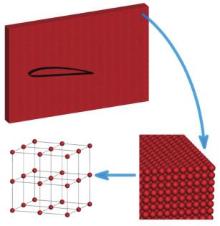
Fig. 1
Arrangement of fluid particles (color online)"
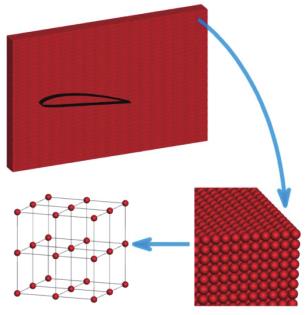
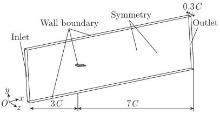
Fig. 2
Computational domain and boundary conditions"
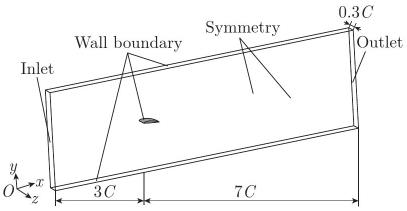
Table 1
Mesh-independent analysis"
| Mesh | Node | ||
|---|---|---|---|
| Mesh 1 | 3 904 320 | 0.12 | 0.75 |
| Mesh 2 | 4 411 840 | 0.12 | 0.75 |
| Mesh 3 | 4 974 430 | 0.12 | 0.75 |
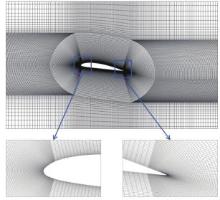
Fig. 3
Mesh division (color online)"
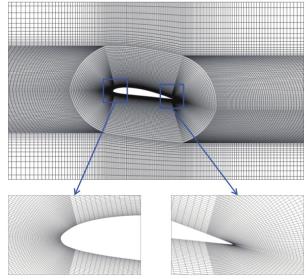
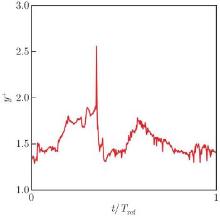
Fig. 4
Analysis of y+ (color online)"
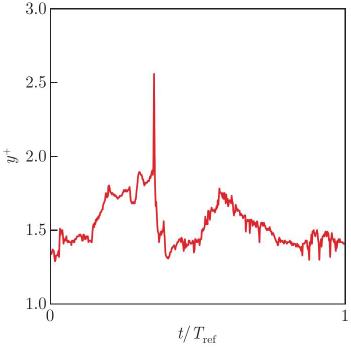
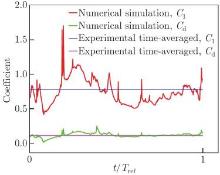
Fig. 5
Time-averaged lift coefficient Cl and drag coefficient Cd around hydrofoil (color online)"
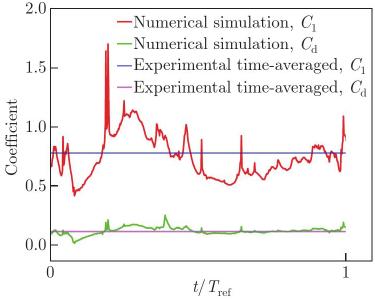
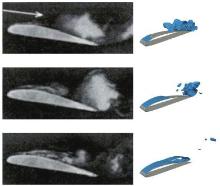
Fig. 6
Stage of new cavity formation and previously detached cavity collapse (color online)"
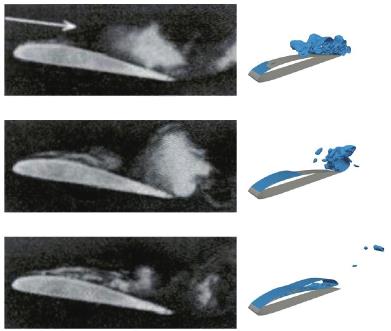
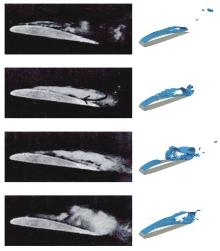
Fig. 7
Stage of cavity development (color online)"
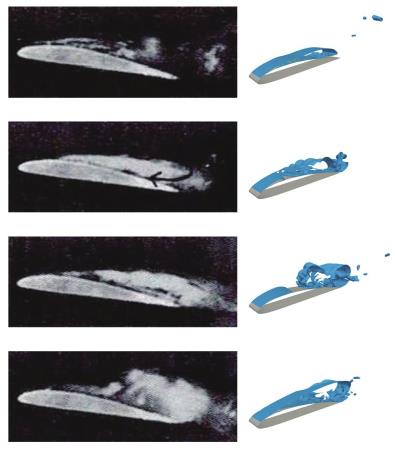
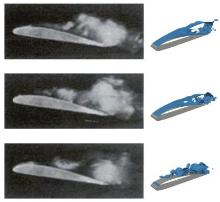
Fig. 8
Shedding stage of the cavity (color online)"
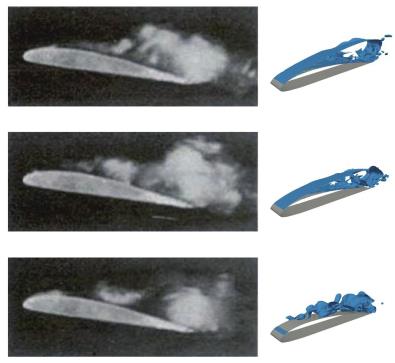
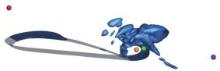
Fig. 9
Fluid particle positions of Stage I (color online)"
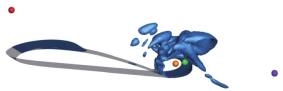
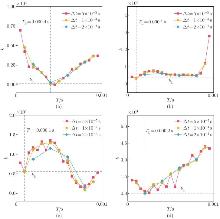
Fig. 10
LITS results of Stage I: (a) Particle A1; (b) Particle B1; (c) Particle C1; (d) Particle D1 (color online)"
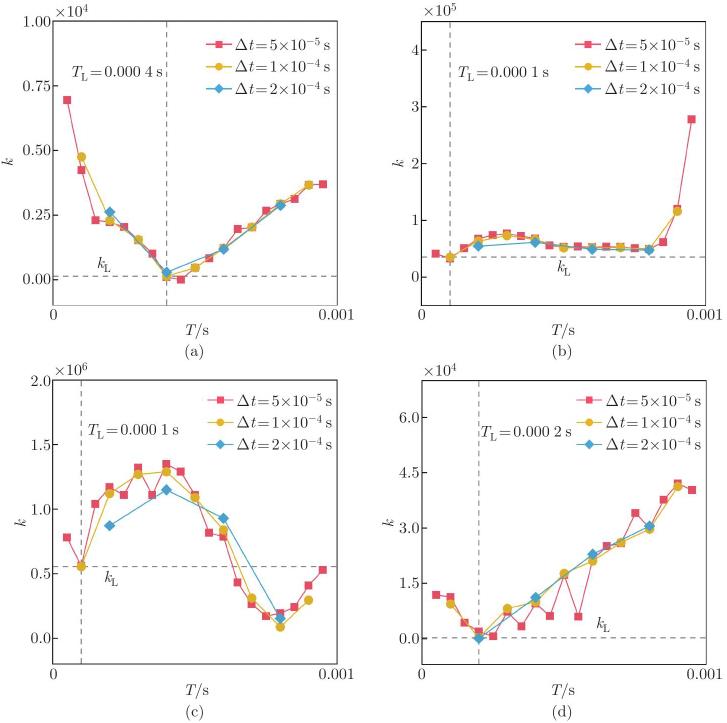
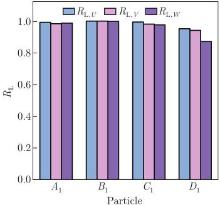
Fig. 11
Lagrangian velocity correlation coefficients of Stage I (color online)"
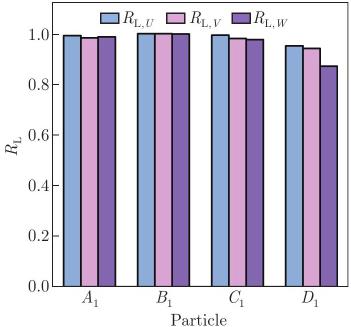
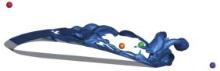
Fig. 12
Fluid particle positions of Stage II (color online)"
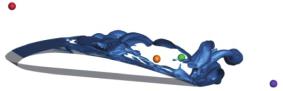
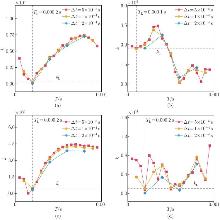
Fig. 13
LITS results of Stage II: (a) Particle A2; (b) Particle B2; (c) Particle C2; (d) Particle D2 (color online)"
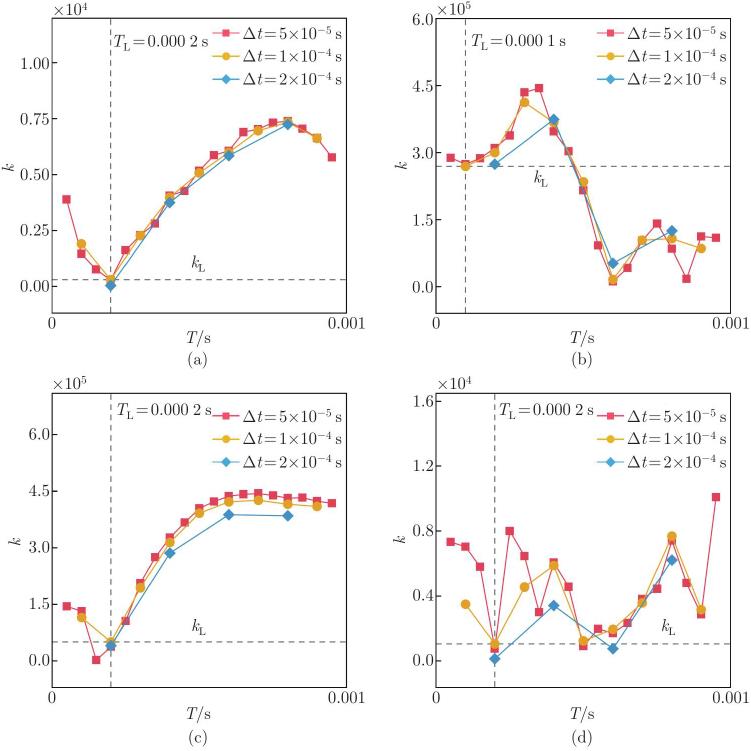
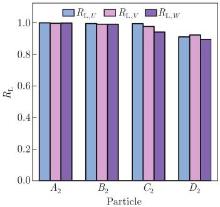
Fig. 14
Lagrangian velocity correlation coefficients of Stage III (color online)"
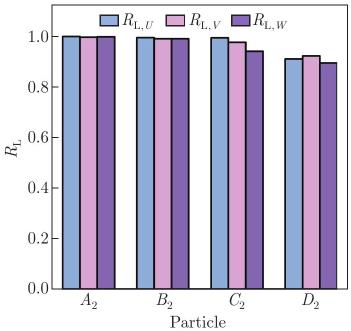

Fig. 15
Fluid particle positions of Stage III (color online)"

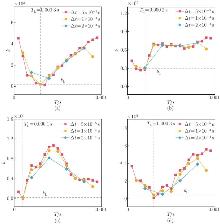
Fig. 16
LITS results of Stage III: (a) Particle A3; (b) Particle B3; (c) Particle C3; (d) Particle D3 (color online)"

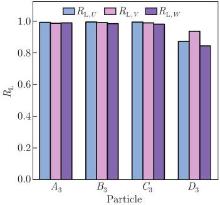
Fig. 17
Lagrangian velocity correlation coefficients of Stage III (color online)"
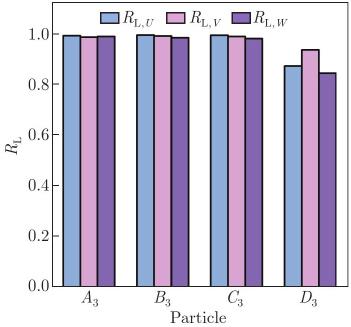
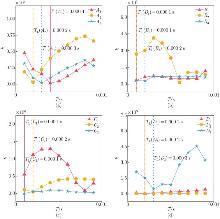
Fig. 18
Spatial and temporal analysis of the LITSs: (a) Particles A1, A2, and A3; (b) Particles B1, B2, and B3; (c) Particles C1, C2, and C3; (d) Particles D1, D2, and D3 (color online)"
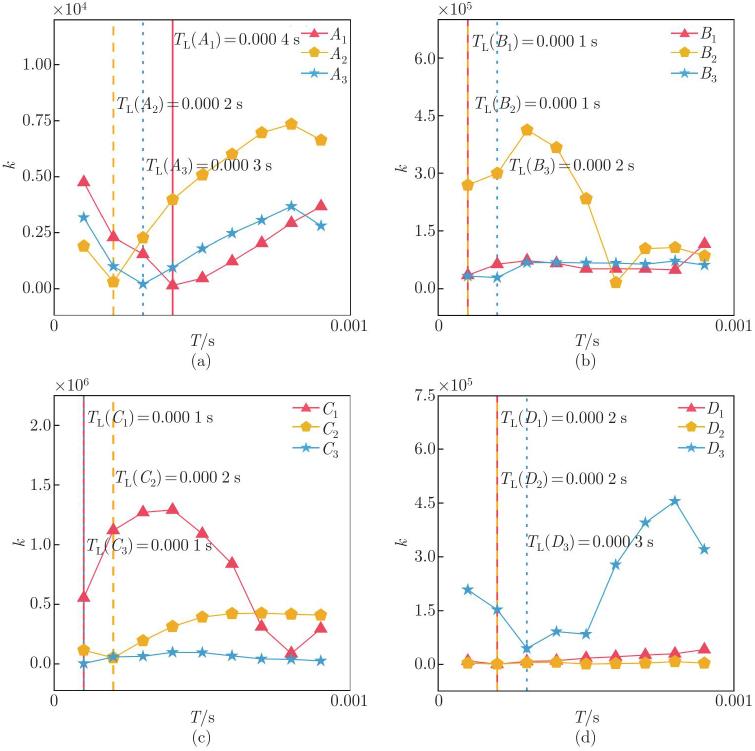
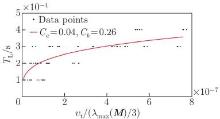
Fig. 19
Determination of model constants (color online)"
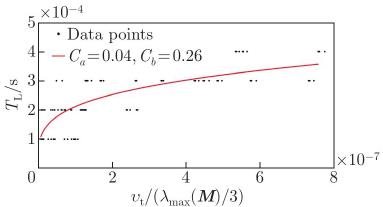
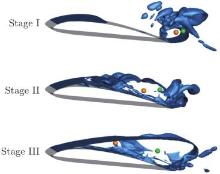
Fig. 20
Distributions of fluid particles (color online)"
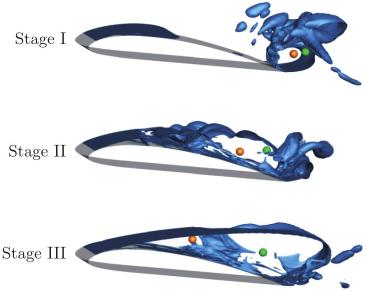
Table 2
LITS results derived from different methods (unit: s)"
| Particle | Berlemont model | FTLE method | New model |
|---|---|---|---|
| 0.000 419 847 0 | 0.000 1 | 0.000 145 501 | |
| 0.000 076 674 7 | 0.000 1 | 0.000 111 179 | |
| 0.000 211 756 0 | 0.000 1 | 0.000 138 492 | |
| 0.000 088 440 3 | 0.000 2 | 0.000 185 086 | |
| 0.000 082 910 7 | 0.000 2 | 0.000 165 730 | |
| 0.000 111 309 0 | 0.000 1 | 0.000 131 161 |
Table 3
Results of RL,U derived from different methods"
| Particle | Berlemont model | FTLE method | New model |
|---|---|---|---|
| 0.979 870 | 0.999 409 | 0.998 821 | |
| 0.994 288 | 0.993 632 | 0.991 963 | |
| 0.967 309 | 0.993 645 | 0.988 344 | |
| 0.985 182 | 0.992 924 | 0.993 697 | |
| 0.992 751 | 0.998 737 | 0.999 111 | |
| 0.975 325 | 0.997 816 | 0.996 334 |
Table 4
1pt Results of RL,V derived from different methods"
| Particle | Berlemont model | FTLE method | New model |
|---|---|---|---|
| 0.977 254 | 0.999 603 | 0.999 123 | |
| 0.984 935 | 0.980 115 | 0.972 441 | |
| 0.951 383 | 0.989 305 | 0.985 153 | |
| 0.988 061 | 0.975 398 | 0.978 168 | |
| 0.986 081 | 0.994 932 | 0.996 485 | |
| 0.977 460 | 0.993 160 | 0.988 032 |
Table 5
Results of RL,W derived from different methods"
| Particle | Berlemont model | FTLE method | New model |
|---|---|---|---|
| 0.973 202 | 0.998 412 | 0.996 920 | |
| 0.962 809 | 0.975 862 | 0.969 563 | |
| 0.940 683 | 0.988 975 | 0.979 073 | |
| 0.981 311 | 0.939 722 | 0.966 545 | |
| 0.986 683 | 0.988 059 | 0.991 612 | |
| 0.979 294 | 0.984 909 | 0.974 075 |
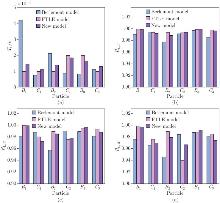
Fig. 21
Comparative results of different methods: (a) TL; (b) RL,U; (c) RL,V; (d) RL,W (color online)"
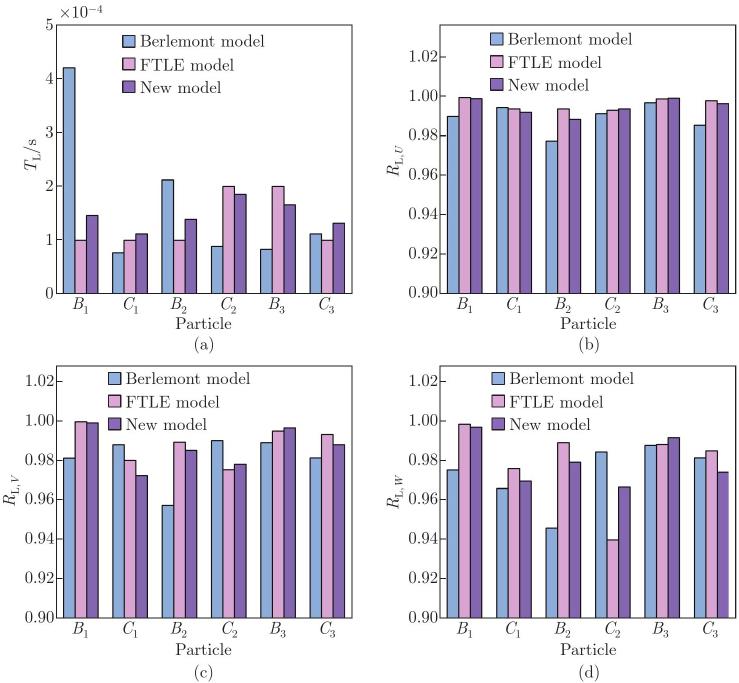
Table 6
Average Lagrangian velocity correlation coefficient derived from different methods"
| Coefficient | Berlemont model | FTLE method | New model |
|---|---|---|---|
| 0.980 970 | 0.988 034 | 0.987 215 |
| [1] | RICHARDSON, L. F. Atmospheric diffusion shown on a distance-neighbour graph. Proceedings of the Royal Society of London. Series A, 110(756), 709–737 (1926) |
| [2] | TAYLOR, G. I. Diffusion by continuous movements. Proceedings of the London Mathematical Society, s2-20(1), 196–212 (1922) |
| [3] | HINZE, J. O. Turbulence, McGraw-Hill, New York (1959) |
| [4] | HE, G., JIN, G., and ZHAO, X. Scale-similarity model for Lagrangian velocity correlations in isotropic and stationary turbulence. Physical Review E, 80(6), 66313 (2009) |
| [5] | KNORPS, M. and POZORSKI, J. Stochastic modeling for subgrid-scale particle dispersion in large-eddy simulation of inhomogeneous turbulence. Physics of Fluids, 33(4), 043323 (2021) |
| [6] | POPE, S. Lagrangian PDF methods for turbulent flows. Annual Review of Fluid Mechanics, 26(1), 23–63 (1994) |
| [7] | SAWFORD, B. Turbulent relative dispersion. Annual Review of Fluid Mechanics, 33(1), 289–317 (2001) |
| [8] | SWAATHI, P., DAS, S., and THYAGU, N. N. Inertial particle dynamics in traveling wave flow. arXiv, arXiv:2409.00484v1 (2024) |
| [9] | VERMA, A. and MAHESH, K. A Lagrangian subgrid-scale model with dynamic estimation of Lagrangian time scale for large eddy simulation of complex flows. Physics of Fluids, 24(8), 085101 (2012) |
| [10] | BERLEMONT, A., DESJONQUERES, P., and GOUESBET, G. Particle Lagrangian simulation in turbulent flows. International Journal of Multiphase Flow, 16(1), 19–34 (1990) |
| [11] | BURRY, D. and BERGELES, G. Dispersion of particles in anisotropic turbulent flows. International Journal of Multiphase Flow, 19(4), 651–664 (1993) |
| [12] | OESTERLÉ, B. and ZAICHIK, L. I. On Lagrangian time scales and particle dispersion modeling in equilibrium turbulent shear flows. Physics of Fluids, 16(9), 3374–3384 (2004) |
| [13] | CARLIER, J. P., KHALIJ, M., and OESTERLÉ, B. An improved model for anisotropic dispersion of small particles in turbulent shear flows. Aerosol Science and Technology, 39(3), 196–205 (2005) |
| [14] | DEGRAZIA, G., ANFOSSI, D., VELHO, H. F. D., and FERRERO, E. A Lagrangian decorrelation time scale in the convective boundary layer. Boundary-Layer Meteorology, 86(3), 525–534 (1998) |
| [15] | AHN, C. K. Generalized passivity-based chaos synchronization. Applied Mathematics and Mechanics (English Edition), 31(8), 1009–1018 (2010) https://doi.org/10.1007/s10483-010-1336-6 |
| [16] | ČOVIĆ, V., DJURIĆ, D., VESKOVIĆ, M., and OBRADOVIĆ, A. Lyapunov-Kozlov method for singular cases. Applied Mathematics and Mechanics (English Edition), 32(9), 1207–1220 (2011) https://doi.org/10.1007/s10483-011-1494-6 |
| [17] | DU, L., YANG, Y., and LEI, Y. M. Synchronization in a fractional-order dynamic network with uncertain parameters using an adaptive control strategy. Applied Mathematics and Mechanics (English Edition), 39(3), 353–364 (2018) https://doi.org/10.1007/s10483-018-2304-9 |
| [18] | FILIPOVIC, V. Global exponential stability of switched systems. Applied Mathematics and Mechanics (English Edition), 32(9), 1197–1206 (2011) https://doi.org/10.1007/s10483-011-1493-7 |
| [19] | WANG, X. H. and HUANG, N. J. Finite-time consensus of multi-agent systems driven by hyperbolic partial differential equations via boundary control. Applied Mathematics and Mechanics (English Edition), 42(12), 1799–1816 (2021) https://doi.org/10.1007/s10483-021-2789-6 |
| [20] | HALLER, G. and YUAN, G. Lagrangian coherent structures and mixing in two-dimensional turbulence. Physica D: Nonlinear Phenomena, 147(3-4), 352–370 (2000) |
| [21] | HO, R. D. J. G., CLARK, D., and BERERA, A. Chaotic measures as an alternative to spectral measures for analysing turbulent flow. Atmosphere, 15(9), 1053 (2024) |
| [22] | BOFFETTA, G., DAVOUDI, J., ECKHARDT, B., and SCHUMACHER, J. Lagrangian tracers on a surface flow: the role of time correlations. Physical Review Letters, 93(13), 134501 (2004) |
| [23] | DE DIVITIIS, N. Self-similarity in fully developed homogeneous isotropic turbulence using the Lyapunov analysis. Theoretical and Computational Fluid Dynamics, 26(1-4), 81–92 (2012) |
| [24] | BRENNEN, C. E. Cavitation and Bubble Dynamics, Oxford University Press, New York (1995) |
| [25] | DELALE, C. F. and PASINLIOĞLU, Ş. On the gas pressure inside cavitation bubbles. Physics of Fluids, 35(2), 023330 (2023) |
| [26] | SU, C. K., CAMARA, C., KAPPUS, B., and PUTTERMAN, S. J. Cavitation luminescence in a water hammer: upscaling sonoluminescence. Physics of Fluids, 15(6), 1457–1461 (2003) |
| [27] | WEI, A. B., YU, L. Y., QIU, L. M., and ZHANG, X. B. Cavitation in cryogenic fluids: a critical research review. Physics of Fluids, 34(10), 101303 (2022) |
| [28] | ZARESHARIF, M., RAVELET, F., KINAHAN, D. J., and DELAURE, Y. M. C. Cavitation control using passive flow control techniques. Physics of Fluids, 33(12), 121301 (2021) |
| [29] | WANG, G. Y., SENOCAK, I., SHYY, W., IKOHAGI, T., and CAO, S. L. Dynamics of attached turbulent cavitating flows. Progress in Aerospace Sciences, 37(6), 551–581 (2001) |
| [1] | M. M. BASKO. Numerical method for simulating rarefaction shocks in the approximation of phase-flip hydrodynamics [J]. Applied Mathematics and Mechanics (English Edition), 2021, 42(6): 871-884. |
| [2] | Xuelan ZHANG, Mingyao LUO, Peilai TAN, Liancun ZHENG, Chang SHU. Magnetic nanoparticle drug targeting to patient-specific atherosclerosis: effects of magnetic field intensity and configuration [J]. Applied Mathematics and Mechanics (English Edition), 2020, 41(2): 349-360. |
| [3] | Qiang LI, Yu GU, Huatao WANG. The influence of temperature on flow-induced forces on quartzcrystal-microbalance sensors in a Chinese liquor identification electronic-nose: three-dimensional computational fluid dynamics simulation and analysis [J]. Applied Mathematics and Mechanics (English Edition), 2019, 40(9): 1301-1312. |
| [4] | Zhenyu ZHANG, Ning ZHAO, Wei ZHONG, Long WANG, Bofeng XU. Progresses in application of computational fluid dynamic methods to large scale wind turbine aerodynamics [J]. Applied Mathematics and Mechanics (English Edition), 2016, 37(S1): 21-30. |
| [5] | WANG Yi. Essential consistency of pressure Poisson equation method and projection method on staggered grids [J]. Applied Mathematics and Mechanics (English Edition), 2011, 32(6): 789-794. |
| [6] | DU Gang;SUN Mao. Effects of unsteady deformation of flapping wing on its aerodynamic forces [J]. Applied Mathematics and Mechanics (English Edition), 2008, 29(6): 731-743 . |
| [7] | TANG You-gang;GU Jia-yang;ZUO Jian-li;MIN Jian-qin. NONLINEAR DYNAMICS RESPONSE OF CASING PIPE UNDER COMBINED WAVE-CURRENT [J]. Applied Mathematics and Mechanics (English Edition), 2005, 26(8): 1040-1046 . |
| [8] | Liu Xi-yun . SOLUTION TO THE FORM OF POlSSON EQUATION BY THE BOUNDARY ELEMENT METHODS [J]. Applied Mathematics and Mechanics (English Edition), 1994, 15(3): 229-234. |
| Viewed | ||||||
|
Full text |
|
|||||
|
Abstract |
|
|||||





 Email Alert
 RSS
RSS