Applied Mathematics and Mechanics (English Edition) ›› 2026, Vol. 47 ›› Issue (2): 255-282.doi: https://doi.org/10.1007/s10483-026-3351-9
Previous Articles Next Articles
N. A. SAEED1,2,3,†( ), Lei HOU2, Haiming YI2, A. A. SHUKUR4, S. M. ALAMRY5, S. M. EL-SHOURBAGY6
Received:2025-07-20
Revised:2025-12-08
Online:2026-02-04
Published:2026-02-04
Contact:
N. A. SAEED, E-mail: Nasser.A.Saeed@el-eng.menofia.edu.egSupported by:2010 MSC Number:
N. A. SAEED, Lei HOU, Haiming YI, A. A. SHUKUR, S. M. ALAMRY, S. M. EL-SHOURBAGY. On a broadband vibration isolator with tunable stiffness: from quasi-zero-stiffness to zero-stiffness behavior. Applied Mathematics and Mechanics (English Edition), 2026, 47(2): 255-282.
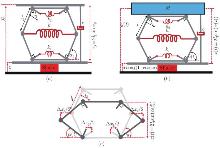
Fig. 1
Hexagonal-shaped vibration isolator: (a) undeformed, unloaded structure with springs at their natural lengths; (b) deformed, loaded structure at a general operating point; (c) mechanisms before and after deformation (color online)"
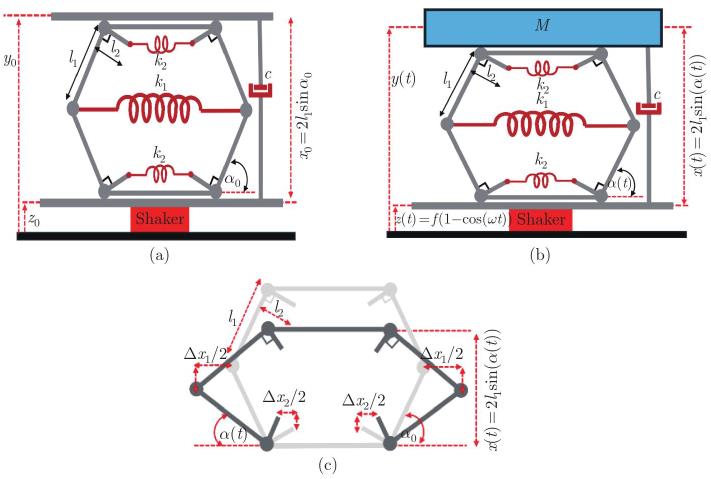
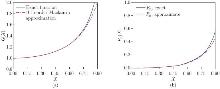
Fig. 2
(a) Exact function versus its 10th-order Maclaurin series approximation for G(X), as given by Eq. (13); (b) exact function versus its 10th-order Maclaurin series approximation for FR(X), as given by Eqs. (15) and (16) with α0=π/3, δ=1−cosα0, and W=δsinα0 (color online)"
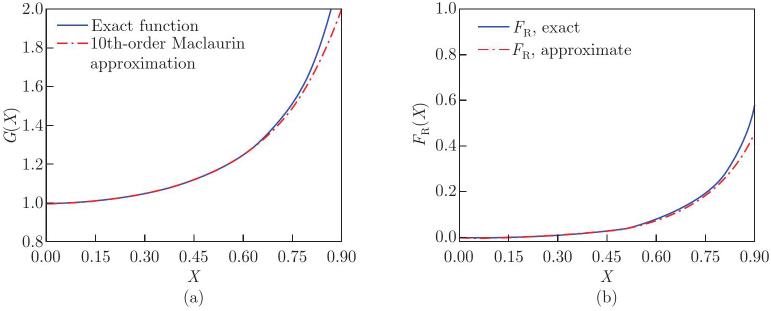
Fig. 3
Variations of FR(X) with X for different initial inclination angles α0 with δ=1−cosα0 and W=δsinα0: (a) two-dimensional (2D); (b) three-dimensional (3D). Variations of KEq(X) with X for different initial inclination angles α0 with δ=1−cosα0: (c) 2D; (d) 3D (color online)"
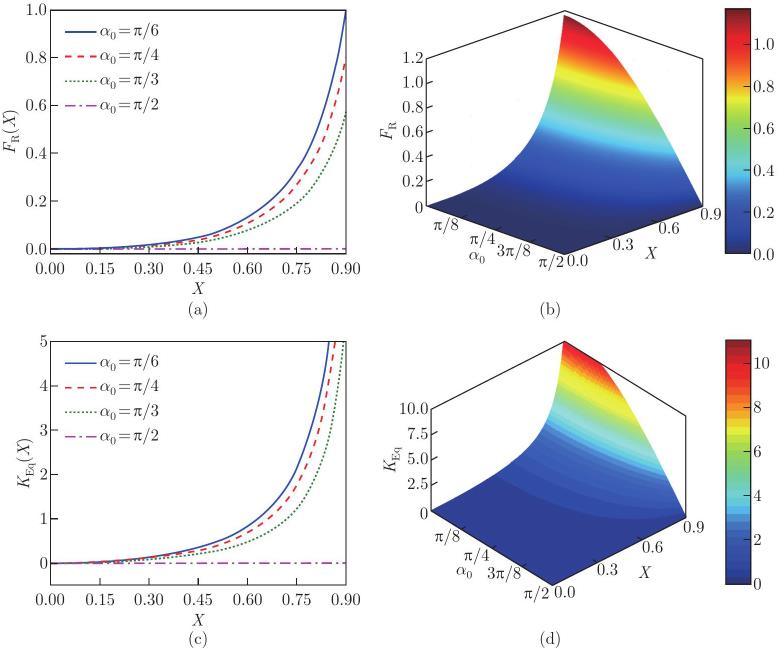
Fig. 4
Static equilibrium point XEq bifurcation of the considered isolator against the load ratio R=W/(δsinα0) for different stiffness coefficients δ: (a) α0=π/3, (b) α0=7π/18, (c) α0=8π/18, and (d) α0=88π/180 (color online)"
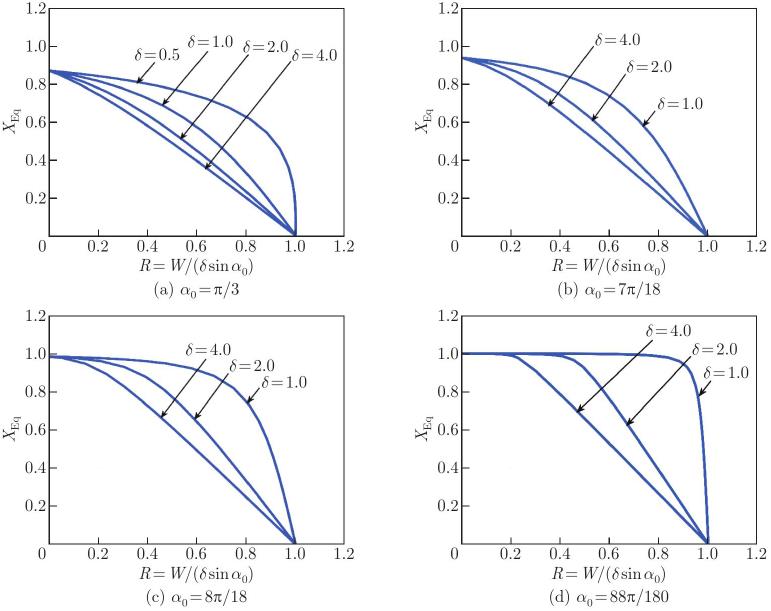
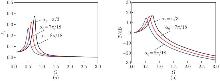
Fig. 5
(a) Isolated mass relative oscillation amplitude Ar and (b) the corresponding displacement transmissibility T at different initial inclination angles α0 for F=0.05, δ=1.0, μ=0.1, and R=0.9 (color online)"
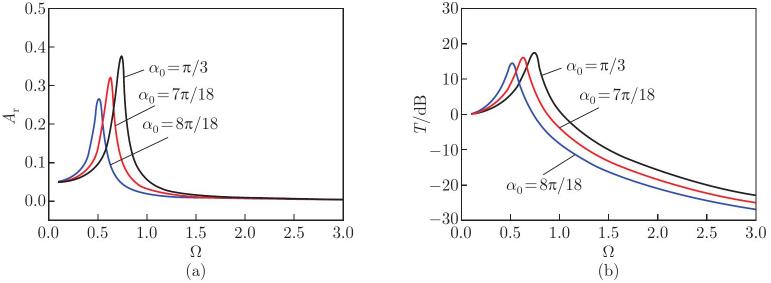
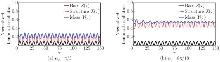
Fig. 6
Isolator time-responses corresponding to Fig. 5 when Ω=1.0: (a) α0=π/3 and (b) α0=8π/18, when Ω=1.0, F=0.05, δ=1.0, μ=0.1, and R=0.9 (color online)"
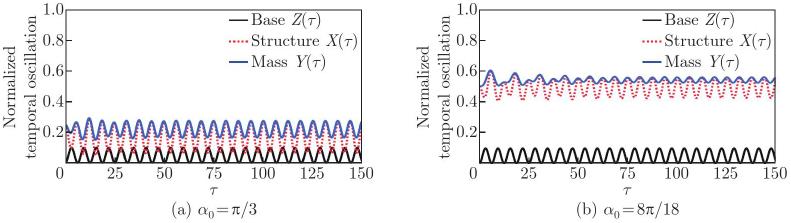
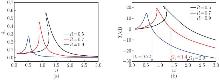
Fig. 7
(a) Isolated mass relative oscillation amplitude Ar and (b) the corresponding displacement transmissibility T at different load ratios R for F=0.05, δ=1.0, α0=8π/18, and μ=0.1 (color online)"
Fig. 8
Isolator time-responses corresponding to Fig. 7 when Ω=0.8: (a) and (b) R=0.7; (c) and (d) R=0.9, when Ω=0.8, F=0.05, δ=1.0, μ=0.1, and α0=8π/18 (color online)"
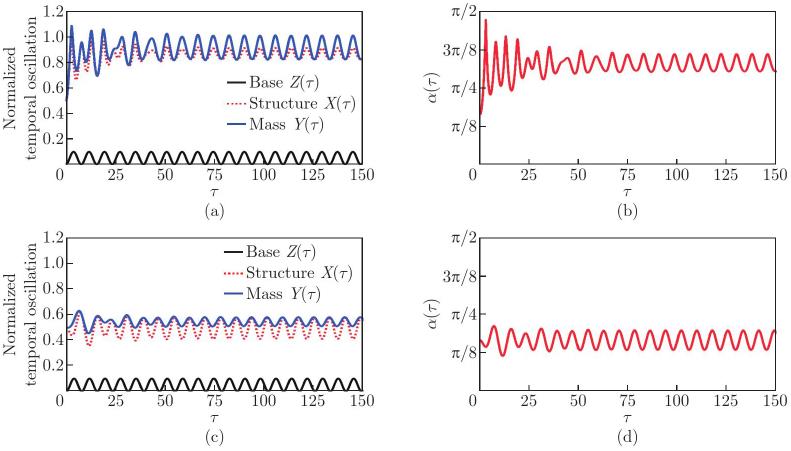
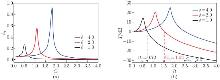
Fig. 9
(a) Isolated mass relative oscillation amplitude Ar and (b) the corresponding displacement transmissibility T at different stiffness ratios δ for F=0.05, R=0.9, α0=8π/18, and μ=0.1 (color online)"
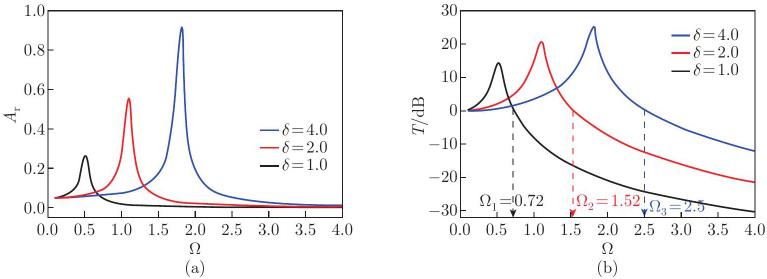
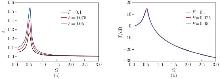
Fig. 10
(a) Isolated mass relative oscillation amplitude Ar and (b) the corresponding displacement transmissibility T at different base excitation amplitudes F for R=0.9, δ=1.0, α0=8π/18, and μ=0.1 (color online)"
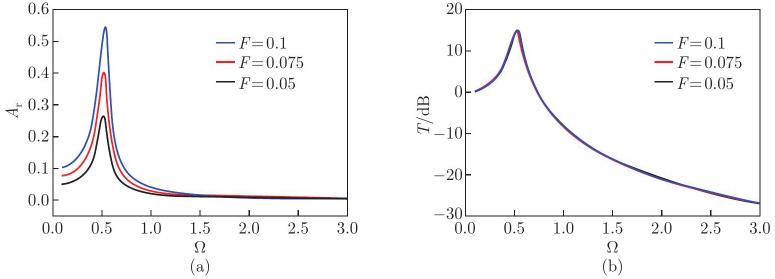
Fig. 11
(a) Isolated mass relative oscillation amplitude Ar and (b) the corresponding displacement transmissibility T at different damping coefficients μ for F=0.05, R=0.9, δ=1.0, and α0=8π/18 (color online)"
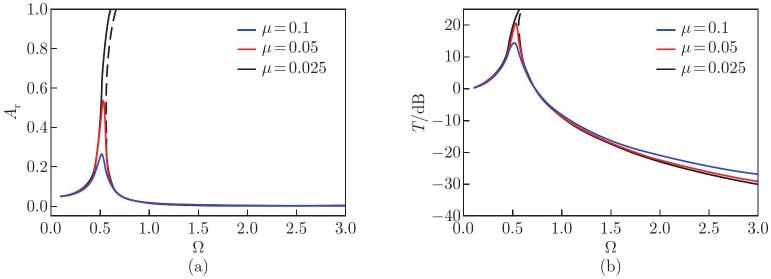
Fig. 12
Static equilibrium point XEq bifurcation of the considered isolator when δ=1−cosα0: (a) XEq against the load ratio R=W/(δsinα0) for different inclination angles α0; (b) XEq against the inclination angle α0 for different load ratios R (color online)"
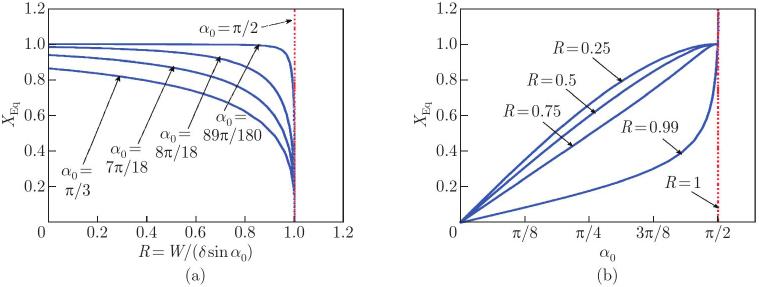
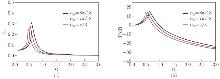
Fig. 13
(a) Isolated mass relative oscillation amplitude Ar and (b) the corresponding displacement transmissibility T at different initial inclination angles α0 for F=0.05, δ=1−cosα0, μ=0.1, and R=0.9 (color online)"
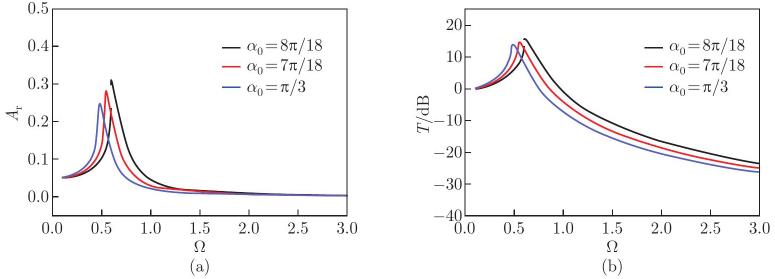
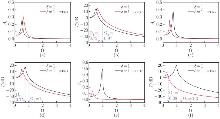
Fig. 14
Isolated mass relative oscillation amplitude Ar and the corresponding displacement transmissibility T at different initial inclination angles α0 for F=0.05, μ=0.1, and R=0.9 when δ=1 and δ=1−cosα0: (a) and (b) α0=8π/18; (c) and (d) α0=π/3; (e) and (f) α0=π/6 (color online)"
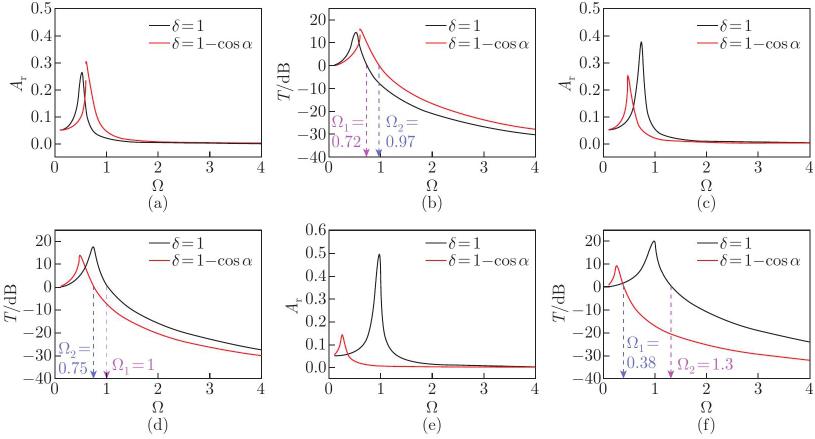
Fig. 15
Isolator time-responses corresponding to Figs. 14(a) and 14(b) when Ω=0.8, F=0.05, μ=0.1, R=0.9, and α0=8π/18: (a) δ=1.0; (b) δ=1−cosα0 (color online)"
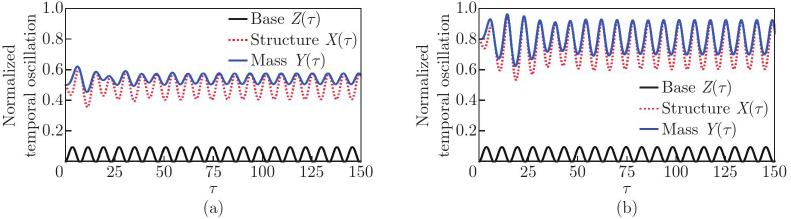
Fig. 16
Isolator time-responses corresponding to Figs. 14(e) and 14(f) when Ω=3.0, F=0.05, μ=0.1, R=0.9, and α0=π/6: (a) δ=1.0; (b) δ=1−cosα0 (color online)"
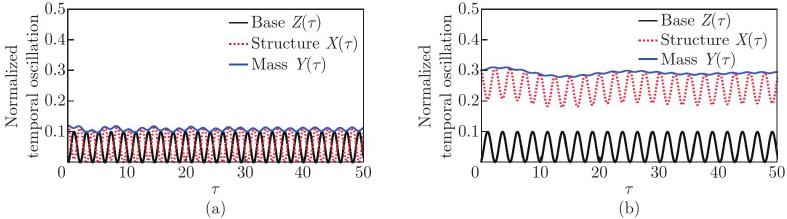
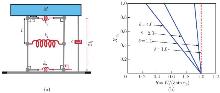
Fig. 17
(a) Full-band zero-stiffness vibration isolator with the initial inclination angle α0=π/2 and (b) static equilibrium point XEq bifurcation of the considered system against the load ratio R=W/δ for different stiffness ratios δ (color online)"
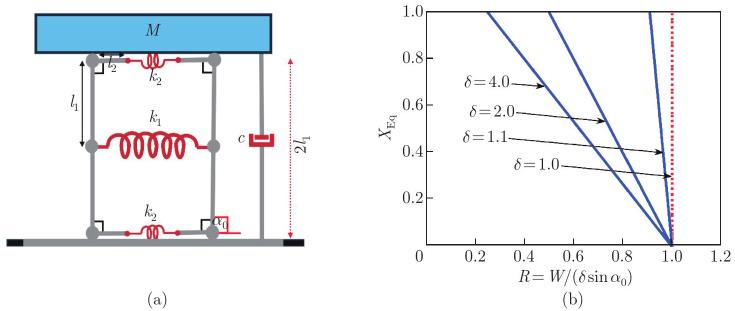
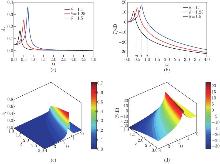
Fig. 18
Isolated mass relative oscillation amplitude Ar (left) and the corresponding displacement transmissibility T of the considered isolator system (right) when α0=π/2 and W=1.09 for different stiffness ratios δ: (a) and (b) Ar and T versus Ω for δ=1.1, 1.25, and 1.5; (c) and (d) 3D surface plots of Ar and T in the δΩ-plane (color online)"
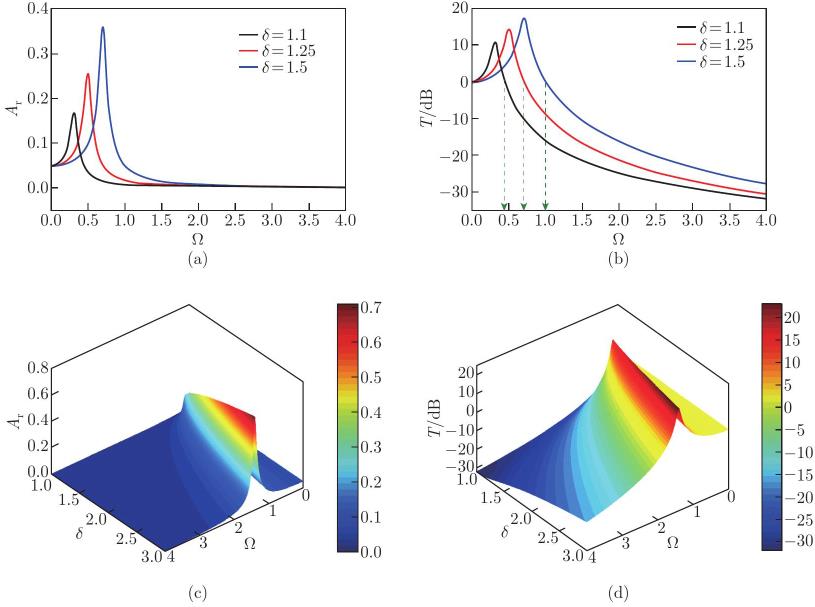
Fig. 19
Isolator time-responses corresponding to Fig. 18 when Ω=1.0, F=0.05, W=1.09, μ=0.1, and α0=π/2: (a) and (b) δ=1.1; (c) and (d) δ=1.5 (color online)"
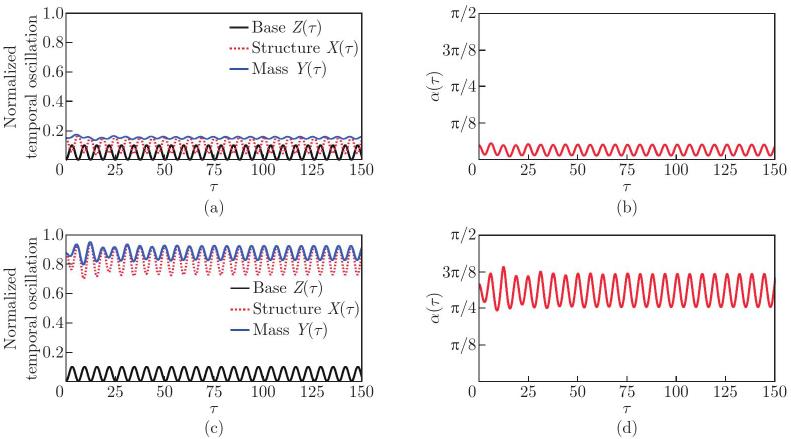
Fig. 20
Time-domain responses demonstrating impact-coexisting behavior at Ω=1.0 when F=0.05, μ=0.1, α0=π/2, W=1, and e=0.8 resulting in a static equilibrium at XEq=1, forcing the system to operate at its mechanical limit and causing repeated impacts during excitation: (a) and (b) corresponding to δ=1.1, while (c) and (d) corresponding to δ=1.5 (color online)"
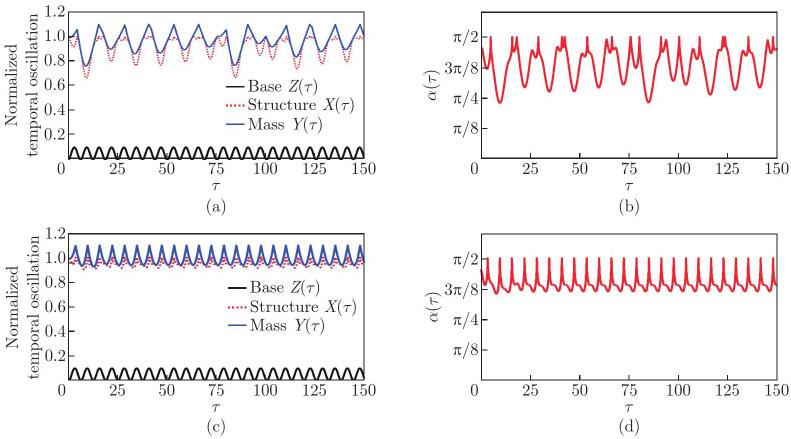
Fig. 21
Isolated mass relative oscillation amplitude Ar (left) and the corresponding displacement transmissibility T of the full-band isolator system (right) when α0=π/2 and δ=W=1 for different damping ratios μ: (a) and (b) Ar and T versus Ω for μ=0.0, 0.01, 0.05, and 0.1; (c) and (d) 3D surface plots of Ar and T in the δΩ-plane (color online)"
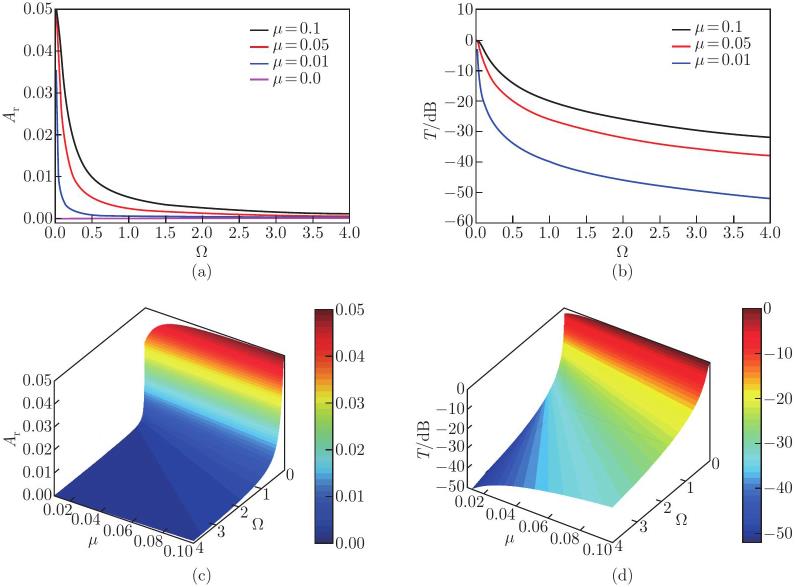
Fig. 22
Full-band vibration isolator time-responses corresponding to Fig. 21 when Ω=0.1, F=0.05, δ=W=1.0, and α0=π/2 and the initial conditions X(0)=0.5 and X˙(0)=0: (a) and (b) μ=0.1; (c) and (d) μ=0.01; (e) and (f) μ=0.0 (color online)"
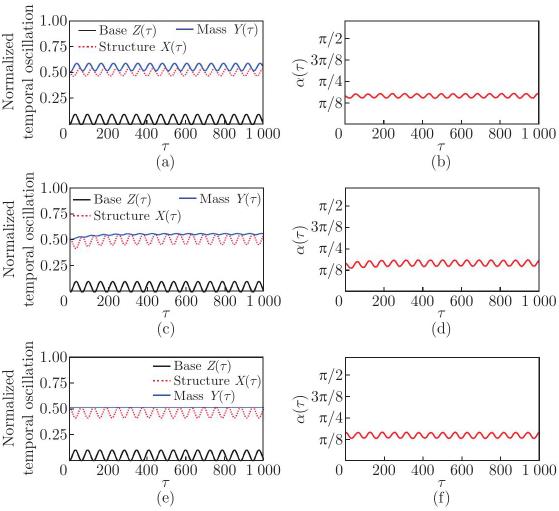
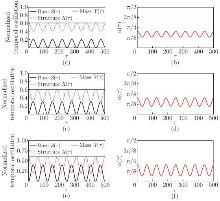
Fig. 23
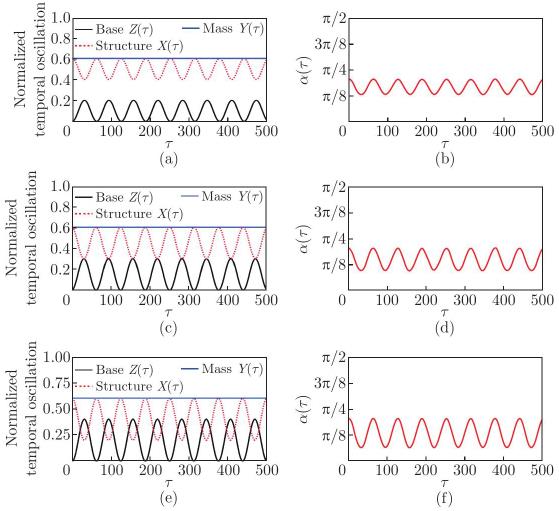
Full-band vibration isolator time-responses corresponding to Fig. 20 when μ=0, δ=W=1, α0=π/2, Ω=0.1, and the initial conditions X(0)=0.6 and X′(0)=0: (a) and (b) F=0.1; (c) and (d) F=0.15; (e) and (f) F=0.2 (color online)"
| [1] | MEAD, D. J. Passive Vibration Control, 1st ed., Wiley, Chichester (1998) |
| [2] | IBRAHIM, R. A. Recent advances in nonlinear passive vibration isolators. Journal of Sound and Vibration, 314, 371–452 (2008) |
| [3] | VAKAKIS, A. F., GENDELMAN, O. V., BERGMAN, L. A., MCFARLAND, D. M., KERSCHEN, G., and LEE, Y. S. Nonlinear Targeted Energy Transfer in Mechanical and Structural Systems, Springer, Dordrecht (2008) |
| [4] | GENDELMAN, O. V. Transition of energy to a nonlinear localized mode in a highly asymmetric system of two oscillators. Nonlinear Dynamics, 25, 237–253 (2001) |
| [5] | FENG, X., JING, X., and GUO, Y. Vibration isolation with passive linkage mechanisms. Nonlinear Dynamics, 106, 1891–1927 (2021) |
| [6] | ALUJEVIĆ, N., ČAKMAK, D., WOLF, H., and JOKIĆ, M. Passive and active vibration isolation systems using inerter. Journal of Sound and Vibration, 418(31), 163–183 (2018) |
| [7] | CARRELLA, A., BRENNAN, M. J., and WATERS, T. P. Static analysis of a passive vibration isolator with quasi-zero-stiffness characteristic. Journal of Sound and Vibration, 301(3-5), 678–689 (2007) |
| [8] | KOVACIC, I., BRENNAN, M. J., and WATERS, T. P. A study of a nonlinear vibration isolator with a quasi-zero stiffness characteristic. Journal of Sound and Vibration, 315(3), 700–711 (2008) |
| [9] | MA, Z., ZHOU, R., and YANG, Q. Recent advances in quasi-zero stiffness vibration isolation systems: an overview and future possibilities. Machines, 10(9), 813 (2022) |
| [10] | CARRELLA, A., BRENNAN, M., WATERS, T., and LOPES, V. Force and displacement transmissibility of a nonlinear isolator with high-static-low-dynamic-stiffness. International Journal of Mechanical Sciences, 55(1), 22–29 (2012) |
| [11] | LE, T. D. and AHN, K. K. Experimental investigation of a vibration isolation system using negative stiffness structure. International Journal of Mechanical Sciences, 70, 99–112 (2013) |
| [12] | HU, Y., ZHANG, H., WANG, K., FANG, Y., and MA, C. Analytical analysis of vibration isolation characteristics of quasi-zero stiffness suspension backpack. International Journal of Dynamics and Control, 12, 4387–4397 (2024) |
| [13] | HUANG, X. C., LIU, X. T., SUN, J. Y., ZHANG, Z. Y., and HUA, H. X. Vibration isolation characteristics of a nonlinear isolator using Euler buckled beam as negative stiffness corrector: a theoretical and experimental study. Journal of Sound and Vibration, 333(4), 1132–1148 (2014) |
| [14] | HUANG, X. C., LIU, X. T., and HUA, H. X. Effects of stiffness and load imperfection on the isolation performance of a high-static-low-dynamic-stiffness non-linear isolator under base displacement excitation. International Journal of Non-Linear Mechanics, 65, 32–43 (2014) |
| [15] | ZHOU, J., WANG, X., XU, D., and BISHOP, S. Nonlinear dynamic characteristics of a quasi-zero stiffness vibration isolator with cam-roller-spring mechanisms. Journal of Sound and Vibration, 346, 53–69 (2015) |
| [16] | GATTI, G., BRENNAN, M. J., and TANG, B. Some diverse examples of exploiting the beneficial effects of geometric stiffness nonlinearity. Mechanical Systems and Signal Processing, 125, 4–20 (2019) |
| [17] | SUN, X., JING, X., XU, J., and CHENG, L. Vibration isolation via a scissor-like structured platform. Journal of Sound and Vibration, 333, 2404–2420 (2014) |
| [18] | ZHANG, W. and ZHAO, J. Analysis on nonlinear stiffness and vibration isolation performance of scissor-like structure with full types. Nonlinear Dynamics, 86, 17–36 (2016) |
| [19] | ZOU, W., CHENG, C., MA, R., HU, Y., and WANG, W. Performance analysis of a quasi-zero stiffness vibration isolation system with scissor-like structures. Archive of Applied Mechanics, 91(1), 117–133 (2020) |
| [20] | LU, Z. Q., GU, D. H., DING, H., LACARBONARA, W., and CHEN, L. Q. Nonlinear vibration isolation via a circular ring. Mechanical Systems and Signal Processing, 136, 106490 (2020) |
| [21] | QIU, Y., ZHU, Y., LUO, Z., GAO, Y., and LI, Y. The analysis and design of nonlinear vibration isolators under both displacement and force excitations. Archive of Applied Mechanics, 91(5), 2159–2178 (2021) |
| [22] | YE, K., JI, J. C., and BROWN, T. A novel integrated quasi-zero stiffness vibration isolator for coupled translational and rotational vibrations. Mechanical Systems and Signal Processing, 149, 107340 (2021) |
| [23] | HAO, Z. and CAO, Q. The isolation characteristics of an archetypal dynamical model with stable-quasi-zero-stiffness. Journal of Sound and Vibration, 340, 61–79 (2015) |
| [24] | ZHOU, J., WANG, K., XU, D., OUYANG, H., and LI, Y. A six degrees-of-freedom vibration isolation platform supported by a hexapod of quasi-zero-stiffness struts. Journal of Vibration and Acoustics, 139(3), 034502 (2017) |
| [25] | ZHOU, J., WANG, K., XU, D., OUYANG, H., and FU, Y. Vibration isolation in neonatal transport by using a quasi-zero-stiffness isolator. Journal of Vibration and Control, 24(15), 3278–3291 (2018) |
| [26] | WANG, X., ZHOU, J., XU, D., OUYANG, H., and DUAN, Y. Force transmissibility of a two-stage vibration isolation system with quasi-zero stiffness. Nonlinear Dynamics, 87(1), 633–646 (2017) |
| [27] | GUO, L., WANG, X., FAN, R. L., and BI, F. R. Review on development of high-static-low-dynamic-stiffness seat cushion mattress for vibration control of seating suspension system. Applied Sciences, 10, 2887 (2020) |
| [28] | LIU, C., TANG, J., YU, K., LIAO, B., HU, R., and ZANG, X. On the characteristics of a quasi-zero-stiffness vibration isolator with viscoelastic damper. Applied Mathematical Modelling, 88, 367–381 (2020) |
| [29] | CHANG, Y., ZHOU, J., WANG, K., and XU, D. A quasi-zero-stiffness dynamic vibration absorber. Journal of Sound and Vibration, 494, 115859 (2021) |
| [30] | LIU, Y., WANG, X., XUE, Y., DENG, E., WANG, Y., SONG, C., and FENG, Q. Dynamic analysis of quasi-zero stiffness vibration isolation system coupled with frequency adjustable dynamic vibration absorber. Archive of Applied Mechanics, 92, 3631–3647 (2022) |
| [31] | MENG, Q., HOU, L., WANG, A, LIN, R., LI, Z., ZHONG, S., CHEN, Y., SAEED, N. A., MOHAMED, A. F., and AWWAD, E. M. Subharmonic response suppression of a quasi-zero stiffness system. Journal of Sound and Vibration, 594, 118674 (2025) |
| [32] | MENG, Q., HOU, L., LIN, R., CHEN, Y., SAEED, N. A., FOULY, A., and AWWAD, E. M. On a quasi-zero stiffness vibration isolator with multiple zero stiffness points for mass load deviation. Applied Mathematical Modelling, 145, 116112 (2025) |
| [33] | SAEED, N. A., ELLABBAN, Y. Y., HOU, L., ZHONG, S., and DURAIHEM, F. Z. Geometric nonlinear dynamics of a quasi-zero stiffness isolator integrated with an energy harvester: monostable, perfect zero-linear stiffness, and bistable oscillation modes. Chaos, Solitons & Fractals, 199(1), 116633 (2025) |
| [34] | BANERJEE, P., BALAJI, P. S., and MURUGAN, S. A dual-function compliant metastructure based on quasi-zero-stiffness for combined vibration isolation and vibration energy harvesting. International Journal of Dynamics and Control, 13, 135 (2025) |
| [35] | JING, X. The Bio-Inspired X-Structure/Mechanism Approach for Exploring Nonlinear Benefits in Engineering, Springer Nature, Singapore (2024) |
| [36] | LIU, C., JING, X., and LI, F. Vibration isolation using a hybrid lever-type isolation system with an X-shape supporting structure. International Journal of Mechanical Sciences, 98, 169–177 (2015) |
| [37] | CHAI, Y., JING, X., and CHAO, X. X-shaped mechanism based enhanced tunable QZS property for passive vibration isolation. International Journal of Mechanical Sciences, 218, 107077 (2022) |
| [38] | WU, Z., LIU, W., LI, F., and ZHANG, C. Band-gap property of a novel elastic metamaterial beam with X-shaped local resonators. Mechanical Systems and Signal Processing, 134, 106357 (2019) |
| [39] | BIAN, J. and JING, X. Analysis and design of a novel and compact X-structured vibration isolation mount (X-mount) with wider quasi-zero-stiffness range. Nonlinear Dynamics, 101, 2195–2222 (2020) |
| [40] | BIAN, J. and JING, X. A nonlinear X-shaped structure based tuned mass damper with multi-variable optimization (X-absorber). Communications in Nonlinear Science and Numerical Simulation, 99, 105829 (2021) |
| [41] | ZHOU, S., LIU, Y., JIANG, Z., and REN, Z. Nonlinear dynamic behavior of a bio-inspired embedded X-shaped vibration isolation system. Nonlinear Dynamics, 110, 153–175 (2022) |
| [42] | XIONG, X., WANG, Y., LI, J., and LI, F. Internal resonance analysis of bio-inspired X-shaped structure with nonlinear vibration absorber. Mechanical Systems and Signal Processing, 185, 109809 (2023) |
| [43] | SAEED, N. A., ELLABBAN, Y. Y., MOATIMID, G. M., HOU, L., and MOHAMED, A. F. Nonlinear interactions of an n-layer X-shape low-frequency vibration isolator equipped with a nonlinear vibration absorber at 1:1 internal resonance: analytical and numerical investigations. Physica Scripta, 99(10), 105207 (2024) |
| [44] | SAEED, N. A., ELLABBAN, Y. Y., HOU, L., MOATIMID, G. M., ZHONG, S., and DURAIHEM, F. Z. Nonlinear dynamics of a bio-inspired 2-DOF low-frequency X-shaped vibration isolator with m-to-n layers driven harmonically under simultaneous primary and 1:1 internal resonances. Chaos, Solitons & Fractals, 190, 115786 (2025) |
| [45] | SUI, G., HOU, S., ZHANG, X., SHAN, X., HOU, C., SONG, H., HOU, W., and LI, J. A bio-inspired spider-like structure isolator for low-frequency vibration. Applied Mathematics and Mechanics (English Edition), 44(8), 1263–1286 (2023) https://doi.org/10.1007/s10483-023-3020-9 |
| [46] | PU, H., LIU, J., WANG, M., DING, J., SUN, Y., PENG, Y., and LUO, J. Bio-inspired quasi-zero stiffness vibration isolator with quasilinear negative stiffness in full stroke. Journal of Sound and Vibration, 574, 118240 (2024) |
| [47] | WU, Z., JING, X., BIAN, J., LI, F., and ALLEN, R. Vibration isolation by exploring bio-inspired structural nonlinearity. Bioinspiration & Biomimetics, 10, 056015 (2015) |
| [48] | PAN, H., JING, X., SUN, W., and LI, Z. Analysis and design of a bioinspired vibration sensor system in noisy environment. ASME Transactions on Mechatronics, 23(2), 845–855 (2018) |
| [49] | WANG, Y., JING, X., DAI, H., and LI, F. M. Subharmonics and ultra-subharmonics of a bio-inspired nonlinear isolation system. International Journal of Mechanical Sciences, 152, 167–184 (2019) |
| [50] | WANG, Y., JING, X., and GUO, Y. Nonlinear analysis of a bio-inspired vertically asymmetric isolation system under different structural constraints. Nonlinear Dynamics, 95, 445–464 (2019) |
| [51] | JIANG, G., JING, X., and GUO, Y. A novel bio-inspired multi-joint anti-vibration structure and its nonlinear HSLDS properties. Mechanical Systems and Signal Processing, 138, 106552 (2020) |
| [52] | YAN, G., ZOU, H., WANG, S., ZHAO, L., WU, Z., and ZHANG, W. Bio-inspired vibration isolation: methodology and design. Applied Mechanics Reviews, 73, 020801 (2021) |
| [53] | OU, H., SUN, X., WU, Q., CHEN, Z., CHEN, Z., CHEN, Q., and HU, L. A novel bio-inspired kangaroo leg structure for low-frequency vibration isolation. Nonlinear Dynamics, 112, 1797–1814 (2024) |
| [54] | SAEED, N. A., MOHAMED, M. S., and ELAGAN, S. K. Periodic, quasi-periodic, and chaotic motions to diagnose a crack on a horizontally supported nonlinear rotor system. Symmetry, 12, 2059 (2020) |
| [55] | SAEED, N. A., MOATIMID, G. M., ELSABAA, F. M. F., and ELLABBAN, Y. Y. Time-delayed control to suppress a nonlinear system vibration utilizing the multiple scales homotopy approach. Archive of Applied Mechanics, 91, 1193–1215 (2021) |
| [56] | EISSA, M., KAMEL, M., SAEED, N. A., EL-GANAINI, W., and EL-GOHARY, H. Time-delayed positive-position and velocity feedback controller to suppress the lateral vibrations in nonlinear Jeffcott-rotor system. Menoufia Journal of Electronic Engineering Research, 27, 261–278 (2018) |
| [57] | SAEED, N. A., MOHAMED, M. S., ELAGAN, S. K., and AWREJCEWICZ, J. Integral resonant controller to suppress the nonlinear oscillations of a two-degree-of-freedom rotor active magnetic bearing system. Processes, 10, 271 (2022) |
| [58] | SAEED, N. A., MOATIMID, G. M., ELSABAA, F. M., ELLABBAN, Y. Y., ELAGAN, S. K., and MOHAMED, M. S. Time-delayed nonlinear integral resonant controller to eliminate the nonlinear oscillations of a parametrically excited system. IEEE Access, 9, 74836–74854 (2021) |
| [59] | EL-SHOURBAGY, S. M., SAEED, N. A., KAMEL, M., RASLAN, K. R., ABOUEL NASR, E., and AWREJCEWICZ, J. On the performance of a nonlinear position-velocity controller to stabilize rotor-active magnetic-bearings system. Symmetry, 13, 2069 (2021) |
| [60] | SAEED, N. A., EL-BENDARY, S., SAYED, M., MOHAMED, M., and ELAGAN, S. On the oscillatory behaviours and rub-impact forces of a horizontally supported asymmetric rotor system under position-velocity feedback controller. Latin American Journal of Solids and Structures, 18(2), e349, (2021) |
| [61] | SAEED, N. A., AWREJCEWICZ, J., HAFEZ, S. T., HOU, L., and ABOUDAIF, M. K. Stability, bifurcation, and vibration control of a discontinuous nonlinear rotor model under rub-impact effect. Nonlinear Dynamics, 111, 20661–20697 (2023) |
| [62] | PAN, H., JING, X., SUN, W., and GAO, H. A bioinspired dynamics-based adaptive tracking control for nonlinear suspension systems. IEEE Transactions on Control Systems Technology, 26(3), 903–914 (2018) |
| [63] | SUN, K., TANG, J., YANG, Y., JIANG, B., LI, Y., and CAO, D. Active control of quasi-zero-stiffness vibration isolator with variable load. International Journal of Structural Stability and Dynamics, 24(21), 2450243 (2024) |
| [64] | WEI, C. H-infinity optimal control based on output feedback for nonlinear two-degree-of-freedom vibration isolator with quasi-zero stiffness. Acta Mechanica, 235, 6365–6378 (2024) |
| [65] | WU, J., HONG, L., and JIANG, J. A robust and efficient stability analysis of periodic solutions based on harmonic balance method and Floquet-Hill formulation. Mechanical Systems and Signal Processing, 173, 109057 (2023) |
| [1] | N. A. SAEED, Y. Y. ELLABBAN, Lei HOU, Haiming YI, Shun ZHONG, F. Z. DURAIHEM, O. M. OMARA. Nonlinear vibration of quasi-zero stiffness structure with piezoelectric harvester and RL-load: intra-well and inter-well oscillation modes under 1:1 internal resonance [J]. Applied Mathematics and Mechanics (English Edition), 2025, 46(8): 1451-1474. |
| [2] | Jie JING, Xiaoye MAO, Hu DING, Honggang LI, Liqun CHEN. Modeling and mechanism of vibration reduction of pipes by visco-hyperelastic materials [J]. Applied Mathematics and Mechanics (English Edition), 2025, 46(6): 1029-1048. |
| [3] | Meng LI, Hu DING. A vertical track nonlinear energy sink [J]. Applied Mathematics and Mechanics (English Edition), 2024, 45(6): 931-946. |
| [4] | Jian ZANG, Ronghuan XIAO, Yewei ZHANG, Liqun CHEN. A novel way for vibration control of FGM fluid-conveying pipes via NiTiNOL-steel wire rope [J]. Applied Mathematics and Mechanics (English Edition), 2023, 44(6): 877-896. |
| [5] | Xin FAN, Changan ZHU, Xiaoye MAO, Hu DING. Adjacent mode resonance of a hydraulic pipe system consisting of parallel pipes coupled at middle points [J]. Applied Mathematics and Mechanics (English Edition), 2023, 44(3): 363-380. |
| [6] | Rongzhou LIN, Lei HOU, Yi CHEN, Yuhong JIN, N. A. SAEED, Yushu CHEN. A novel adaptive harmonic balance method with an asymptotic harmonic selection [J]. Applied Mathematics and Mechanics (English Edition), 2023, 44(11): 1887-1910. |
| [7] | Bo YAN, Ning YU, Chuanyu WU. A state-of-the-art review on low-frequency nonlinear vibration isolation with electromagnetic mechanisms [J]. Applied Mathematics and Mechanics (English Edition), 2022, 43(7): 1045-1062. |
| [8] | Guoxin JIN, Zhenghao WANG, Tianzhi YANG. Cascaded quasi-zero stiffness nonlinear low-frequency vibration isolator inspired by human spine [J]. Applied Mathematics and Mechanics (English Edition), 2022, 43(6): 813-824. |
| [9] | Hu DING, Yufei SHAO. NES cell [J]. Applied Mathematics and Mechanics (English Edition), 2022, 43(12): 1793-1804. |
| [10] | Weijiao CHEN, Yiming CAO, Xumin GUO, Hui MA, Bangchun WEN, Bo WANG. Nonlinear vibration analysis of pipeline considering the effects of soft nonlinear clamp [J]. Applied Mathematics and Mechanics (English Edition), 2022, 43(10): 1555-1568. |
| [11] | Shaowu YANG, Yuxin HAO, Wei ZHANG, Li YANG, Lingtao LIU. Nonlinear vibration of functionally graded graphene plateletreinforced composite truncated conical shell using first-order shear deformation theory [J]. Applied Mathematics and Mechanics (English Edition), 2021, 42(7): 981-998. |
| [12] | Zhong ZHANG, Muqing NIU, Kai YUAN, Yewei ZHANG. Research on linear/nonlinear viscous damping and hysteretic damping in nonlinear vibration isolation systems [J]. Applied Mathematics and Mechanics (English Edition), 2020, 41(7): 983-998. |
| [13] | Junda LI, Jianliang HUANG. Subharmonic resonance of a clamped-clamped buckled beam with 1:1 internal resonance under base harmonic excitations [J]. Applied Mathematics and Mechanics (English Edition), 2020, 41(12): 1881-1896. |
| [14] | Xun WANG, Chunxia XUE, Haitao LI. Nonlinear primary resonance analysis for a coupled thermo-piezoelectric-mechanical model of piezoelectric rectangular thin plates [J]. Applied Mathematics and Mechanics (English Edition), 2019, 40(8): 1155-1168. |
| [15] | Wenan JIANG, Guoce ZHANG, Liqun CHEN. Forced response of quadratic nonlinear oscillator: comparison of various approaches [J]. Applied Mathematics and Mechanics (English Edition), 2015, 36(11): 1403-1416. |
| Viewed | ||||||
|
Full text |
|
|||||
|
Abstract |
|
|||||





 Email Alert
 RSS
RSS