Applied Mathematics and Mechanics (English Edition) ›› 2026, Vol. 47 ›› Issue (8): 1835-1854.doi: https://doi.org/10.1007/s10483-026-3422-8
Previous Articles Next Articles
Xiang XU1, Peilin FU2( ), Xiaowei WANG1, Jianming GONG1, Jianping ZHAO1, Qianhua KAN3
Received:2026-02-27
Revised:2026-06-01
Online:2026-07-31
Published:2026-07-31
Contact:
Peilin FU, E-mail: plfu@pku.edu.cnSupported by:2010 MSC Number:
Xiang XU, Peilin FU, Xiaowei WANG, Jianming GONG, Jianping ZHAO, Qianhua KAN. Semi-analytical contact modeling of finite-width functionally graded coatings. Applied Mathematics and Mechanics (English Edition), 2026, 47(8): 1835-1854.
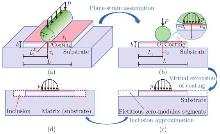
Fig. 1
Illustrations of (a) the frictionless elastic contact between an FG coating-homogeneous substrate structure and a rigid cylinder, (b) the theoretical modeling based on the plane-strain assumption, (c) the treatment of the void regions flanking the actual coating as two zero-modulus segments to extend the finite-width coating to a fictitious infinite-width coating, and (d) the replacement of the fictitious infinite-width coating with a finite-width inclusion (color online)"
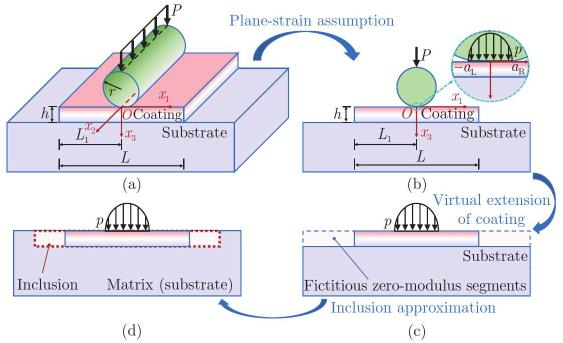
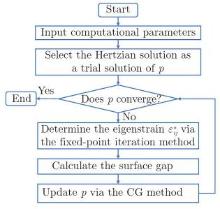
Fig. 2
Flowchart for solving the contact problem of interest (color online)"
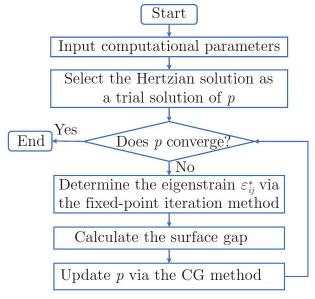
Table 1
Computational parameters"
| Computational parameter | Value |
|---|---|
| Size of computational domain | |
| Number of elements |
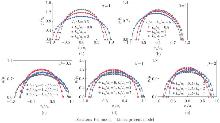
Fig. 3
Comparisons of the normal traction between the present model and FE simulations under various widths and moduli of an elastically graded coating: (a) β=1 and L1/L=0.5; (b) β=1 and L/a0−L1/a0=6; (c) β=0.5; (d) β=1; (e) β=2 (color online)"
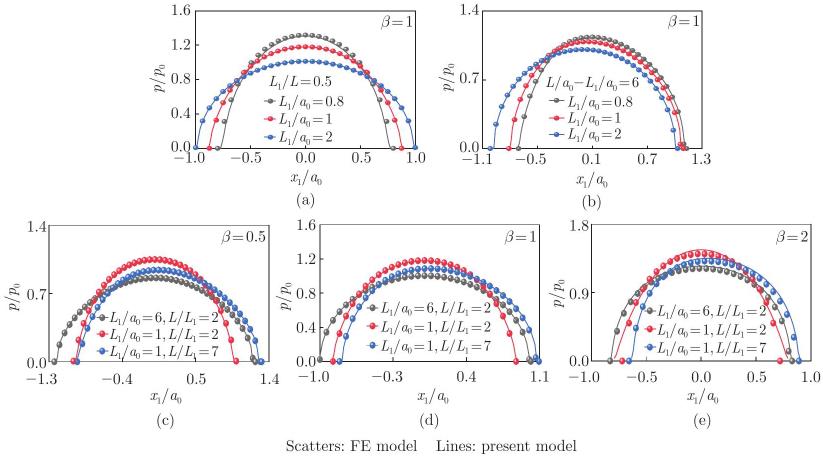
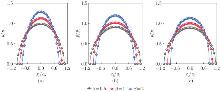
Fig. 4
Variations of the normal traction with the gradient factor β for L/L1=2 under different dimensionless coating half-widths: (a) L1/a0=1.2; (b) L1/a0=1.8; (c) L1/a0=6 (color online)"
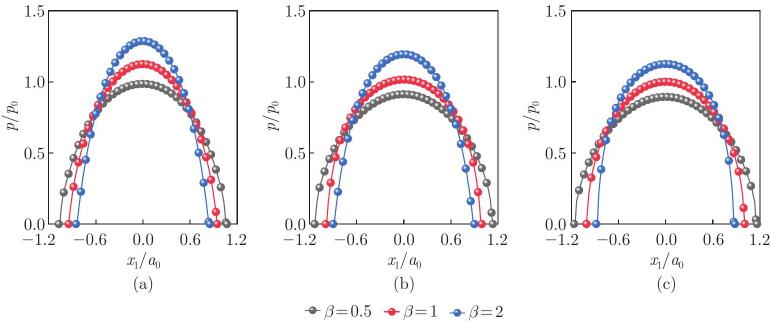
Fig. 5
Variations of the von Mises equivalent stress distributions with the gradient factor β for L/L1=2 under different dimensionless coating half-widths: (a)–(c) L1/a0=1.2; (d)–(f) L1/a0=1.8; (g)–(i) L1/a0=6. Left column β=0.5; middle column: β=1; right column: β=2. These bold black lines in stress contours indicate the free edges of the coated structure. Here, the equivalent stress is nondimensionalized using the Hertzian solution of the maximum normal traction p0 (color online)"
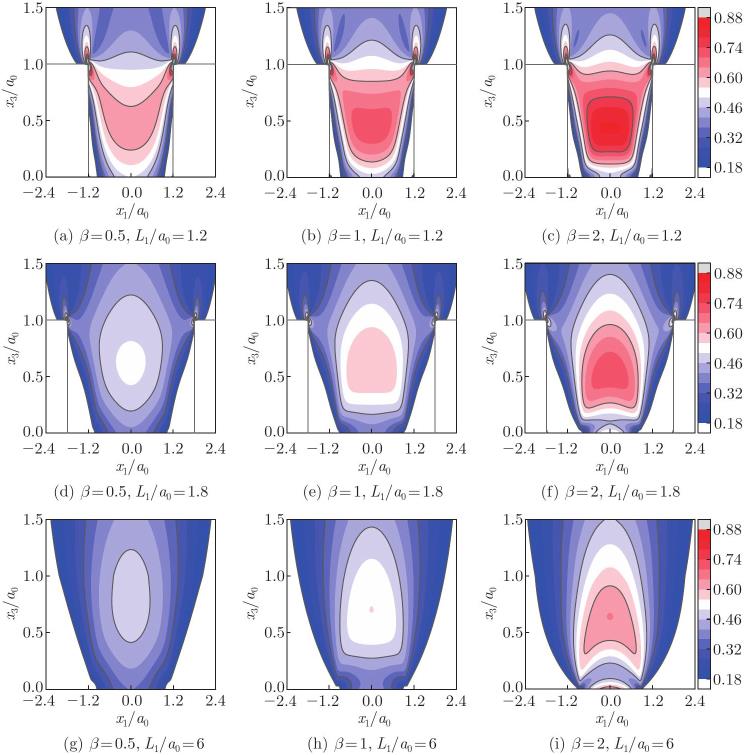
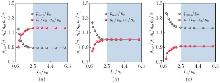
Fig. 6
Variations of the maximum normal traction, left contact half-width, and right contact half-width for L/L1=2 under different levels of β: (a) β=0.5; (b) β=1; (c) β=2 (color online)"
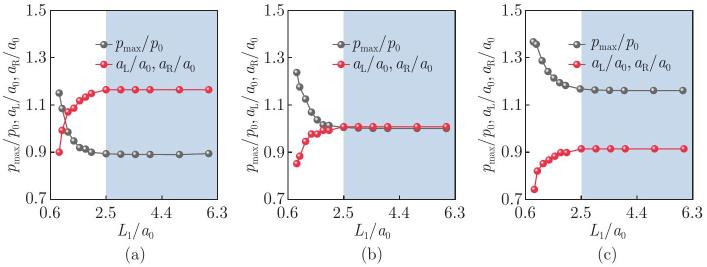
Fig. 7
Variations of the subsurface equivalent stress distributions for L/L1=0.2 under different levels of β: (a)–(d) β=0.5; (e)–(h) β=1; (i)–(l) β=2. The dimensionless coating half-widths in the first, second, third, and fourth columns are set to 2.5, 3, 4, and 5, respectively. These bold black lines in stress contours indicate the free edges of the coated structure. Here, the equivalent stress is nondimensionalized using the Hertzian solution of maximum normal traction p0 (color online)"
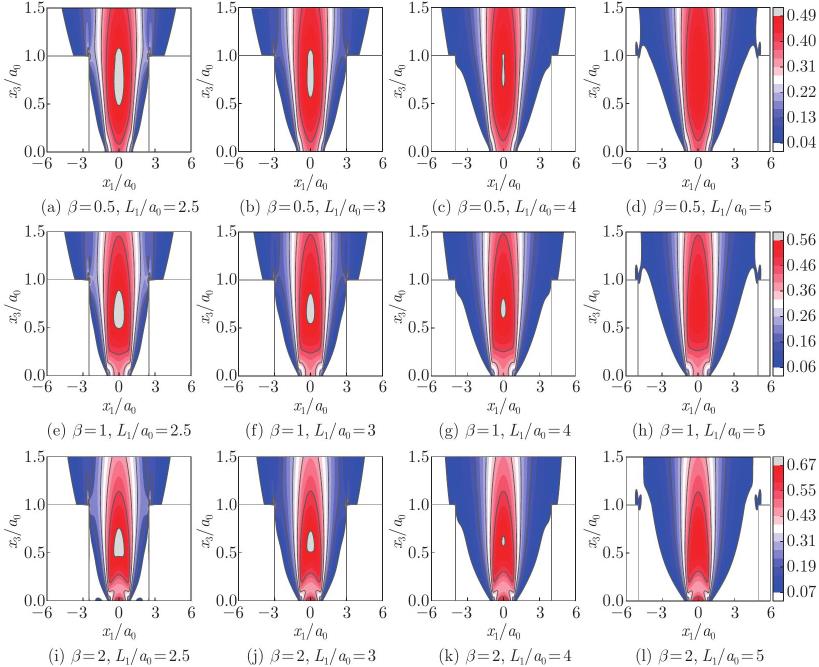
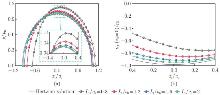
Fig. 8
Variations of the surface contact stresses for L/a0−L1/a0=5 and β=1: (a) the normal traction (i.e., −σ33 (x3/a0=0)); (b) the in-plane stress (x3/a0=0) (color online)"
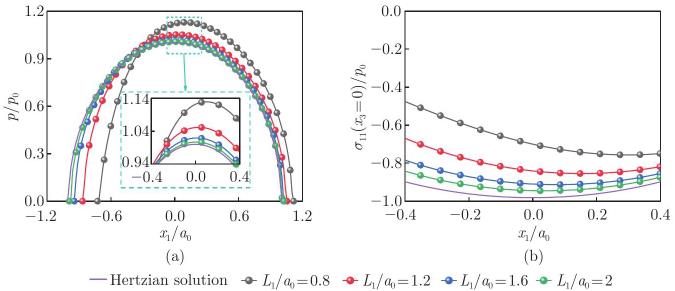
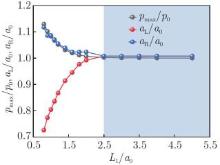
Fig. 9
Variations of the maximum normal traction, left contact half-width, and right contact half-width for L/a0−L1/a0=5 and β=1 (color online)"
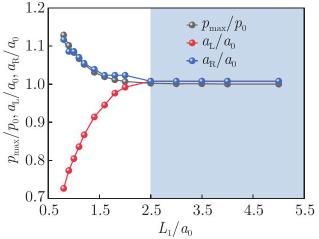
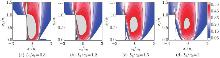
Fig. 10
Variations of the subsurface equivalent stress distributions for β=1 and L/a0−L1/a0=5: (a) L1/a0=0.8; (b) L1/a0=1.2; (c) L1/a0=1.6; (d) L1/a0=2. These bold black lines in stress contours indicate the free edges of the coated structure. Here, the equivalent stress is nondimensionalized using the Hertzian solution of maximum normal traction p0 (color online)"
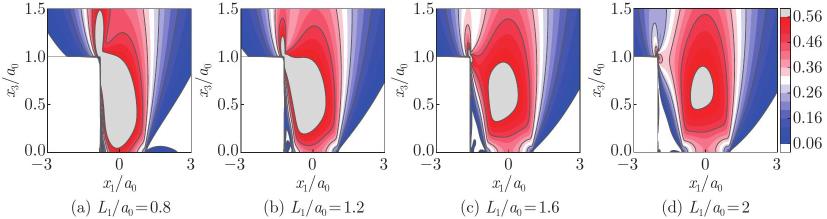
Fig. 11
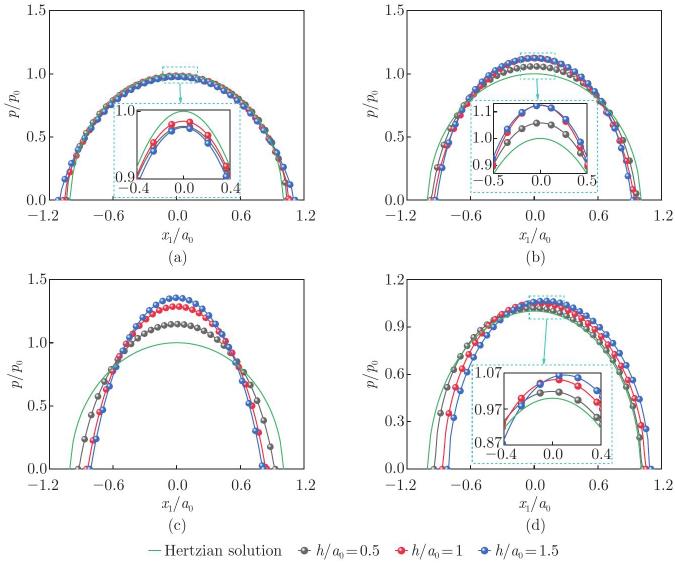
Variations of the normal traction under different coating widths and gradient factors: (a) L/L1=2, L1/a0=1.2, and β=0.5; (b) L/L1=2, L1/a0=1.2, and β=1; (c) L/L1=2, L1/a0=1.2, and β=2; (d) L/a0−L1/a0=5, L1/a0=1.2, and β=1 (color online)"
| [1] | DING, H. H., CUI, T., WANG, W. J., LIN, Q., WANG, L., YANG, Y., YANG, W. B., ZHANG, Q. L., XIAO, Q., and QI, H. Laser cladding WC/Fe composite coating on nose rail of turnout: microstructure characteristics and wear behaviors. Wear, 570, 205929 (2025) |
| [2] | ALVES, U. C., RICCI, V. P., MOTA, I. G. C., KOGA, G. Y., HASSUI, A., and VENTURA, C. E. H. Mechanical and tribological characterization of TiAlN/TiN and TiSiN/AlTiN coating systems for cutting tools. Journal of Manufacturing Processes, 145, 522–535 (2025) |
| [3] | LIU, J. L., WANG, Y. S., and YU, C. B. Few-layer MoS2 modified epoxy/MoS2-graphite coating: robust solid lubrication enabling sustained tribological performance during oil lubrication failure. Surfaces and Interfaces, 72, 107346 (2025) |
| [4] | SUN, Y. Y., MIAO, Q., LIANG, W. P., YI, J. W., XU, J. Y., GUPTA, M., JOHANES, M., JIA, F. L., and CHANG, X. L. Wear-resistant ZrN/Ti functionally graded coating prepared on TA18 alloy by double glow plasma alloying. Surface and Coatings Technology, 484, 130837 (2024) |
| [5] | ZHANG, B. Q., LIU, K., LI, J., CHEN, B. B., HUANG, C. J., and SOBOLEVA, N. A comprehensive review on the rare earth elements improving microstructure and properties of laser cladded coatings. Journal of Alloys and Compounds, 1036, 181761 (2025) |
| [6] | DING, H. H., YANG, T., WANG, W. J., ZHU, Y., LIN, Q., GUO, J., XIAO, Q., GAN, L., and LIU, Q. Y. Optimization and wear behaviors of 316L stainless steel laser cladding on rail material. Wear, 523, 204830 (2023) |
| [7] | YANG, L. F., SU, D. N., MIAO, P. X., and LI, P. Analysis of thermoelastic dissipation in microbeam resonators covered with multiple partial coatings. Applied Mathematical Modelling, 129, 112–136 (2024) |
| [8] | ZHUO, X., TENG, Y. P., CAO, J., LIU, L., and WANG, X. C. The investigation of support effect from hard substrate to soft coating of PI/EP-PTFE under different coating thicknesses and frictional contacts. Materials Today Communications, 41, 110690 (2024) |
| [9] | WU, D. Y., ZHOU, X., and ZHAI, G. F. Continuously layer-by-layer assembled multilayer coating to achieve excellent tribological properties and electrical contact stability. Journal of Manufacturing Processes, 151, 66–74 (2025) |
| [10] | XIA, G. Z., HONG, W., and CHEN, W. Q. Indentation of pre-deformed compressible soft electroactive layer on substrate. International Journal of Mechanical Sciences, 238, 107834 (2023) |
| [11] | WEN, J. J., JU, C. J., NIE, G. Q., LIU, J. X., and HU, Y. T. On two-dimensional frictionless contact of piezoelectric semiconductors. International Journal of Mechanical Sciences, 304, 110680 (2025) |
| [12] | KE, L. L. and WANG, Y. S. Two-dimensional sliding frictional contact of functionally graded materials. European Journal of Mechanics A/Solids, 26(1), 171–188 (2007) |
| [13] | SUN, Y. Y., SU, J., SONG, H. X., and KE, L. L. The size-dependent frictionless contact of piezoelectric materials. International Journal of Mechanical Sciences, 261, 108685 (2024) |
| [14] | VASILIEV, A. S., VOLKOV, S. S., and AIZIKOVICH, S. M. Hot indentation of a FGM-coated thermoelastic half-space by a conical punch: approximated analytical solution of the contact problem. Composite Structures, 309, 116612 (2023) |
| [15] | DING, S. H., HU, Y. Q., JIAN, B., ZHANG, Y. H., XIA, R., and HU, G. M. A semi-analytical solution to incipient sliding contact on viscoelastic layer-elastic substrate with imperfectly bonded interface. Applied Mathematical Modelling, 125, 35–58 (2024) |
| [16] | PRASERTSRI, T., WONGVIBOONSIN, W., and RUNGAMORNRAT, J. Analysis of size-dependent response of surface excited functionally graded layer with consideration of couple-stress effects. Applied Mathematical Modelling, 129, 696–713 (2024) |
| [17] | PRADHAN, P., AJAYRAJ, I. R., and MURTHY, H. Modeling of FGM contacts using piecewise linear variation in Young’s modulus. Tribology International, 186, 108645 (2023) |
| [18] | KULCHYTSKY-ZHYHAILO, R. and BAJKOWSKI, A. Analytical and numerical methods of solution of three-dimensional problem of elasticity for functionally graded coated half-space. International Journal of Mechanical Sciences, 54(1), 105–112 (2012) |
| [19] | HAN, L. F. and LIU, T. J. Sliding frictional and adhesive coupling contact analysis of FGPM layered half-space under an insulating indenter. International Journal of Solids and Structures, 299, 112874 (2024) |
| [20] | KE, L. L. and WANG, Y. S. Two-dimensional contact mechanics of functionally graded materials with arbitrary spatial variations of material properties. International Journal of Solids and Structures, 43(18-19), 5779–5798 (2006) |
| [21] | FU, P. L., ZHAO, J. Z., ZHANG, X., KANG, G. Z., WANG, P., and KAN, Q. H. Elastic shakedown analysis of two-dimensional thermo-elastic rolling/sliding contact for a functionally graded coating/substrate structure with arbitrarily varying thermo-elastic properties. Composite Structures, 280, 114891 (2022) |
| [22] | LIU, J., KE, L. L., WANG, Y. S., YANG, J., and ALAM, F. Thermoelastic frictional contact of functionally graded materials with arbitrarily varying properties. International Journal of Mechanical Sciences, 63(1), 86–98 (2012) |
| [23] | LIU, T. J. and XING, Y. M. Analysis of graded coatings for resistance to contact deformation and damage based on a new multi-layer model. International Journal of Mechanical Sciences, 81, 158–164 (2014) |
| [24] | WEI, C. X. and ZHANG, Y. A contact model for the functionally graded coated elastic structures: extension of the Hertz theory to the contact of beam structures. International Journal of Solids and Structures, 302, 112968 (2024) |
| [25] | BAN, Y. X., LI, Z. Q., and MI, C. W. On the tractive rolling nanocontact of an exponentially graded coating-substrate structure. Mechanics of Materials, 198, 105127 (2024) |
| [26] | GULER, M. A., ALINIA, Y., and ADIBNAZARI, S. On the rolling contact problem of two elastic solids with graded coatings. International Journal of Mechanical Sciences, 64(1), 62–81 (2012) |
| [27] | TIAN, X. J., ZHOU, Y. T., DING, S. H., and WANG, L. H. Exploring the effects of finite size and indenter shape on the contact behavior of functionally graded thermoelectric materials. International Journal of Solids and Structures, 305, 113089 (2024) |
| [28] | GAO, S. J., JU, C. J., NIE, G. Q., LIU, J. X., and CHEN, W. Q. Indentation response characteristics of a piezoelectric semiconductor layer. International Journal of Mechanical Sciences, 286, 109809 (2025) |
| [29] | JULIÁ, J. M. and RODRÍGUEZ-TEMBLEQUE, L. Wear and subsurface stress evolution in tractive rolling contact. International Journal of Mechanical Sciences, 294, 110195 (2025) |
| [30] | JIN, Z. J., PAN, E. N., ZHANG, Z. Q., and LIU, K. F. Conical indentation over a transversely isotropic and layered elastic half-space. Mechanics of Materials, 196, 105081 (2024) |
| [31] | HAN, Y. C., YONG, H. D., and ZHOU, Y. H. Modeling of discrete-continuous contact behaviors in multilevel helical structures. International Journal of Mechanical Sciences, 287, 109977 (2025) |
| [32] | POLONSKY, I. A. and KEER, L. M. A numerical method for solving rough contact problems based on the multi-level multi-summation and conjugate gradient techniques. Wear, 231(2), 206–219 (1999) |
| [33] | YANG, W. Y., BAI, P. P., FANG, J. B., LI, Y. T., SHI, Z. Q., and ZHOU, Q. H. Contact responses of transversely isotropic layered material with imperfect interface. International Journal of Mechanical Sciences, 272, 109145 (2024) |
| [34] | FU, P. L., ZHAO, J. Z., ZHANG, X., MIAO, H. C., WEN, Z. F., WANG, P., KANG, G. Z., and KAN, Q. H. Elasto-plastic partial slip contact modeling of graded layers. International Journal of Mechanical Sciences, 264, 108823 (2024) |
| [35] | LI, J. R., SUN, L. L., ZHAO, N., LI, P., WANG, H. Q., and YAN, Y. L. A semi-analytical solution for inhomogeneous material in the quarter space. International Journal of Mechanical Sciences, 263, 108766 (2024) |
| [36] | AHYEE, A. K., NELIAS, D., CHAISE, T., and DUVAL, A. New numerical resolution of the elastic quarter-space, eighth-space and finite-length-space contact problems. International Journal of Solids and Structures, 304, 113031 (2024) |
| [37] | LIU, S. B. and WANG, Q. Studying contact stress fields caused by surface tractions with a discrete convolution and fast Fourier transform algorithm. Journal of Tribology, 124(1), 36–45 (2002) |
| [38] | CHEN, Y., ZHANG, M. Q., and WANG, Q. J. Analysis of adhesive contact of heterogeneous elastic materials. International Journal of Mechanical Sciences, 266, 108986 (2024) |
| [39] | DONG, Q. B., CHEN, Z., ZHOU, K., and HE, D. Fretting contact of layered materials with vertical cracks near surfaces. International Journal of Mechanical Sciences, 198, 106361 (2021) |
| [40] | DONG, Q. B., ZHOU, K., CHEN, W. W., and FAN, Q. Partial slip contact modeling of heterogeneous elasto-plastic materials. International Journal of Mechanical Sciences, 114, 98–110 (2016) |
| [41] | DONG, Q. B., LI, Y., WEI, J., and LU, F. X. Layered structures with rough surfaces and interfaces at contact loading. International Journal of Mechanical Sciences, 178, 105611 (2020) |
| [42] | YANG, W. Y., BAI, P. P., FANG, J. B., QI, K. A., and ZHOU, Q. H. Impact contact behaviors of elastic coated medium with imperfect interfaces. International Journal of Mechanical Sciences, 236, 107743 (2022) |
| [43] | JIANG, Y. B., ZHAO, P. Y., and WU, W. W. Thermoelastic contact of layer-substrate system: effects of force-like interface and Kapitza thermal resistance models. Composite Structures, 352, 118675 (2025) |
| [44] | SUI, Y. J., WANG, W. Z., and ZHANG, H. B. Effects of electromagnetic fields on the contact of magneto-electro-elastic materials. International Journal of Mechanical Sciences, 223, 107283 (2022) |
| [45] | LUO, X. W., LI, P., ZHOU, Q. H., CHEN, J. J., HUANG, Y. Y., LIU, Y. M., ZHANG, Q., and ZHU, H. A micromechanical model for solving competitive relationship between Joule and frictional heating in sliding electrical contact. International Journal of Heat and Mass Transfer, 252, 127511 (2025) |
| [46] | LIU, J., KE, L. L., and WANG, Y. S. Two-dimensional thermoelastic contact problem of functionally graded materials involving frictional heating. International Journal of Solids and Structures, 48(18), 2536–2548 (2011) |
| [47] | FU, P. L., ZHAO, J. Z., ZHANG, X., MIAO, H. C., WEN, Z. F., WANG, P., KAN, Q. H., and KANG, G. Z. Modeling of fully coupled thermo-elastic sliding contact of coated systems. International Journal of Heat and Mass Transfer, 223, 125213 (2024) |
| [48] | CHEN, W. W., ZHOU, K., KEER, L. M., and WANG, Q. J. Modeling elasto-plastic indentation on layered materials using the equivalent inclusion method. International Journal of Solids and Structures, 47(20), 2841–2854 (2010) |
| [49] | ESHELBY, J. D. The determination of the elastic field of an ellipsoidal inclusion, and related problems. Proceedings of the Royal Society of London Series A: Mathematical and Physical Sciences, 241(1226), 376–396 (1957) |
| [50] | FU, P. L., XU, X., ZHAO, J. Z., ZHANG, X., MIAO, H. C., KANG, G. Z., KAN, Q. H., and WEI, Y. G. Modeling of thermo-elasto-plastic sliding contact of layered structures. International Journal of Mechanical Sciences, 302, 110584 (2025) |
| [51] | WALLACE, E. R., CHAISE, T., DUVAL, A., and NELIAS, D. Transient tractive rolling contact between elastically dissimilar and multi-layered bodies. International Journal of Solids and Structures, 265-266, 112124 (2023) |
| [52] | ALINIA, Y., BEHESHTI, A., GULER, M. A., EL-BORGI, S., and POLYCARPOU, A. A. Sliding contact analysis of functionally graded coating/substrate system. Mechanics of Materials, 94, 142–155 (2016) |
| [53] | FU, P. L., ZHAO, J. Z., ZHANG, X., MIAO, H. C., WEN, Z. F., KANG, G. Z., and KAN, Q. H. Three-dimensional tractive rolling contact analysis of functionally graded coating-substrate systems with interfacial imperfection and frictional anisotropy. Composite Structures, 307, 116671 (2023) |
| [54] | GUO, L., ZHANG, Z. M., WANG, W., ZHAO, Y., and WONG, P. L. An explicit solution to a three-dimensional wedge problem considering two edges effect. Friction, 8(2), 370–383 (2020) |
| [55] | WANG, Z. J., JIN, X. Q., KEER, L. M., and WANG, Q. Numerical methods for contact between two joined quarter spaces and a rigid sphere. International Journal of Solids and Structures, 49(18), 2515–2527 (2012) |
| [1] | Guozheng ZHANG, Zhaohe DA. Asymptotic models for thin transversely isotropic elastic layers [J]. Applied Mathematics and Mechanics (English Edition), 2026, 47(7): 1603-1624. |
| [2] | Zhengzhe XIE, S. EL-BORGI, Jie SU, Liaoliang KE. Mixed elastohydrodynamic lubrication contact of piezoelectric materials with different Gaussian rough surfaces [J]. Applied Mathematics and Mechanics (English Edition), 2026, 47(5): 965-984. |
| [3] | Ling WANG, Huoming SHEN, Yuxing WANG. Generalized semi-analytical modeling of three-dimensional contact responses in piezoelectric semiconductors with conductive indenters [J]. Applied Mathematics and Mechanics (English Edition), 2026, 47(3): 555-572. |
| [4] | Pengxu GUO, Yueting ZHOU. Exact analysis of the orientation-adjusted adhesive full stick contact of layered structures with the asymmetric bipolar coordinates [J]. Applied Mathematics and Mechanics (English Edition), 2022, 43(6): 883-898. |
| [5] | Xinchun SHANG, Jiaxuan LIU, Xuhua GAO, Weiyao ZHU. Analysis on nonlinear effect of unsteady percolation in the inhomogeneous shale gas reservoir [J]. Applied Mathematics and Mechanics (English Edition), 2020, 41(1): 105-122. |
| [6] | Xiaohua TAN, Yilan KANG, E. A. PATTERSON. Experimental investigation on surface deformation of soft half plane indented by rigid wedge [J]. Applied Mathematics and Mechanics (English Edition), 2016, 37(10): 1349-1360. |
| [7] | LUO Lin;XIANG Yu;WANG Qi-Zhi. Stress concentration factor expression for tension strip with eccentric elliptical hole [J]. Applied Mathematics and Mechanics (English Edition), 2012, 33(1): 117-128. |
| [8] | GONG Wen-hui;XIE Hong-yang;WANG Yuan-han. SEMI-ANALYTICAL AND SEMI-NUMERICAL METHOD FOR DYNAMIC ANALYSIS OF FOUNDATION [J]. Applied Mathematics and Mechanics (English Edition), 2006, 27(5): 607-615 . |
| Viewed | ||||||
|
Full text |
|
|||||
|
Abstract |
|
|||||





 Email Alert
 RSS
RSS