Applied Mathematics and Mechanics (English Edition) ›› 2026, Vol. 47 ›› Issue (1): 39-60.doi: https://doi.org/10.1007/s10483-026-3338-9
Previous Articles Next Articles
Tingrui CHEN1, Fan YANG1,2,3,†( ), Jingchun ZHANG1, Dong HAN1, Qingcheng YANG2,4
Received:2025-07-10
Revised:2025-10-09
Published:2025-12-30
Contact:
Fan YANG, E-mail: fanyang@tongji.edu.cnSupported by:2010 MSC Number:
Tingrui CHEN, Fan YANG, Jingchun ZHANG, Dong HAN, Qingcheng YANG. Micropolar homogenization constitutive modeling and size effect analysis of lattice materials. Applied Mathematics and Mechanics (English Edition), 2026, 47(1): 39-60.
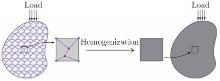
Fig. 1
Schematic of homogenization for a lattice material (color online)"
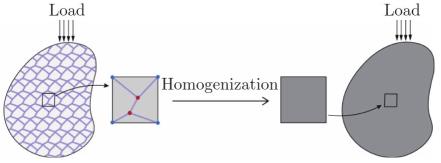
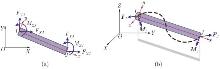
Fig. 2
Schematic diagrams of Euler-Bernoulli micropolar beams in (a) 2D and (b) 3D cases (color online)"
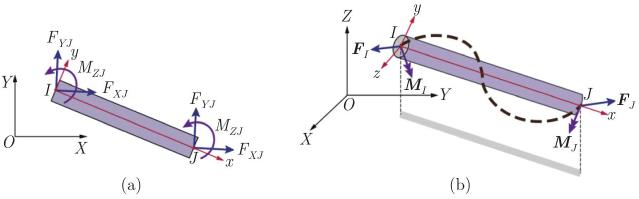
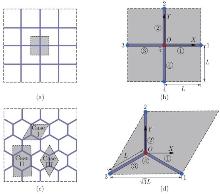
Fig. 3
2D lattice materials: (a) simple-square lattice material, (b) unit cell of the simple-square lattice, (c) honeycomb lattice material, and (d) unit cell of the honeycomb lattice for Case I (color online)"
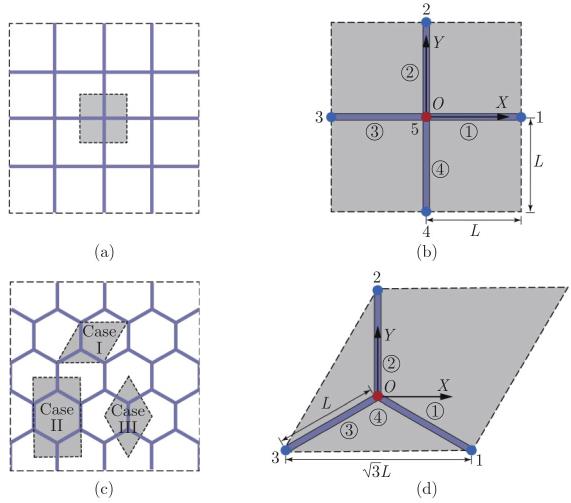
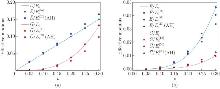
Fig. 4
Equivalent modulus as a function of relative density for the 2D lattice materials: (a) simple-square lattice and (b) honeycomb lattice (color online)"
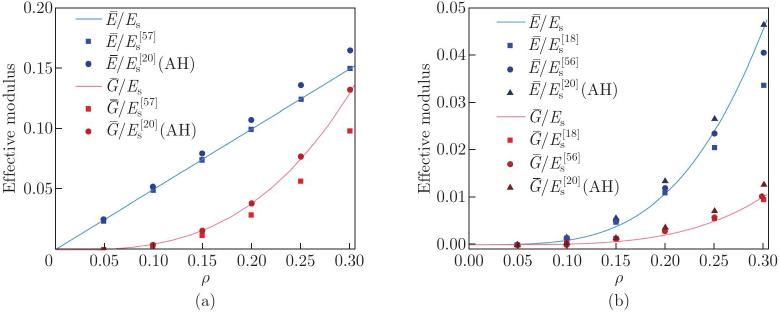
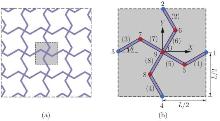
Fig. 5
Zigzag chiral lattice material: (a) lattice structure and (b) unit cell (color online)"
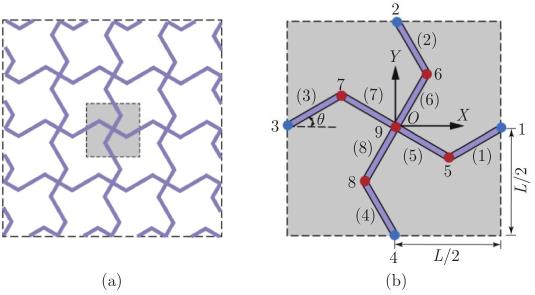
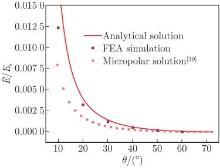
Fig. 6
Equivalent Young’s modulus of a simple-square lattice composed of zigzag beams (color online)"
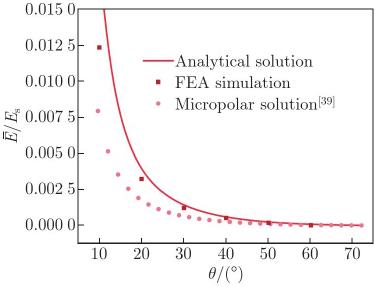
Table 1
Constitutive parameters for the zigzag chiral lattice with θ=30∘"
| 40 | 3.024 7 | 0.203 9 | ||
| 4 | 3.024 7 | 0.203 9 | ||
| 0.4 | 3.024 7 | 0.203 9 | ||
| 0.04 | 3.024 7 | 0.203 9 | ||
| 0.004 | 3.024 7 | 0.203 9 |
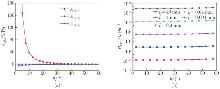
Fig. 7
Constitutive coefficients of a simple-square lattice composed of zigzag beams: (a) Aijkl and (b) H1313 (color online)"
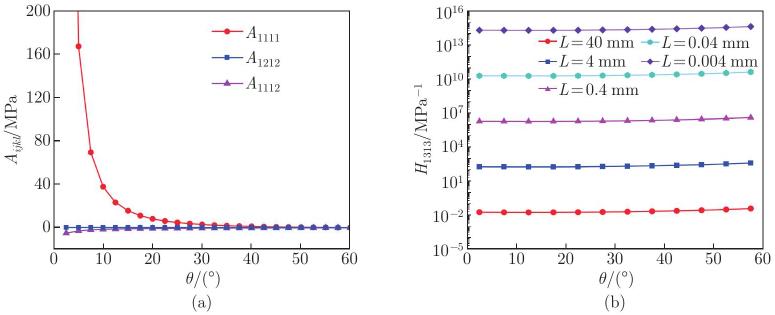
Fig. 8
Schematic of the configurations of BCC lattice: (a) traditional BCC and (b) eccentric BCC (color online)"
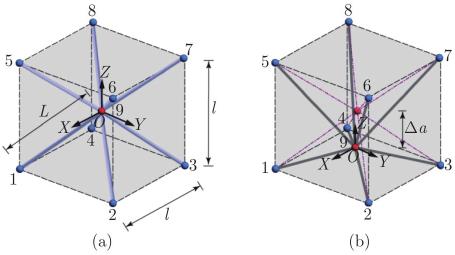
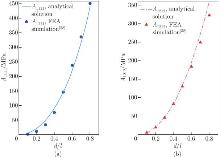
Fig. 9
Comparison of (a) A1111 and (b) A1212 from the analytical solution and FEA simulation for traditional BCC lattice structures (color online)"
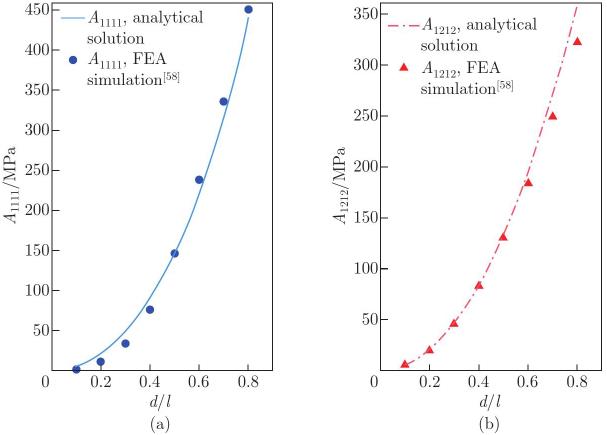
Table 2
Relationship between the constitutive constants and geometrical parameters for BCC lattice structures"
| 0.1 | 0.001 | 5.235 | 5.196 | 5.215 | |||
| 0.1 | 0.1 | 5.235 | 5.196 | 5.215 | |||
| 0.1 | 10 | 5.235 | 5.196 | 5.215 | |||
| 0.2 | 0.001 | 21.25 | 20.63 | 20.94 | |||
| 0.2 | 0.1 | 21.25 | 20.63 | 20.94 | |||
| 0.2 | 10 | 21.25 | 20.63 | 20.94 | |||
| 0.4 | 0.001 | 90.01 | 80.01 | 85.01 | |||
| 0.4 | 0.1 | 90.01 | 80.01 | 85.01 | |||
| 0.4 | 10 | 90.01 | 80.01 | 85.01 |
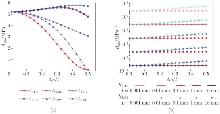
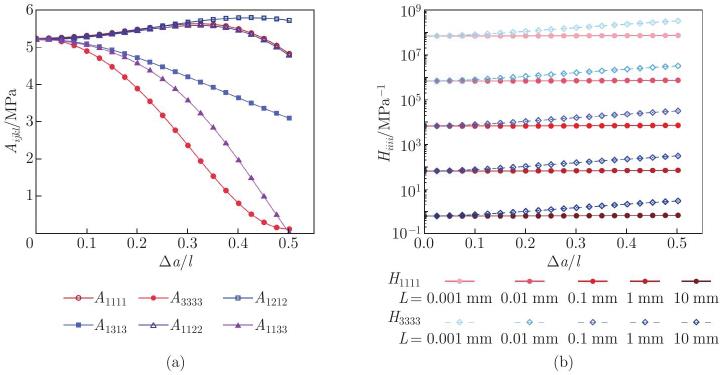
Fig. 10
Variations of the elastic constants with Δa/l at d/l=0.1: (a) Aijkl and (b) Hiiii (color online)"
| [46] | WANG, B. Y., LIU, J. X., and LIANG, N. G. Wavelength-dependent strain gradient modeling of two-dimensional lattice metamaterials. Acta Mechanica Sinica, 41(9), 124524 (2025) |
| [47] | WANG, B. Y., LIU, J. X., SOH, A. K., and LIANG, N. G. Exact strain gradient modelling of prestressed nonlocal diatomic lattice metamaterials. Mechanics of Advanced Materials and Structures, 30(13), 2718–2734 (2023) |
| [48] | HILL, R. Elastic properties of reinforced solids: some theoretical principles. Journal of the Mechanics and Physics of Solids, 11, 357–372 (1963) |
| [49] | LI, X. K. and LIU, Q. P. A version of Hill’s lemma for Cosserat continuum. Acta Mechanica Sinica, 25(4), 499–506 (2009) |
| [50] | LIU, Q. P. Hill’s lemma for the average-field theory of Cosserat continuum. Acta Mechanica, 224(4), 851–866 (2013) |
| [51] | LIU, Q. P. A new version of Hill’s lemma for Cosserat continuum. Archive of Applied Mechanics, 85(6), 761–773 (2015) |
| [52] | GAD, A. I. and GAO, X. L. Extended Hill’s lemma for non-Cauchy continua based on a modified couple stress theory. Acta Mechanica, 231(3), 977–997 (2020) |
| [53] | GAD, A. I. and GAO, X. L. An extended Hill’s lemma for non-Cauchy continua based on the modified couple stress and surface elasticity theories. Mathematics and Mechanics of Solids, 28(7), 1652–1670 (2023) |
| [54] | VANNUCCI, P. Anisotropic Elasticity: Lecture Notes in Applied and Computational Mechanics, Springer, Singapore (2018) |
| [55] | TING, T. C. T. and HORGAN, C. O. Anisotropic elasticity: theory and applications. Journal of Applied Mechanics, 63(4), 1056 (1996) |
| [56] | GIBSON, L. J. and ASHBY, M. F. Cellular Solids, Cambridge University Press, Cambridge, UK (1999) |
| [1] | QUEHEILLALT, D. T. and WADLEY, H. N. G. Cellular metal lattices with hollow trusses. Acta Materialia, 53(2), 303–313 (2005) |
| [2] | DU PLESSIS, A., RAZAVI, N., BENEDETTI, M., MURCHIO, S., LEARY, M., WATSON, M., BHATE, D., and BERTO, F. Properties and applications of additively manufactured metallic cellular materials: a review. Progress in Materials Science, 125, 100918 (2022) |
| [3] | LI, X. W., CHUA, J. W., YU, X., LI, Z. D., ZHAO, M., WANG, Z. G., and ZHAI, W. 3D-printed lattice structures for sound absorption: current progress, mechanisms and models, structural-property relationships, and future outlook. Advanced Science, 11(4), 2305232 (2024) |
| [4] | AI, L. and GAO, X. L. Three-dimensional metamaterials with a negative Poisson’s ratio and a non-positive coefficient of thermal expansion. International Journal of Mechanical Sciences, 135, 101–113 (2018) |
| [5] | HAN, D., REN, X., LUO, C., ZHANG, Y., ZHANG, X. Y., ZHANG, X. G., JIANG, W., HAO, J., and XIE, Y. M. Experimental and computational investigations of novel 3D printed square tubular lattice metamaterials with negative Poisson’s ratio. Additive Manufacturing, 55, 102789 (2022) |
| [6] | FANG, X., YU, D. L., WEN, J. H., DAI, Y. F., BEGLEY, M. R., GAO, H. J., and GUMBSCH, P. Large recoverable elastic energy in chiral metamaterials via twist buckling. nature, 639(8055), 639–645 (2025) |
| [7] | SOMNIC, J. and JO, B. W. Status and challenges in homogenization methods for lattice materials. Materials, 15(2), 605 (2022) |
| [8] | MOLAVITABRIZI, D., KHAKALO, S., BENGTSSON, R., and MOUSAVI, S. M. Second-order homogenization of 3-D lattice materials towards strain gradient media: numerical modelling and experimental verification. Continuum Mechanics and Thermodynamics, 35(6), 2255–2274 (2023) |
| [9] | TOLLENAERE, H. and CAILLERIE, D. Continuous modeling of lattice structures by homogenization. Advances in Engineering Software, 29(7-9), 699–705 (1998) |
| [10] | GUO, X., WANG, E. D., YANG, H., and ZHAI, W. Mechanical characterization and constitutive modeling of additively-manufactured polymeric materials and lattice structures. Journal of the Mechanics and Physics of Solids, 189, 105711 (2024) |
| [11] | YI, S. N., XU, L., CHENG, G. D., and CAI, Y. W. FEM formulation of homogenization method for effective properties of periodic heterogeneous beam and size effect of basic cell in thickness direction. Computers & Structures, 156, 1–11 (2015) |
| [12] | CHENG, G. D., CAI, Y. W., and XU, L. Novel implementation of homogenization method to predict effective properties of periodic materials. Acta Mechanica Sinica, 29(4), 550–556 (2013) |
| [13] | CAI, Y. W., XU, L., and CHENG, G. D. Novel numerical implementation of asymptotic homogenization method for periodic plate structures. International Journal of Solids and Structures, 51(1), 284–292 (2014) |
| [14] | KARTTUNEN, A. T., REDDY, J. N., and ROMANOFF, J. Two-scale constitutive modeling of a lattice core sandwich beam. Composites Part B: Engineering, 160, 66–75 (2019) |
| [15] | GIBSON, L. J., ASHBY, M. F., SCHAJER, G. S., and ROBERTSON, C. I. The mechanics of two-dimensional cellular materials. Proceedings of the Royal Society of London A-Mathematical and Physical Sciences, 382(1782), 25–42 (1982) |
| [16] | KUMAR, R. S. and MCDOWELL, D. L. Generalized continuum modeling of 2-D periodic cellular solids. International Journal of Solids and Structures, 41(26), 7399–7422 (2004) |
| [17] | NIU, B. and YAN, J. A new micromechanical approach of micropolar continuum modeling for 2-D periodic cellular material. Acta Mechanica Sinica, 32(3), 456–468 (2016) |
| [18] | VIGLIOTTI, A. and PASINI, D. Linear multiscale analysis and finite element validation of stretching and bending dominated lattice materials. Mechanics of Materials, 46, 57–68 (2012) |
| [19] | VIGLIOTTI, A., DESHPANDE, V. S., and PASINI, D. Nonlinear constitutive models for lattice materials. Journal of the Mechanics and Physics of Solids, 64, 44–60 (2014) |
| [20] | ARABNEJAD, S. and PASINI, D. Mechanical properties of lattice materials via asymptotic homogenization and comparison with alternative homogenization methods. International Journal of Mechanical Sciences, 77, 249–262 (2013) |
| [21] | ZOPF, C. and KALISKE, M. Numerical characterisation of uncured elastomers by a neural network based approach. Computers & Structures, 182, 504–525 (2017) |
| [22] | FERNÁNDEZ, M., FRITZEN, F., and WEEGER, O. Material modeling for parametric, anisotropic finite strain hyperelasticity based on machine learning with application in optimization of metamaterials. International Journal for Numerical Methods in Engineering, 123(2), 577–609 (2022) |
| [23] | BISHARA, D. and LI, S. F. A machine-learning aided multiscale homogenization model for crystal plasticity: application for face-centered cubic single crystals. Computational Mechanics, 72(1), 77–93 (2023) |
| [24] | REZAKHANI, R., ZHOU, X. W., and CUSATIS, G. Adaptive multiscale homogenization of the lattice discrete particle model for the analysis of damage and fracture in concrete. International Journal of Solids and Structures, 125, 50–67 (2017) |
| [25] | LI, S., DUAN, K., HE, Y., and LI, L. A configuration-driven nonlocal model for functionally graded lattices. International Journal of Engineering Science, 209, 104222 (2025) |
| [26] | LI, Z., YANG, F., and YANG, Q. C. A generalized summation rule-based nonlocal quasicontinuum approach (GSR-QC) for efficient modeling of architected lattice structures. International Journal for Numerical Methods in Engineering, 126(15), e70093 (2025) |
| [27] | MASTERS, I. G. and EVANS, K. E. Models for the elastic deformation of honeycombs. Composite Structures, 35(4), 403–422 (1996) |
| [28] | GAD, A. I. and GAO, X. L. A generalized strain energy-based homogenization method for 2-D and 3-D cellular materials with and without periodicity constraints. Symmetry, 13(10), 1870 (2021) |
| [29] | COSSERAT, E. and COSSERAT, F. Théorie des Corps Déformables, Hermann, Paris, France (1909) |
| [30] | ERINGEN, A. C. Linear theory of micropolar elasticity. Theory Micropolar Elasticity (Chapter 5), 15, 909–923 (1965) |
| [31] | ERINGEN, A. C. Microcontinuum Field Theories: I. Foundations and Solids, Springer, New York, USA (1999) |
| [32] | LIU, X. N., HUANG, G. L., and HU, G. K. Chiral effect in plane isotropic micropolar elasticity and its application to chiral lattices. Journal of the Mechanics and Physics of Solids, 60(11), 1907–1921 (2012) |
| [33] | LAKES, R. S. Reduced warp in torsion of reticulated foam due to Cosserat elasticity: experiment. Zeitschrift für Angewandte Mathematik und Physik, 67(3), 46 (2016) |
| [34] | SPADONI, A. and RUZZENE, M. Elasto-static micropolar behavior of a chiral auxetic lattice. Journal of the Mechanics and Physics of Solids, 60(1), 156–171 (2012) |
| [35] | DUAN, S. Y., WEN, W. B., and FANG, D. N. A predictive micropolar continuum model for a novel three-dimensional chiral lattice with size effect and tension-twist coupling behavior. Journal of the Mechanics and Physics of Solids, 121, 23–46 (2018) |
| [36] | GAD, A. I., GAO, X. L., and LI, K. A strain energy-based homogenization method for 2-D and 3-D cellular materials using the micropolar elasticity theory. Composite Structures, 265, 113594 (2021) |
| [37] | CUI, Z. M. and JU, J. Mechanical coupling effects of 2D lattices uncovered by decoupled micropolar elasticity tensor and symmetry operation. Journal of the Mechanics and Physics of Solids, 167, 105012 (2022) |
| [38] | HUANG, L. H., YUAN, H., and ZHAO, H. Y. An FEM-based homogenization method for orthogonal lattice metamaterials within micropolar elasticity. International Journal of Mechanical Sciences, 238, 107836 (2023) |
| [39] | CHI, Z. Y., LIU, J. X., and SOH, A. K. Micropolar modeling of a typical bending-dominant lattice comprising zigzag beams. Mechanics of Materials, 160, 103922 (2021) |
| [40] | GUO, Z., LIU, X., HUANG, L., ADHIKARI, S., and LIANG, X. F. Analytical homogenization for equivalent in-plane elastic moduli of prestressed lattices based on the micropolar elasticity model. Composite Structures, 346, 118391 (2024) |
| [41] | DIANA, V., BACIGALUPO, A., and GAMBAROTTA, L. Continuum-molecular modeling of planar micropolar media: anisotropy, chiral properties and length-scale effects. International Journal of Solids and Structures, 295, 112810 (2024) |
| [42] | ULLOA, J., ARIZA, M. P., ANDRADE, J. E., and ORTIZ, M. Homogenized models of mechanical metamaterials. Computer Methods in Applied Mechanics and Engineering, 433, 117454 (2025) |
| [57] | WANG, A. J. and MCDOWELL, D. L. In-plane stiffness and yield strength of periodic metal honeycombs. Journal of Engineering Materials and Technology, 126, 137–156 (2004) |
| [58] | ALWATTAR, T. A. and MIAN, A. Development of an elastic material model for BCC lattice cell structures using finite element analysis and neural networks approaches. Journal of Composites Science, 3(2), 33 (2019) |
| [59] | USHIJIMA, K., CANTWELL, W. J., and CHEN, D. H. Prediction of the mechanical properties of micro-lattice structures subjected to multi-axial loading. International Journal of Mechanical Sciences, 68, 47–55 (2013) |
| [60] | ZHAO, M., ZHANG, D. Z., LI, Z. H., ZHANG, T., ZHOU, H. L., and REN, Z. H. Design, mechanical properties, and optimization of BCC lattice structures with taper struts. Composite Structures, 295, 115830 (2022) |
| [61] | DAI, J. S. Euler-Rodrigues formula variations, quaternion conjugation and intrinsic connections. Mechanism and Machine Theory, 92, 144–152 (2015) |
| [43] | CHI, Z. Y., LIU, J. X., and SOH, A. K. Overlapping-field modeling (OFM) of periodic lattice metamaterials. International Journal of Solids and Structures, 269, 112201 (2023) |
| [44] | CHI, Z., LIU, J., and SOH, A. K. On complete and micropolar-based incomplete strain gradient theories for periodic lattice structures. Applied Mathematics and Mechanics (English Edition), 44(10), 1651–1674 (2023) https://doi.org/10.100 7/s10483-023-3033-9 |
| [45] | OTERO, J. A., ESPINOSA-ALMEYDA, Y., RODRÍGUEZ-RAMOS, R., and MERODIO, J. Semi-analytical finite element method applied for characterizing micropolar fibrous composites. Applied Mathematics and Mechanics (English Edition), 45(12), 2147–2164 (2024) https://doi.org/10.100 7/s10483-024-3195-6 |
| [1] | Xiyan ZOU, Huaiwei HUANG, Xiaohu YAO. Flexoelectric energy dissipating mechanism for multi-impact protection [J]. Applied Mathematics and Mechanics (English Edition), 2025, 46(4): 699-710. |
| [2] | Chang LI, Hai QING. Size-dependent axisymmetric bending and buckling analysis of functionally graded sandwich Kirchhoff nanoplates using nonlocal strain gradient integral model [J]. Applied Mathematics and Mechanics (English Edition), 2025, 46(3): 467-484. |
| [3] | J. A. OTERO, Y. ESPINOSA-ALMEYDA, R. RODRÍGUEZ-RAMOS, J. MERODIO. Semi-analytical finite element method applied for characterizing micropolar fibrous composites [J]. Applied Mathematics and Mechanics (English Edition), 2024, 45(12): 2147-2164. |
| [4] | Hai QING, Huidiao SONG. Nonlocal stress gradient formulation for damping vibration analysis of viscoelastic microbeam in thermal environment [J]. Applied Mathematics and Mechanics (English Edition), 2023, 44(5): 773-786. |
| [5] | Jun JIN, Ningdong HU, Hongping HU. Size effects on the mixed modes and defect modes for a nano-scale phononic crystal slab [J]. Applied Mathematics and Mechanics (English Edition), 2023, 44(1): 21-34. |
| [6] | Chunyu ZHANG, Biao WANG. Influence of nonlinear spatial distribution of stress and strain on solving problems of solid mechanics [J]. Applied Mathematics and Mechanics (English Edition), 2022, 43(9): 1355-1366. |
| [7] | Yang ZHENG, Bin HUANG, Lijun YI, Tingfeng MA, Longtao XIE, Ji WANG. Nonlinear thickness-shear vibration of an infinite piezoelectric plate with flexoelectricity based on the method of multiple scales [J]. Applied Mathematics and Mechanics (English Edition), 2022, 43(5): 653-666. |
| [8] | Chi XU, Yang LI, Mingyue LU, Zhendong DAI. Buckling analysis of functionally graded nanobeams under non-uniform temperature using stress-driven nonlocal elasticity [J]. Applied Mathematics and Mechanics (English Edition), 2022, 43(3): 355-370. |
| [9] | Jun HONG, Zhuangzhuang HE, Gongye ZHANG, Changwen MI. Size and temperature effects on band gaps in periodic fluid-filled micropipes [J]. Applied Mathematics and Mechanics (English Edition), 2021, 42(9): 1219-1232. |
| [10] | M. KOHANSAL-VAJARGAH, R. ANSARI, M. FARAJI-OSKOUIE, M. BAZDID-VAHDATI. Vibration analysis of two-dimensional structures using micropolar elements [J]. Applied Mathematics and Mechanics (English Edition), 2021, 42(7): 999-1012. |
| [11] | Jie SU, Hongxia SONG, Liaoliang KE, S. M. AIZIKOVICH. The size-dependent elastohydrodynamic lubrication contact of a coated half-plane with non-Newtonian fluid [J]. Applied Mathematics and Mechanics (English Edition), 2021, 42(7): 915-930. |
| [12] | Zhangna XUE, Gongqi CAO, Jianlin LIU. Size-dependent thermoelasticity of a finite bi-layered nanoscale plate based on nonlocal dual-phase-lag heat conduction and Eringen's nonlocal elasticity [J]. Applied Mathematics and Mechanics (English Edition), 2021, 42(1): 1-16. |
| [13] | Zhu SU, Lifeng WANG, Kaipeng SUN, Jie SUN. Transverse shear and normal deformation effects on vibration behaviors of functionally graded micro-beams [J]. Applied Mathematics and Mechanics (English Edition), 2020, 41(9): 1303-1320. |
| [14] | Liang ZHAO, Jiajia SUN, Xian WANG, Li ZENG, Chunlei WANG, Yusong TU. System-size effect on the friction at liquid-solid interfaces [J]. Applied Mathematics and Mechanics (English Edition), 2020, 41(3): 471-478. |
| [15] | M. FARAJI-OSKOUIE, A. NOROUZZADEH, R. ANSARI, H. ROUHI. Bending of small-scale Timoshenko beams based on the integral/differential nonlocal-micropolar elasticity theory: a finite element approach [J]. Applied Mathematics and Mechanics (English Edition), 2019, 40(6): 767-782. |
| Viewed | ||||||
|
Full text |
|
|||||
|
Abstract |
|
|||||





 Email Alert
 RSS
RSS