Applied Mathematics and Mechanics (English Edition) ›› 2026, Vol. 47 ›› Issue (2): 325-346.doi: https://doi.org/10.1007/s10483-026-3342-9
Previous Articles Next Articles
Huameng WANG1, Zhangna XUE1,†( ), Jianlin LIU1, Z. T. CHEN2
Received:2025-07-31
Revised:2025-11-03
Online:2026-02-04
Published:2026-02-04
Contact:
Zhangna XUE, E-mail: xueangel168@126.comSupported by:2010 MSC Number:
Huameng WANG, Zhangna XUE, Jianlin LIU, Z. T. CHEN. Size effect on the thermal fracture behavior of collinear interface cracks in functionally graded coating/substrate structures. Applied Mathematics and Mechanics (English Edition), 2026, 47(2): 325-346.
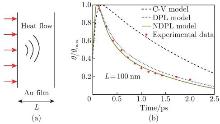
Fig. 1
(a) Schematic diagram of the laser irradiated Au film; (b) comparison of various models with the experimental results (color online)"
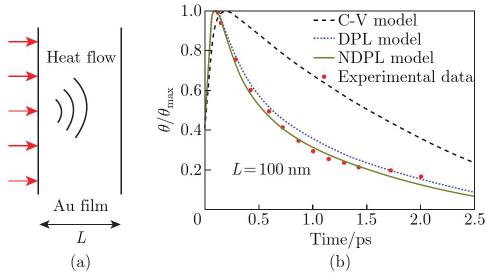
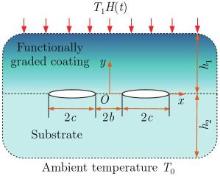
Fig. 2
Schematic diagram of two collinear interface cracks in a functionally graded coating/substrate structure under thermal shock (color online)"
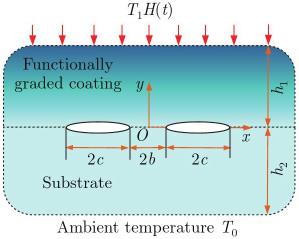
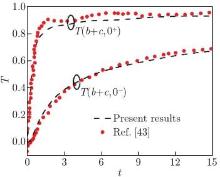
Fig. 3
Comparison with Ref. [43] (color online)"
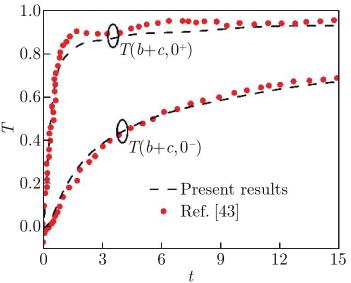
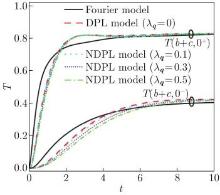
Fig. 4
Transient temperature at the center of the right crack surfaces for different nonlocal parameters λq (color online)"
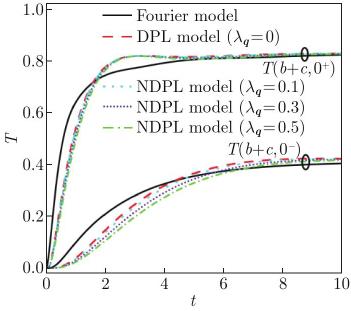
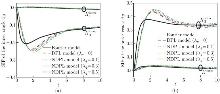
Fig. 5
Transient SIFs around the tips of the right crack for different nonlocal parameters λq (color online)"
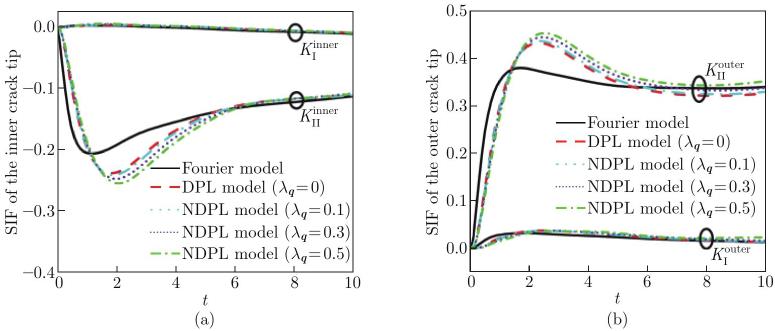
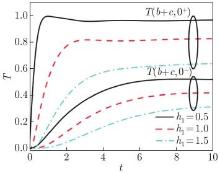
Fig. 6
Transient temperature at the center of the right crack surfaces for different coating thicknesses h1 (color online)"
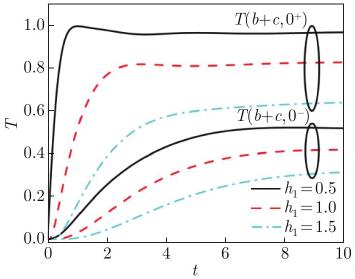
Fig. 7
Temperature distributions for different coating thicknesses h1 when the maximum temperature occurs (color online)"
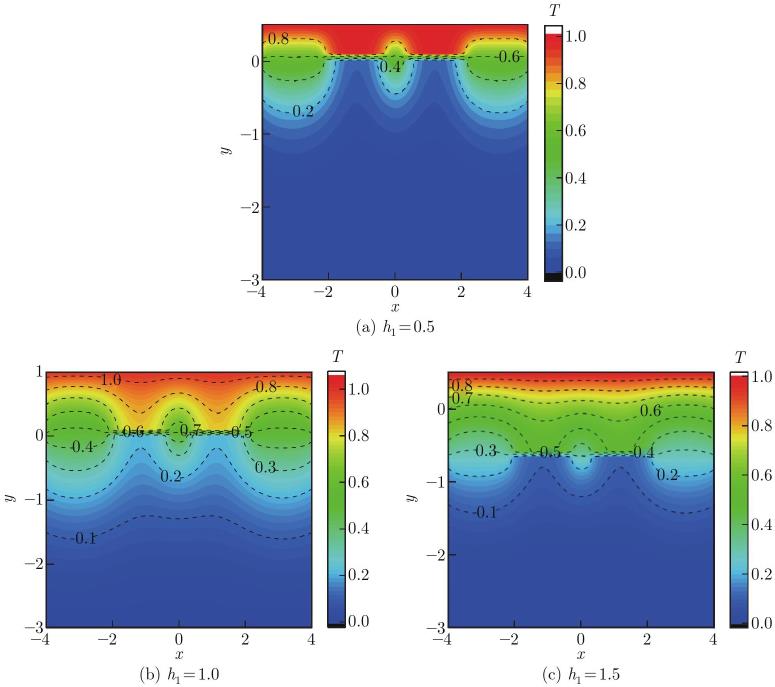
Fig. 8
Transient SIFs around the tips of the right crack for different coating thicknesses h1 (color online)"
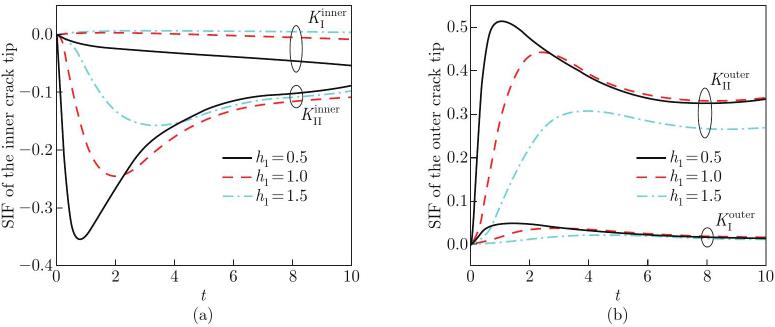
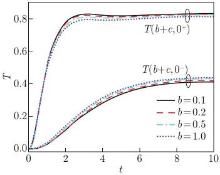
Fig. 9
Transient temperature at the center of the right crack surfaces for varying crack spacing b (color online)"
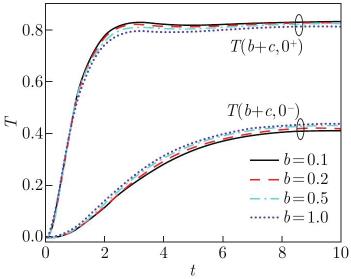
Fig. 10
Transient SIFs around the crack tips with different crack spacings: (a) b=2.0 and (b) b=0.2 (color online)"
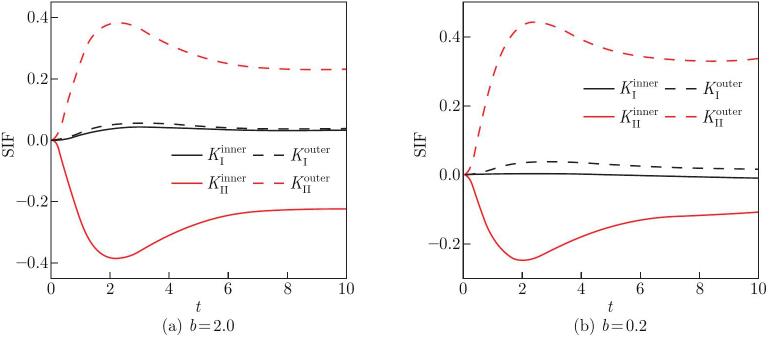
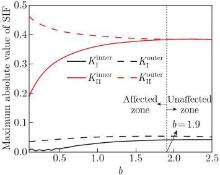
Fig. 11
Variations of the maximum absolute values of the SIFs with the crack spacing b (color online)"
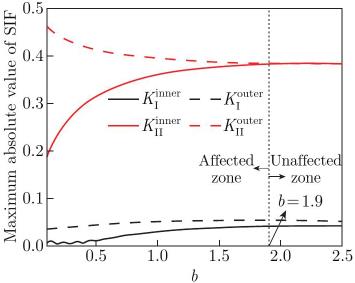
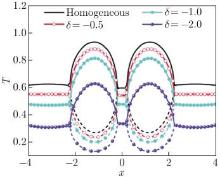
Fig. 12
Transient temperature distributions at the line y=0 for various values of the non-homogeneous parameter δ at the occurrence of the maximum temperature (color online)"
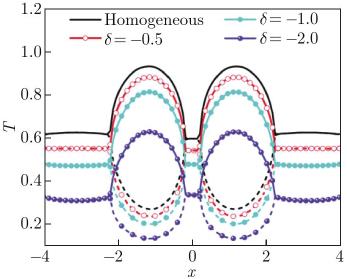
Fig. 13
Transient SIFs for varying non-homogeneous parameter δ (color online)"
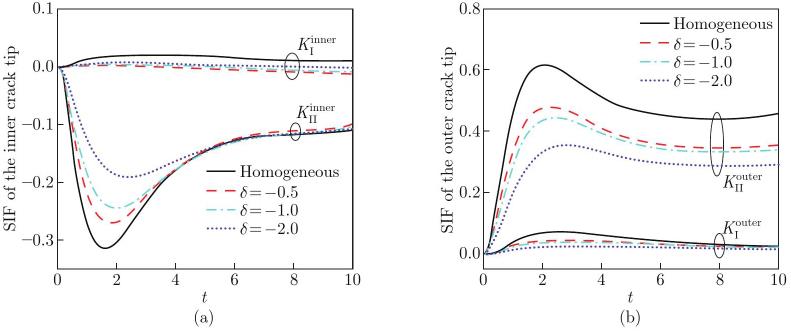
Fig. 14
Transient SIFs for varying non-homogeneous parameter β (color online)"
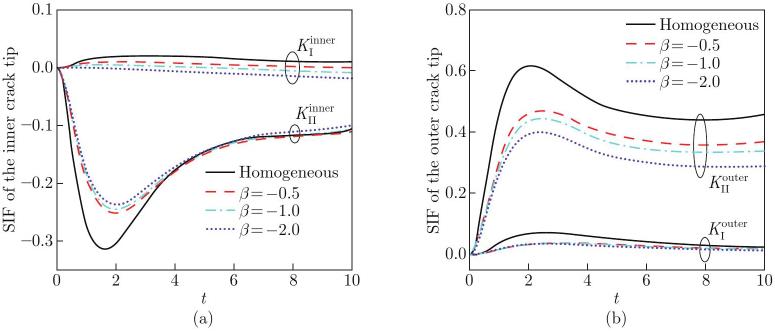
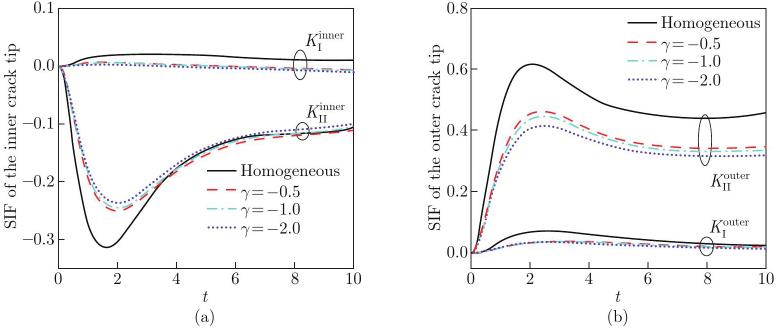
Fig. 15
Transient SIFs for varying non-homogeneous parameter γ (color online)"
| [1] | PADTURE, N. P., GELL, M., and JORDAN, E. H. Thermal barrier coatings for gas-turbine engine applications. Science, 296(5566), 280–284 (2002) |
| [2] | GUO, L. C., WU, L. Z., ZENG, T., and MA, L. The dynamic fracture behavior of a functionally graded coating-substrate system. Composite Structures, 64(3-4), 433–441 (2004) |
| [3] | JIN, Z. H. Heat conduction in a functionally graded plate subjected to finite cooling/heating rates: an asymptotic solution. Materials, 4(12), 2108–2118 (2011) |
| [4] | JIN, Z. H. and NODA, N. Transient thermal stress intensity factors for a crack in a semi-infinite plate of a functionally gradient material. International Journal of Solids and Structures, 31(2), 203–218 (1994) |
| [5] | ZHANG, X. Y., XIE, Y. J., and LI, X. F. Transient thermoelastic response in a cracked strip of functionally graded materials via generalized fractional heat conduction. Applied Mathematical Modelling, 70, 328–349 (2019) |
| [6] | ZHANG, X. Y. and LI, X. F. Transient response of a functionally graded thermoelastic plate with a crack via fractional heat conduction. Theoretical and Applied Fracture Mechanics, 104, 102318 (2019) |
| [7] | CHENG, Z. Q., MEGUID, S. A., and ZHONG, Z. Thermo-mechanical behavior of a viscoelastic FGMs coating containing an interface crack. International Journal of Fracture, 164(1), 15–29 (2010) |
| [8] | PETROVA, V. and SCHMAUDER, S. Mathematical modelling and thermal stress intensity factors evaluation for an interface crack in the presence of a system of cracks in functionally graded/homogeneous bimaterials. Computational Materials Science, 52(1), 171–177 (2012) |
| [9] | CHEN, Y. F. and ERDOGAN, F. The interface crack problem for a nonhomogeneous coating bonded to a homogeneous substrate. Journal of the Mechanics and Physics of Solids, 44(5), 771–787 (1996) |
| [10] | YANG, W. Z., POURASGHAR, A., and CHEN, Z. T. Nonlocal fracture analysis of an interface crack between a functionally graded coating and a homogeneous substrate under thermal loading. Composite Structures, 257, 113096 (2021) |
| [11] | GUO, L. C., HUANG, S. Q., ZHANG, L., and JIA, P. F. The interface crack problem for a functionally graded coating-substrate structure with general coating properties. International Journal of Solids and Structures, 146, 136–153 (2018) |
| [12] | HUANG, S. Q., GUO, L. C., ZHANG, L., ZHANG, Y. Y., and PAN, H. Z. The interface crack problem under steady heat flux for a functionally graded coating-substrate structure with general coating properties. Theoretical and Applied Fracture Mechanics, 109, 102675 (2020) |
| [13] | LU, S. N., DING, S. H., MA, Y. Y., ZHAO, X. F., and LI, X. Analytical solution of the thermoelastic problem of the asymmetric collinear nano-cracks in one-dimensional hexagonal quasicrystals. Zeitschrift für Angewandte Mathematik und Physik, 76, 4 (2025) |
| [14] | LU, S. N., DING, S. H., MA, Y. Y., ZHANG, B. W., ZHAO, X. F., and LI, X. The plane thermoelastic analysis of asymmetric collinear crack interactions in one-dimensional hexagonal quasicrystals. Applied Mathematical Modelling, 144, 116094 (2025) |
| [15] | ŞIMŞEK, M. Nonlinear free vibration of a functionally graded nanobeam using nonlocal strain gradient theory and a novel Hamiltonian approach. International Journal of Engineering Science, 105, 12–27 (2016) |
| [16] | TZOU, D. Y. Macro- to Microscale Heat Transfer: the Lagging Behavior, John Wiley & Sons, U. K. (2014) |
| [17] | CATTANEO, C. A form of heat conduction equation which eliminates the paradox of instantaneous propagation. Compte Rendus, 247, 431–433 (1958) |
| [18] | VERNOTTE, P. Paradoxes in the continuous theory of the heat conduction. Compte Rendus, 246, 3154–3155 (1958) |
| [19] | TZOU, D. Y. A unified field approach for heat conduction from macro- to micro-scales. Journal of Heat Transfer, 117(1), 8–16 (1995) |
| [20] | CHOUDHURI, S. K. R. On a thermoelastic three-phase-lag model. Journal of Thermal Stresses, 30, 231–238 (2007) |
| [21] | ZHANG, X. Y. and LI, X. F. Transient response of a functionally graded thermoelastic plate with a crack via fractional heat conduction. Theoretical and Applied Fracture Mechanics, 104, 102318 (2019) |
| [22] | ZHANG, X. Y., XIE, Y. J., and LI, X. F. Transient thermoelastic response in a cracked strip of functionally graded materials via generalized fractional heat conduction. Applied Mathematical Modelling, 70, 328–349 (2019) |
| [23] | GHASEMI, M. H., HOSEINZADEH, S., and MEMON, S. A dual-phase-lag (DPL) transient non-Fourier heat transfer analysis of functional graded cylindrical material under axial heat flux. International Communications in Heat and Mass Transfer, 131, 105858 (2022) |
| [24] | YANG, W. Z., POURASGHAR, A., and CHEN, Z. T. Non-Fourier thermal fracture analysis of a Griffith interface crack in orthotropic functionally graded coating/substrate structure. Applied Mathematical Modelling, 104, 548–566 (2022) |
| [25] | YANG, W. Z., ZHANG, X. Y., CUI, Y., and CHEN, Z. T. Thermal and fracture analysis of collinear interface cracks in graded coating systems under ramp-type heating. International Journal of Heat and Mass Transfer, 216, 124581 (2023) |
| [26] | XUE, Z. N., WANG, H. M., LIU, J. L., WEN, M. J., and CHEN, Z. T. Thermal fracture analysis of two collinear cracks in a functionally graded medium based on the three-phase-lag model. Applied Mathematics and Mechanics (English Edition), 46(3), 501–520 (2025) https://doi.org/10.1007/s10483-025-3223-6 |
| [27] | TZOU, D. Y. and GUO, Z. Y. Nonlocal behavior in thermal lagging. International Journal of Thermal Sciences, 49, 1133–1137 (2010) |
| [28] | TZOU, D. Y. Nonlocal behavior in phonon transport. International Journal of Heat and Mass Transfer, 54, 475–481 (2011) |
| [29] | BRORSON, S. D., FUJIMOTO, J. G., and IPPEN, E. P. Femtosecond electronic heat-transport dynamics in thin gold films. Physical Review Letters, 59, 1962–1965 (1987) |
| [30] | XUE, Z. N., TIAN, X. G., LUAN, Y. L., and LIU, J. L. Size effect on heat conduction and associate thermal fracture behavior of thin ceramic plates. Theoretical and Applied Fracture Mechanics, 113, 102951 (2021) |
| [31] | PENG, W. and PAN, B. C. Size-dependent thermoelastic damping analysis in functionally graded bi-layered microbeam resonators considering the nonlocal dual-phase-lag heat conduction model. Archive of Applied Mechanics, 94, 1203–1219 (2024) |
| [32] | CHEN, J. Determination of thermal stress intensity factors for an interface crack in a graded orthotropic coating-substrate structure. International Journal of Fracture, 133(4), 303–328 (2005) |
| [33] | SUR, A. and MONDAL, S. A generalized thermoelastic problem due to nonlocal effect in presence of mode I crack. Journal of Thermal Stresses, 43(10), 1277–1299 (2020) |
| [34] | XUE, Z. N., TIAN, X. G., and LIU, J. L. Thermal shock fracture of a crack in a functionally gradient half-space based on the memory-dependent heat conduction model. Applied Mathematical Modelling, 80, 840–858 (2020) |
| [35] | SINGH, R. and DAS, S. Investigation of interactions among collinear Griffith cracks situated in a functionally graded medium under thermo-mechanical loading. Journal of Thermal Stresses, 44(4), 433–455 (2021) |
| [36] | ERDOGAN, F., GUPTA, G. D., and COOK, T. S. Numerical solution of singular integral equations. Methods of Analysis and Solutions of Crack Problems, Springer, Netherlands, 368–425 (1973) |
| [37] | DELALE, F. and ERDOGAN, F. Effect of transverse shear and material orthotropy in a cracked spherical cap. International Journal of Solids and Structures, 15, 907–926 (1979) |
| [38] | THEOCARIS, P. S. and IOAKIMIDIS, N. I. Numerical integration methods for the solution of singular integral equations. Quarterly of Applied Mathematics, 35, 173–183 (1977) |
| [39] | DING, S. H. and LI, X. The collinear crack problem for an orthotropic functionally graded coating-substrate structure. Archive of Applied Mechanics, 84(3), 291–307 (2014) |
| [40] | EL-BORGI, S., ERDOGAN, F., and HIDRI, L. A partially insulated embedded crack in an infinite functionally graded medium under thermo-mechanical loading. International Journal of Engineering Science, 42, 371–393 (2004) |
| [41] | MILLER, M. K. and GUY, W. T. Numerical inversion of the Laplace transform by use of Jacobi polynomials. SIAM Journal on Numerical Analysis, 3, 624–635 (1966) |
| [42] | ERDOGAN, F. and WU, B. H. Crack problems in FGM layers under thermal stresses. Journal of Thermal Stresses, 19, 237–265 (1996) |
| [43] | CHEN, Z. T. and HU, K. Q. Hyperbolic heat conduction in a cracked thermoelastic half-plane bonded to a coating. International Journal of Thermophysics, 33, 895–912 (2012) |
| [44] | TWEED, J. and MELROSE, G. The thermal stresses due to a uniform heat flow past two collinear cracks. International Journal of Engineering Science, 26(10), 1053–1057 (1988) |
| [1] | Zhangna XUE, Huameng WANG, Jianlin LIU, Minjie WEN, Z. T. CHEN. Thermal fracture analysis of two collinear cracks in a functionally graded medium based on the three-phase-lag model [J]. Applied Mathematics and Mechanics (English Edition), 2025, 46(3): 501-520. |
| [2] | Jinjian XIE, Zhaoxia ZHANG, Pengpeng SHI, Xiaofan GOU. Analytical solution for the fracture problem in superconducting tapes with oblique cracks under the electromagnetic force [J]. Applied Mathematics and Mechanics (English Edition), 2025, 46(3): 485-500. |
| [3] | Kai LUO, Cuiying FAN, Minghao ZHAO, C. S. LU, Huayang DANG. Interfacial analysis of a penny-shaped one-dimensional hexagonal functionally graded piezoelectric quasicrystal film on a temperature-dependent substrate [J]. Applied Mathematics and Mechanics (English Edition), 2025, 46(12): 2297-2316. |
| [4] | Huayang DANG, Dongpei QI, Minghao ZHAO, Cuiying FAN, C.S. LU. Thermal-induced interfacial behavior of a thin one-dimensional hexagonal quasicrystal film [J]. Applied Mathematics and Mechanics (English Edition), 2023, 44(5): 841-856. |
| [5] | Yansong WANG, Baolin WANG, Youjiang CUI, Kaifa WANG. Anti-plane pull-out of a rigid line inclusion from an elastic medium [J]. Applied Mathematics and Mechanics (English Edition), 2023, 44(5): 809-822. |
| [6] | Xin ZHANG, Minghao ZHAO, Cuiying FAN, C. S. LU, Huayang DANG. Three-dimensional interfacial fracture analysis of a one-dimensional hexagonal quasicrystal coating [J]. Applied Mathematics and Mechanics (English Edition), 2022, 43(12): 1901-1920. |
| [7] | Minghao ZHAO, Cuiying FAN, C. S. LU, Huayang DANG. Interfacial fracture analysis for a two-dimensional decagonal quasi-crystal coating layer structure [J]. Applied Mathematics and Mechanics (English Edition), 2021, 42(11): 1633-1648. |
| [8] | M. HAJIMOHAMADI, R. GHAJAR. An analytical solution for the stress field and stress intensity factor in an infinite plane containing an elliptical hole with two unequal aligned cracks [J]. Applied Mathematics and Mechanics (English Edition), 2018, 39(8): 1103-1118. |
| [9] | S. SINGH, K. SHARMA, R. R. BHARGAVA. Complex variable approach in studying modified polarization saturation model in two-dimensional semipermeable piezoelectric media [J]. Applied Mathematics and Mechanics (English Edition), 2017, 38(11): 1517-1532. |
| [10] | M. FAKOOR, S. M. N. GHOREISHI. Comprehensive investigation of stress intensity factors in rotating disks containing three-dimensional semi-elliptical cracks [J]. Applied Mathematics and Mechanics (English Edition), 2017, 38(11): 1565-1578. |
| [11] | Hualiang WAN, Qizhi WANG, Xing ZHANG. Closed form solution of stress intensity factors for cracks emanating from surface semi-spherical cavity in finite body with energy release rate method [J]. Applied Mathematics and Mechanics (English Edition), 2016, 37(12): 1689-1706. |
| [12] | M. GHADIRI;A. R. SHAHANI. Analysis of bonded anisotropic wedges with interface crack under anti-plane shear loading [J]. Applied Mathematics and Mechanics (English Edition), 2014, 35(5): 637-654. |
| [13] | GUO Jun-Hong;YUAN Ze-Shuai;LU Zi-Xin. General solutions of plane problem for power function curved cracks [J]. Applied Mathematics and Mechanics (English Edition), 2011, 32(5): 563-570. |
| Viewed | ||||||
|
Full text |
|
|||||
|
Abstract |
|
|||||





 Email Alert
 RSS
RSS