Applied Mathematics and Mechanics (English Edition) ›› 2026, Vol. 47 ›› Issue (2): 303-324.doi: https://doi.org/10.1007/s10483-026-3345-8
Previous Articles Next Articles
Guoquan NIE1,2, Zhiwei WU3, Jinxi LIU1,3,†( )
)
Received:2025-08-20
Revised:2025-11-13
Online:2026-02-04
Published:2026-02-04
Contact:
Jinxi LIU, E-mail: liujx02@hotmail.comSupported by:2010 MSC Number:
Guoquan NIE, Zhiwei WU, Jinxi LIU. Static and dynamic responses of a piezoelectric semiconductor beam under different boundary conditions. Applied Mathematics and Mechanics (English Edition), 2026, 47(2): 303-324.

Fig. 1
The coordinate system of a PS beam"

Table 1
Material parameters of an n-type GaN PS beam[27]"
| Elastic constant/ | |
| Piezoelectric constant/ | |
| Dielectric constant/ | |
| Electron mobility coefficient/ | |
| Electron diffusion coefficient/ |
Table 2
Calculated dimensionless frequency, damping, and critical buckling load using different numbers of grid points (N)"
| 7 | 0.274 51 | 0.092 32 | |
| 9 | 0.274 41 | 0.092 25 | |
| 11 | 0.274 41 | 0.092 26 | |
| 13 | 0.274 41 | 0.092 26 | |
| 15 | 0.274 41 | 0.092 26 | |
| 17 | 0.274 41 | 0.092 26 |
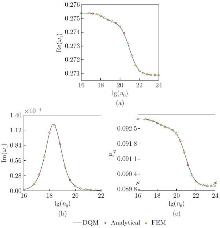
Fig. 2
Comparison of the numerical results by the DQM, FEM, and analytical method: (a) frequency; (b) damping; (c) critical buckling load (color online)"
Fig. 3
Dependence of the frequency and damping on the initial electron density under different boundary conditions: (a) frequency; (b) damping (color online)"
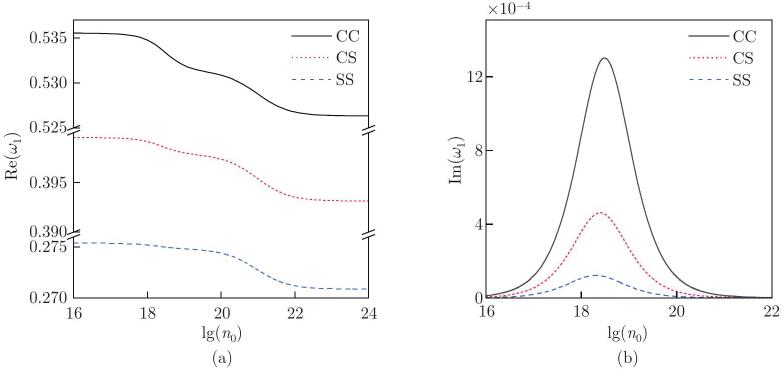
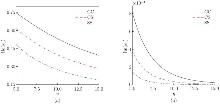
Fig. 4
Variations of the frequency and damping with the length-to-thickness ratio under different boundary conditions: (a) frequency; (b) damping (color online)"
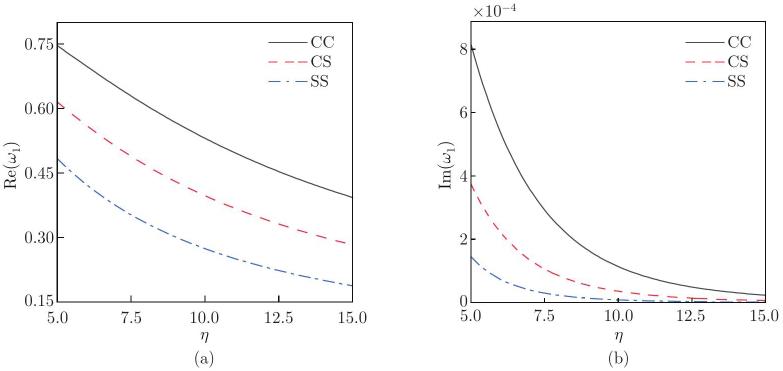
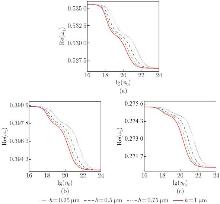
Fig. 5
Effects of the beam thickness on the frequency: (a) CC; (b) CS; (c) SS (color online)"
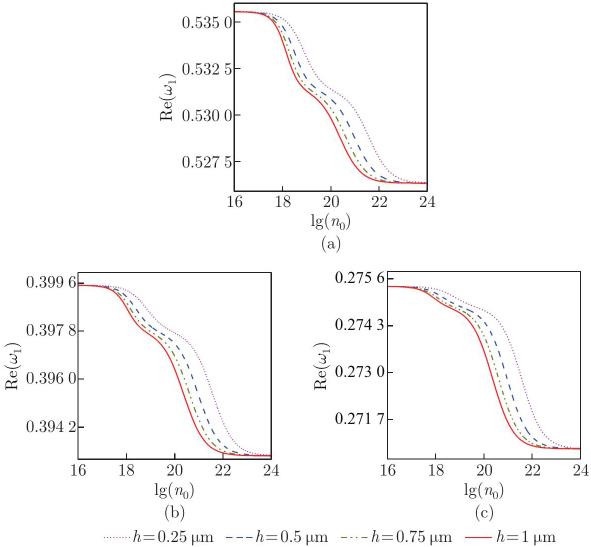
Fig. 6
Effects of the beam thickness on the damping: (a) CC; (b) CS; (c) SS (color online)"
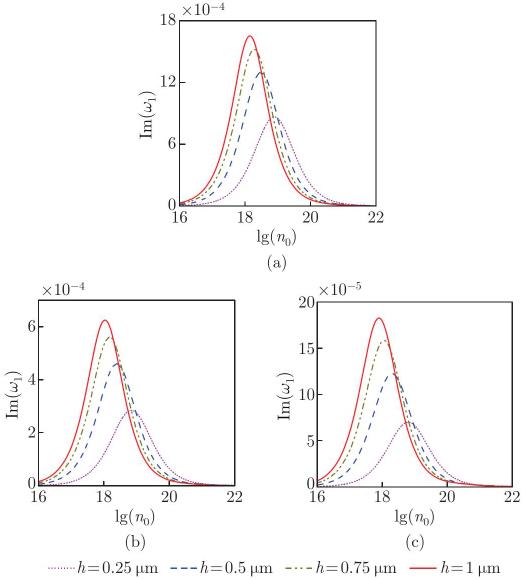
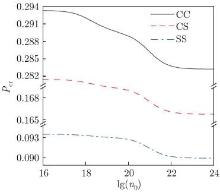
Fig. 7
Dependence of the critical buckling load on the initial electron density under different boundary conditions (color online)"
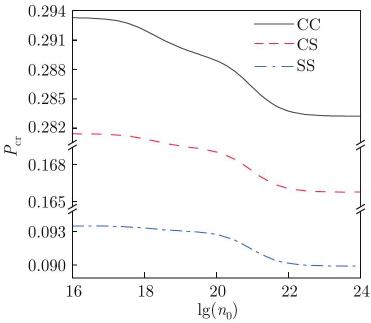
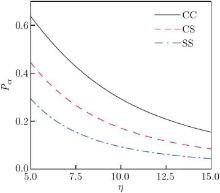
Fig. 8
Variations of the critical buckling load with the length-to-thickness ratio under different boundary conditions (color online)"
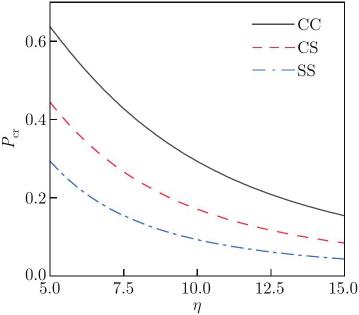
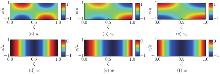
Fig. 9
Modes of displacements ux and w under different boundary conditions: (a), (d) CC; (b), (e) CS; (c), (f) SS (color online)"
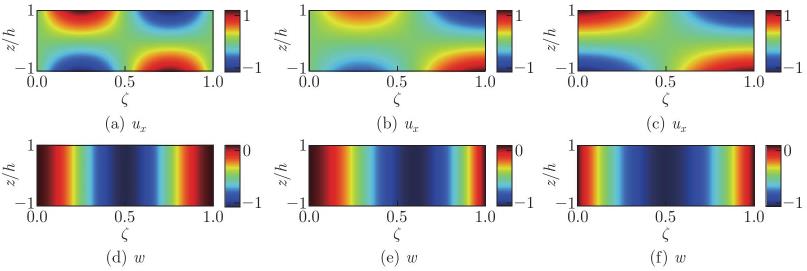
Fig. 10
Modes of the electric potential φ under different boundary conditions: (a), (d) CC; (b), (e) CS; (c), (f) SS (color online)"
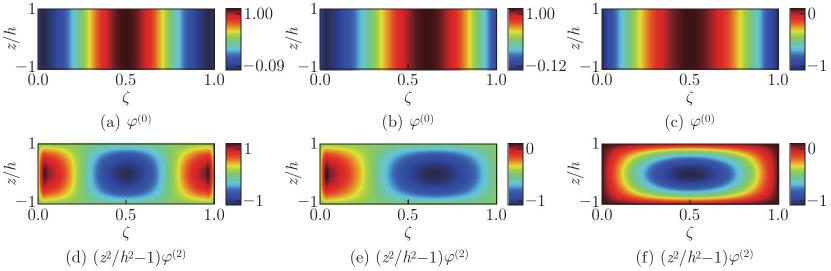
Fig. 11
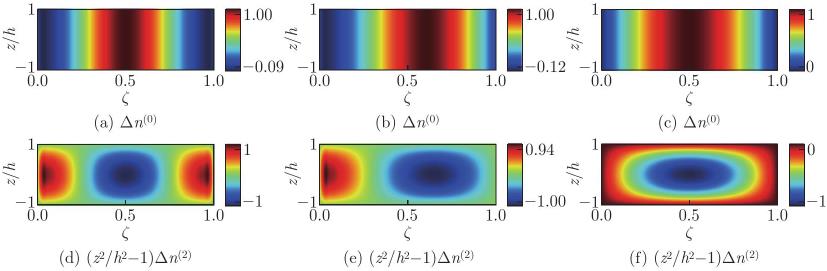
Modes of the electron density perturbation Δn under different boundary conditions: (a), (d) CC; (b), (e) CS; (c), (f) SS (color online)"
| [1] | HUTSON, A. R. Piezoelectricity and conductivity in ZnO and CdS. Physical Review Letters, 4(10), 505–507 (1960) |
| [2] | JOFFE, H., BERLINCOURT, D., KRUEGER, H., and SHIOZAWA, L. Piezoelectric properties of cadmium sulfide crystals. The 14th Annual Symposium on Frequency Control, Atlantic City, NJ, USA (1960) |
| [3] | WANG, Z. L. and SONG, J. H. Piezoelectric nanogenerators based on zinc oxide nanowire arrays. Science, 312(5771), 242–246 (2006) |
| [4] | WANG, Z. L., ZHANG, Y., and HU, W. G. Piezotronics and Piezo-Phototronics, 2nd ed., Springer Nature, Switzerland (2023) |
| [5] | WANG, Z. L. and WU, W. Z. Recent advances in piezotronics and piezo-phototronics. MRS Bulletin, 50, 115–122 (2025) |
| [6] | HUTSON, A. R. and WHITE, D. L. Elastic wave propagation in piezoelectric semiconductors. Journal of Applied Physics, 33(1), 40–47 (1962) |
| [7] | WHITE, D. L. Amplification of ultrasonic waves in piezoelectric semiconductors. Journal of Applied Physics, 33(8), 2547–2554 (1962) |
| [8] | ZHU, F., JI, S. H., ZHU, J. Q., QIAN, Z. H., and YANG, J. S. Study on the influence of semiconductive property for the improvement of nanogenerator by wave mode approach. Nano Energy, 52, 474–484 (2018) |
| [9] | CHEN, T., ZHANG, X. M., ZHOU, H. M., and YU, J. G. Characteristics of complete circumferential guided wave in a piezoelectric semiconductor cylindrical shell. Journal of Intelligent Material Systems and Structures, 34(6), 733–748 (2023) |
| [10] | GU, C. L. and JIN, F. Shear-horizontal surface waves in a half-space of piezoelectric semiconductors. Philosophical Magazine Letters, 95(2), 92–100 (2015) |
| [11] | TIAN, R., NIE, G. Q., LIU, J. X., PAN, E. N., and WANG, Y. S. On Rayleigh waves in a piezoelectric semiconductor thin film over an elastic half-space. International Journal of Mechanical Sciences, 204, 106565 (2021) |
| [12] | GUO, X. and WEI, P. J. Dispersion relations of in-plane elastic waves in nano-scale one dimensional piezoelectric semiconductor/piezoelectric dielectric phononic crystal with the consideration of interface effect. Applied Mathematical Modelling, 96, 189–214 (2021) |
| [13] | YANG, W. L., LIU, J. X., YANG, Y. Z., and HU, Y. T. The mechanism to reform dynamic performance of an elastic wave-front in a piezoelectric semiconductor by the wave-carrier interaction induced from static biasing fields. Applied Mathematics and Mechanics (English Edition), 44(3), 381–396 (2023) https://doi.org/10.1007/s10483-023-2968-7 |
| [14] | XIA, Q. G., ZOU, Y. Y., LOU, J., ZHANG, M. H., and DU, J. K. Effect of initial stresses on propagation of leaky surface acoustic wave in a piezoelectric semiconductor composite structure. Applied Mathematical Modelling, 141, 115908 (2025) |
| [15] | TIAN, R., LIU, J. X., PAN, E. N., and WANG, Y. S. SH waves in multilayered piezoelectric semiconductor plates with imperfect interfaces. European Journal of Mechanics-A/Solids, 81, 103961 (2020) |
| [16] | ZHANG, L. L., GUO, H. C., LIU, J. X., and HU, Y. T. SH surface waves in piezoelectric semiconductors loaded with a finite viscous liquid layer. Acta Mechanica, 236, 903–914 (2025) |
| [17] | XU, C. Y., WEI, P. J., WEI, Z. B., and GUO, X. Shear horizontal wave in a piezoelectric semiconductor substrate covered with a metal layer with consideration of Schottky junction effects. Applied Mathematical Modelling, 109, 509–518 (2022) |
| [18] | YANG, W. L., GUO, L. Y., ZHANG, S. L., and HU, Y. T. On elastic wave propagation in piezoelectric semiconductors with coupled piezoelectric and semiconductor properties. International Journal of Engineering Science, 205, 104160 (2024) |
| [19] | FAN, S. Q., LIANG, Y. X., XIE, J. M., and HU, Y. T. Exact solutions to the electromechanical quantities inside a statically-bent circular ZnO nanowire by taking into account both the piezoelectric property and the semiconducting performance part I: linearized analysis. Nano Energy, 40, 82–87 (2017) |
| [20] | ZHANG, C. L., WANG, X. Y., CHEN, W. Q., and YANG, J. S. An analysis of the extension of a ZnO piezoelectric semiconductor nanofiber under an axial force. Smart Material Structures, 26(2), 025030 (2017) |
| [21] | QU, Y. L., JIN, F., and YANG, J. S. Torsion of a piezoelectric semiconductor rod of cubic crystals with consideration of warping and in-plane shear of its rectangular cross section. Mechanics of Materials, 172, 104407 (2022) |
| [22] | LIANG, Y. X., YANG, W. L., and YANG, J. S. Transient bending vibration of a piezoelectric semiconductor nanofiber under a suddenly applied shear force. Acta Mechanica Solida Sinica, 32(6), 688–697 (2019) |
| [23] | YANG, W. L., HU, Y. T., and YANG, J. S. Transient extensional vibration in a ZnO piezoelectric semiconductor nanofiber under a suddenly applied end force. Materials Research Express, 6(2), 025902 (2019) |
| [24] | ZHANG, L. L., ZHAO, Z., HU, X. F., NIE, G. Q., and LIU, J. X. Exact multi-field coupling modeling and analysis of piezoelectric semiconductor plates. Applied Mathematics and Mechanics (English Edition), 46(7), 1331–1346 (2025) https://doi.org/10.1007/s10483-025-3272-7 |
| [25] | ZHU, J. Y., NEGAHBAN, M., XU, J., XIA, R. Y., and LI, Z. Theoretical analysis of piezoelectric semiconductor thick plates with periodic boundary conditions. Micromachines, 14, 2174 (2023) |
| [26] | ZHAO, L. K., JIN, F., SHAO, Z. S., and WANG, W. J. Nonlinear analysis on electrical properties in a bended composite piezoelectric semiconductor beam. Applied Mathematics and Mechanics (English Edition), 44(12), 2039–2056 (2023) https://doi.org/10.1007/s10483-023-3064-9 |
| [27] | HAN, C. F., LU, C. S., ZHAO, M. H., and ZHANG, Q. Y. Nonlinear finite element analysis of electromechanical behaviors in a piezoelectric semiconductor beam. International Journal of Non-Linear Mechanics, 149, 104311 (2023) |
| [28] | YANG, Y. Z., YANG, H. Z., and HU, Y. T. The functional switching on the operating modes of a piezoelectric semiconductor bipolar junction transistor via mechanical loadings. International Journal of Mechanical Sciences, 264, 108797 (2024) |
| [29] | WU, C. W., XIAO, Z. G., GUO, Y. T., and ZHANG, C. L. Analysis of nonlinear multi-field coupling responses of piezoelectric semiconductor rods via machine learning. International Journal of Smart and Nano Materials, 15(1), 62–74 (2024) |
| [30] | XIAO, Z. G., SUN, L., CHEN, W. Q., and ZHANG, C. L. Nonlinear multi-field coupling modeling of multilayer-stacked piezoelectric semiconductor structures. International Journal of Mechanical Sciences, 288, 110025 (2025) |
| [31] | XIAO, Z. G., WENG, Y. L., YAO, W., CHEN, W. Q., and ZHANG, C. L. Nonlinear multi-field coupling analysis of piezoelectric semiconductors via PINNs. Science China Physics, Mechanics & Astronomy, 69(1), 214611 (2026) |
| [32] | DAI, X. Y., ZHU, F., QIAN, Z. H., and YANG, J. S. Electric potential and carrier distribution in a piezoelectric semiconductor nanowire in time-harmonic bending vibration. Nano Energy, 43, 22–28 (2018) |
| [33] | ZHANG, Z. C., LIANG, C., WANG, Y., XU, R. Q., GAO, C. F., and ZHANG, C. L. Static bending and vibration analysis of piezoelectric semiconductor beams considering surface effects. Journal of Vibration Engineering & Technologies, 9, 1789–1800 (2021) |
| [34] | WANG, G. L., LIU, J. X., LIU, X. L., FENG, W. J., and YANG, J. S. Extensional vibration characteristics and screening of polarization charges in a ZnO piezoelectric semiconductor nanofiber. Journal of Applied Physics, 124(9), 094502 (2018) |
| [35] | ZHANG, Z. C., LI, D. Z., GUO, Y. T., KONG, D. J., and ZHANG, C. L. Torsional vibration analysis of a core-shell piezoelectric semiconductor rod. Mechanics of Solids, 58(1), 315–324 (2023) |
| [36] | YAN, Y. X., ZHU, C. S., and FANG, X. Q. Free vibration of three-layered piezoelectric semiconductor rectangular beam. Materials Today Communications, 38, 107859 (2024) |
| [37] | LI, P., JIN, F., and MA, J. X. One-dimensional dynamic equations of a piezoelectric semiconductor beam with a rectangular cross section and their application in static and dynamic characteristic analysis. Applied Mathematics and Mechanics (English Edition), 39(5), 685–702 (2018) https://doi.org/10.1007/s10483-018-2325-6 |
| [38] | GUO, J. Y., NIE, G. Q., LIU, J. X., and ZHANG, L. L. Free vibration of a piezoelectric semiconductor plate. European Journal of Mechanics-A/Solids, 95, 104647 (2022) |
| [39] | HE, Q. L., ZHU, C. S., HAN, B. H., FANG, X. Q., and LIU, J. X. Size-dependent free vibration of piezoelectric semiconductor plate. Acta Mechanica, 234, 4821–4836 (2023) |
| [40] | GUO, J. Y., NIE, G. Q., LIU, J. X., and ZHANG, L. L. Free vibration of a bi-layered composite plate of a piezoelectric semiconductor and a piezoelectric dielectric. AIP Advances, 13(9), 095317 (2023) |
| [41] | LI, Y. S., FENG, W. J., and WEN, L. Free vibration of piezoelectric semiconductor composite structure with fractional viscoelastic layer. Applied Mathematics and Mechanics (English Edition), 46(4), 683–698 (2025) https://doi.org/10.1007/s10483-025-3237-8 |
| [42] | FANG, X. Q., HE, Q. L., MA, H. W., and ZHU, C. S. Multi-field coupling and free vibration of a sandwiched functionally-graded piezoelectric semiconductor plate. Applied Mathematics and Mechanics (English Edition), 44(8), 1351–1366 (2023) https://doi.org/10.1007/s10483-023-3017-6 |
| [43] | CAO, Y., GUO, Z. W., and QU, Y. L. Static bending and forced vibration analyses of a piezoelectric semiconductor cylindrical shell within first-order shear deformation theory. Applied Mathematical Modelling, 126, 625–645 (2024) |
| [44] | XU, Z. Q., ZHU, C. S., and LIU, J. X. Multi-field coupling and vibration analysis of a piezoelectric semiconductor cylindrical shell. Acta Mechanica, 235, 6739–6757 (2024) |
| [45] | ZHU, C. S., FANG, X. Q., and LIU, J. X. Nonlinear free vibration of piezoelectric semiconductor doubly-curved shells based on nonlinear drift-diffusion model. Applied Mathematics and Mechanics (English Edition), 44(10), 1761–1776 (2023) https://doi.org/10.1007/s10483-023-3039-7 |
| [46] | LIANG, C., ZHANG, C. L., CHEN, W. Q., and YANG, J. S. Static buckling of piezoelectric semiconductor fibers. Materials Research Express, 6(12), 125919 (2019) |
| [47] | ZHANG, Z. C., LIANG, C., KONG, D. J., XIAO, Z. G., ZHANG, C. L., and CHEN, W. Q. Dynamic buckling and free bending vibration of axially compressed piezoelectric semiconductor rod with surface effect. International Journal of Mechanical Sciences, 238, 107823 (2023) |
| [48] | QU, Y. L., JIN, F., and YANG, J. S. Buckling of a Reissner-Mindlin plate of piezoelectric semiconductors. Meccanica, 57(11), 2797–2807 (2022) |
| [49] | YANG, J. S. Analysis of Piezoelectric Semiconductor Structures, Springer Nature, Switzerland (2020) |
| [50] | CAO, Y., GUO, Z. W., and QU, Y. L. Mechanically induced electric potential and charge redistribution in laminated composite piezoelectric semiconductor circular cylindrical thin shells. Thin-Walled Structures, 195, 111372 (2024) |
| [51] | TIERSTEN, H. F. Linear Piezoelectric Plate Vibrations, Springer, New York (1969) |
| [52] | GERMAIN, P. The method of virtual power in the mechanics of continuous media, I: second-gradient theory. Mathematics and Mechanics of Complex Systems, 8(2), 153–190 (2020) |
| [53] | WANG, T. Q., ZHU, F., LI, P., XU, Z. L., MA, T. F., KUZNETSOVA, I., and QIAN, Z. H. Analysis of the electromechanical coupling characteristics of piezoelectric semiconductor PN junction shell structures. Applied Mathematics and Mechanics (English Edition), 46(6), 1167–1186 (2025) https://doi.org/10.1007/s10483-025-3259-6 |
| [54] | WANG, T. Q., ZHU, F., LI, P., XU, Z. L., MA, T. F., KUZNETSOVA, I., and QIAN, Z. H. Analysis and modeling of two-dimensional piezoelectric semiconductor shell theory. European Journal of Mechanics-A/Solids, 106, 105331 (2024) |
| [55] | BELLMAN, R. and CASTI, J. Differential quadrature and long-term integration. Journal of Mathematical Analysis and Applications, 34(2), 235–238 (1971) |
| [56] | BERT, C. W. and MALIK, M. Differential quadrature method in computational mechanics: a review. Applied Mechanics Reviews, 49(1), 1–28 (1996) |
| [57] | QUAN, J. R. and CHANG, C. T. New insights in solving distributed system equations by the quadrature methods I: analysis. Computers & Chemical Engineering, 13(7), 779–788 (1989) |
| [58] | QUAN, J. R. and CHANG, C. T. New insights in solving distributed system equations by the quadrature methods II: numerical experiments. Computers & Chemical Engineering, 13(9), 1017–1024 (1989) |
| [1] | Kangfan YU, Yunwei CHEN, Chuanyun YU, Jianrun ZHANG, Xi LU, Xiaofei DU, Qidi FU. Modular reconfigurable quasi-zero-stiffness isolators: design, analysis, and experiment [J]. Applied Mathematics and Mechanics (English Edition), 2026, 47(8): 1647-1668. |
| [2] | T. DAS, M. T. OZDEMIR, M. S. GUL, I. ESEN. Effect of the tetra-chiral auxetic cell and layer geometries on the thermomechanical vibration response of magneto-electro-elastic smart sandwich nanoplates [J]. Applied Mathematics and Mechanics (English Edition), 2026, 47(8): 1691-1722. |
| [3] | Kai WANG, Ao CHENG, Tingting CHEN, Jiaxi ZHOU, Zhuang LI, Shengtao ZHANG, Li CHENG. End-to-end analysis of vibration of time-varying mass systems [J]. Applied Mathematics and Mechanics (English Edition), 2026, 47(8): 1723-1746. |
| [4] | Chenxu LIU, Yingjing QIAN, Guilan YU, Zhanli LIU, Xiaodong YANG. A modular physics-informed neural network for nonlinear vibration isolators [J]. Applied Mathematics and Mechanics (English Edition), 2026, 47(8): 1747-1768. |
| [5] | Guanghui HAN, Xinyu LIAN, Jixia YI, Huaxia DENG, Mengchao MA, Xiang ZHONG, Xinglong GONG. Structural optimization for dynamic stability of a plane-grating monochromator [J]. Applied Mathematics and Mechanics (English Edition), 2026, 47(8): 1789-1810. |
| [6] | Xiaofeng GENG, Shican LIU, Li ZHANG, Kexiang WEI, Yingan KANG, Xingjian JING, Hu DING. Excitation direction and intensity-dependent damping performance of a nonlinear energy sink: theory and experiments [J]. Applied Mathematics and Mechanics (English Edition), 2026, 47(7): 1433-1446. |
| [7] | Runqing CAO, Yixiang HE, Jiachun HU, Huliang DAI, Lin WANG. Offset support design for enhancing the stability of flexible fluid-conveying pipes [J]. Applied Mathematics and Mechanics (English Edition), 2026, 47(7): 1447-1468. |
| [8] | Jin WANG, Yisong ZHAO, Fei GAO, Yongjian ZHAO. Adaptive piecewise Euler-Bernoulli beam model for tendon-actuated soft slender manipulator [J]. Applied Mathematics and Mechanics (English Edition), 2026, 47(7): 1469-1486. |
| [9] | Xin SU, Yuhang LI, Jufang JIA, Xinsheng XU, Andi LAI, Zhenhuan ZHOU. Symplectic electrothermomechanical buckling solutions for two-dimensional decagonal piezoelectric quasicrystal cylindrical shells [J]. Applied Mathematics and Mechanics (English Edition), 2026, 47(7): 1549-1568. |
| [10] | M. JAFARI, M. MOHAMMADIMEHR. Frequency and vibration responses of a magneto-rheological sandwich micro-beam based on modified couple stresstheory and finite difference method [J]. Applied Mathematics and Mechanics (English Edition), 2026, 47(7): 1581-1602. |
| [11] | Haiting ZHENG, Hu DING, J. C. JI. A nonlinear damping absorber for broadband and multi-directional vibration suppression [J]. Applied Mathematics and Mechanics (English Edition), 2026, 47(6): 1301-1322. |
| [12] | Jialei DENG, Xinhua LONG. Improved dynamic anti-resonance vibration isolator based on a Halbach array negative stiffness mechanism [J]. Applied Mathematics and Mechanics (English Edition), 2026, 47(5): 941-964. |
| [13] | Kefan XU, Zhuoda ZHOU, Yaohua LIU, Yewei ZHANG, Liqun CHEN. An investigation on self-powered semi-active vibration isolation system with adjustable stiffness [J]. Applied Mathematics and Mechanics (English Edition), 2026, 47(5): 1019-1040. |
| [14] | Shenao ZHAO, Lei LI, Pengpeng SHI. Bending solutions of Reddy beams based on modified couple stress theory in terms of Euler-Bernoulli beams [J]. Applied Mathematics and Mechanics (English Edition), 2026, 47(5): 1085-1104. |
| [15] | Z. KHODDAMI MARAGHI, E. ARSHID, P. RAHIMKHANI. Revolutionizing buckling mechanics of agglomerated nanocomposite-honeycomb sandwich annular plates through a refined zigzag theory-based thermoelastic model on modified Winkler-Pasternak foundation [J]. Applied Mathematics and Mechanics (English Edition), 2026, 47(5): 1105-1130. |
| Viewed | ||||||
|
Full text |
|
|||||
|
Abstract |
|
|||||





 Email Alert
 RSS
RSS