Applied Mathematics and Mechanics (English Edition) ›› 2026, Vol. 47 ›› Issue (1): 19-38.doi: https://doi.org/10.1007/s10483-026-3330-9
Previous Articles Next Articles
Yunkai TANG1,2,3, Shengyi TANG1,2,3, Kai LING1,2,3, Donghui LIU1,2,3, Huadong YONG1,2,3,†( ), Youhe ZHOU1,2,3
Received:2025-07-18
Revised:2025-10-17
Published:2025-12-30
Contact:
Huadong YONG, E-mail: yonghd@lzu.edu.cnSupported by:2010 MSC Number:
Yunkai TANG, Shengyi TANG, Kai LING, Donghui LIU, Huadong YONG, Youhe ZHOU. Deformation and stability of a circular-arc arch compressed by a rigid plate: incorporating tension, shear, and bending. Applied Mathematics and Mechanics (English Edition), 2026, 47(1): 19-38.
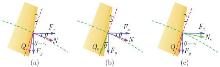
Fig. 1
Decomposition of internal forces on the rod cross section under finite deformation: (a) Engesser’s approach[41–43], (b) Timoshenko’s approach[44–45], and (c) Haringx’s approach[46–48] (color online)"
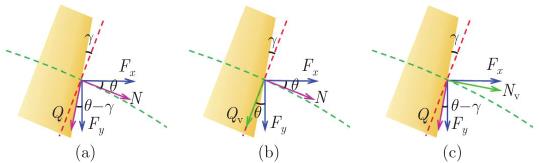
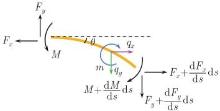
Fig. 2
Force analysis on the microelement ds (color online)"
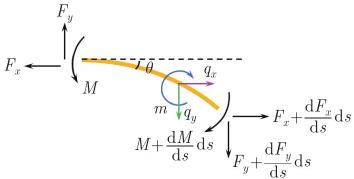
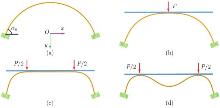
Fig. 3
(a) The initial configuration of the arch, (b) the point contact or point-to-line contact transition stage, (c) the line contact or critical buckling stage, and (d) the post-buckling stage (color online)"
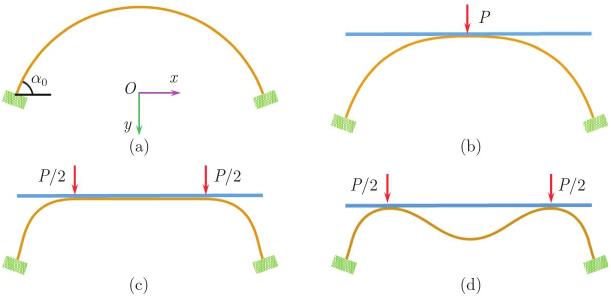
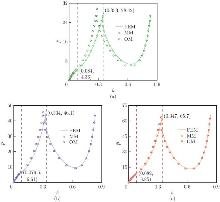
Fig. 4
Displacement-load curves of the arch under compression with (a) α0=30∘ and R=100 mm, (b) α0=45∘ and R=70.7 mm, and (c) α0=60∘ and R=57.735 mm (color online)"
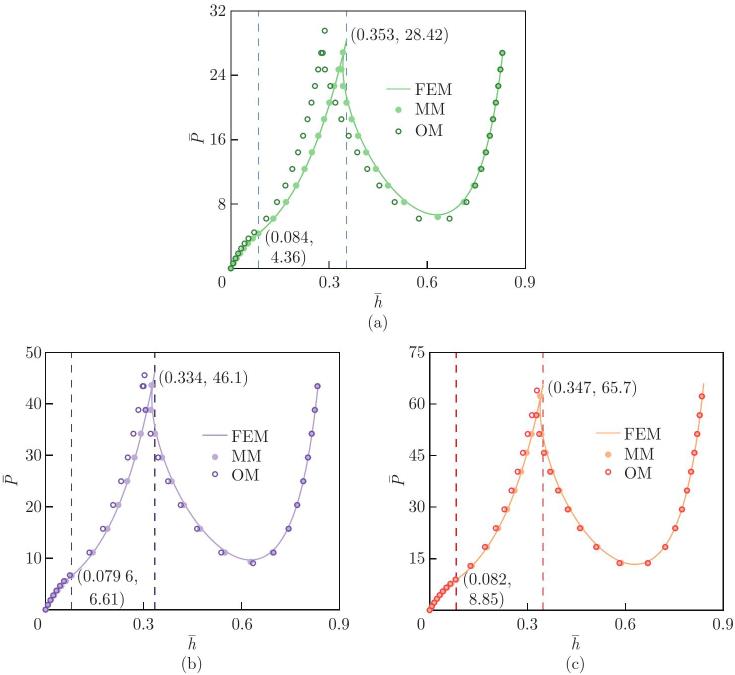
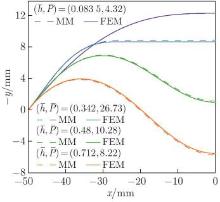
Fig. 5
Deflection curves with α0=30∘ and R=100 mm in different stages (color online)"
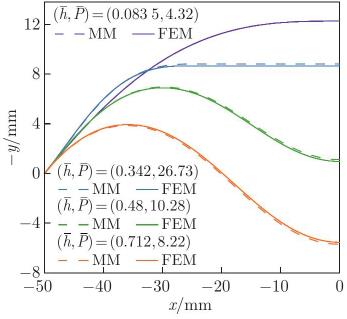
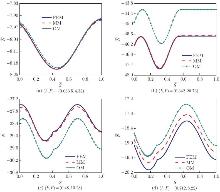
Fig. 6
Dimensionless normal force N¯ in different stages (color online)"
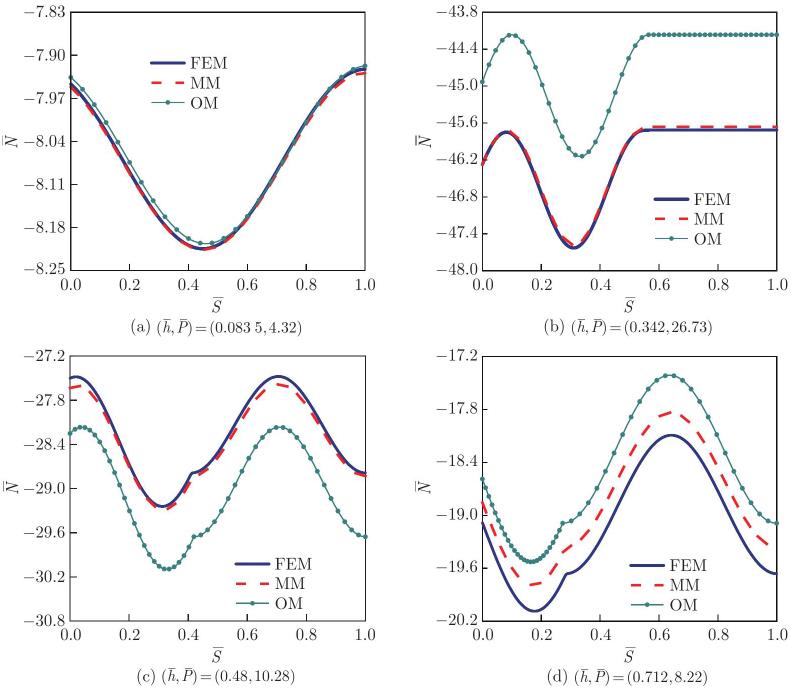
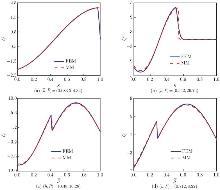
Fig. 7
Dimensionless shear force Q¯ in different stages (color online)"
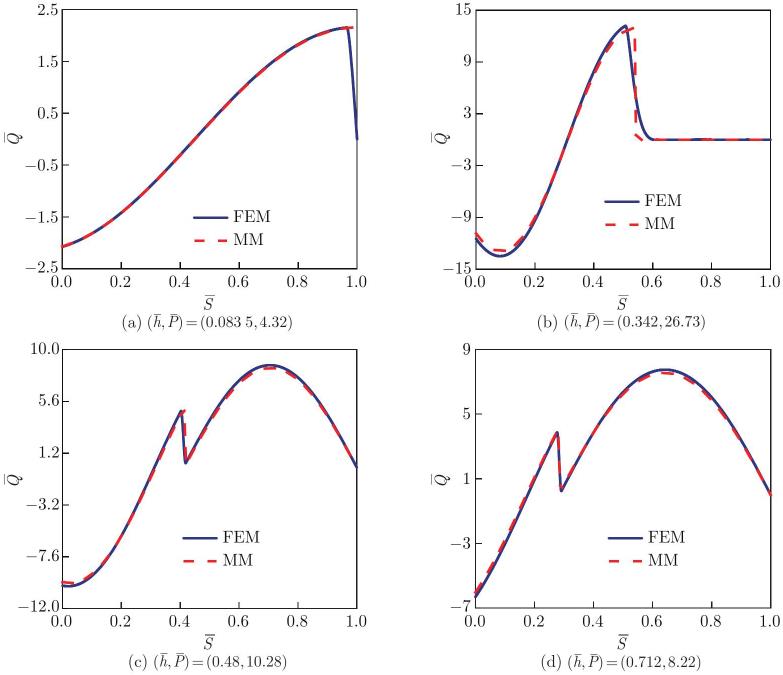
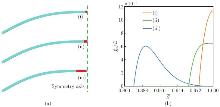
Fig. 8
(a) The contact pressure region (highlighted in red) and (b) the dimensionless contact pressure at (i)–(ii) the point contact stages and (iii) the line contact stage calculated by the FEM (color online)"
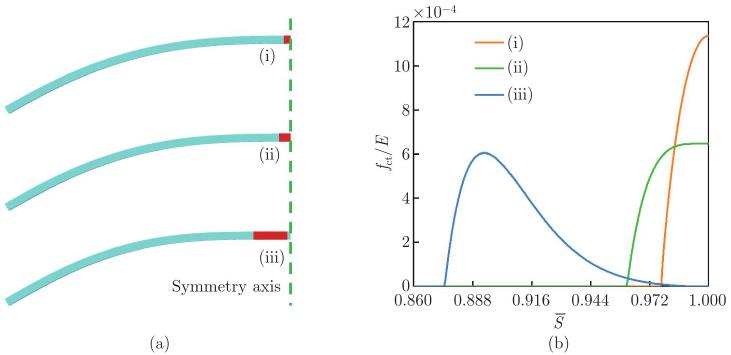
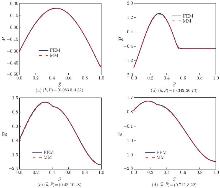
Fig. 9
Dimensionless moment M¯ in different stages (color online)"
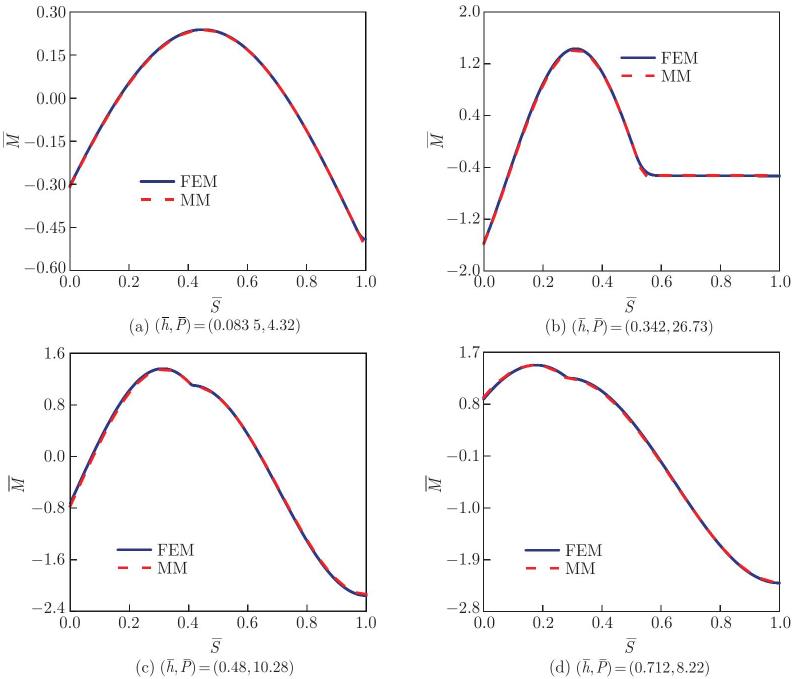
Table 1
The scaling exponents of the critical load and the independent quantities"
| Variable | ||||||
|---|---|---|---|---|---|---|
| 1 | 1 | 0 | 0 | 0 | 0 | |
| 1 | 1 | 1 | 0 | 0 | ||
| 0 | 0 | 0 | 0 |
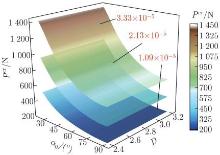
Fig. 10
The relationships of Pcr and D with different α0 and IAR2, where the values of IAR2 are equal to 1.09×10⁻⁵, 2.13×10⁻⁵, and 3.33×10⁻⁵ (color online)"
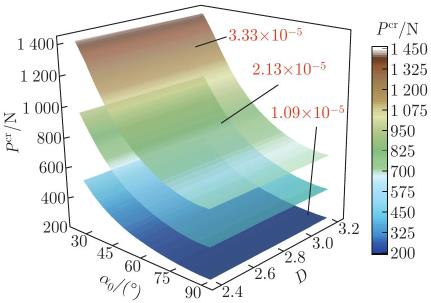
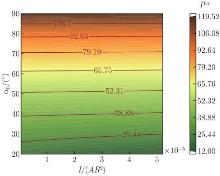
Fig. 11
Effects of α0 and IAR2 on the dimensionless critical load P¯cr (color online)"
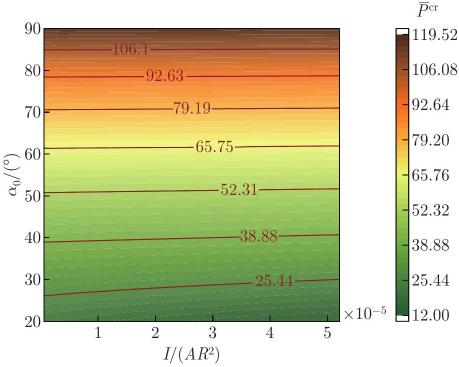
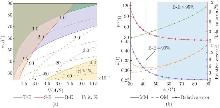
Fig. 12
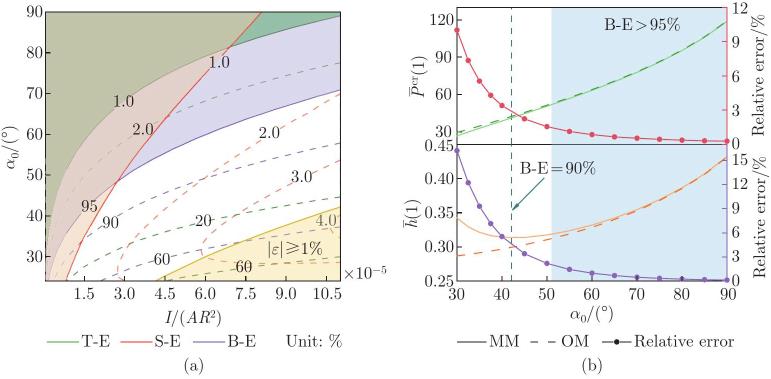
(a) The relationship between the proportions of the three strain energy components at the critical buckling state and the parameters α0 and IAR2; (b) the comparison of the dimensionless critical load P¯cr and the dimensionless displacement h¯ of the rigid plate between the MM and OM when IAR2=3.33×10⁻⁵, where T-E, S-E, and B-E represent the tensile, shear, and bending strain energies, respectively (color online)"
| [1] | LUBINSKI, A. K. and BLENKARN, A. Buckling of tubing in pumping wells, its effects and means for controlling it. Transactions of the AIME, 210, 73–88 (1957) |
| [2] | THOMPSON, J. M. T., SILVEIRA, M., VAN DER HEIJDEN, G. H. M., and WIERCIGROCH, M. Helical post-buckling of a rod in a cylinder: with applications to drill-strings. Proceedings of the Royal Society A: Mathematical, Physical and Engineering Sciences, 468, 1591–1614 (2012) |
| [3] | LATSON, L. A. and QURESHI, A. M. Techniques for transcatheter recanalization of completely occluded vessels and pathways in patients with congenital heart disease. Annals of Pediatric Cardiology, 3, 140–146 (2010) |
| [4] | ALDERLIESTEN, T., KONINGS, M. K., and NIESSEN, W. J. Modeling friction, intrinsic curvature, and rotation of guide wires for simulation of minimally invasive vascular interventions. IEEE Transactions on Biomedical Engineering, 54, 29–38 (2007) |
| [5] | LAJNEF, N., BURGUEÑO, R., BORCHANI, W., and SUN, Y. A concept for energy harvesting from quasi-static structural deformations through axially loaded bilaterally constrained columns with multiple bifurcation points. Smart Materials and Structures, 23, 055005 (2014) |
| [6] | JIAO, P. C., BORCHANI, W., ALAVI, A. H., HASNI, H., and LAJNEF, N. An energy harvesting and damage sensing solution based on postbuckling response of nonuniform cross-section beams. Structural Control and Health Monitoring, 25, e2052 (2018) |
| [7] | LIANG, K., ZHOU, S. J., LUO, Y. J., ZHANG, X. P., and KANG, Z. Topology optimization design of recoverable bistable structures for energy absorption with embedded shape memory alloys. Thin-Walled Structures, 198, 111757 (2024) |
| [8] | JIN, T., ZHAO, J., and ZHANG, Y. Postbuckling analyses of ribbon-type 3D structures assembled on cylindrical substrates. Acta Mechanica Sinica, 40, 424130 (2024) |
| [9] | PRONK, S., GEISSLER, P. L., and FLETCHER, D. A. Limits of filopodium stability. Physical Review Letters, 100, 258102 (2008) |
| [10] | SIPOS, A. A. and VÁRKONYI, P. L. A unified morphoelastic rod model with application to growth-induced coiling, waving, and skewing of plant roots. Journal of the Mechanics and Physics of Solids, 160, 104789 (2022) |
| [11] | RIKS, E. The application of Newton’s method to the problem of elastic stability. ASME Journal of Applied Mechanics, 39, 1060–1065 (1972) |
| [12] | RIKS, E. An incremental approach to the solution of snapping and buckling problems. International Journal of Solids and Structures, 15, 529–551 (1979) |
| [13] | SIMO, J. C., WRIGGERS, P., SCHWEIZERHOF, K. H., and TAYLOR, R. L. Finite deformation post-buckling analysis involving inelasticity and contact constraints. International Journal for Numerical Methods in Engineering, 23, 779–800 (1986) |
| [14] | KANTO, Y. and YAGAWA, G. A dynamic contact buckling analysis by the penalty finite element method. International Journal for Numerical Methods in Engineering, 29, 755–774 (1990) |
| [15] | SEO, K. and MAN, K. Post-buckling analysis of nonfrictional contact problems using linear complementarity formulation. Computers & Structures, 57, 783–794 (1995) |
| [16] | DENOËL, V. and DETOURNAY, E. Eulerian formulation of constrained elastica. International Journal of Solids and Structures, 48, 625–636 (2011) |
| [17] | WANG, J., DEBOEUF, S., ANTKOWIAK, A., and NEUKIRCH, S. Constrained Euler buckling: the von Kármán approximation. International Journal of Solids and Structures, 313, 113279 (2025) |
| [18] | ADAN, N., SHEINMAN, I., and ALTU, E. Post-buckling behavior of beams under contact constraints. ASME Journal of Applied Mechanics, 61, 764–772 (1994) |
| [19] | ADAMS, G. G. and BENSON, R. C. Postbuckling of an elastic plate in a rigid channel. International Journal of Mechanical Sciences, 28, 153–162 (1986) |
| [20] | DOMOKOS, G., HOLMES, P., and ROYCE, B. Constrained euler buckling. Journal of Nonlinear Science, 7, 281–314 (1997) |
| [21] | CHAI, H. The post-buckling response of a bi-laterally constrained column. Journal of the Mechanics and Physics of Solids, 46, 1155–1181 (1998) |
| [22] | RO, W., CHEN, J., and HONG, S. Vibration and stability of a constrained elastica with variable length. International Journal of Solids and Structures, 47, 2143–2154 (2010) |
| [23] | CHEN, J. and LI, C. Planar elastica inside a curved tube with clearance. International Journal of Solids and Structures, 44, 6173–6186 (2007) |
| [24] | LU, Z. and CHEN, J. Deformations of a clamped-clamped elastica inside a circular channel with clearance. International Journal of Solids and Structures, 45, 2470–2492 (2008) |
| [25] | VILLAGGIO, P. Buckling under unilateral constraints. International Journal of Solids and Structures, 15, 193–201 (1979) |
| [26] | ROMAN, B. and POCHEAU, A. Buckling cascade of thin plates: forms, constraints and similarity. Europhysics Letters, 46, 602 (1999) |
| [27] | WANG, Z., RUIMI, A., and SRINIVASA, A. R. A direct minimization technique for finding minimum energy configurations for beam buckling and post-buckling problems with constraints. International Journal of Solids and Structures, 72, 165–173 (2015) |
| [28] | WU. J. and JUVKAM-WOLD, H. C. The effect of wellbore curvature on tubular buckling and lockup. ASME Journal of Applied Mechanics, 117, 214–218 (1995) |
| [29] | HUANG, W. and GAO, D. Helical buckling of a thin rod with connectors constrained in a torus. International Journal of Mechanical Sciences, 98, 14–28 (2015) |
| [30] | HUANG, W., GAO, D., and LIU, Y. A study of tubular string buckling in vertical wells. International Journal of Mechanical Sciences, 118, 231–253 (2016) |
| [31] | LIU, J., ZHONG, X., CHENG, Z., FENG, X., and REN, G. Buckling of a slender rod confined in a circular tube: theory, simulation, and experiment. International Journal of Mechanical Sciences, 140, 288–305 (2018) |
| [32] | LIU, C. and CHEN, J. Effect of Coulomb friction on the deformation of an elastica constrained in a straight channel with clearance. European Journal of Mechanics-A/Solids, 39, 50–59 (2013) |
| [33] | TIKHONOV, V. S. and SAFRONOV, A. I. Analysis of postbuckling drillstring vibrations in rotary drilling of extended-reach wells. ASME Journal of Energy Resources Technology, 133, 043102 (2011) |
| [34] | HORVÁTH, M. G., SIPOS, A. A., and VÁKONYI, P. L. Shape of an elastica under growth restricted by friction. International Journal of Solids and Structures, 156-157, 137–147 (2019) |
| [35] | PLAUT, R. H., SUHERMAN, S., DILLARD, D. A., WILLIAMS, B. E., and WATSON, L. T. Deflections and buckling of a bent elastica in contact with a flat surface. International Journal of Solids and Structures, 36, 1209–1229 (1999) |
| [36] | CHEN, J. and HUNG, S. Deformation and stability of an elastica constrained by curved surfaces. International Journal of Mechanical Sciences, 82, 1–12 (2014) |
| [37] | MORIMOTO, T. and SATO, K. Contact responses between a semi-circular ring and a rigid plane. International Journal of Solids and Structures, 264, 112122 (2023) |
| [38] | JUDAH, N. and GIVLI, S. The post-buckling behavior of a beam constrained by nonlinear springy walls. ASME Journal of Applied Mechanics, 91, 061004 (2024) |
| [39] | CHAI, H. On the post-buckling behavior of bilaterally constrained plates. International Journal of Solids and Structures, 39, 2911–2926 (2002) |
| [40] | LIU, Z. and JU, J. Developing a scalable analytical framework for predicting the contact behavior of elastic rings against rigid surfaces. International Journal of Solids and Structures, 301, 112967 (2024) |
| [41] | ENGESSER, F. Die Knickfestigkeit Gerader Stabe, W. Ernst & Sohn, Berlin (1891) |
| [42] | PISANTY, A. and TENE, Y. Equilibrium equations for plane slender bars undergoing large shear deformations. Acta Mechanica, 17, 263–275 (1973) |
| [43] | SCHMIDT, R. and DADEPPO, D. A. Nonlinear theory of arches and beams with shear deformation. ASME Journal of Applied Mechanics, 39, 1144–1146 (1972) |
| [44] | TIMOSHENKO, S. P. and GERE, J. M. Theory of Elastic Stability, McGraw-Hill, New York (1961) |
| [45] | DADEPPO, D. A. and SCHMIDT, R. Large deflections of elastic arches and beams with shear deformation. The Journal of the Industrial Mathematics Society, 22, 17–34 (1972) |
| [46] | HARINGX, J. A. On highly compressible helical springs and rubber rods, and their application for vibration—free mountings, part I, Philips Res. report 3. Philips Gloeilampenfabrieken, Eindhoven, the Netherlands (1948) |
| [47] | ANTMAN, S. S. and ROSENFELD, G. Global behavior of buckled states of nonlinearly elastic rods. SIAM Review, 20, 513–566 (1978) |
| [48] | ROGERS, R. C. Derivation of linear beam equations using nonlinear continuum mechanics. Zeitschrift für angewandte Mathematik und Physik, 44, 732–754 (1993) |
| [49] | ATANACKOVIC, T. M. Stability Theory of Elastic Rods, World Scientific Publishing Co. Pte. Ltd., Singapore (1997) |
| [50] | YOSHIAKI, G., TOMOO, Y., and MAKOTO, O. Elliptic integral solutions of plane elastica with axial and shear deformations. International Journal of Solids and Structures, 26, 375–390 (1990) |
| [51] | REISSNER, E. On one-dimensional finite-strain beam theory: the plane problem. Zeitschrift für angewandte Mathematik und Physik, 23, 795–804 (1972) |
| [52] | PLAUT, R. H., DALRYMPLE, A. J., and DILLARD, D. A. Effect of work of adhesion on contact of an elastica with a flat surface. Journal of Adhesion Science and Technology, 15, 565–581 (2001) |
| [53] | MAJIDI, C. Remarks on formulating an adhesion problem using Euler’s elastica (draft). Mechanics Research Communications, 34, 85–90 (2007) |
| [54] | GLASSMAKER, N. J. and HUI, C. Y. Elastica solution for a nanotube formed by self-adhesion of a folded thin film. Journal of Applied Physics, 96, 3429–3434 (2004) |
| [55] | LI, J., ZHANG, X. Y., QIN, J. Q., MA, M. Z., and LIU, R. P. Strength and grain refinement of Ti-30Zr-5Al-3V alloy by Fe addition. Materials Science and Engineering: A, 691, 25–30 (2017) |
| [1] | Kangfan YU, Yunwei CHEN, Chuanyun YU, Jianrun ZHANG, Xi LU, Xiaofei DU, Qidi FU. Modular reconfigurable quasi-zero-stiffness isolators: design, analysis, and experiment [J]. Applied Mathematics and Mechanics (English Edition), 2026, 47(8): 1647-1668. |
| [2] | Xin SU, Yuhang LI, Jufang JIA, Xinsheng XU, Andi LAI, Zhenhuan ZHOU. Symplectic electrothermomechanical buckling solutions for two-dimensional decagonal piezoelectric quasicrystal cylindrical shells [J]. Applied Mathematics and Mechanics (English Edition), 2026, 47(7): 1549-1568. |
| [3] | Runqing CAO, Yixiang HE, Jiachun HU, Huliang DAI, Lin WANG. Offset support design for enhancing the stability of flexible fluid-conveying pipes [J]. Applied Mathematics and Mechanics (English Edition), 2026, 47(7): 1447-1468. |
| [4] | Z. KHODDAMI MARAGHI, E. ARSHID, P. RAHIMKHANI. Revolutionizing buckling mechanics of agglomerated nanocomposite-honeycomb sandwich annular plates through a refined zigzag theory-based thermoelastic model on modified Winkler-Pasternak foundation [J]. Applied Mathematics and Mechanics (English Edition), 2026, 47(5): 1105-1130. |
| [5] | Guoquan NIE, Zhiwei WU, Jinxi LIU. Static and dynamic responses of a piezoelectric semiconductor beam under different boundary conditions [J]. Applied Mathematics and Mechanics (English Edition), 2026, 47(2): 303-324. |
| [6] | Dejuan KONG, Zhuangzhuang HE, Chengbin LIU, Chunli ZHANG. Analysis of multi-field coupling behaviors of sandwich piezoelectric semiconductor beams under thermal loadings [J]. Applied Mathematics and Mechanics (English Edition), 2025, 46(8): 1571-1590. |
| [7] | Lu LU, Min LI, Shuang WANG. Surface effects on buckling instability and large deformation of magneto-active soft beams [J]. Applied Mathematics and Mechanics (English Edition), 2025, 46(4): 617-632. |
| [8] | Chang LI, Hai QING. Size-dependent axisymmetric bending and buckling analysis of functionally graded sandwich Kirchhoff nanoplates using nonlocal strain gradient integral model [J]. Applied Mathematics and Mechanics (English Edition), 2025, 46(3): 467-484. |
| [9] | S. SAURABH, S. K. SINGH, V. S. CHAUHAN, R. KIRAN. On the buckling and vibration behavior of carbon nanotube-reinforced bioinspired composite plates: a combined microstructural and hygrothermal investigation via isogeometric analysis [J]. Applied Mathematics and Mechanics (English Edition), 2025, 46(12): 2317-2340. |
| [10] | Yongqi LIU, Jianwei WANG, Dong DU, Guohua NIE. A variational differential quadrature formulation for buckling analysis of anisogrid composite lattice conical shells [J]. Applied Mathematics and Mechanics (English Edition), 2025, 46(11): 2155-2176. |
| [11] | Wei WANG, Gaofei GUAN, Yongqi LI, Jiabin SUN, Zhenhuan ZHOU, Xinsheng XU. Nonlinear post-buckling modeling of a magneto-electro-elastic cylindrical shell with flexomagnetic and flexoelectric effects [J]. Applied Mathematics and Mechanics (English Edition), 2025, 46(11): 2135-2154. |
| [12] | Dali WANG, Tianli JIANG, Huliang DAI, Lin WANG. Non-planar vibration characteristics and buckling behaviors of two fluid-conveying pipes coupled with an intermediate spring [J]. Applied Mathematics and Mechanics (English Edition), 2025, 46(10): 1829-1850. |
| [13] | N. D. NGUYEN, T. N. NGUYEN. Chebyshev polynomial-based Ritz method for thermal buckling and free vibration behaviors of metal foam beams [J]. Applied Mathematics and Mechanics (English Edition), 2024, 45(5): 891-910. |
| [14] | H.M. FEIZABAD, M.H. YAS. Free vibration and buckling analysis of polymeric composite beams reinforced by functionally graded bamboo fibers [J]. Applied Mathematics and Mechanics (English Edition), 2024, 45(3): 543-562. |
| [15] | Lei WANG, Yingge LIU, Juxi HU, Weimin CHEN, Bing HAN. A non-probabilistic reliability topology optimization method based on aggregation function and matrix multiplication considering buckling response constraints [J]. Applied Mathematics and Mechanics (English Edition), 2024, 45(2): 321-336. |
| Viewed | ||||||
|
Full text |
|
|||||
|
Abstract |
|
|||||





 Email Alert
 RSS
RSS