Applied Mathematics and Mechanics (English Edition) ›› 2026, Vol. 47 ›› Issue (5): 1041-1064.doi: https://doi.org/10.1007/s10483-026-3386-8
Previous Articles Next Articles
Jing PENG1, Hui FENG1, Hong WU2, Jia LI1, Qihong FANG1,†( )
)
Received:2025-12-25
Revised:2026-03-24
Published:2026-05-06
Contact:
Qihong FANG, E-mail: fangqh1327@hnu.edu.cnSupported by:2010 MSC Number:
Jing PENG, Hui FENG, Hong WU, Jia LI, Qihong FANG. Decoupling strength-damage trade-offs in additively manufactured alloys via engineered strain gradient. Applied Mathematics and Mechanics (English Edition), 2026, 47(5): 1041-1064.
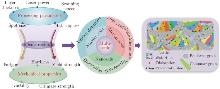
Fig. 1
Schematic diagram of the process-microstructure-property relationship of AM metals (color online)"
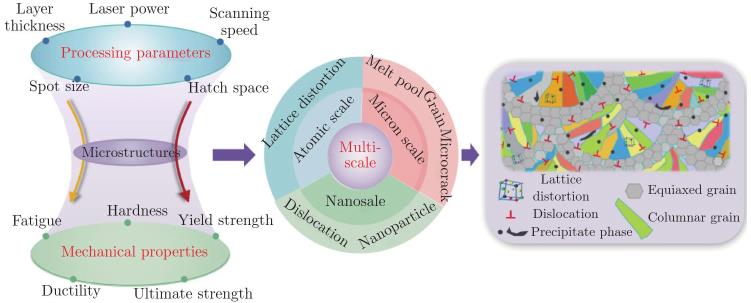

Fig. 2
(a) Grain morphology of AM CuNiSn alloys[33]; (b) schematic diagram of FEM (color online)"
Table 1
Constitutive parameters of AM-fabricated CuNiSn alloys[33,35,43]"
| Parameter | Symbol | Equiaxed crystal | Columnar crystal |
|---|---|---|---|
| Shear modulus/GPa | G | 58 | 58 |
| Poisson’s ratio | ν | 0.326 | 0.326 |
| Taylor parameter | M | 3.06 | 3.06 |
| Burgers vector/nm | b | 0.256 | 0.256 |
| Hall-Petch constant/(MPa·m1/2) | kHP | 356 | 356 |
| Taylor constant | α | 0.3 | 0.3 |
| Geometric factor | k1 | 0.1 | 0.1 |
| Proportionality factor | k2 | 0.035 | 0.038 |
| Dynamic recovery constant | k3 | 8 | 4.3 |
| Reference strain rate/s-1 | 1 | 1 | |
| Rate sensitivity coefficient | m | 20 | 20 |
| Dynamic recovery parameter | n0 | 21.26 | 21.26 |
| Initial dislocation density/μm-2 | ρ | 280 | 200 |
| Reference grain size | ddef | 0.9 | 0.8 |
| Grain size/μm | d | 5 | 22 |
| Effective radius of GND/μm | R | 1 | 1 |
| Average radius of nanoprecipitate/nm | dp | 72 | 72 |
| Volume fraction of nanoprecipitate | fp | 2.24 | 2.24 |
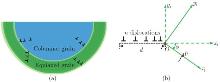
Fig. 3
(a) Schematic diagram of the dislocation pile-up at the interface between equiaxed grain and columnar grain; (b) microcrack nucleation induced by dislocation pile-up on a plane at an angle φ (color online)"
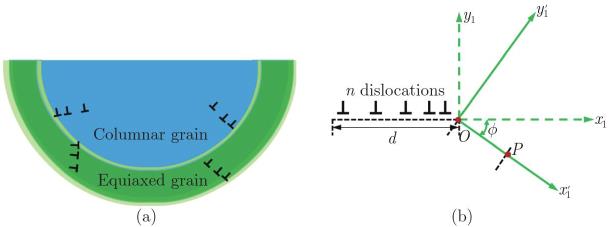

Fig. 4
(a) Stress-strain curves of AM-fabricated CuNiSn alloys under the uniaxial tension; (b) stress-strain curves for different cases; (c) hardening rate; (d) stress-strain curves for different regions (color online)"
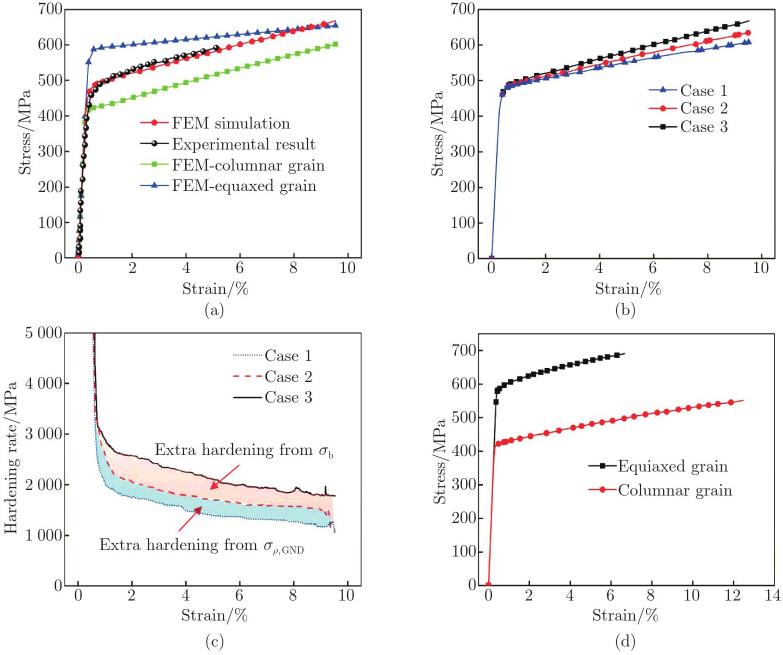

Fig. 5
Von Mises stress distributions considering different hardening mechanisms at strains of 2%, 5%, and 10%: (a) Case 1 without σb or σρ,GND; (b) Case 2 only with σρ,GND; (c) Case 3 with both σb and σρ,GND (color online)"


Fig. 6
Von Mises stress near the zone boundary along Path A at strains of (a) 2%, (b) 5%, and (c) 10% (color online)"
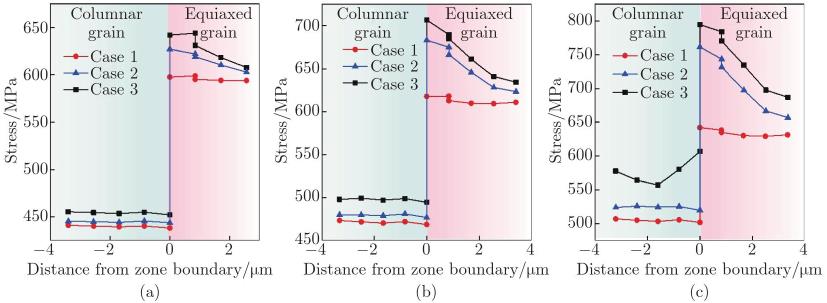
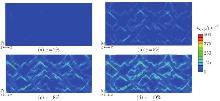
Fig. 7
Distributions of GND at strains of (a) 2%, (b) 5%, (c) 8%, and (d) 10% (color online)"

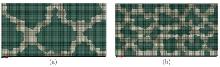
Fig. 8
Schematic diagrams of the printed CuNiSn alloy with different melt pool sizes: (a) the large-melt-pool structure; (b) the small-melt-pool structure (color online)"


Fig. 9
Stress-strain curves of (a) the large-melt-pool structure and (b) the small-melt-pool structure; (c) hardening rate curves for two different structures (color online)"
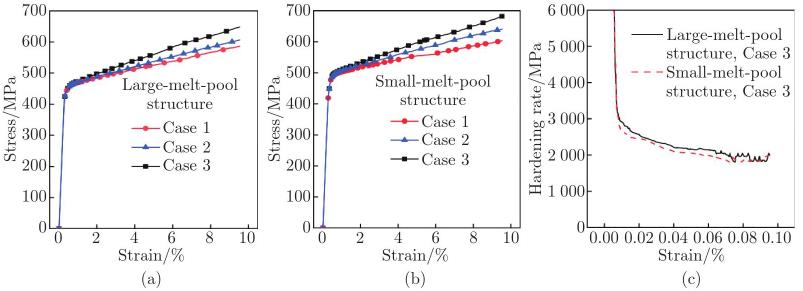
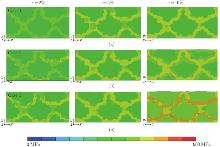
Fig. 10
Von Mises stress distributions of large-melt-pool structure considering different hardening mechanisms at strains of 2%, 5%, and 10%: (a) Case 1 without σb or σρ,GND; (b) Case 2 only with σρ,GND; (c) Case 3 with both σb and σρ,GND (color online)"


Fig. 11
Von Mises stress distributions of the small-melt-pool structure considering different hardening mechanisms at strains of 2%, 5%, and 10%: (a) Case 1 without σb or σρ,GND; (b) Case 2 only with σρ,GND; (c) Case 3 with both σb and σρ,GND (color online)"
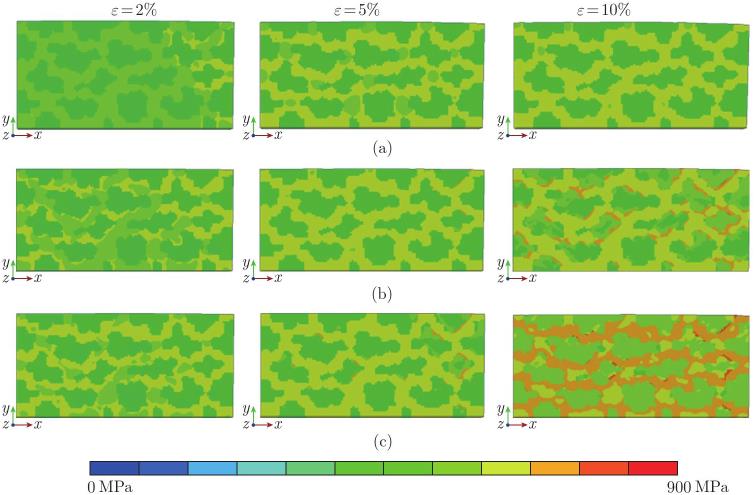
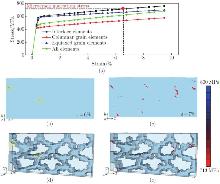
Fig. 12
(a) Stress-strain curves of various elements in AM CuNiSn alloys; distributions of the von Mises stress at strains of (b) 6% and (c) 7%; distributions of elements with von Mises stress larger than the critical stress 713 MPa for microcrack nucleation at strains of (d) 6% and (e) 7% (color online)"

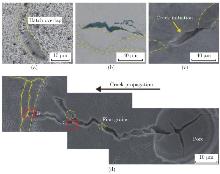
Fig. 13
Crack morphology in AM CuNiSn alloys: (a) fracture surface; (b) section of building direction; (c) horizontal section; (d) crack propagation path in the CuNiSn sample[33] (color online)"


Fig. 14
(a)–(d) Distributions of elements with von Mises stress larger than the critical stress 713 MPa for microcrack nucleation at strains of 6% and 7% in two- and four-melt-pool models; (e) damage evolution for different melt pool sizes (color online)"

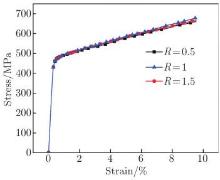
Fig. A1
Stress-strain curves for different values of R (color online)"

| [1] | LIU, Z. Z., ZHOU, Q. H., LIANG, X. K., WANG, X. B., LI, G. C., VANMEENSEL, K., and XIE, J. X. Alloy design for laser powder bed fusion additive manufacturing: a critical review. International Journal of Extreme Manufacturing, 6(2), 022002 (2024) |
| [2] | GAO, S. B., LI, Z., VAN PETEGEM, S., GE, J. Y., GOEL, S., VAS, J. V., LUZIN, V., HU, Z. H., SEET, H. L., SANCHEZ, D. F., VAN SWYGENHOVEN, H., GAO, H. J., and SEITA, M. Additive manufacturing of alloys with programmable microstructure and properties. Nature Communications, 14, 6752 (2023) |
| [3] | NARTU, M. S. K. K. Y., WELK, B. A., MANTRI, S. A., TAYLOR, N. L., VISWANATHAN, G. B., DAHOTRE, N. B., BANERJEE, R., and FRASER, H. L. Underlying factors determining grain morphologies in high-strength titanium alloys processed by additive manufacturing. Nature Communications, 14, 3288 (2023) |
| [4] | LIN, H. D., MAO, Y. Q., and HOU, S. J. Homogenization-based numerical framework of second-phase reinforced alloys integrating strain gradient effects. Applied Mathematics and Mechanics (English Edition), 46(7), 1273–1294 (2025) https://doi.org/10.1007/s10483-025-3268-7 |
| [5] | LU, H. J., SHEN, Q. K., CHEN, X. Z., WEN, M., and JAYALAKSHMI, S. Dual wire arc additive manufacturing of compositionally graded Alx-Co-Cr-Fe-Ni high-entropy alloy. Journal of Materials Research and Technology, 29, 4052–4062 (2024) |
| [6] | TANG, X., ZHANG, H., ZHU, Z. W., XUE, P., WU, L. H., LIU, F. C., NI, D. R., XIAO, B. L., and MA, Z. Y. Dual-phase synergistic deformation characteristics and strengthening mechanism of AlCoCrFeNi2.1 eutectic high entropy alloy fabricated by laser powder bed fusion. Journal of Materials Science & Technology, 150, 75–85 (2023) |
| [7] | LI, J. K., CHENG, T., LIU, Y. B., YANG, Y. Q., LI, W., and WEI, Q. S. Simultaneously enhanced strength and ductility of Cu-15Ni-8Sn alloy with periodic heterogeneous microstructures fabricated by laser powder bed fusion. Additive Manufacturing, 54, 102726 (2022) |
| [8] | MOUSSAOUI, K., RUBIO, W., MOUSSEIGNE, M., SULTAN, T., and REZAI, F. Effects of selective laser melting additive manufacturing parameters of Inconel 718 on porosity, microstructure and mechanical properties. Materials Science and Engineering: A, 735, 182–190 (2018) |
| [9] | LING, P. H., JIANG, W. G., ZHAN, Z. C., CHEN, T., QIN, Q. H., and MAO, L. H. Insights into microstructural variations in GH4169 thin-walled parts by laser powder bed fusion: a coupling finite-element/cellular-automaton study. Acta Mechanica Sinica, 42(7), 124808 (2025) |
| [10] | BIFFI, C. A., FIOCCHI, J., FERRARIO, E., FORNACI, A., RICCIO, M., ROMEO, M., and TUISSI, A. Effects of the scanning strategy on the microstructure and mechanical properties of a TiAl6V4 alloy produced by electron beam additive manufacturing. The International Journal of Advanced Manufacturing Technology, 107(11), 4913–4924 (2020) |
| [11] | JING, C. C., CHEN, Z., LIU, B., XU, T. Q., WANG, J., LU, T., LU, J. P., GUO, Y. L., and LIU, C. M. Improving mechanical strength and isotropy for wire-arc additive manufactured 304L stainless steels via controlling arc heat input. Materials Science and Engineering: A, 845, 143223 (2022) |
| [12] | PENG, J., LIU, B., LI, W. P., LIAW, P. K., LI, J., and FANG, Q. H. Data-driven investigation of microstructure and surface integrity in additively manufactured multi-principal-element alloys. Journal of Alloys and Compounds, 937, 168431 (2023) |
| [13] | BANDYOPADHYAY, A., TRAXEL, K. D., LANG, M., JUHASZ, M., ELIAZ, N., and BOSE, S. Alloy design via additive manufacturing: advantages, challenges, applications and perspectives. Materials Today, 52, 207–224 (2022) |
| [14] | ZHANG, T. L., HUANG, Z. H., YANG, T., KONG, H. J., LUAN, J. H., WANG, A. D., WANG, D., KUO, W., WANG, Y. Z., and LIU, C. T. In situ design of advanced titanium alloy with concentration modulations by additive manufacturing. Science, 374(6566), 478–482 (2021) |
| [15] | SUN, Z. J., TAN, X. P., WANG, C. C., DESCOINS, M., MANGELINCK, D., TOR, S. B., JÄGLE, E. A., ZAEFFERER, S., and RAABE, D. Reducing hot tearing by grain boundary segregation engineering in additive manufacturing: example of an AlxCoCrFeNi high-entropy alloy. Acta Materialia, 204, 116505 (2021) |
| [16] | ZHANG, K., WU, F. F., LIU, W. D., WANG, H. R., HOU, Z. Z., XI, W. C., and LIU, W. J. Synergistic enhancement of strength and toughness in selective laser melted CuSn10 alloy via particle reinforcement and heat treatment. The International Journal of Advanced Manufacturing Technology, 140(9), 4713–4756 (2025) |
| [17] | LI, M., GUPTA, A., BENNETT, C. J., YUE, Z. F., SUN, W., and TU, S. T. Cyclic plasticity of additively manufactured Ti-6Al-4V bracket for aeroengine application. International Journal of Mechanical Sciences, 258, 108567 (2023) |
| [18] | LI, X. Y., LU, L., LI, J. G., ZHANG, X., and GAO, H. J. Mechanical properties and deformation mechanisms of gradient nanostructured metals and alloys. Nature Reviews Materials, 5(9), 706–723 (2020) |
| [19] | LI, J., YI, M., WU, H. Y., FANG, Q. H., LIU, Y., LIU, B., ZHOU, K., and LIAW, P. K. Fine-grain-embedded dislocation-cell structures for high strength and ductility in additively manufactured steels. Materials Science and Engineering: A, 790, 139736 (2020) |
| [20] | YANG, X., BARRETT, R. A., HARRISON, N. M., and LEEN, S. B. A physically-based structure-property model for additively manufactured Ti-6Al-4V. Materials & Design, 205, 109709 (2021) |
| [21] | GENG, Y. Y., XIE, W. L., TU, Y. H., DENG, S. Y., EGAN, D., DOWLING, D. P., SONG, H. W., ZHANG, S. H., and HARRISON, N. Ti-6Al-4V microstructural functionally graded material by additive manufacturing: experiment and computational modelling. Materials Science and Engineering: A, 823, 141782 (2021) |
| [22] | PLOTKOWSKI, A., SISCO, K., BAHL, S., SHYAM, A., YANG, Y., ALLARD, L., NANDWANA, P., ROSSY, A. M., and DEHOFF, R. R. Microstructure and properties of a high temperature Al-Ce-Mn alloy produced by additive manufacturing. Acta Materialia, 196, 595–608 (2020) |
| [23] | HERATH, C., WANNI, J., ARNOLD, S. M., and ACHUTHAN, A. A microstructure-informed constitutive model for hierarchical materials with subgrain features. International Journal of Mechanical Sciences, 261, 108691 (2024) |
| [24] | PAI, N., SAMAJDAR, I., and PATRA, A. Microstructural and mechanistic insights into the tension-compression asymmetry of rapidly solidified Fe-Cr alloys: a phase field and strain gradient plasticity study. Journal of the Mechanics and Physics of Solids, 189, 105695 (2024) |
| [25] | SUI, S., QI, J. W., MA, D., XU, C. J., QI, Y. S., XU, M. T., LIU, Y. H., YU, W. J., GUO, C., WU, X. Q., and ZHANG, Z. M. Additive manufacturing of ultrastrong and ductile nickel matrix composites via hetero-deformation induced strengthening. International Journal of Extreme Manufacturing, 7(4), 045003 (2025) |
| [26] | HU, D. J., GUO, Z. X., GRILLI, N., TAY, A., LU, Z., and YAN, W. T. Understanding the strain localization in additively manufactured materials: micro-scale tensile tests and crystal plasticity modeling. International Journal of Plasticity, 177, 103981 (2024) |
| [27] | TOURSANGSARAKI, M., TANG, R. L., DU, D. F., ZHANG, X., DONG, A. P., LEEN, S. B., XUAN, Y., ZHANG, Z. B., and SUN, B. D. Non local crystal plasticity and in-situ EBSD of deformation anisotropy in LPBF-ed Inconel 718. International Journal of Mechanical Sciences, 310, 111136 (2026) |
| [28] | PENG, J., LI, L., LI, F., LIU, B., ZHEREBTSOV, S., FANG, Q. H., LI, J., STEPANOV, N., LIU, Y., LIU, F., and LIAW, P. K. The predicted rate-dependent deformation behaviour and multistage strain hardening in a model heterostructured body-centered cubic high entropy alloy. International Journal of Plasticity, 145, 103073 (2021) |
| [29] | LI, L., PENG, J., TANG, S., FANG, Q., and WEI, Y. Micromechanism of strength and damage trade-off in second-phase reinforced alloy by strain gradient plasticity theory. International Journal of Plasticity, 176, 103970 (2024) |
| [30] | DING, L., YU, C., ZHANG, X., WEN, Z. F., KAN, Q. H., and KANG, G. Z. Incremental strain gradient plasticity model and torsion simulation of copper micro-wires. International Journal of Mechanical Sciences, 239, 107891 (2023) |
| [31] | HUANG, Y., QU, S., HWANG, K. C., LI, M., and GAO, H. A conventional theory of mechanism-based strain gradient plasticity. International Journal of Plasticity, 20(4-5), 753–782 (2004) |
| [32] | NARAYANA SAMY, V. P., SCHÄFLE, M., BRASCHE, F., KRUPP, U., and HAASE, C. Understanding the mechanism of columnar-to-equiaxed transition and grain refinement in additively manufactured steel during laser powder bed fusion. Additive Manufacturing, 73, 103702 (2023) |
| [33] | ZHAO, C., WANG, Z., LI, D. X., KOLLO, L., LUO, Z. Q., ZHANG, W. W., and PRASHANTH, K. G. Selective laser melting of Cu-Ni-Sn: a comprehensive study on the microstructure, mechanical properties, and deformation behavior. International Journal of Plasticity, 138, 102926 (2021) |
| [34] | LI, L., FANG, Q. H., LI, J., LIU, B., LIU, Y., and LIAW, P. K. Lattice-distortion dependent yield strength in high entropy alloys. Materials Science and Engineering: A, 784, 139323 (2020) |
| [35] | ZHAO, C., WANG, Z., LI, D. X., PAN, D. Q., LOU, B. M., LUO, Z. Q., and ZHANG, W. W. Optimization of strength and ductility in an as-extruded Cu-15Ni-8Sn alloy by the additions of Si and Ti. Journal of Alloys and Compounds, 823, 153759 (2020) |
| [36] | LI, J., LUO, K., and AN, Q. Unraveling the Hall-Petch to inverse Hall-Petch transition in nanocrystalline CdTe. International Journal of Mechanical Sciences, 286, 109852 (2025) |
| [37] | LI, W. H., XIANG, M. Z., AITKEN, Z. H., CHEN, S., XU, Y. L., YANG, X. Y., PEI, Q. X., WANG, J., LI, X. Y., VASTOLA, G., GAO, H. J., and ZHANG, Y. W. Unraveling the Hall-Petch to inverse Hall-Petch transition in nanocrystalline high entropy alloys under shock loading. International Journal of Plasticity, 178, 104010 (2024) |
| [38] | LUO, G. J., LI, L., FANG, Q. H., LI, J., TIAN, Y. Y., LIU, Y., LIU, B., PENG, J., and LIAW, P. K. Microstructural evolution and mechanical properties of FeCoCrNiCu high entropy alloys: a microstructure-based constitutive model and a molecular dynamics simulation study. Applied Mathematics and Mechanics (English Edition), 42(8), 1109–1122 (2021) https://doi.org/10.1007/s10483-021-2756-9 |
| [39] | HU, D. J., GRILLI, N., and YAN, W. T. Dislocation structures formation induced by thermal stress in additive manufacturing: multiscale crystal plasticity modeling of dislocation transport. Journal of the Mechanics and Physics of Solids, 173, 105235 (2023) |
| [40] | YU, S. X., WU, H., LI, X. L., DENG, X. T., and WANG, Z. D. Collaboratively enhancing the strength and ductility of multicrystalline nickel-based ultrathin strips by manipulating their size effects and dislocation slipping mode. Science China Technological Sciences, 68(9), 1920202 (2025) |
| [41] | LI, G. D., JIANG, J. X., MA, H. C., ZHENG, R. X., GAO, S., ZHAO, S. T., MA, C. L., AMEYAMA, K., DING, B., and LI, X. Y. Superior strength-ductility synergy in three-dimensional heterogeneous-nanostructured metals. Acta Materialia, 256, 119143 (2023) |
| [42] | BAYLEY, C. J., BREKELMANS, W. A. M., and GEERS, M. G. D. A comparison of dislocation induced back stress formulations in strain gradient crystal plasticity. International Journal of Solids and Structures, 43(24), 7268–7286 (2006) |
| [43] | WANG, Y., ZHU, Y., YU, Z., ZHAO, J., and WEI, Y. Hetero-zone boundary affected region: a primary microstructural factor controlling extra work hardening in heterostructure. Acta Materialia, 241, 118395 (2022) |
| [44] | PENG, J., LI, J., LIU, B., FANG, Q. H., and LIAW, P. K. Origin of thermal deformation induced crystallization and microstructure formation in additive manufactured FCC, BCC, HCP metals and its alloys. International Journal of Plasticity, 172, 103831 (2024) |
| [45] | OKUGAWA, M., OHIGASHI, Y., FURISHIRO, Y., KOIZUMI, Y., and NAKANO, T. Equiaxed grain formation by intrinsic heterogeneous nucleation via rapid heating and cooling in additive manufacturing of aluminum-silicon hypoeutectic alloy. Journal of Alloys and Compounds, 919, 165812 (2022) |
| [46] | XU, M. N., XIAO, L. R., GAO, B., LI, Z. H., WU, Z. X., CHEN, X. F., ZHOU, H., and ZHU, Y. T. Strengthening mechanisms induced by sequential grain refinement and solid solution strengthening in dual-phase heterostructured Mg-Li alloys with low Al content. Journal of Alloys and Compounds, 1021, 179527 (2025) |
| [47] | ZHANG, S., ZHOU, J., WANG, L., LIU, H., and DONG, S. Crack nucleation due to dislocation pile-ups at twin boundary-grain boundary intersections. Materials Science and Engineering: A, 632, 78–81 (2015) |
| [48] | NOELL, P. J., CARROLL, J. D., and BOYCE, B. L. The mechanisms of ductile rupture. Acta Materialia, 161, 83–98 (2018) |
| [49] | JIANG, M. Y., MONNET, G., and DEVINCRE, B. Stress fields of finite-size dislocation walls and prediction of back stress induced by geometrically necessary dislocations at grain boundaries. Journal of the Mechanics and Physics of Solids, 143, 104071 (2020) |
| [50] | ZOU, Y. M., DING, H., ZHANG, Y., and TANG, Z. Y. Microstructural evolution and strain hardening behavior of a novel two-stage warm rolled ultra-high strength medium Mn steel with heterogeneous structures. International Journal of Plasticity, 151, 103212 (2022) |
| [51] | ZHANG, X., ZHAO, J. F., KANG, G. Z., and ZAISER, M. Geometrically necessary dislocations and related kinematic hardening in gradient grained materials: a nonlocal crystal plasticity study. International Journal of Plasticity, 163, 103553 (2023) |
| [52] | ZHU, B., XUE, X. Y., KOU, H. C., DONG, R. F., and LI, J. S. The nucleation of microcracks under tensile stress in multi-phase high Nb-containing TiAl alloys. Intermetallics, 106, 13–19 (2019) |
| [53] | WANG, S. K., LI, M. Q., NING, Z. L., CHEN, G., LIU, Z., WU, J., and JIANG, W. C. Microstructural insights into the influence of stress amplitudes on the crack nucleation mechanism of Ti-2Al-2.5Zr alloy using quasi in-situ tests. Journal of Materials Research and Technology, 35, 1178–1209 (2025) |
| [54] | WANG, C. C., CAO, Y., LI, J. G., PENG, W. H., XIN, D. Q., and CHEN, J. Cryogenic strength-ductility mechanism of heterostructured CoCrFeMnNi high-entropy alloy. Journal of Materials Research and Technology, 33, 7004–7016 (2024) |
| [55] | ZHANG, C. L., LIU, S. Y., ZHANG, J. Y., ZHANG, D. D., KUANG, J., BAO, X. Y., LIU, G., and SUN, J. Trifunctional nanoprecipitates ductilize and toughen a strong laminated metastable titanium alloy. Nature Communications, 14, 1397 (2023) |
| [56] | GAO, Q., SANG, B., WANG, W. B., WANG, Q., REN, J. Q., LU, X. F., and QIAO, J. S. In-situ study of dislocation coordinated plastic deformation mechanism in as-cast Ni33Co40Mn27 medium entropy alloy. Materials Science and Engineering: A, 924, 147818 (2025) |
| [57] | MEDE, T. and EL SHAWISH, S. Analytical model for predicting induced-stress distributions in polycrystalline materials. International Journal of Mechanical Sciences, 301, 110470 (2025) |
| [58] | KAWATA, I., NAKAI, H., and AIHARA, S. Experimental evaluation of effective surface energy for cleavage microcrack propagation across grain boundary in steels. Acta Materialia, 150, 40–52 (2018) |
| [59] | WEST, J. M. Chemical potential and surface energy in stress-corrosion cracking. Metal Science, 14(11), 534–540 (1980) |
| [60] | KAN, X. F., YIN, Y. J., YANG, D. C., LI, W., and SUN, J. Q. Micro pool characteristics of 316L and the influence of sulfur during SLM. Optics & Laser Technology, 142, 107136 (2021) |
| [61] | CAI, Y. H., XIONG, J., CHEN, H., and ZHANG, G. J. A review of in-situ monitoring and process control system in metal-based laser additive manufacturing. Journal of Manufacturing Systems, 70, 309–326 (2023) |
| [62] | ZHANG, K., CHEN, Y. H., MARUSSI, S., FAN, X. Q., FITZPATRICK, M., BHAGAVATH, S., MAJKUT, M., LUKIC, B., JAKATA, K., RACK, A., JONES, M. A., SHINJO, J., PANWISAWAS, C., LEUNG, C. L. A., and LEE, P. D. Pore evolution mechanisms during directed energy deposition additive manufacturing. Nature Communications, 15, 1715 (2024) |
| [63] | REIJONEN, J., REVUELTA, A., METSÄ-KORTELAINEN, S., and SALMINEN, A. Effect of laser focal point position on porosity and melt pool geometry in laser powder bed fusion additive manufacturing. Additive Manufacturing, 85, 104180 (2024) |
| [1] | Jie WANG, Juan LIU, Yinghui LI, Cheng LI, Bo ZHANG, Biao HU, Huoming SHENG. Wave propagation in functionally graded piezoelectric sandwich doubly-curved nanoplates based on nonlocal strain gradient theory [J]. Applied Mathematics and Mechanics (English Edition), 2026, 47(4): 767-790. |
| [2] | Haidong LIN, Yiqi MAO, Shujuan HOU. Homogenization-based numerical framework of second-phase reinforced alloys integrating strain gradient effects [J]. Applied Mathematics and Mechanics (English Edition), 2025, 46(7): 1273-1294. |
| [3] | Chang LI, Hai QING. Size-dependent axisymmetric bending and buckling analysis of functionally graded sandwich Kirchhoff nanoplates using nonlocal strain gradient integral model [J]. Applied Mathematics and Mechanics (English Edition), 2025, 46(3): 467-484. |
| [4] | Yijin ZHANG, Bin LIU, Fei PENG, Heran JIA, Zeang ZHAO, Shengyu DUAN, Panding WANG, Hongshuai LEI. Adaptive enhancement design of triply periodic minimal surface lattice structure based on non-uniform stress distribution [J]. Applied Mathematics and Mechanics (English Edition), 2023, 44(8): 1317-1330. |
| [5] | Pei ZHANG, P. SCHIAVONE, Hai QING. Dynamic stability analysis of porous functionally graded beams under hygro-thermal loading using nonlocal strain gradient integral model [J]. Applied Mathematics and Mechanics (English Edition), 2023, 44(12): 2071-2092. |
| [6] | Xinte WANG, Juan LIU, Biao HU, Bo ZHANG, Huoming SHEN. Wave propagation responses of porous bi-directional functionally graded magneto-electro-elastic nanoshells via nonlocal strain gradient theory [J]. Applied Mathematics and Mechanics (English Edition), 2023, 44(10): 1821-1840. |
| [7] | Shaopeng WANG, Jun HONG, Dao WEI, Gongye ZHANG. Bending and wave propagation analysis of axially functionally graded beams based on a reformulated strain gradient elasticity theory [J]. Applied Mathematics and Mechanics (English Edition), 2023, 44(10): 1803-1820. |
| [8] | Zeyang CHI, Jinxing LIU, A. K. SOH. On complete and micropolar-based incomplete strain gradient theories for periodic lattice structures [J]. Applied Mathematics and Mechanics (English Edition), 2023, 44(10): 1651-1674. |
| [9] | Lingkang ZHAO, Peijun WEI, Yueqiu LI. Free vibration of thermo-elastic microplate based on spatiotemporal fractional-order derivatives with nonlocal characteristic length and time [J]. Applied Mathematics and Mechanics (English Edition), 2023, 44(1): 109-124. |
| [10] | Jun JIN, Ningdong HU, Hongping HU. Size effects on the mixed modes and defect modes for a nano-scale phononic crystal slab [J]. Applied Mathematics and Mechanics (English Edition), 2023, 44(1): 21-34. |
| [11] | Binying WANG, Jinxing LIU, A. K. SOH, Naigang LIANG. On band gaps of nonlocal acoustic lattice metamaterials: a robust strain gradient model [J]. Applied Mathematics and Mechanics (English Edition), 2022, 43(1): 1-20. |
| [12] | Rui SONG, S. SAHMANI, B. SAFAEI. Isogeometric nonlocal strain gradient quasi-three-dimensional plate model for thermal postbuckling of porous functionally graded microplates with central cutout with different shapes [J]. Applied Mathematics and Mechanics (English Edition), 2021, 42(6): 771-786. |
| [13] | Zhu SU, Lifeng WANG, Kaipeng SUN, Jie SUN. Transverse shear and normal deformation effects on vibration behaviors of functionally graded micro-beams [J]. Applied Mathematics and Mechanics (English Edition), 2020, 41(9): 1303-1320. |
| [14] | Shan ZENG, Kaifa WANG, Baolin WANG, Jinwu WU. Vibration analysis of piezoelectric sandwich nanobeam with flexoelectricity based on nonlocal strain gradient theory [J]. Applied Mathematics and Mechanics (English Edition), 2020, 41(6): 859-880. |
| [15] | Gao XU, Feng HAO, Jiawang HONG, Daining FANG. Atomic-scale simulations for lithium dendrite growth driven by strain gradient [J]. Applied Mathematics and Mechanics (English Edition), 2020, 41(4): 533-542. |
| Viewed | ||||||
|
Full text |
|
|||||
|
Abstract |
|
|||||





 Email Alert
 RSS
RSS