Applied Mathematics and Mechanics (English Edition) ›› 2026, Vol. 47 ›› Issue (2): 235-254.doi: https://doi.org/10.1007/s10483-026-3353-7
Previous Articles Next Articles
Linchuan ZHAO1,2,3,4, Zewen CHEN2, X. CHEN4, Qiuhua GAO3, Zhiyuan WU3, Ge YAN3, Kexiang WEI2, E. M. YEATMAN4,5, Guang MENG2,3, Wenming ZHANG1,3, Hongxiang ZOU2,†( )
)
Received:2025-10-12
Revised:2025-12-08
Online:2026-02-04
Published:2026-02-04
Contact:
Hongxiang ZOU, E-mail: zouhongxiang@163.comSupported by:2010 MSC Number:
Linchuan ZHAO, Zewen CHEN, X. CHEN, Qiuhua GAO, Zhiyuan WU, Ge YAN, Kexiang WEI, E. M. YEATMAN, Guang MENG, Wenming ZHANG, Hongxiang ZOU. Design and analysis of a mechanically intelligent system for biomechanical energy harvesting. Applied Mathematics and Mechanics (English Edition), 2026, 47(2): 235-254.
Fig. 1
Conceptual design diagram of a BEHMIM: (a) diagram of mechanically intelligent biomechanical energy harvesting; (b) detailed structural and potential applications of the BEHMIM (color online)"
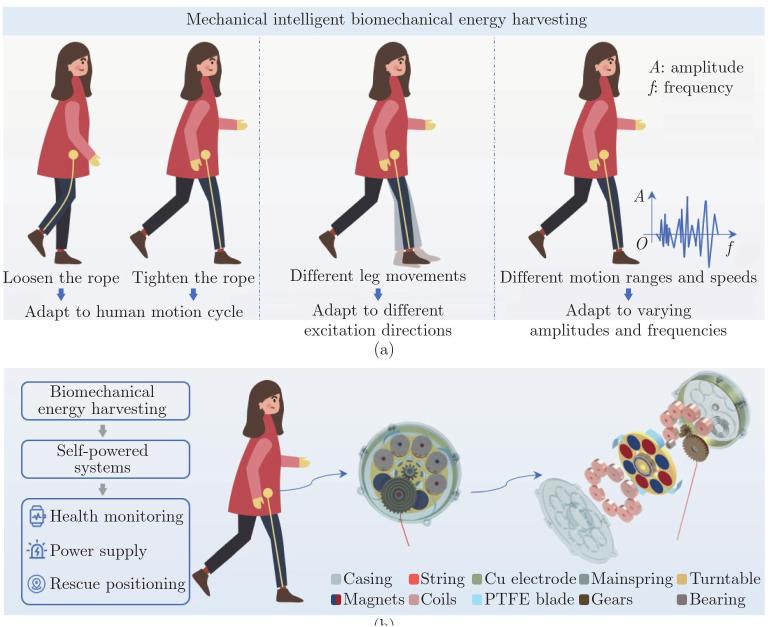
Fig. 2
Working mechanism of the BEHMIM: (a) schematic diagram of the working principle of the TENG; (b) electric potential distributions of the TENG; (c) schematic diagram of the working principle of the electromagnetic unit (EMH); (d) comparison of the magnetic field distribution between N-S alternating arrangement and N-N arrangement (color online)"
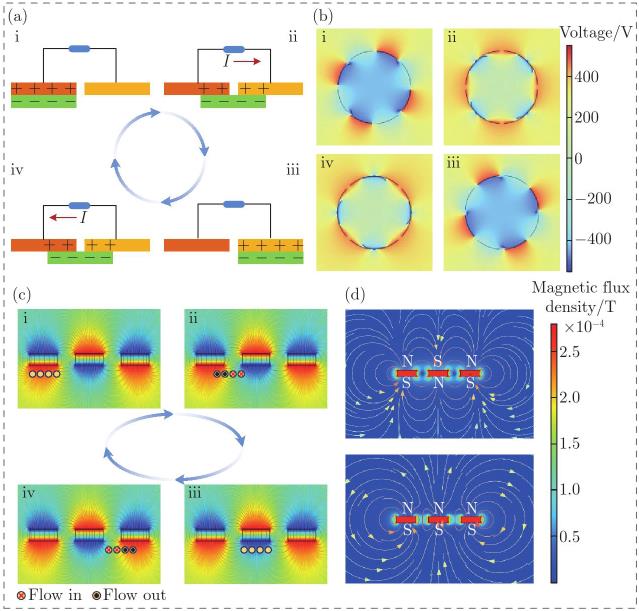
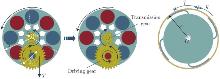
Fig. 3
Geometric configuration of the BEHMIM (color online)"
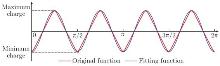
Fig. 4
Simulation of the charge output behavior of the TENG (color online)"
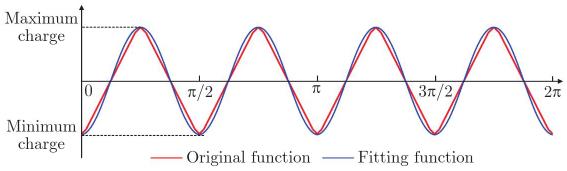
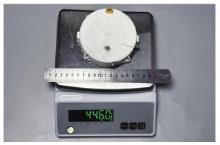
Fig. 5
Photograph of the prototype of the BEHMIM (color online)"
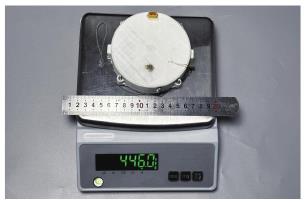
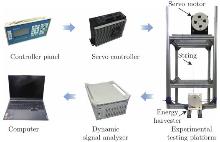
Fig. 6
Experimental setup (color online)"
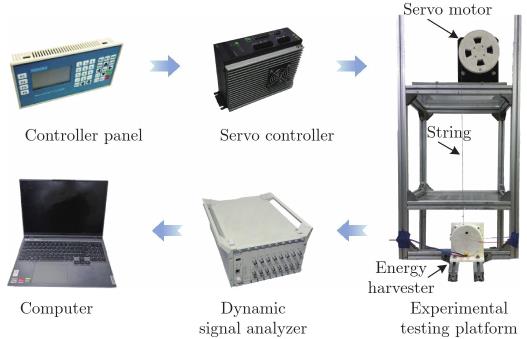
Fig. 7
Comparisons of the average output power of the BEHMIM at different excitation angles: (a) average output power of the EMH; (b) average output power of the TENG (color online)"
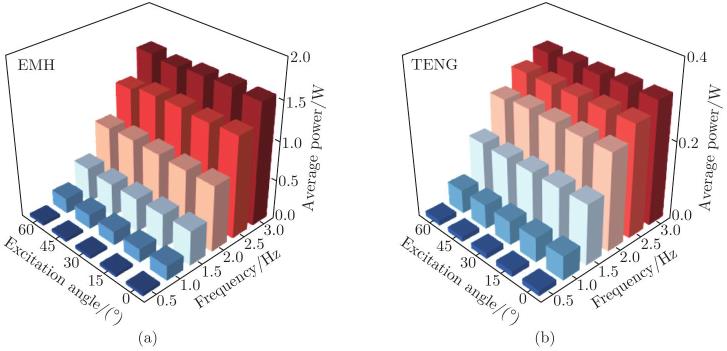
Fig. 8
Experimental results of the output voltage of the EMH, with excitation frequencies of 0.5 Hz, 1 Hz, 1.5 Hz, 2 Hz, 2.5 Hz, and 3 Hz, and excitation amplitudes of (a) 100 mm, (b) 200 mm, and (c) 300 mm (color online)"
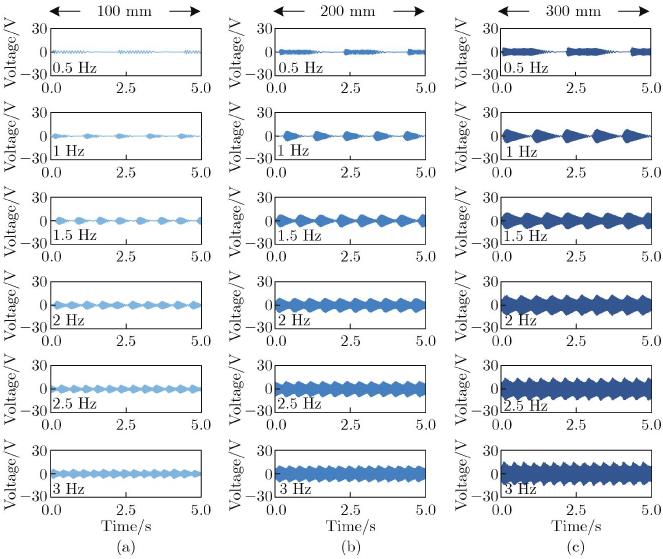
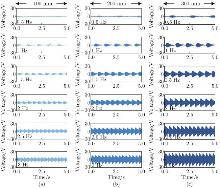
Fig. 9
Simulation results of the output voltage of the EMH, with excitation frequencies of 0.5 Hz, 1 Hz, 1.5 Hz, 2 Hz, 2.5 Hz, and 3 Hz, and excitation amplitudes of (a) 100 mm, (b) 200 mm, and (c) 300 mm (color online)"
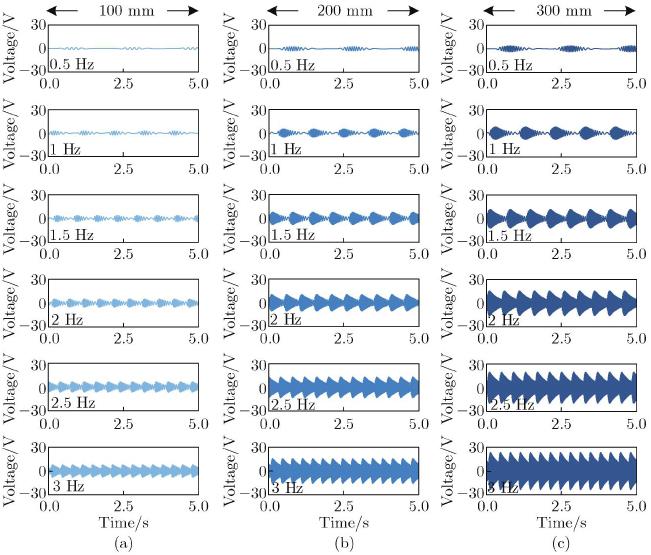
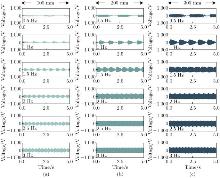
Fig. 10
Experimental results of the output voltage of the TENG, with excitation frequencies of 0.5 Hz, 1 Hz, 1.5 Hz, 2 Hz, 2.5 Hz, and 3 Hz, and excitation amplitudes of (a) 100 mm, (b) 200 mm, and (c) 300 mm (color online)"
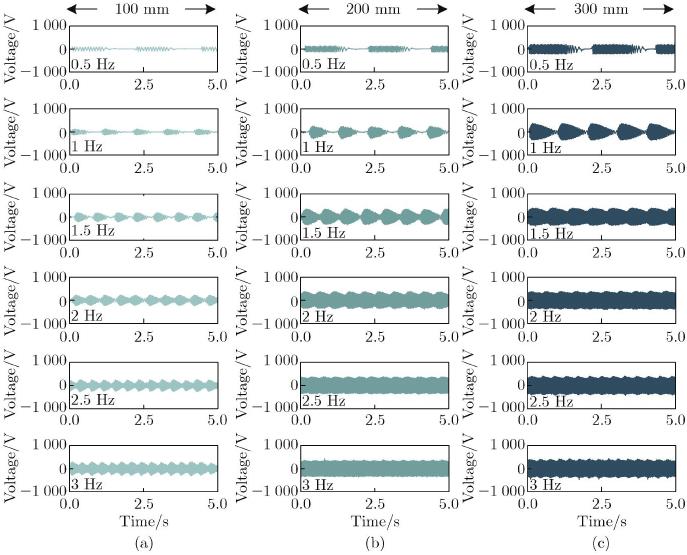
Fig. 11
Simulation results of the output voltage of the TENG, with excitation frequencies of 0.5 Hz, 1 Hz, 1.5 Hz, 2 Hz, 2.5 Hz, and 3 Hz, and excitation amplitudes of (a) 100 mm, (b) 200 mm, and (c) 300 mm (color online)"
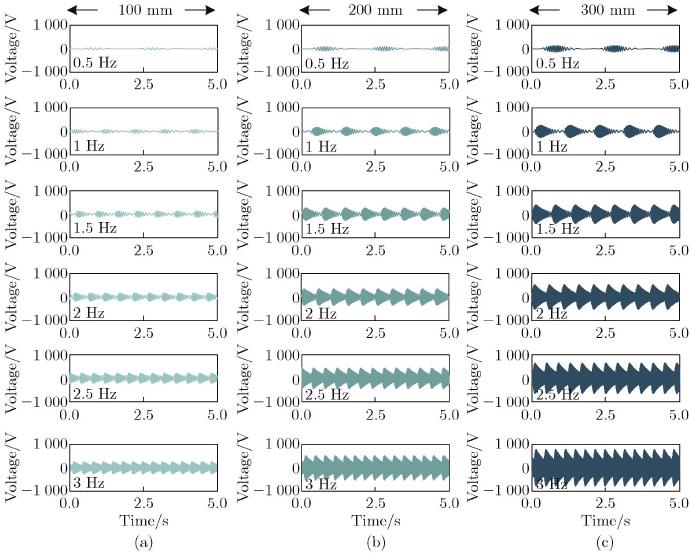
Fig. 12
Experimental results of the electrical output for the EMH and TENG: (a) peak voltage of the EMH; (b) average power of the EMH; (c) peak voltage of the TENG; (d) average power of the TENG (color online)"
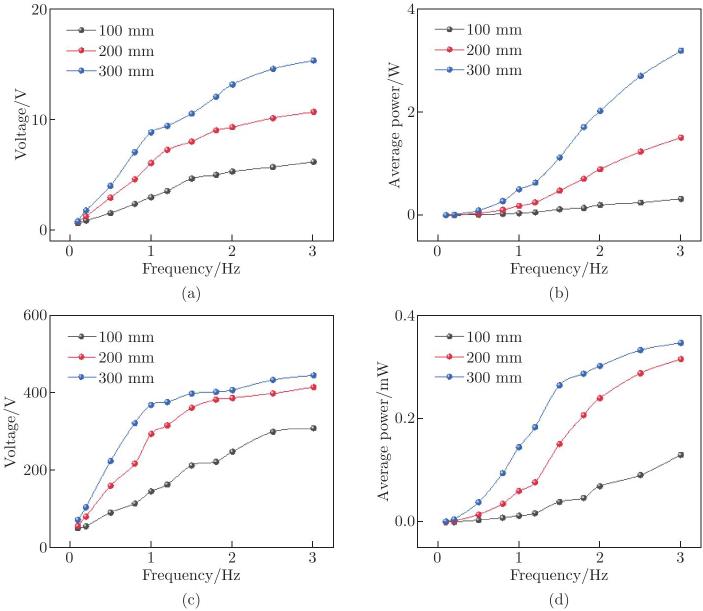

Table 1
Comparison of this work with existing previous designs"
| Reference | Electromechanical conversion | Power/(mW) | Power density |
|---|---|---|---|
| Wang et al.[ | Electromagnetic nanogenerator, piezoelectric nanogenerator, and TENG | 87.21 | 2.07 mW/cm3 |
| Han et al.[ | Electromagnetic nanogenerator and piezoelectric nanogenerator | 115.52 | / |
| Hao et al.[ | Electromagnetic nanogenerator and TENG | 357 | 1.67 W/kg |
| Wang et al.[ | Electromagnetic nanogenerator | 11.2 | 0.252 mW/cm3 |
| Zhang et al.[ | Electromagnetic nanogenerator and TENG | 3.9 | 0.08 mW/cm3 |
| Present | Electromagnetic nanogenerator and TENG | 3 530* | 12.67 mW/cm3 7.91 W/kg |
| * This value is the average power or calculated from the average power | |||
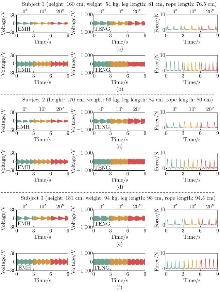
Fig. 13
Experimental results of wearing BEHMIM during movement on different slopes. The output voltage and string tension of the device for Subject 1 at (a) a speed of 4 km/h and (b) a speed of 8 km/h. The output voltage and string tension of the device for Subject 2 at (c) a speed of 4 km/h and (d) a speed of 8 km/h. The output voltage and string tension of the device for Subject 3 at (e) a speed of 4 km/h and (f) a speed of 8 km/h (color online)"
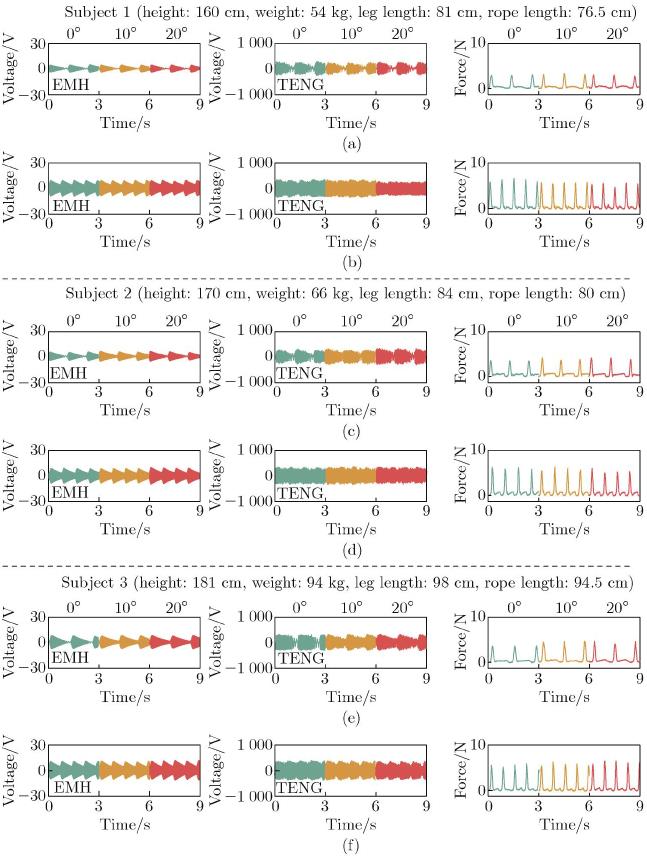
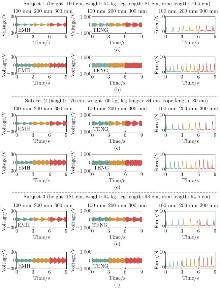
Fig. 14
Experimental results of wearing BEHMIM during movement with different pretension string lengths. The output voltage and string tension of the device for Subject 1 at (a) a speed of 4 km/h and (b) a speed of 8 km/h. The output voltage and string tension of the device for Subject 2 at (c) a speed of 4 km/h and (d) a speed of 8 km/h. The output voltage and string tension of the device for Subject 3 at (e) a speed of 4 km/h and (f) a speed of 8 km/h (color online)"
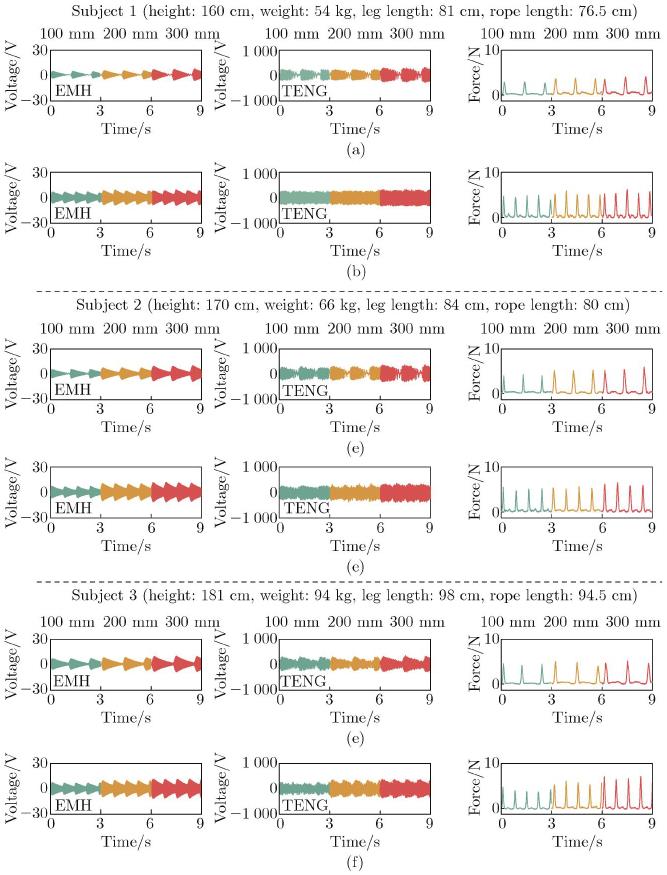
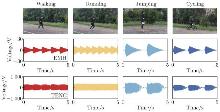
Fig. 15
Outdoor multi-scenario human motion demonstration of the BEHMIM (color online)"
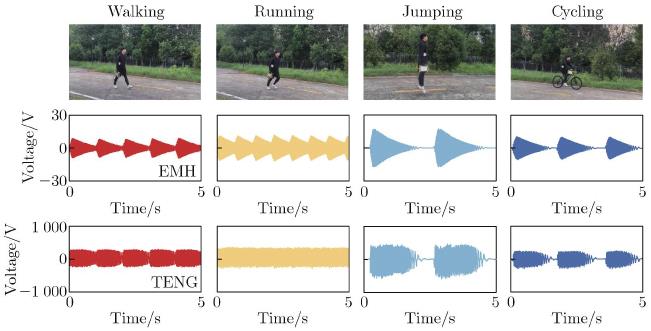
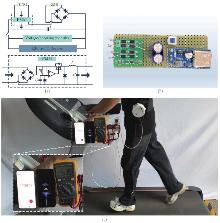
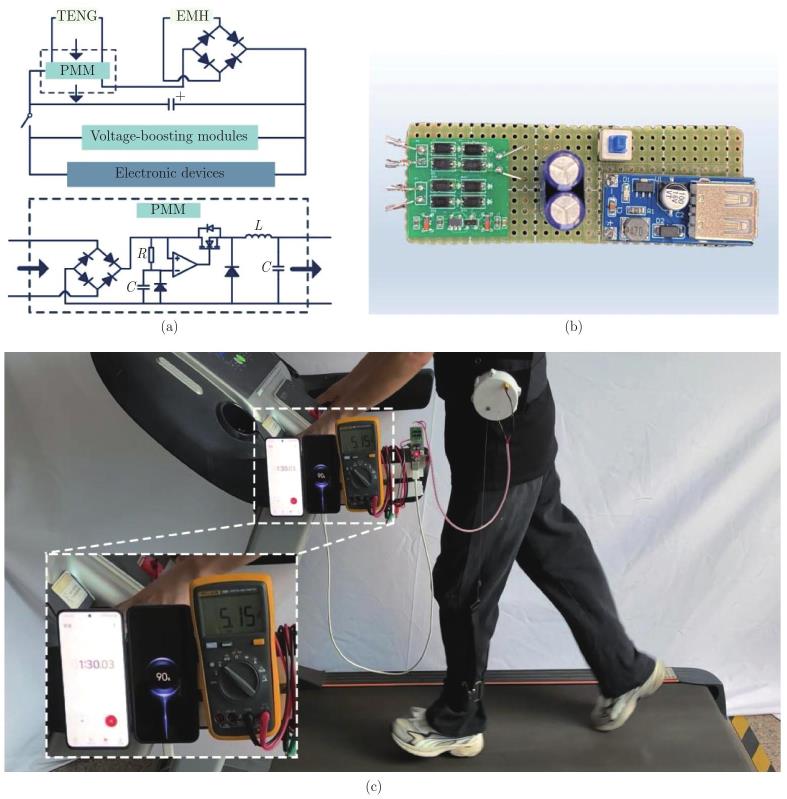
Fig. 16
Applications demonstration of the BEHMIM as a wearable energy source for self-powered capabilities: (a) schematic illustration of the energy management circuit; (b) photograph of the energy management module; (c) demonstration of BEHMIM powering a mobile phone (color online)"
| [1] | YANG, Y. Q., GUO, X. G., ZHU, M. L., SUN, Z. D., ZHANG, Z. X., HE, T. Y. Y., and LEE, C. K. Triboelectric nanogenerator enabled wearable sensors and electronics for sustainable internet of things integrated green earth. Advanced Energy Materials, 13(1), 2203040 (2023) |
| [2] | ZHAO, X., ASKARI, H., and CHEN, J. Nanogenerators for smart cities in the era of 5G and Internet of Things. Joule, 5(6), 1391–1431 (2021) |
| [3] | ZHANG, S. L., BICK, M., XIAO, X., CHEN, G. R., NASHALIAN, A., and CHEN, J. Leveraging triboelectric nanogenerators for bioengineering. Matter, 4(3), 845–887 (2021) |
| [4] | CHIEW, T. K., KHOO, S., ANSARI, P., and KIRUTHIKA, U. Mobile and wearable technologies for persons with disabilities: a bibliometric analysis (2000–2021). Disability and Rehabilitation: Assistive Technology, 19(3), 994–1002 (2024) |
| [5] | ZOU, H. X., LI, M., ZHAO, L. C., LIAO, X. W., GAO, Q. H., YAN, G., DU, R. H., WEI, K. X., and ZHANG, W. M. Cooperative compliant traction mechanism for human-friendly biomechanical energy harvesting. Energy Conversion and Management, 258, 115523 (2022) |
| [6] | YANG, J. H., ZHANG, W. X., and YANG, X. D. Integrated device for multiscale series vibration reduction and energy harvesting. Applied Mathematics and Mechanics (English Edition), 44(12), 2227–2242 (2023) https://doi.org/10.1007/s10483-023-3063-8 |
| [7] | LAI, Z. H., XU, J. C., BOWEN, C. R., and ZHOU, S. X. Self-powered and self-sensing devices based on human motion. Joule, 6(7), 1501–1565 (2022) |
| [8] | LI, H. T., ZHENG, T. Y., QIN, W. Y., TIAN, R. L., DING, H., JI, J. C., and CHEN, L. Q. Theoretical and experimental study of a bi-stable piezoelectric energy harvester under hybrid galloping and band-limited random excitations. Applied Mathematics and Mechanics (English Edition), 45(3), 461–478 (2024) https://doi.org/10.1007/s10483-024-3098-5 |
| [9] | LIU, M. Y., QIAN, F., MI, J., and ZUO, L. Biomechanical energy harvesting for wearable and mobile devices: state-of-the-art and future directions. Applied Energy, 321, 119379 (2022) |
| [10] | WENG, S., WU, L. Y., LI, Z. Q., ZHANG, L. B., and DAI, H. L. Optimizing wind energy harvester with machine learning. Applied Mathematics and Mechanics (English Edition), 46(8), 1417–1432 (2025) https://doi.org/10.1007/s10483-025-3279-6 |
| [11] | ZHANG, L. B., HE, Y. X., MENG, B., DAI, H. L., and WANG, L. Unlocking multidirectional and broadband wind energy harvesting with triboelectric nanogenerator and vortex-induced vibration of sphere. Applied Mathematics and Mechanics (English Edition), 45(11), 1895–1912 (2024) https://doi.org/10.1007/s10483-024-3185-8 |
| [12] | DU, X. Z., CHEN, H. X., LI, C. C., LI, Z. H., WANG, W. X., GUO, D. X., YU, H., WANG, J. L., and TANG, L. H. Wake galloping piezoelectric-electromagnetic hybrid ocean wave energy harvesting with oscillating water column. Applied Energy, 353, 122081 (2024) |
| [13] | ZHANG, B., LIU, H. S., ZHOU, S. X., and GAO, J. A review of nonlinear piezoelectric energy harvesting interface circuits in discrete components. Applied Mathematics and Mechanics (English Edition), 43(7), 1001–1026 (2022) https://doi.org/10.1007/s10483-022-2863-6 |
| [14] | YU, T. C., LIANG, F., and YANG, H. L. Vibration energy harvesting of a three-directional functionally graded pipe conveying fluids. Applied Mathematics and Mechanics (English Edition), 46(5), 795–812 (2025) https://doi.org/10.1007/s10483-025-3249-8 |
| [15] | WANG, Q., CHEN, Z. W., ZHAO, L. C., LI, M., ZOU, H. X., WEI, K. X., ZHANG, X. Z., and ZHANG, W. M. Enhanced galloping energy harvester with cooperative mode of vibration and collision. Applied Mathematics and Mechanics (English Edition), 43(7), 945–958 (2022) https://doi.org/10.1007/s10483-022-2869-9 |
| [16] | YU, N., FEI, X. Y., WU, C. Y., and YAN, B. Modeling and analysis of magnetic spring enhanced lever-type electromagnetic energy harvesters. Applied Mathematics and Mechanics (English Edition), 43(5), 743–760 (2022) https://doi.org/10.1007/s10483-022-2849-9 |
| [17] | ZHAO, L., LU, Z. Q., DING, H., and CHEN, L. Q. A viscoelastic metamaterial beam for integrated vibration isolation and energy harvesting. Applied Mathematics and Mechanics (English Edition), 45(7), 1243–1260 (2024) https://doi.org/10.1007/s10483-024-3159-7 |
| [18] | CAI, M. J. and LIAO, W. H. Enhanced electromagnetic wrist-worn energy harvester using repulsive magnetic spring. Mechanical Systems and Signal Processing, 150, 107251 (2021) |
| [19] | CAI, M. J. and LIAO, W. H. Toward high-performance wrist-worn energy harvester via hybrid approach. IEEE/ASME Transactions on Mechatronics, 30(1), 469–481 (2024) |
| [20] | XIE, L. H. and CAI, M. J. Increased energy harvesting and reduced accelerative load for backpacks via frequency tuning. Mechanical Systems and Signal Processing, 58-59, 399–415 (2015) |
| [21] | HOU, Z. H., LIU, Q. H., ZHAO, H., XIE, J. X., CAO, J. Y., LIAO, W. H., and BOWEN, C. R. Biomechanical modeling and experiments of energy harvesting backpacks. Mechanical Systems and Signal Processing, 200, 110612 (2023) |
| [22] | CAO, D. X., WANG, J. R., GUO, X. Y., LAI, S. K., and SHEN, Y. J. Recent advancement of flow-induced piezoelectric vibration energy harvesting techniques: principles, structures, and nonlinear designs. Applied Mathematics and Mechanics (English Edition), 43(7), 959–978 (2022) https://doi.org/10.1007/s10483-022-2867-7 |
| [23] | GAO, F., LIAO, W. H., LIANG, J. R., and WU, X. Y. Performance enhancement of piezoelectric bending beam-based human knee energy harvester. IEEE/ASME Transactions on Mechatronics, 29(4), 2779–2784 (2024) |
| [24] | GAO, F., LIU, G. Y., FU, X. L., LI, L., and LIAO, W. H. Lightweight piezoelectric bending beam-based energy harvester for capturing energy from human knee motion. IEEE/ASME Transactions on Mechatronics, 27(3), 1256–1266 (2022) |
| [25] | XIONG, J. Q., CUI, P., CHEN, X. L., WANG, J. X., PARIDA, K., LIN, M. F., and LEE, P. S. Skin-touch-actuated textile-based triboelectric nanogenerator with black phosphorus for durable biomechanical energy harvesting. Nature Communications, 9(1), 4280 (2018) |
| [26] | ZHOU, Z. H., WENG, L., TAT, T., LIBANORI, A., LIN, Z. M., GE, L. J., YANG, J., and CHEN, J. Smart insole for robust wearable biomechanical energy harvesting in harsh environments. ACS Nano, 14(10), 14126–14133 (2020) |
| [27] | ZOU, Y. J., RAVEENDRAN, V., and CHEN, J. Wearable triboelectric nanogenerators for biomechanical energy harvesting. Nano Energy, 77, 105303 (2020) |
| [28] | TAN, D. G., ZHOU, J. X., WANG, K., ZHANG, C., LI, Z. Y., and XU, D. L. Wearable bistable triboelectric nanogenerator for harvesting torsional vibration energy from human motion. Nano Energy, 109, 108315 (2023) |
| [29] | KONG, L. J., FANG, Z., ZHANG, T. S., ZHANG, Z. T., PAN, Y. J., HAO, D. N., CHEN, J. F., and QI, L. F. A self-powered and self-sensing lower-limb system for smart healthcare. Advanced Energy Materials, 13(31), 2301254 (2023) |
| [30] | CHEN, T. T., WANG, K., CHEN, S. C., XU, Z. Y., LI, Z., and ZHOU, J. X. Nonlinear electromechanical coupling dynamics of a two-degree-of-freedom hybrid energy harvester. Applied Mathematics and Mechanics (English Edition), 46(6), 989–1010 (2025) https://doi.org/10.1007/s10483-025-3264-7 |
| [31] | RAHMAN, M. T., RANA, S. S., SALAUDDIN, M., MAHARJAN, P., BHATTA, T., and PARK, J. Y. Biomechanical energy-driven hybridized generator as a universal portable power source for smart/wearable electronics. Advanced Energy Materials, 10(12), 1903663 (2020) |
| [32] | FAN, K. Q., HAO, J. Y., WANG, C. Y., ZHANG, C., WANG, W. D., and WANG, F. An eccentric mass-based rotational energy harvester for capturing ultralow-frequency mechanical energy. Energy Conversion and Management, 241, 114301 (2021) |
| [33] | JI, L. J., ZHAO, C., YANG, T. Y., YANG, H. R., AZEEM, M., LI, Z. Y., FENG, R., FENG, G. Q., LI, S., and LI, W. Energy harvesting and human motion sensing of a 2D piezoelectric hybrid organic-inorganic perovskite. APL Materials, 12(9), 091116 (2024) |
| [34] | WANG, W., CAO, J. Y., ZHANG, N., LIN, J., and LIAO, W. H. Magnetic-spring based energy harvesting from human motions: design, modeling and experiments. Energy Conversion and Management, 132, 189–197 (2017) |
| [35] | MA, X. Q., LI, H. T., ZHOU, S. X., YANG, Z. C., and LITAK, G. Characterizing nonlinear characteristics of asymmetric tristable energy harvesters. Mechanical Systems and Signal Processing, 168, 108612 (2022) |
| [36] | XIA, G. Y., LU, Q. T., CAI, M. J., LI, X., ZHANG, D. X., WANG, C. S., and LIAO, W. H. Comprehensive investigation of a broadband wearable energy harvester using adaptive kinetic energy reallocation mechanism. Mechanical Systems and Signal Processing, 206, 110907 (2024) |
| [37] | ZHU, Y., CHEN, G. T., ZHANG, J. Q., LI, Z. Y., and ZHOU, S. X. A flexible piezoelectric energy harvester featuring an eccentric pendulum via frequency up-conversion for human motion. Smart Materials and Structures, 33(8), 085032 (2024) |
| [38] | ZHAO, L. C., ZOU, H. X., WEI, K. X., ZHOU, S. X., MENG, G., and ZHANG, W. M. Mechanical intelligent energy harvesting: from methodology to applications. Advanced Energy Materials, 13(29), 2300557 (2023) |
| [39] | FEBRIOLA, N. A., SINGH, S., JEONG, E., and YOON, J. Highly deformable triboelectric nanogenerators fabricated using high-dielectric elastomers and double-network ionic hydrogels for use in energy harvesting and motion sensing. Chemical Engineering Journal, 503, 158641 (2025) |
| [40] | ZHOU, X. R., PARIDA, K., CHEN, J., XIONG, J. Q., ZHOU, Z. H., JIANG, F., XIN, Y. Y., MAGDASSI, S., and LEE, P. S. 3D printed auxetic structure-assisted piezoelectric energy harvesting and sensing. Advanced Energy Materials, 13(34), 2301159 (2023) |
| [41] | ZHAO, L., GONG, Y., SHEN, F., PENG, Y., XIE, S. R., and LI, Z. J. Diminishing potential well barrier in bi-stable energy harvesters by introducing symmetric stiffness. Thin-Walled Structures, 209, 112880 (2025) |
| [42] | LIAO, X., CHEN, L., ZHAO, H. L., JIANG, Q. B., and ZHANG, L. Electromagnetic vari-potential bi-stable energy harvester under low-amplitude excitation. International Journal of Mechanical Sciences, 307, 110871 (2025) |
| [43] | WANG, H., ZHAO, Q. L., SONG, R. J., GUO, J. L., CHANG, W. Y., YANG, X. H., and ZHANG, L. A. Design and performance study of low frequency magnetic coupling bistable piezoelectric and electromagnetic energy harvester. Energy, 320, 135178 (2025) |
| [44] | LI, Z. J., WANG, C. Y, SHEN, F., PENG, Y., and WANG, M. Goose queue inspired V-array with cross-section variations for enhanced electromechanical energy harvesting behaviors. IEEE/ASME Transactions on Mechatronics, 30(6), 4525–4534 (2025) |
| [45] | XIE, Z. Q., RAN, Y. A., FANG, G., ZHU, Y., HUANG, W. B., FU, B. Y., GE, S. S., ZHANG, Z. G., and WANG, Z. G. A novel variable potential energy well bistable piezoelectric rotational energy harvester. Mechanical Systems and Signal Processing, 239, 113312 (2025) |
| [46] | ZHAO, L., GONG, Y., SHEN, F., WU, H., PENG, Y., XIE, S. R., and LI, Z. J. Effect of stability state transition of variable potential well in tri-hybridized energy harvesters. Mechanical Systems and Signal Processing, 223, 111855 (2025) |
| [47] | WANG, C., CHAI, H. F., LI, G. L., WANG, W., TIAN, R. L., WEN, G. L., WANG, C. H., and LAI, S. K. Boosting biomechanical and wave energy harvesting efficiency through a novel triple hybridization of piezoelectric, electromagnetic, and triboelectric generators. Applied Energy, 374, 123876 (2024) |
| [48] | HAN, L. T., HE, L. P., LV, X. Q., SUN, L., ZHANG, L. M., and FAN, W. Piezoelectric-electromagnetic wearable harvester for energy harvesting and motion monitoring. Sustainable Energy Technologies and Assessments, 71, 104030 (2024) |
| [49] | HAO, D. N., FAN, C. L., XIA, X. F., ZHANG, Z. T., and YANG, Y. W. Hybrid electromagnetic-triboelectric hip energy harvester for wearables and AI-assisted motion monitoring. Small, 21(21), 2500643 (2025) |
| [50] | WANG, Z. H., HOU, L., YAO, M. H., and YANG, T. Z. A pendulum inertial electromagnetic energy harvester for harvesting multiple-source low-frequency human motion energy. Science China Technological Sciences, 68, 2020102 (2025) |
| [51] | ZHANG, J. J., YUAN, Q. J., GAO, S. H., LI, R., MAO, B. J., MA, Y. B., QI, G. Q., QU, J. T., MU, X. J., and ZHOU, Z. H. Wearable pendulum-rotor-separated hybrid generator for smart healthcare monitoring. ACS Applied Materials & Interfaces, 16(42), 56666–56675 (2024) |
| [1] | Huirong ZHANG, Gantong CHEN, Bohao DUAN, Shengxi ZHOU. Multi-physics coupling of piezoelectric laminated beam with temperature-dependent material property [J]. Applied Mathematics and Mechanics (English Edition), 2026, 47(8): 1811-1834. |
| [2] | Kefan XU, Zhuoda ZHOU, Yaohua LIU, Yewei ZHANG, Liqun CHEN. An investigation on self-powered semi-active vibration isolation system with adjustable stiffness [J]. Applied Mathematics and Mechanics (English Edition), 2026, 47(5): 1019-1040. |
| [3] | Z. Z. RASHED, S. E. AHMED. Effects of surface roughness on nonlinear convective dissipative flow of micropolar nanofluids with dual activation energies and triple diffusion [J]. Applied Mathematics and Mechanics (English Edition), 2025, 46(9): 1809-1828. |
| [4] | M. A. FARAJI, M. ASKARI-SEDEH, A. ZOLFAGHARIAN, M. BAGHANI. Enhancing hydrogel predictive modeling: an augmented neural network approach for swelling dynamics in pH-responsive hydrogels [J]. Applied Mathematics and Mechanics (English Edition), 2025, 46(9): 1787-1808. |
| [5] | N. A. SAEED, Y. Y. ELLABBAN, Lei HOU, Haiming YI, Shun ZHONG, F. Z. DURAIHEM, O. M. OMARA. Nonlinear vibration of quasi-zero stiffness structure with piezoelectric harvester and RL-load: intra-well and inter-well oscillation modes under 1:1 internal resonance [J]. Applied Mathematics and Mechanics (English Edition), 2025, 46(8): 1451-1474. |
| [6] | Yudong LI, Yan LI, Chunfa WANG, P. JOLI, Zhiqiang FENG. Numerical investigation on a comprehensive high-order finite particle scheme [J]. Applied Mathematics and Mechanics (English Edition), 2025, 46(6): 1187-1214. |
| [7] | Tingting CHEN, Kai WANG, Shengchao CHEN, Ziyu XU, Zhe LI, Jiaxi ZHOU. Nonlinear electromechanical coupling dynamics of a two-degree-of-freedom hybrid energy harvester [J]. Applied Mathematics and Mechanics (English Edition), 2025, 46(6): 989-1010. |
| [8] | Tianchi YU, Feng LIANG, Hualin YANG. Vibration energy harvesting of a three-directional functionally graded pipe conveying fluids [J]. Applied Mathematics and Mechanics (English Edition), 2025, 46(5): 795-812. |
| [9] | Tao CHEN, Tianshu LIU. Physical structures of boundary fluxes of orbital rotation and spin for incompressible viscous flow [J]. Applied Mathematics and Mechanics (English Edition), 2025, 46(4): 745-762. |
| [10] | Yu ZHANG, Chao ZHANG, Shaohua LI, Shaopu YANG. Research on the application of the parameter freezing precise exponential integrator in vehicle-road coupling vibration [J]. Applied Mathematics and Mechanics (English Edition), 2025, 46(2): 373-390. |
| [11] | Xuefeng WANG, Zhan SHI, Qiqi YANG, Yuzhi CHEN, Xueyong WEI, Ronghua HUAN. Recent advancements of nonlinear dynamics in mode coupled microresonators: a review [J]. Applied Mathematics and Mechanics (English Edition), 2025, 46(2): 209-232. |
| [12] | Peifeng LIN, Tianyu ZANG, Jinming ZHANG. A methodology of Lagrangian integral time scale in cavitating flow based on finite-time Lyapunov exponent [J]. Applied Mathematics and Mechanics (English Edition), 2025, 46(12): 2407-2426. |
| [13] | Feng JIANG, Lin DU, Qing XUE, Zichen DENG, C. GREBOGI. Adaptive backward stepwise selection of fast sparse identification of nonlinear dynamics [J]. Applied Mathematics and Mechanics (English Edition), 2025, 46(12): 2361-2384. |
| [14] | Yunting HAN, Hui HU, Haoran SUN, Xi SHI. A new rope-sheave traction contact force model incorporating complex geometric features developed through parameter identification methods [J]. Applied Mathematics and Mechanics (English Edition), 2025, 46(10): 1983-2006. |
| [15] | Ye TANG, Yuxiang WANG, Hujie ZHANG, Tianzhi YANG, Fantai MENG. Nonlinear dynamics of intricate constrained fluid-conveying pipelines based on the global modal method [J]. Applied Mathematics and Mechanics (English Edition), 2025, 46(10): 1851-1866. |
| Viewed | ||||||
|
Full text |
|
|||||
|
Abstract |
|
|||||





 Email Alert
 RSS
RSS