Applied Mathematics and Mechanics (English Edition) ›› 2026, Vol. 47 ›› Issue (8): 1723-1746.doi: https://doi.org/10.1007/s10483-026-3414-8
Previous Articles Next Articles
Kai WANG1, Ao CHENG1, Tingting CHEN2, Jiaxi ZHOU1, Zhuang LI1, Shengtao ZHANG3, Li CHENG4( )
)
Received:2026-02-25
Revised:2026-05-18
Online:2026-07-31
Published:2026-07-31
Contact:
Li CHENG, E-mail: li.cheng@polyu.edu.hkSupported by:2010 MSC Number:
Kai WANG, Ao CHENG, Tingting CHEN, Jiaxi ZHOU, Zhuang LI, Shengtao ZHANG, Li CHENG. End-to-end analysis of vibration of time-varying mass systems. Applied Mathematics and Mechanics (English Edition), 2026, 47(8): 1723-1746.
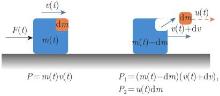
Fig. 1
Schematic of Newton’s momentum theorem (color online)"
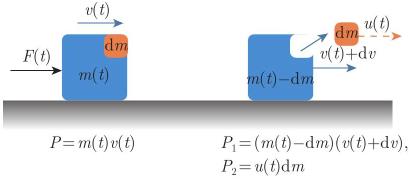
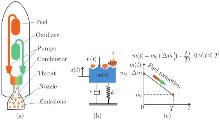
Fig. 2
Schematic representation of the rocket system: (a) structural components of a liquid rocket; (b) simplified vibration isolation model of the rocket system; (c) functional representation of the fuel-mass reduction profile (color online)"
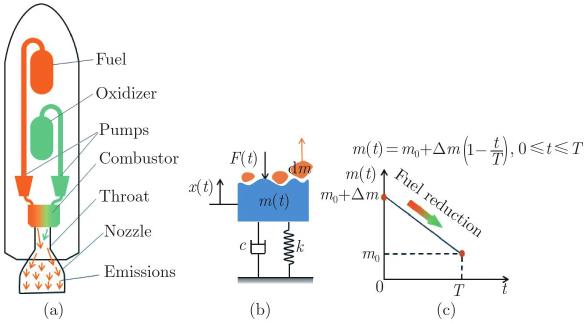
Table 1
The system parameters used for calculations"
| Parameter | Symbol | Value | Parameter | Symbol | Value |
|---|---|---|---|---|---|
| Constant mass | m0 | 5 kg | Damping coefficient | c | 2 N · s/m |
| Time-dependent mass | 50 kg | Stiffness | K | 10 000 N/m | |
| Combustion duration | T | 25 s |
Fig. 3
Solutions to the three differential equations involved in the inverse transformation at an excitation frequency of 0.16 Hz: (a) variation in w with respect to τ; (b) displacement x as a function of intermediate variable ε; (c) displacement x as a function of time t (color online)"
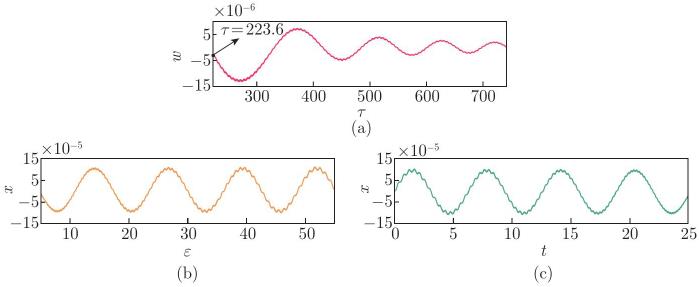
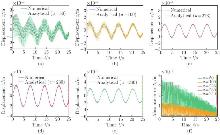
Fig. 4
Comparison of analytical and numerical solutions obtained via the variable upper-limit integration method: (a) a=50, (b) a=100, (c) a=223, (d) a=230, and (e) a=240; (f) absolute errors between analytical and numerical solutions at different a, where the maximum absolute errors are as follows: Ea,max=3.65×10⁻⁴ for a=50, Ea,max=1.65×10⁻⁴ for a=100, and Ea,max=1.5×10⁻⁵ for a=223, 230, 240, and Ea,max is evidently larger than 1.5×10⁻⁵ (color online)"
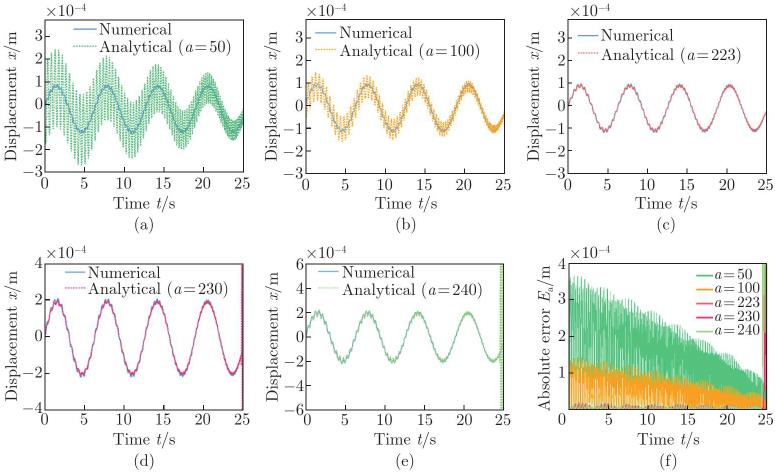
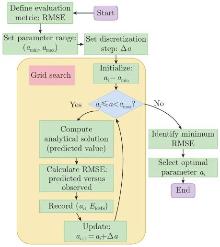
Fig. 5
Flowchart of the grid-search procedure for determining the optimal lower limit (color online)"
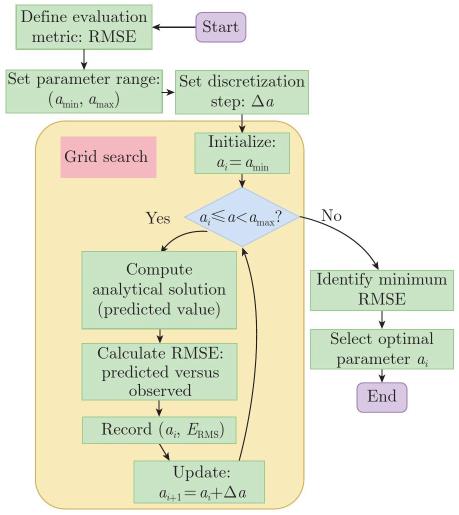
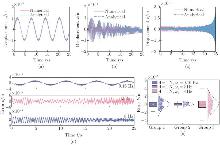
Fig. 6
Comparison of numerical and analytical solutions: (a)–(c) system response diagrams for f=0.16, 2, 8 Hz, respectively; (d) time-domain error plots under three operating conditions; (e) box-and-whisker plots of errors from two methods under three operating conditions (Group 1: 1 N, 0.16 Hz; Group 2: 1 N, 2 Hz; Group 3: 1 N, 8 Hz) (color online)"
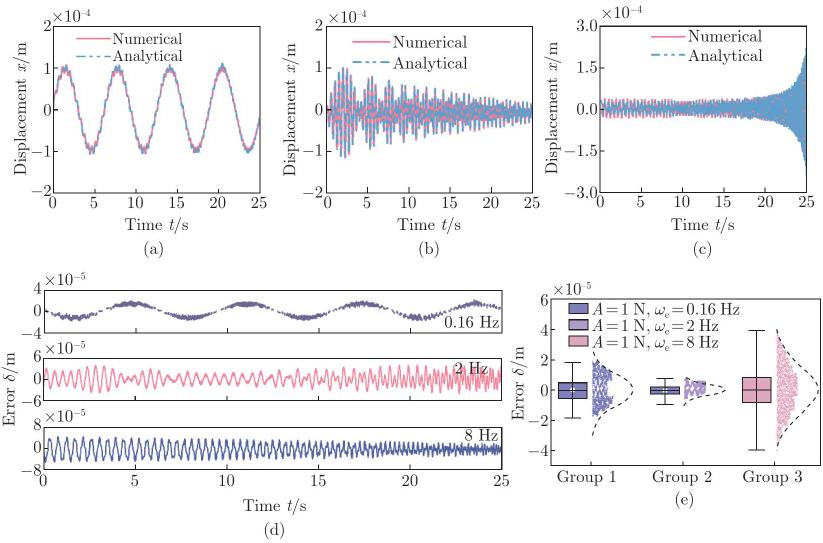
Fig. 7
Comparison of two methods under different excitation amplitudes at 0.16 Hz (Group I: 1 N; Group II: 2 N; Group III: 3 N): (a) system response comparison, (b) error distribution (box plots); (c) maximum absolute error; (d) maximum RMSE (color online)"
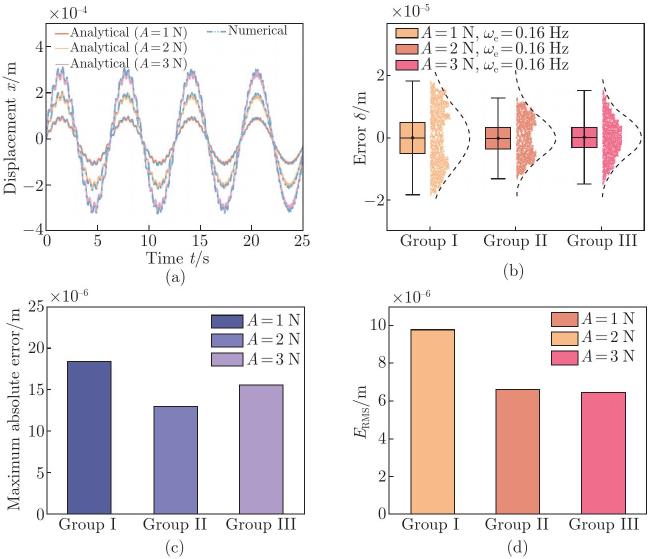
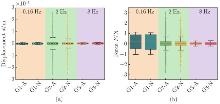
Fig. 8
Box plots of system responses and forces transmitted to the foundation under three operating conditions, determined by both the numerical simulation and the closed-form solution: (a) displacement; (b) transmitted force (color online)"
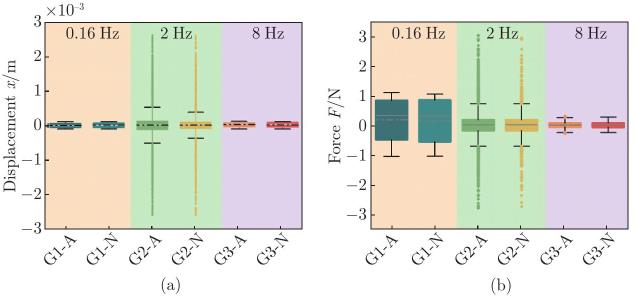
Fig. 9
Effects of system stiffness on vibration isolation effectiveness: (a)–(c) when k is 12 000 N/m, 10 000 N/m, and 8 000 N/m, respectively, the system transmits force responses within 20–30 s; (d) amplitude bar chart for three key time periods in the time-varying process (the peak value of the response within the given time range); (e) characteristic curve of RMS force transmissibility at different stiffness levels; (f) characteristic curve of RMS transmitted force after transient at different stiffness levels (color online)"
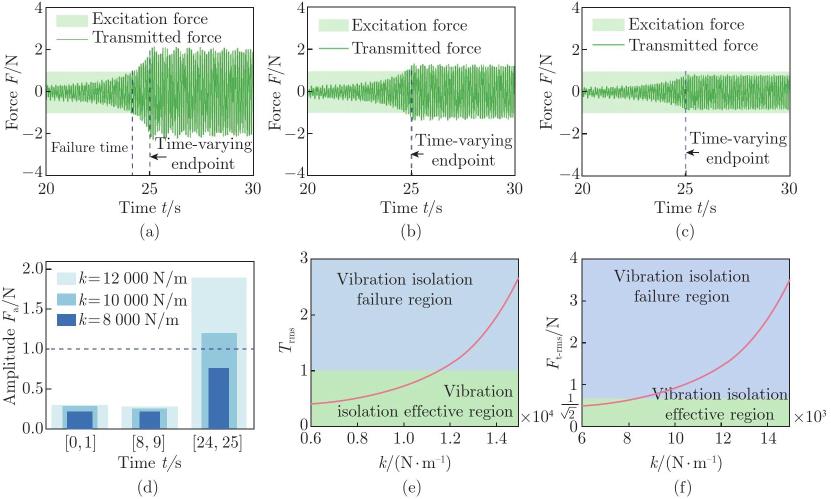
Fig. 10
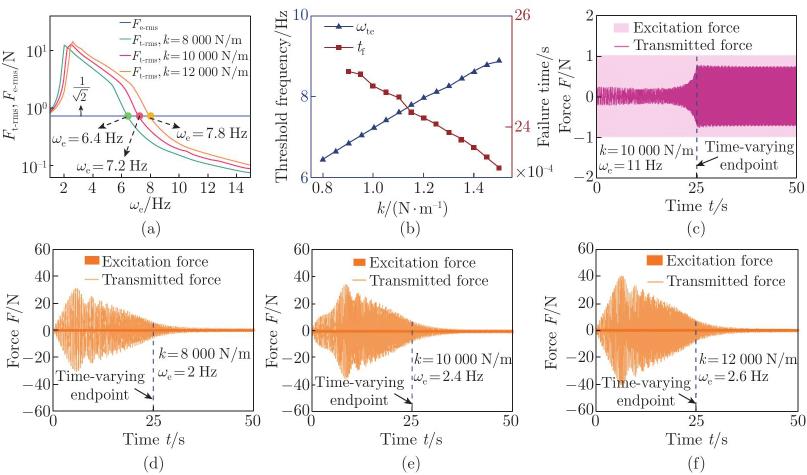
Effects of excitation frequency on vibration isolation effectiveness: (a) curves of RMS values for transmitted force Ft,rms and excitation force Fe,rms as a function of excitation frequency; (b) vibration isolation threshold frequency ωte and failure time tf as a function of system stiffness; (c) time-domain diagram of force transmission when the vibration isolation system is active, as shown in (a); (d)–(f) complete time-domain curves of force under extreme resonance, with (d) k=8 000 N/m, ωe=2 Hz, (e) k=10 000 N/m, ωe=2.4 Hz, and (f) k=12 000 N/m, ωe=2.6 Hz (color online)"
| [46] | YANG, T., ZHOU, S. X., FANG, S. T., QIN, W. Y., and INMAN, D. J. Nonlinear vibration energy harvesting and vibration suppression technologies: designs, analysis, and applications. Applied Physics Reviews, 8(3), 031317 (2021) |
| [47] | ZHOU, S. X., LALLART, M., and ERTURK, A. Multistable vibration energy harvesters: principle, progress, and perspectives. Journal of Sound and Vibration, 528, 116886 (2022) |
| [48] | CHEN, T. T., WANG, K., CHEN, S. C., XU, Z. Y., LI, Z., and ZHOU, J. X. Nonlinear electromechanical coupling dynamics of a two-degree-of-freedom hybrid energy harvester. Applied Mathematics and Mechanics (English Edition), 46(6), 989–1010 (2025) https://doi.org/10.1007/s10483-025-3264-7 |
| [49] | ZHOU, J. H., ZHOU, J. X., PAN, H. B., WANG, K., CAI, C. Q., and WEN, G. L. Multi-layer quasi-zero-stiffness meta-structure for high-efficiency vibration isolation at low frequency. Applied Mathematics and Mechanics (English Edition), 45(7), 1189–1208 (2024) https://doi.org/10.1007/s10483-024-3157-6 |
| [50] | YU, Y. H., ZHANG, X. C., and LI, F. M. Reducing vibration isolation frequency in an X-shaped two-stage nonlinear system. Communications in Nonlinear Science and Numerical Simulation, 135, 108080 (2024) |
| [51] | ZHANG, Q., YANG, Y. H., HOU, T., and ZHANG, R. J. Dynamic analysis of high-speed traction elevator and traction car-rope time-varying system. Noise & Vibration Worldwide, 50(2), 37–45 (2019) |
| [52] | PENG, Q. F., XU, P., YUAN, H., MA, H. X., XUE, J. H., HE, Z. Y., and LI, S. Q. Analysis of vibration monitoring data of flexible suspension lifting structure based on time-varying theory. Sensors, 20(22), 6586 (2020) |
| [53] | YANG, J. S., XIE, J. S., CHEN, G. G., and CHEN, J. L. An efficient method for vibration equations with time varying coefficients and nonlinearities. Journal of Low Frequency Noise, Vibration and Active Control, 40(4), 1744–1763 (2021) |
| [54] | WANG, J. H., LIU, J., and PAN, G. A time-domain piecewise calculation method of a time-varying isolation platform. Mechanical Systems and Signal Processing, 228, 112416 (2025) |
| [55] | WANG, K., ZHOU, J. X., TAN, D. G., LI, Z. Y., LIN, Q. D., and XU, D. L. A brief review of metamaterials for opening low-frequency band gaps. Applied Mathematics and Mechanics (English Edition), 43(7), 1125–1144 (2022) https://doi.org/10.1007/s10483-022-2870-9 |
| [56] | HUANG, J. H. and ZHOU, X. M. A time-varying mass metamaterial for non-reciprocal wave propagation. International Journal of Solids and Structures, 164, 25–36 (2019) |
| [1] | PISCHANSKYY, O. V. and VAN HORSSEN, W. T. On the nonlinear dynamics of a single degree of freedom oscillator with a time-varying mass. Journal of Sound and Vibration, 331(8), 1887–1897 (2012) |
| [2] | EKE, F. O. and MAO, T. C. On the dynamics of variable mass systems. International Journal of Mechanical Engineering Education, 30(2), 123–137 (2002) |
| [3] | ZHANG, N., CAO, G. H., ZHU, Z. C., WANG, K., and YAN, L. Nonlinear dynamics of time-varying curvature balance rope coupled with time-varying length hoisting rope in friction hoisting system. Journal of Sound and Vibration, 567, 117910 (2023) |
| [4] | CVETICANIN, L. J. The vibrations of a textile machine rotor with nonlinear characteristics. Mechanism and Machine Theory, 21(1), 29–32 (1986) |
| [5] | LEE, C. W., HAN, D. J., SUH, J. H., and HONG, S. W. Modal analysis of periodically time-varying linear rotor systems. Journal of Sound and Vibration, 303(3-5), 553–574 (2007) |
| [6] | GANJI, D. D., GORJI, M., HATAMI, M., HASANPOUR, A., and KHADEMZADEH, N. Propulsion and launching analysis of variable-mass rockets by analytical methods. Propulsion and Power Research, 2(3), 225–233 (2013) |
| [7] | CARRERA, E., CAVALLO, T., and ZAPPINO, E. Effect of solid mass consumption on the free-vibration analysis of launchers. Journal of Spacecraft and Rockets, 54(3), 774–781 (2017) |
| [8] | MEIROVITCH, L. General motion of a variable-mass flexible rocket with internal flow. Journal of Spacecraft and Rockets, 7(2), 186–195 (1970) |
| [9] | CHEN, W. T., CHEN, G. P., CHEN, T. F., TAN, X., SHAO, H. B., and HE, H. Dynamic response analysis of a typical time-varying mass system: a moving-interface pipe model, the WKB-recursive solution and experimental validation. Applied Mathematical Modelling, 125, 147–166 (2024) |
| [10] | WANG, Y. B., FANG, X. R., DING, H., and CHEN, L. Q. Quasi-periodic vibration of an axially moving beam under conveying harmonic varying mass. Applied Mathematical Modelling, 123, 644–658 (2023) |
| [11] | ZHANG, L. X., BAI, Z. F., ZHAO, Y., and CAO, X. B. Dynamic response of solar panel deployment on spacecraft system considering joint clearance. Acta Astronautica, 81(1), 174–185 (2012) |
| [12] | LI, D. X. and LIU, W. Vibration control for the solar panels of spacecraft: innovation methods and potential approaches. International Journal of Mechanical System Dynamics, 3(4), 300–330 (2023) |
| [13] | YANG, Y., TANG, J. Y., HU, N. Q., SHEN, G. J., LI, Y. H., and ZHANG, L. Research on the time-varying mesh stiffness method and dynamic analysis of cracked spur gear system considering the crack position. Journal of Sound and Vibration, 548, 117505 (2023) |
| [14] | ZHANG, W., GAO, Y. H., and LU, S. F. Theoretical, numerical and experimental researches on time-varying dynamics of telescopic wing. Journal of Sound and Vibration, 522, 116724 (2022) |
| [15] | LIAO, F. L., HUANG, J. L., and ZHU, W. D. Investigation on nonlinear vibration of a gear transmission system considering time-varying mesh stiffness and time-varying supporting stiffness. Journal of Sound and Vibration, 603, 118957 (2025) |
| [16] | SHI, J. F., GOU, X. F., and ZHU, L. Y. Five-state engaging model and dynamics of gear-rotor-bearing system based on time-varying contact analysis considering gear temperature and lubrication. Applied Mathematical Modelling, 112, 47–77 (2022) |
| [17] | XIANG, L., JIA, Y., and HU, A. J. Bifurcation and chaos analysis for multi-freedom gear-bearing system with time-varying stiffness. Applied Mathematical Modelling, 40(23-24), 10506–10520 (2016) |
| [18] | MA, H., GUAN, H., QU, L., GUO, X. M., MU, Q. Q., ZENG, Y., and CHEN, Y. Y. Dynamic modeling and simulation of blade-casing system with rubbing considering time-varying stiffness and mass of casing. Applied Mathematics and Mechanics (English Edition), 46(5), 849–868 (2025) https://doi.org/10.1007/s10483-025-3244-7 |
| [19] | LIU, K. Identification of linear time-varying systems. Journal of Sound and Vibration, 206(4), 487–505 (1997) |
| [20] | BARTFAI, A., PONCE-VANEGAS, F. E., HOGAN, S. J., KUSKE, R., and DOMBOVARI, Z. Semi-analytical framework for the study of finite-time stability of forced dynamical systems with slowly varying parameters. Journal of Sound and Vibration, 618, 119359 (2025) |
| [21] | LI, C. Y., HAO, J., LIU, H. W., HUA, C. L., and YAO, Z. H. Nonlinear parametric vibration and stability analysis of worm drive system with time-varying meshing stiffness and backlash. Journal of Sound and Vibration, 575, 118264 (2024) |
| [22] | BISAILLON, P., ROBINSON, B., KHALIL, M., PETTIT, C. L., POIREL, D., and SARKAR, A. Robust Bayesian state and parameter estimation framework for stochastic dynamical systems with combined time-varying and time-invariant parameters. Journal of Sound and Vibration, 575, 118106 (2024) |
| [23] | WEI, S., CHEN, S. Q., DONG, X. J., PENG, Z. K., and ZHANG, W. M. Parametric identification of time-varying systems from free vibration using intrinsic chirp component decomposition. Acta Mechanica Sinica, 36(1), 188–205 (2020) |
| [24] | HOZHABROSSADATI, S. M. and SANI, A. A. Free vibration of MDOF systems with nonperiodically time-varying mass. International Journal of Structural Stability and Dynamics, 18(6), 1850077 (2018) |
| [25] | LI, Q. S. Free vibration of SDOF systems with arbitrary time-varying coefficients. International Journal of Mechanical Sciences, 43(3), 759–770 (2001) |
| [26] | LI, Q. S., FANG, J. Q., and LIU, D. K. Exact solutions for free vibration of single-degree-of-freedom systems with nonperiodically varying parameters. Journal of Vibration and Control, 6(3), 449–462 (2000) |
| [27] | NHLEKO, S. Free vibration states of an oscillator with a linear time-varying mass. Journal of Vibration and Acoustics, 131(5), 051011 (2009) |
| [28] | LI, Q. S. A new exact approach for analyzing free vibration of SDOF systems with nonperiodically time varying parameters. Journal of Vibration and Acoustics, 122(2), 175–179 (2000) |
| [29] | LI, Q. S. Forced vibrations of single-degree-of-freedom systems with nonperiodically time-varying parameters. Journal of Engineering Mechanics, 128(12), 1267–1275 (2002) |
| [30] | LIU, M., LI, Z., YANG, X. D., ZHANG, W., and LIM, C. W. Dynamic analysis of a deployable/retractable damped cantilever beam. Applied Mathematics and Mechanics (English Edition), 41(9), 1321–1332 (2020) https://doi.org/10.1007/s10483-020-2650-6 |
| [31] | LI, J., ZHANG, R. S., and TIMOSHIN, S. A. Asymptotically almost periodic solutions for time-varying integro-differential inclusions with nonlocal conditions. Communications in Nonlinear Science and Numerical Simulation, 152, 109229 (2026) |
| [32] | SRINIVASAN, P. and SANKAR, T. S. A study of linear systems with time varying coefficients by the methods of Bessel and Weber functions. Journal of Sound and Vibration, 37(3), 297–309 (1974) |
| [33] | LI, Q. S. Analytical evaluation of dynamic responses of time-varying systems. Journal of Vibration and Control, 15(8), 1123–1142 (2009) |
| [34] | ZUKOVIC, M. and KOVACIC, I. An insight into the behaviour of oscillators with a periodically piecewise-defined time-varying mass. Communications in Nonlinear Science and Numerical Simulation, 42, 187–203 (2017) |
| [35] | FU, J., BAI, J. F., LAI, J. J., LI, P. D., YU, M., and LAM, H. K. Adaptive fuzzy control of a magnetorheological elastomer vibration isolation system with time-varying sinusoidal excitations. Journal of Sound and Vibration, 456, 386–406 (2019) |
| [36] | DUAN, X. F., YE, J. M., HUANG, D. M., and DENG, H. Investigation of dynamical behaviors of bionic paw-inspired vibration isolators by theoretical and numerical analysis. International Journal of Dynamics and Control, 13(12), 399 (2025) |
| [57] | ENGHETA, N. Four-dimensional optics using time-varying metamaterials. Science, 379(6638), 1190–1191 (2023) |
| [58] | HUANG, J. H. and ZHOU, X. M. Non-reciprocal metamaterials with simultaneously time-varying stiffness and mass. Journal of Applied Mechanics, 87(7), 071003 (2020) |
| [59] | LIU, Z. Y., YI, K. J., SUN, H. P., ZHU, R., ZHOU, X. M., HU, G. K., and HUANG, G. L. Inherent temporal metamaterials with unique time-varying stiffness and damping. Advanced Science, 11(43), 2404695 (2024) |
| [60] | HOLL, H. J., BELYAEV, A. K., and IRSCHIK, H. Simulation of the Duffing-oscillator with time-varying mass by a BEM in time. Computers & Structures, 73(1-5), 177–186 (1999) |
| [61] | FLORES, J., SOLOVEY, G., and GIL, S. Variable mass oscillator. American Journal of Physics, 71(7), 721–725 (2003) |
| [62] | YONEZAWA, A., YONEZAWA, H., and KAJIWARA, I. Vibration control for various structures with time-varying properties via model-free adaptive controller based on virtual controlled object and SPSA. Mechanical Systems and Signal Processing, 170, 108801 (2022) |
| [63] | JEONG, H. K., HAN, J. H., YOUN, S. H., and LEE, J. Frequency tunable vibration and shock isolator using shape memory alloy wire actuator. Journal of Intelligent Material Systems and Structures, 25(7), 908–919 (2014) |
| [64] | PARK, Y. H., KWON, S. C., KOO, K. R., and OH, H. U. High damping passive launch vibration isolation system using superelastic SMA with multilayered viscous lamina. Aerospace, 8(8), 201 (2021) |
| [37] | ZHENG, H. B., QIN, H., REN, M. K., and ZHANG, Z. Y. Active vibration control for the time-varying systems with a new adaptive algorithm. Journal of Vibration and Control, 26(3-4), 200–213 (2020) |
| [38] | LIU, F. H., YU, D. Y., WANG, C., and WANG, G. Y. Advances in variable stiffness vibration isolator and its application in spacecraft. International Journal of Structural Stability and Dynamics, 22(13), 2230004 (2022) |
| [39] | ZHAO, L., LU, Z. Q., DING, H., and CHEN, L. Q. A viscoelastic metamaterial beam for integrated vibration isolation and energy harvesting. Applied Mathematics and Mechanics (English Edition), 45(7), 1243–1260 (2024) https://doi.org/10.1007/s10483-024-3159-7 |
| [40] | CHEN, T. T., WANG, K., WANG, Q., WANG, Y. D., CHENG, L., and ZHOU, J. X. A Chinese lantern-inspired low frequency energy harvester with synchronized multi-branched conversion elements. Engineering Structures, 334, 120266 (2025) |
| [41] | SHU, Y. Q., WANG, K., CHEN, T. T., PAN, H. B., DENG, Y. P., YIN, H. F., and ZHOU, J. X. A quasi-zero-stiffness metastructure for concurrent low-frequency vibration attenuation and energy harvesting. Thin-Walled Structures, 214, 113371 (2025) |
| [42] | CHEN, T. T., DING, Y., XU, Z. Y., WANG, K., ZHOU, J. X., and CHANG, Y. P. Bidirectional vibration energy harvesting and sensing system with biomimetic petal architecture. Renewable Energy, 256, 124614 (2026) |
| [43] | LI, M. and DING, H. A vertical track nonlinear energy sink. Applied Mathematics and Mechanics (English Edition), 45(6), 931–946 (2024) https://doi.org/10.1007/s10483-024-3127-6 |
| [44] | ZENG, Y. C., DING, H., and JI, J. C. An origami-inspired nonlinear energy sink: design, modeling, and analysis. Applied Mathematics and Mechanics (English Edition), 46(4), 601–616 (2025) https://doi.org/10.1007/s10483-025-3239-6 |
| [45] | HU, Y., ZHANG, H. C., WANG, K., FANG, Y. G., and MA, C. H. Analytical analysis of vibration isolation characteristics of quasi-zero stiffness suspension backpack. International Journal of Dynamics and Control, 12(12), 4387–4397 (2024) |
| [1] | Chenxu LIU, Yingjing QIAN, Guilan YU, Zhanli LIU, Xiaodong YANG. A modular physics-informed neural network for nonlinear vibration isolators [J]. Applied Mathematics and Mechanics (English Edition), 2026, 47(8): 1747-1768. |
| [2] | Kangfan YU, Yunwei CHEN, Chuanyun YU, Jianrun ZHANG, Xi LU, Xiaofei DU, Qidi FU. Modular reconfigurable quasi-zero-stiffness isolators: design, analysis, and experiment [J]. Applied Mathematics and Mechanics (English Edition), 2026, 47(8): 1647-1668. |
| [3] | Jialei DENG, Xinhua LONG. Improved dynamic anti-resonance vibration isolator based on a Halbach array negative stiffness mechanism [J]. Applied Mathematics and Mechanics (English Edition), 2026, 47(5): 941-964. |
| [4] | N. A. SAEED, Lei HOU, Haiming YI, A. A. SHUKUR, S. M. ALAMRY, S. M. EL-SHOURBAGY. On a broadband vibration isolator with tunable stiffness: from quasi-zero-stiffness to zero-stiffness behavior [J]. Applied Mathematics and Mechanics (English Edition), 2026, 47(2): 255-282. |
| [5] | Zeyu CHAI, Zhen ZHANG, Kefan XU, Xuyuan SONG, Yewei ZHANG, Liqun CHEN. An innovative nonlinear bionic X-shaped vibration isolator enhanced by quasi-zero stiffness characteristics: theory and experimental investigation [J]. Applied Mathematics and Mechanics (English Edition), 2025, 46(8): 1475-1492. |
| [6] | Lingjun MENG, Xiuting SUN, Jian XU. A novel multi-dimensional isolation platform for low-frequency excitations: analysis and experiment [J]. Applied Mathematics and Mechanics (English Edition), 2025, 46(12): 2241-2264. |
| [7] | Zeyu CHAI, J. T. HAN, Xuyuan SONG, Jian ZANG, Yewei ZHANG, Zhen ZHANG. Theoretical and experimental investigations on an X-shaped vibration isolator with active controlled variable stiffness [J]. Applied Mathematics and Mechanics (English Edition), 2024, 45(8): 1371-1386. |
| [8] | Long ZHAO, Zeqi LU, Hu DING, Liqun CHEN. A viscoelastic metamaterial beam for integrated vibration isolation and energy harvesting [J]. Applied Mathematics and Mechanics (English Edition), 2024, 45(7): 1243-1260. |
| [9] | Jiahao ZHOU, Jiaxi ZHOU, Hongbin PAN, Kai WANG, Changqi CAI, Guilin WEN. Multi-layer quasi-zero-stiffness meta-structure for high-efficiency vibration isolation at low frequency [J]. Applied Mathematics and Mechanics (English Edition), 2024, 45(7): 1189-1208. |
| [10] | Wei WEI, Feng GUAN, Xin FANG. A low-frequency and broadband wave-insulating vibration isolator based on plate-shaped metastructures [J]. Applied Mathematics and Mechanics (English Edition), 2024, 45(7): 1171-1188. |
| [11] | Qingqing LIU, Shenlong WANG, Ge YAN, Hu DING, Haihua WANG, Qiang SHI, Xiaohong DING, Huijie YU. A human-sensitive frequency band vibration isolator for heavy-duty truck seats [J]. Applied Mathematics and Mechanics (English Edition), 2024, 45(10): 1733-1748. |
| [12] | Bo YAN, Ning YU, Chuanyu WU. A state-of-the-art review on low-frequency nonlinear vibration isolation with electromagnetic mechanisms [J]. Applied Mathematics and Mechanics (English Edition), 2022, 43(7): 1045-1062. |
| [13] | Guoxin JIN, Zhenghao WANG, Tianzhi YANG. Cascaded quasi-zero stiffness nonlinear low-frequency vibration isolator inspired by human spine [J]. Applied Mathematics and Mechanics (English Edition), 2022, 43(6): 813-824. |
| [14] | Guilin WEN, Yu LIN, Junfeng HE. A quasi-zero-stiffness isolator with a shear-thinning viscous damper [J]. Applied Mathematics and Mechanics (English Edition), 2022, 43(3): 311-326. |
| [15] | Chenxu QIANG, Yuxin HAO, Wei ZHANG, Jinqiang LI, Shaowu YANG, Yuteng CAO. Bandgaps and vibration isolation of local resonance sandwich-like plate with simply supported overhanging beam [J]. Applied Mathematics and Mechanics (English Edition), 2021, 42(11): 1555-1570. |
| Viewed | ||||||
|
Full text |
|
|||||
|
Abstract |
|
|||||





 Email Alert
 RSS
RSS