Applied Mathematics and Mechanics (English Edition) ›› 2026, Vol. 47 ›› Issue (8): 1811-1834.doi: https://doi.org/10.1007/s10483-026-3418-8
Previous Articles Next Articles
Huirong ZHANG1,2, Gantong CHEN1,2, Bohao DUAN1,2, Shengxi ZHOU1,2( )
)
Received:2026-02-12
Revised:2026-05-21
Online:2026-07-31
Published:2026-07-31
Contact:
Shengxi ZHOU, E-mail: zhoushengxi@nwpu.edu.cnSupported by:2010 MSC Number:
Huirong ZHANG, Gantong CHEN, Bohao DUAN, Shengxi ZHOU. Multi-physics coupling of piezoelectric laminated beam with temperature-dependent material property. Applied Mathematics and Mechanics (English Edition), 2026, 47(8): 1811-1834.
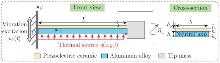
Fig. 1
Schematic diagram of multi-physics coupling forced vibration (color online)"
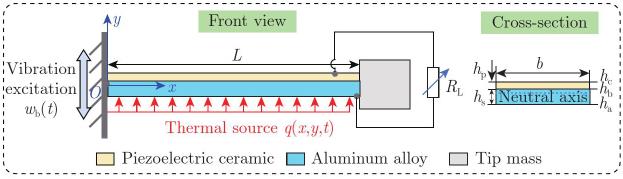
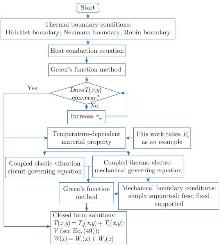
Fig. 2
Flowchart depicting modeling and solving steps for multi-physics coupling with temperature-dependent material property (color online)"
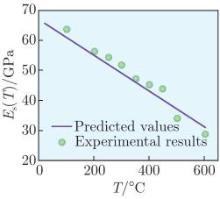
Fig. 3
Young’s modulus of aluminum alloy 6063-T5 versus temperature based on Ref. [40] (color online)"
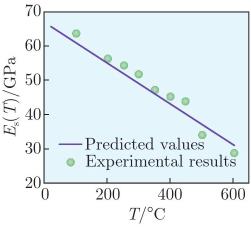

Table 1
Calculation results at different accumulation orders and FEM result"
| rm | e1/% | rm | e1/% | ||
|---|---|---|---|---|---|
| 1 | 64.000 1 | 30 | 64.000 0 | ||
| 5 | 64.000 0 | 40 | 64.000 0 | ||
| 10 | 64.000 0 | 50 | 64.000 0 | ||
| 20 | 64.000 0 | FEM result | 64.000 0 | ||
| Note that the precision of the numerical results is determined as | |||||
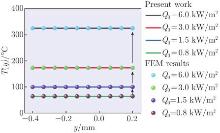
Fig. 4
Comparison of temperature distribution results of present study and FEM results at different thermal source intensities (color online)"
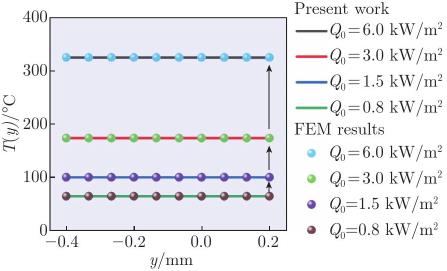
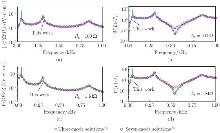
Fig. 5
Comparison of present results with those in Ref. [22] at different modal solutions and load resistances RL: (a) voltage and (b) displacement verification at RL=100 Ω; (c) voltage and (d) displacement verification at RL=1 MΩ (color online)"
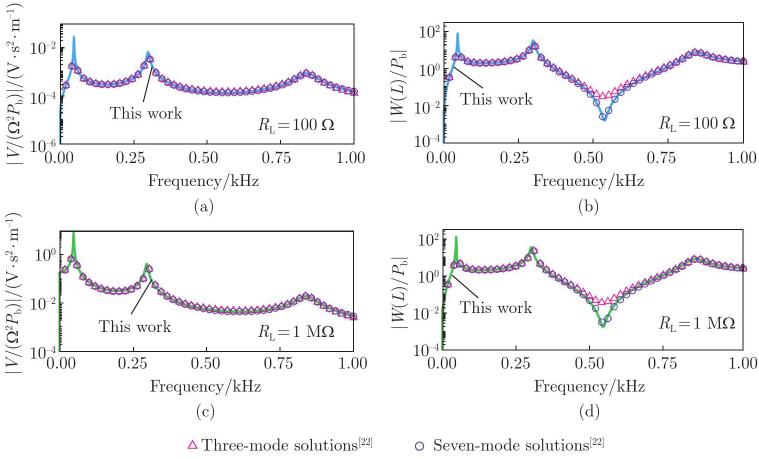
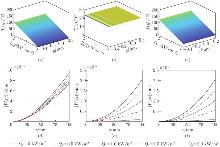
Fig. 6
(a) Temperature distribution Tq(y), (b) temperature distribution Te(y), and (c) global temperature distribution T(y) along thickness direction under different thermal source intensities; (d) uncoupling displacement amplitude |Wb(x)|; (e) displacement amplitude |Wc(x)|; (f) global displacement amplitude |W(x)|. Data are obtained by setting Ω=0 rad/s, h=20 W/(m2⋅K), Pb=1 mm, RL=300 kΩ, and L=100 mm (color online)"
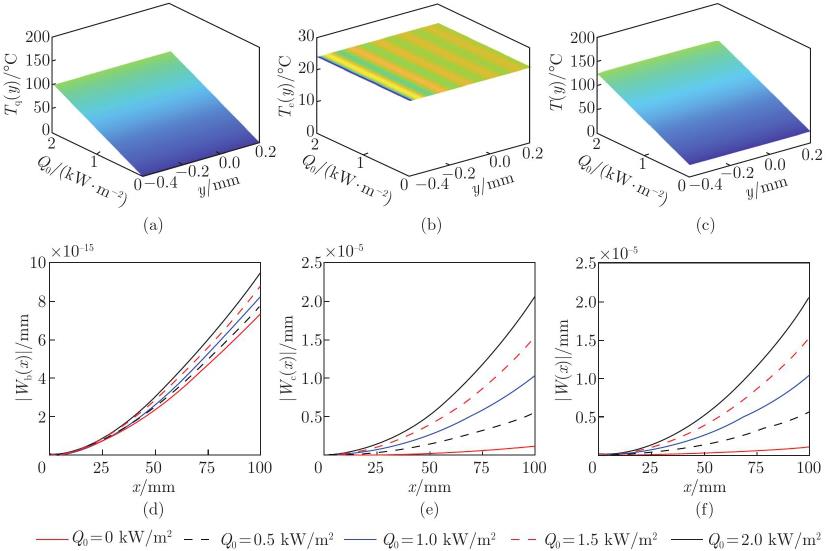
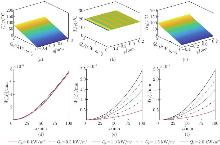
Fig. 7
(a) Temperature distribution Tq(y), (b) temperature distribution Te(y), and (c) global temperature distribution T(y) along thickness direction under different thermal source intensities; (d) uncoupling displacement amplitude |Wb(x)|; (e) displacement amplitude |Wc(x)|; (f) global displacement amplitude |W(x)|. Data are obtained by setting Ω=0.01 rad/s, h=20 W/(m2⋅K), Pb=1 mm, RL=300 kΩ, and L=100 mm (color online)"
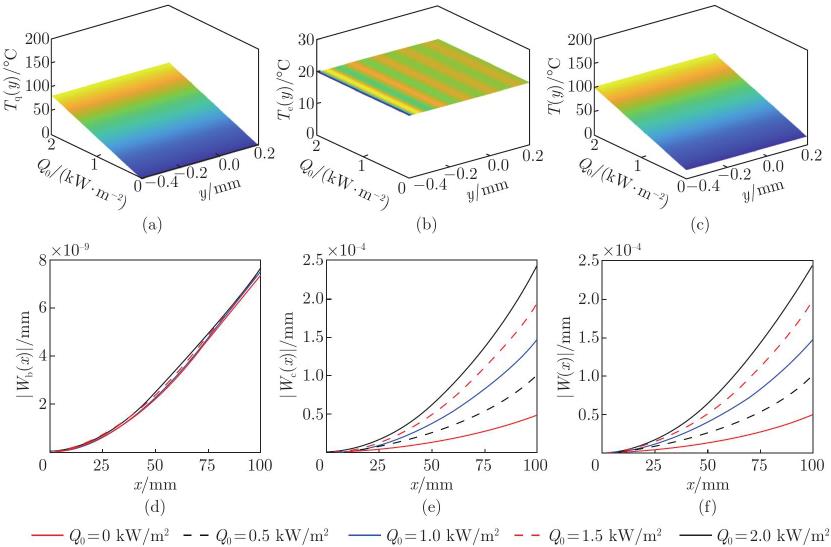
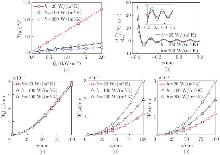
Fig. 8
(a) Temperature distribution T (y0) versus thermal source intensity Q0 at different convective heat transfer coefficients h, where Q0=2.0 kW/m2; (b) temperature gradient along thickness direction; (c) uncoupled displacement amplitude |Wb(x)|; (d) displacement amplitude |Wc(x)|; (e) global displacement amplitude |W(x)|. Data are obtained by setting Ω=0 rad/s, Pb=1 mm, RL=300 kΩ, and L=100 mm (color online)"
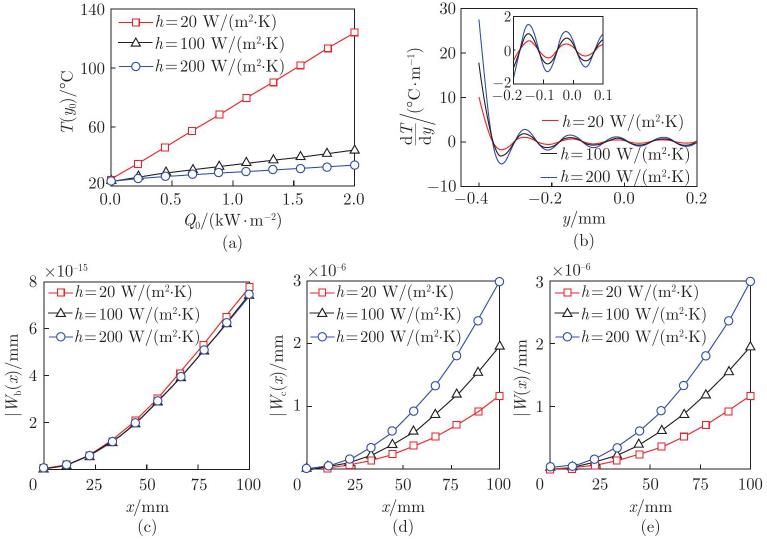
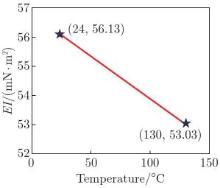
Fig. 9
Flexural rigidity EI of PLB versus temperature (color online)"
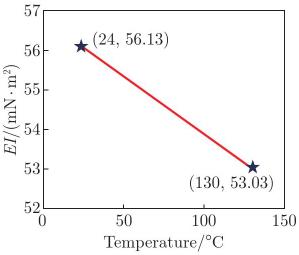
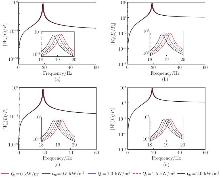
Fig. 10
Relative tip displacements (a) |W(L)/Pb| and (b) |Wd(L)/Pb| versus vibration excitation frequency at different thermal source intensities Q0 while ΩT=0 rad/s; relative tip displacements (c) |Wce(L)/Pb| and (d) |Wd(L)/Pb| versus vibration excitation frequency at different thermal source intensities Q0 while ΩT=0.01 rad/s. Data are obtained by setting h=20 W/(m2⋅K), RL=300 kΩ, and L=100 mm (color online)"
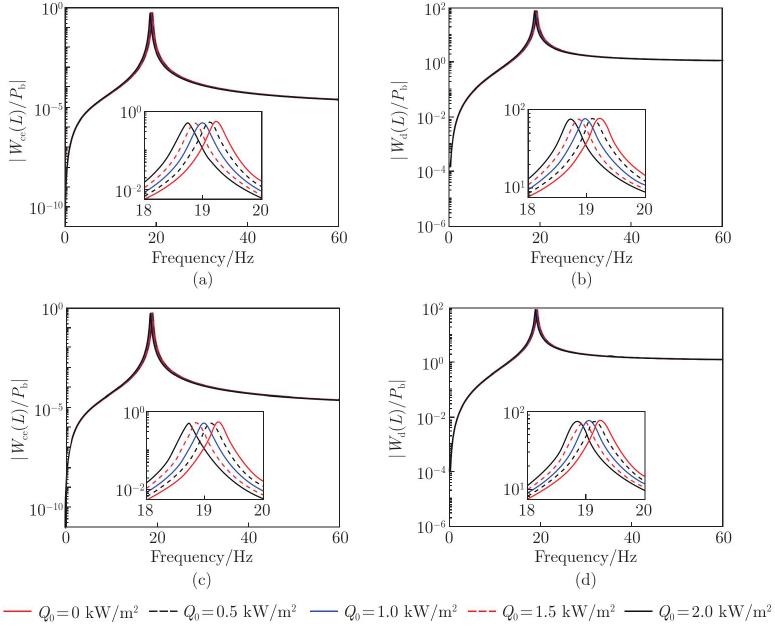
Fig. 11
Voltage amplitude |Vd| versus vibration excitation frequency at RL=300 kΩ while (a) ΩT=0 rad/s and (b) ΩT=0.01 rad/s; (c) voltage amplitude |Vd| and (d) power Pd versus load resistance RL and thermal source intensity Q0 at vibration excitation frequency 19.3 Hz, where Pd=|Vd|2/RL. Data are obtained by setting h=20 W/(m2⋅K) and L=100 mm (color online)"
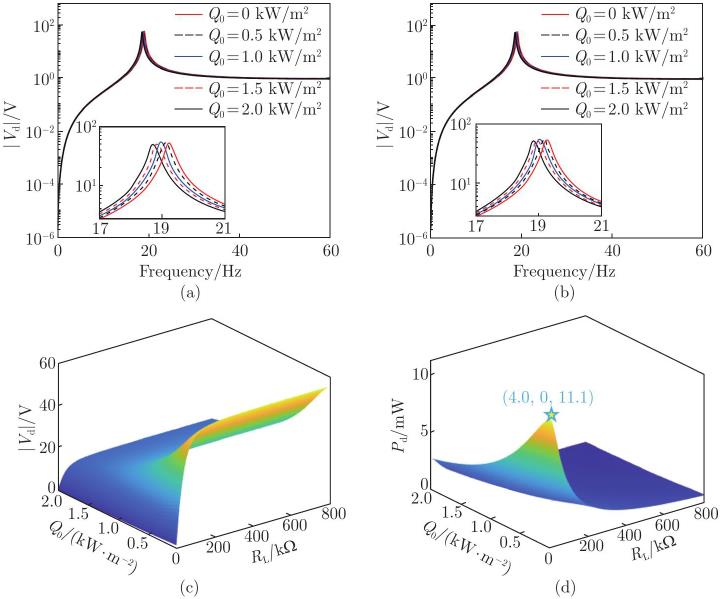
Fig. 12
Relative tip displacements (a) |W(L)/Pb| and (b) |Wd(L)/Pb| versus vibration excitation frequency at different convective heat transfer coefficients h; (c) voltage amplitude |Vd| and (d) power Pd versus vibration excitation frequency at different h. Data are obtained by setting ΩT=0 rad/s, Q0=2 kW/m2, RL=300 k Ω, and L=100 mm (color online)"
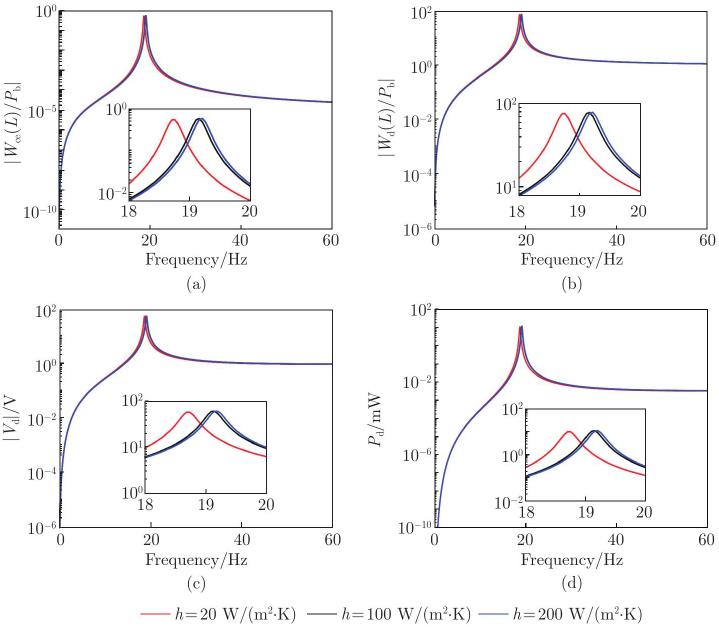
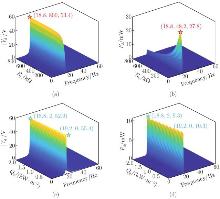
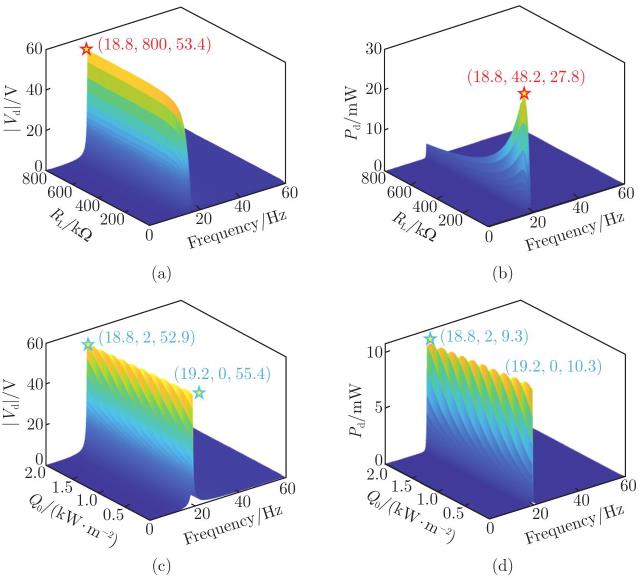
Fig. 13
(a) Voltage amplitude |Vd| and (b) power Pd versus vibration excitation frequency and load resistance RL at Q0=2 kW/m2; (c) voltage amplitude |Vd| and (d) power Pd versus vibration excitation frequency and thermal source intensity Q0 at RL=300 kΩ. Data are obtained by setting ΩT=0 rad/s, h=20 W/(m2⋅K), and L=100 mm (color online)"
| [1] | RINDI, A., BALDASSARRE, L., PANARA, D., MELI, E., RIDOLFI, A., FRILLI, A., NOCCIOLINI, D., and PANCONI, S. An efficient iterative approach for the analysis of thermal instabilities in rotating machines. Journal of Vibration and Acoustics, 139(6), 061019 (2017) |
| [2] | MATNEY, A., MURTHY, R., SONG, P. C., WANG, X. Q., and MIGNOLET, M. P. Nonlinear reduced order modeling of heated structures with temperature-dependent properties. AIAA Journal, 63(1), 244–259 (2025) |
| [3] | NESARHOSSEINI, S., ANSARI, R., OSKOUIE, M. F., and ROUHI, H. Thermally induced vibration analysis of Timoshenko beams based on the micropolar thermoelasticity. Acta Mechanica, 234(5), 1957–1971 (2023) |
| [4] | ZHAO, X., ZHU, W. D., and LI, Y. H. Analytical solutions of nonlocal coupled thermoelastic forced vibrations of micro-/nano-beams by means of Green’s functions. Journal of Sound and Vibration, 481, 115407 (2020) |
| [5] | KONG, D. J., HE, Z. Z., LIU, C. B., and ZHANG, C. L. Analysis of multi-field coupling behaviors of sandwich piezoelectric semiconductor beams under thermal loadings. Applied Mathematics and Mechanics (English Edition), 46(8), 1571–1590 (2025) https://doi.org/10.1007/s10483-025-3284-7 |
| [6] | LOTFAN, S. and CIGEROGLU, E. Coupled thermo-elastic dynamics of rotating pre-twisted blades exposed to thermal shock including nonlinear rotational effects. Journal of Sound and Vibration, 594, 118669 (2025) |
| [7] | YAMAMOTO, R., HEGENDÖRFER, A., MERGHEIM, J., and KAKIMOTO, K. I. Temperature-dependent vibration energy harvesting performance of polyimide/(Na, K)NbO3 piezoelectric composites. Japanese Journal of Applied Physics, 61, SN1028 (2022) |
| [8] | NODA, N. Thermal stresses in materials with temperature-dependent properties. Applied Mechanics Reviews, 44(9), 383–397 (1991) |
| [9] | YANG, W. and YOU, P. B. Thermal stress analysis and fatigue life assessment of bridge structures under multi-physical field coupling. International Journal of Heat and Technology, 41(6), 1561–1572 (2023) |
| [10] | BOWEN, C. R., KIM, H. A., WEAVER, P. M., and DUNN, S. Piezoelectric and ferroelectric materials and structures for energy harvesting applications. Energy & Environmental Science, 7(1), 25–44 (2014) |
| [11] | IQBAL, M., NAUMAN, M. M., KHAN, F. U., ABAS, P. E., CHEOK, Q., IQBAL, A., and AISSA, B. Vibration-based piezoelectric, electromagnetic, and hybrid energy harvesters for microsystems applications: a contributed review. International Journal of Energy Research, 45(1), 65–102 (2021) |
| [12] | TOPRAK, A. and TIGLI, O. Piezoelectric energy harvesting: state-of-the-art and challenges. Applied Physics Reviews, 1(3), 031104 (2014) |
| [13] | MAO, J. J., GAO, W., LIU, C. R., CAO, D. X., and LAI, S. Transition analysis of meta-stable and bi-stable nonlinear behavior in piezoelectric vibration energy harvesting through a pre-shaped curved beam model. Applied Mathematics and Mechanics (English Edition), 46(11), 2017–2034 (2025) https://doi.org/10.1007/s10483-025-3319-6 |
| [14] | MANOACH, E. and RIBEIRO, P. Coupled, thermoelastic, large amplitude vibrations of Timoshenko beams. International Journal of Mechanical Sciences, 46(11), 1589–1606 (2004) |
| [15] | MOHAMMADI, R. and HOSSEINI, M. Modeling and free vibration analysis of a rotating functionally graded thin-walled hub-blade system under aerothermoelastic loading. Aerospace Science and Technology, 146, 108935 (2024) |
| [16] | PRIYA, S. and INMAN, D. J. Energy Harvesting Technologies, Springer, New York (2009) |
| [17] | TSUSHIMA, N. and SU, W. H. A study on adaptive vibration control and energy conversion of highly flexible multifunctional wings. Aerospace Science and Technology, 79, 297–309 (2018) |
| [18] | DAI, H. L., ABDELKEFI, A., and WANG, L. Theoretical modeling and nonlinear analysis of piezoelectric energy harvesting from vortex-induced vibrations. Journal of Intelligent Material Systems and Structures, 25(14), 1861–1874 (2014) |
| [19] | RAZZAQ, S., ASGHAR, A., and IQBAL, S. Advances in Hybrid Conducting Polymer Technology, Springer, Switzerland (2021) |
| [20] | HANISZEWSKI, T., BUCKI, S., MARGIELEWICZ, J., GĄSKA, D., KUANG, Y., and LITAK, G. Energy harvesting system with a hyperelastic mechanical vibration amplifier. Mechanical Systems and Signal Processing, 224, 112038 (2025) |
| [21] | LI, H. T., ZHENG, T. Y., QIN, W. Y., TIAN, R. L., DING, H., JI, J. C., and CHEN, L. Q. Theoretical and experimental study of a bi-stable piezoelectric energy harvester under hybrid galloping and band-limited random excitations. Applied Mathematics and Mechanics (English Edition), 45(3), 461–478 (2024) https://doi.org/10.1007/s10483-024-3098-5 |
| [22] | ERTURK, A. and INMAN, D. J. A distributed parameter electromechanical model for cantilevered piezoelectric energy harvesters. Journal of Vibration and Acoustics, 130(4), 041002 (2008) |
| [23] | DAQAQ, M. F. Transduction of a bistable inductive generator driven by white and exponentially correlated Gaussian noise. Journal of Sound and Vibration, 330(11), 2554–2564 (2011) |
| [24] | STANTON, S. C., OWENS, B. A. M., and MANN, B. P. Harmonic balance analysis of the bistable piezoelectric inertial generator. Journal of Sound and Vibration, 331(15), 3617–3627 (2012) |
| [25] | ZHOU, S. X. and ZUO, L. Nonlinear dynamic analysis of asymmetric tristable energy harvesters for enhanced energy harvesting. Communications in Nonlinear Science and Numerical Simulation, 61, 271–284 (2018) |
| [26] | HUANG, D. M., ZHOU, S. X., and LITAK, G. Theoretical analysis of multi-stable energy harvesters with high-order stiffness terms. Communications in Nonlinear Science and Numerical Simulation, 69, 270–286 (2019) |
| [27] | ZHAO, L., HU, G. B., ZHOU, S. X., PENG, Y., XIE, S. R., and LI, Z. J. Magnetic coupling and amplitude truncation based bistable energy harvester. International Journal of Mechanical Sciences, 273, 109228 (2024) |
| [28] | ZHANG, B., YANG, G., HU, B. X., XIONG, Y. P., and ZHOU, S. X. Optimized design of self-powered SSHI interface circuit for enhanced vibration energy harvesting. Smart Materials and Structures, 34(2), 025025 (2025) |
| [29] | ZHANG, H., ZHOU, S. X., and LIM, C. W. Flutter suppression of a heated panel in supersonic airflow using energy harvesters. AIAA Journal (2026) https://doi.org/10.2514/1.J066769 |
| [30] | ZHAO, X., IEGAINK, F. J. N., ZHU, W. D., and LI, Y. H. Coupled thermo-electro-elastic forced vibrations of piezoelectric laminated beams by means of Green’s functions. International Journal of Mechanical Sciences, 156, 355–369 (2019) |
| [31] | ZHANG, H. R., INMAN, D. J., and ZHOU, S. X. Coupled thermo-electric-elastic piezoelectric vibration energy harvester with axial movement: modeling, verification, and analysis. Journal of Vibration and Acoustics, 146(5), 051002 (2024) |
| [32] | ARROYO, E., JIA, Y., DU, S., CHEN, S., and SESHIA, A. High temperature performance of a piezoelectric micro cantilever for vibration energy harvesting. Journal of Physics: Conference Series, 773(1), 012001 (2016) |
| [33] | ARROYO, E., JIA, Y., DU, S. J., CHEN, S. T., and SESHIA, A. A. Experimental and theoretical study of a piezoelectric vibration energy harvester under high temperature. Journal of Microelectromechanical Systems, 26(6), 1216–1225 (2017) |
| [34] | BARKER, S., VASSILEVSKI, K. V., WRIGHT, N. G., and HORSFALL, A. B. High temperature vibration energy harvester system. IEEE Sensors, IEEE, 300–303 (2011) |
| [35] | KIM, S. B., PARK, J. H., AHN, H., LIU, D., and KIM, D. J. Temperature effects on output power of piezoelectric vibration energy harvesters. Microelectronics Journal, 42(8), 988–991 (2011) |
| [36] | WACHTMAN, J. B., TEFFT, W. E., LAM, D. G., and APSTEIN, C. S. Exponential temperature dependence of Young’s modulus for several oxides. Physical Review, 122(6), 1754–1759 (1961) |
| [37] | CHO, C. H. Characterization of Young’s modulus of silicon versus temperature using a “beam deflection” method with a four-point bending fixture. Current Applied Physics, 9(2), 538–545 (2009) |
| [38] | LI, W. G., KOU, H. B., ZHANG, X. Y., MA, J. Z., LI, Y., GENG, P. J., WU, X. Z., CHEN, L. M., and FANG, D. N. Temperature-dependent elastic modulus model for metallic bulk materials. Mechanics of Materials, 139, 103194 (2019) |
| [39] | EN 1999-1-2: 2007. Eurocode 9: Design of Aluminium Structures — Part 1-2: Structural Fire Design, European Committee for Standardization (2007) |
| [40] | SU, M. N. and YOUNG, B. Material properties of normal and high strength aluminium alloys at elevated temperatures. Thin-Walled Structures, 137, 463–471 (2019) |
| [41] | LI, P., LI, C. L., and CONG, B. L. Piezoelectric-thermo-elastic coupling effect analysis for piezoelectric vibration energy harvester. Microsystem Technologies, 24(9), 3823–3832 (2018) |
| [42] | XIAO, Y. S. and WU, Z. Multi-objective optimization on thermomechanical behaviors of temperature-dependent graphene platelet reinforced sandwich plates. Chinese Journal of Aeronautics, 38(5), 103363 (2025) |
| [43] | YANG, Z. Y., ZHU, H., YU, F., WU, P., and FANG, H. Thermo-mechanical coupled behavior of laminated beams with temperature-dependent viscoelastic interlayers. European Journal of Mechanics A, 100, 105000 (2023) |
| [44] | GUO, X. X., WANG, Z. M., WANG, Y., and ZHOU, Y. F. Analysis of the coupled thermoelastic vibration for axially moving beam. Journal of Sound and Vibration, 325(3), 597–608 (2009) |
| [45] | ZHANG, H. R., SUI, W. T., YANG, C. Q., ZHANG, L. A., SONG, R. J., and WANG, J. L. An asymmetric magnetic-coupled bending-torsion piezoelectric energy harvester: modeling and experimental investigation. Smart Materials and Structures, 31(1), 015037 (2022) |
| [46] | GROVER, D. and SHARMA, J. N. Transverse vibrations in piezothermoelastic beam resonators. Journal of Intelligent Material Systems and Structures, 23(1), 77–84 (2012) |
| [47] | ERTURK, A. and INMAN, D. J. Piezoelectric Energy Harvesting, Wiley, Chichester, U. K. (2011) |
| [48] | ÖZISIK, M. N. Heat Conduction, Wiley, New York (1993) |
| [49] | ASMAR, N. H. Partial Differential Equations with Fourier Series and Boundary Value Problems, Pearson Education, Upper Saddle River, N. J. (2005) |
| [1] | Kefan XU, Zhuoda ZHOU, Yaohua LIU, Yewei ZHANG, Liqun CHEN. An investigation on self-powered semi-active vibration isolation system with adjustable stiffness [J]. Applied Mathematics and Mechanics (English Edition), 2026, 47(5): 1019-1040. |
| [2] | Tangrui LAI, Xiaoyu FU, Xiang MU, Liangliang ZHANG, Yang GAO. Fundamental solutions for two-dimensional piezoelectric quasicrystals with polygonal holes [J]. Applied Mathematics and Mechanics (English Edition), 2026, 47(3): 623-638. |
| [3] | Linchuan ZHAO, Zewen CHEN, X. CHEN, Qiuhua GAO, Zhiyuan WU, Ge YAN, Kexiang WEI, E. M. YEATMAN, Guang MENG, Wenming ZHANG, Hongxiang ZOU. Design and analysis of a mechanically intelligent system for biomechanical energy harvesting [J]. Applied Mathematics and Mechanics (English Edition), 2026, 47(2): 235-254. |
| [4] | N. A. SAEED, Y. Y. ELLABBAN, Lei HOU, Haiming YI, Shun ZHONG, F. Z. DURAIHEM, O. M. OMARA. Nonlinear vibration of quasi-zero stiffness structure with piezoelectric harvester and RL-load: intra-well and inter-well oscillation modes under 1:1 internal resonance [J]. Applied Mathematics and Mechanics (English Edition), 2025, 46(8): 1451-1474. |
| [5] | Tingting CHEN, Kai WANG, Shengchao CHEN, Ziyu XU, Zhe LI, Jiaxi ZHOU. Nonlinear electromechanical coupling dynamics of a two-degree-of-freedom hybrid energy harvester [J]. Applied Mathematics and Mechanics (English Edition), 2025, 46(6): 989-1010. |
| [6] | Tianchi YU, Feng LIANG, Hualin YANG. Vibration energy harvesting of a three-directional functionally graded pipe conveying fluids [J]. Applied Mathematics and Mechanics (English Edition), 2025, 46(5): 795-812. |
| [7] | Kai LUO, Cuiying FAN, Minghao ZHAO, C. S. LU, Huayang DANG. Interfacial analysis of a penny-shaped one-dimensional hexagonal functionally graded piezoelectric quasicrystal film on a temperature-dependent substrate [J]. Applied Mathematics and Mechanics (English Edition), 2025, 46(12): 2297-2316. |
| [8] | Jiamei WANG, Siukai LAI, Chen WANG, Yiting ZHANG, Zhaolin CHEN. On the role of sliding friction effect in nonlinear tri-hybrid vibration-based energy harvesting [J]. Applied Mathematics and Mechanics (English Edition), 2024, 45(8): 1295-1314. |
| [9] | Long ZHAO, Zeqi LU, Hu DING, Liqun CHEN. A viscoelastic metamaterial beam for integrated vibration isolation and energy harvesting [J]. Applied Mathematics and Mechanics (English Edition), 2024, 45(7): 1243-1260. |
| [10] | Lanbin ZHANG, Yixiang HE, Bo MENG, Huliang DAI, Lin WANG. Unlocking multidirectional and broadband wind energy harvesting with triboelectric nanogenerator and vortex-induced vibration of sphere [J]. Applied Mathematics and Mechanics (English Edition), 2024, 45(11): 1895-1912. |
| [11] | Yang JIN, Tianzhi YANG. Enhanced vibration suppression and energy harvesting in fluid-conveying pipes [J]. Applied Mathematics and Mechanics (English Edition), 2023, 44(9): 1487-1496. |
| [12] | Jihou YANG, Weixing ZHANG, Xiaodong YANG. Integrated device for multiscale series vibration reduction and energy harvesting [J]. Applied Mathematics and Mechanics (English Edition), 2023, 44(12): 2227-2242. |
| [13] | Bin ZHANG, Hongsheng LIU, Shengxi ZHOU, Jun GAO. A review of nonlinear piezoelectric energy harvesting interface circuits in discrete components [J]. Applied Mathematics and Mechanics (English Edition), 2022, 43(7): 1001-1026. |
| [14] | Dongxing CAO, Junru WANG, Xiangying GUO, S. K. LAI, Yongjun SHEN. Recent advancement of flow-induced piezoelectric vibration energy harvesting techniques: principles, structures, and nonlinear designs [J]. Applied Mathematics and Mechanics (English Edition), 2022, 43(7): 959-978. |
| [15] | Qiong WANG, Zewen CHEN, Linchuan ZHAO, Meng LI, Hongxiang ZOU, Kexiang WEI, Xizheng ZHANG, Wenming ZHANG. Enhanced galloping energy harvester with cooperative mode of vibration and collision [J]. Applied Mathematics and Mechanics (English Edition), 2022, 43(7): 945-958. |
| Viewed | ||||||
|
Full text |
|
|||||
|
Abstract |
|
|||||





 Email Alert
 RSS
RSS