Applied Mathematics and Mechanics (English Edition) ›› 2026, Vol. 47 ›› Issue (8): 1855-1878.doi: https://doi.org/10.1007/s10483-026-3419-9
Daiwei DONG1,2, Wei SUO1,2, Jiaqing KOU1,2,3, Weiwei ZHANG1,2,3( )
)
Received:2026-02-09
Revised:2026-05-19
Online:2026-07-31
Published:2026-07-31
Contact:
Weiwei ZHANG, E-mail: aeroelastic@nwpu.edu.cnSupported by:2010 MSC Number:
Daiwei DONG, Wei SUO, Jiaqing KOU, Weiwei ZHANG. PINN-MG: a multigrid-inspired hybrid framework combining the iterative method and physics-informed neural networks. Applied Mathematics and Mechanics (English Edition), 2026, 47(8): 1855-1878.
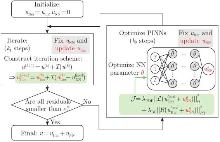
Fig. 1
Solving process of the PMG framework (color online)"
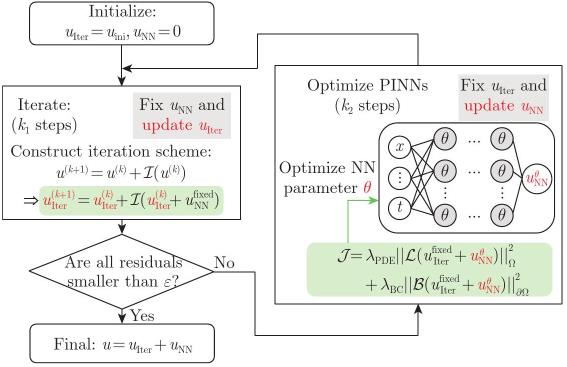
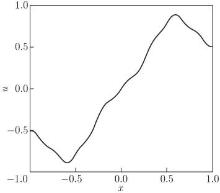
Fig. 2
Exact solution to the 1D multi-frequency Poisson equation"
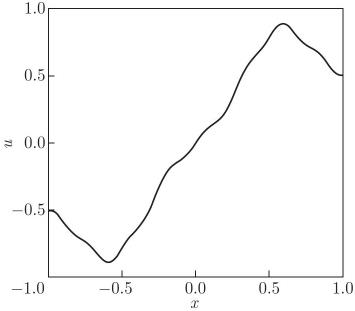
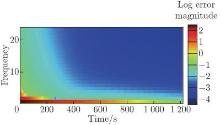
Fig. 3
Evolution of the spectral error over time during solving the 1D linear Poisson equation using the GS method (color online)"
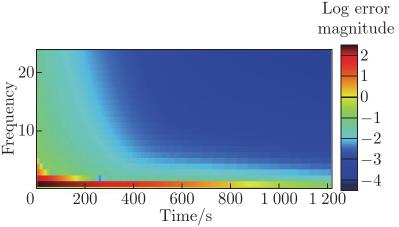
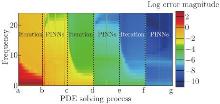
Fig. 4
Evolution of the spectral error throughout the convergence process of solving the 1D linear Poisson equation using the PMG based on the GS method (color online)"
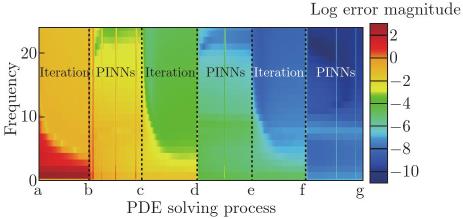
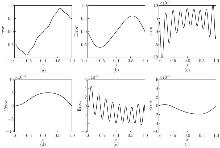
Fig. 5
Error distributions at different stages of solving the 1D linear Poisson equation using the PMG based on the GS iterative method: (a) initial error; (b) 1st GS iteration; (c) 1st PINN solving; (d) 2nd GS iteration; (e) 2nd PINN solving; (f) 3rd GS iteration"
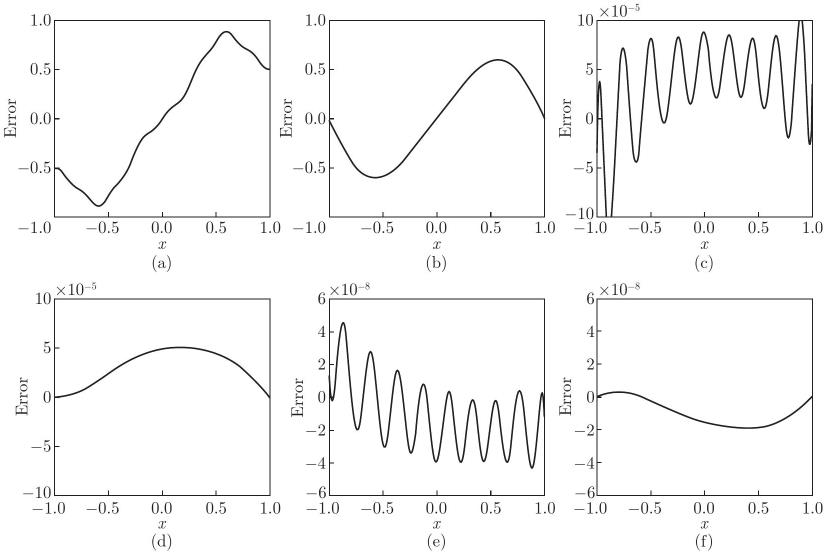
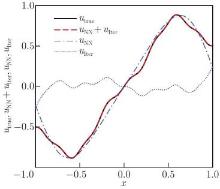
Fig. 6
Distributions of the components uIter and uNN of the solution u obtained by the PMG (color online)"
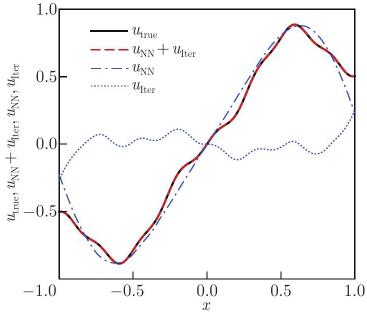
Fig. 7
Convergence of the solution error and equation residual in solving the 1D linear Poisson equation: (a) solution error; (b) equation residual (color online)"
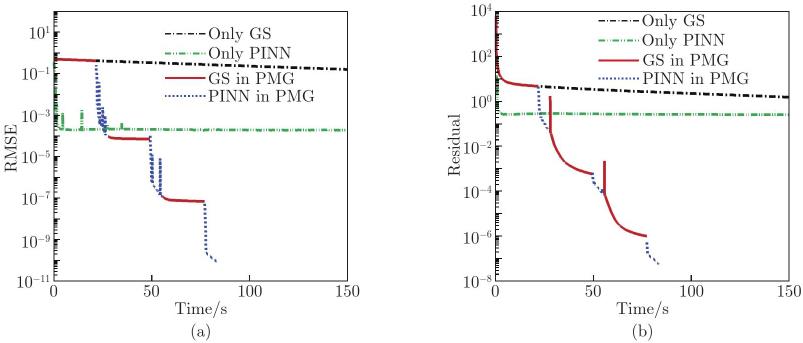
Fig. 8
Convergence of the solution error and equation residual in solving the 1D Poisson equation with different settings of the PINN: (a) solution error; (b) equation residual (color online)"
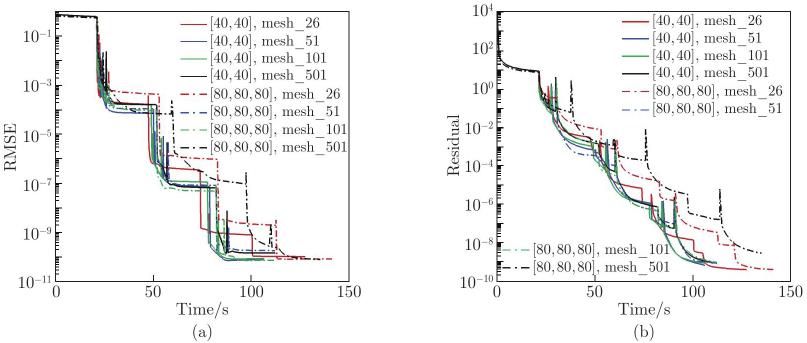
Fig. 9
Convergence of the solution error and equation residual in solving the 1D Poisson equation under different switching strategies: (a) solution error; (b) equation residual (color online)"
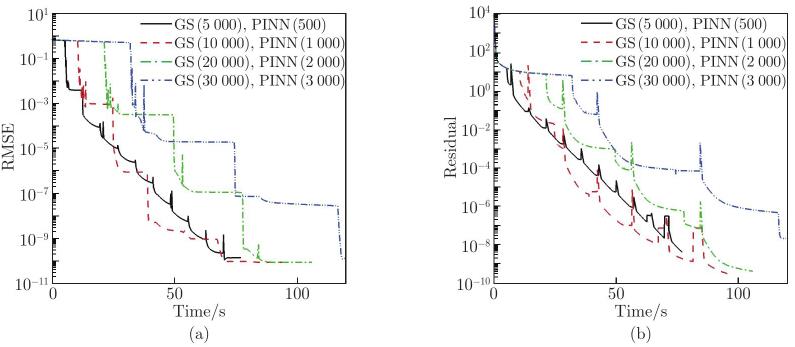

Table 1
Solution time of multigrid methods of different levels and the PMG framework"
| Method | GS | 2-level multigrid | 3-level multigrid | 4-level multigrid | 5-level multigrid | PMG |
|---|---|---|---|---|---|---|
| Time/s | 8 777 | 2 229 | 526 | 138 | 37 | 84 |
| Speed-up | – |
Fig. 10
Exact solution to the 2D multi-frequency Poisson equation (color online)"
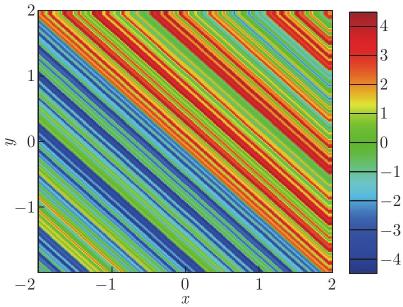
Fig. 11
Convergence of the solution error and equation residual in solving the 2D linear Poisson equation: (a) solution error; (b) equation residual (color online)"
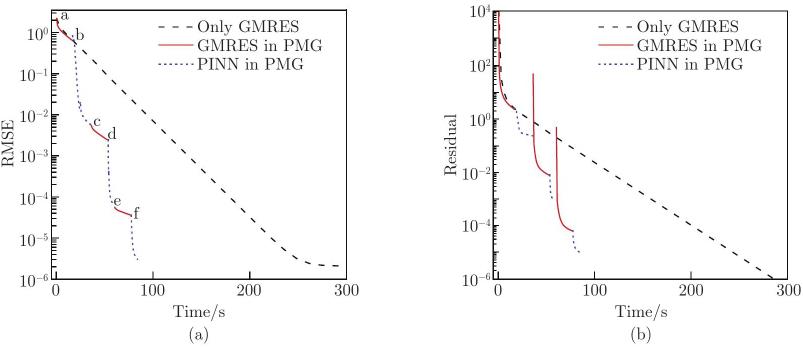
Fig. 12
Error distributions at different stages of solving the 2D multi-frequency linear Poisson equation using the PMG based on the GMRES iterative method: (a) initial error; (b) 1st GMRES phase; (c) 1st PINN solving; (d) 2nd GMRES phase; (e) 2nd PINN solving; (f) 3rd GMRES phase (color online)"
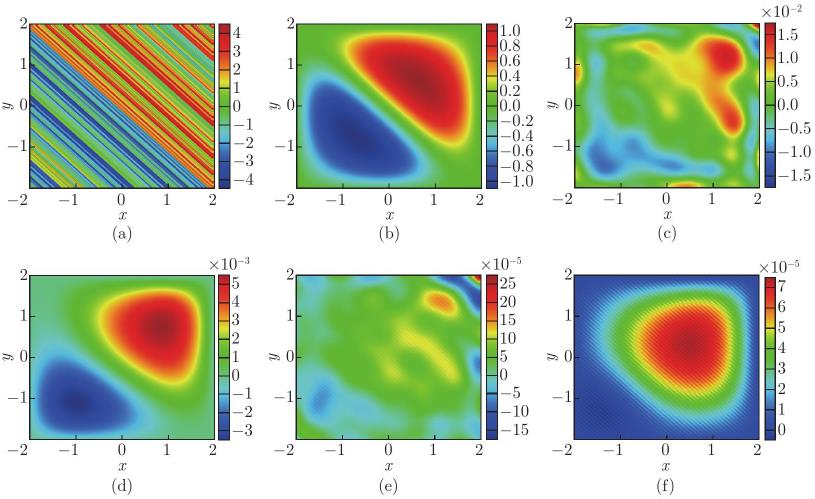
Table 2
Solution time of multigrid methods of different levels and the PMG framework"
| Method | GMRES | 2-level multigrid | 3-level multigrid | 4-level multigrid | 5-level multigrid | PMG |
|---|---|---|---|---|---|---|
| Time/s | 274 | 62 | 39 | 37 | 36 | 83 |
| Speed-up | – |
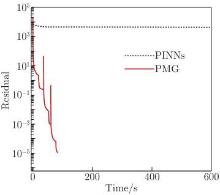
Fig. 13
Comparison of the residual convergence for solving the 2D linear Poisson equation using the PMG and PINNs (color online)"
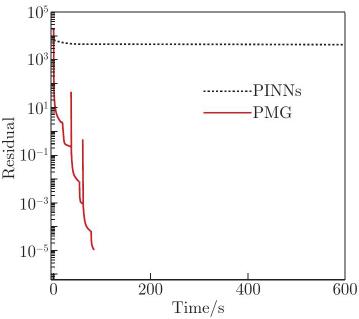
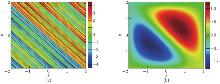
Fig. 14
Distributions of the components uIter and uNN of the solution u obtained by the PMG: (a) uIter; (b) uNN (color online)"
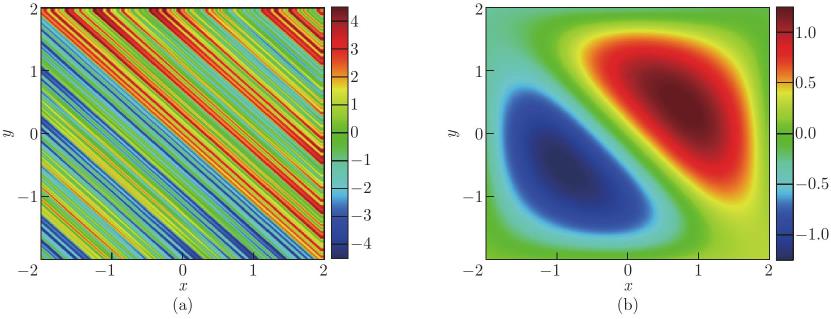
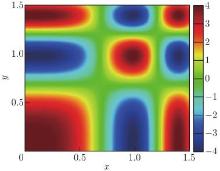
Fig. 15
Exact solution to the 2D nonlinear Helmholtz equation (color online)"
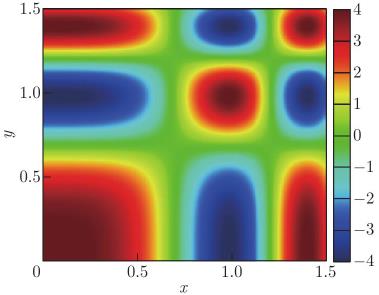
Fig. 16
Convergence of the solution error and equation residual in solving the 2D nonlinear Helmholtz equation: (a) solution error; (b) equation residual (color online)"
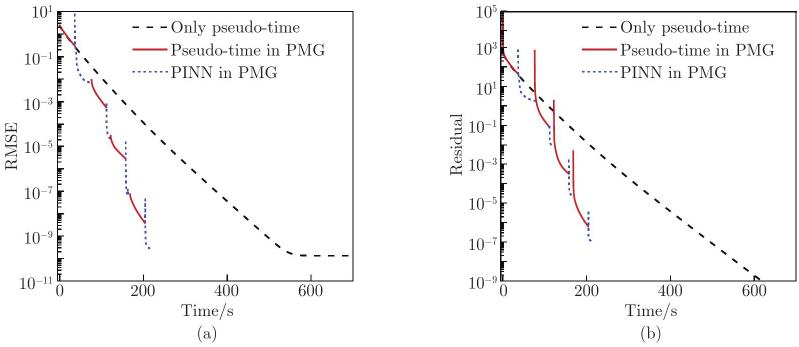
Table 3
Solution time of multigrid methods of different levels and the PMG framework"
| Method | Pseudo-time | 2-level multigrid | 3-level multigrid | 4-level multigrid | PMG |
|---|---|---|---|---|---|
| Time/s | 556 | 537 | 170 | 53 | 213 |
| Speed-up | – |
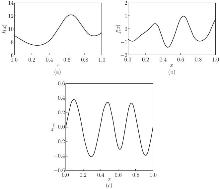
Fig. 17
Profiles of (a) k(x) and (b) f(x), along with (c) their corresponding exact solution"
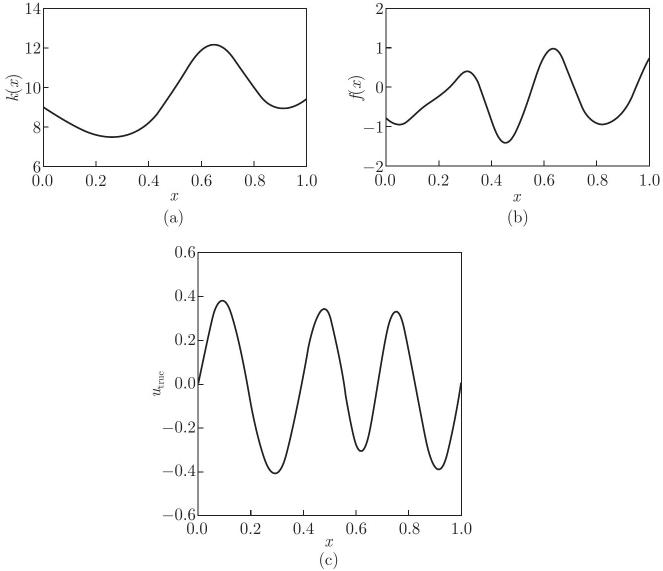
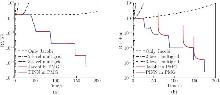
Fig. 18
Convergence of the solution error and equation residual in solving the 1D Helmholtz equation involving indefiniteness: (a) solution error; (b) equation residual (color online)"
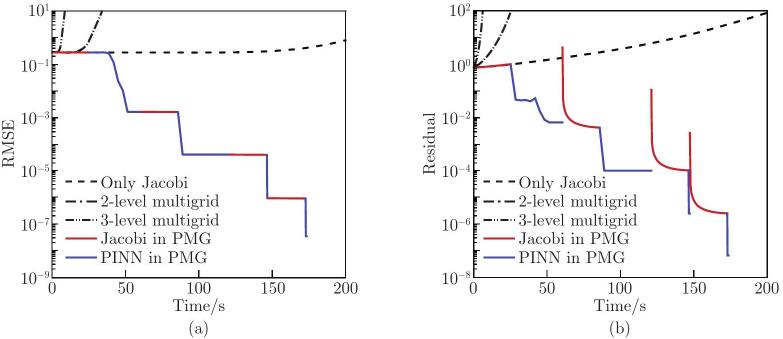
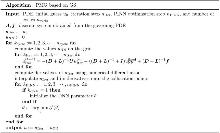
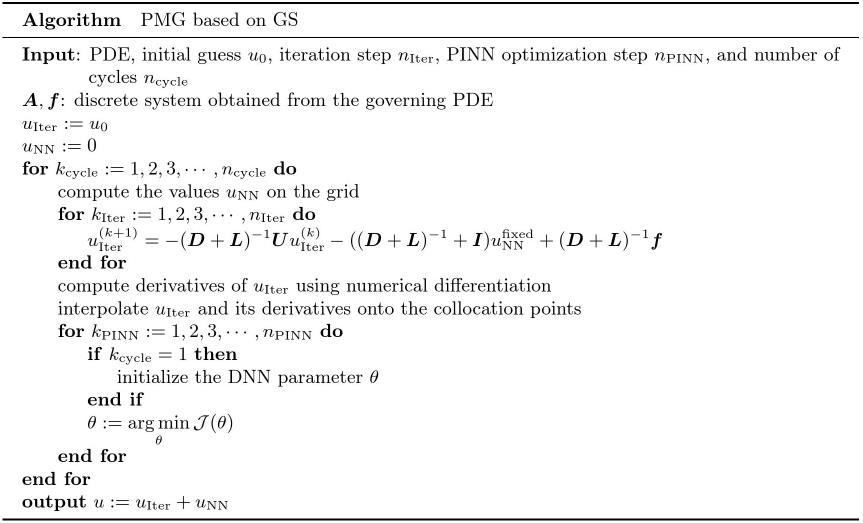
Fig. A1
Pseudo-code for the PMG based on the GS method"
| [1] | SMITH, G. D. Numerical Solution of Partial Differential Equations, 3rd ed., Clarendon Press, Oxford (1985) |
| [2] | EYMARD, R., GALLOUËT, T., and HERBIN, R. Finite volume methods. Solution of Equation in ℝn (Part 3), Techniques of Scientific Computing (Part 3), 713–1018, Elsevier, Amsterdam (2000) |
| [3] | REDDY, J. N. An Introduction to the Finite Element Method, McGraw-Hill, New York (1985) |
| [4] | TREFETHEN, L. N. and BAU, D. Numerical Linear Algebra, Society for Industrial and Applied Mathematics, Philadelphia (1997) |
| [5] | SAAD, Y. and SCHULTZ, M. H. GMRES: a generalized minimal residual algorithm for solving nonsymmetric linear systems. SIAM Journal on Scientific and Statistical Computing, 7(3), 856–869 (1986) |
| [6] | BRANDT, A. and LIVNE, O. E. Multigrid Techniques: 1984 Guide with Applications to Fluid Dynamics, Revised Edition, Society for Industrial and Applied Mathematics, Philadelphia (2011) |
| [7] | TROTTENBERG, U., OOSTERLEE, C. W., and SCHULLER, A. Multigrid, Elsevier, FL, United States (2000) |
| [8] | HACKBUSCH, W. Multi-Grid Methods and Applications, Springer Science & Business Media, Berlin (2013) |
| [9] | STÜBEN, K. Numerical Analysis: Historical Developments in the 20th Century, Elsevier, FL, United States (2001) |
| [10] | LIU, Y. L., ZHANG, W. W., and KOU, J. Q. Mode multigrid — a novel convergence acceleration method. Aerospace Science and Technology, 92, 605–619 (2019) |
| [11] | RAISSI, M., PERDIKARIS, P., and KARNIADAKIS, G. E. Physics-informed neural networks: a deep learning framework for solving forward and inverse problems involving nonlinear partial differential equations. Journal of Computational Physics, 378, 686–707 (2019) |
| [12] | SIRIGNANO, J. and SPILIOPOULOS, K. DGM: a deep learning algorithm for solving partial differential equations. Journal of Computational Physics, 375, 1339–1364 (2018) |
| [13] | E, W. N. and YU, B. The deep Ritz method: a deep learning-based numerical algorithm for solving variational problems. Communications in Mathematics and Statistics, 6(1), 1–12 (2018) |
| [14] | LIAO, Y. L. and MING, P. B. Deep Nitsche method: deep Ritz method with essential boundary conditions. Communications in Computational Physics, 29(5), 1365–1384 (2025) |
| [15] | SAMANIEGO, E., ANITESCU, C., GOSWAMI, S., NGUYEN-THANH, V. M., GUO, H., HAMDIA, K., ZHUANG, X., and RABCZUK, T. An energy approach to the solution of partial differential equations in computational mechanics via machine learning: concepts, implementation and applications. Computer Methods in Applied Mechanics and Engineering, 362, 112790 (2020) |
| [16] | XU, Z. Q. J., ZHANG, Y. Y., LUO, T., XIAO, Y. Y., and MA, Z. Frequency principle: Fourier analysis sheds light on deep neural networks. Communications in Computational Physics, 28(5), 1746–1767 (2025) |
| [17] | XU, Z. Q. J., ZHANG, Y. Y., and LUO, T. Overview frequency principle/spectral bias in deep learning. Communications on Applied Mathematics and Computation, 7(3), 827–864 (2025) |
| [18] | XU, Z. Q. J., ZHANG. Y., and XIAO, Y. Training behavior of deep neural network in frequency domain. Proceedings of the Neural Information, Springer, Berlin (2019) |
| [19] | RAHAMAN, N., BARATIN, A., ARPIT, D., DRAXLER, F., LIN, M., HAMPRECHT, F., BENGIO, Y., and COURVILLE, A. On the spectral bias of neural networks. Proceedings of the 36th International Conference on Machine Learning, PMLR, Victoria, BC, Canada, 5301–5310 (2019) |
| [20] | BASRI, R., JACOBS, D., KASTEN, Y., and KRITCHMAN, S. The convergence rate of neural networks for learned functions of different frequencies. Advances in Neural Information Processing Systems, 32, 4761–4771 (2019) |
| [21] | BASRI, R., GALUN, M., GEIFMAN, A., JACOBS, D., KASTEN, Y., and KRITCHMAN, S. Frequency bias in neural networks for input of non-uniform density. Proceedings of the 37th International Conference on Machine Learning, PMLR, Victoria, BC, Canada, 685–694 (2020) |
| [22] | LEE, J., XIAO, L. C., SCHOENHOLZ, S. S., BAHRI, Y., NOVAK, R., SOHL-DICKSTEIN, J., and PENNINGTON, J. Wide neural networks of any depth evolve as linear models under gradient descent. Journal of Statistical Mechanics: Theory and Experiment, 2020(12), 124002 (2020) |
| [23] | JACOT, A., GABRIEL, F., and HONGLER, C. Neural tangent kernel: convergence and generalization in neural networks (invited paper). Proceedings of the 53rd Annual ACM SIGACT Symposium on Theory of Computing, ACM, New York (2021) |
| [24] | DU, S. S., ZHAI, X., PÓCZOS, B., and SINGH, A. Gradient descent provably optimizes over-parameterized neural networks. International Conference on Learning Representations, ICLR 2019, New Orleans, LA, USA (2019) |
| [25] | BIETTI, A. and MAIRAL, J. On the inductive bias of neural tangent kernels. Advances in Neural Information Processing Systems 32, Curran Associates, Inc., Vancouver, Canada (2019) |
| [26] | ARORA, S., DU, S. S., HU, W., LI, Z., and WANG, R. Fine-grained analysis of optimization and generalization for overparameterized two-layer neural networks. Proceedings of the 36th International Conference on Machine Learning, PMLR, Victoria, BC, Canada, 322–332 (2019) |
| [27] | TANCIK, M., SRINIVASAN, P. P., MILDENHALL, B., and FRIDOVICH-KEIL, S. Fourier features let networks learn high frequency functions in low dimensional domains. Proceedings of the 34th International Conference on Neural Information Processing Systems, ACM, New York, 7537–7547 (2020) |
| [28] | WANG, S. F., YU, X. L., and PERDIKARIS, P. When and why PINNs fail to train: a neural tangent kernel perspective. Journal of Computational Physics, 449, 110768 (2022) |
| [29] | CUI, C., JIANG, K., LIU, Y., and SHU, S. Fourier neural solver for large sparse linear algebraic systems. Mathematics, 10(21), 4014 (2022) |
| [30] | ZHANG, E. R., KAHANA, A., KOPANIČÁKOVÁ, A., TURKEL, E., RANADE, R., PATHAK, J., and KARNIADAKIS, G. E. Blending neural operators and relaxation methods in PDE numerical solvers. Nature Machine Intelligence, 6(11), 1303–1313 (2024) |
| [31] | HU, J. and JIN, P. A hybrid iterative method based on MIONet for PDEs: theory and numerical examples. Mathematics of Computation, 95, 2103–2127 (2026) |
| [32] | SUO, W. and ZHANG, W. W. A novel paradigm for solving PDEs: multi-scale neural computing. Acta Mechanica Sinica, 41(6), 324172 (2024) |
| [33] | CHIU, P. H., WONG, J. C., OOI, C., DAO, M. H., and ONG, Y. S. CAN-PINN: a fast physics-informed neural network based on coupled-automatic-numerical differentiation method. Computer Methods in Applied Mechanics and Engineering, 395, 114909 (2022) |
| [34] | BARAKAT, A. and BIANCHI, P. Convergence and dynamical behavior of the ADAM algorithm for nonconvex stochastic optimization. SIAM Journal on Optimization, 31(1), 244–274 (2021) |
| [35] | LIU, D. C. and NOCEDAL, J. On the limited memory BFGS method for large scale optimization. Mathematical Programming, 45(1), 503–528 (1989) |
| [1] | Chenxu LIU, Yingjing QIAN, Guilan YU, Zhanli LIU, Xiaodong YANG. A modular physics-informed neural network for nonlinear vibration isolators [J]. Applied Mathematics and Mechanics (English Edition), 2026, 47(8): 1747-1768. |
| [2] | Zhengzhe XIE, S. EL-BORGI, Jie SU, Liaoliang KE. Mixed elastohydrodynamic lubrication contact of piezoelectric materials with different Gaussian rough surfaces [J]. Applied Mathematics and Mechanics (English Edition), 2026, 47(5): 965-984. |
| [3] | P. T. NGUYEN, K. A. LUONG, J. H. LEE. Neural boundary shape functions in physics-informed neural networks for discontinuous and high-frequency problems [J]. Applied Mathematics and Mechanics (English Edition), 2026, 47(2): 423-442. |
| [4] | Jiamin QIAN, Lincong CHEN, J. Q. SUN. Neural network solution based on the minimum potential energy principle for static problems of structural mechanics [J]. Applied Mathematics and Mechanics (English Edition), 2025, 46(6): 1125-1142. |
| [5] | Nanxi DING, Hengzhen FENG, H. Z. LOU, Shenghua FU, Chenglong LI, Zihao ZHANG, Wenlong MA, Zhengqian ZHANG. Prediction of velocity and pressure of gas-liquid flow using spectrum-based physics-informed neural networks [J]. Applied Mathematics and Mechanics (English Edition), 2025, 46(2): 341-356. |
| [6] | K. CHANDAN, K. KARTHIK, K. V. NAGARAJA, B. C. PRASANNAKUMARA, R. S. VARUN KUMAR, T. MUHAMMAD. Radiative heat transfer analysis of a concave porous fin under the local thermal non-equilibrium condition: application of the clique polynomial method and physics-informed neural networks [J]. Applied Mathematics and Mechanics (English Edition), 2024, 45(9): 1613-1632. |
| [7] | Long WANG, Lei ZHANG, Guowei HE. Chien-physics-informed neural networks for solving singularly perturbed boundary-layer problems [J]. Applied Mathematics and Mechanics (English Edition), 2024, 45(9): 1467-1480. |
| [8] | Lei WANG, Zikun LUO, Mengkai LU, Minghai TANG. A physics-informed neural network for simulation of finite deformation in hyperelastic-magnetic coupling problems [J]. Applied Mathematics and Mechanics (English Edition), 2024, 45(10): 1717-1732. |
| [9] | Jing'ang ZHU, Yiheng XUE, Zishun LIU. A transfer learning enhanced physics-informed neural network for parameter identification in soft materials [J]. Applied Mathematics and Mechanics (English Edition), 2024, 45(10): 1685-1704. |
| [10] | J. N. FUHG, A. KARMARKAR, T. KADEETHUM, H. YOON, N. BOUKLAS. Deep convolutional Ritz method: parametric PDE surrogates without labeled data [J]. Applied Mathematics and Mechanics (English Edition), 2023, 44(7): 1151-1174. |
| [11] | Xuhui MENG. Variational inference in neural functional prior using normalizing flows: application to differential equation and operator learning problems [J]. Applied Mathematics and Mechanics (English Edition), 2023, 44(7): 1111-1124. |
| [12] | Yichuan HE, Zhicheng WANG, Hui XIANG, Xiaomo JIANG, Dawei TANG. An artificial viscosity augmented physics-informed neural network for incompressible flow [J]. Applied Mathematics and Mechanics (English Edition), 2023, 44(7): 1101-1110. |
| [13] | Zhiping MAO, Xuhui MENG. Physics-informed neural networks with residual/gradient-based adaptive sampling methods for solving partial differential equations with sharp solutions [J]. Applied Mathematics and Mechanics (English Edition), 2023, 44(7): 1069-1084. |
| [14] | W. WU, M. DANEKER, M. A. JOLLEY, K. T. TURNER, L. LU. Effective data sampling strategies and boundary condition constraints of physics-informed neural networks for identifying material properties in solid mechanics [J]. Applied Mathematics and Mechanics (English Edition), 2023, 44(7): 1039-1068. |
| [15] | SHAO Xin-Hui;JI Cui;SHEN Hai-Long;LI Chang-Jun. Modified iterative method for augmented system [J]. Applied Mathematics and Mechanics (English Edition), 2014, 35(4): 503-514. |
| Viewed | ||||||
|
Full text |
|
|||||
|
Abstract |
|
|||||





 Email Alert
 RSS
RSS