Applied Mathematics and Mechanics (English Edition) ›› 2026, Vol. 47 ›› Issue (4): 675-694.doi: https://doi.org/10.1007/s10483-026-3372-6
Xiaoye MAO†( ), Kexin CHANG, Jie JING, Tianchang DENG†(), Hu DING, Liqun CHEN
Received:2025-12-02
Revised:2026-02-05
Published:2026-03-31
Contact:
Xiaoye MAO, E-mails: xmao3@shu.edu.cnSupported by:2010 MSC Number:
Xiaoye MAO, Kexin CHANG, Jie JING, Tianchang DENG, Hu DING, Liqun CHEN. Buckling and parametric excitation stability optimization of fluid-conveying pipes by frequency design. Applied Mathematics and Mechanics (English Edition), 2026, 47(4): 675-694.
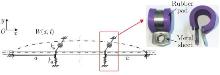
Fig. 1
Schematic of the multi-constraint hydraulic pipe (color online)"
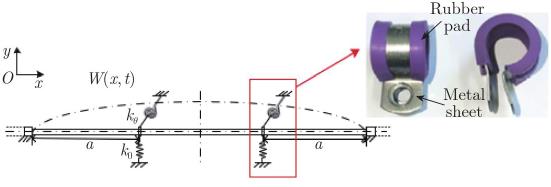
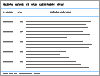
Table 1
Physical parameters of the fluid-conveying pipe"
| Parameter | Symbol | Value | Unit |
|---|---|---|---|
| Inner diameter | d | 0.005 | m |
| Outer diameter | D | 0.006 | m |
| Young’s modulus | E | 194 | GPa |
| Axial force | T0 | 10 | N |
| Viscous damping coefficient | α | | |
| Pipe density | | 7 390 | kg/m3 |
| Fluid density | | 872 | kg/m3 |
| Fluid velocity | v | 30 | m/s |
| Pipe length | | 1 | m |
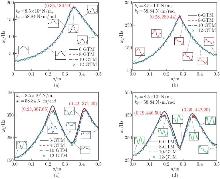
Fig. 2
Variations of the natural frequencies with the constraint location a when v=30 m/s: (a) natural frequency of the first order; (b) natural frequency of the second order; (c) natural frequency of the third order; (d) natural frequency of the fourth order (color online)"
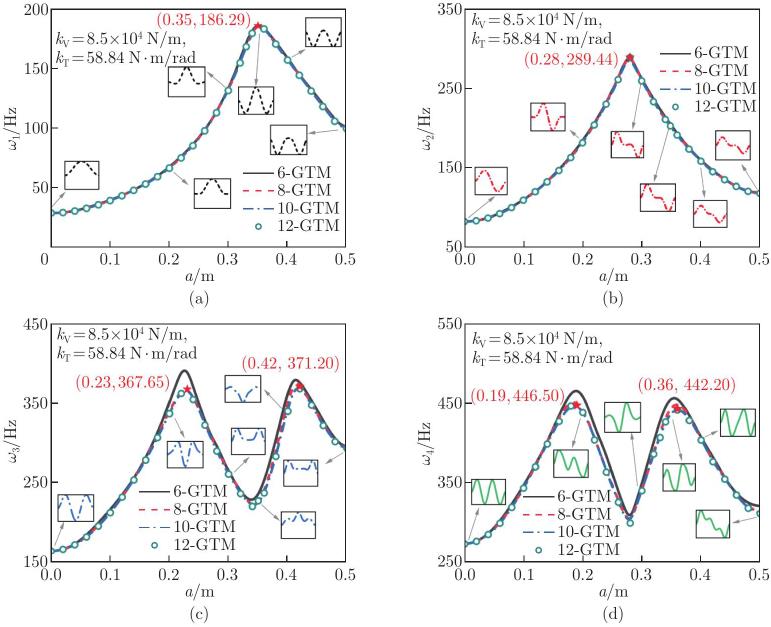
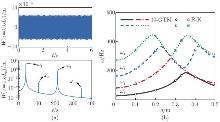
Fig. 3
Validations of the analytical processing for natural frequencies when v=30 m/s: (a) time-domain response of the free vibration when a=0.1Lp and Ω1st=40.1 Hz (top) and its frequency spectrum (bottom); (b) comparison between the analytical results and simulation results (color online)"
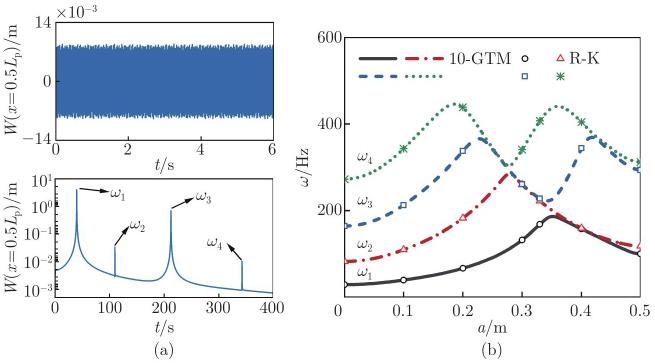
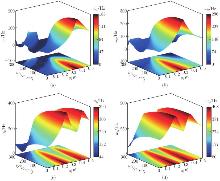
Fig. 4
Variations of the maximum frequencies with the flow speed: (a) natural frequency of the first order; (b) natural frequency of the second order; (c) natural frequency of the third order; (d) natural frequency of the fourth order (color online)"
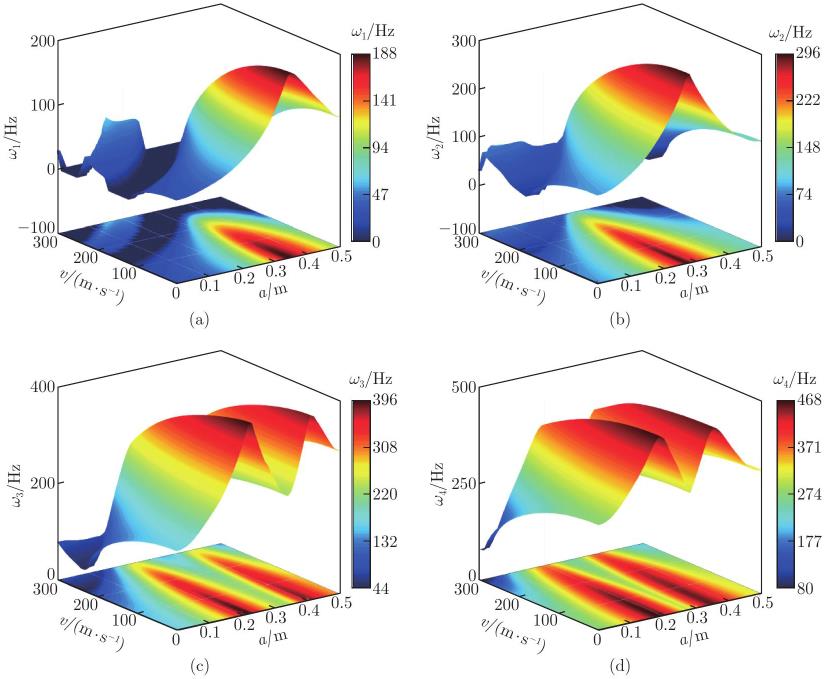
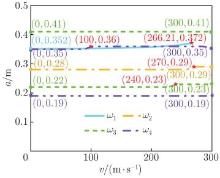
Fig. 5
Sensitivity of the optimal constraint location to the flow speed (color online)"
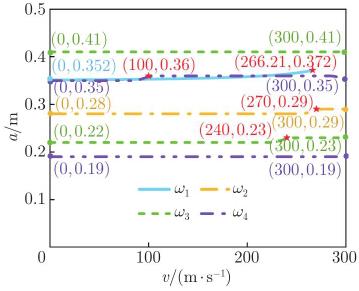
Fig. 6
Critical flow speeds under different constraint locations: (a) variations of the critical speed with the constraint location a; (b) difference between the optimal location for an arbitrarily selected flow speed and the optimal location for the best static stability (color online)"
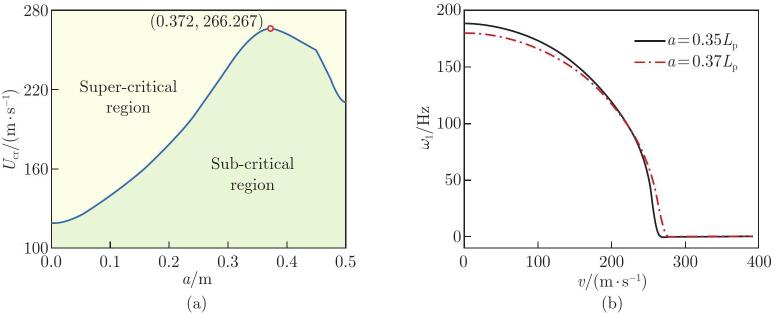
Fig. 7
Verification of the first-order resonance: (a) time-domain response via the simulation when a=0.1Lp and Ω1st=39.73 Hz (top) and its partially enlarged detail (bottom); (b) comparison between the simulation and analytical results (color online)"
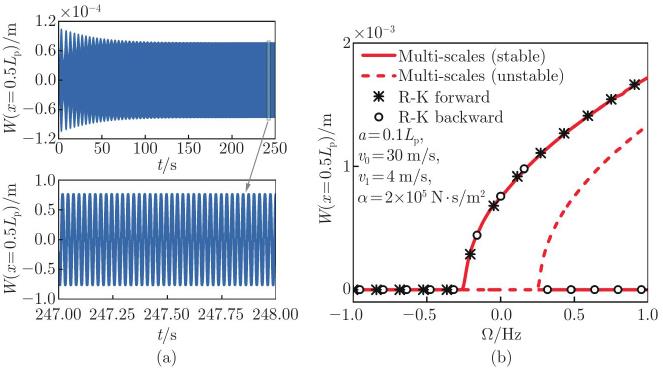
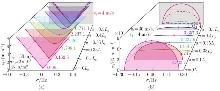
Fig. 8
Key parameters of the parametric resonance: (a) triggering threshold of the pulsating flow speed under different constraint locations; (b) damping threshold under different constraint locations (color online)"
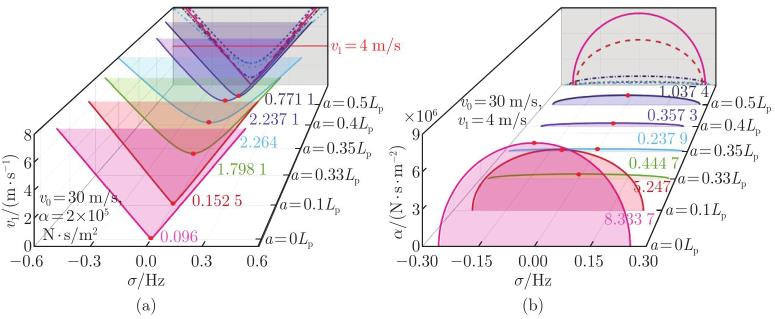
Table 2
Critical pulsating flow speed and damping with different constraint locations"
| a | Critical pulsating flow speed/(m·s-1) (vs. uniform optimization rate) | Critical damping/(N·s·m-2) (vs. uniform optimization rate) |
|---|---|---|
| | 0.096 | |
| | 1.798 1 | |
| | 2.264 (25.91%) | |
| | 0.771 1 | |
| [1] | FAN, J. M., CHANG, X. P., CHEN, B., YANG, Y. K., LUO, Q., and LI, Y. H. Stability optimization of spinning FGM pipes conveying fluid via intermediate elastic supports. Ocean Engineering, 292, 116368 (2024) |
| [2] | HOU, X. Y., LONG, X. H., MENG, G., and LIU, X. B. Nonlinear coupled motions of a pipe-in-pipe system experiencing vortex-induced vibrations. Nonlinear Dynamics, 112, 11829–11850 (2024) |
| [3] | JIN, Y. Y., GUO, X. T., CHEN, Y., and LIANG, F. Synchronous piezoelectric-electromagnetic energy harvesting of a bi-directional functionally graded pipe conveying fluid. Thin-Walled Structures, 221, 114433 (2026) |
| [4] | XIE, W. D., LIANG, Z. L., JIANG, Z. Y., and ZHU, L. X. Dynamic responses of a flexible pipe conveying variable-density fluid and experiencing cross-flow and in-line coupled vortex-induced vibrations. Ocean Engineering, 260, 111811 (2022) |
| [5] | WANG, T., FENG, L. H., ZHANG, L., ZHANG, C. H., and WU, Y. Dynamic characteristics of nonlinear vibration isolator for gas turbine. International Journal of Mechanical System Dynamics, 4, 374–383 (2024) |
| [6] | DAI, W., CARBONI, B., QUARANTA, G., PAN, Y. J., and LACARBONARA, W. Nonlinear response of a multidirectional negative-stiffness isolation system via semirecursive multibody dynamic approach. International Journal of Mechanical System Dynamics, 4, 258–277 (2024) |
| [7] | LIN, Y. H. and TSAI, Y. K. Nonlinear vibrations of Timoshenko pipes conveying fluid. International Journal of Solids and Structures, 34, 2945–2956 (1997) |
| [8] | XU, J. and HUANG, Y. Y. Bifurcations of a cantilevered pipe conveying steady fluid with a terminal nozzle. Acta Mechanica Sinica, 16, 264–272 (2000) |
| [9] | MODARRES-SADEGHI, Y. and PAÏDOUSSIS, M. P. Nonlinear dynamics of extensible fluid-conveying pipes, supported at both ends. Journal of Fluids and Structures, 25, 535–543 (2009) |
| [10] | YAN, H., LI, M. W., and WANG, L. Bifurcation and stability analysis of static equilibrium configuration of curved pipe conveying fluid. European Journal of Mechanics A: Solids, 97, 104813 (2023) |
| [11] | DEHROUYEH-SEMNANI, A. M. Geometrically exact post-buckling and post-flutter of standing cantilevered pipe conveying fluid. Physica D: Nonlinear Phenomena, 472, 134478 (2025) |
| [12] | ZHAO, A. X., GUO, X. T., LIANG, F., and CHEN, Y. Enhanced energy harvesting of a spinning bi-directional piezoelectric pipe conveying fluid. Applied Mathematical Modelling, 155, 116730 (2026) |
| [13] | PAÏDOUSSIS, M. P. and LI, G. X. Pipes conveying fluid: a model dynamical problem. Journal of Fluids and Structures, 7, 137–204 (1993) |
| [14] | GHAYESH, M. H. and PAÏDOUSSIS, M. P. Dynamics of a fluid-conveying cantilevered pipe with inter mediate spring support. 7th International Symposium on Fluid-Structure Interactions, Flow-Sound Interactions, and Flow-Induced Vibration and Noise, 3, 893–902 (2010) |
| [15] | KUIPER, G. L. and METRIKINE, A. V. Experimental investigation of dynamic stability of a cantilever pipe aspirating fluid. Journal of Fluids and Structures, 24, 541–558 (2008) |
| [16] | ZHU, B., GUO, Y., ZHAO, T. Y., and LI, X. Nonlinear dynamics of inclined viscoelastic pipes subjected to pulsatile flow and multi-harmonic excitations. Nonlinear Dynamics, 111, 11823–11849 (2023) |
| [17] | CHAI, Q. D., ZENG, J., MA, H., LI, K., and HAN, Q. K. A dynamic modeling approach for nonlinear vibration analysis of the L-type pipeline system with clamps. Chinese Journal of Aeronautics, 33, 3253–3265 (2020) |
| [18] | HAO, M. Y., DING, H., MAO, X. Y., WEI, S., and CHEN, L. Q. Parametric resonance of pipe conveying pulsating fluid with initial geometric imperfection. Ocean Engineering, 303, 117733 (2024) |
| [19] | JAYARAMAN, K. and NARAYANAN, S. Chaotic oscillations in pipes conveying pulsating fluid. Nonlinear Dynamics, 10, 333–357 (1996) |
| [20] | DAI, H. L., WANG, L., QIAN, Q., and NI, Q. Vortex-induced vibrations of pipes conveying pulsating fluid. Ocean Engineering, 77, 12–22 (2014) |
| [21] | HAYASHI, I. and KANEKO, S. Pressure pulsations in piping system excited by a centrifugal turbomachinery taking the damping characteristics into consideration. Journal of Fluids and Structures, 45, 216–234 (2014) |
| [22] | XIE, W. D., GAO, X. F., and XU, W. H. Stability and nonlinear vibrations of a flexible pipe parametrically excited by an internal varying flow density. Acta Mechanica Sinica, 36, 206–219 (2020) |
| [23] | ZHU, B., ZHANG, X. L., and ZHAO, T. Y. Nonlinear planar and non-planar vibrations of viscoelastic fluid-conveying pipes with external and internal resonances. Journal of Sound and Vibration, 548, 117558 (2023) |
| [24] | WANG, D., HAO, Z. F., PAVLOVSKAIA, E., and WIERCIGROCH, M. Bifurcation analysis of vortex-induced vibration of low-dimensional models of marine risers. Nonlinear Dynamics, 106, 147–167 (2021) |
| [25] | PANDA, L. N. and KAR, R. C. Nonlinear dynamics of a pipe conveying pulsating fluid with combination, principal parametric and internal resonances. Journal of Sound and Vibration, 309, 375–406 (2008) |
| [26] | FAN, X., ZHU, C. G., MAO, X. Y., and DING, H. Adjacent mode resonance of a hydraulic pipe system consisting of parallel pipes coupled at middle points. Applied Mathematics and Mechanics (English Edition), 44(3), 363–380 (2023) https://doi.org/10.1007/s10483-023-2967-6 |
| [27] | JING, J., MAO, X. Y., DING, H., and CHEN, L. Q. Vibration control of pipes by the visco-hyperelastic inertial damper. Nonlinear Dynamics, 113, 27407–27433 (2025) |
| [28] | ZHENG, C., GAO, J., LIU, J. C., and XUE, X. Dynamic performances of a double-layer vibration isolation system: nonlinear modeling and experimental validation. International Journal of Mechanical System Dynamics, 5, 113–128 (2025) |
| [29] | DENG, T. C., DING, H., and CHEN, L. Q. Critical velocity and supercritical natural frequencies of fluid-conveying pipes with retaining clips. International Journal of Mechanical Sciences, 222, 107254 (2022) |
| [30] | LIMARCHENKO, V. O., LIMARCHENKO, O. S., and SAPON, N. N. Dynamics of a pipeline with a liquid on a rotating base. International Applied Mechanics, 56, 351–357 (2020) |
| [31] | DENG, T. C., DING, H., MAO, X. Y., and CHEN, L. Q. Natural vibration of pipes conveying high-velocity fluids with multiple distributed retaining clips. Nonlinear Dynamics, 111, 18819–18836 (2023) |
| [32] | CHEN, W. J., CAO, Y. M., GUO, X. M., MA, H., WEN, B. C., and WANG, B. Semi-analytical dynamic modeling and fluid-structure interaction analysis of L-shaped pipeline. Thin-Walled Structures, 196, 111485 (2024) |
| [33] | GUO, X. M., MA, H., GE, H., CHEN, S., and WEN, B. C. Vibration transmission characteristics analysis of a flexible casing-multiple pipes system. Mechanical Systems and Signal Processing, 217, 111536 (2024) |
| [34] | LIU, M. Y., WANG, Z. C., ZHOU, Z. D., QU, Y. Z., YU, Z. X., WEI, Q., and LU, L. Vibration response of multi-span fluid-conveying pipe with multiple accessories under complex boundary conditions. European Journal of Mechanics A: Solids, 72, 41–56 (2018) |
| [35] | LI, B. H., GAO, H. S., LIU, Y. S., and YUE, Z. F. Transient response analysis of multi-span pipe conveying fluid. Journal of Vibration and Control, 19, 2164–2176 (2013) |
| [36] | CHEE, J., WATSON, P., and WALKER, A. The reliability of pre-deformation to control lateral buckling of pipelines: an evaluation based on observed embedment trends. Ocean Engineering, 314, 119657 (2024) |
| [37] | WANG, Z. C., GAO, P. X., ZHOU, Z. D., TIJSSELING, A. S., QU, Y. Z., YAN, W. J., YUEN, K. V., and CHENG, S. S. A numerically stable flexural dynamics model of complex multi-span fluid-conveying pipes with flexible components and its application to clamp stiffness identification. Thin-Walled Structures, 195, 111488 (2024) |
| [38] | GUO, X. M., XIAO, C. L., GE, H., MA, H., LI, H., SUN, W., and LIU, Z. H. Dynamic modeling and experimental study of a complex fluid-conveying pipeline system with series and parallel structures. Applied Mathematical Modelling, 109, 186–208 (2022) |
| [39] | OKE, W. A., KHULIEF, Y. A., OWOLABI, T. O., and IKUMAPAYI, O. M. Dynamic analysis of a multi-span pipe conveying fluid using wavelet based finite element method. Arabian Journal for Science and Engineering, 49, 14663–14682 (2024) |
| [40] | DOU, B., DING, H., MAO, X. Y., FENG, H. R., and CHEN, L. Q. Modeling and parametric studies of retaining clips on pipes. Mechanical Systems and Signal Processing, 186, 109912 (2023) |
| [41] | CHEN, W. J., CAO, Y. M., CHEN, S., GUO, X. M., MA, H., and WEN, B. C. Semi-analytical dynamic modeling of parallel pipeline considering soft nonlinearity of clamp: a simulation and experimental study. Mechanical Systems and Signal Processing, 201, 110648 (2023) |
| [42] | DOU, B., LI, M., and DING, H. A novel retaining clip for vibration reduction of fluid-conveying pipes by piecewise constraints. Mechanical Systems and Signal Processing, 210, 111159 (2024) |
| [43] | LIANG, F., GAO, A., and YANG, X. D. Dynamical analysis of spinning functionally graded pipes conveying fluid with multiple spans. Applied Mathematical Modelling, 83, 454–469 (2020) |
| [44] | DENG, T. C. and DING, H. Frequency band preservation: pipe design strategy away from resonance. Acta Mechanica Sinica, 40, 523201 (2023) |
| [45] | XU, W. H., JIA, K., MA, Y. X., and SONG, Z. Y. Vortex-induced vibration response features of a submarine multi-span pipeline via towing tank experimental tests. China Ocean Engineering, 37, 175–189 (2023) |
| [46] | LI, X., LI, W. H., SHI, J., LI, Q., and WANG, S. P. Pipelines vibration analysis and control based on clamps’ locations optimization of multi-pump system. Chinese Journal of Aeronautics, 35, 352–366 (2022) |
| [47] | ZHANG, Y. C., SUN, L. Y., ZHANG, Y. C., DU, J. Y., GAO, H. H., SONG, P. G., and YUAN, C. Z. A study of pre- and post-perception comparisons and evaluation of satisfaction and influencing factors among physicians with pediatric and adolescent gynecology subspecialty training in China. Journal of Pediatric and Adolescent Gynecology, 36, 243–245 (2023) |
| [48] | FAN, J. M., LI, Y. H., and YANG, J. Nonlinear forced vibration and synchronization behavior of pipe-in-pipe system. International Journal of Mechanical Sciences, 291-292, 110089 (2025) |
| [49] | LIU, X. D., SUN, W., and GAO, Z. H. Optimization of hoop layouts for reducing vibration amplitude of pipeline system using the semi-analytical model and genetic algorithm. IEEE Access, 8, 224394–224408 (2020) |
| [50] | LIU, J., XIE, C. Y., FU, C., WEI, X. L., and WU, D. K. Hydrochloric acid pretreatment of different types of rice husk ash influence on the properties of cement paste. Materials, 13, 1524 (2020) |
| [51] | LIU, F. M., SUN, W., ZHANG, H., and LYU, S. Dynamic modeling and stress reduction optimization of parallel pipelines based on pipe-solid element coupling. International Journal of Pressure Vessels and Piping, 207, 105107 (2024) |
| [52] | HAO, M. Y., DING, H., JI, J. C., MAO, X. Y., and CHEN, L. Q. Nonlinear vibration and regulation of a double-span functionally graded pipe conveying pulsating flow. Nonlinear Dynamics, 113(18), 24245–24263 (2025) |
| [53] | JING, J., SHAO, Z. H., MAO, X. Y., DING, H., and CHEN, L. Q. Forced resonance of a buckled beam flexibly restrained at the inner point. Engineering Structures, 303, 117444 (2024) |
| [54] | ZHU, B., FENG, J. Z., GUO, Y., and WANG, Y. Q. Exact closed-form solution for buckling and free vibration of pipes conveying fluid with intermediate elastic supports. Journal of Sound and Vibration, 596, 118762 (2025) |
| [55] | MAO, X. Y., JING, J., DING, H., and CHEN, L. Q. Dynamics of axially functionally graded pipes conveying fluid. Nonlinear Dynamics, 111, 11023–11044 (2023) |
| [56] | MAO, X. Y., WU, J. B., ZHANG, J. N., DING, H., and CHEN, L. Q. Dirac method for nonlinear and non-homogenous boundary value problems of plates. Applied Mathematics and Mechanics (English Edition), 45(1), 15–38 (2024) https://doi.org/10.1007/s10483-024-3066-7 |
| [57] | MAO, X. Y., GAO, S. Y., DING, H., and CHEN, L. Q. Static bifurcation and nonlinear vibration of pipes conveying fluid in thermal environment. Ocean Engineering, 278, 114418 (2023) |
| [58] | LI, Z. M., YU, Y., HUANG, S. L., ZHAO, M. R., MA, W. T., YOU, Y. F., WU, J. Y., and YU, J. X. On the buckling propagation and its arrest in buried offshore pipeline crossing strike-slip fault. Ocean Engineering, 287, 115821 (2023) |
| [59] | JING, J., MAO, X. Y., DING, H., and CHEN, L. Q. Parametric resonance of axially functionally graded pipes conveying pulsating fluid. Applied Mathematics and Mechanics (English Edition), 45(2), 239–260 (2024) https://doi.org/10.1007/s10483-024-3083-6 |
| [60] | GAO, S. Y., MAO, X. Y., LUO, Z. B., XU, J. W., DING, H., and CHEN, L. Q. Parametric resonance for pipes conveying fluid in thermal environment. Journal of Sound and Vibration, 568, 118075 (2024) |
| [1] | Runqing CAO, Yixiang HE, Jiachun HU, Huliang DAI, Lin WANG. Offset support design for enhancing the stability of flexible fluid-conveying pipes [J]. Applied Mathematics and Mechanics (English Edition), 2026, 47(7): 1447-1468. |
| [2] | Hufei LI, Sha WEI, Hu DING, Liqun CHEN. Stochastic stability analysis of fluid-conveying pipes under multiplicative Gaussian white noise excitations [J]. Applied Mathematics and Mechanics (English Edition), 2026, 47(4): 741-766. |
| [3] | Jinming FAN, Zhongbiao PU, Jie YANG, Xueping CHANG, Yinghui LI. Orthogonality conditions and analytical response solutions of damped gyroscopic double-beam system: an example of pipe-in-pipe system [J]. Applied Mathematics and Mechanics (English Edition), 2025, 46(5): 927-946. |
| [4] | Tianchi YU, Feng LIANG, Hualin YANG. Vibration energy harvesting of a three-directional functionally graded pipe conveying fluids [J]. Applied Mathematics and Mechanics (English Edition), 2025, 46(5): 795-812. |
| [5] | Guilin SHE, Yujie HE. Nonlinear 1:1 internal resonance in graphene platelet-reinforced fluid-conveying pipes [J]. Applied Mathematics and Mechanics (English Edition), 2025, 46(10): 1903-1920. |
| [6] | Ye TANG, Yuxiang WANG, Hujie ZHANG, Tianzhi YANG, Fantai MENG. Nonlinear dynamics of intricate constrained fluid-conveying pipelines based on the global modal method [J]. Applied Mathematics and Mechanics (English Edition), 2025, 46(10): 1851-1866. |
| [7] | Dali WANG, Tianli JIANG, Huliang DAI, Lin WANG. Non-planar vibration characteristics and buckling behaviors of two fluid-conveying pipes coupled with an intermediate spring [J]. Applied Mathematics and Mechanics (English Edition), 2025, 46(10): 1829-1850. |
| [8] | Donghai HAN, Qi JIA, Yuanyu GAO, Qiduo JIN, Xin FANG, Jihong WEN, Dianlong YU. Local resonance metamaterial-based integrated design for suppressing longitudinal and transverse waves in fluid-conveying pipes [J]. Applied Mathematics and Mechanics (English Edition), 2024, 45(10): 1821-1840. |
| [9] | Yang JIN, Tianzhi YANG. Enhanced vibration suppression and energy harvesting in fluid-conveying pipes [J]. Applied Mathematics and Mechanics (English Edition), 2023, 44(9): 1487-1496. |
| [10] | Hu DING, J. C. JI. Vibration control of fluid-conveying pipes: a state-of-the-art review [J]. Applied Mathematics and Mechanics (English Edition), 2023, 44(9): 1423-1456. |
| [11] | Bo DOU, Hu DING, Xiaoye MAO, Sha WEI, Liqun CHEN. Dynamic modeling of fluid-conveying pipes restrained by a retaining clip [J]. Applied Mathematics and Mechanics (English Edition), 2023, 44(8): 1225-1240. |
| [12] | Jian ZANG, Ronghuan XIAO, Yewei ZHANG, Liqun CHEN. A novel way for vibration control of FGM fluid-conveying pipes via NiTiNOL-steel wire rope [J]. Applied Mathematics and Mechanics (English Edition), 2023, 44(6): 877-896. |
| [13] | Sha WEI, Xiong YAN, Xin FAN, Xiaoye MAO, Hu DING, Liqun CHEN. Vibration of fluid-conveying pipe with nonlinear supports at both ends [J]. Applied Mathematics and Mechanics (English Edition), 2022, 43(6): 845-862. |
| [14] | Runqing CAO, Zhijian WANG, Jian ZANG, Yewei ZHANG. Resonance response of fluid-conveying pipe with asymmetric elastic supports coupled to lever-type nonlinear energy sink [J]. Applied Mathematics and Mechanics (English Edition), 2022, 43(12): 1873-1886. |
| [15] | Tianli JIANG, Huliang DAI, Kun ZHOU, Lin WANG. Nonplanar post-buckling analysis of simply supported pipes conveying fluid with an axially sliding downstream end [J]. Applied Mathematics and Mechanics (English Edition), 2020, 41(1): 15-32. |
| Viewed | ||||||
|
Full text |
|
|||||
|
Abstract |
|
|||||





 Email Alert
 RSS
RSS