Applied Mathematics and Mechanics (English Edition) ›› 2026, Vol. 47 ›› Issue (4): 839-858.doi: https://doi.org/10.1007/s10483-026-3374-8
Previous Articles Next Articles
Fenglian LI†( ), Yin ZHU, Junhui YAN
Received:2025-10-19
Revised:2026-02-09
Published:2026-03-31
Contact:
Fenglian LI, E-mail: lifenglian@126.comSupported by:2010 MSC Number:
Fenglian LI, Yin ZHU, Junhui YAN. Analysis and optimization of bandgaps in plate-type metastructures with different configurations. Applied Mathematics and Mechanics (English Edition), 2026, 47(4): 839-858.
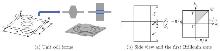
Fig. 1
Diagrams of the unit cell model for the plate-type metastructure (color online)"
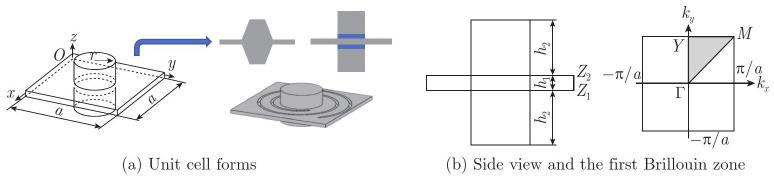
Table 1
Parameters of different elastic materials"
| Matrix | Scatterer | ||||||
|---|---|---|---|---|---|---|---|
| Material | | E/Pa | μ | Material | | E/Pa | μ |
| Polytetrafluoroethylene | 2 200 | | 0.39 | Aurum | 19 500 | | 0.30 |
| Epoxy | 1 180 | | 0.368 | Titanium | 4 500 | | 0.32 |
| Nylon | 1 160 | | 0.31 | Molybdenum | 10 280 | | 0.25 |
| Polyethylene | 960 | | 0.43 | Chromium | 7 190 | | 0.30 |
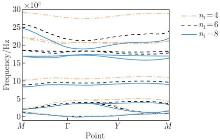
Fig. 2
Influence of different wave numbers on band structures (color online)"
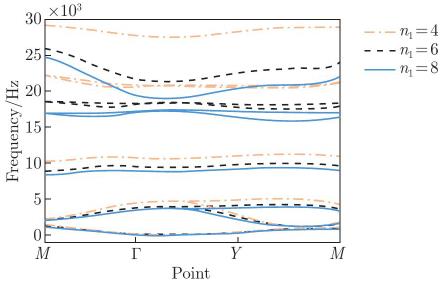
Fig. 3
Comparison of band structures for elastic materials (color online)"
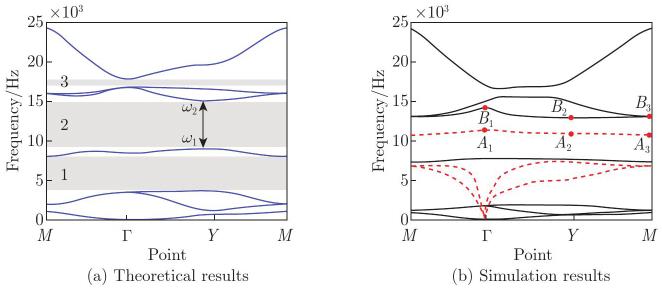
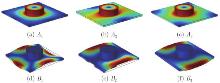
Fig. 4
Vibration modes of corresponding points in the band structure (color online)"
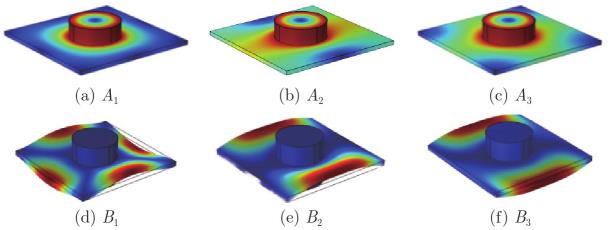
Table 2
Piezoelectric material parameters"
| Material | | | | | |
|---|---|---|---|---|---|
| Matrix (PZT-5J) | 7 400 | | | | |
| Scatterer (PZT-5A) | 7 750 | | | | |
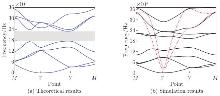
Fig. 5
Comparison of band structures for piezoelectric materials (color online)"
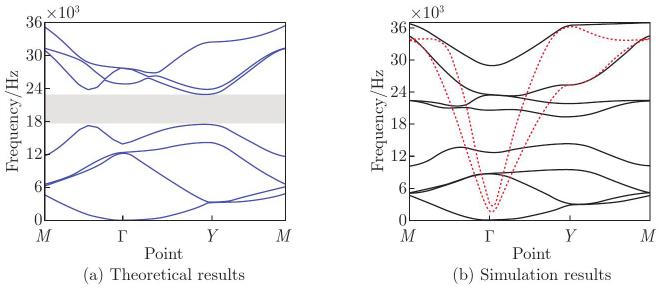
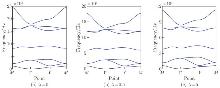
Fig. 6
Band structures for different gradient indices (color online)"
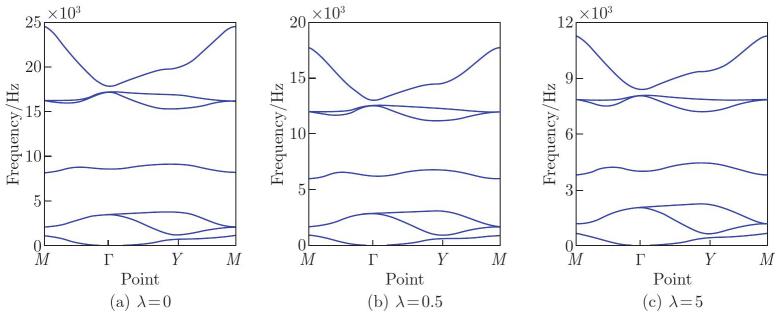
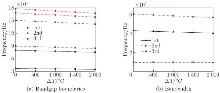
Fig. 7
Effects of temperature variations on the upper and lower boundaries of bandgaps and bandwidth (color online)"
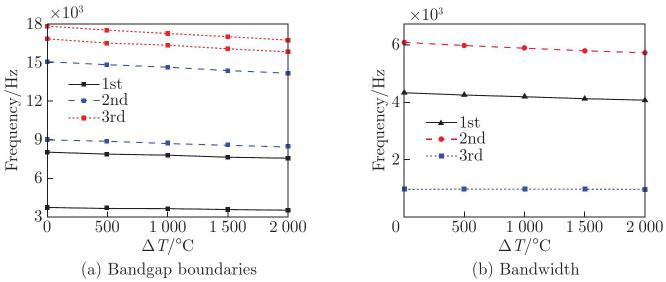
Table 3
Variations of piezoelectric material parameters for the matrix and scatterer"
| Material | Parameter | Group 1 | Group 2 | Group 3 | Group 4 | Group 5 |
|---|---|---|---|---|---|---|
| Scatterer | | | | | | |
| | | | | | | |
| Matrix | | | | | | |
| | | | | | |
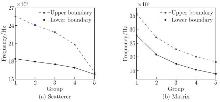
Fig. 8
Effects of piezoelectric constants on the upper and lower boundaries of the bandgap (color online)"
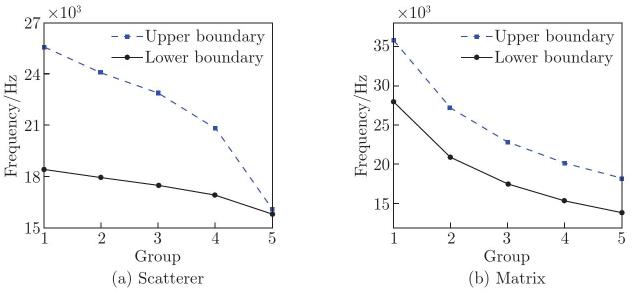
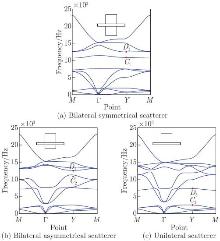
Fig. 9
Effects of geometric asymmetry in plate-type metastructures on bandgaps (color online)"
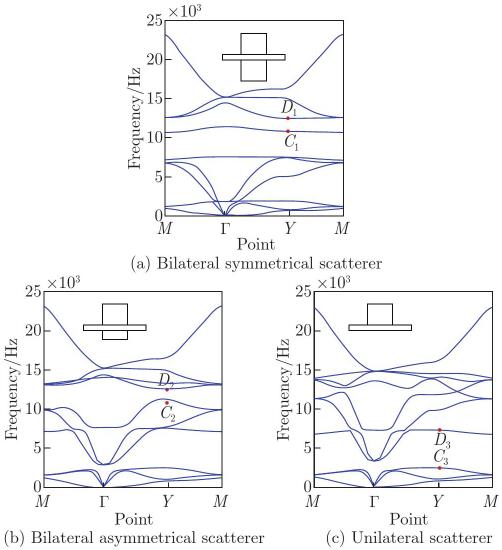
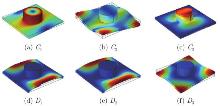
Fig. 10
Vibration modes of the corresponding points in the band structure (color online)"
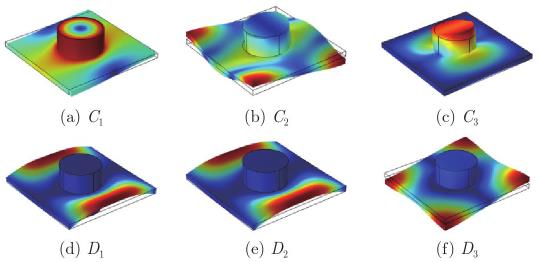
Fig. 11
Effects of material asymmetry in plate-type metastructures on bandgaps (color online)"
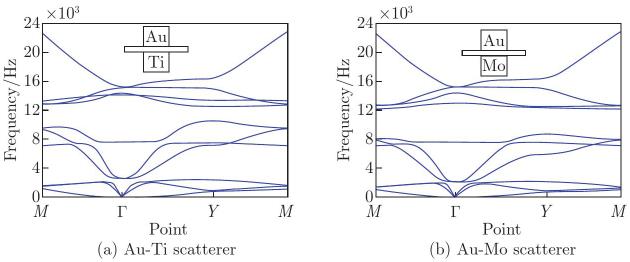
Table 4
Influence of scatterer tapers on the band structures and bandgap coverage"
| Scatter taper | 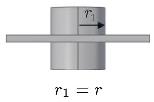 | 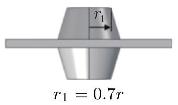 | 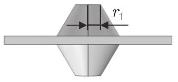 |
| Band structure | 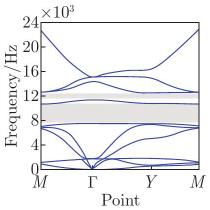 | 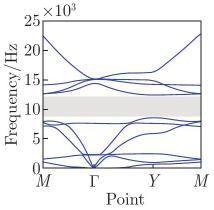 | 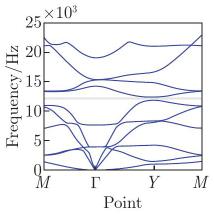 |
| Bandgap coverage/% | 18.05 | 16.48 | 2.07 |
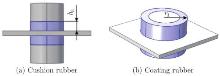
Fig. 12
Schematic diagrams of the rubber layer (color online)"
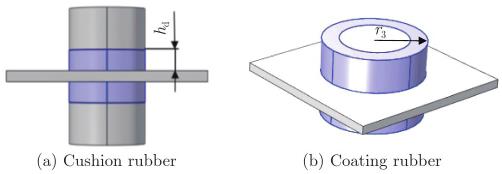
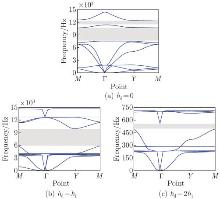
Fig. 13
Band structures of plate-type metastructures with the cushion rubber of different thicknesses (color online)"
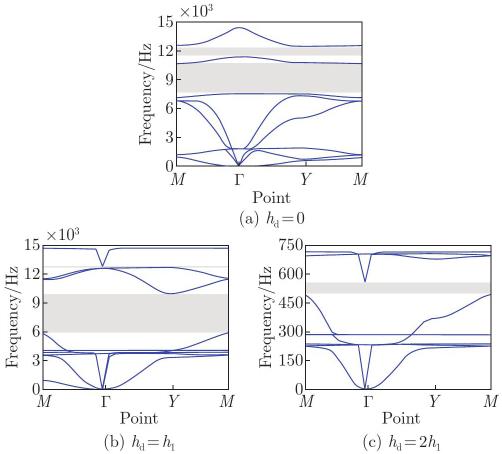
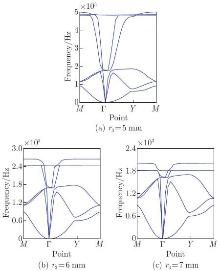
Fig. 14
Effects of the outer diameter of the coating rubber on the band structures (color online)"
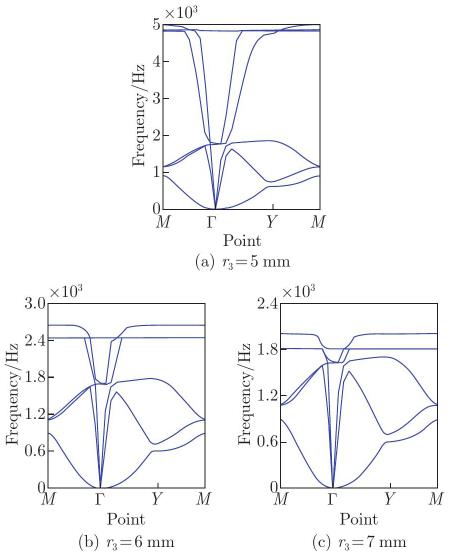
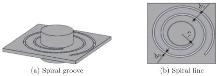
Fig. 15
Schematic diagrams of spiral groove structure (color online)"
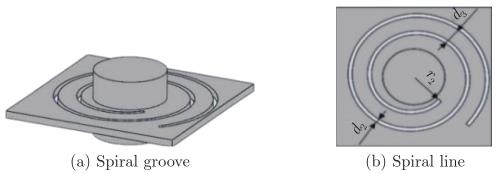
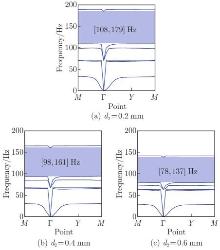
Fig. 16
Effects of the slot width on the bandgap (color online)"
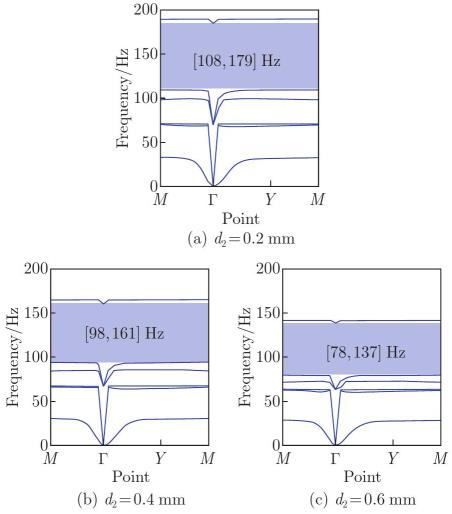
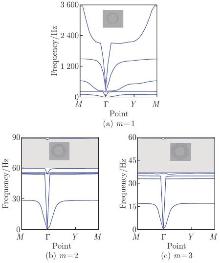
Fig. 17
Effects of the number of spiral turns on band structures (color online)"
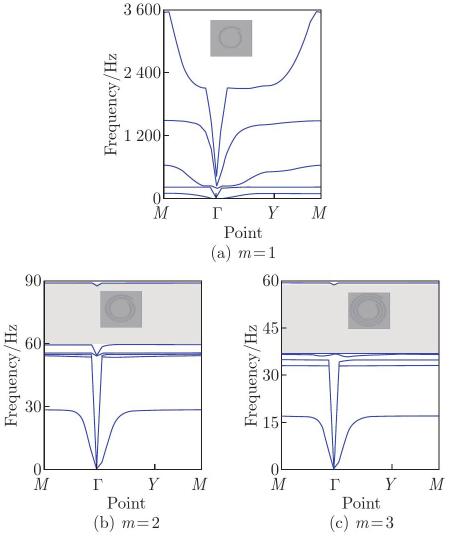
Table 5
GA parameters"
| Parameter | Population size | Generation algebra | Chromosome length | Generation gap | Cross-probability | Probability of mutation |
|---|---|---|---|---|---|---|
| Value | 10 | 50 | 10 | 0.85 | 0.8 | 0.015 |
Fig. 18
Band structures before optimization and after optimizing geometric and material parameters (color online)"
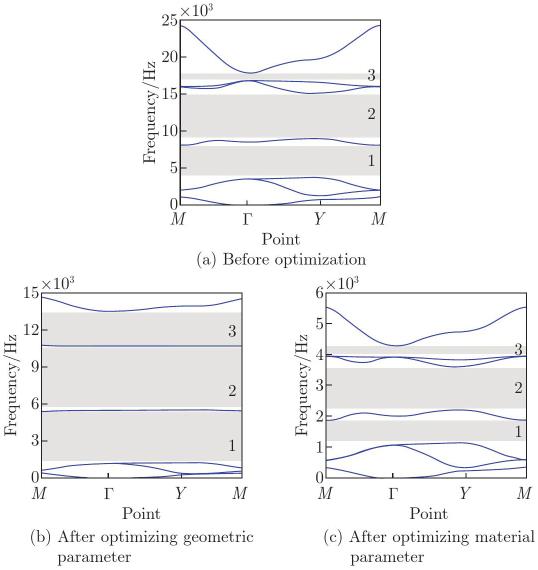
Table 6
Material parameter optimization"
| Parameter | | | E1/Pa | E2/Pa |
|---|---|---|---|---|
| Optimization range | [15 000, 25 000] | [500, 3 000] | | |
| After optimization | 25 000 | 3 000 | | |
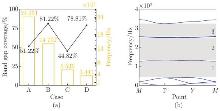
Fig. 19
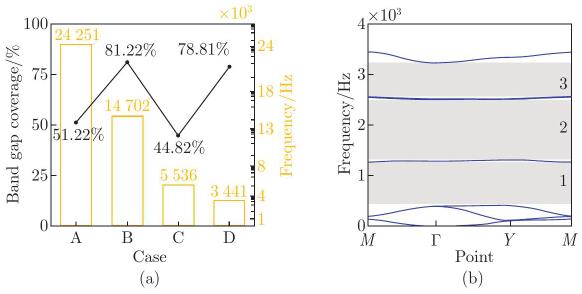
(a) Comparison of optimized results and (b) band structures by double-type optimization (color online)"
| [1] | LI, Y., ZHOU, Q., ZHOU, L., ZHU, L., and GUO, K. Flexural wave band gaps and vibration attenuation characteristics in periodic bi-directionally orthogonal stiffened plates. Ocean Engineering, 178, 95–103 (2019) |
| [2] | KUSHWAHA, M. S., HALEVI, P., DOBRZYNSKI, L., and DJAFARI-ROUHANI, B. Acoustic band structure of periodic elastic composites. Physical Review Letters, 71(13), 2022–2025 (1993) |
| [3] | MIZUKAMI, K., KAWAGUCHI, T., OGI, K., and KOGA, Y. Three-dimensional printing of locally resonant carbon-fiber composite metastructures for attenuation of broadband vibration. Composite Structures, 255, 112949 (2021) |
| [4] | REN, S., CHAI, Y., and YANG, X. Multistable locally resonant elastic metamaterial with tunable anisotropy. Applied Mathematics and Mechanics (English Edition), 46(9), 1663–1678 (2025)https://doi.org/10.1007/s10483-025-3289-8 |
| [5] | BAO, Y., WEI, Z., JIA, Z., WANG, D., ZHANG, X., and KANG, Z. Mechanical metamaterial design with the customized low-frequency bandgap and negative Poisson’s ratio via topology optimization. Extreme Mechanics Letters, 67, 102124 (2024) |
| [6] | ZHANG, W., YANG, D., and GUO, X. Low-frequency vibration suppression of meta-beam withsoftening nonlinearity. Applied Mathematics and Mechanics (English Edition), 46(6), 1011–1028 (2025)https://doi.org/10.1007/s10483-025-3258-9 |
| [7] | AMARAL, D. R., ICHCHOU, M. N., KOKOWSKI, P., FOSSAT, P., and SALVIA, M. Lightweight gearbox housing with enhanced vibro-acoustic behavior through the use of locally resonant metamaterials. Applied Acoustics, 210, 109435 (2023) |
| [8] | TREMATERRA, A., BEVILACQUA, A., and IANNACE, G. Noise control in air mechanical ventilation systems with three-dimensional metamaterials. Applied Science, 13, 1650 (2023) |
| [9] | YANG, R., ZHANG, X., and WANG, G. A hybrid acoustic cloaking based on binary splitting metasurfaces and near-zero-index metamaterials. Applied Physics Letters, 120, 021603 (2022) |
| [10] | DONG, H., ZHAO, S., XIANG, P., WANG, B., ZHANG, C., CHENG, L., WANG, Y., and FANG, D. Porous-solid metaconverters for broadband underwater sound absorption and insulation. Physical Review Applied, 19, 044074 (2023) |
| [11] | WEI, Z., WEI, P., XU, C., and GUO, X. Dispersion, attenuation, and bandgap of in-plane coupled Bloch waves in piezoelectric semiconductor phononic crystal with PN junction. Applied Mathematics and Mechanics (English Edition), 46(5), 813–830 (2025)https://doi.org/10.1007/s10483-025-3252-7 |
| [12] | DENG, Z., ZHANG, B., ZHANG, K., and PANG, F. The coupled band gap of the double panel with periodic attached spring-mass structure. Journal of Vibration Engineering & Technologies, 12(4), 6273–6295 (2024) |
| [13] | YANG, F., MA, Z., and GUO, X. Bandgap characteristics analysis and graded design of a novel metamaterial for flexural wave suppression. Applied Mathematics and Mechanics (English Edition), 46(1), 1–24 (2025)https://doi.org/10.1007/s10483-025-3204-7 |
| [14] | WU, Z., LI, F., and WANG, Y. Study on vibration characteristics in periodic plate structures using the spectral element method. Acta Mechanica, 224(5), 1089–1101 (2013) |
| [15] | MI, Y., YANG, H., LEI, B., and ZHENG, H. A variational method for band-gap analysis of metamaterial plates with local resonator (in Chinese). Acta Acustica, 45(3), 104–414 (2020) |
| [16] | DING, Q., ZOU, P., ZHANG, J., and CHEN, M. Tunability of resonator with pre-compressed springs on thermo-magneto-mechanical coupling band gaps of locally resonant phononic crystal nanobeam with surface effects. Mechanical Systems and Signal Processing, 176, 109184 (2022) |
| [17] | LEI, L., ZHANG, S., ZHENG, Z., and MA, M. Theoretical calculation and band gap characteristics of outward hierarchical local resonance Euler beam. Applied Physics A: Materials Science & Processing, 130(7), 509 (2024) |
| [18] | HOSSEINI, S., SLADEK, J., SLADEK, V., and ZHANG, C. Effects of the strain gradients on the band structures of the elastic waves propagating in 1D phononic crystals: an analytical approach. Thin-Walled Structures, 194, 111316 (2024) |
| [19] | DENG, T., ZHAO, L., and JIN, F. Dual-functional perforated metamaterial plate for amplified energy harvesting of both acoustic and flexural waves. Thin-Walled Structures, 197, 111615 (2024) |
| [20] | OSTA, A. and MOHAMMED, A. Wave propagation investigation of a porous sandwich FG plate under hygrothermal environments via a new first-order shear deformation theory. Steel and Composite Structures, 43(1), 117–127 (2023) |
| [21] | ASHRAF, M. and HELA, D. Hygrothermal forced vibration of a viscoelastic laminated plate with magnetostrictive actuators resting on viscoelastic foundations. International Journal of Mechanics and Materials in Design, 17, 301–320 (2021) |
| [22] | LI, Y., LIU, B., and SHI, H. Vibro-acoustic response and sound transmission loss of sandwich plates with tunable Poisson ratio core in a hygrothermal environment. European Journal of Mechanics A-Solids, 106, 105281 (2024) |
| [23] | ZHANG, Y., PAN, Y., HAN, D., JIANG, W., JIANG, W., ZHANG, X., TENG, X., NI, X., and REN, X. A hybrid design for bending and stretching dominated metamaterial with tailorable thermal expansion. Composite Structures, 323, 117474 (2023) |
| [24] | LI, F., HAO, Y., HAO, Y., and LV, M. Analysis of free vibration and acoustic responses of FG-CNTRC sandwich plates with different piezoelectric material lay-up layers. Journal of Vibration Engineering & Technologies, 13(2), 139–156 (2025) |
| [25] | SCHIMIDT, C., OLIVEIRA, L., and MARQUI, C. Vibro-acoustic performance of graded piezoelectric metamaterial plates. Composite Structures, 327, 117656 (2024) |
| [26] | LI, J., XUE, Y., and LI, F. Active band gap control of magnetorheological meta-plate using frequency feedback control law. Journal of Sound and Vibration, 567, 118076 (2023) |
| [27] | SONG, Y. and SHEN, Y. A smoothly tunable shape memory metamaterial with adaptive bandgaps for ultra-wide frequency spectrum vibration control. Smart Materials and Structures, 31, 055019 (2022) |
| [28] | DONG, H., ZHAO, S., WANG, Y., and ZHANG, C. Topology optimization of anisotropic broadband double-negative elastic metamaterials. Journal of the Mechanics and Physics of Solids, 105, 54–80 (2017) |
| [29] | GAO, H., QU, Y., and MENG, G. Topology optimization and wave propagation of three-dimensional phononic crystals. Journal of Vibration and Acoustics, 145(1), 11002 (2022) |
| [30] | WU, Q., HE, J., CHEN, W., LI, Q., and LIU, S. Topology optimization of phononic crystal with prescribed band gaps. Computer Methods in Applied Mechanics and Engineering, 412, 116071 (2023) |
| [31] | XIN, Y., CAI, P., LI, P., QUN, Y., SUN, Y., DING, Q., CHENG, S., and ZHAO, Q. Comprehensive analysis of band gap of phononic crystal structure and objective optimization based on genetic algorithm. Physica B: Condensed Matter, 667, 415157 (2023) |
| [32] | LI, F., WANG, Y., and ZOU, Y. Optimization for sound insulation of a sandwich plate with a corrugation and auxetic honeycomb hybrid core. Applied Mathematics and Mechanics (English Edition), 45(9), 1595–1612 (2024)https://doi.org/10.1007/s10483-024-3139-6 |
| [33] | YIN, S., HUANG, J., LIU, S., GU, S., BUI, T. Q., and ZHAO, Z. Isogeometric topology optimization for maximizing band gap of two-dimensional phononic crystal structures. Applied Mathematical Modelling, 137, 115702 (2025) |
| [34] | YU, F., HUO, Y., DING, Q., WANG, C., YAO, J., HE, Z., SUN, Y., GAO, H., and SUN, A. Structural design and band gap properties of 3D star-shaped single-phase metamaterials. Journal of Vibration Engineering & Technologies, 10(3), 863–871 (2022) |
| [35] | HAO, Y., XU, Y., and XIA, H. Band gap analysis of a locally resonant meta-beam with a low-frequency, stiffness-adjustable buckled beam-spring-mass resonator. Chinese Journal of Physics, 96, 1047–1064 (2025) |
| [36] | XIAO, P., MIAO, L., ZHENG, H., and LEI, L. Band gap characteristics of new composite multiple locally resonant phononic crystal metamaterial. Journal of Physics: Condensed Matter, 36(19), 195702 (2024) |
| [37] | JIA, Q., YU, D., HAN, D., and WEN, J. Lightweight multifunctional metamaterial with low-frequency vibroacoustic reduction and load-bearing performances. Applied Mathematics and Mechanics (English Edition), 46(3), 403–422 (2025)https://doi.org/10.1007/s10483-025-3231-6 |
| [38] | ALAM, Z. and SHARMA, A. K. Functionally graded soft dielectric elastomer phononic crystals: finite deformation, electro-elastic longitudinal waves, and band gaps tunability via electro-mechanical loading. International Journal of Applied Mechanics, 14(6), 2250050 (2022) |
| [39] | CHENG, S., LIANG, J., DING, Q., YAN, Q., SUN, Y., XIN, Y., and WANG, L. Analysis of the band gap characteristics of a new type of three-dimensional single phase phononic crystal. Wave Motion, 122, 103195 (2023) |
| [40] | LIU, H., JIANG, Y., XU, W., WANG, W., and YU, X. Band gap characteristics of multi-functional lattice metamaterials with adjustable thermal expansion and Poisson’s ratio. Physica Scripta, 98(7), 75914 (2023) |
| [1] | Guanghui HAN, Xinyu LIAN, Jixia YI, Huaxia DENG, Mengchao MA, Xiang ZHONG, Xinglong GONG. Structural optimization for dynamic stability of a plane-grating monochromator [J]. Applied Mathematics and Mechanics (English Edition), 2026, 47(8): 1789-1810. |
| [2] | Shuo ZHANG, Ning GUO, Chao XU. Theoretical modeling of nonlinear rotational stiffness for missile radial countersunk screw lap joints [J]. Applied Mathematics and Mechanics (English Edition), 2026, 47(7): 1625-1646. |
| [3] | M. H. BAE, J. H. PARK, C. S. PARK, H. LEE, H. M. SEUNG. Inherent nonreciprocity in double-alternatingnonlinear metamaterial [J]. Applied Mathematics and Mechanics (English Edition), 2026, 47(7): 1487-1510. |
| [4] | Qinfeng DI, Dakun LUO, Heyuan YANG, Tianxin LI, Wenchang WANG, Feng CHEN, H. ZHANG. AI-driven triple-optimization based on ant colony optimization for minimizing deformation energy in three-dimensional analysis of bottom-hole assemblies [J]. Applied Mathematics and Mechanics (English Edition), 2026, 47(6): 1417-1432. |
| [5] | N. VO, T. LE-DUC, H. TANG, H. NGUYEN-XUAN, S. H. LEE, J. H. LEE. Solving high-dimensional global optimization problems via solution space restructuring with neural network [J]. Applied Mathematics and Mechanics (English Edition), 2026, 47(6): 1383-1400. |
| [6] | T. T. BANH, E. DAMTSAS, H. P. BAN, M. HERRMANN, D. LEE. A novel multi-material topology design automation algorithm for a customized MATLAB and Rhino-Grasshopper plugin with a generalized solid isotropic material with penalization [J]. Applied Mathematics and Mechanics (English Edition), 2026, 47(6): 1363-1382. |
| [7] | T. T. BANH, N. T. Y. NGUYEN, H. P. BAN, D. LEE. Structural optimization of stress-bearing structures of nearly incompressible problems under design-dependent pressure loads [J]. Applied Mathematics and Mechanics (English Edition), 2026, 47(4): 905-926. |
| [8] | Zhigang ZHAO, Jun GAO, Feng LI, H. AFSHARI. Frequency and mass optimization for an axially functionally graded GNP-reinforced conical shell with variable thickness [J]. Applied Mathematics and Mechanics (English Edition), 2026, 47(4): 859-882. |
| [9] | Fanyu ZHANG, Yulai ZHAO, Qingyu ZHU, Xiangyu MENG, Junzhe LIN, Qingkai HAN. Study on the influence of internal bearing parameters on the critical speed and vibration behavior of the rotor-bearing coupled system [J]. Applied Mathematics and Mechanics (English Edition), 2026, 47(3): 653-674. |
| [10] | Dongxu GUO, Xiaolong ZHANG, Ruilan TIAN, Xiangyang LI, Minghao WANG. Synergistic design of ultra-wide low-frequency continuous bandgap metastructure for audible noise attenuation [J]. Applied Mathematics and Mechanics (English Edition), 2026, 47(3): 473-496. |
| [11] | Qian GENG, Xing ZHOU, Mengyang WANG, Xiongwei YANG, Zhushan SHAO, Yueming LI. Thermal stability design for flexural wave bandgap of metamaterial plates with perforated and pre-curved patterns [J]. Applied Mathematics and Mechanics (English Edition), 2026, 47(3): 443-472. |
| [12] | F. ESLAMI, R. KAMALI. A hybrid method based on particle swarm optimization and machine learning algorithm for predicting droplet diameter in a microfluidic T-junction [J]. Applied Mathematics and Mechanics (English Edition), 2026, 47(1): 203-214. |
| [13] | M. N. NGUYEN, S. JUNG, D. LEE. Multi-material topology optimization under stress constraints of respective materials in multi-physics structures [J]. Applied Mathematics and Mechanics (English Edition), 2026, 47(1): 115-134. |
| [14] | Siyu REN, Yijun CHAI, Xiongwei YANG. Multistable locally resonant elastic metamaterial with tunable anisotropy [J]. Applied Mathematics and Mechanics (English Edition), 2025, 46(9): 1663-1678. |
| [15] | S. CHOWDHURY, S. ADHIKARI. Structural vibration control using nonlinear damping amplifier friction vibration absorbers [J]. Applied Mathematics and Mechanics (English Edition), 2025, 46(5): 965-988. |
| Viewed | ||||||
|
Full text |
|
|||||
|
Abstract |
|
|||||





 Email Alert
 RSS
RSS