Applied Mathematics and Mechanics (English Edition) ›› 2026, Vol. 47 ›› Issue (7): 1487-1510.doi: https://doi.org/10.1007/s10483-026-3404-6
Previous Articles Next Articles
M. H. BAE1, J. H. PARK1, C. S. PARK1,2, H. LEE3, H. M. SEUNG1,2( )
)
Received:2026-01-27
Revised:2026-04-27
Published:2026-06-30
Contact:
H. M. SEUNG, E-mail: shm@kriss.re.krSupported by:2010 MSC Number:
M. H. BAE, J. H. PARK, C. S. PARK, H. LEE, H. M. SEUNG. Inherent nonreciprocity in double-alternatingnonlinear metamaterial. Applied Mathematics and Mechanics (English Edition), 2026, 47(7): 1487-1510.

Fig. 1
(a) Linear reciprocal wave propagation in a linear asymmetric medium, where the internal mode distribution maintains a constant ratio between the odd and even amplitudes for both propagation directions despite the structural symmetry; (b) nonlinear nonreciprocal wave propagation in a nonlinear asymmetric medium, where direction-dependent wave transmission exists because of the change of the internal mode distribution, owing to the amplitude dependence (color online)"
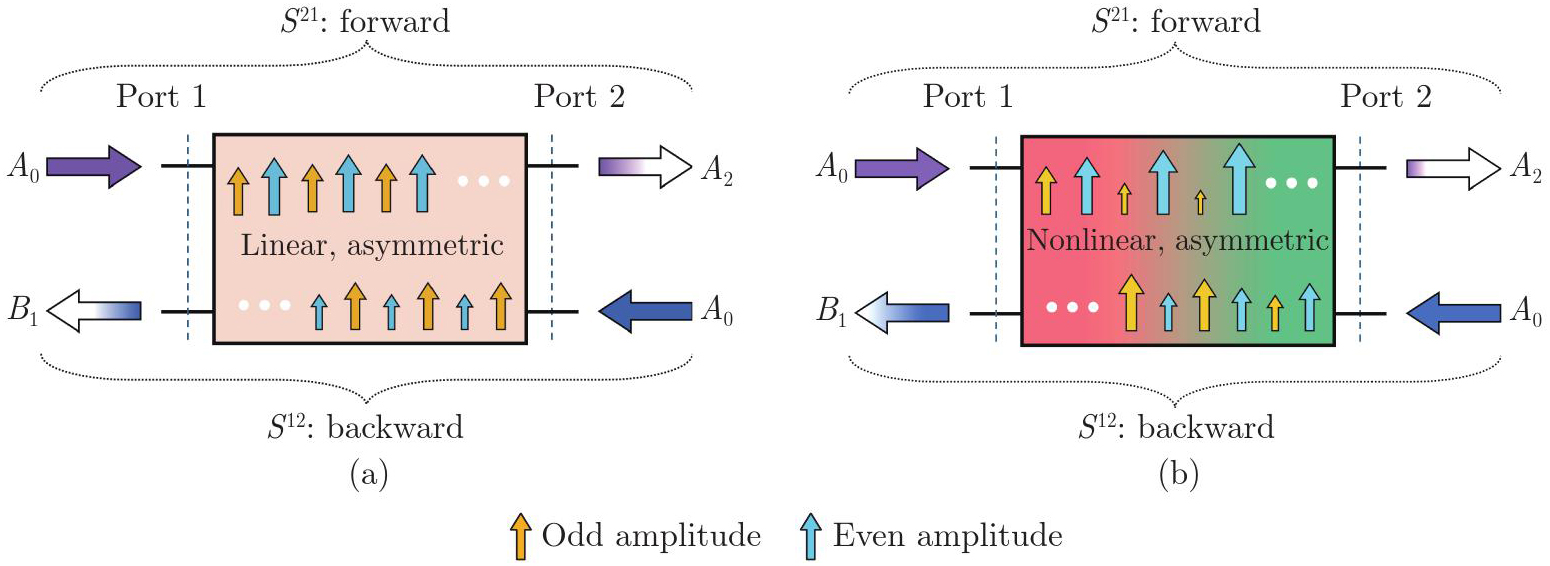
Fig. 2
(a) Configured system with m1=1.20, m2=0.80, and k=1.00. (b) Three representative nonlinear stiffness configurations: Case I, hardening-hardening (Γ1=0.50, Γ2=1.00); Case II, softening-softening (Γ1=−0.50, Γ2=−1.00); Case III, hardening-softening (Γ1=1.00, Γ2=−1.00) (color online)"
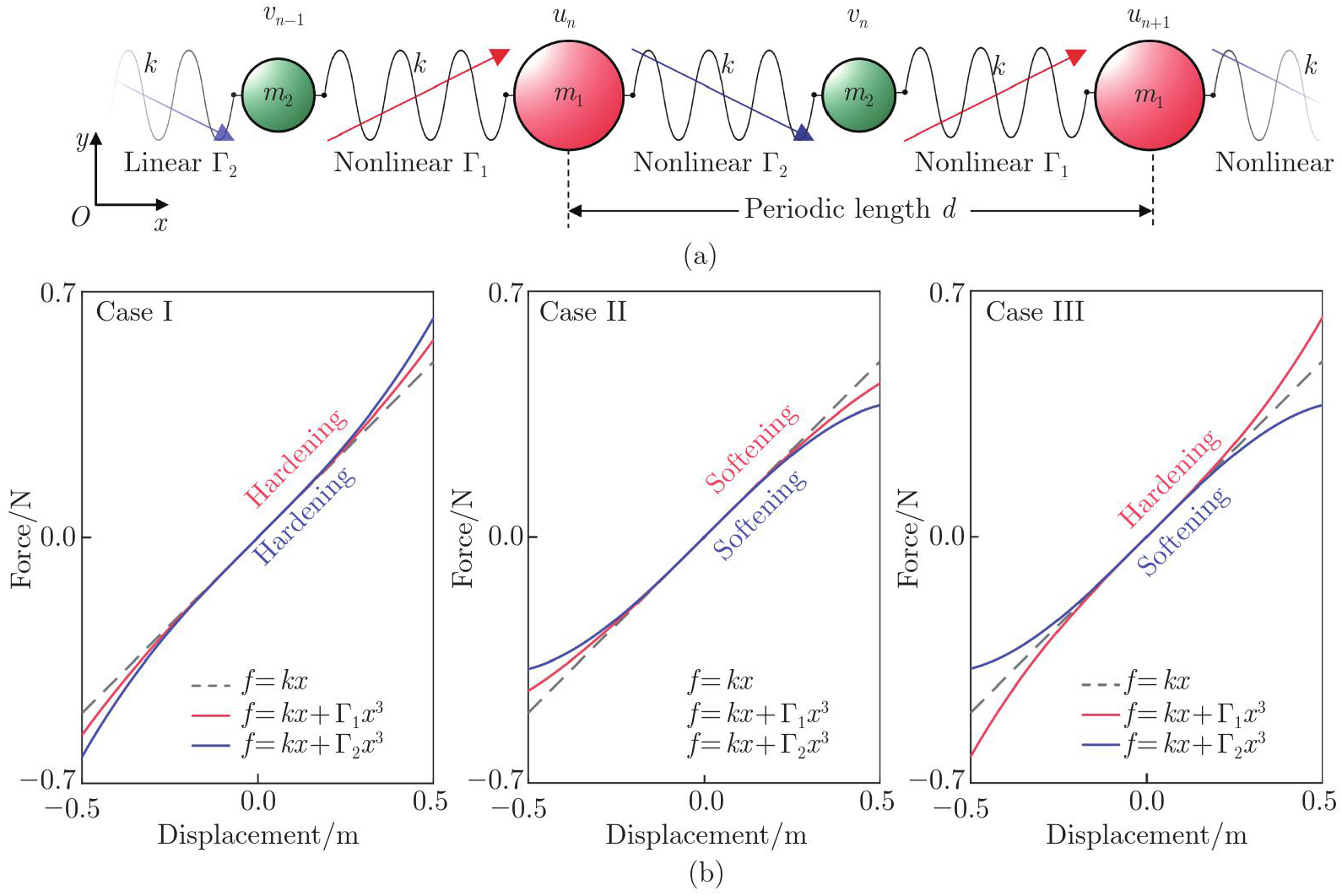
Fig. 3
Linear zero-order solutions obtained from the eigen analysis: (a) acoustic and optical dispersion relation derived from the eigenvalue E(0) of the zeroth-order system with alternating masses; (b) amplitude ratios of the corresponding acoustic and optical modes along the wavevector q (color online)"
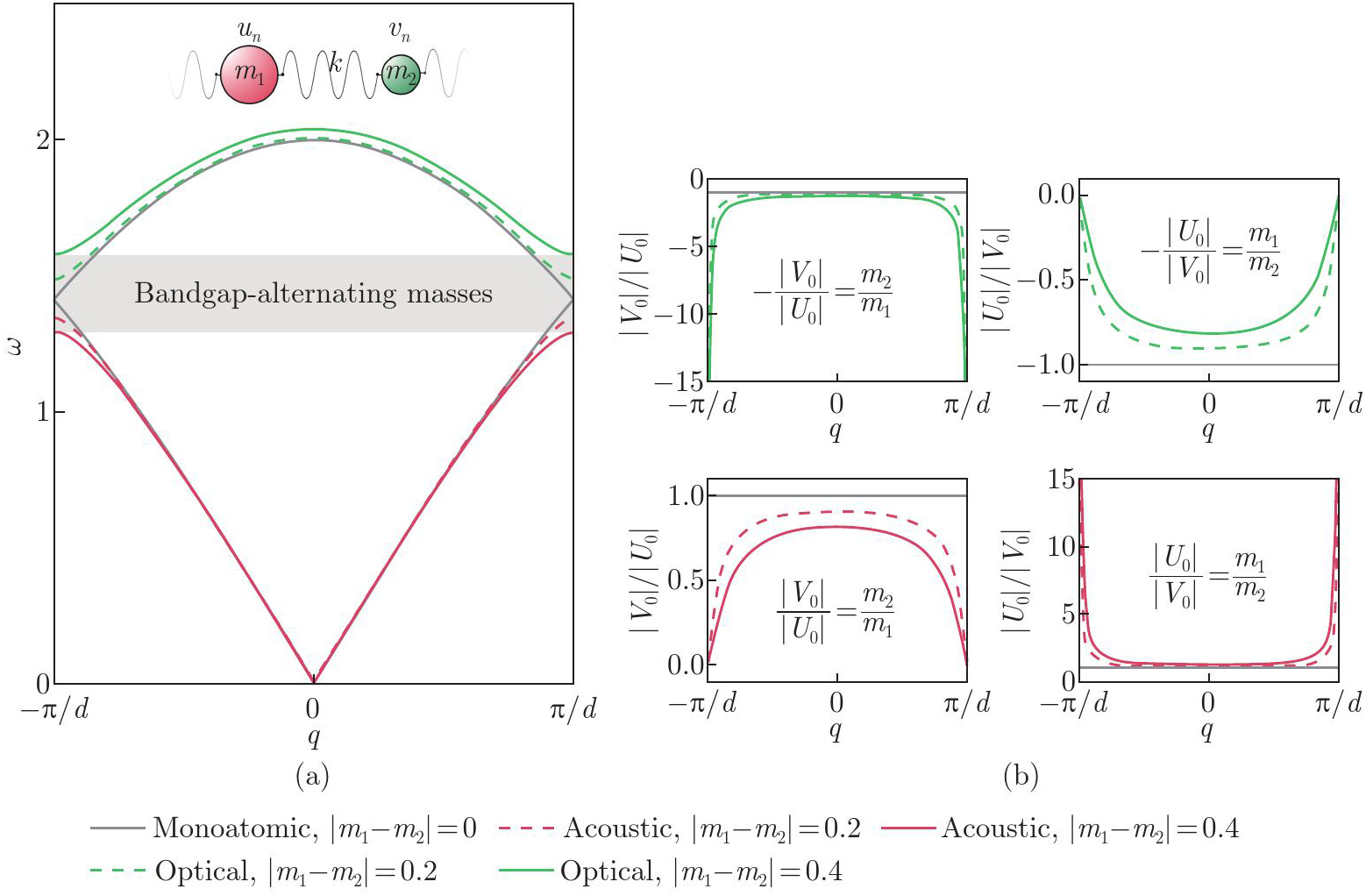
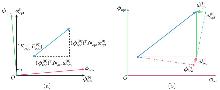
Fig. 4
Geometric interpretation of capturing dispersion shift with perturbed mode shapes: (a) projection of the nonlinear response onto the unperturbed linear eigenvector basis (ϕaco(0), ϕopt(0)), which captures only eigenvalue shifts while neglecting the rotation of basis from the unperturbed linear eigenvector basis; (b) proposed mode alignment procedure that updates the basis to the perturbed eigenvectors (ϕaco, ϕopt), thereby reconstructing the corrected eigenvalues and accurately capturing the full nonlinear dispersion shift (color online)"

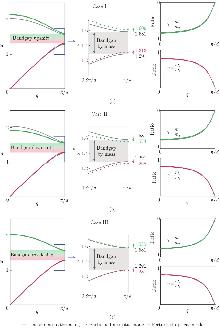
Fig. 5
Bandgap shifts in double-alternating nonlinear metamaterial for the three representative cases under an incident amplitude A0 = 0.25 m: (a) Case I, acoustic branch 1.291→1.313, optical branch 1.581→1.609; (b) Case II, acoustic branch 1.291→1.268, optical branch 1.581→1.553; (c) Case III: acoustic branch 1.291→1.287, optical branch 1.581→1.585 (color online)"
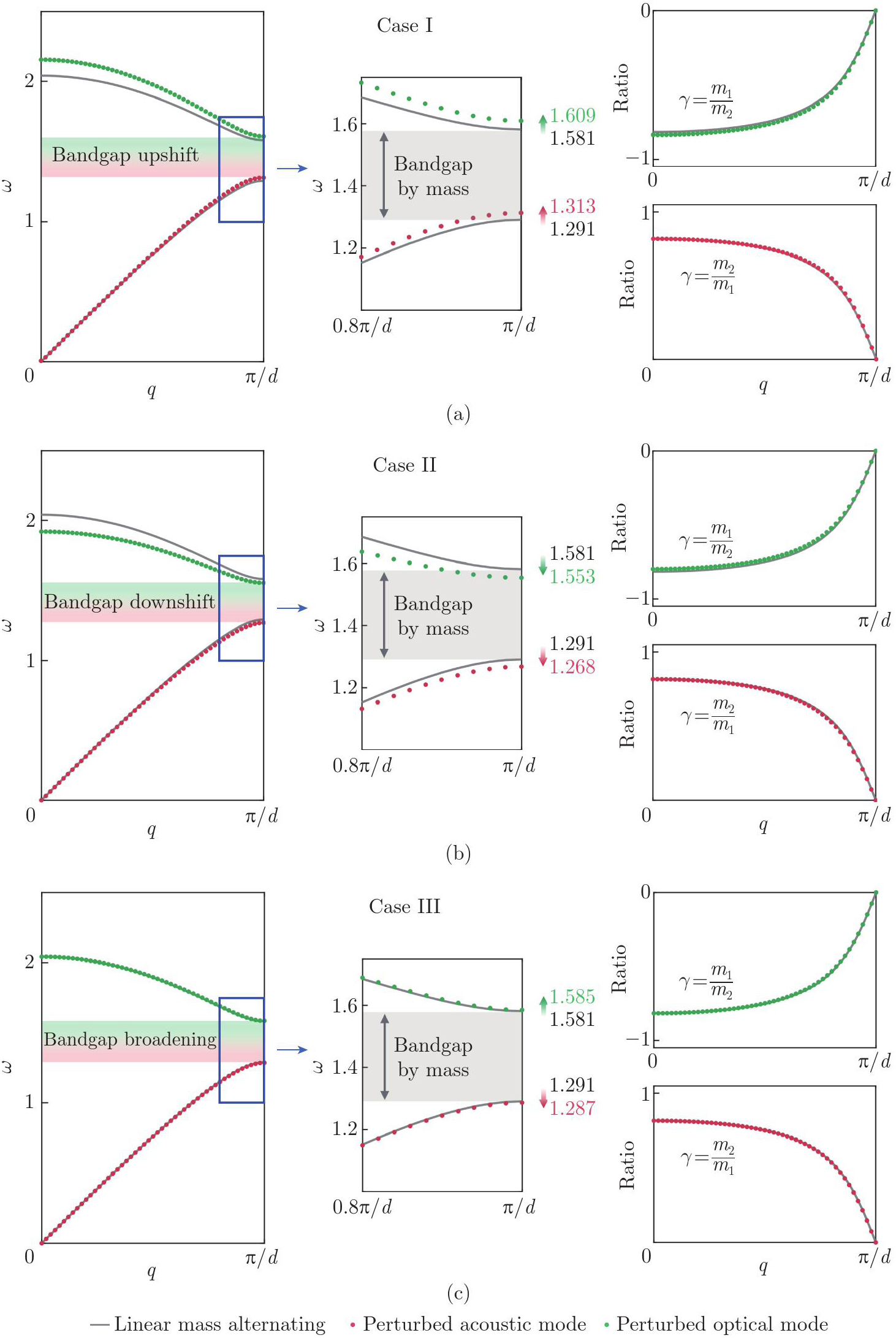

Fig. 6
Bandgap shifts in double-alternating nonlinear metamaterial for the three representative cases under an incident amplitude A0 = 0.40 m: (a) Case I, acoustic branch 1.291→1.346, optical branch 1.581→1.652; (b) Case II, acoustic branch 1.291→1.230, optical branch 1.581→1.510; (c) Case III: acoustic branch 1.291→1.263, optical branch 1.581→1.604 (color online)"
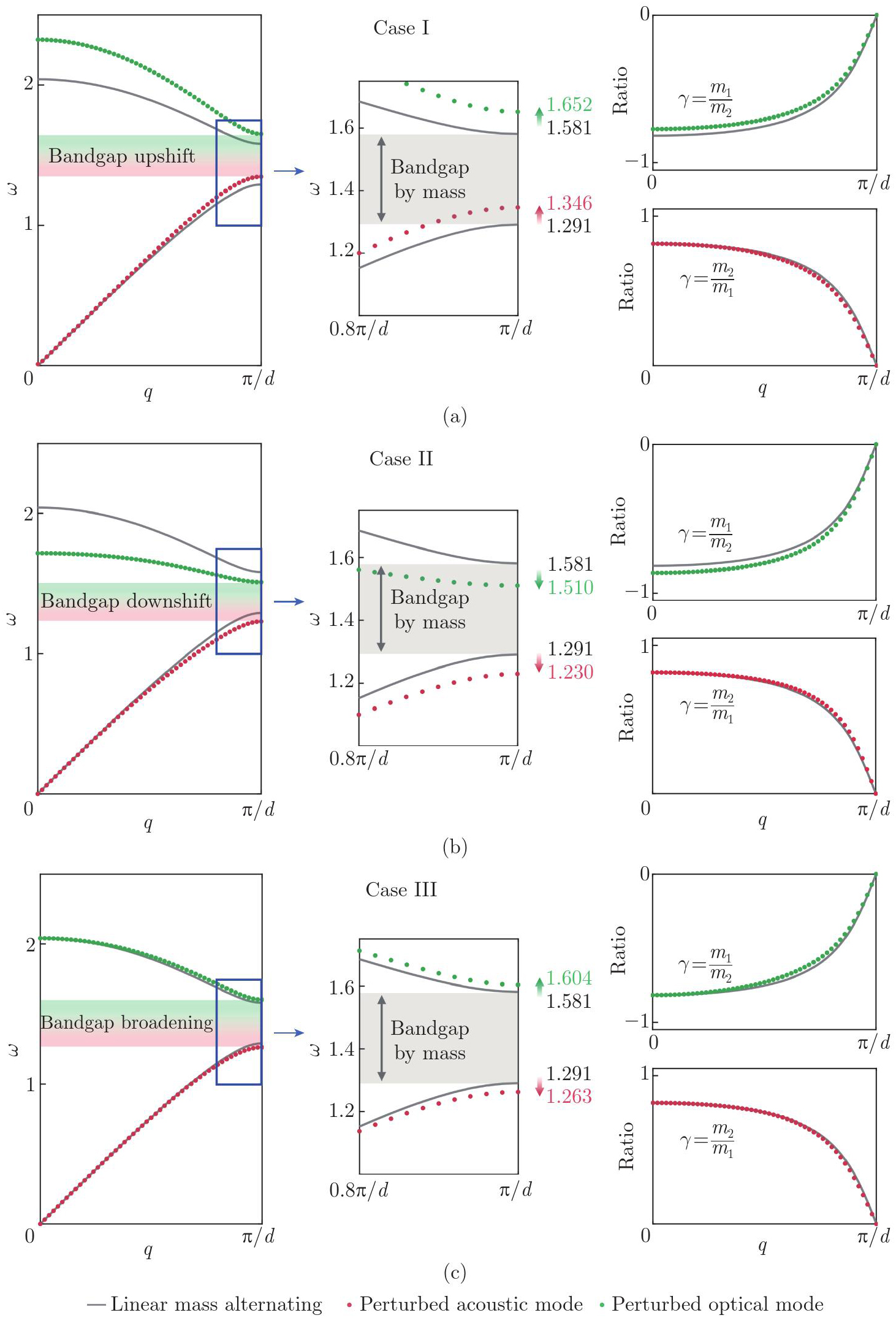
Fig. 7
Inherent nonreciprocal dispersion in the double-alternating nonlinear metamaterial: (a) forward and backward boundary configurations under an identical excitation amplitude of A0 = 0.100 m; direction-dependent dispersion relations for (b) Case I: alternating hardening, (c) Case II: alternating softening, and (d) Case III: mixed hardening-softening, where the forward (purple dotted markers) and backward (blue dotted markers) branches exhibit pronounced asymmetry near the bandgap, demonstrating inherent nonreciprocity (color online)"
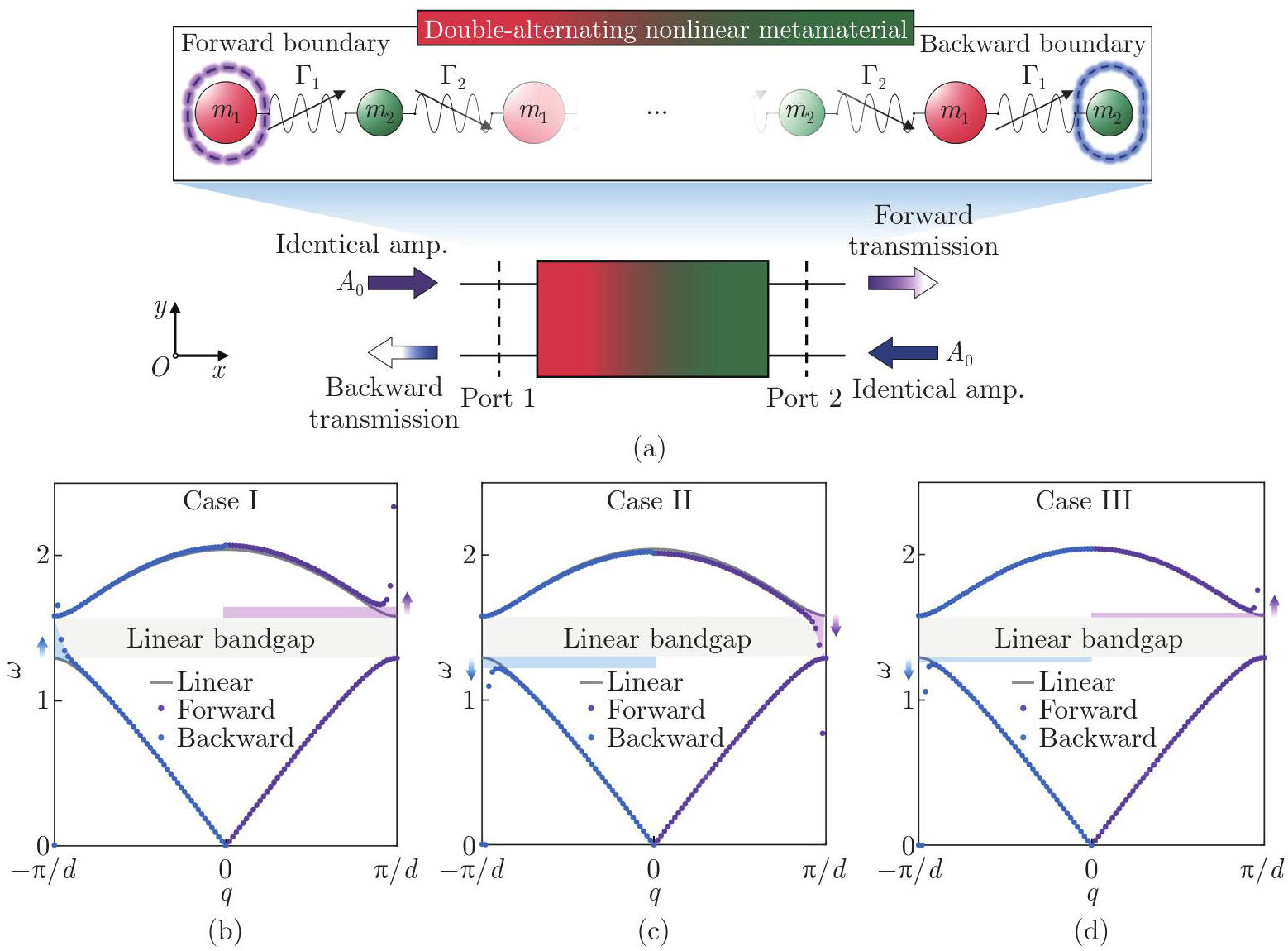
Fig. 8
Numerical simulation setup for (a) forward propagation and (b) backward propagation in the double-alternating nonlinear metamaterial (color online)"


Fig. 9
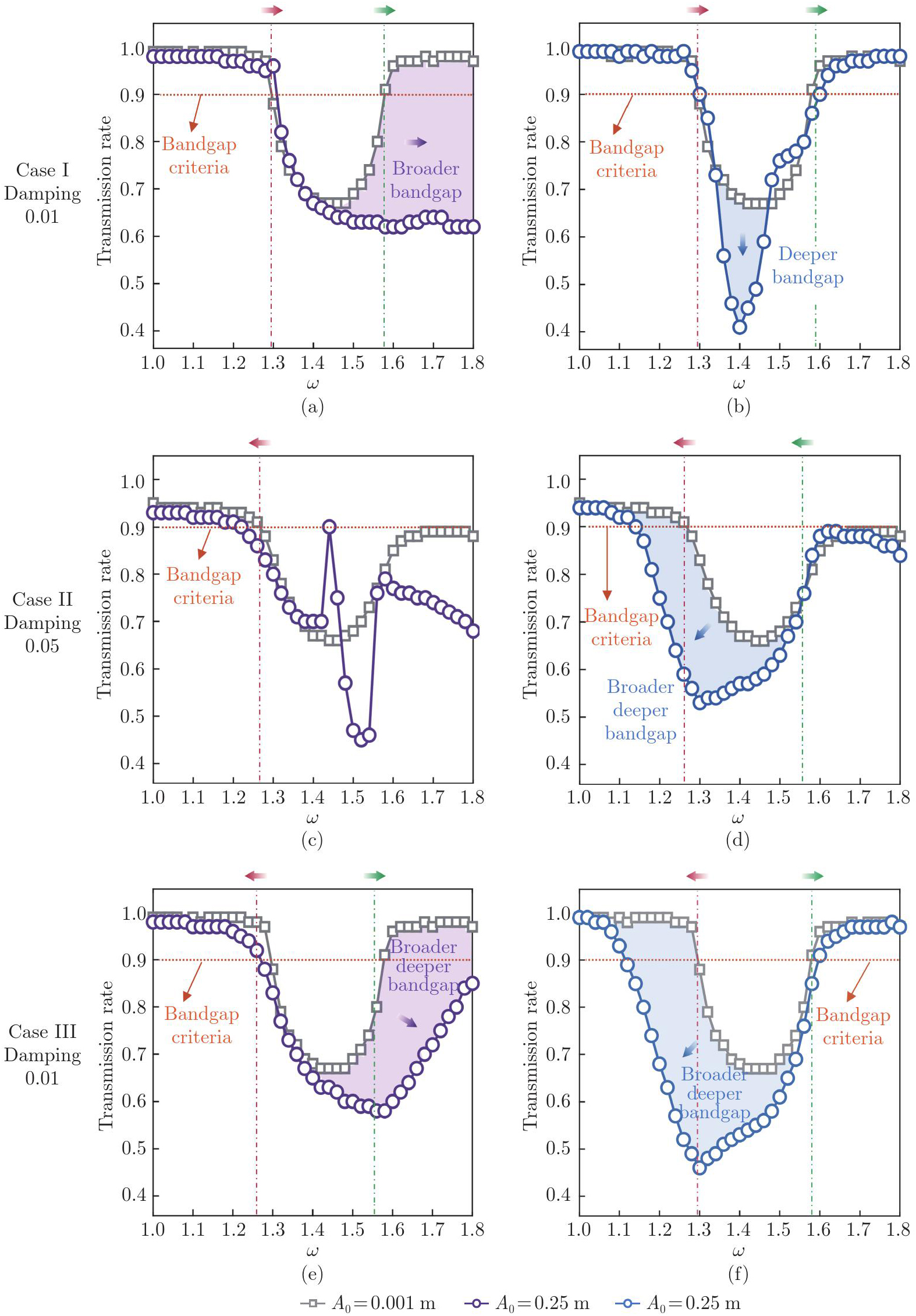
Transmission spectra for forward propagation (left) and backward propagation (right) across three nonlinear configurations: (a), (b), Case I; (c), (d), Case II; (e), (f), Case III, where the vertical dashed lines denote the boundaries of the identified nonlinear bandgap (color online)"
| [10] | FRUCHART, M., HANAI, R., LITTLEWOOD, P. B., and VITELLI, V. Non-reciprocal phase transitions. Nature, 592, 363–369 (2021) |
| [11] | XU, H., JIANG, L. Y., CLERK, A. A., and HARRIS, J. G. E. Nonreciprocal control and cooling of phonon modes in an optomechanical system. Nature, 568, 65–69 (2019) |
| [12] | HWAN OH, J., WOONG KIM, H., SIK MA, P., MIN SEUNG, H., and YOUNG KIM, Y. Inverted bi-prism phononic crystals for one-sided elastic wave transmission applications. Applied Physics Letters, 100, 213503 (2012) |
| [13] | NASSAR, H., YOUSEFZADEH, B., FLEURY, R., RUZZENE, M., ALÙ, A., DARAIO, C., NORRIS, A. N., HUANG, G. L., and HABERMAN, M. R. Nonreciprocity in acoustic and elastic materials. Nature Reviews Materials, 5, 667–685 (2020) |
| [14] | RASMUSSEN, C., QUAN, L., and ALÙ, A. Acoustic nonreciprocity. Journal of Applied Physics, 129, 210903 (2021) |
| [15] | LEE, S. H., PARK, C. M., SEO, Y. M., WANG, Z. G., and KIM, C. K. Composite acoustic medium with simultaneously negative density and modulus. Physical Review Letters, 104, 054301 (2010) |
| [16] | ZHU, R., LIU, X. N., HU, G. K., SUN, C. T., and HUANG, G. L. Negative refraction of elastic waves at the deep-subwavelength scale in a single-phase metamaterial. Nature Communications, 5, 5510 (2014) |
| [17] | OH, J. H., SEUNG, H. M., and KIM, Y. Y. Adjoining of negative stiffness and negative density bands in an elastic metamaterial. Applied Physics Letters, 108, 093501 (2016) |
| [18] | LEE, H., OH, J. H., SEUNG, H. M., CHO, S. H., and KIM, Y. Y. Extreme stiffness hyperbolic elastic metamaterial for total transmission subwavelength imaging. Scientific Reports, 6, 24026 (2016) |
| [19] | KUSHWAHA, M. S., HALEVI, P., DOBRZYNSKI, L., and DJAFARI-ROUHANI, B. Acoustic band structure of periodic elastic composites. Physical Review Letters, 71, 2022–2025 (1993) |
| [20] | LIU, Z. Y., ZHANG, X. X., MAO, Y. W., ZHU, Y. Y., YANG, Z. Y., CHAN, C. T., and SHENG, P. Locally resonant sonic materials. Science, 289, 1734–1736 (2000) |
| [21] | RUI, S. T., ZHANG, W. Q., YU, R. H., WANG, X. Z., and MA, F. Y. A multi-band elastic metamaterial for low-frequency multi-polarization vibration absorption. Mechanical Systems and Signal Processing, 216, 111464 (2024) |
| [22] | ZHANG, Q. and SUN, Y. X. Low frequency bandgap and high stiffness of innovative auxetic metamaterial with negative thermal expansion. Thin-Walled Structures, 201, 112010 (2024) |
| [23] | ASSOUAR, B., LIANG, B., WU, Y., LI, Y., CHENG, J. C., and JING, Y. Acoustic metasurfaces. Nature Reviews Materials, 3, 460–472 (2018) |
| [24] | SHIN, Y. J., SEUNG, H. M., and OH, J. H. Fluid-like elastic metasurface. Applied Physics Letters, 122, 101701 (2023) |
| [25] | OH, Y. B., KIM, S. Y., CHO, S. H., LEE, J. S., and KIM, Y. Y. Near-perfect retroreflection of flexural waves via optimized elastic metagratings. International Journal of Mechanical Sciences, 262, 108750 (2024) |
| [26] | SHEN, C., XU, J., FANG, N. X., and JING, Y. Anisotropic complementary acoustic metamaterial for canceling out aberrating layers. Physical Review X, 4, 041033 (2014) |
| [27] | PARK, C. I., PIAO, C. G., LEE, H., and KIM, Y. Y. Elastic complementary meta-layer for ultrasound penetration through solid/liquid/gas barriers. International Journal of Mechanical Sciences, 206, 106619 (2021) |
| [28] | PARK, C. I., CHOE, S., LEE, W., CHOI, W., KIM, M., SEUNG, H. M., and KIM, Y. Y. Ultrasonic barrier-through imaging by Fabry-Perot resonance-tailoring panel. Nature Communications, 14, 7818 (2023) |
| [29] | NASSAR, H., CHEN, H., NORRIS, A. N., HABERMAN, M. R., and HUANG, G. L. Non-reciprocal wave propagation in modulated elastic metamaterials. Proceedings of the Royal Society A: Mathematical, Physical and Engineering Sciences, 473, 20170188 (2017) |
| [30] | ZHU, Y. F., CAO, L. Y., MERKEL, A., FAN, S. W., VINCENT, B., and ASSOUAR, B. Janus acoustic metascreen with nonreciprocal and reconfigurable phase modulations. Nature Communications, 12, 7089 (2021) |
| [31] | MERKEL, A., ROMERO-GARCÍA, V., GROBY, J. P., LI, J., and CHRISTENSEN, J. Unidirectional zero sonic reflection in passive PT-symmetric Willis media. Physical Review B, 98, 201102 (2018) |
| [32] | LI, Z. N., WANG, Y. Z., and WANG, Y. S. Nonreciprocal phenomenon in nonlinear elastic wave metamaterials with continuous properties. International Journal of Solids and Structures, 150, 125–134 (2018) |
| [33] | WANG, Y. F., YOUSEFZADEH, B., CHEN, H., NASSAR, H., HUANG, G. L., and DARAIO, C. Observation of nonreciprocal wave propagation in a dynamic phononic lattice. Physical Review Letters, 121, 194301 (2018) |
| [34] | CHEN, Y. Y., LI, X. P., NASSAR, H., NORRIS, A. N., DARAIO, C., and HUANG, G. L. Nonreciprocal wave propagation in a continuum-based metamaterial with space-time modulated resonators. Physical Review Applied, 11, 064052 (2019) |
| [35] | ATTARZADEH, M. A., CALLANAN, J., and NOUH, M. Experimental observation of nonreciprocal waves in a resonant metamaterial beam. Physical Review Applied, 13, 021001 (2020) |
| [36] | HAGAG, M. F., JONES, T. R., SEDDIK, K., and PEROULIS, D. Nonreciprocal signal growth in space-time modulated transmission lines. Scientific Reports, 15, 18992 (2025) |
| [37] | WALLEN, S. P. and HABERMAN, M. R. Nonreciprocal wave phenomena in spring-mass chains with effective stiffness modulation induced by geometric nonlinearity. Physical Review E, 99, 013001 (2019) |
| [38] | CHEN, Z. X., LI, Z. W., WENG, J. K., LIANG, B., LU, Y. Q., CHENG, J. C., and ALÙ, A. Sound non-reciprocity based on synthetic magnetism. Science Bulletin, 68, 2164–2169 (2023) |
| [39] | MERKEL, A., WILLATZEN, M., and CHRISTENSEN, J. Dynamic nonreciprocity in loss-compensated piezophononic media. Physical Review Applied, 9, 034033 (2018) |
| [40] | CHEN, Y. Y., LI, X. P., HU, G. K., HABERMAN, M. R., and HUANG, G. L. An active mechanical Willis meta-layer with asymmetric polarizabilities. Nature Communications, 11, 3681 (2020) |
| [41] | ALSHAQAQ, M., SUGINO, C., and ERTURK, A. Digital programming of reciprocity breaking in resonant piezoelectric metamaterials. Physical Review Research, 5, 043003 (2023) |
| [42] | ZHENG, Y. S., WU, Z., ZHANG, X. N., and WANG, K. W. A piezo-metastructure with bistable circuit shunts for adaptive nonreciprocal wave transmission. Smart Materials and Structures, 28, 045005 (2019) |
| [43] | BRAGHINI, D., VILLANI, L. G. G., ROSA, M. I. N., and DE F ARRUDA, J. R. Non-Hermitian elastic waveguides with piezoelectric feedback actuation: non-reciprocal bands and skin modes. Journal of Physics D: Applied Physics, 54, 285302 (2021) |
| [44] | WANG, R., HAN, L., ZHANG, M. N., WANG, L. F., and HUANG, Q. A. Nonreciprocal transmission in silicon micromechanical resonators via parity-time symmetry breaking. Physical Review Applied, 22, 034060 (2024) |
| [45] | GAO, Y. Q., WANG, L. F., and LU, T. J. Coding non-Hermitian metamaterial beams based on nonlocal feedback control. International Journal of Mechanical Science, 286, 109904 (2025) |
| [46] | GUO, X. X., LISSEK, H., and FLEURY, R. Observation of non-reciprocal harmonic conversion in real sounds. Communications Physics, 6, 93 (2023) |
| [47] | NARISETTI, R. K., LEAMY, M. J., and RUZZENE, M. A perturbation approach for predicting wave propagation in one-dimensional nonlinear periodic structures. Journal of Vibration and Acoustics, 132, 031001 (2010) |
| [48] | BAE, M. H. and OH, J. H. Amplitude-induced bandgap: new type of bandgap for nonlinear elastic metamaterials. Journal of the Mechanics and Physics of Solids, 139, 103930 (2020) |
| [49] | PATIL, G. U. and MATLACK, K. H. Review of exploiting nonlinearity in phononic materials to enable nonlinear wave responses. Acta Mechanica, 233, 1–46 (2022) |
| [50] | FRONK, M. D., FANG, L. Z., PACKO, P., and LEAMY, M. J. Elastic wave propagation in weakly nonlinear media and metamaterials: a review of recent developments. Nonlinear Dynamics, 111, 10709–10741 (2023) |
| [51] | HUANG, R. N., HU, H. X., LI, X. F., and ZHANG, Z. W. Asymmetric potential-induced strong nonreciprocity in nonlinear acoustic metamaterials. International Journal of Mechanical Sciences, 305, 110798 (2025) |
| [52] | WEI, L. S., WANG, Y. Z., and WANG, Y. S. Nonreciprocal transmission of nonlinear elastic wave metamaterials by incremental harmonic balance method. International Journal of Mechanical Sciences, 173, 105433 (2020) |
| [53] | MICHALOLIAKOS, A., WANG, C. A., and VAKAKIS, A. F. Machine learning extreme acoustic non-reciprocity in a linear waveguide with multiple nonlinear asymmetric gates. Nonlinear Dynamics, 111, 17277–17297 (2023) |
| [54] | ZHOU, W. and WANG, Y. Z. Metamaterial robot driven by nonlinear elastic waves with stop band and nonreciprocal crawling. Nonlinear Dynamics, 112, 5825–5845 (2024) |
| [55] | MOJAHED, A., BUNYAN, J., TAWFICK, S., and VAKAKIS, A. F. Tunable acoustic nonreciprocity in strongly nonlinear waveguides with asymmetry. Physical Review Applied, 12, 034033 (2019) |
| [56] | KONG, N., SUN, M., and CHEN, J. N. Non-reciprocity of energy transfer derived from cubic stiffness-induced nonlinear phenomena. Results in Physics, 108290 (2025) |
| [57] | JANG, Y., OH, B., KIM, E., and RHO, J. Bidirectional asymmetric frequency conversion in nonlinear phononic crystals. Physical Review Letters, 135, 036603 (2025) |
| [58] | MAI, Y. W. and ZHOU, W. J. Anomalous wave dynamics in nonlinear acoustic metamaterials with odd elasticity. Journal of Vibration Engineering and Technologies, 13, 1–12 (2025) |
| [59] | BAE, M. H., KIM, S. H., SEUNG, H. M., and OH, J. H. Opening Bandgap in monoatomic-diatomic convertible metamaterial with nonlinearity. International Journal of Mechanical Sciences, 289, 110067 (2025) |
| [60] | CHAUNSALI, R. and THEOCHARIS, G. Self-induced topological transition in phononic crystals by nonlinearity management. Physical Review B, 100, 014302 (2019) |
| [61] | EZAWA, M. Nonlinearity-induced transition in the nonlinear Su-Schrieffer-Heeger model and a nonlinear higher-order topological system. Physical Review B, 104, 235420 (2021) |
| [62] | JIAO, W. Equivalent eigenvalue approach to nonlinear plane waves revealing nonlinearity-induced bandgap opening and closing phenomena. Physical Review B, 111, 214308 (2025) |
| [63] | FRONK, M. D. and LEAMY, M. J. Higher-order dispersion, stability, and waveform invariance in nonlinear monoatomic and diatomic systems. Journal of Vibration and Acoustics, 139, 051003 (2017) |
| [64] | FRANDSEN, N. M. M. and JENSEN, J. S. Modal interaction and higher harmonic generation in a weakly nonlinear, periodic mass-spring chain. Wave Motion, 68, 149–161 (2019) |
| [65] | WANG, Y. Z. and WANG, Y. S. Active control of elastic wave propagation in nonlinear phononic crystals consisting of diatomic lattice chain. Wave Motion, 78, 1–8 (2018) |
| [66] | CHEN, Z. Y., ZHOU, W. J., and LIM, C. W. Active control for acoustic wave propagation in nonlinear diatomic acoustic metamaterials. International Journal of Non-Linear Mechanics, 125, 103535 (2020) |
| [1] | JIMÉNEZ, N., UMNOVA, O., and GROBY, J. P. The transfer matrix method in acoustics. Acoustic Waves in Periodic Structures, Metamaterials, and Porous Media, Springer International Publishing, Cham, 103–164 (2021) |
| [2] | FLEURY, R., SOUNAS, D., HABERMAN, M. R., and ALÙ, A. Nonreciprocal acoustics. Acoust Today, 11, 14–21 (2015) |
| [3] | Hill, C. T. and STULL, D. E. Disclosure reciprocity: conceptual and measurement issues. Social Psychology Quarterly, 45, 238–244 (1982) |
| [4] | HATANO, H. and MORI, E. Acoustic-emission transducer and its absolute calibration. The Journal of the Acoustical Society of America, 59, 344–349 (1979) |
| [5] | SAMARASINGHE, P., ABHAYAPALA, T. D., and KELLERMANN, W. Acoustic reciprocity: an extension to spherical harmonics domain. The Journal of the Acoustical Society of America, 142, 337–343 (2017) |
| [6] | JIMÉNEZ-GAMBÍN, S., JIMÉNEZ, N., POULIOPOULOS, A. N., BENLLOCH, J. M., KONOFAGOU, E. E., and CAMARENA, F. Acoustic holograms for bilateral blood-brain barrier opening in a mouse model. IEEE Transactions on Biomedical Engineering, 69, 1359–1368 (2021) |
| [7] | BRANDENBOURGER, M., LOCSIN, X., LERNER, E., and COULAIS, C. Non-reciprocal robotic metamaterials. Nature Communications, 10, 4608 (2019) |
| [8] | LI, B., ALAMRI, S., and TAN, K. T. A diatomic elastic metamaterial for tunable asymmetric wave transmission in multiple frequency bands. Scientific Reports, 7, 6226 (2017) |
| [9] | FLEURY, R., SOUNAS, D. L., SIECK, C. F., HABERMAN, M. R., and ALÙ, A. Sound isolation and giant linear nonreciprocity in a compact acoustic circulator. Science, 343, 516–519 (2014) |
| [67] | BAE, M. H. and OH, J. H. Nonlinear elastic metamaterial for tunable bandgap at quasi-static frequency. Mechanical Systems and Signal Processing, 170, 108832 (2022) |
| [68] | CHAKRABORTY, G. and MALLIK, A. K. Dynamics of a weakly non-linear periodic chain. International Journal of Non-Linear Mechanics, 36, 375–389 (2001) |
| [69] | WANG, H. Y., ZHAO, J., WANG, X. F., DONG, Z. Y., and HUANG, Y. Non-reciprocal wave propagations in a one-dimensional periodic structure modified with a linkage mechanism. Nonlinear Dynamics, 112, 19611–19631 (2024) |
| [70] | WU, G. M., LONG, Y., and REN, J. Asymmetric nonlinear system is not sufficient for a nonreciprocal wave diode. Physical Review B, 97, 205423 (2018) |
| [71] | MUHLESTEIN, M. B., SIECK, C. F., ALÙ, A., and HABERMAN, M. R. Reciprocity, passivity and causality in Willis materials. Proceedings of the Royal Society A: Mathematical, Physical and Engineering Sciences, 472, 20160604 (2016) |
| [72] | CHAKRABORTY, G. and MALLIK, A. K. Dynamics of a weakly non-linear periodic chain. International Journal of Non-Linear Mechanics, 36, 375–389 (2001) |
| [73] | CUI, J. G., YANG, T. Z., and CHEN, L. Q. Frequency-preserved non-reciprocal acoustic propagation in a granular chain. Applied Physics Letters, 112, 181904 (2018) |
| [74] | KIM, H., KIM, E., and YANG, J. Nonlinear wave propagation in 3D-printed graded lattices of hollow elliptical cylinders. Journal of the Mechanics and Physics of Solids, 125, 774–784 (2019) |
| [75] | YANG, T. L. and WANG, Y. Z. Hall effect and topological phase transition of nonlinear elastic wave metamaterials with local resonators. Journal of the Mechanics and Physics of Solids, 193, 105889 (2024) |
| [1] | Fenglian LI, Yin ZHU, Junhui YAN. Analysis and optimization of bandgaps in plate-type metastructures with different configurations [J]. Applied Mathematics and Mechanics (English Edition), 2026, 47(4): 839-858. |
| [2] | Dongxu GUO, Xiaolong ZHANG, Ruilan TIAN, Xiangyang LI, Minghao WANG. Synergistic design of ultra-wide low-frequency continuous bandgap metastructure for audible noise attenuation [J]. Applied Mathematics and Mechanics (English Edition), 2026, 47(3): 473-496. |
| [3] | Qian GENG, Xing ZHOU, Mengyang WANG, Xiongwei YANG, Zhushan SHAO, Yueming LI. Thermal stability design for flexural wave bandgap of metamaterial plates with perforated and pre-curved patterns [J]. Applied Mathematics and Mechanics (English Edition), 2026, 47(3): 443-472. |
| [4] | Siyu REN, Yijun CHAI, Xiongwei YANG. Multistable locally resonant elastic metamaterial with tunable anisotropy [J]. Applied Mathematics and Mechanics (English Edition), 2025, 46(9): 1663-1678. |
| [5] | Dengbo ZHANG, Qingke ZHOU, Xiangfei JI, Youqi TANG. Nonlinear vibrations of axially transporting viscoelastic plates immersed in liquids [J]. Applied Mathematics and Mechanics (English Edition), 2025, 46(12): 2341-2360. |
| [6] | Yongzhe LI, Yongqiang LI, Gaoge LIANG, Quanxing LIU, Yong XIAO. Single-phase multi-resonant metabeam for broadband reduction of multi-polarization low-frequency vibration [J]. Applied Mathematics and Mechanics (English Edition), 2025, 46(12): 2265-2280. |
| [7] | Fan YANG, Zhaoyang MA, Xingming GUO. Bandgap characteristics analysis and graded design of a novel metamaterial for flexural wave suppression [J]. Applied Mathematics and Mechanics (English Edition), 2025, 46(1): 1-24. |
| [8] | Long WANG, Lei ZHANG, Guowei HE. Chien-physics-informed neural networks for solving singularly perturbed boundary-layer problems [J]. Applied Mathematics and Mechanics (English Edition), 2024, 45(9): 1467-1480. |
| [9] | Wei WEI, Feng GUAN, Xin FANG. A low-frequency and broadband wave-insulating vibration isolator based on plate-shaped metastructures [J]. Applied Mathematics and Mechanics (English Edition), 2024, 45(7): 1171-1188. |
| [10] | Changqi CAI, Chenjie ZHU, Fengyi ZHANG, Jiaojiao SUN, Kai WANG, Bo YAN, Jiaxi ZHOU. Modeling and analysis of gradient metamaterials for broad fusion bandgaps [J]. Applied Mathematics and Mechanics (English Edition), 2024, 45(7): 1155-1170. |
| [11] | Yiming CAO, Hui MA, Xumin GUO, Bingfeng ZHAO, Hui LI, Xin WANG, Bing WANG. Comparison of nonlinear modeling methods for the composite rubber clamp [J]. Applied Mathematics and Mechanics (English Edition), 2024, 45(5): 763-778. |
| [12] | Huaqing JIN, Haicheng ZHANG, Ye LU, Daolin XU. Floating periodic pontoons for broad bandgaps of water waves [J]. Applied Mathematics and Mechanics (English Edition), 2024, 45(11): 1913-1928. |
| [13] | Xingjian DONG, Shuo WANG, Anshuai WANG, Liang WANG, Zhaozhan ZHANG, Yuanhao TIE, Qingyu LIN, Yongtao SUN. Low-frequency bandgap and vibration suppression mechanism of a novel square hierarchical honeycomb metamaterial [J]. Applied Mathematics and Mechanics (English Edition), 2024, 45(10): 1841-1856. |
| [14] | Yunping ZHAO, Xiuhui HOU, Kai ZHANG, Zichen DENG. Symplectic analysis for regulating wave propagation in a one-dimensional nonlinear graded metamaterial [J]. Applied Mathematics and Mechanics (English Edition), 2023, 44(5): 745-758. |
| [15] | Jian'en CHEN, Jianling LI, Minghui YAO, Jun LIU, Jianhua ZHANG, Min SUN. Nonreciprocity of energy transfer in a nonlinear asymmetric oscillator system with various vibration states [J]. Applied Mathematics and Mechanics (English Edition), 2023, 44(5): 727-744. |
| Viewed | ||||||
|
Full text |
|
|||||
|
Abstract |
|
|||||





 Email Alert
 RSS
RSS