Applied Mathematics and Mechanics (English Edition) ›› 2026, Vol. 47 ›› Issue (8): 1747-1768.doi: https://doi.org/10.1007/s10483-026-3413-7
Previous Articles Next Articles
Chenxu LIU1, Yingjing QIAN1, Guilan YU2, Zhanli LIU3, Xiaodong YANG1,4( )
)
Received:2026-03-08
Revised:2026-05-18
Online:2026-07-31
Published:2026-07-31
Contact:
Xiaodong YANG, E-mail: jxdyang@163.comSupported by:2010 MSC Number:
Chenxu LIU, Yingjing QIAN, Guilan YU, Zhanli LIU, Xiaodong YANG. A modular physics-informed neural network for nonlinear vibration isolators. Applied Mathematics and Mechanics (English Edition), 2026, 47(8): 1747-1768.
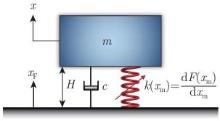
Fig. 1
Schematic of the nonlinear vibration isolator, where k(xm) denotes the nonlinear stiffness, and F(xm) denotes the nonlinear restoring force (color online)"
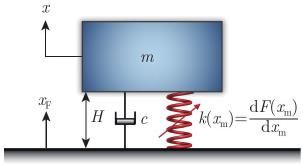
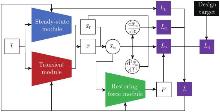
Fig. 2
Schematic of MPINN (color online)"
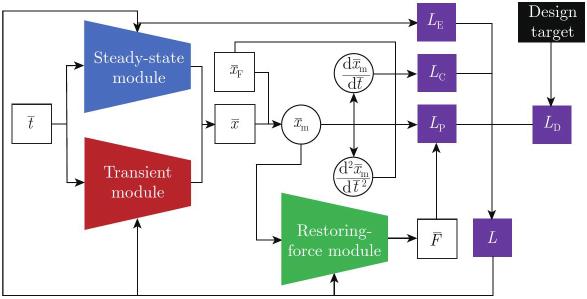
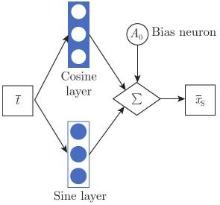
Fig. 3
Steady-state module based on harmonic balance network (color online)"
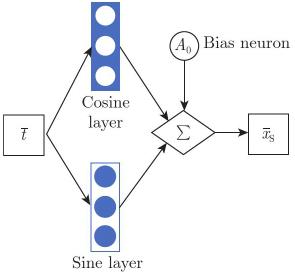
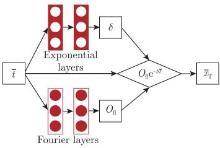
Fig. 4
Transient module with exponential and Fourier layers (color online)"
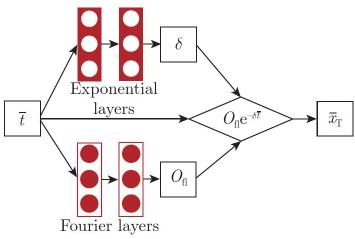
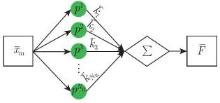
Fig. 5
Restoring-force module in a polynomial form (color online)"
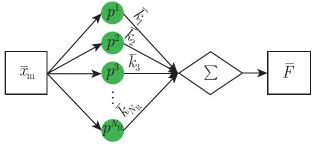
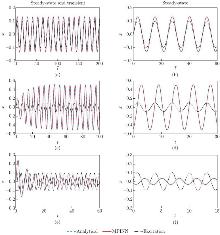
Fig. 6
Feasibility validation of the MPINN: (a) complete responses comprising steady-state and transient components at ω¯F=0.5; (b) steady-state responses at ω¯F=0.5; (c) complete responses comprising steady-state and transient components at ω¯F=1.0; (d) steady-state responses at ω¯F=1.0; (e) complete responses comprising steady-state and transient components at ω¯F=2.0; (f) steady-state responses at ω¯F=2.0. The linear isolator parameters m, k1, c, H, and X¯F are 1 kg, 1 N/m, 0.2 kg/s, 1 m, and 0.1, respectively, and the initial displacement and velocity are both set to zero when calculating the complete response. The dotted blue, solid red, and dashed black lines represent the analytical solution, MPINN prediction, and excitation, respectively (color online)"
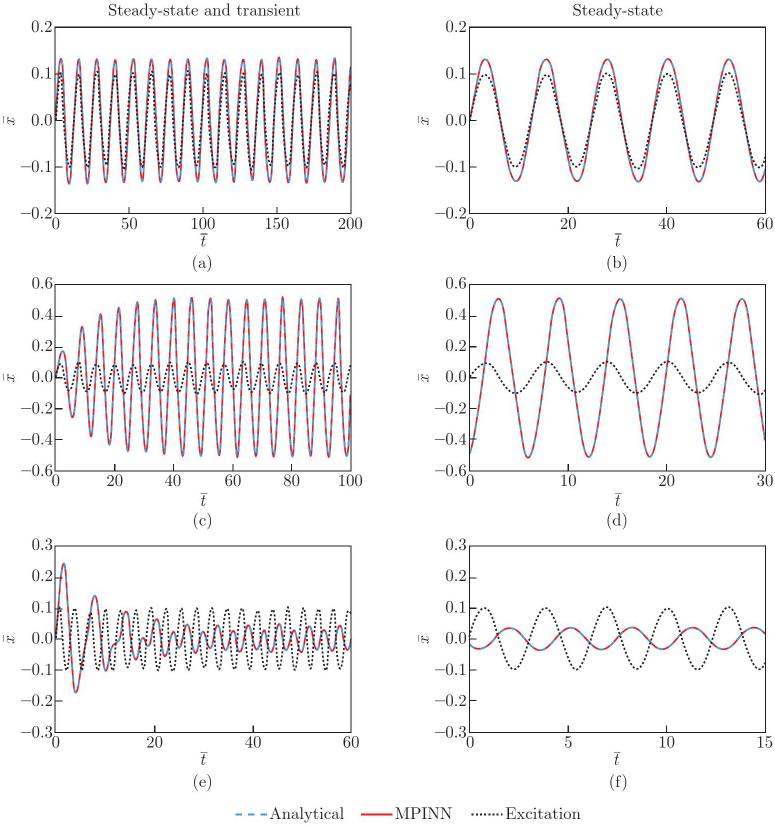
Table 1
Coefficient of determination (R2) and root mean square error (ERMSE) of the responses predicted by the MPINN in Fig. 6"
| Response type | R2 | ||
|---|---|---|---|
| 0.5 | Steady-state and transient | 0.999 98 | 0.000 35 |
| Steady-state | 0.999 67 | 0.001 71 | |
| 1.0 | Steady-state and transient | 0.999 95 | 0.002 48 |
| Steady-state | 0.997 57 | 0.017 62 | |
| 2.0 | Steady-state and transient | 0.994 50 | 0.004 35 |
| Steady-state | 0.997 40 | 0.001 24 |
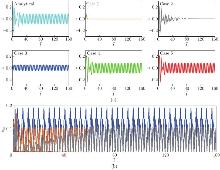
Fig. 7
Comparative analysis of five MPINN cases: (a) complete responses predicted by the MPINN; (b) corresponding residual errors (eres). Case 1 (solid orange line) employs MLPs for all three modules; Cases 2–4 (solid gray, blue, and green lines, respectively) use an MLP only for the steady-state, transient, and restoring-force module, respectively; Case 5 (solid red line) adopts the customized architectures for all three modules. The solid cyan line is the analytical solution. The linear isolator parameters m, k1, c, H, X¯F, and ω¯F are 1 kg, 1 N/m, 0.2 kg/s, 1 m, 0.1, and 1.5, respectively, where the initial displacement and velocity are zero (color online)"
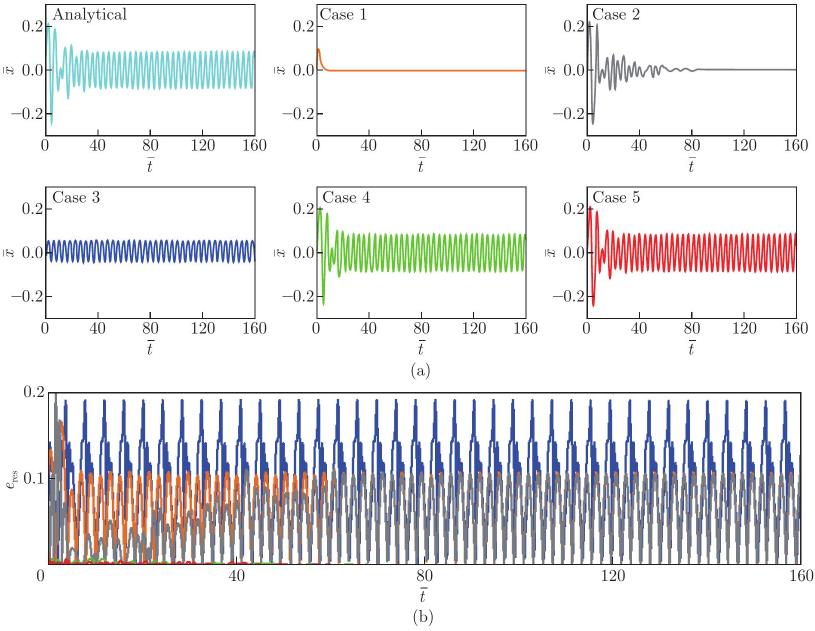
Table 2
Coefficients of determination (R2), root mean square error (ERMSE), and mean of residual error (eres) of the responses predicted by the MPINN in Fig. 7"
| Case | R2 | ||
|---|---|---|---|
| 1 | 0.047 20 | 0.065 34 | 0.068 17 |
| 2 | 0.403 00 | 0.051 72 | 0.058 14 |
| 3 | 0.086 23 | 0.099 31 | |
| 4 | 0.995 05 | 0.004 71 | 0.000 76 |
| 5 | 0.998 58 | 0.002 52 | 0.000 60 |
Fig. 8
Dynamic responses of a cubic Duffing-type isolator predicted by the MPINN with or without the energy-conservation loss: (a) force-displacement of the cubic Duffing-type isolator; (b) complete responses; (c) learning curves for complete response predictions; (d) steady-state responses; (e) learning curves for steady-state response predictions. The cubic Duffing-type isolator parameters m, k1, k3, c, H, X¯F, and ω¯F are 1 kg, 0.1 N/m, 1 N/m3, 0.2 kg/s, 1 m, 0.1, and 2.0, respectively, and the initial displacement and velocity are zero for complete response predictions. The dashed black and dotted cyan lines are the base excitation and the responses by the Runge-Kutta method, whose detailed settings are provided in Section S4 of the electronic supplementary material. The solid red and gray lines represent results by the MPINN with or without the energy-conservation loss, respectively (color online)"
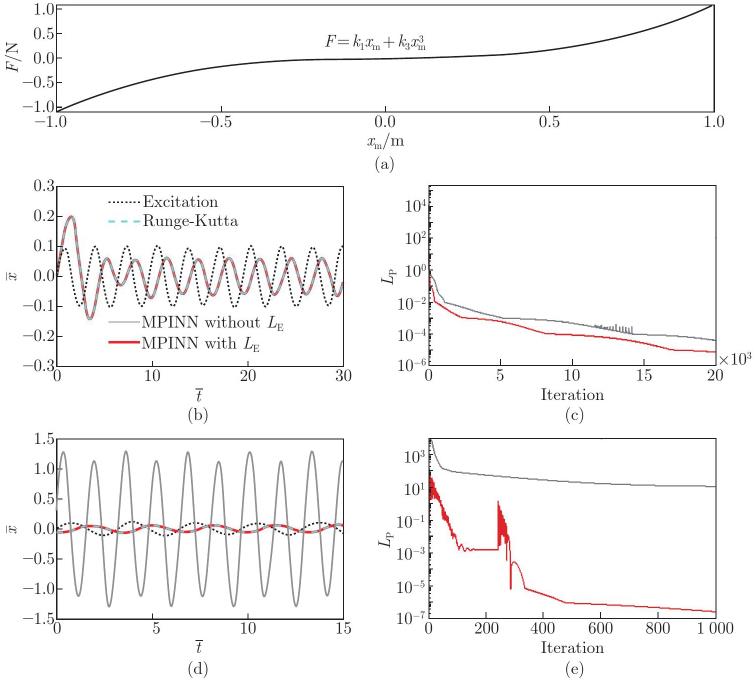
Fig. 9
Steady-state responses of a quintic Duffing-type isolator predicted by the MPINN under different excitation amplitudes: (a) force-displacement of the quintic Duffing-type isolator; (b) X¯F is 0.1; (c) X¯F is 0.12; (d) X¯F is 0.15; (e) mean of residual errors. The quintic Duffing-type isolator parameters m, k1, k3, k5, c, H, and ω¯F are 1 kg, 0.1 N/m, 1 N/m3, 10 N/m5, 0.2 kg/s, 1 m, and 2.0, respectively. The dashed black lines are the base excitations. The dotted cyan and solid red lines are the results by the Runge-Kutta method and the MPINN, respectively. The cyan and red boxes are means of residual errors of results by the Runge-Kutta method and the MPINN, respectively. The green points are the response amplitudes (color online)"
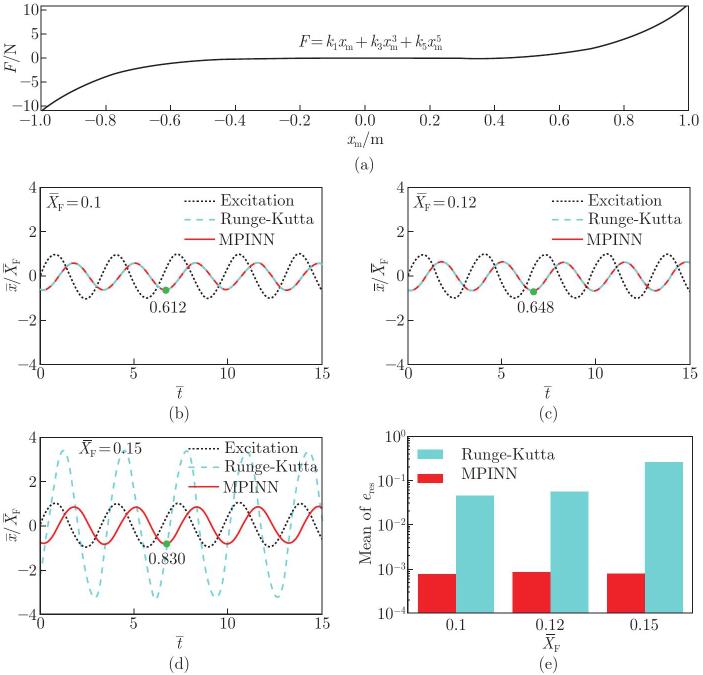
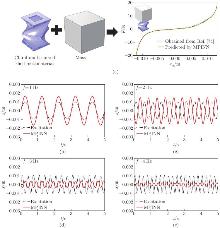
Fig. 10
Steady-state responses of a metamaterial-based isolator predicted by the MPINN under different excitation frequencies: (a) chiral multi-curved shell metamaterial, where the dotted orange and solid green lines are the force-displacement curves obtained from Ref. [74] and predicted by the MPINN’s restoring-force module, respectively; the parameters m, c, H, and XF are 2.39 kg, 0.2 kg/s, 0.027 6 m, and 0.001 m, respectively; (b) excitation frequency is 1 Hz; (c) excitation frequency is 2 Hz; (d) excitation frequency is 3 Hz; (e) excitation frequency is 4 Hz. The dashed black lines are the base excitations, and the solid red lines are the results by the MPINN (color online)"
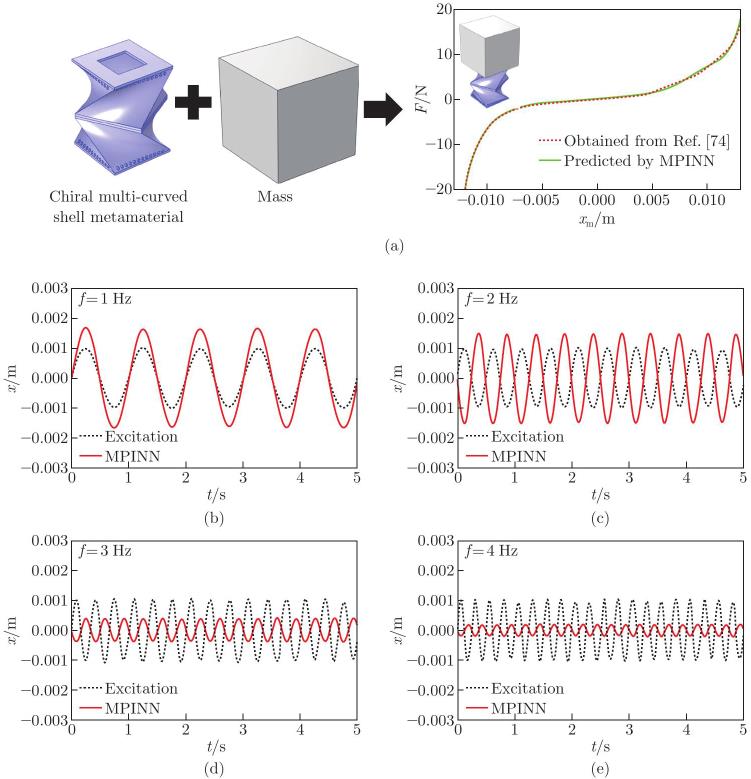
Fig. 11
Inverse design for a three-spring isolator: (a) design target and designed results by the MPINN; (b) designed force-displacement curves obtained from the approximation relation in Eq. (S24) (dashed black line), the exact geometry-based restoring-force relation in Eq. (S23) (dotted orange line), and the restoring-force module (solid green line), respectively; (c) steady-state response of the designed result, where the dashed black, solid red, and dotted green lines are the base excitation, response by the MPINN, and maximum of target response, respectively. The prescribed parameters of the three-spring isolator m, c, H, kS, f, and XF are 1 kg, 0.2 kg/s, 1 m, 10 N/m, 0.5 Hz, and 0.1 m, respectively (color online)"
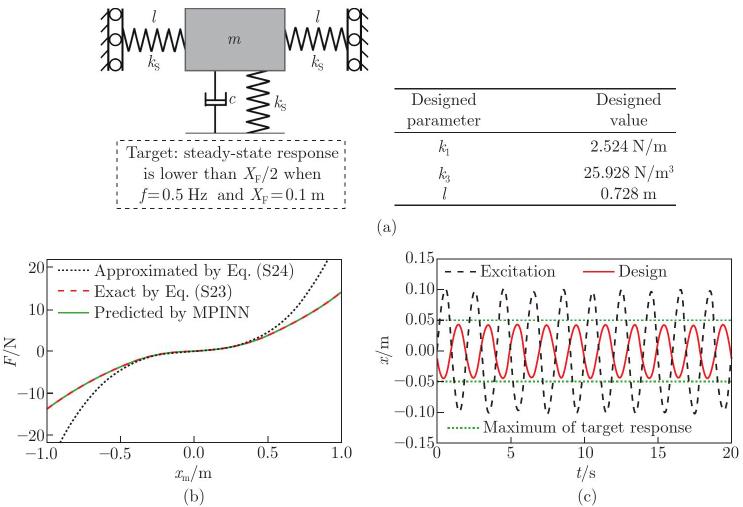
Fig. 12
Inverse design for isolators with a fifth-order polynomial restoring-force module: (a) designed force-displacement curves, where corresponding stiffness weights are provided in Table 3; (b) steady-state response of Design 1; (c) steady-state response of Design 2; (d) steady-state response of Design 3. The prescribed parameters of the isolator m, c, H, f, and XF are 1 kg, 0.2 kg/s, 1 m, 0.5 Hz, and 0.1 m, respectively. The solid red, magenta, and violet lines are the results of Designs 1, 2, and 3, respectively. The dashed and dotted green lines are the base excitation and maximum of target response, respectively (color online)"
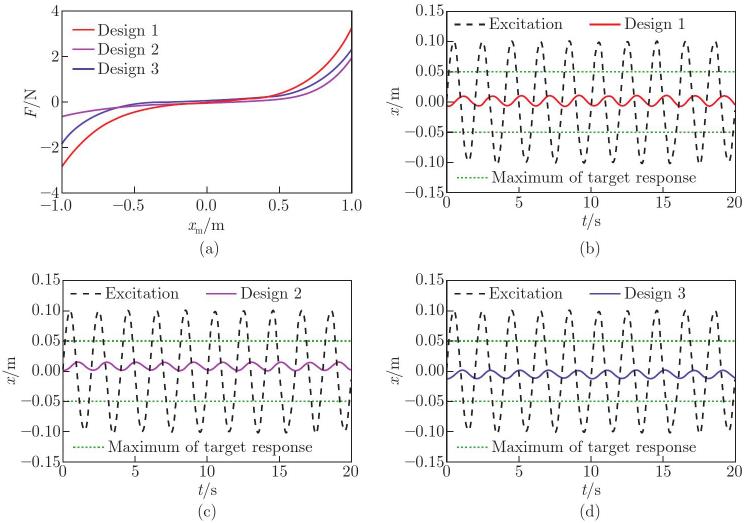
Table 3
Designed stiffness weights of the restoring-force module for Designs 1, 2, and 3 in Fig. 12"
| Design | |||||
|---|---|---|---|---|---|
| 1 | 0.439 | 1.264 | 0.432 | 1.342 | |
| 2 | 0.248 | 1.084 | 1.067 | ||
| 3 | 0.223 | 0.239 | 0.515 | 1.325 |
| [1] | SHIN, J. M. and AHN, H. J. Vibration issues in precision equipment: challenges and mitigation strategies of pneumatic vibration isolators. International Journal of Precision Engineering and Manufacturing, 26(9), 2223–2242 (2025) |
| [2] | XIE, X. L., HE, P. T., WU, D., and ZHANG, Z. Y. Ultra-low frequency active vibration isolation in high precision equipment with electromagnetic suspension: analysis and experiment. Precision Engineering, 84, 91–101 (2023) |
| [3] | LU, J. J., YAN, G., CAO, Y. B., QI, W. H., LIU, F. R., and ZHANG, W. M. Integration of nonlinear-vibration-isolation and actuation: design and control. IEEE/ASME Transactions on Mechatronics, 30(6), 7137–7148 (2025) |
| [4] | YUAN, Z. X., ZHANG, Z. G., ZENG, L. Z., and LI, X. Q. Microvibration isolation in sensitive payloads: methodology and design. Nonlinear Dynamics, 111(21), 19563–19611 (2023) |
| [5] | XIE, X. L., SHEN, Y., LA, Q. Y., LIU, X. T., and ZHANG, Z. Y. Low-frequency active vibration isolation via independent modal control and harmonic cancellation for space precision payloads. IEEE Sensors Journal, 25(14), 27065–27076 (2025) |
| [6] | CHANG, Y. P., LI, Y., ZHOU, J. X., WANG, K., WANG, Q., and WEN, G. L. Compensation strategy for quasi-zero-stiffness vibration isolator under payload mismatch. Acta Mechanica Sinica, 40(10), 524033 (2024) |
| [7] | MA, Y. H., TANG, X. X., WANG, Y. F., and HONG, J. Design of nonlinear metal rubber isolator subjected to random vibration. Mechanical Systems and Signal Processing, 197, 110375 (2023) |
| [8] | DAL BO, L., GARDONIO, P., BATTISTELLA, N., and TURCO, E. Non-linear isolator for vibration and force transmission control of unbalanced rotating machines. Journal of Vibration Engineering & Technologies, 11(4), 1741–1764 (2023) |
| [9] | ZHU, Z. R., ZHOU, Y., TAN, Z. K., HE, H., and ZHOU, X. F. Application of tuned viscous mass damper isolation systems for equipment-induced vibration control of industrial buildings. Structures, 51, 1934–1943 (2023) |
| [10] | LIU, Q., ZHANG, W. K., BHATT, M. W., and KUMAR, A. Seismic nonlinear vibration control algorithm for high-rise buildings. Nonlinear Engineering, 10(1), 574–582 (2021) |
| [11] | NIU, M. Q., ZHUANG, Y. S., HAN, W. J., and CHEN, L. Q. History dependent analysis of compliant beams for nonlinear vibration isolation. International Journal of Mechanical Sciences, 281, 109571 (2024) |
| [12] | GKATZOGIAS, K. I. and KAPPOS, A. J. Deformation-based design of seismically isolated bridges. Earthquake Engineering & Structural Dynamics, 51(14), 3243–3271 (2022) |
| [13] | BALAJI, P. S. and SELVAKUMAR, K. K. Applications of nonlinearity in passive vibration control: a review. Journal of Vibration Engineering & Technologies, 9(2), 183–213 (2021) |
| [14] | ZHAO, L., LU, Z. Q., DING, H., and CHEN, L. Q. A viscoelastic metamaterial beam for integrated vibration isolation and energy harvesting. Applied Mathematics and Mechanics (English Edition), 45(7), 1243–1260 (2024) https://doi.org/10.1007/s10483-024-3159-7 |
| [15] | LIU, C. R., ZHANG, W., YU, K. P., LIU, T., and ZHENG, Y. Quasi-zero-stiffness vibration isolation: designs, improvements and applications. Engineering Structures, 301, 117282 (2024) |
| [16] | YAN, B., YU, N., and WU, C. Y. A state-of-the-art review on low-frequency nonlinear vibration isolation with electromagnetic mechanisms. Applied Mathematics and Mechanics (English Edition), 43(7), 1045–1062 (2022) https://doi.org/10.1007/s10483-022-2868-5 |
| [17] | WATANABE, Y. and INOUE, T. Characteristics of self-excited vibration of vertical rotating shaft system considering amplitude dependent nonlinearity of sliding bearing. Journal of Vibration and Acoustics, 145(2), 021008 (2023) |
| [18] | WANG, G. B., LI, H., YANG, Y., QIAO, Z., ZOU, Z. Y., DU, D. X., LIU, D. M., GUO, X. M., and WU, H. H. Nonlinear vibration characteristics of composite pyramidal truss sandwich cylindrical shell panels with amplitude dependence. Applied Mathematical Modelling, 119, 273–294 (2023) |
| [19] | NOH, J., YOON, Y. J., and KIM, P. Anhysteretic high-static-low-dynamic stiffness vibration isolators with tunable inertial nonlinearity. Nonlinear Dynamics, 112(4), 2569–2588 (2024) |
| [20] | LU, Z. Q., WU, Y. G., ZHAO, L., DING, H., and CHEN, L. Q. A 6-DOF semi-active vibration isolator with tunable HSLDS. International Journal of Mechanical Sciences, 311, 111157 (2026) |
| [21] | LIU, C. C., JING, X. J., DALEY, S., and LI, F. M. Recent advances in micro-vibration isolation. Mechanical Systems and Signal Processing, 56, 55–80 (2015) |
| [22] | ZHANG, Y. L., WEN, H., HU, H. Y., and JIN, D. P. A novel quasi-zero stiffness isolator with designable stiffness using cam-roller-spring-rod mechanism. Acta Mechanica Sinica, 41(6), 524210 (2024) |
| [23] | YANG, S., LI, H. X., MENG, T. S., QI, Y. H., ZHANG, Y. Q., LI, J. Y., and MAN, J. Frontier advances in bionic-driven low-frequency nonlinear vibration isolation systems: a review of design mechanisms and analytical methods. Smart Materials and Structures, 34(9), 093001 (2025) |
| [24] | XU, K. F., ZHOU, Z. D., ZHANG, Y. W., and CHEN, L. Q. An improved nonlinear vibration absorber with adjustable stiffness and rotating mass. Acta Mechanica Sinica, 42(3), 524515 (2025) |
| [25] | LU, Z. Q., HAO, R. B., WU, D., DING, H., and CHEN, L. Q. An investigation of a self-powered low-frequency nonlinear vibration isolation system. Engineering Structures, 315, 118395 (2024) |
| [26] | CHOWDHURY, S. and BANERJEE, A. The nonlinear dynamic analysis of optimum nonlinear inertial amplifier base isolators for vibration isolation. Nonlinear Dynamics, 111(14), 12749–12786 (2023) |
| [27] | ALBERDI, R., HAMEL, C., TALAMINI, B., and TUPEK, M. R. An optimization-based approach to tailor the mechanical response of soft metamaterials undergoing rate-dependent instabilities. Computer Methods in Applied Mechanics and Engineering, 435, 117679 (2025) |
| [28] | GRANLUND, G. and WALLIN, M. Design of stiff elasto-plastic structures. Computer Methods in Applied Mechanics and Engineering, 450, 118622 (2026) |
| [29] | BEDNAREK, M., BALARAM, B., and AWREJCEWICZ, J. A tunable electromagnetic stiffness with bistable, hardening and softening characteristics. Mechanical Systems and Signal Processing, 230, 112577 (2025) |
| [30] | CHAI, Z. Y., ZHANG, Z., XU, K. F., SONG, X. Y., ZHANG, Y. W., and CHEN, L. Q. An innovative nonlinear bionic X-shaped vibration isolator enhanced by quasi-zero stiffness characteristics: theory and experimental investigation. Applied Mathematics and Mechanics (English Edition), 46(8), 1475–1492 (2025) https://doi.org/10.1007/s10483-025-3277-8 |
| [31] | SAEED, N. A., ELLABBAN, Y. Y., HOU, L., YI, H. M., ZHONG, S., DURAIHEM, F. Z., and OMARA, O. M. Nonlinear vibration of quasi-zero stiffness structure with piezoelectric harvester and RL-load: intra-well and inter-well oscillation modes under 1:1 internal resonance. Applied Mathematics and Mechanics (English Edition), 46(8), 1451–1474 (2025) https://doi.org/10.1007/s10483-025-3285-8 |
| [32] | LIU, C. R., WANG, J. F., ZHANG, W., YANG, X. D., GUO, X. Y., LIU, T., and SU, X. Y. Synchronization of broadband energy harvesting and vibration mitigation via 1:2 internal resonance. International Journal of Mechanical Sciences, 301, 110503 (2025) |
| [33] | ZENG, Y. C., DING, H., DU, R. H., and CHEN, L. Q. A suspension system with quasi-zero stiffness characteristics and inerter nonlinear energy sink. Journal of Vibration and Control, 28(1-2), 143–158 (2022) |
| [34] | MAO, X. Y., YIN, M. M., DING, H., GENG, X. F., SHEN, Y. J., and CHEN, L. Q. Modeling, analysis, and simulation of X-shape quasi-zero-stiffness-roller vibration isolators. Applied Mathematics and Mechanics (English Edition), 43(7), 1027–1044 (2022) https://doi.org/10.1007/s10483-022-2871-6 |
| [35] | HUANG, X. B., WANG, B., HUANG, Z. W., HUA, X. G., and CHEN, Z. Q. A theoretical model for a low-frequency two-stage hybrid vibration isolator with a nonlinear energy sink and a negative stiffness spring. Applied Mathematical Modelling, 142, 115948 (2025) |
| [36] | RUI, S. T., YANG, S. K., ZHENG, P. Y., WANG, X. Z., HAN, B., and MA, F. Y. Self-contacting overlay complementary multi-level multi-stable quasi-zero stiffness vibration isolation device. Mechanical Systems and Signal Processing, 226, 112340 (2025) |
| [37] | ZHENG, W. Z., TAN, P., LI, J., WANG, H., LIU, Y. H., and XIAN, Z. B. Superelastic pendulum isolator with multi-stage variable curvature for seismic resilience enhancement of cold-regional bridges. Engineering Structures, 284, 115960 (2023) |
| [38] | ZHANG, P. J., CHEN, X. Y., YU, P. H., ZHAO, K., MA, H. X., LIU, S. Q., TAN, H. F., LAUDE, V., and KADIC, M. Grid hollow octet truss lattices that are stable at low relative density. Journal of the Mechanics and Physics of Solids, 197, 106068 (2025) |
| [39] | LIU, J., WANG, Y. H., YANG, S. Q., SUN, T. S., YANG, M., and NIU, W. D. Customized quasi-zero-stiffness metamaterials for ultra-low frequency broadband vibration isolation. International Journal of Mechanical Sciences, 269, 108958 (2024) |
| [40] | XU, Y. Q., DONG, H. W., and WANG, Y. S. Topology optimization of programable quasi-zero-stiffness metastructures for low-frequency vibration isolation. International Journal of Mechanical Sciences, 280, 109557 (2024) |
| [41] | ANSARI, M., KHAJEPOUR, A., and ESMAILZADEH, E. Application of level set method to optimal vibration control of plate structures. Journal of Sound and Vibration, 332(4), 687–700 (2013) |
| [42] | LU, Y. F., LUO, Q. T., and TONG, L. Y. Topology optimization for metastructures with quasi-zero stiffness and snap-through features. Computer Methods in Applied Mechanics and Engineering, 434, 117587 (2025) |
| [43] | HU, C. Z., WAN, Z. S., LI, Z. H., TAN, X. M., WANG, L. C., and CHEN, M. J. Inverse-designed metastructures with customizable low dynamic stiffness characteristics for low-frequency vibration isolation. European Journal of Mechanics-A/Solids, 110, 105515 (2025) |
| [44] | LIU, H. Z., ZHAO, C. Y., HUANG, X. Z., and YAO, G. Data-driven modeling for the dynamic behavior of nonlinear vibratory systems. Nonlinear Dynamics, 111(12), 10809–10834 (2023) |
| [45] | HU, C. Z., LI, Z. H., TAN, X. M., and CHEN, M. J. Accelerated inverse design of vibration isolators with customizable low dynamic stiffness characteristics via deep neural network. Aerospace Science and Technology, 155, 109735 (2024) |
| [46] | SHI, H. R., DUAN, S. W., ZHANG, C. Z., ZHANG, L., WANG, C. L., REN, S. S., CHEN, S. B., and ZHANG, L. Design and verification of an intelligent variable-stiffness vibration isolator for a high-resolution optical satellite based on machine learning. Aerospace Science and Technology, 170, 111553 (2026) |
| [47] | JIANG, J. Y., TANG, J., LIU, M., LI, Y. H., CHEN, H. T., and CAO, D. Q. A data-driven neural model predictive controller for multi-layer nonlinear vibration isolation system. Aerospace Science and Technology, 166, 110583 (2025) |
| [48] | YANG, K., TONG, W. H., ZHOU, X., LI, R. H., ZHANG, T. T., YURCHENKO, D., and SHU, Y. C. Active vibration isolation of a monostable nonlinear electromagnetic actuator using machine learning adaptive feedforward control. Chaos, Solitons & Fractals, 192(C), 116035 (2025) |
| [49] | OCAK, A., IŞIKDAĞ, Ü., BEKDAŞ, G., NIGDELI, S. M., KIM, S., and GEEM, Z. W. Prediction of damping capacity demand in seismic base isolators via machine learning. Computer Modeling in Engineering & Sciences, 138(3), 2899–2924 (2024) |
| [50] | HONG, H., KIM, W., KIM, W., JEONG, J. M., KIM, S., and KIM, S. S. Machine learning-driven design optimization of buckling-induced quasi-zero stiffness metastructures for low-frequency vibration isolation. ACS Applied Materials & Interfaces, 16(14), 17965–17972 (2024) |
| [51] | WEI, Z. Y., WEI, K., and YANG, X. J. Inverse design of irregular architected materials with programmable stiffness based on deep learning. Composite Structures, 340, 118210 (2024) |
| [52] | LIANG, K., WEI, Z. S., and ZHANG, X. P. Machine learning based inverse design of variable stiffness mechanical metamaterials. International Journal of Mechanical Sciences, 312, 111265 (2026) |
| [53] | HE, J. S., ZHOU, J. X., WANG, K., and WANG, Q. Design of quasi-zero-stiffness elastic diodes for low-frequency nonreciprocity through machine learning. Acta Mechanica Sinica, 40(7), 523461 (2024) |
| [54] | SAEED, N. A., HOU, L., YI, H. M., SHUKUR, A. A., ALAMRY, S. M., and EL-SHOURBAGY, S. M. On a broadband vibration isolator with tunable stiffness: from quasi-zero-stiffness to zero-stiffness behavior. Applied Mathematics and Mechanics (English Edition), 47(2), 255–282 (2026) https://doi.org/10.1007/s10483-026-3351-9 |
| [55] | HAMZEHEI, R., BODAGHI, M., and WU, N. Mastering the art of designing mechanical metamaterials with quasi-zero stiffness for passive vibration isolation: a review. Smart Materials and Structures, 33(8), 083001 (2024) |
| [56] | LIU, C. X., YU, G. L., and LIU, Z. L. Fast topology optimization of phononic crystal-based metastructures for vibration isolation by deep learning. Computer-Aided Civil and Infrastructure Engineering, 39(5), 776–790 (2024) |
| [57] | DONG, H. W., SHEN, C., LIU, Z., ZHAO, S. D., REN, Z. W., LIU, C. X., HE, X. D., CUMMER, S. A., WANG, Y. S., FANG, D. N., and CHENG, L. Inverse design of phononic meta-structured materials. Materials Today, 80, 824–855 (2024) |
| [58] | LIU, C. X., YU, G. L., and LIU, Z. L. Machine learning models in phononic metamaterials. Current Opinion in Solid State and Materials Science, 28, 101133 (2024) |
| [59] | LECUN, Y., BENGIO, Y., and HINTON, G. Deep learning. Nature, 521, 436–444 (2015) |
| [60] | NGUYEN, P. T., HEIDER, Y., KOCHMANN, D. M., and ALDAKHEEL, F. Deep learning-aided inverse design of porous metamaterials. Computer Methods in Applied Mechanics and Engineering, 449, 118499 (2026) |
| [61] | HABIB, A. and YILDIRIM, U. Developing block-based physics-informed multi-layered neural network model for simulating the inelastic response of base-isolated structures. Neural Computing and Applications, 37(15), 8963–8986 (2025) |
| [62] | KARNIADAKIS, G. E., KEVREKIDIS, I. G., LU, L., PERDIKARIS, P., WANG, S. F., and YANG, L. Physics-informed machine learning. Nature Reviews Physics, 3(6), 422–440 (2021) |
| [63] | LIU, C. X., WANG, X. H., LIU, W. M., YANG, Y. F., YU, G. L., and LIU, Z. L. A physics-informed neural network for Kresling origami structures. International Journal of Mechanical Sciences, 269, 109080 (2024) |
| [64] | SUN, B. X., LIU, C. X., YU, G. L., and LIU, Z. L. A physics-informed machine learning model for phononic metamaterials manipulating elastic waves. Engineering Structures, 343, 121152 (2025) |
| [65] | LIANG, J. W. and SU, C. Impulse response function-based PINN for dynamic response prediction of engineering structures with nonlinear energy-dissipating devices. Nonlinear Dynamics, 114(2), 143 (2026) |
| [66] | ZHAI, W. D., TAO, D. W., and BAO, Y. Q. Parameter estimation and modeling of nonlinear dynamical systems based on Runge-Kutta physics-informed neural network. Nonlinear Dynamics, 111(22), 21117–21130 (2023) |
| [67] | HUANG, Y. W., TANG, J., JIANG, J. Y., LI, Y. H., LIU, M., CHEN, H. T., and CAO, D. Q. Physics-informed neural networks identification and reinforcement learning control for a nonlinear vibration system. Journal of Vibration Engineering & Technologies, 13(5), 301 (2025) |
| [68] | ZHU, M., CHANG, B., and FU, C. Convolutional neural networks combined with Runge-Kutta methods. Neural Computing and Applications, 35(2), 1629–1643 (2023) |
| [69] | DALELA, S., BALAJI, P. S., LEBLOUBA, M., TRIVEDI, S., and KALAM, A. Nonlinear static and dynamic response of a metastructure exhibiting quasi-zero-stiffness characteristics for vibration control: an experimental validation. Scientific Reports, 14, 19195 (2024) |
| [70] | YAN, Z. P., DAI, H. H., WANG, Q. S., and ATLURI, S. N. Harmonic balance methods: a review and recent developments. Computer Modeling in Engineering & Sciences, 137(2), 1419–1459 (2023) |
| [71] | NGOM, M. and MARIN, O. Fourier neural networks as function approximators and differential equation solvers. Statistical Analysis and Data Mining: the ASA Data Science Journal, 14(6), 647–661 (2021) |
| [72] | SITZMANN, V., MARTEL, J., BERGMAN, A., LINDELL, D., and WETZSTEIN, G. Implicit neural representations with periodic activation functions. Advances in Neural Information Processing Systems, 33, 7462–7473 (2020) |
| [73] | SAMANIEGO, E., ANITESCU, C., GOSWAMI, S., NGUYEN-THANH, V. M., GUO, H., HAMDIA, K., ZHUANG, X., and RABCZUK, T. An energy approach to the solution of partial differential equations in computational mechanics via machine learning: concepts, implementation and applications. Computer Methods in Applied Mechanics and Engineering, 362, 112790 (2020) |
| [74] | LIU, C. X., ZHANG, Y. Z., WANG, X. H., YU, G. L., ZHUANG, Z., and LIU, Z. L. Chiral multi-curved shell metamaterials integrating compression-torsion and buckling mechanisms for ideal energy absorption. Nature Communications, 16, 11359 (2025) |
| [75] | ZHENG, X. Y., ZHANG, X. B., CHEN, T. T., and WATANABE, I. Deep learning in mechanical metamaterials: from prediction and generation to inverse design. Advanced Materials, 35(45), 2302530 (2023) |
| [76] | ZHANG, C. H. and ZHAO, Y. F. A hybrid deep learning approach for the design of 2D auxetic metamaterials. Computer Methods in Applied Mechanics and Engineering, 441, 117972 (2025) |
| [77] | LEE, D., CHEN, W., WANG, L. W., CHAN, Y. C., and CHEN, W. Data-driven design for metamaterials and multiscale systems: a review. Advanced Materials, 36(8), 2305254 (2024) |
| [78] | CERNIAUSKAS, G., SADIA, H., and ALAM, P. Machine intelligence in metamaterials design: a review. Oxford Open Materials Science, 4(1), itae001 (2024) |
| [1] | Daiwei DONG, Wei SUO, Jiaqing KOU, Weiwei ZHANG. PINN-MG: a multigrid-inspired hybrid framework combining the iterative method and physics-informed neural networks [J]. Applied Mathematics and Mechanics (English Edition), 2026, 47(8): 1855-1878. |
| [2] | Kai WANG, Ao CHENG, Tingting CHEN, Jiaxi ZHOU, Zhuang LI, Shengtao ZHANG, Li CHENG. End-to-end analysis of vibration of time-varying mass systems [J]. Applied Mathematics and Mechanics (English Edition), 2026, 47(8): 1723-1746. |
| [3] | Kangfan YU, Yunwei CHEN, Chuanyun YU, Jianrun ZHANG, Xi LU, Xiaofei DU, Qidi FU. Modular reconfigurable quasi-zero-stiffness isolators: design, analysis, and experiment [J]. Applied Mathematics and Mechanics (English Edition), 2026, 47(8): 1647-1668. |
| [4] | Jialei DENG, Xinhua LONG. Improved dynamic anti-resonance vibration isolator based on a Halbach array negative stiffness mechanism [J]. Applied Mathematics and Mechanics (English Edition), 2026, 47(5): 941-964. |
| [5] | N. A. SAEED, Lei HOU, Haiming YI, A. A. SHUKUR, S. M. ALAMRY, S. M. EL-SHOURBAGY. On a broadband vibration isolator with tunable stiffness: from quasi-zero-stiffness to zero-stiffness behavior [J]. Applied Mathematics and Mechanics (English Edition), 2026, 47(2): 255-282. |
| [6] | P. T. NGUYEN, K. A. LUONG, J. H. LEE. Neural boundary shape functions in physics-informed neural networks for discontinuous and high-frequency problems [J]. Applied Mathematics and Mechanics (English Edition), 2026, 47(2): 423-442. |
| [7] | Zeyu CHAI, Zhen ZHANG, Kefan XU, Xuyuan SONG, Yewei ZHANG, Liqun CHEN. An innovative nonlinear bionic X-shaped vibration isolator enhanced by quasi-zero stiffness characteristics: theory and experimental investigation [J]. Applied Mathematics and Mechanics (English Edition), 2025, 46(8): 1475-1492. |
| [8] | Shun WENG, Liying WU, Zuoqiang LI, Lanbin ZHANG, Huliang DAI. Optimizing wind energy harvester with machine learning [J]. Applied Mathematics and Mechanics (English Edition), 2025, 46(8): 1417-1432. |
| [9] | Tianchang DENG, Hu DING, S. KITIPORNCHAI, Jie YANG. Machine learning-based design strategy for weak vibration pipes conveying fluid [J]. Applied Mathematics and Mechanics (English Edition), 2025, 46(7): 1215-1236. |
| [10] | Jiamin QIAN, Lincong CHEN, J. Q. SUN. Neural network solution based on the minimum potential energy principle for static problems of structural mechanics [J]. Applied Mathematics and Mechanics (English Edition), 2025, 46(6): 1125-1142. |
| [11] | K. A. LUONG, M. A. WAHAB, J. H. LEE. Simultaneous imposition of initial and boundary conditions via decoupled physics-informed neural networks for solving initial-boundary value problems [J]. Applied Mathematics and Mechanics (English Edition), 2025, 46(4): 763-780. |
| [12] | Nanxi DING, Hengzhen FENG, H. Z. LOU, Shenghua FU, Chenglong LI, Zihao ZHANG, Wenlong MA, Zhengqian ZHANG. Prediction of velocity and pressure of gas-liquid flow using spectrum-based physics-informed neural networks [J]. Applied Mathematics and Mechanics (English Edition), 2025, 46(2): 341-356. |
| [13] | Lingjun MENG, Xiuting SUN, Jian XU. A novel multi-dimensional isolation platform for low-frequency excitations: analysis and experiment [J]. Applied Mathematics and Mechanics (English Edition), 2025, 46(12): 2241-2264. |
| [14] | K. CHANDAN, K. KARTHIK, K. V. NAGARAJA, B. C. PRASANNAKUMARA, R. S. VARUN KUMAR, T. MUHAMMAD. Radiative heat transfer analysis of a concave porous fin under the local thermal non-equilibrium condition: application of the clique polynomial method and physics-informed neural networks [J]. Applied Mathematics and Mechanics (English Edition), 2024, 45(9): 1613-1632. |
| [15] | Long WANG, Lei ZHANG, Guowei HE. Chien-physics-informed neural networks for solving singularly perturbed boundary-layer problems [J]. Applied Mathematics and Mechanics (English Edition), 2024, 45(9): 1467-1480. |
| Viewed | ||||||
|
Full text |
|
|||||
|
Abstract |
|
|||||





 Email Alert
 RSS
RSS