Applied Mathematics and Mechanics (English Edition) ›› 2026, Vol. 47 ›› Issue (7): 1433-1446.doi: https://doi.org/10.1007/s10483-026-3401-7
Xiaofeng GENG1, Shican LIU1, Li ZHANG1, Kexiang WEI1, Yingan KANG1, Xingjian JING2, Hu DING3( )
)
Received:2026-02-28
Revised:2026-04-21
Published:2026-06-30
Contact:
Hu DING, E-mail: dinghu3@shu.edu.cnSupported by:2010 MSC Number:
Xiaofeng GENG, Shican LIU, Li ZHANG, Kexiang WEI, Yingan KANG, Xingjian JING, Hu DING. Excitation direction and intensity-dependent damping performance of a nonlinear energy sink: theory and experiments. Applied Mathematics and Mechanics (English Edition), 2026, 47(7): 1433-1446.
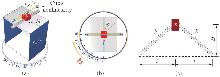
Fig. 1
(a) Mechanical model of the LO coupled NES; (b) excitation force with different directions; (c) cubic nonlinearity is generated by two helical springs (color online)"
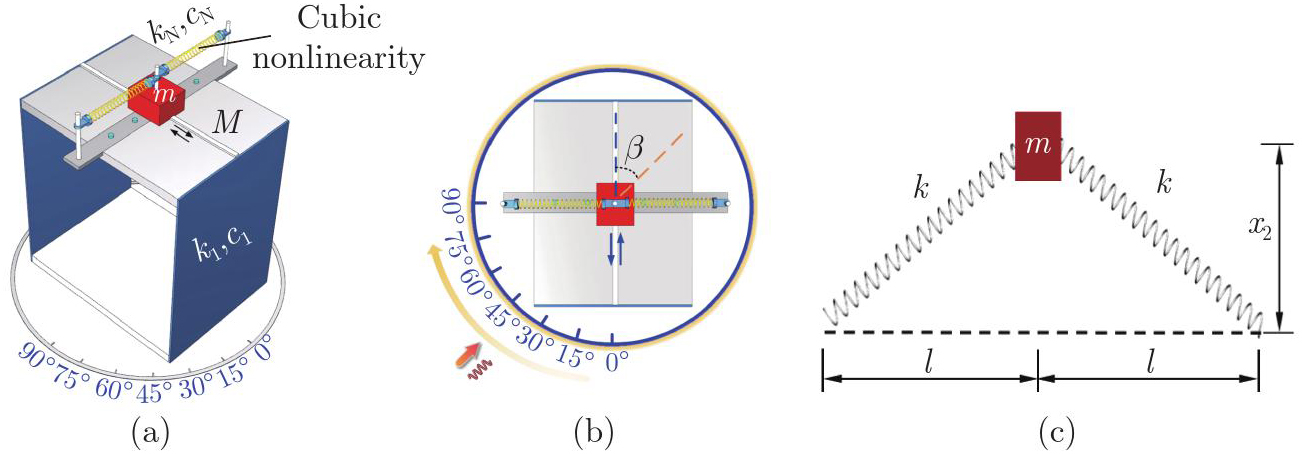
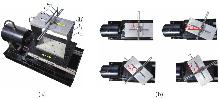
Fig. 2
(a) Experimental platform; (b) input excitation force in varying directions (color online)"

Table 1
The parameters of the experimental setup"
| Item | Value | Item | Value |
|---|---|---|---|
| Primary mass (M) | 2.52 kg | NES mass (m) | 0.21 kg |
| Primary stiffness coefficient (k1) | 2 052 N/m | NES stiffness coefficient (kN) | 4.8×10⁴ N/m3 |
| Primary damping coefficient (c1) | 0.5 N·s/m | NES damping coefficient (cN) | 0.7 N·s/m |
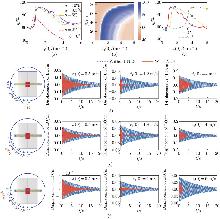
Fig. 3
(a) Energy dissipation efficiency under different mass ratios; (b) performance of the NES with different initial velocities and angles; (c) curves of η at 0°, 45°, and 75°; (d) time-history curves at 0°; (e) time-history curves at 45°; (f) time-history curves at 75° (color online)"
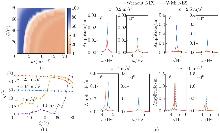
Fig. 4
(a) Damping performance of NES with different excitation intensities and directions; (b) damping performance of NES with a=0.2 m/s2, a=2.5 m/s2, a=4 m/s2, and a=10 m/s2; (c) amplitude-frequency curves at 0° and 60°, a=0.2 m/s2, a=2.5 m/s2, a=4 m/s2, and a=10 m/s2 (color online)"
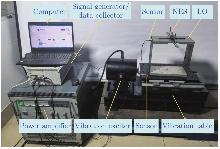
Fig. 5
Experimental testing platform (color online)"
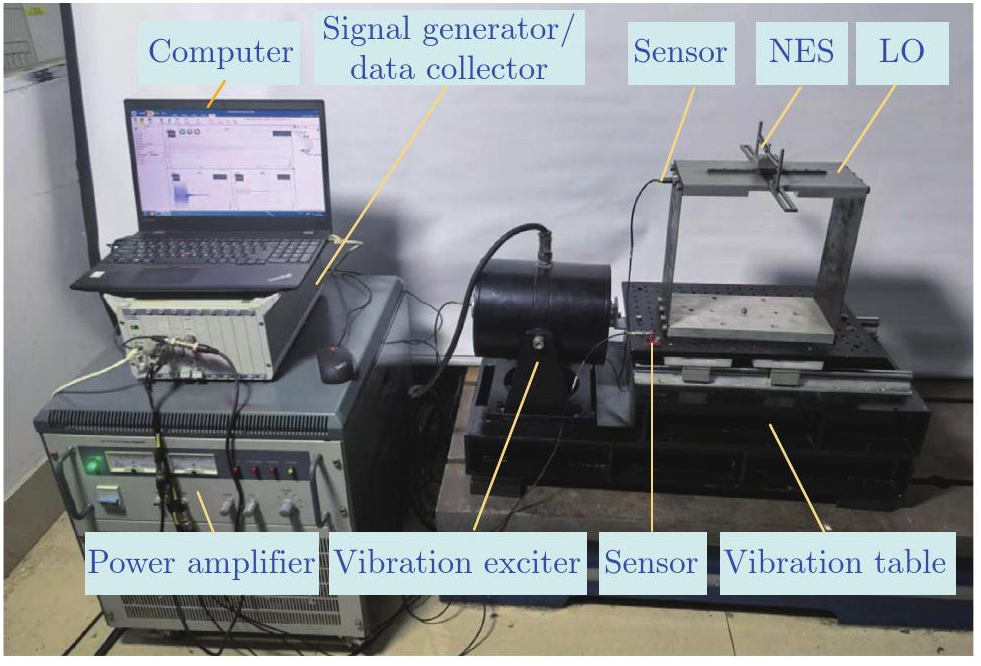
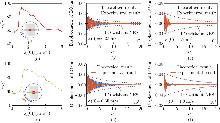
Fig. 6
(a) and (d) Theoretical damping efficiency curves at 0° and 45°; (b) and (c) comparison of theoretical and experimental results at 0°; (e) and (f) comparison of theoretical and experimental results at 45° (color online)"
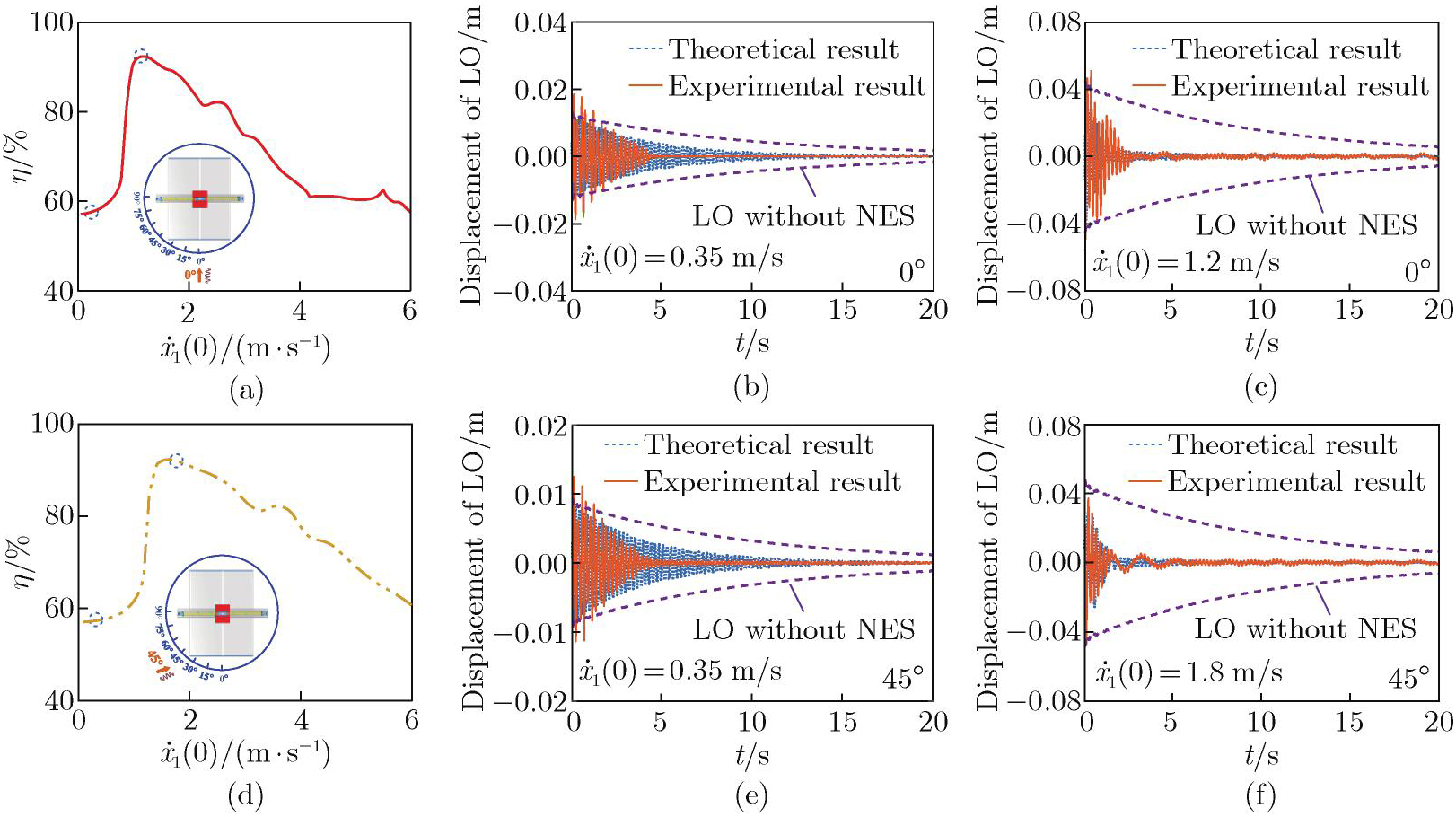
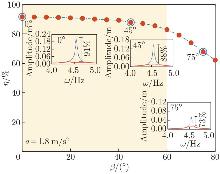
Fig. 7
Theoretical damping performance curves of the NES (a=1.8 m/s2) and amplitude-frequency curves at 0°, 45°, and 75° (color online)"
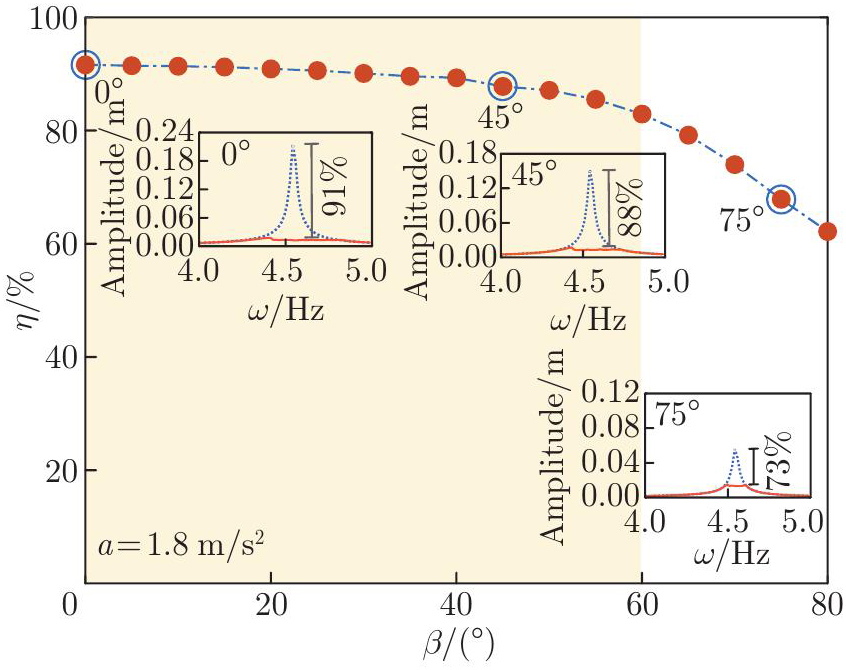

Fig. 8
Amplitude-frequency curves of the experimental and theoretical results with the NES: (a) 0°; (b) 45°; (c) 75° (color online)"
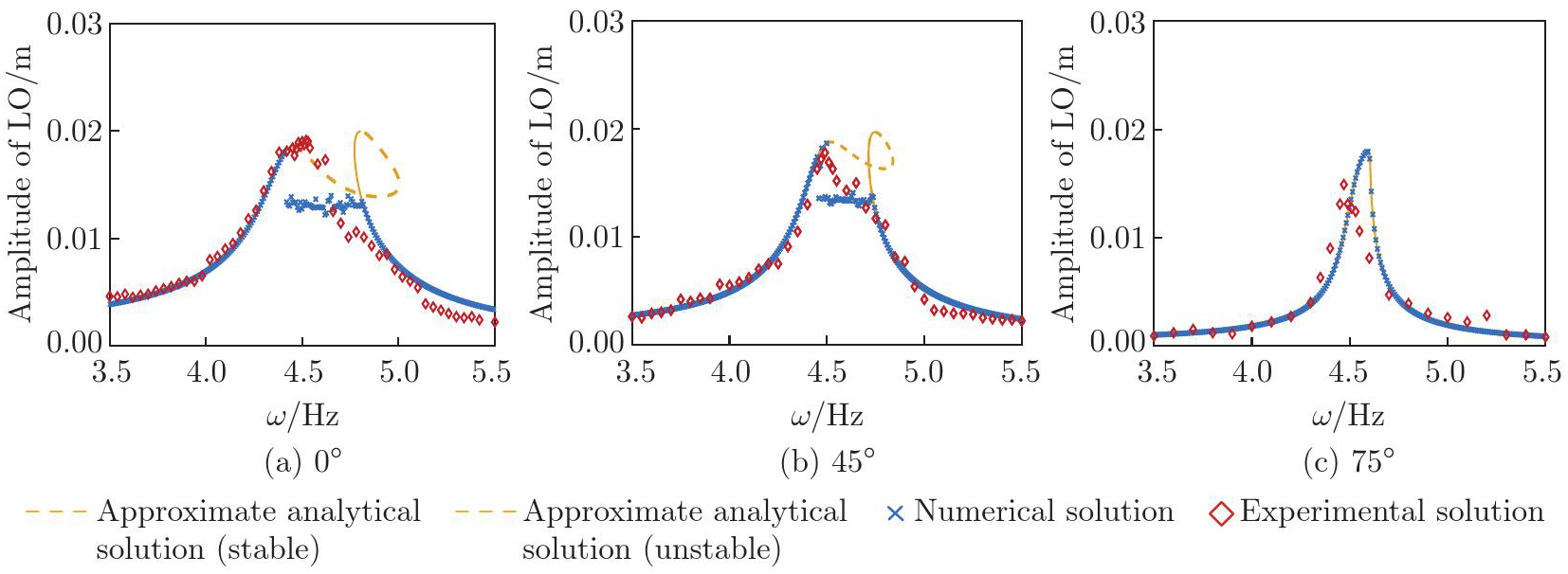
Fig. 9
Time-history curves of the LO with different angles: (a) 0°; (b) 45°; (c) 75° (color online)"

| [1] | VAKAKIS, A. F. Inducing passive nonlinear energy sinks in vibrating systems. Journal of Vibration and Acoustics, 123(3), 324–332 (2001) |
| [2] | SAEED, A. S., NASAR, R. A., and AL-SHUDEIFAT, M. A. A review on nonlinear energy sinks: designs, analysis and applications of impact and rotary types. Nonlinear Dynamics, 111(1), 1–37 (2023) |
| [3] | DING, H. and CHEN, L. Q. Designs, analysis, and applications of nonlinear energy sinks. Nonlinear Dynamics, 100(4), 3061–3107 (2020) |
| [4] | MANEVITCH, L. I., MUSIENKO, A. I., and LAMARQUE, C. H. New analytical approach to energy pumping problem in strongly nonhomogeneous 2dof systems. Meccanica, 42(1), 77–83 (2007) |
| [5] | GENG, X. F., DING, H., JI, J. C., WEI, K. X., JING, X. J., and CHEN, L. Q. A state-of-the-art review on the dynamic design of nonlinear energy sinks. Engineering Structures, 313, 118228 (2024) |
| [6] | SELWANIS, M. M., FRANZINI, G. R., BÉGUIN, C., and GOSSELIN, F. P. Wind tunnel demonstration of galloping mitigation with a purely nonlinear energy sink. Journal of Fluids and Structures, 100, 103169 (2021) |
| [7] | CHEN, P., YANG, J. H., LYU, N., and YANG, X. D. A combined vibration isolation system with quasi-zero stiffness and bistable nonlinear energy sink. Journal of Vibration Engineering & Technologies, 13(3), 219 (2025) |
| [8] | ZHAO, Y. H., CAO, Y., WU, Z. F., CHEN, M. F., and YIN, C. H. A theoretical and experimental study on the dynamic behavior and vibration control of a nonlinear coupling beam system under double excitation sources. Mechanical Systems and Signal Processing, 241, 113459 (2025) |
| [9] | LIU, E. G., SHAO, Y. F., DOU, B., CUI, J. F., and DING, H. High-order modal vibration control of Timoshenko beams based on nonlinear energy sink cells. Journal of Vibration Engineering & Technologies, 12(4), 6809–6819 (2024) |
| [10] | JIN, Y. and YANG, T. Z. Enhanced vibration suppression and energy harvesting in fluid-conveying pipes. Applied Mathematics and Mechanics (English Edition), 44(9), 1487–1496 (2023) https://doi.org/10.1007/s10483-023-3022-8 |
| [11] | FU, J. D., WAN, S., LI, W. K., SHEN, J. W., VENUGOPAL, H., LOCCUFIER, M., and DEKEMELE, K. Vibration control of a cantilever beam coupled with magnetic tri-stable nonlinear energy sink. Nonlinear Dynamics, 112(17), 14829–14851 (2024) |
| [12] | GENG, X. F., DING, H., MAO, X. Y., and CHEN, L. Q. A ground-limited nonlinear energy sink. Acta Mechanica Sinica, 38(5), 521558 (2022) |
| [13] | VAKAKIS, A. F., GENDELMAN, O. V., BERGMAN, L. A., MOJAHED, A., and GZAL, M. Nonlinear targeted energy transfer: state of the art and new perspectives. Nonlinear Dynamics, 108(2), 711–741 (2022) |
| [14] | AL-SHUDEIFAT, M. A. and SAEED, A. S. Frequency-energy plot and targeted energy transfer analysis of coupled bistable nonlinear energy sink with linear oscillator. Nonlinear Dynamics, 105(4), 2877–2898 (2021) |
| [15] | YU, N., FEI, X. Y., WU, C. Y., and YAN, B. Modeling and analysis of magnetic spring enhanced lever-type electromagnetic energy harvesters. Applied Mathematics and Mechanics (English Edition), 43(5), 743–760 (2022) https://doi.org/10.1007/s10483-022-2849-9 |
| [16] | CHEN, P., YANG, J. H., QIAN, Y. J., GUO, X. Y., and YANG, X. D. Nonlinear dynamics analysis and design of bistable nonlinear energy sinks of magnet-enhanced spring-Tie rods. Mechanical Systems and Signal Processing, 240, 113429 (2025) |
| [17] | LI, H. B., DING, H., CHANG, T. C., and CHEN, L. Q. Nonlinear dynamics of a track nonlinear energy sink. Nonlinear Dynamics, 112(14), 11803–11827 (2024) |
| [18] | LI, H. B., DING, H., CHANG, T. C., and CHEN, L. Q. A track nonlinear energy sink cellular strategy for structural response mitigation subjected to harmonic and seismic ground accelerations. Engineering Structures, 328, 119675 (2025) |
| [19] | LI, M. and DING, H. A vertical track nonlinear energy sink. Applied Mathematics and Mechanics (English Edition), 45(6), 931–946 (2024) https://doi.org/10.1007/s10483-024-3127-6 |
| [20] | MIGUEL, L. F. F. A Ball-Track-NES for the vibration control of flexible structures under seismic excitation. Soil Dynamics and Earthquake Engineering, 184, 108825 (2024) |
| [21] | GENG, X. F. and DING, H. Theoretical and experimental study of an enhanced nonlinear energy sink. Nonlinear Dynamics, 104(4), 3269–3291 (2021) |
| [22] | REN, Y. K., LU, H. Y., HABIB, G., SHI, L., ZHANG, N., and WU, X. D. Wheel shimmy suppression through the piecewise nonlinear energy sink: elimination of detrimental isolas. Nonlinear Dynamics, 113(18), 24225–24244 (2025) |
| [23] | GZAL, M., VAKAKIS, A. F., BERGMAN, L. A., and GENDELMAN, O. V. Extreme intermodal energy transfers through vibro-impacts for highly effective and rapid blast mitigation. Communications in Nonlinear Science and Numerical Simulation, 103, 106012 (2021) |
| [24] | LI, J., LI, S. B., YU, G. L., and ZHU, L. A single-sided vibro-impact bistable nonlinear energy sink designed for pulse and seismic control. Structures, 71, 107958 (2025) |
| [25] | LIZUNOV, P., POGORELOVA, O., and POSTNIKOVA, T. Comparison of the performance and dynamics of the asymmetric single-sided and symmetric double-sided vibro-impact nonlinear energy sinks with optimized designs. International Journal of Mechanical System Dynamics, 4(3), 303–316 (2024) |
| [26] | SHAO, J. W., LUO, Q. M., ZENG, T., and WU, X. Influence of boundary impedance of 3D cavity on targeted energy transfer between a damped acoustic mode and a nonlinear membrane absorber. Machines, 10(10), 841 (2022) |
| [27] | WANG, C. G., KRINGS, E. J., ALLEN, A. T., MARKVICKA, E. J., and MOORE, K. J. Low-to-high frequency targeted energy transfer using a nonlinear energy sink with softening-hardening nonlinearity. International Journal of Non-Linear Mechanics, 147, 104194 (2022) |
| [28] | RONG, K. J., LU, Z., ZHANG, J. W., ZHOU, M. Y., and HUANG, W. Y. Nonlinear gas-spring DVA for seismic response control: experiment and numerical simulation. Engneering Structures, 283, 115940 (2023) |
| [29] | GAO, T., ZHAO, H. Z., and ZHANG, Y. F. Dynamic characteristics and vibration suppression performance of an inerter-based nonlinear energy sink with negative stiffness. Journal of Vibration Engineering & Technologies, 13(7), 465 (2025) |
| [30] | SONG, W. Z., LIU, Z. E., LU, C. H., LI, B., ZHU, D. R., and NIE, F. Q. Analysis of vibration suppression performance of nonlinear energy sink with negative stiffness. Journal of Vibration Engineering & Technologies, 10(4), 1481–1493 (2022) |
| [31] | LI, H. Q., LI, S. H., ZHANG, Z. Y., XIONG, H., and DING, Q. Effectiveness of vibro-impact nonlinear energy sinks for vibration suppression of beams under traveling loads. Mechanical Systems and Signal Processing, 223, 111861 (2025) |
| [32] | CHEN, H. Y., ZENG, Y. C., DING, H., LAI, S. K., and CHEN, L. Q. Dynamics and vibration reduction performance of asymmetric tristable nonlinear energy sink. Applied Mathematics and Mechanics (English Edition), 45(3), 389–406 (2024) https://doi.org/10.1007/s10483-024-3095-9 |
| [33] | CHEN, J. E., ZHANG, W., LIU, J., and HU, W. H. Vibration absorption of parallel-coupled nonlinear energy sink under shock and harmonic excitations. Applied Mathematics and Mechanics (English Edition), 42(8), 1135–1154 (2021) https://doi.org/10.1007/s10483-021-2757-6 |
| [34] | YANG, Y. G. and LI, G. F. Digital twin for stochastic systems coupled with a nonlinear energy sink under harmonic and Gaussian white noise excitation. Journal of Vibration Engineering & Technologies, 14(2), 99 (2026) |
| [35] | SUN, Y. H. and YE, X. Q. Digital twin of a vibration energy harvesting system under Gaussian noise excitation. Chinese Physics B (2025) https://doi.org/10.1088/1674-1056/ae2d3d |
| [36] | SELWANIS, M. M., FRANZINI, G. R., BÉGUIN, C., and GOSSELIN, F. P. How a ball free to orbit in a circular track mitigates the galloping of a square prism. Nonlinear Dynamics, 111(1), 179–197 (2023) |
| [37] | SELWANIS, M. M., FRANZINI, G. R., BÉGUIN, C., and GOSSELIN, F. P. Multi-ball rotative nonlinear energy sink for galloping mitigation. Journal of Sound and Vibration, 526, 116744 (2022) |
| [38] | SAEED, A. S., AL-SHUDEIFAT, M. A., CANTWELL, W. J., and VAKAKIS, A. F. Two-dimensional nonlinear energy sink for effective passive seismic mitigation. Communications in Nonlinear Science and Numerical Simulation, 99, 105787 (2021) |
| [39] | WANG, C. G., BROWN, J. D., SINGH, A., and MOORE, K. J. A two-dimensional nonlinear vibration absorber using elliptical impacts and sliding. Mechanical Systems and Signal Processing, 189, 110068 (2023) |
| [1] | Youcheng ZENG, Hu DING, J. C. JI. An origami-inspired nonlinear energy sink: design, modeling, and analysis [J]. Applied Mathematics and Mechanics (English Edition), 2025, 46(4): 601-616. |
| [2] | Hongli LIU, Shangchuan XIE, Jie CHEN, Fengming LI, Wei ZHOU. Reduction of moving-load induced vibrations of graphene-reinforced composite beams with general boundary conditions viaa nonlinear energy sink [J]. Applied Mathematics and Mechanics (English Edition), 2025, 46(11): 2075-2094. |
| [3] | Hongyan CHEN, Youcheng ZENG, Hu DING, Siukai LAI, Liqun CHEN. Dynamics and vibration reduction performance of asymmetric tristable nonlinear energy sink [J]. Applied Mathematics and Mechanics (English Edition), 2024, 45(3): 389-406. |
| [4] | Jinxin DOU, Zhenping LI, Hongliang YAO, Muchuan DING, Guochong WEI. Torsional vibration suppression and electromechanical coupling characteristics of electric drive system considering misalignment [J]. Applied Mathematics and Mechanics (English Edition), 2024, 45(11): 1987-2010. |
| [5] | Yong WANG, Peili WANG, Haodong MENG, Liqun CHEN. Dynamic performance and parameter optimization of a half-vehicle system coupled with an inerter-based X-structure nonlinear energy sink [J]. Applied Mathematics and Mechanics (English Edition), 2024, 45(1): 85-110. |
| [6] | Yang JIN, Tianzhi YANG. Enhanced vibration suppression and energy harvesting in fluid-conveying pipes [J]. Applied Mathematics and Mechanics (English Edition), 2023, 44(9): 1487-1496. |
| [7] | Hu DING, J. C. JI. Vibration control of fluid-conveying pipes: a state-of-the-art review [J]. Applied Mathematics and Mechanics (English Edition), 2023, 44(9): 1423-1456. |
| [8] | Shengtao ZHANG, Jiaxi ZHOU, Hu DING, Kai WANG, Daolin XU. Fractional nonlinear energy sinks [J]. Applied Mathematics and Mechanics (English Edition), 2023, 44(5): 711-726. |
| [9] | Weixing ZHANG, Wei ZHANG, Xiangying GUO. Vertical vibration control using nonlinear energy sink with inertial amplifier [J]. Applied Mathematics and Mechanics (English Edition), 2023, 44(10): 1721-1738. |
| [10] | A. MOSLEMI, M. R. HOMAEINEZHAD. Effects of viscoelasticity on the stability and bifurcations of nonlinear energy sinks [J]. Applied Mathematics and Mechanics (English Edition), 2023, 44(1): 141-158. |
| [11] | Hu DING, Yufei SHAO. NES cell [J]. Applied Mathematics and Mechanics (English Edition), 2022, 43(12): 1793-1804. |
| [12] | Jian'en CHEN, Wei ZHANG, Jun LIU, Wenhua HU. Vibration absorption of parallel-coupled nonlinear energy sink under shock and harmonic excitations [J]. Applied Mathematics and Mechanics (English Edition), 2021, 42(8): 1135-1154. |
| [13] | Jiren XUE, Yewei ZHANG, Hu DING, Liqun CHEN. Vibration reduction evaluation of a linear system with a nonlinear energy sink under a harmonic and random excitation [J]. Applied Mathematics and Mechanics (English Edition), 2020, 41(1): 1-14. |
| [14] | Yimin WEI, Sha WEI, Qianlong ZHANG, Xinjian DONG, Zhike PENG, Wenming ZHANG. Targeted energy transfer of a parallel nonlinear energy sink [J]. Applied Mathematics and Mechanics (English Edition), 2019, 40(5): 621-630. |
| [15] | Yewei ZHANG, Kefan XU, Jian ZANG, Zhiyu NI, Yunpeng ZHU, Liqun CHEN. Dynamic design of a nonlinear energy sink with NiTiNOL-steel wire ropes based on nonlinear output frequency response functions [J]. Applied Mathematics and Mechanics (English Edition), 2019, 40(12): 1791-1804. |
| Viewed | ||||||
|
Full text |
|
|||||
|
Abstract |
|
|||||





 Email Alert
 RSS
RSS